
By Harleen Gambhir with Claire Coyne and ISW’sCounterterrorism Team
ISIS is using its foreign fighters and safe haven in Iraq and Syria to execute a terror campaign within Europe. ISIS’s March 22 Brussels attacks support a larger strategy to punish, destabilize, and polarize the West. ISIS will likely continue to attempt attacks in France and Belgium in 2016, using its large Francophone foreign fighter population and local supporters. ISIS’s support networks in southern Europe may enable ISIS’soperatives to launch operations in other parts of the continent, including Austria, Germany, Spain, and Italy. ISIS may also increasingly target Westerners in Turkey in order to punish members of the anti-ISIS coalition and undermine the Turkish economy, as part of its stated objective to seize Constantinople. Current efforts to address these threats through law enforcement, surgical strikes on ISIS’s leadership, and linear attrition ofISIS’s terrain and resources are necessary but not sufficient to destroy the ISIS threat to Europe. The anti-ISIS coalition must deprive ISIS of its primary source of strength, its territorial control as a caliphate in Iraq, Syria, and now Libya.
ISIS’ssuicide bombings in Brussels demonstrate that the jihadist threat to Europe is outpacing domestic and international law enforcement efforts. ISIS is successfully using its safe haven in Iraq and Syria to trainas many as 600 foreign fighters for external attacks. ISIS’s fighters benefit from extensive support networks across the European continent. The logistical requirements for facilitating European foreign fighter travel into Iraq and Syria can also export those fighters from ISIS’s safe havens back to Europe. Reports following the November 2015 Paris attacks and the recent Brussels attacks indicate European governments have incomplete, fragmented intelligence on the identity and communications of ISIS’s members in Europe. ISIS likely retains attack cells and logistical networks within Europe that will enable it to launch additional spectacular attacks, with support from the organization’s leadership within Iraq and Syria.
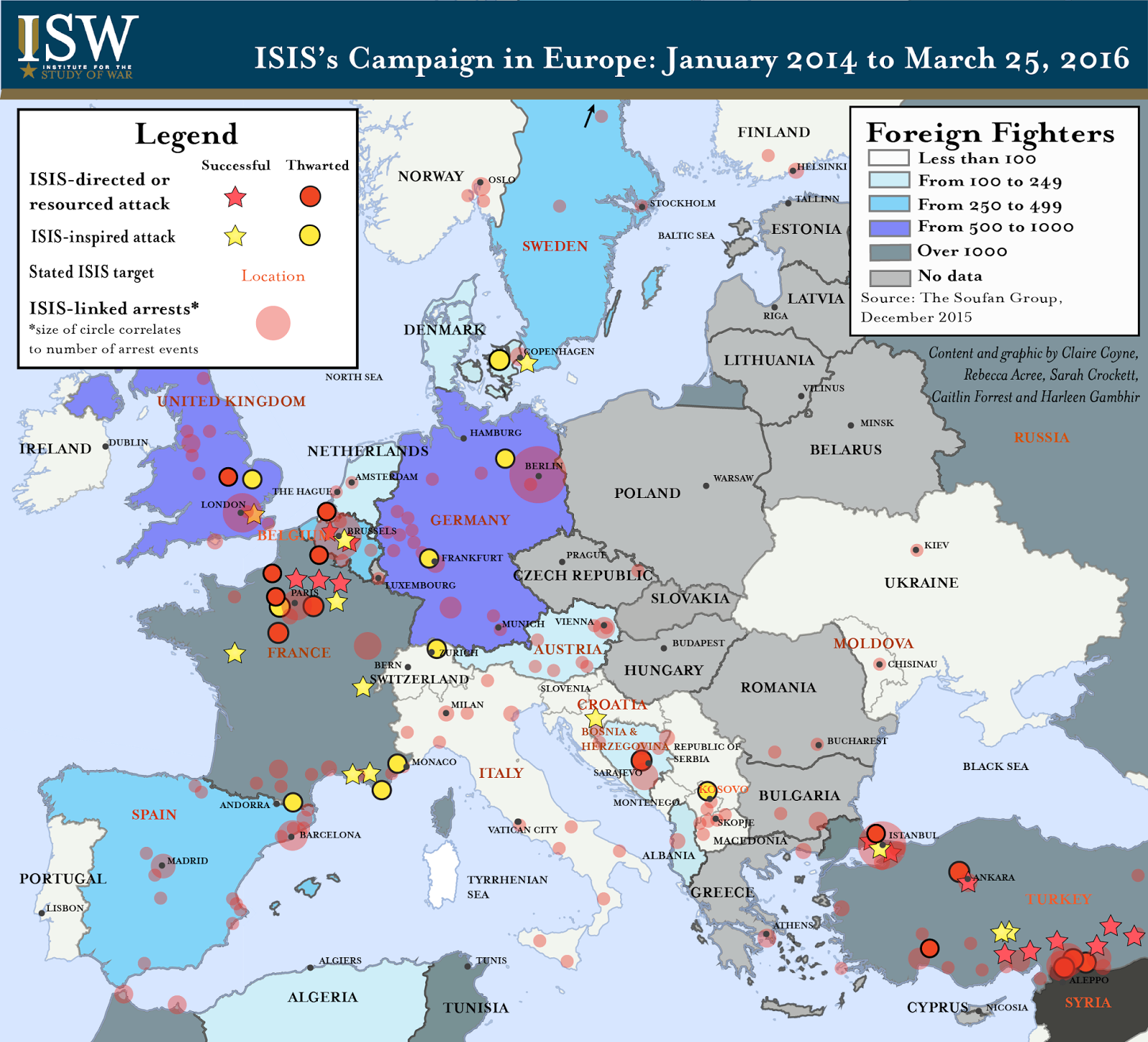
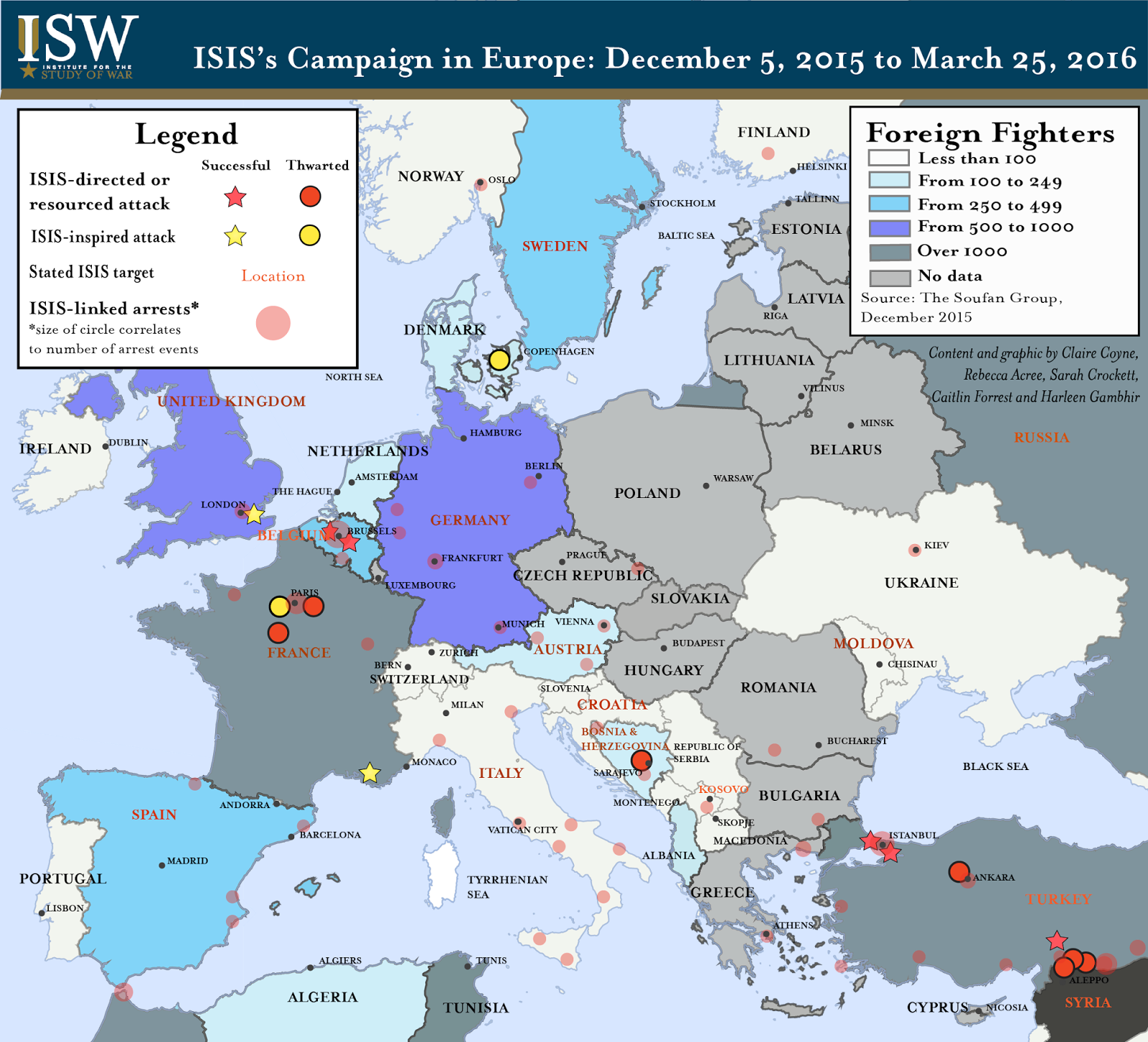
ISW last published its ISIS’sCampaign in Europe map on December 2015. The graphic below updates that visualization to depict all attacks inspired or coordinated by ISIS in Europe from January 2014 to present. This group includes attempted and successful attacks in the United Kingdom, France, Belgium, the Netherlands, Germany,Spain, Bosnia, Kosovo, and Turkey. The graphic also marks locations where ISIS-linked individuals have been arrested in that timeframe. Locations with more than two arrest events are depicted with opaque circles with varying sizes depending on the number of events. Events that occurred at an unspecified location within a country are marked on that country’s capitol. The graphic also highlights where ISIS has directed public threats or recruitment calls. Individuals inspired by and responsive to ISIS are active across Europe, particularly in France,Belgium, Germany, and the United Kingdom. ISIS-linked attacks and arrests in Europe are distinct from ISIS’s activity in Turkey, which reflects spillover from ISIS’s campaigns in Iraq and Syria as well as ISIS’s campaign to attack the West.
ISIS’sObjectives in Europe
The Brussels attacks are recent successes in ISIS’s long-standing strategy to punish, destabilize, and polarize the West. The Brussels attacks are recent successes in ISIS’s long-standing strategy to punish, destabilize, and polarize the West. ISIS’s leadershiphas encouraged supporters outside of Iraq and Syria to launch lone wolf attacks since September 2014. It has facilitated more sophisticated attacks by deploying foreign fighters to Europe since at least January 2015,when Belgian counterterrorism forces raided an ISIS attack cell in Molenbeek, Brussels.ISIS seeks to punish those attacking it in Iraq and Syria, as reflected in its post-Brussels statements criticizing “Crusader Belgium” and framing the attacks as a response to “aggression against the Islamic State.”
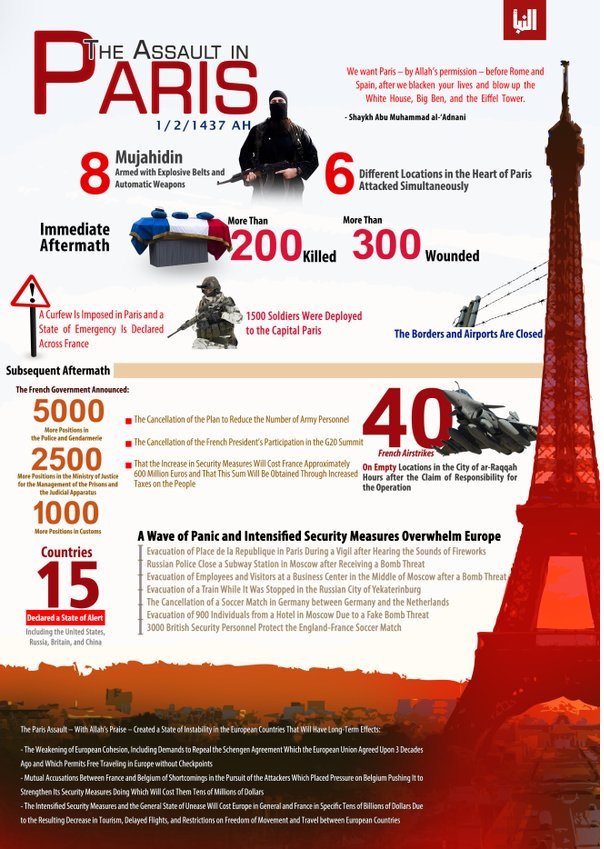
ISIS also aims to destabilize Europe more broadly through spectacular attacks. ISIS seeks to exacerbate tensions between European states, raise defensive requirements within those states, cause an environment of fear, and inflict additional economic damage on Europe. An official ISIS media outlet affirmed each of these operational objectivesin a publication released January 2016. The graphic claimed the November 2015 Paris attacks “[weakened] European cohesion” and caused “demands to repeal the Schengen Agreement.” It also argued that the Paris attacks caused tension between France and Belgium over intelligence failures. It celebrated how the attacks created a “general state of unease” and predicted that decreased tourism revenues and increased security requirements would cost Europe “tens of billions of dollars.” ISIS’s directed and inspired attacks set conditions for the organization’s desired apocalyptic war by draining resources and exacerbating internal conflict in the West.
European unity is already threatened by financial pressures, debates over refugee policy, and Russian-fundedfar-right parties. ISIS’s successful attacks in Paris strengthened the position of European anti-immigrant parties, shown by supportfor France’s National Front (FN) party in first-round regional elections in December 2015 and the victoriesof Germany’s Alternative fur Deutschland (AfD) party in state elections in March 2016. The Brussels attacks may strengthen organizations calling forBritain’s exitfrom the European Union, as indicated by U.K. Independence Party defense spokesman Mike Hookem’s March 23 claim that the attacks proved “Schengen free movement and lax border controls are a threat to our security.”
ISIS’sattacks and resultant European disunity will undermine efforts to address theregional refugee crisis, as demonstrated by Poland’s decision on March 23 to renegeon a plan to settle 7,000 refugees from Syria and Eritrea. The crisis willlikely intensify over the next year. Refugee inflow on the Mediterranean from January to March 2016 increasedmore than sevenfoldas compared to the same period in 2015. Russia may also be encouragingmigration to Europe to exacerbate this problem, according to NATO SupremeCommander General Philip Breedlove and Estonian President Toomas Hendrik Ilves.Increasing pressure on European security and cohesion will open opportunitiesfor both Russia and ISIS to expand influence.
ISISparticularly aims to destabilize Europe through polarization, which it calls “destroyingthe grayzone.” ISIS hopes attacks in its name will provoke state and socialbacklash against Europe’s Muslim communities, encouraging radicalization andjihadist recruitment. Such reactions have already surfaced from the Brussels attacks, as Dutch far-right leader Geert Wilders called to “de-Islamize the West” and as American presidential candidates suggested patrollingMuslim neighborhoods and banningMuslims from entering the U.S. ISIS will likely exploit these actions in orderto claim it is the defender of Muslims in a broader cultural war.
ISISis best positioned to launch attacks within France and Belgium due to in partto its large Francophone foreign fighter population. An estimated 1700 Frenchcitizens and 470 Belgian citizens are fighting in Syria, with the latterrepresenting the largestper capita amount of any Western nation. ISIS’s Francophone fightersreportedly formed cohesivefighting units with Syria, likely forming the basis of attack cells deployedback to Europe. These operatives recruit and gain logistical support from theirhome networks in France and Belgium.
Emergingtrends in 2016
Authoritieshave thwarted several attack plots linked to or inspired by ISIS in France andBelgium since December 2015, reflecting an enduring jihadist support base withinthose countries. The ISIS network responsible for the Paris and Brussels attacks demonstrated resiliency and adaptiveness over past months through the abilityof Paris attacker Salah Abdeslam to go undetected and the progressionto the group’s first large explosive attack in Brussels on March 22. ISISlikely maintains attack cells within France and Belgium and will continue toattempt spectacular attacks on soft targets in those countries over comingmonths in order to replicate the success of its previous attacks. Europeanauthorities may locate and detain some of this network through intelligencegained from Salah Abdeslam, but ISIS will likely balance this loss with newEuropean recruits.
ISIS also retains pre-existing recruitment networks in Spain, Italy and the Balkans,as demonstrated by arrest patterns in 2016. This group will likely continue to provide financial and logistical support to individuals seeking to join ISIS in Syria, Iraq, and Libya. ISIS’s recruitment networks in Spain may increasingly orient towards Libya, where ISIS’s affiliate controls terrain and operates training camps. This affiliate could attempt to strike Europe, possibly exploiting migrant flow to Europe to do so. ISIS’s networks in Italy and the Balkans could aid this effort, as those countries host major migrant entry points. Germanand Austrianauthorities arrested alleged ISIS operatives in refugee shelters since December 2015, confirming that ISIS members are intentionally using refugee transit to enter Europe. ISIS likely does so in order to strengthen xenophobic organizations and rhetoric in Europe, thereby fueling anti-Muslim sentiment and encouraging cultural polarization.
ISIS shifted its attack campaign in Turkey in 2016, possibly in order to discourage Turkish efforts to curb ISIS’s foreign fighter flows. ISIS already faces potential disruption of its primary supply route to Turkey due to U.S.-backed Syrian Democratic Forces (SDF) and Kurdish PYD gains in northern Syria. ISIS may intend to incite broader conflict within Turkey in order to forestall this development. ISIS has increasingly struck foreign, tourism-related targets in Turkey, a shift from its attacks against political and military targets from July to December 2015. An alleged ISIS operative launched a suicide attack near Istanbul’s Blue Mosque on January 12, killing twelve German and one Peruvian tourists. An ISIS-linked individual launched another suicide attack on a popular shopping area of Istanbul on March 19, killing one Iranian and three Israeli citizens.
Strengthening European law enforcement and intelligence capabilities will only address one element of the ISIS threat to Europe. Programs to counter ISIS’s message, its finances, and other capabilities will assist, but will not suffice. ISIS’s safe haven within Iraq, Syria, and now Libya will continue to provide the logistical infrastructure necessary to train, resource, and direct attack cells in Europe. The anti-ISIS coalition must deprive ISIS of its territorial control as a caliphate, which is its primary source of strength, in order to destroy the ISIS threat to Europe.


