
Authors: Matthew Sperzel, Daniel Shats, Alison O’Neil, Karina Wugang, Tiffany Cowan, Kelly Campa, and Carolyn Moorman of the Institute for the Study of War;
Alexis Turek and Alex Chou of the American Enterprise Institute
Editors: Dan Blumenthal and Nicholas Carl of the American Enterprise Institute
Data Cutoff: July 9, 2025
The China–Taiwan Weekly Update is a joint product from the Institute for the Study of War and the American Enterprise Institute. The update supports the ISW–AEI Coalition Defense of Taiwan project, which assesses Chinese campaigns against Taiwan, examines alternative strategies for the United States and its allies to deter the Chinese Communist Party’s (CCP) aggression, and—if necessary—defeat the People’s Liberation Army (PLA). The update focuses on the Chinese Communist Party’s paths to controlling Taiwan and cross–Taiwan Strait developments.
People’s Republic of China (PRC) Foreign Affairs Minister Wang Yi reportedly told the European Union’s (EU) top diplomat that the PRC does not want Russia to lose in Ukraine, contradicting PRC public claims of neutrality in the war. Wang met with Kaja Kallas, the EU high representative for foreign affairs and security policy and vice president of the European Commission, on July 2 for the 13th EU–PRC High-level Strategic Dialogue in Brussels.[1] Hong Kong-based outlet South China Morning Post reported that Wang told Kallas that Beijing does not want Russia to lose in Ukraine because the United States could then shift its focus to countering the PRC. Wang reportedly denied that Beijing is financially or militarily supporting Russia’s war effort, however, and implied that Russia would have already won if that were the case.[2] These comments were not present in the official EU and PRC readouts of the meeting.[3] PRC Ministry of Foreign Affairs spokesperson Mao Ning neither confirmed nor denied whether Wang made the comments but reiterated standard rhetoric that “China is not a party to the Ukrainian issue” and that Beijing has consistently advocated for a diplomatic solution to the conflict.[4] Mao claimed that prolonging the war was not in any party’s interest, contradicting the implication from Wang’s comments that Beijing may use the war in Ukraine to keep the West distracted as long as possible.
Wang’s unusually frank comments to Kallas are consistent with Coalition Defense of Taiwan’s (CDOT) assessment that Beijing views a Russian defeat in Ukraine as the worst-case scenario for PRC interests and that the PRC supports Russia in holding NATO at risk.[5] A definitive Russian defeat that involves pushing Russia out of occupied Ukrainian lands would likely create a severe political crisis in Russia and thus weaken one of the PRC’s most reliable partners. Political turmoil in Russia, the depletion of Russian resources and manpower in the war, and the reputational humiliation of a costly defeat will make Russia less able to threaten NATO in the short to medium term. This would allow the West to refocus its attention on building security and alliances in the Indo-Pacific, which would result in more effective responses to PRC aggression. Wang’s comments suggest that Beijing sees Russia’s war in Ukraine as a way to distract the West from the Indo-Pacific, which Russia can achieve either by continuing the war or by decisively winning and threatening NATO from a new position of strength on a more preferable frontline. PRC officials have strongly objected to the expansion of Western-aligned coalitions in East Asia, including NATO.[6]
The PRC has attempted to balance its interests in supporting Russia and maintaining good trade relations with Western countries. The PRC has echoed Russian rhetoric blaming NATO for instigating or prolonging the war in Ukraine, defending Russia’s “legitimate security interests,” and opposing sanctions on Russia.[7] It has also increased trade with Russia since 2022, providing Moscow with an economic lifeline amid international sanctions and supplying critical dual-use components and equipment for Russia’s defense-industrial base.[8] Beijing has framed the sale of dual-use goods as “normal trade,” however, and has claimed that it is not sending Russia complete military equipment.[9] Wang’s comments undercut Beijing’s claims of neutrality in the Ukraine war, as do increasing recent reports that Ukraine is finding PRC-origin equipment and components on the battlefield.[10] Wang’s statements clarify that Beijing and Moscow see their futures as intertwined. This makes plain the infeasibility of policy premised on splitting Russia from the PRC for the purpose of focusing on the Indo-Pacific.
Key Takeaways
- PRC Foreign Affairs Minister Wang Yi reportedly told the EU’s top diplomat that the PRC does not want Russia to lose the Ukraine War. Wang’s statements confirm CDOT’s longstanding assessment that the PRC believes Russian success aligns with PRC strategic interests, despite PRC claims of neutrality in the war.
Cross-Strait Relations
Taiwan
Taiwan’s National Security Bureau (NSB) released a report highlighting significant cybersecurity concerns posed by five PRC-made social media apps. The PRC could use these apps to collect and transfer data to PRC authorities for “national security” reasons, reducing Taiwan’s overall security. The NSB reported that Weibo, Douyin/TikTok, WeChat, RedNote, and Baidu Cloud all violated regulations on personal data collection, including biometric data and location information.[11] The five apps were also all found to send data back to servers located in the PRC. The PRC Cybersecurity Law and National Intelligence Law requires PRC companies to disclose user data related to national security, public security, and intelligence.[12] Taiwan’s Ministry of Digital Affairs reported that 22 percent of Taiwanese adults have used TikTok/Douyin in the past three months, with the highest usage rate of 34 percent observed among those aged 18–29.[13] PRC-made apps, while increasingly used by Taiwanese people, are used significantly less than non-PRC apps, such as Facebook or the Japanese messaging app Line.
The PRC has identified Taiwanese youth as a target demographic for propaganda, which is conveyed to these youths through PRC-made apps. The PRC’s dissemination of Chinese Communist Party (CCP) propaganda could spread anti-Democratic Progressive Party (DPP) sentiments and lessen public trust in Taiwan’s governance. PRC collection of Taiwanese biometric data and location information is also a major cause for concern, given the vague wording of PRC laws that would allow for large quantities of data to be transferred to PRC authorities. This data could aid the PRC in a Taiwan contingency by providing greater detail on potential invasion and targeting locations.
A Taiwanese court sentenced three political and community figures to prison for acting as agents of the PRC. The PRC’s co-optation of Taiwanese political figures on the fringe underscores its strategy of exploiting those who are sympathetic to the PRC to manipulate political discourse at the grassroots level. The verdict is the latest in a string of prosecutions against minor Taiwanese political figures for acting as PRC agents.[14]
Chou Ke-chi — the primary defendant — is the chairman of the Republican Party, a minor political party with no presence in government, as well as the Third Force 333 Party Unity Alliance, a coalition of minor pro-unification parties that coordinate political activities. The Third Force 333 Party Unity Alliance has held anti-DPP and anti-United States protests alongside pro-unification organizations involved in treason, including retired Lieutenant General Kao An-Kuo’s Taiwan Military Government of the Republic of China.[15] Kao and his associates were charged in January with developing spy networks and establishing an armed insurrection group that would support the People’s Liberation Army (PLA) in an invasion.[16]
Taiwanese authorities convicted Chou of accepting PRC money to organize protests in October 2022 during Taiwan’s midterm elections.[17] Chou solicited help from his associates Chu Chun-yuan and Pan Jindong to acquire funding from the PRC to organize the protest. Chu and Pan are both board members of Taipei’s Putian Hometown Association, a social and cultural organization of people with common ancestry or ties to certain cities or regions in the PRC. Pan, who is a PRC-born naturalized Taiwanese citizen, coordinated with the PRC Taiwan Affairs Office (TAO) of Putian City to pay protesters and promote pro-PRC and anti-US political candidates at the demonstrations.[18]
Hometown associations are primary targets for PRC infiltration to advance United Front work on Taiwanese territory, primarily by exploiting members’ sympathy for Chinese identity and using cross-strait cultural exchanges to promote certain narratives.[19] The United Front is a whole-of-government and -society effort to advance CCP ideology and interests by co-opting non-government segments of society that the PRC deems subject to its rule. United Front activities in Taiwan aim to inculcate in the Taiwanese public CCP notions that the PRC is the only legitimate government of China and that Taiwan is a part of that China.
The PRC unilaterally opened the third connecting line of the M503 flight route near the median line of the Taiwan Strait. This move is likely intended to decrease Taiwan’s threat awareness and delegitimize Taiwanese territorial sovereignty. The PRC Civil Aviation Administration of China (CAAC) announced the opening of the W121 connection line to the existing M503 flight route to “further optimize the airspace environment.”[20] PRC Taiwan Affairs Office (TAO) Spokesperson Chen Binhua said that the effort would address flight safety concerns and protect passenger rights and interests.[21] Similar reasoning was given when the other two lines along the M503 flight path were opened in April 2024.[22]
Taiwanese government officials and lawmakers cast doubt on PRC rationales for opening the W121 route, saying that flight traffic in the area had not significantly increased.[23] The decision to activate the W121 route follows announcements of Taiwan’s annual Han Kuang joint military exercise and President William Lai Ching-te’s calls for an increased defense budget during the fourth speech in Lai’s lecture series on national unity. These efforts aim to promote Taiwanese defense capabilities and resilience in the face of PRC threats to Taiwan’s sovereignty.
Taiwan’s Civil Aeronautics Administration (CAA) urged the PRC to halt the connection’s opening and act according to the March 2015 consensus, in which the PRC and Taiwan agreed to move the M503 route 6 nautical miles closer to PRC territory and not activate the W121, W122, or W123 connecting lines.[24] The CAA also stated that the PRC was in violation of International Civil Aviation Organization (ICAO) regulations by not negotiating the route modification with the Taiwanese government.[25] Taiwan has not been a member of the ICAO since the United Nations adopted UN General Assembly Resolution 2758, which changed “the legitimate representative of China” from Taiwan to the PRC. The PRC has exploited Taiwan’s exclusion from international organizations to violate Taiwanese territorial sovereignty and rights. The opening of the W121 connection is the latest example of PRC tactics intended to undermine Taiwanese government authority.
The opening of the W121 connection could also impact the safety of Taiwan’s airspace and overall defense capabilities. Senior analyst at the ROC-funded Institute for National Defense and Security Research Su Tzu-yun estimated that the W121 route could compress Taiwan’s air traffic controllers’ response time to as little as 30 seconds if a civilian aircraft deviated from the flight path due to weather or mechanical issues.[26] An increased volume of flights along the M503 route would require Taiwan to devote additional resources toward assessing whether flights constitute an airspace incursion and safely managing its airspace under reduced early-warning times.

China
CCP General Secretary Xi Jinping missed the 2025 BRICS summit, possibly to prioritize domestic concerns and commemorate the anniversary of the start of the Second Sino-Japanese War. Differing views and priorities among members of BRICS and the Shanghai Cooperation Organization (SCO) are increasingly impeding the viability of those organizations to advance PRC interests. The BRICS summit occurred in Rio de Janeiro, Brazil on July 6 and 7. Xi did not attend and instead inspected the PRC’s Shanxi Province on July 7–8. He also attended a ceremony on June 7 for the 88th anniversary of the Marco Polo Bridge Incident, considered the inciting incident for the Japanese invasion of China during World War II.[27] PRC Premier Li Qiang attended the BRICS summit in Xi’s place. This is the first time that Xi has skipped the annual BRICS summit since becoming the president of the PRC in 2013. The PRC did not explain Xi’s absence except to say that he had a scheduling conflict.[28] The South China Morning Post cited anonymous sources who ascribed Xi’s absence to the fact that he had already met with Brazilian President Luiz Inácio Lula da Silva twice in under a year.[29]
BRICS released a joint declaration that included condemnations of the US and Israeli strikes on Iran as well as against “unilateral coercive measures” and protectionist trade barriers.[30] The statement did not name Israel or the United States in the criticisms, however, likely reflecting differences among BRICS members in their views of the Israel-Iran conflict and the interest of some members in maintaining good relations with the United States.[31] PRC officials have made stronger criticisms in unilateral statements that named the United States and Israel.[32]
The PRC has promoted BRICS and other non-Western multilateral organizations, such as the SCO, as key to its vision for a multilateral world order challenging what it perceives to be US and Western hegemony. The PRC has championed these organizations in the name of giving a more prominent voice to the “Global South” and claimed that these organizations do not target any other country. BRICS and the SCO nevertheless allow Beijing to promote narratives and policies that support a more Sino-centric world order, including the perception that a large coalition of non-Western nations is aligned against Western dominance.[33] The ability of BRICS to advance PRC interests depends on its ability to reach consensus on key issues, which is often hampered by the competing ambitions of other member states, particularly India. India has opposed efforts by Russia and the PRC to promote “de-dollarization” in international trade, including using the Chinese renminbi or another currency for trade among BRICS members.[34] India has similarly been a consensus-breaker in the SCO, objecting to an SCO statement that condemned Israeli strikes on Iran and blocking an SCO defense ministers’ joint statement in June because it did not directly condemn the terrorist attack in Kashmir in April.[35] India has blamed fellow SCO member Pakistan for the attack. India has friendlier relations with the United States than other members and has its own aspirations for “Global South” leadership that competes with PRC ambitions.[36]
The United States Department of Justice (DOJ) charged two PRC nationals with espionage on July 1.[37] The two spies were operatives of the PRC Ministry of State Security (MSS), tasked with identifying potential agents to recruit in the US Navy. The pair contacted Navy employees over social media, obtained personal information about Navy recruits, and transmitted that information to the MSS. The DOJ indictment noted that the MSS directed operatives to focus on those with Chinese heritage, underscoring the PRC’s scheme to appeal to shared nationality when recruiting assets. The MSS allegedly instructed one of the defendants on how to approach potential recruits and discuss possible remuneration, preferred job assignments in the Navy, and compartmentalization.[38] PRC efforts to embed spies in the Navy could be aimed at obtaining sensitive information on a range of topics, including weapons systems, training procedures, logistical operations, or warfighting plans — all of which could undermine the United States’ warfighting capabilities and give the PRC an advantage in a conflict.
The People’s Liberation Army Navy (PLAN) harassed a German aircraft supporting the EU mission to defend international shipping in the Red Sea, which could decrease the ability of US partners to defend the freedom of navigation in the Red Sea against the Houthis. The German Foreign Affairs Ministry said on July 8 that a PLAN ship used a laser to harass a German surveillance aircraft above the Red Sea in early July.[39] The German Foreign Affairs Ministry said that the PLAN ship lasered the civilian-contracted German aircraft “without any reason” or prior contact while the aircraft had been operating under the European Union’s mission to protect merchant vessels from Houthi attacks in the Red Sea.[40] The ministry added that the aircraft and its crew, which included German army personnel, have resumed operations since the incident. The German aircraft is based at a base in Djibouti, where the PLA also has a military base.[41] PRC Foreign Ministry Spokesperson Mao Ning denied Germany’s allegations during a July 9 press conference.[42]
The PLAN previously used lasers to harass US aircraft operating from Djibouti as well.[43] The United States and Australia have previously accused the PLAN of using lasers against US and Australian aircraft in the Pacific Ocean.[44] The Philippines accused the PRC of using a laser against a Philippine coast guard vessel in the South China Sea and causing temporary blindness among the ship’s crew.[45] The PRC is likely using lasers as a denial tactic to forcibly alter sailing patterns around areas of interest and disputed territory.
The PRC does not actively support the Houthis in the Red Sea, but PRC harassment of vessels and assets supporting the defense of international shipping can pull these assets off station and make them unable to fulfill their mission. This result, in turn, would mean that the net effect of PRC behavior supports Houthi operations even if the PRC does not directly do so.[46]
Northeast Asia
Japan
PRC state media criticized the potential export of used Japan Maritime Self Defense Force (JMSDF) destroyer escort vessels to the Philippines. The Japanese government is considering transferring six 2000-ton Abukuma-class destroyer escorts to the Philippine Navy.[47] These ships have been in service with the JMSDF for 30 years and are being replaced by the newer Mogami-class frigates. The transfer plan was discussed between the defense ministers of Japan and the Philippines during the Shangri La Dialogue in June 2025.[48] Philippine Navy spokesperson Captain John Percie Alcos confirmed that the Philippine Navy will inspect the main armaments and maintenance status of the vessels in August.[49] Japan will also install additional equipment and communication systems requested by the Philippines prior to the transfer. The transfer would mark Japan’s first export of used destroyer escorts and could pave the way for Japan to export more naval vessels in the future. Increasing defense exports could help Japan strengthen its defense industry as outlined in Japan’s Defense Buildup Plan, which the PRC will likely see as a prelude to Japan’s remilitarization.[50] Philippine Navy Vice Admiral Jose Maria Ambrosio Quiatchon Ezpeleta stated that in addition to the escort ships the Philippines are also “in the early stages of talks” regarding the transfer of Japanese surveillance aircraft.[51]
Chinese state media described the sales as evidence of Japanese and Philippine collusion to “support the US attempt to contain and suppress China in its ‘Indo-Pacific Strategy.’”[52] The article further accused the Philippines of undermining peace and stability in the South China Sea by inviting “external forces,” and that Japan is aiding Manila’s “illegal territorial expansion goals” by providing the Philippines with weapons and equipment in order to divert the PRC’s pressure on the Senkakus. The PRC has not responded to the deal at the time of writing however, PRC MFA spokesperson Guo Jiakun previously criticized the Philippines’ decision to strengthen bilateral security cooperation with Japan in April 2025.[53] Guo also reiterated the PRC’s opposition to regional groupings that “target any third party or harm their interests.”[54] The PRC likely perceives closer ties between Japan and the Philippines as an encirclement effort intended to limit the PRC’s maritime claims in the East and South China seas.[55]
Southeast Asia
Philippines
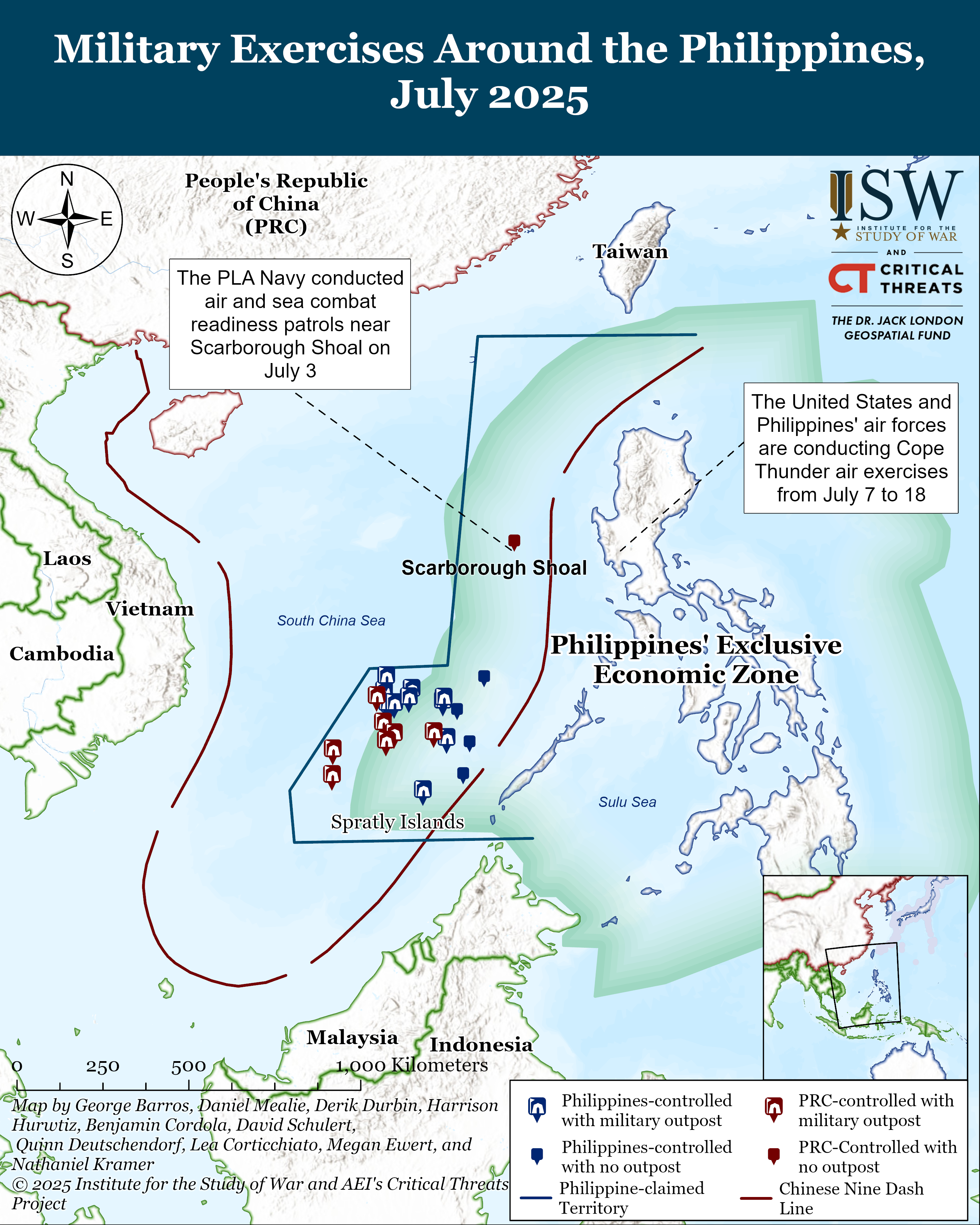
The People’s Liberation Army Southern Theater Command (PLA STC) conducted combat-readiness patrols around Scarborough Shoal on July 3. The Philippines and the United States will conduct the Cope Thunder combined air exercises from July 7 to 18. The PLA STC issued a press statement and video on state media stating that it conducted air and sea combat readiness patrols “in the territorial waters and airspace of China’s Huangyan Island (Scarborough Shoal) and surrounding areas.”[56] It also stated that PLA naval and air forces have been conducting patrols around Scarborough Shoal since June to strengthen the PRC’s territorial claim and assert control over the area. The video footage and subsequent reporting from PRC media the Global Times showed the Type 054 frigate, Type 056A corvette, J-16 fighter jet, and H-6K bomber equipped with YJ-12 supersonic anti-ship missiles.[57] The Scarborough Shoal, which the PRC calls Huangyan Island, is an uninhabited atoll that the Philippines, PRC, and Taiwan all claim. The PRC has been working to normalize activities in the South China Sea and has maintained a steady presence around Scarborough Shoal since 2012.[58] Philippine Coast Guard Commodore Jay Tarriela stated that Manila has adopted a “transparency strategy” to speak out against PRC efforts to assert territorial claims in the South China Sea.[59] Tarriela contrasted the Philippines’ approach with other Southeast Asian states, who he claims “ignore” PRC aggressions. The Philippines has maintained a strong stance against PRC aggression and the ongoing Cope Thunder exercises between the Philippines and the United States in the South China Sea from July 7 to July 18 are in response to PRC aggression.[60] This is the second iteration of the Cope Thunder exercises, with the first occurring in 2024.[61]
Europe
Ukraine reported on July 9 that the Security Service of Ukraine (SBU) arrested two PRC nationals for attempting to steal information relating to the Neptune anti-ship missile system. The PRC’s interest in the Neptune system may stem partly from the PRC’s desire to extend the range of its missiles into the Western Pacific. Ukrainian intelligence detained a father and son attempting to smuggle technical information relating to the Neptune system out of the country.[62] The son, a 24-year-old former student, attempted to recruit a Ukrainian citizen “related to the development of the latest weapons of the Defense Forces,” according to SBU.[63] Ukrainian counterintelligence officials reportedly arrested the son after they gave him “technical documentation” pertaining to the Neptune system. They later arrested his father, who had visited Ukraine to coordinate his son’s work.[64] These were the first PRC nationals arrested for spying since Russia invaded Ukraine in 2022.[65]
The PRC may seek to apply lessons of the Neptune system to an Indo-Pacific contingency. Ukraine originally developed the Neptune subsonic anti-ship missile system in 2021 with a maximum range of 300 km and has since developed a variant — the Neptune RK-360MT — with a 1000-km range.[66] Ukraine used the Neptune system against the Black Sea fleet when the war first began and has since used it against Russian oil terminals and other targets.[67] Ukraine’s maritime drone strategy couples longer-range assets, such as the Neptune with sea drones to provide intelligence, reconnaissance, and surveillance and to conduct precision strikes against Russian ships.
Middle East
Iran
PRC officials denied a report by Middle East Eye on July 8 that the PRC sent surface-to-air missile (SAM) batteries to Iran after the 12-day war with Israel. The rumored arms transfer would be the PRC’s first known arms transfer to Iran in 20 years and mark a shift from Beijing’s hands-off approach to conflicts in the Middle East. Unspecified Arab officials told UK-based news outlet Middle East Eye on July 8 that the PRC delivered an unspecified number of Chinese SAM batteries to Iran in exchange for oil shipments after the Israel–Iran ceasefire went into effect on June 24.[68] CDOT cannot verify the Arab officials’ claims. The PRC Embassy in Israel told Israeli media on July 8 that the report was “incorrect” and claimed that the PRC never exports weapons to “countries engaged in warfare.[69] An unnamed Iranian security source similarly denied the report to a France 24 reporter the same day.[70] The Arab officials who spoke to Middle East Eye did not specify which systems the PRC sent to Iran. The PRC’s HQ-9 long-range SAMs bear similarities to the Russian S-300 system, which is the most advanced air defense system that Iran has. The PRC recently sold an extended-range variant of the HQ-9 to Egypt and has also sold the system to other countries.[71]
The alleged SAM sale would indicate that the PRC is more willing than previously expected to help Iran recover its defensive capabilities from the Israel–Iran war or prepare for possible future Israeli strikes. The PRC is likely still unwilling to directly intervene in any conflict between Iran and Israel, even as it helps Iran reconstitute its defensive capabilities, however. CDOT previously noted that the PRC would likely be unwilling to provide concrete military assistance to Iran because of the PRC’s reservations about directly intervening in foreign conflicts and the regional ramifications that would entail.[72] The PRC’s sale of SAM batteries to Iran would constitute an inflection in PRC-Iranian strategic cooperation, assuming Middle East Eye’s reporting is accurate. The PRC’s reported transfer of SAMs to Iran would mark its first known direct weapons sale to Iran since 2005, though the PRC has sold dual-use equipment and materials, such as drone parts and components of missile fuel, in the years since.[73] The PRC could reconcile this arms transfer with its opposition to arming countries engaged in warfare if it interprets the June 24 ceasefire as an end to the war between Iran and Israel. Iranian and Arab media speculated that one of the aims of Iranian Defense Minister Aziz Nasirzadeh’s recent meeting with PRC Defense Minister Dong Jun on June 26 was to secure the purchase of Chengdu J-10 multirole combat aircraft, which Iran has reportedly been interested in acquiring for at least a decade.[74] Iranian Armed Forces General Staff-affiliated media Defa Press claimed on June 29 that Iran was “likely” to buy J-10s in order to defend its airspace.[75] The PRC’s reported sale of SAM batteries could suggest that the PRC may intend to sell Iran J-10s in the future, although ISW has not observed any indicators that this is the case as of the time of this writing.
South Asia
The PRC may have leveraged the performance of its fighter jets in India and Pakistan’s May 2025 conflict to promote the sale of PRC-made fighter jets over French Rafale jets. The Associated Press (AP) cited an anonymous French military official who said that the PRC deployed defense attaches to promote the sale of PRC fighter jets in PRC embassies.[76] French officials have observed a series of online narratives, including AI-generated content, related to “Rafale-bashing,” according to AP. Officials have not assessed links between this content and the PRC government, however.[77]
PRC media has exploited the war to propagate narratives highlighting the role of the PRC-made jets and praising their alleged superiority over Western military systems.[78] The PRC may also have provided Pakistan with additional information which gave it an advantage over India. India accused the PRC of providing location data to Pakistan during the conflict, which Pakistan denied.[79] The PRC claims neutrality and seeks to project a united front before “Global South” countries but maintains longstanding military and economic ties with Pakistan as the latter’s top arms supplier.[80]

[1] https://www.eeas.europa.eu/eeas/china-high-representative vice-president-kaja-kallas-holds-eu-china-strategic-dialogue-foreign_en
[2] https://www.scmp dot com/news/china/diplomacy/article/3316875/china-tells-eu-it-cannot-afford-russian-loss-ukraine-war-sources-say?module=top_story&pgtype=subsection
[3] https://www.fmprc.gov dot cn/mfa_eng/wjbzhd/202507/t20250703_11664496.html ; https://www.eeas.europa.eu/eeas/china-high-representative vice-president-kaja-kallas-holds-eu-china-strategic-dialogue-foreign_en
[4] https://www.mfa.gov dot cn/web/fyrbt_673021/202507/t20250704_11665456.shtml
[5] https://understandingwar.org/sites/default/files/The%20Strengthening%20China-Russia%20Nexus.pdf
[6] https://www.mfa.gov dot cn/eng/xw/fyrbt/lxjzh/202407/t20240730_11463260.html
[7] https://understandingwar.org/backgrounder/ukraine-conflict-update-2; https://www.reuters.com/world/europe/china-says-it-respects-ukraines-sovereignty-russias-security-concerns-2022-02-25/ ; http:/paper.people.com dot cn/rmrb/html/2022-03/15/nw.D110000renmrb_20220315_2-17.htm ; http:/paper.people.com dot cn/rmrb/html/2022-03
[8] https://merics.org/en/china-russia-dashboard-facts-and-figures-special-relationship ;
https://www.occrp.org/en/news/china-becomes-russias-lifeline-for-critical-war-minerals ;
https://www.rferl.org/a/russia-ukraine-china-sanctions-dual-use-yangjie-technology/33223415.html ;
https://understandingwar.org/sites/default/files/The%20Strengthening%20China-Russia%20Nexus.pdf
[9] https://www.fmprc.gov dot cn/eng/xw/fyrbt/lxjzh/202407/t20240730_11463257.html
[10] https://t.me/ab3army/5699; https://armyinform dot com.ua/2025/07/07/zrobleno-v-kytayi-znyshheno-v-ukrayini-shturmovyky-demilitaryzuvaly-ridkisnu-kytajsku-rszv/ ;
https://global.espreso.tv/russia-ukraine-war-107-mm-rockets-for-chinese-type-63-mlrs-found-at-russias-51st-grau-arsenal ;
https://x.com/andrii_sybiha/status/1941091923671851271
[11] https://www.nsb.gov dot tw/en/#/%E5%85%AC%E5%91%8A%E8%B3%87%E8%A8%8A/%E6%96%B0%E8%81%9E%E7%A8%BF%E6%9A%A8%E6%96%B0%E8%81%9E%E5%8F%83%E8%80%83%E8%B3%87%E6%96%99/2025-07-02/NSB%20Alerts%20the%20Significant%20Cybersecurity%20Risks%20in%20China-Made%20Mobile%20Applications
[12] https://www.gov dot cn/xinwen/2016-11/07/content_5129723.htm; http://www.npc.gov dot cn/zgrdw/npc/xinwen/2017-06/27/content_2024529.htm
[13] https://report.twnic dot tw/2024/en/TrendAnalysis_globalCompetitiveness.html
[14] https://www.cna dot com.tw/news/asoc/202506260085.aspx
[15] https://www.youtube.com/watch?v=MTToAYMFhRo
https://news.ltn dot com.tw/news/politics/breakingnews/2759573
https://today.line dot me/tw/v2/article/PGrrJm8
[16] https://news.ltn dot com.tw/news/politics/breakingnews/5098977
[17] https://news.ltn dot com.tw/news/politics/breakingnews/5093692
[18] https://www.chinatimes dot com/realtimenews/20231214005410-263201?chdtv
[19] https://www.cna dot com.tw/news/asoc/202411050087.aspx
[20] https://www.caac.gov dot cn/XWZX/MHYW/202507/t20250706_227865.html
[22] http://www.gwytb.gov dot cn/xwdt/xwfb/wyly/202507/t20250706_12710653.htm
[23] https://www.caa.gov dot tw/NewsPublish-Content.aspx?lang=1&nid=2474&a=381&ssd=2024/07/10&sed=2025/07/10&title=&ngid=1; https://www.scmp dot com/news/china/politics/article/3317268/alarms-ring-taipei-beijing-activates-another-taiwan-strait-flight-route?module=perpetual_scroll_0&pgtype=article
[24] https://www.caa.gov dot tw/NewsPublish-Content.aspx?lang=1&nid=2474&a=381&ssd=2024/07/10&sed=2025/07/10&title=&ngid=1
[25] https://www.caa.gov dot tw/NewsPublish-Content.aspx?lang=1&nid=2474&a=381&ssd=2024/07/10&sed=2025/07/10&title=&ngid=1
[26] https://www.taipeitimes dot com/News/taiwan/archives/2025/07/07/2003839868
[27] https://english.www.gov dot cn/news/202507/07/content_WS686bc3f5c6d0868f4e8f3eaa.html ;
[28] https://www.scmp dot com/news/china/diplomacy/article/3315708/first-xi-will-miss-brics-summit-rio-li-qiang-leads-china-delegation-sources
[29] https://www.scmp dot com/news/china/diplomacy/article/3315708/first-xi-will-miss-brics-summit-rio-li-qiang-leads-china-delegation-sources
[30] https://brics dot br/en/documents/presidency-documents/250705-brics-leaders-declaration-en.pdf
[31] https://brics dot br/en/documents/presidency-documents/250705-brics-leaders-declaration-en.pdf
[32] https://www.fmprc.gov dot cn/mfa_eng/xw/fyrbt/202506/t20250622_11654698.html
[33] https://www.mfa.gov dot cn/web/fyrbt_673021/202507/t20250707_11666634.shtml
[34] https://www.newindianexpress dot com/nation/2025/Jan/31/de-dollarisation-not-our-policy-or-strategy-india-after-yet-another-trump-threat-to-brics ; https://www.globaltimes dot cn/page/202410/1321609.shtml
[35] https://www.reuters.com/world/china/india-says-defence-gathering-china-unable-adopt-joint-statement-2025-06-26/ ; https://timesofindia.indiatimes dot com/india/india-distances-itself-from-sco-statement-condemning-israeli-strikes-on-iran-we-did-not-participate-in-the-discussions-says-mea/articleshow/121848870.cms
[36] https://www.cfr.org/article/battle-global-south-leadership
[37] https://www.justice.gov/opa/pr/justice-department-charges-two-individuals-acting-agents-prc-government
[38] https://www.justice.gov/usao-ndca/pr/justice-department-charges-two-individuals-acting-agents-prc-government
[39] https://x.com/GermanyDiplo/status/1942508825895920012 ; https://apnews.com/article/germany-china-red-sea-laser-c0f7e743dd1446b262b3afbcefd7966d
[40] https://apnews.com/article/germany-china-red-sea-laser-c0f7e743dd1446b262b3afbcefd7966d
[41] https://www.theguardian.com/world/2025/jul/08/germany-summons-chinese-envoy-over-laser-targeting-of-surveillance-plane
[42] https://www.fmprc.gov dot cn/mfa_eng/xw/fyrbt/202507/t20250709_11668073.html
[43] https://www.defense.gov/News/News-Stories/Article/Article/1511708/us-protests-chinese-interference-with-us-planes-in-djibouti/
[44] https://thehill.com/policy/defense/485075-us-accuses-china-of-using-laser-against-navy-patrol-plane/ ; https://theowp.org/australia-demands-full-investigation-into-china-naval-laser-incident/
[45] https://apnews.com/article/politics-philippines-government-manila-china-8ee5459dcac872b14a49c4a428029259
[46] https://understandingwar.org/backgrounder/iran-update-july-8-2025
[47] https://www.yomiuri.co dot jp/politics/20250705-OYT1T50142/
[48] https://www.yomiuri.co dot jp/politics/20250705-OYT1T50142/
[49] https://www.pna.gov dot ph/articles/1253797
[50] https://www.csis.org/analysis/japans-new-defense-buildup-plan-and-its-defense-industrial-base
[51] https://www.navalnews.com/naval-news/2025/07/japan-in-talks-to-transfer-warships-surveillance-aircraft-to-the-philippines/
[52] https://www.globaltimes dot cn/page/202507/1337732.shtml
[53] https://www.mfa.gov dot cn/web/wjdt_674879/fyrbt_674889/202504/t20250430_11614167.shtml
[54] https://www.mfa.gov dot cn/web/wjdt_674879/fyrbt_674889/202504/t20250430_11614167.shtml
[55] https://www.scmp dot com/news/china/diplomacy/article/3307928/will-closer-us-japan-philippines-security-ties-create-hostile-bloc-chinas-doorstep
[56] https://mp.weixin dot qq.com/s/Q6gU0z1QruU0hkOFbvzdmQ
[57] https://www.globaltimes dot cn/page/202507/1337559.shtml
[58] https://www.reuters.com/world/asia-pacific/what-is-risk-conflict-disputed-scarborough-shoal-2023-09-26/
[59] https://asia.nikkei.com/Editor-s-Picks/Interview/Philippine-Coast-Guard-commodore-on-mission-to-expose-China
[60] https://www.pacaf.af.mil/News/Article-Display/Article/4235528/press-release-us-and-philippine-air-forces-to-begin-exercise-cope-thunder/
[61] https://www.philstar dot com/headlines/2025/07/08/2456329/philippines-us-cope-thunder-2025-kicks-off
[62] https://www.reuters.com/world/china/ukraine-arrests-two-chinese-nationals-alleged-espionage-2025-07-09/
[63] https://t.me/SBUkr/15283
[64] https://www.scmp dot com/news/world/europe/article/3317570/ukraine-detains-chinese-father-son-duo-alleged-espionage
[65] https://www.scmp dot com/news/world/europe/article/3317570/ukraine-detains-chinese-father-son-duo-alleged-espionage
[66] https://odin.tradoc.army.mil/WEG/Asset/R-360_Neptune_Ukrainian_Short-Range_Anti-Ship_Cruise_Missile
[67] https://www.scmp dot com/news/world/europe/article/3317570/ukraine-detains-chinese-father-son-duo-alleged-espionage
[68] https://www.middleeasteye.net/news/iran-receives-chinese-surface-air-missile-batteries-after-israel-ceasefire-say-sources
[69] https://www.israelhayom dot com/2025/07/08/china-denies-report-of-air-defense-system-transfers-to-iran/
[70] https://x.com/saeedazimi1772/status/1942519127090049267?s=46&t=EGYcIyXosW6lVJmixq2r5Q
[71] https://www.military.africa/2025/07/egypt-confirms-acquisition-of-chinese-hq-9b-long-range-air-defence-system/
[72] https://understandingwar.org/backgrounder/adversary-entente-task-force-update-july-2-2025
[73] https://www.scmp dot com/news/china/diplomacy/article/3316215/china-stay-cautious-iran-seeks-help-amid-clashes-us-israel-middle-east-expert
[74] https://thediplomat.com/2015/08/will-iran-order-150-new-fighter-jets-from-china; https://armyrecognition.com/news/aerospace-news/2025/intelligence-iran-seeks-to-acquire-chinese-j-10c-fighter-jets-to-counter-israeli-f-35i-superiority ;
https://defapress dot ir/fa/news/750222/%D8%A7%D8%AD%D8%AA%D9%85%D8%A7%D9%84-%D8%AE%D8%B1%DB%8C%D8%AF-%D8%AC%D9%86%DA%AF%D9%86%D8%AF%D9%87%E2%80%8C%D9%87%D8%A7%DB%8C-%D8%AC%DB%8C-%DB%B1%DB%B0-%D8%AA%D9%88%D8%B3%D8%B7-%D8%A7%DB%8C%D8%B1%D8%A7%D9%86
[75] https://defapress dot ir/fa/news/750222; https://understandingwar.org/backgrounder/iran-update-june-29-2025
[76] https://apnews.com/article/france-china-pakistan-india-defense-rafale-64eec86b6e89718d6a49d8fdedf565f4
[77] https://apnews.com/article/france-china-pakistan-india-defense-rafale-64eec86b6e89718d6a49d8fdedf565f4
[78] https://understandingwar.org/backgrounder/china-taiwan-weekly-update-may-23-2025
[79] https://www.msn.com/en-us/news/world/pakistan-army-chief-rejects-indian-allegation-of-chinese-help-in-may-conflict/ar-AA1I7nnb?ocid=winp2fptaskbar&cvid=471e9fcb2de345e7d1eb4b250743cd9c&ei=26
[80] https://chinapower.csis.org/china-global-arms-trade/


