Authors: Matthew Sperzel, Alison O’Neil, Karina Wugang, Nathan Blustajn, Tiffany Cowan, and Brysen Winthrop of the Institute for the Study of War;
Alexis Turek and Alex Chou of the American Enterprise Institute
Editors: Dan Blumenthal and Nicholas Carl of the American Enterprise Institute
Data Cutoff: July 23, 2025
The China–Taiwan Weekly Update is a joint product from the Institute for the Study of War and the American Enterprise Institute. The update supports the ISW–AEI Coalition Defense of Taiwan project, which assesses Chinese campaigns against Taiwan, examines alternative strategies for the United States and its allies to deter the Chinese Communist Party’s (CCP) aggression, and—if necessary—defeat the People’s Liberation Army (PLA). The update focuses on the Chinese Communist Party’s paths to controlling Taiwan and cross–Taiwan Strait developments.
Taiwan will hold special legislative recall votes in the coming days and weeks. The ruling Democratic Progressive Party (DPP) could take control of the Legislative Yuan (LY) at least temporarily if enough opposition legislators are recalled. Thirty-one seats in the 113-member LY will face recall votes. Twenty-four of the votes are scheduled for July 26, and seven are scheduled for August 23.[1] The recall elections are in 31 of 39 single-member constituencies represented by the opposition Kuomintang (KMT). The KMT and the minority Taiwan People’s Party (TPP) have used their combined majority to obstruct Taiwanese President William Lai Ching-te’s agenda and pass controversial legislation, including sweeping budget cuts. These cuts have jeopardized the Taiwanese ability to resist PRC aggression.
Successful recalls against 12 KMT legislators would grant the DPP a temporary simple majority, at least until the special legislative elections are held to replace recalled lawmakers. The DPP would need to flip six seats in the special elections to gain a simple majority in the LY until the 2028 legislative elections. A legislative majority—even if temporary—would allow the Lai administration to more easily pursue its agenda, including passing special defense spending packages and other policies to bolster Taiwanese resilience against PRC aggression.
The 113 LY seats are determined by three systems.
1) Seventy-three seats represent single-member constituencies based on a first-past-the-post system. All the recall votes target seats in this category.
2) Thirty-four seats are allocated via party-list proportional representation and are not eligible for recalls.
3) Six seats represent multi-member constituencies based on a single non-transferable vote system to represent the indigenous population.
The map below shows the 73 single-member constituencies. Each hexagon represents a LY seat that is color-coded based on the incumbent’s victory margin. Seats facing recall votes are outlined in black. An interactive map is available here as well.
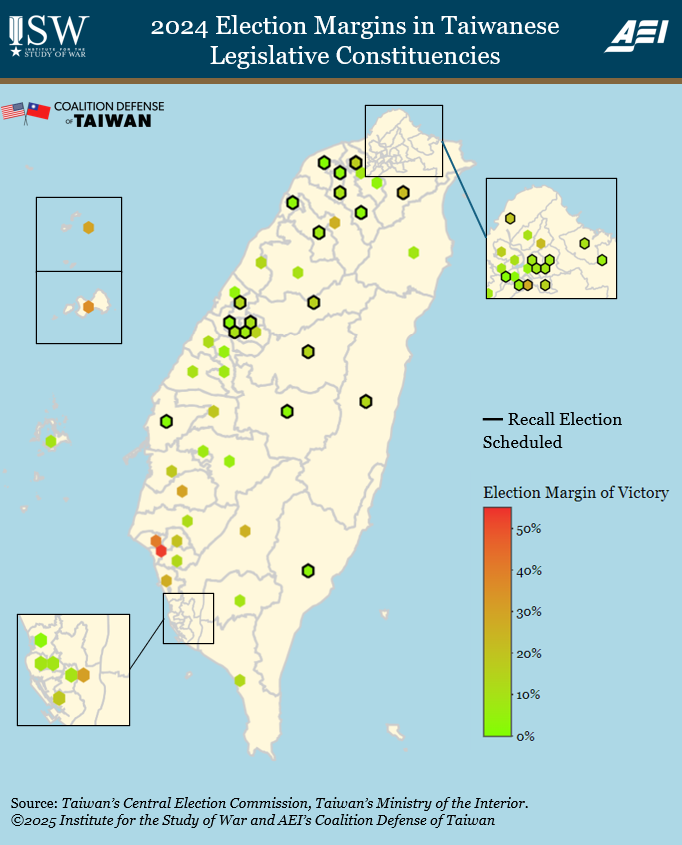
The LY seats facing recall votes are in more competitive districts. The 73 single-member constituency seats had an average electoral victory margin of 12.8 percent. But the average margin for seats facing and not facing recall votes are 9.2 percent and 15.5 percent, respectively. The vote margins may be skewed in a few instances by competitive third-party candidates who split votes in various directions.
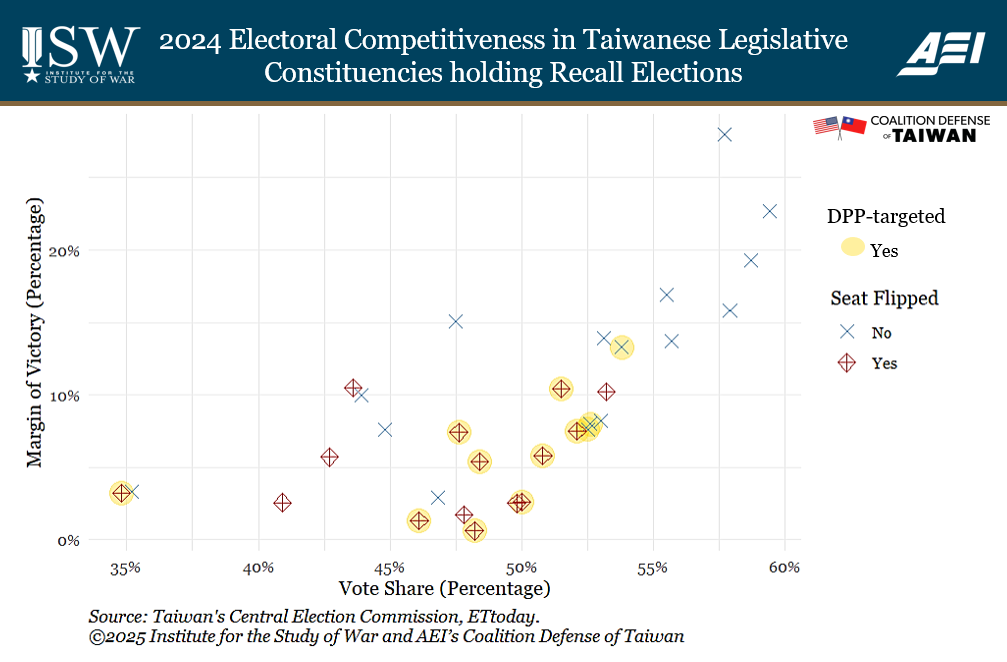
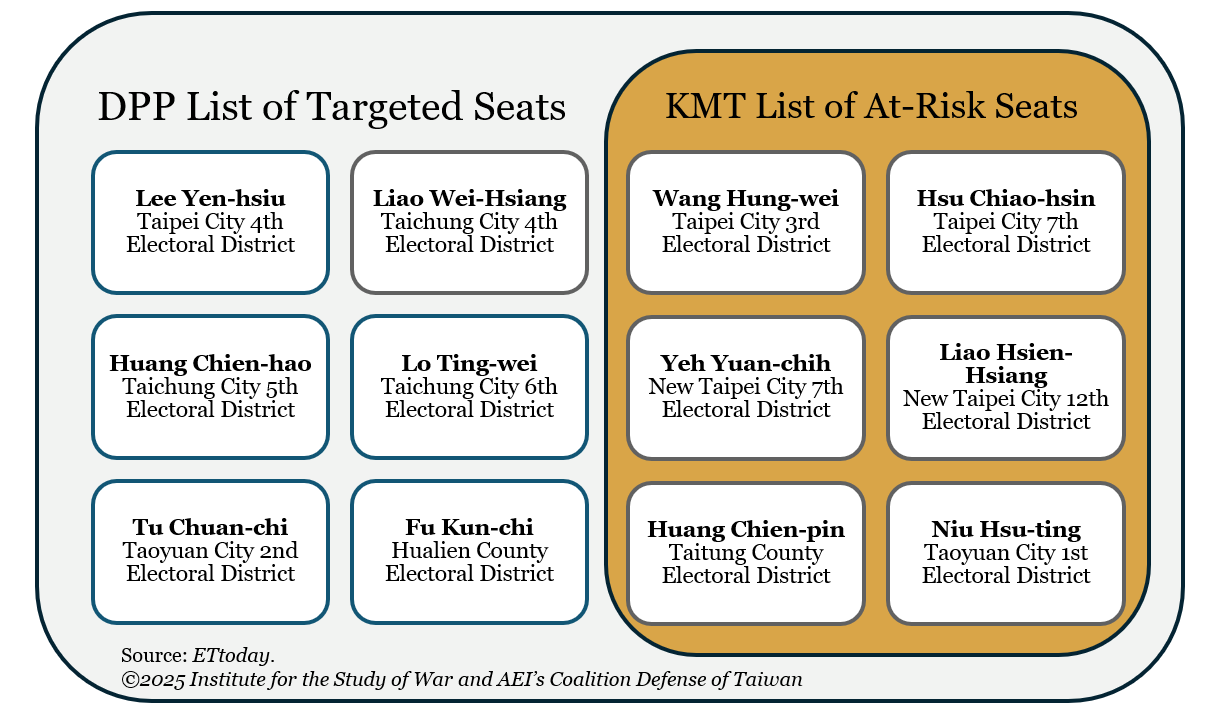
Taiwanese media outlet ETtoday published that the DPP is focusing on recall votes in 12 districts. The KMT has identified six of these seats as being at particular risk.[2] These districts are more competitive, even compared to the other districts that are holding recall votes. The average victory margin across the 12 districts was 6.1 percent. Nine of the 12 seats were flipped in the 2024 legislative elections. Only 17 out of 73 single-member constituencies were flipped in the 2024 LY election. These recall votes are thus functioning as unofficial midterm elections, threatening to dislodge the KMT from recently won ground.
The Taiwanese Mainland Affairs Council (MAC) accused the CCP of interfering in the recall votes with content published in state outlets and social media to influence Taiwanese voters.[3]
Key Takeaways
- Taiwan: Taiwan will hold its first round of recall elections on July 26. These recall elections have the potential to significantly change the balance of power within the Taiwanese Legislative Yuan (LY) and could potentially allow President William Lai Ching-te to more easily accomplish his foreign policy objectives.
Cross-Strait Relations
Taiwan
Taiwan concluded its annual Han Kuang military exercises on July 18. The PRC held military exercises and increased its ADIZ incursions around Taiwan during the exercises, likely to protest the Han Kuang exercises. The 2025 Han Kuang exercises represented the largest and most comprehensive drills in the series and emphasized civilian and urban resilience.[4] Taiwanese defense experts praised the drills’ realism in comparison to past Han Kuang exercises, which have been criticized as excessively scripted.
Taiwanese observers have identified the need to incorporate drones and other unmanned technology in future Han Kuang iterations to further prepare Taiwan’s military for potential conflict scenarios. Lin Ying-yu of Tamkang University’s Graduate Institute of International Affairs and Strategic Studies said that Han Kuang could improve its incorporation of drone warfare.[5] Yang Tai-yuan of the Secure Taiwan Associate Corp. told Taipei Times that Han Kuang did not adequately incorporate counter-drone warfare to match PRC drone capabilities.[6] Taiwan’s Armaments Bureau has requested that Taiwanese companies produce nearly 50,000 drones of five different categories by 2027, reflecting a belief in the importance of drone technology to Taiwan’s warfighting.[7] The 2025 Han Kuang drills incorporated quadcopter drones to support minelaying missions, reconnaissance and surveillance, and air defense.[8]
The PLA conducted several operations during the Han Kuang exercises, likely intended to communicate PRC disapproval of the Taiwanese exercises. The Taiwanese Ministry of Defense (MOD) reported that 45 PLA aircraft crossed the median line on July 16, two days before the exercises concluded.[9] The PLA crossed Taiwan’s median line at higher levels around Han Kuang 2025 than during Han Kuang 2024, likely intended to intimidate Taiwan during its largest-ever Han Kuang exercises.[10] Taiwan reported a similarly high spike in PLA air incursions in July 2024, shortly before that year’s Han Kuang exercises.[11] The PLA Eastern Theater Command, the division responsible for military affairs involving Taiwan, held a four-day military training involving nighttime flights and electronic warfare drills as well as naval drills.[12] The PRC has similarly shown disapproval for past Han Kuang exercises via patrols, economic sanctions, and amphibious exercises.[13] Taiwanese Vice President Hsiao Bi-khim accused the PRC of “aggressive military posturing” in a July 18 address to the Taiwan Foreign Correspondents’ Club but said that Taiwan will not provoke conflict and seeks to maintain the status quo.[14]
The PRC stated its opposition to Taiwanese President William Lai Ching-te’s potential layover in the United States during his official visit to the Americas. Paraguayan President Santiago Peña confirmed that Lai will be visiting Paraguay in August 2025.[15] Paraguay is one of the 12 countries, and the only country in Latin America that still maintains formal diplomatic relations with Taiwan. Belizean Minister of Home Affairs Kareem Musa also confirmed that Lai will be visiting Belize during his trip.[16] The Taiwanese government has not yet confirmed Lai’s itinerary, but Lai is also likely to visit Guatemala while transiting through New York City and Dallas.[17]
PRC Taiwan Affairs Office (TAO) spokesperson Chen Binhua stated that the PRC “firmly opposes any form of official exchanges between Taiwan and the United States,” and accused Lai of making an “illegitimate visit to the United States [窜美]” under the pretext of transit.[18] Chen also warned that Taiwan’s effort to seek independence by “relying on the United States” is doomed to fail and urged the United States to abide by the “one-China principle” and refrain from “sending any wrong signals to the ‘Taiwan independence separatist forces.’”[19] Chen further expressed the PRC’s hope that countries in Latin America and the Caribbean would “recognize the general trend” and switch diplomatic recognition from Taiwan to the PRC as soon as possible.[20]
The PRC routinely objects to senior Taiwanese officials making layovers in the United States. In August 2023, the PRC framed then-Vice President Lai’s transit as a crisis that would endanger peace in the Taiwan Strait.[21] The PRC lodged formal complaints with the United States in December 2024 when Lai transited through Guam and Hawaii and conducted an unannounced large-scale military exercise shortly after Lai returned to Taiwan.[22] US Department of State spokesperson Tammy Bruce affirmed that transits in the United States by senior Taiwanese officials, including the president, are “in line with past practice” and fully consistent with longstanding US policy.[23] Bruce did not confirm that Lai would transit through the United States in August, however. PRC efforts to limit the travel of Taiwanese officials are intended to downplay the legitimacy of the Taiwanese government internationally and further diplomatically isolate Taiwan.
The PRC will likely exploit its leverage over US demand for rare earth elements to deter the United States from adopting protectionist trade and technology policies. The Donald Trump administration allowed semiconductor manufacturing firm Nvidia to resume sales of its H20 semiconductor to the PRC, according to a company announcement on July 14.[24] Nvidia is the dominant provider of advanced semiconductors that are optimized to train generative artificial intelligence (AI) models, maintaining a market share of approximately 80 percent.[25]
US Treasury Secretary Scott Bessent confirmed on July 15 that the cancellation of export controls on the H20 was an outcome of trade talks with the PRC in London in June.[26] One of the United States’ primary objectives during the London trade negotiations was to secure access to PRC rare earth exports, which the PRC restricted in April.[27] US firms’ shortages of restricted rare earths, which are necessary for automotive and defense manufacturing, were likely the impetus for the United States backpedaling on H20 export bans.
The US reversal of the H20 export controls underscores its sensitivity to the PRC’s rare earth export restrictions. The PRC will likely increasingly exploit rare earth export restrictions to extract economic and trade concessions from the United States, especially regarding ensuring access to critical technologies, such as semiconductors.
PRC access to H20 semiconductors will facilitate its development and training of AI models. H20 chips composed approximately half of those used to train PRC-based AI firm Deepseek’s R1 reasoning model, which first prompted the United States to restrict their sale to the PRC in April.[28]
Chairman John Moolenaar of the House Select Committee on the CCP called for the Trump administration to reinstate the H20 export controls in an open letter to Commerce Secretary Howard Lutnick on July 18.[29] Moolenaar outlined the importance of inhibiting PRC access to AI semiconductors to prevent the PRC from gaining an edge in AI technologies, which poses a security risk to the United States.[30] The PRC seeks to integrate AI into its military decision-making, planning, and logistics as part of its pursuit of “intelligentization”—a primary objective of PRC military modernization.
China
The PRC Central Military Commission (CMC) enacted new political guidelines for PLA political officers to reinforce loyalty to the CCP and prevent ideological drift amid high-level purges in the military. The CMC is the highest decision-making body in the PLA and is chaired by CCP General Secretary Xi Jinping. The PLA Daily, a CMC-run publication, stated that the rules “draw clear red lines on power and social behavior.”[31] The PLA Daily stated that guidelines require political cadres to “embody fairness, discipline, and ideological conformity,” but did not provide greater detail on these requirements. The CMC has not disclosed the release date or published the full text of the new guidelines.[32] The new regulations are likely in response to the expanding PLA purges that have targeted over a dozen generals and defense industry executives.[33] Targeted individuals include former CMC member Miao Hua, former defense ministers Li Shangfu and Wei Fenghe, and Navy Chief of Staff Vice Admiral Li Hanjun.[34] He Weidong, the CMC vice chairman, has also not appeared publicly since March 2025, prompting speculation that he, too, is under investigation. [35]
The new regulations aim to strengthen CCP ideological dominance over the PLA and restore internal discipline.[36] The PLA’s purges could partially be a result of the military leaders’ perceived inadequate commitment to Xi’s vision of political loyalty within the military. The PRC issued new controls on military publications in February, which emphasized the responsibility of publishers of military-related content to endorse Xi Jinping’s political ideology.[37] These came after PLA-affiliated outlets promoted collective leadership and intra-party democracy, views that run counter to Xi Jinping’s centralized governance model.[38] These new regulations and controls also align with propaganda themes from the March Two Sessions, which emphasized deeper integration of Xi Jinping Thought into military training and command. The party likely views tighter political supervision as essential to mitigating future dissent and maintaining PLA cohesion.
Northeast Asia
North Korea
North Korean-PRC trade, tourism, and diplomatic relations continue to strengthen, reflecting the broader improvement in bilateral relations between the two countries. The China General Administration of Customs (GAC) released official trade statistics, stating that North Korea-PRC trade increased nearly 30 percent year-on-year for June to 228.9 million US dollars.[39] The GAC’s data from January 2025 to June 2025 reported a significant increase in bilateral trade between the PRC and North Korea.[40] North Korea imports a number of products from the PRC, including crude oil, refined petroleum, electronics, textiles, trucks, and agricultural products.[41] UN Security Council Resolution 2397 set a cap on North Korean crude oil imports to 4 million barrels per year and refined petroleum imports at 500,000 per year.[42] The PRC likely significantly underreports exports of crude oil and petroleum to North Korea to avoid violation of UN sanctions. The GAC’s data is therefore likely much lower than actual levels of PRC-North Korea trade.
North Korea is likely taking steps to restart tourism with the PRC, which has been halted since the COVID-19 pandemic. The DPR Korea Tour website, operated by the North Korean National Tourism Administration, showed train routes connecting Pyongyang to Beijing, PRC; Dandong, PRC; and Moscow, Russia.[43] The DPR Korea Tour website also added to its schedule of Air Koryo international flights to include a flight from Pyongyang to Shanghai in addition to two existing flights from Pyongyang to PRC cities.[44] North Korean officials have not yet confirmed the resumption of North Korean-PRC train routes.
The PRC Embassy in Pyongyang held a commemoration of the anniversary of the PLA’s founding on July 22.[45] North Korean party-run outlet Rodong Sinmun reported on the anniversary on July 23, marking the first mention of the PLA anniversary since 2022.[46] Rodong Sinmun reported that the commemoration was attended by a number of high-level North Korean officials, including Vice Defense Minister Kim Kang Il, Vice Director of the General Political Bureau of the Korean People’s Army (KPA) Pak Yong Il, Vice Department Director of the Workers Party of Korea Central Committee Mun Song Hyok, and Vice Minister of Foreign Affairs Pak Myong Ho. The presence of these officials symbolized North Korean support for the PRC.[47] This event followed two similarly high-profile commemorations of the PRC-North Korean mutual defense treaty on July 9 and 10.[48] The PRC likely seeks to maintain its economic influence over North Korea, which has grown weaker as North Korea-Russia relations have strengthened.
Southeast Asia
Philippines
The PRC issued a protest to the Philippines following reports of increased military exchanges between the Philippines and Taiwan. Increased interoperability between the Philippines and Taiwan would benefit Taiwan’s overall security in a PRC invasion scenario. The PRC Department of Foreign Affairs lodged a protest to the Philippines over “negative moves” toward Taiwan and other security issues on July 18.[49] The PRC’s protest could be in response to a July 14 Washington Post article that detailed increasing engagement between the Philippine and Taiwanese military.[50] Philippine and Taiwanese officials confirmed that the two countries have engaged in high-level forums, held combined coast guard patrols in the Bashi Channel, and that Taiwan attended the Philippine-US-Japan combined Kamandag exercises since the beginning of 2025. This increased military engagement coincides with Philippine President Ferdinand Marcos Jr. loosening restrictions on engagement between Philippine and Taiwanese government officials and allowing visa-free travel into the Philippines for Taiwanese citizens.[51]
The PRC has lodged protests against previous instances of Philippine-Taiwan dialogue and cooperation.[52] The PRC typically expresses dissatisfaction towards any government that engages with Taiwan, as it maintains that Taiwan is a matter of ”internal concern.”[53] The PRC often suggests that the Philippines is acting on behalf of its ally, the United States, particularly regarding the South China Sea and Taiwan. The PRC is likely concerned that closer Taiwanese-Philippine alignment will move Taiwan closer to other US allies and partners, thus decreasing the effectiveness of PRC efforts to isolate Taiwan. Greater Taiwan-Philippines military cooperation could also lead to better interoperability during a future Taiwan contingency. The Marcos administration has acknowledged that a Taiwan Strait crisis would have implications for Philippine security and the safety of the more than 150,000 Philippine workers in Taiwan, making it difficult for the Philippines to ignore a conflict over Taiwan.[54]
The Marcos administration is likely to continue engaging with Taiwan and the United States, opposing the pro-PRC stances of political rival Sarah Duterte.[55] Sarah Duterte and her supporters may seek to shift Philippine foreign policy if she is victorious in the 2028 Philippine Presidential elections. The Philippines’ foreign policy under Marcos differs from many of its fellow Association of Southeast Asian Nations (ASEAN) members. Coalition Defense of Taiwan (CDOT)-ISW reported that ASEAN states have largely avoided acting against PRC interests out of fear of losing PRC assistance amid perceived United States instability.[56] The Philippines has continued dialogues with the United States, most recently holding negotiations with the Trump administration over tariff rates.[57]
Oceania
The United States and Australia began the Talisman Sabre combined exercises on July 15, their largest bilateral military training event to date. The PRC has surveilled past instances of these exercises and may seek to glean operational lessons from them. The exercises incorporate 19 partner nations, the most in the history of the exercises.[58] Talisman Sabre will last through August 4, involving over 30,000 personnel, and feature maritime operations including amphibious landings.[59] Pacific island nations Papua New Guinea, Fiji, and Tonga are participating in the exercises, reflecting a heightened focus on coalition-building in the Pacific.[60] Vietnam and Malaysia will attend the exercises as observers.[61] Deputy Commanding General for US Army Pacific Lieutenant General Joel B. Vowell emphasized the exercises’ deterrent role and said that exercises like Talisman Sabre “allow us to employ war-winning capabilities, operate in critical locations, signal our multinational resolve, and galvanize our collective will.”[62]
The Talisman Sabre exercises came as Australian Prime Minister Anthony Albanese began a visit to the PRC, his fourth in-person meeting with CCP General Secretary Xi Jinping.[63] Xi and Albanese met on July 15 and discussed the positive direction of PRC-Australia relations, including Australia’s statement against “Taiwan independence.”[64] The PRC may still view the Talisman Sabre exercises as an opportunity for a show of force following Albanese’s visit, however. PRC surveillance ships have shadowed past Talisman Sabre exercises and may do so again.[65] Australian Defense Minister Pat Conroy said that the PRC has shadowed Talisman Sabre exercises since 2017 and that it would be “very unusual” for the PRC not to do so.[66] This may support PRC efforts to study how the United States and coalition partners might approach a Pacific military contingency. The PRC may criticize efforts to expand Talisman Sabre, especially to Pacific states it regards as economic partners. PRC efforts to surveil the exercises or frame them in a negative light would support coalition-breaking efforts in the region.

[1] https://www.taipeitimes dot com/News/front/archives/2025/06/21/2003838985
https://www.focustaiwan dot tw/politics/202507180024
[2] https://www.ettoday dot net/news/20250713/2995318.htm
https://www.ettoday dot net/news/20250714/2996120.htm
[3] https://www.mac.gov dot tw/News_Content.aspx?n=05B73310C5C3A632&sms=1A40B00E4C745211&s=824C44B32B2FB650; https://www.taipeitimes dot com/News/taiwan/archives/2025/07/24/2003840831
[4] https://www.president.gov dot tw/News/39345#new
[5] https://focustaiwan dot tw/politics/202507210020
[6] https://www.taipeitimes dot com/News/taiwan/archives/2025/07/22/2003840714
[7] https://www.taiwannews.com dot tw/news/6162246
[8] https://focustaiwan dot tw/politics/202507180010
[9] https://x.com/MoNDefense/status/1945649661282537747
[10] https://chinapower.csis.org/data/taiwan-adiz-violations/
[11] https://www.voanews.com/a/taiwan-to-host-unscripted-drills-aimed-at-simulating-china-invasion-/7700329.html
[12] https://www.scmp dot com/news/china/military/article/3318604/pla-offers-back-back-drill-updates-taiwans-han-kuang-exercise-ramps?module=top_story&pgtype=subsection
[13] https://www.scmp dot com/news/china/military/article/3318604/pla-offers-back-back-drill-updates-taiwans-han-kuang-exercise-ramps
[14] https://www.msn.com/en-us/news/world/taiwan-says-it-will-not-provoke-confrontation-with-china/ar-AA1IPSN8?ocid=BingNewsSerp
[15] https://www.msn.com/en-ca/news/world/taiwan-president-to-visit-paraguay-next-month-paving-way-for-possible-us-transits/ar-AA1IBJ9j
[16] https://www.msn.com/en-ca/news/world/taiwan-president-to-visit-paraguay-next-month-paving-way-for-possible-us-transits/ar-AA1IBJ9j
[17] https://udn dot com/news/story/6656/8880266
[18] http://www.gwytb.gov dot cn/m/fyrbt/202507/t20250716_12712545.htm
[19] http://www.gwytb.gov dot cn/m/fyrbt/202507/t20250716_12712545.htm
[20] http://www.gwytb.gov dot cn/m/fyrbt/202507/t20250716_12712545.htm
[21] https://understandingwar.org/backgrounder/people%E2%80%99s-republic-china-framing-lai%E2%80%99s-us-transit-crisis
[22] https://globaltaiwan.org/2025/01/the-prc-sends-a-message-to-the-international-community/
[23] https://www.state.gov/briefings/department-press-briefing-july-17-2025/
[24] https://blogs.nvidia.com/blog/nvidia-ceo-promotes-ai-in-dc-and-china/
[25] https://www.fool.com/investing/2025/02/03/deepseek-shocked-the-ai-market-last-week-heres-why/
[26] https://www.bloomberg.com/news/articles/2025-07-15/nvidia-expects-license-to-sell-h20-ai-chip-to-china-again
[27] https://www.mofcom dot gov.cn/zwgk/zcfb/art/2025/art_9c2108ccaf754f22a34abab2fedaa944.html
[28] https://semianalysis.com/2025/01/31/deepseek-debates/#closing-the-gap-v3’s-performance
[29] https://selectcommitteeontheccp.house.gov/sites/evo-subsites/selectcommitteeontheccp.house.gov/files/evo-media-document/2025.07.18-letter-to-commerce-h20-chip.pdf
[30] https://selectcommitteeontheccp.house.gov/sites/evo-subsites/selectcommitteeontheccp.house.gov/files/evo-media-document/2025.07.18-letter-to-commerce-h20-chip.pdf
[31] http://www.81 dot cn/szb_223187/szbxq/index.html?paperName=jfjb&paperDate=2025-07-21&paperNumber=01&articleid=959582
[32] https://www.chinadailyhk dot com/hk/article/616418
[33] https://www.scmp dot com/news/china/military/article/3319030/eliminate-toxic-influences-chinas-military-issues-new-political-guidelines-after-wave-corruption
[34] https://www.scmp dot com/news/china/military/article/3319030/eliminate-toxic-influences-chinas-military-issues-new-political-guidelines-after-wave-corruption
[35] https://www.ft.com/content/8226e1d9-2e4a-4079-8f3c-2ae877ba5ba9
[36] http://www.mod dot gov.cn/gfbw/jmsd/16398480.html
http://www.81 dot cn/szb_223187/szbxq/index.html?paperName=jfjb&paperDate=2025-07-21&paperNumber=01&articleid=959582
[37] https://www.cac dot gov.cn/2025-02/08/c_1740714184323988.htm
[38] https://jamestown.org/program/military-content-restrictions-could-indicate-trouble-ahead/
[39] http://www.customs.gov dot cn/customs/302249/zfxxgk/2799825/302274/302277/302276/6630064/index.html
[40] http://www.customs.gov dot cn/customs/302249/zfxxgk/2799825/302274/302277/302276/6422001/index.html; https://www.nknews.org/2025/07/north-korea-china-trade-surges-to-229m-in-june-amid-signs-of-improved-ties/
[41] https://www.ncnk.org/resources/briefing-papers/all-briefing-papers/special-report-china-dprk-trade-what-do-we-know
[42] https://main.un.org/securitycouncil/en/s/res/2397-%282017%29
[43] https://www.nknews.org/2025/07/north-korean-website-posts-schedules-for-train-to-beijing-flight-to-shanghai/; https://www3.nhk.or.jp/nhkworld/en/news/20250712_09/
[44] https://www.nknews.org/2025/07/north-korean-website-posts-schedules-for-train-to-beijing-flight-to-shanghai/
[45] https://www.nknews.org/2025/07/north-korean-media-marks-chinese-army-anniversary-for-first-time-in-three-years/
[46] http://rodong.rep dot kp/ko/index.php?MTJAMjAyNS0wNy0yMy0wNDFAMTVAMkBAMEAyNkA==
[47] https://www.nknews.org/2025/07/north-korean-media-marks-chinese-army-anniversary-for-first-time-in-three-years/
[48] https://www.nknews.org/2025/07/north-korea-sends-senior-official-to-mark-defense-pact-anniversary-with-china/?popup=signin&login=recaptcha; https://www.nknews.org/2025/07/north-korea-hosts-rare-event-celebrating-china-ties-at-luxury-beijing-hotel/
[49] https://www.reuters.com/world/china/china-protests-philippines-over-taiwan-maritime-security-issues-2025-07-18/
[50] https://www.washingtonpost.com/world/2025/07/14/philippines-taiwan-security-ties-china/
[51] https://focustaiwan dot tw/politics/202504220005; https://focustaiwan dot tw/politics/202506190026
[52] http://www.gwytb.gov dot cn/bmst/202401/t20240116_12594119.htm; http://www.xinhuanet dot com/20250421/9c72403a0e76481aa31e61e70994a8f7/c.html
[53] http://www.xinhuanet dot com/20250421/9c72403a0e76481aa31e61e70994a8f7/c.html
[54] https://www.rand.org/pubs/commentary/2025/02/the-philippines-is-ever-more-focused-on-taiwan.html; https://www.nbr.org/publication/entangled-fronts-the-philippines-anxiety-over-a-taiwan-crisis/
[55] https://globalnation.inquirer dot net/282096/palace-on-sara-dutertes-foreign-policy-remarks-expected-from-a-pro-china
[56] https://www.aei.org/articles/china-taiwan-weekly-update-july-21-2025/; https://understandingwar.org/backgrounder/china-taiwan-weekly-update-july-21-2025
[57] https://www.nytimes.com/2025/07/22/us/politics/trump-trade-philippines-marcos.html
[58] https://www.navy.mil/Press-Office/News-Stories/display-news/Article/4244039/talisman-sabre-2025-begins-with-record-participation-and-enduring-purpose/
[59][59] https://www.scmp dot com/week-asia/politics/article/3319230/talisman-sabre-australia-us-push-pacific-deterrence-amid-chinas-security-overtures
[60] https://www.scmp dot com/week-asia/politics/article/3319230/talisman-sabre-australia-us-push-pacific-deterrence-amid-chinas-security-overtures
[61] https://au.usembassy.gov/exercise-talisman-sabre-2025-opens/
[62] https://au.usembassy.gov/exercise-talisman-sabre-2025-opens/
[63] https://www.scmp dot com/news/asia/australasia/article/3318087/australias-largest-ever-military-exercise-underway-chinese-spy-ships-expected
[64] https://www.mfa.gov dot cn/zyxw/202507/t20250715_11670897.shtml
[65] https://www.scmp dot com/news/asia/australasia/article/3318087/australias-largest-ever-military-exercise-underway-chinese-spy-ships-expected
[66] https://www.scmp dot com/week-asia/politics/article/3319230/talisman-sabre-australia-us-push-pacific-deterrence-amid-chinas-security-overture


