
Toplines
The People’s Liberation Army (PLA) is relying on cooperation with Russia to improve the PLA Air Force Airborne Corps’ ability to establish and defend an airhead during a Taiwan invasion. A December 3 Kyiv Independent investigation reported that over 40 high-level PRC military officers, defense industry personnel, and diplomatic staff conducted clandestine visits to Russia between 2023 and 2024.[1] The PRC officials were primarily focused on evaluating and acquiring advanced Russian airborne equipment.
The leaks reveal that the PRC purchased up to 10 Il-78M-90A transport aircraft capable of serving as airborne equipment drop platforms.[2] Additional Russian documents reported that the PRC sought Russian support for its existing transport fleet, including in-country training for Chinese pilots and engineers in advanced airdrop and airborne operations using Russian platforms.[3] The PRC also plans to acquire roughly a battalion’s worth of Russian equipment capable of being paradropped from large transport aircraft, including 37 BMD-4M amphibious infantry fighting vehicles (IFV), 11 BTR-MDM airborne armored personnel carriers (APC), and 11 Sprut-SDM1 light, self-propelled anti-tank guns.[4]
The PLA views airborne insertions as a valuable complement to amphibious operations, especially for seizing key terrain and disrupting enemy movements.[5] PLA documents on airborne operations stress their importance in facilitating the landing of follow-on forces and resisting enemy counterattack until reinforcements arrive.[6] The PLA Airborne Corps could be tasked with securing a major airport in Taiwan to allow larger PLA formations to rapidly deploy on the island in tandem with an amphibious assault. The PLA Airborne Corps has severe limitations that the PLA likely aims to address before it can be confident in its combat effectiveness. The PLA’s heavy transport capacity is limited and can only deploy a single heavy mechanized airborne brigade or two light airborne brigades in a single combat drop.[7] The Airborne Corps’ mechanized equipment is lightly armed and largely unable to reliably damage the most advanced main battle tanks that Taiwan deploys.[8]
The PRC procurements from Russia likely aim to offset some of these limitations. The purchase of Il-78M-90As would increase the PLA’s heavy lift capacity albeit by a small margin. The Sprut-SDM1 self-propelled anti-tank gun would improve the Airborne Corps’ ability to resist an armored or mechanized counterattack at an airhead.[9] The BMD-4M infantry fighting vehicle is also a firepower enhancement over the PLA’s ZBD-03.[10] The PLA airborne battalion equipped with these systems could be tasked with making the initial paradrop and securing a sustainable airhead from enemy counterattack until subsequent echelons arrive. The risks of such an operation are substantial, even for a modernized and experienced military, however.
US President Donald Trump signed the 2026 National Defense Appropriations Act (NDAA) on December 18. The bill places a significant focus on enhancing US alliances in the Indo-Pacific, increasing defense cooperation with Taiwan, and countering the PRC. The 2026 NDAA authorized 900.6 billion US dollars in defense spending for fiscal year 2026.[11] The NDAA lays out the congressional strategy for enhancing US alliances and partnerships in the Indo-Pacific by expanding multilateral engagements, acquiring the long-range precision fire and integrated air defenses, enhancing interoperability and information sharing between the United States and its partners and allies, and increasing the scale and number of combined exercises in the region to include additional exercises in the Taiwan Strait and South China Sea.[12] The NDAA also dedicated additional resources to accelerate the modernization of the Philippines’ Armed Forces.[13]
The NDAA includes a section restricting the drawdown of US forces in Korea to ensure a minimum of 28,500 US troops deployed.[14] The bill also requires that the Secretary of Defense conduct an assessment of the impact that operational control (OPCON) transfer in a wartime scenario will have on US and allied interests. US Secretary of Defense Pete Hegseth and South Korean Defense Minister Ahn Gyu-back agreed to develop an expedited OPCON transfer road map on November 4, where they also discussed a “South Korea-US role sharing” plan.[15]
The NDAA also indicated continued congressional support for Taiwan. Taiwan-related provisions include establishing a joint US-Taiwan production program for unscrewed systems and counter-uncrewed systems technology, establishing joint operational training between the US Coast Guard and Taiwan’s Coast Guard Administration, supporting Taiwan’s admission into the International Monetary Fund (IMF), and expanding the Taiwan Security Cooperation Initiative (TSCI).[16] The TSCI is a legislative framework aimed at enhancing Taiwanese defense capabilities through joint US-Taiwanese programs.
The White House issued a statement on December 18 that acknowledged the passage of the NDAA but also identified a list of provisions in the bill that “raise concerns.”[17] Among the provisions listed were those concerning the drawback of US forces in Korea and OPCON transfer, supporting Taiwan’s entry to the IMF, and establishing a joint US-Taiwan unmanned systems production line. The White House stated that these complaints were due to Congress infringing on the Executive Branch’s ability to dictate foreign policy and military posture.
The NDAA also included several provisions aimed at countering PRC malign activity, limiting PRC supply chain control for key industries, and limiting PRC investment in US biotechnology firms.[18] PRC Ministry of National Defense spokesperson Jiang Bin commented on the NDAA on December 12, criticizing the inclusion of Taiwan-related provisions.[19]
Key Takeaways
- PLA modernization: Russia is helping the PLA improve its airborne capabilities, which the PLA could use to establish and defend an airhead in an invasion of Taiwan.
- US policy: US President Donald Trump signed the 2026 NDAA, dedicating substantial funding toward enhancing Taiwanese defenses, strengthening regional alliances, and countering PRC coercion.
Cross-Strait Relations
Taiwan
Taiwan’s Navy is attempting to acquire unmanned surface vessels (USV) that could improve Taiwan’s coastal defense. The Navy’s ability to do so is contingent on bipartisan support for the Special Budget for Asymmetric Warfare, which continues to face opposition from the opposition Kuomintang (KMT). Taiwanese media reported on December 10 that the Taiwanese Navy Command is soliciting bids for as many as 1500 USVs.[20] The Navy Command requested that the USVs be able to operate up to 24 nautical miles (44 kilometers), disseminate battlefield intelligence, deploy “swarm” tactics, and resist electronic warfare (EW) jamming.[21]
The Ukrainian Armed Forces have successfully used USVs to deny the Russian Navy from controlling the Black Sea despite lacking crewed surface combatants.[22] Sea denial will be imperative for Taiwan in the event of a conflict with the PRC. USVs operating at distances up to 44 km could prevent large amphibious assault vessels from approaching Taiwan’s coastline, significantly complicating a PLA effort to conduct an amphibious assault on the island.[23] Integrating USVs with land-based anti-ship missiles and small, survivable surface combatants could impose unsustainable losses on a much larger PLA Navy operating off Taiwan’s coast.[24] USVs are also more likely than Taiwan’s manned surface combatants to survive a PLA first strike.
The Navy’s procurement of USVs is part of the broader 1.25 trillion New Taiwan Dollar (44 billion US dollar) Special Budget for Asymmetric Warfare that is awaiting review by Taiwan’s Legislative Yuan (LY).[25] The KMT and Taiwan People’s Party (TPP) continue to prevent the special budget from reaching the LY until Taiwanese President William Lai Ching-te agrees to answer questions about the bill.[26] KMT lawmakers threatened on December 14 to block the budget completely if Lai refused to promulgate a KMT-led effort to freeze government pension cuts.[27] Opposition to the special budget, the largest in Taiwan’s history, will hamper the Navy’s efforts to integrate lessons from modern warfare into its defense posture.
China
The PLA is advancing its autonomous drone carrier capabilities, likely to enhance the range of its smaller strike drones. The PLA could use these “mothership” capabilities to conduct drone strikes deep in the enemy rear to interdict resupply and reinforcement to the frontline in the event of a conflict. PRC state media released footage on December 11 of the unmanned drone carrier Jiutian making its maiden flight.[28] Jiutian is the PRC’s first aircraft of this kind and the largest unmanned drone carrier in the world.[29] The PRC claims that Jiutian can carry up to 100 one-way attack drones that it can coordinate simultaneously.[30] The PRC has also claimed that the unmanned aerial vehicle (UAV) can carry eight hardpoints for air-to-air, air-to-ground, or anti-ship missions, as well as a 1,000-kilogram bomb.[31] PRC state media site Global Times claimed that Jiutian has an operating range of 7,000 km, can operate up to 12 hours, and can carry a cargo or armament of up to 6 tons.[32]
The Russian Armed Forces have deployed “mothership” drones in Ukraine that deploy smaller drones with shorter ranges from the mothership, increasing the range at which the smaller drones can be used.[33] The Russian Armed Forces have used mothership drones to interdict Ukrainian reinforcements and supplies from reaching the frontline, enabling advances in some sectors of the front.[34] Jiutian dwarfs the mothership drones used in Ukraine in its size, carrying capacity, and range. Its reported ability to deploy a swarm of 100 drones could overwhelm an air defense network with its sheer scale. The PLA could use this capability to enable drone strikes well beyond the frontline in a Taiwan invasion, potentially complicating the movement and supply of Taiwanese forces during the conflict.
Jiutian’s range also suggests it could be used in military operations well beyond the PRC’s borders. Jiutian could likely be launched from the newest PLA aircraft carrier Fujian or the Type 076 amphibious assault vessel Sichuan due to their electromagnetic catapult systems.[35] Jiutian could enhance PLA power projection by ensuring PLA expeditionary forces have large-scale drone capabilities that can deploy from PLAN vessels to support out-of-area deployments.
Northeast Asia
Japan
The PRC applied additional pressure on Japan in response to Japanese Prime Minister Sanae Takaichi’s statement on November 7 that linked Japan’s survival to Taiwan’s security. The PRC Foreign Affairs Ministry announced countermeasures against the former chief of staff of the Japan Self Defense Force, Shigeru Iwasaki, on December 15.[36] Iwasaki has been serving as political affairs advisor to Taiwan’s Executive Yuan since March 2025.[37] The Ministry of Foreign Affairs (MFA) accused Iwasaki of “openly colluding with independence separatist forces,” which violates the “one-China principle” and seriously interferes with the PRC’s “internal affairs.”[38] PRC countermeasures against Iwasaki include freezing Iwasaki’s assets in the PRC and banning him from entering the PRC, Hong Kong, and Macau.[39] The Tokyo metropolitan government separately said that the PRC has not indicated whether it will renew its panda loan agreement after Tokyo’s Ueno Zoo returns Japan’s last remaining pandas to the PRC in January 2026.[40] Beijing often utilizes “panda diplomacy” to indicate its diplomatic preferences.[41] The PRC continues to apply a multi-pronged coercion effort to pressure Takaichi into retracting her remarks and prevent countries and individuals from supporting Taiwan.
The PRC criticized the Japanese Defense Ministry for citing the PRC’s increased defense budget as justification for the increase in Japan’s defense budget. The Japanese Diet passed a supplementary budget on December 16 for Fiscal Year (FY) 2025, which ends on March 31, 2026.[42] The supplementary budget includes approximately 1.1 billion US dollars for defense and diplomacy expenses.[43] The supplementary budget will allow Japan’s defense spending to reach 2 percent of its GDP two years ahead of its original goal, which Prime Minister Takaichi pledged during her first major policy address to the National Diet on October 25, 2025.[44] Japanese media separately reported that Japan’s draft initial budget for FY 2026 planned to allocate approximately 58 billion US dollars for defense spending.[45] Japanese Defense Minister Shinjiro Koizumi stated that increasing Japan’s defense budget was necessary due to the PRC’s significant defense budget increases.[46] Koizumi added that if Japan doesn’t increase its defense spending, it would lose credible deterrence, leading to a military imbalance in the region.[47]
Ministry of Foreign Affairs spokesperson Guo Jiakun rejected Koizumi’s statement, claiming that the increase in the PRC defense budget is necessary to carry out PRC obligations to the international community.[48] Guo also criticized Japan’s plan to increase its defense budget and listed a series of Japanese policies that he claimed violated Japan’s pacifist constitution by loosening the restrictions imposed on Japan after World War II.[49] Guo accused Japan of seeking to interfere in other countries’ internal affairs by force and threatening regional peace and stability, likely referring to Takaichi’s remarks on November 7, which indicated the possibility of mobilizing the Japan Self Defense Force in response to a hypothetical PRC invasion against Taiwan.[50]
North Korea
Workers’ Party of Korea (WPK) General Secretary Kim Jong Un publicly praised military engineers who returned from deployment in Kursk, Russia. North Korea acknowledged the dispatch of mine engineers to Russia for the first time on December 12, which could indicate that Pyongyang is planning for additional deployments.[51] North Korea and Russia agreed in June to deploy an additional 5,000 construction workers and 1,000 engineers for mine clearing along the frontline in Kursk. The troops received training from Russian experts, including operating mine-clearing robots.[52] Russian Kursk Governor Alexander Khinshtein announced on December 13 that North Korea would redeploy mine-clearing troops within a few months.[53]
Kim Jong Un may use this public event to strengthen internal military cohesion and further emphasize the importance of sacrifice for the state before the 9th WPK Congress early next year. Kim will likely present a new Pyongjin policy—a movement to enhance the military and economy simultaneously—at the congress.[54] North Korea has deployed a total of approximately 21,000 troops to Russia since October 2024.[55] Pyongyang may continue to organize and sustain deployments to build a close partnership with Moscow. North Korea could also acquire new military technologies in return and gain financial benefits through arms sales. The Korea Institute for Defense Analyses (KIDA) estimated in April that North Korea may have generated an economic effect of up to 28.7 trillion South Korean won (19.5 billion US dollars) through troop deployment and arms support.[56] This figure amounts to approximately 67 percent of the estimated 2024 GDP of 42.7 trillion South Korean won (28.96 billion US dollars).[57]
PRC export of drone-manufacturing technology to North Korea could accelerate North Korea’s ability to mass-produce indigenous unmanned aerial systems. International sanctions prohibit any sale of industrial machinery to North Korea, yet the PRC is unlikely to regulate the trade. Seoul-based media outlet NK News reported on December 12 that PRC industrial manufacturer Jiangsu Nengtai Automation Equipment is marketing drone manufacturing technology to North Korea.[58] A video posted on the PRC social media platform Douyin shows an employee of Jiangsu Nengtai promoting a drone assembly line, claiming it could produce up to “100 multi-rotor drones” per day.[59] UN Security Council Resolutions (UNSCR) ban the sale or transfer of all “industrial machinery” to North Korea.[60] The PRC and Russia opposed additional UNSC sanctions on North Korea requested by the United States, according to a December 14 report.[61]
WPK General Secretary Kim Jong Un directed the rapid establishment of a drone production system in November 2024.[62] South Korean defense analyst Shin Seung-ki told NK News that North Korea could “secure multiple additional production lines” through “reverse engineering” PRC technology.[63] The PRC is unlikely to enforce UNSC sanctions related to drone technology transfers, which will increase the risk that commercial channels will continue to support North Korea’s expanding drone production objectives.
South Korea
The United States and South Korea held a high-level foreign affairs meeting on December 16 to discuss US-South Korea affairs and North Korea. The South Korean Ministry of Unification (MOU) expressed its desire for a separate direct discussion channel with the United States, reflecting internal conflict within the Lee Jae Myung administration. The South Korean and US delegations discussed Korean Peninsula issues based on the October 29 US-South Korea summit fact sheet including discussions on coordination of North Korea policy and the complete denuclearization of North Korea.[64] The South Korean Ministry of Foreign Affairs (MOFA) and the US State Department agreed to regularize the bilateral discussion meetings to strengthen policy sharing. The MOU announced on December 15 that it would not participate in the high-level discussion, despite the agenda containing inter-Korean relations, which falls under the MOU’s purview. The MOU previously participated in US-South Korea discussions, including a “working group” under the Moon Jae-in administration.[65] [66] An MOU official announced its intention to pursue direct communication with Washington, excluding MOFA, which was echoed by MOU Minister Chung Dong-young.[67] National Security Advisor Wi Sung-lac, who previously voiced disagreement with Chung’s policy preferences, said the MOU’s statement represented a “difference in methodology, not a conflict.”[68] Seoul’s misaligned North Korea policy and fragmentation within the Lee administration could result in policy inconsistency and delayed implementation.
Southeast Asia
Philippines
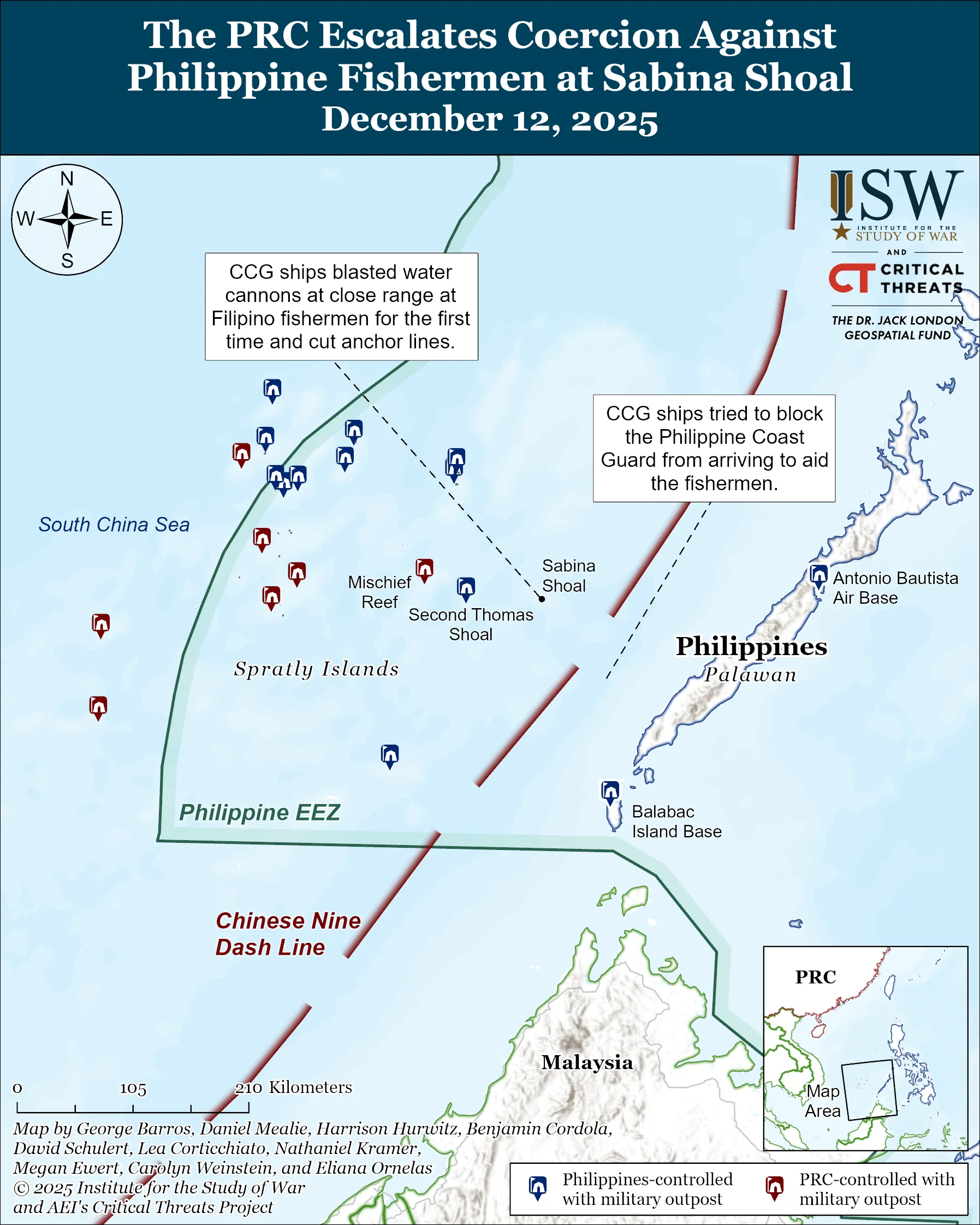
China Coast Guard (CCG) ships fired water cannons and cut the anchor lines of Philippine fishermen at Sabina Shoal in the most serious PRC-Philippine clash since June 2024. The PRC escalated aggressive tactics against Filipino civilians likely to deter them from helping the Philippines hold territory in the South China Sea. The Philippine Coast Guard (PCG) reported that CCG ships 21559 and 21562 and several Chinese Maritime Militia (CMM) vessels on December 12 confronted around 20 Philippine fishing boats at Sabina Shoal, an uninhabited atoll in the South China Sea.[69] The CCG carried out blocking maneuvers and blasted some of the Philippine boats with water cannons at close range, injuring three fishermen. The CCG also deployed inflatable-hull boats to cut the anchor lines of several Philippine boats. CCG 21559, 21562, and CCG 5204 tried to block the PCG as it sailed to assist the fishermen. Ship-tracking data from Starboard Maritime Intelligence also shows CCG ships 5009 and 23519 around Sabina Shoal at the time, but does not show CCG 21559, likely because that ship illegally shut off its Automatic Identification System (AIS). The CCG described its actions on December 12 as “necessary control measures” against Philippine boats gathered to “provoke trouble” under the guise of fishing.[70] The PRC MFA claimed on December 15 that the Philippine fishing boat gathering was “premeditated” and that the fishermen threatened CCG officers with knives.[71] Philippine fishermen have a right to fish at Sabina Shoal because it is within the Philippine Exclusive Economic Zone (EEZ) and classified as a Low-Tide Elevation, meaning that no other country can claim it as territory under international law.[72] The PRC disputes this classification and claims the shoal and surrounding waters as PRC territory anyway, however.
The CCG is escalating its tactics against Philippine civilians, likely to prevent and deter civilians from aiding the Philippines in occupying disputed areas. The Philippines supports the long-term presence of fishermen near contested features through the KBBM program, which delivers supplies to and purchases fish from fishermen at sea.[73] This is the first time the PRC has targeted Philippine civilians with water cannons at close range, according to the Philippine National Maritime Council.[74] The PRC has previously used water cannons at long range against fishermen and at close range against Philippine government ships.[75]
The PRC likely aims to deny Philippine access to Sabina Shoal to weaken Philippine control of its occupied features in the South China Sea. The Philippines uses the Sabina Shoal as a staging ground for resupply missions to various Philippine outposts and fishing grounds throughout the Spratly Islands. The Sabina shoal is one of the easternmost features of the Spratly Archipelago and is close to Palawan, a large Philippine island that hosts a major naval base. The PRC claims nearly all land features in the South China Sea within its unilateral Nine Dash Line boundary and has built up seven artificial islands in the Spratly archipelago as military outposts.[76] The PRC likely aims to use these outposts to expand its strategic depth, power projection, and anti-access/area denial capabilities in the region.
The Sabina Shoal became a major flashpoint in 2024 after the PCG accused the PRC of island reclamation activities there and anchored the PCG flagship, Teresa Magbanua, in the lagoon of the shoal for several months.[77] The PRC sent several CCG ships and dozens of CMM boats to dislodge the Philippine ship from the area, repeatedly ramming Teresa Magbanua and blocking resupply missions until the ship had to return to port.[78] The PRC accused the Philippines of trying to occupy the shoal under the guise of fishing or humanitarian resupply missions.
Oceania
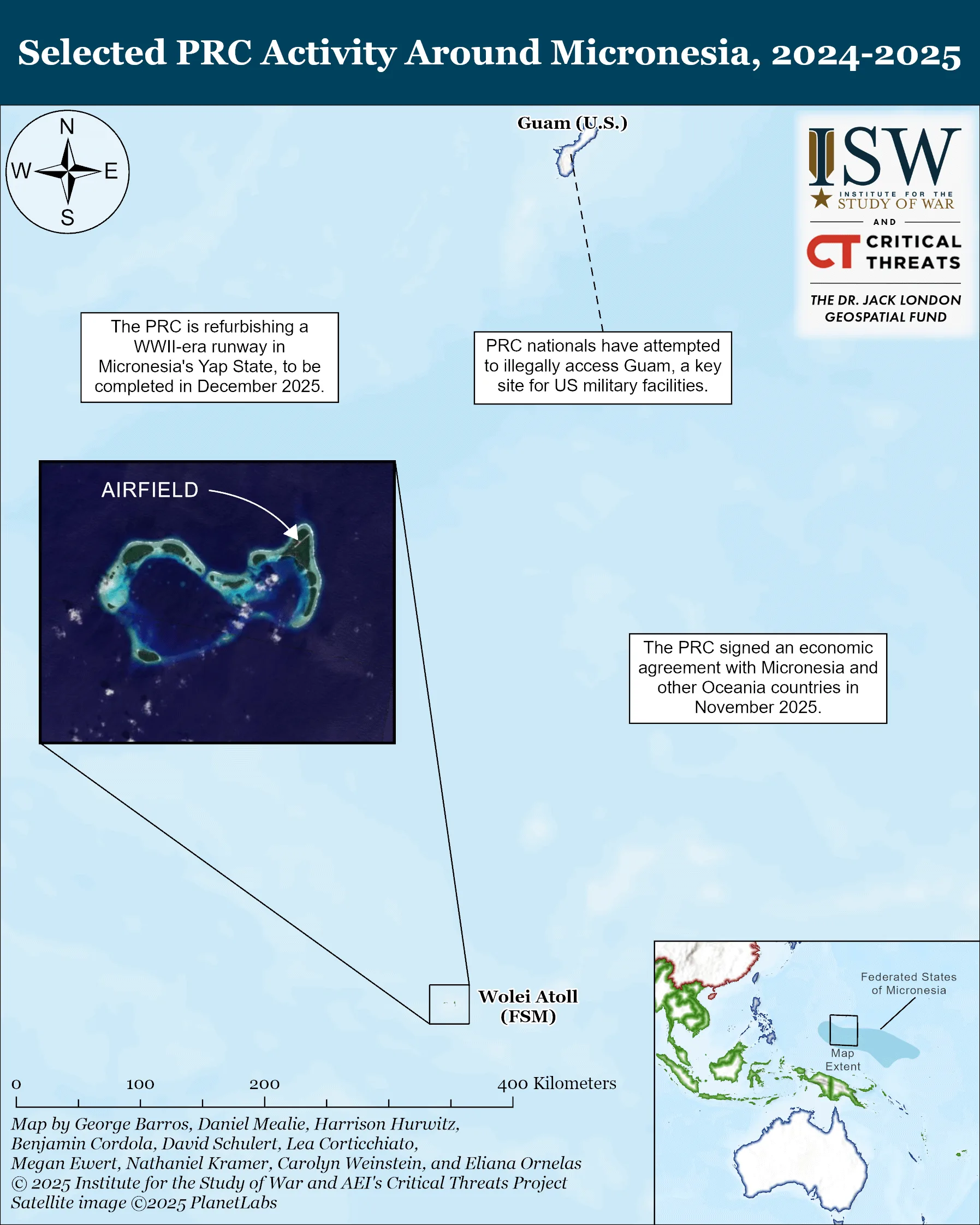
The PRC is refurbishing a WWII airstrip in Micronesia’s Yap State, indicating ongoing PRC efforts to militarize strategic locations in the Pacific. Newsweek reported on December 11 that PRC firm Shandong Hengyue Municipal Engineering Co. is refurbishing the airfield, originally built by Japan, at Woleai. Construction began in May 2025 and will finish in December.[79] Micronesia maintains a compact of free association (COFA), an agreement containing special defense and migration provisions, with the United States.[80] The PRC signed an economic agreement with Micronesia in November, which ISW-CDOT assessed may represent a coalition breaking effort.[81]The runway reconstruction aligns with ongoing PRC efforts to expand its presence in Oceania. The refurbished airfield would improve PRC aircrafts’ access to nearby strategic sites in Oceania — including Guam —in addition to enhancing PRC presence in Micronesia itself. The airfield also positions the PRC closer to Palau, another US COFA partner that the PRC has sought to intimidate due to its stance on Taiwan. Palau is one of three remaining Pacific states that recognize Taiwan.[82] Palau’s president accused the PRC of weaponizing tourism against it in 2024.[83] Palau has similarly accused PRC vessels of loitering in its waters, including suspicious behavior near an undersea fiber optic cable.[84]
Europe
The United Kingdom sanctioned two PRC tech companies for allegedly carrying out cyberattacks against the UK and its allies. The UK announced sanctions against i-Soon (Sichuan Anxun Information Technology) and Integrity Technology (Integrity Tech) on December 9 for “reckless and indiscriminate cyberattacks.”[85] The UK government’s sanctions announcement said that both companies were examples of the PRC “cyber industry,” including data brokers and hackers for hire, that sometimes provide stolen information to PRC intelligence services. The UK said that i-Soon had targeted over 80 government and private industry IT systems around the world and supported others planning malicious cyber activity. The UK said that Integrity Tech controlled and managed a covert cyber network and provided technical assistance for other cyberattackers. The UK’s National Cyber Security Centre (NCSC) described Integrity Tech as synonymous with the state-affiliated cyber threat actor Flax Typhoon.[86] The NCSC said in its 2025 annual report that the PRC “continues to be a highly sophisticated and capable threat actor, targeting a wide range of sectors and institutions across the globe, including the UK.”[87] The PRC MFA claimed on December 10 that the UK was spreading disinformation and was itself a “springboard” for US cyberattacks against the PRC.[88]
The UK has faced a growing volume of cyberthreats and infiltration from the PRC in recent years. It co-signed a multinational cyber advisory in August 2025 on countering a PRC state-sponsored threat actor known as Salt Typhoon, which the advisory linked to three different PRC tech firms that provide products and services to PRC intelligence services.[89] The threat actors and companies mentioned in that advisory are separate from the ones that the UK sanctioned on December 9. MI5 Director General Ken McCallum said on October 16 that his agency has seen a 35 percent increase in the number of individuals it is investigating for state-affiliated hacking, though he did not specify what portion of those was from the PRC.[90] The UK charged a parliamentary researcher and an academic in 2024 for passing insider information about UK politics to a PRC intelligence agent but dropped the case in September 2025 because the PRC was not officially considered a “national security threat” at the time of the alleged crimes.[91] The UK also delayed the construction of a planned PRC “super-embassy” in London for the third time on December 3, amid security concerns.[92] Former UK intelligence officials said that the PRC could use the larger facility to host a greater number of covert intelligence personnel and to tap underground communication cables that run underneath or near the planned embassy site.[93]
Middle East
PRC Foreign Minister Wang Yi pressed Gulf Cooperation Council (GCC) Secretary-General Jasem Mohamed Albudaiwi to conclude negotiations for a PRC-GCC free trade agreement on December 14. The PRC’s urgency to conclude the GCC trade negotiations may reflect PRC efforts to secure long-term petroleum supply links as the United States pressures Venezuela and other significant PRC oil suppliers. Wang used more insistent language than in previous meetings with Albudaiwi and other GCC officials, calling for a “final decision” to be made after 20 years of negotiations.[94] Wang also met with Emirati Minister of Foreign Affairs Abdullah bin Zayed Al Nahyan on December 13 and Saudi Crown Prince Mohammad bin Salman on December 15, calling for increased cooperation between the PRC and Gulf nations on oil and other industries.[95]
The PRC and the GCC began negotiations for a free trade agreement in 2004, but talks repeatedly stalled in 2009 and the early 2010s over PRC tariffs on Gulf oil exports and the PRC’s decision to veto a UN Security Council resolution to support Syrian opposition fighters that Saudi Arabia supported.[96] PRC-GCC stalled again in 2024 over Saudi concerns about the potentially damaging effect of low-cost PRC imports on Saudi Arabia’s domestic industrial development.[97]
GCC nations supplied around one-third of the PRC’s crude oil and naphtha in 2024.[98] The PRC demand for imported petroleum products has increased significantly over recent years.[99] Russia provided 20 percent of the PRC’s crude oil imports in 2024, but dropped to 11 percent by October, likely due to pressure from increasingly strict US and international sanctions on Russian oil.[100] PRC state oil firms halted purchases of seaborne Russian oil after the United States imposed sanctions on Russia’s two largest oil producers, Lukoil and Rosneft, in late October.[101] Venezuelan oil exports to the PRC rose from 2024 to 2025, but recent US pressure on Venezuela’s oil industry has likely caused the PRC to doubt its reliability as a stable supplier.[102] Iran likewise faces heavy US sanctions on its oil sector and relies on a “shadow fleet” of shell companies and tankers to evade sanctions and export its oil and petroleum, much of which is sold to the PRC.[103] The PRC is likely interested in signing a free trade agreement with the GCC to secure the bloc as a reliable supplier for non-sanctioned oil and petroleum products.
The PRC also likely seeks to pull GCC member Saudi Arabia, the world’s largest oil exporter and a major target for PRC investment and construction, away from the United States after a recent thaw in US-Saudi relations.[104] The PRC likely hopes to avoid ceding influence in Saudi Arabia and the GCC to the United States and secure closer economic and security ties with Saudi Arabia.[105]

[1] https://kyivindependent dot com/investigation-chinese-military-officials-quiet-visits-to-moscow-exposed/
[2] https://kyivindependent dot com/investigation-chinese-military-officials-quiet-visits-to-moscow-exposed/
[3] https://www.rusi.org/explore-our-research/publications/commentary/how-russia-helping-china-prepare-seize-taiwan
[4] https://understandingwar.org/research/china-taiwan/china-taiwan-weekly-update-october-3-2025/
[5] https://www.airuniversity.af.edu/Portals/10/CASI/documents/Translations/2020-12-02%20In%20Their%20Own%20Words-%20Science%20of%20Campaigns%20(2006).pdf
[6] https://digital-commons.usnwc.edu/cmsi-maritime-reports/19/
[7] https://ndupress.ndu.edu/Portals/68/Documents/Books/crossing-the-strait/crossing-the-strait.pdf
[8] https://odin.tradoc.army.mil/WEG/Asset/3ff858bfb80253e2df8e2a4588c1b078; https://odin.tradoc.army.mil/WEG/Asset/0b0252ef60737282417f02e725ae471d; https://odin.tradoc.army.mil/WEG/Asset/5a727fec87d6c3fe2334e0d1f2ae0e27; https://www.armyrecognition.com/military-products/army/main-battle-tanks/light-tanks/vt5-light-weight-main-battle-tank-technical-data-sheet-specifications-pictures-video-11711164; https://archive.org/details/m1abramsatwar0000gree
[9] https://www.army-technology.com/projects/sprut-sdm1-light-amphibious-tank/; https://digital-commons.usnwc.edu/cgi/viewcontent.cgi?article=1018&context=cmsi-maritime-reports
[10] https://odin.tradoc.army.mil/WEG/Asset/5a727fec87d6c3fe2334e0d1f2ae0e27; https://odin.tradoc.army.mil/WEG/Asset/0b0252ef60737282417f02e725ae471d
[11] https://docs.house.gov/billsthisweek/20251208/RCP_xml%5B2%5D.pdf
[12] https://rules.house.gov/sites/evo-subsites/rules.house.gov/files/documents/rcp_xml-2.pdf#page=1008; https://rules.house.gov/sites/evo-subsites/rules.house.gov/files/documents/rcp_xml-2.pdf#page=1003
[13] https://rules.house.gov/sites/evo-subsites/rules.house.gov/files/documents/rcp_xml-2.pdf#page=1030; https://rules.house.gov/sites/evo-subsites/rules.house.gov/files/documents/rcp_xml-2.pdf#page=1034
[14] https://rules.house.gov/sites/evo-subsites/rules.house.gov/files/documents/rcp_xml-2.pdf#page=1023
[15] https://www.reuters.com/world/china/hegseth-says-us-south-korea-alliance-will-stay-focused-north-korea-2025-11-04/
[16] https://rules.house.gov/sites/evo-subsites/rules.house.gov/files/documents/rcp_xml-2.pdf#page=1020; https://rules.house.gov/sites/evo-subsites/rules.house.gov/files/documents/rcp_xml-2.pdf#page=1019; https://rules.house.gov/sites/evo-subsites/rules.house.gov/files/documents/rcp_xml-2.pdf#page=2448
[17] https://www.whitehouse.gov/briefings-statements/2025/12/statement-by-the-president-7598/
[18] https://rules.house.gov/sites/evo-subsites/rules.house.gov/files/documents/rcp_xml-2.pdf#page=2206; https://rules.house.gov/sites/evo-subsites/rules.house.gov/files/documents/rcp_xml-2.pdf#page=5148; https://rules.house.gov/sites/evo-subsites/rules.house.gov/files/documents/rcp_xml-2.pdf#page=621
[19] http://www.mod.gov dot cn/gfbw/qwfb/16427151.html
[20] https://def.ltn.com dot tw/article/breakingnews/5272138
[21] https://www.taiwannews.com dot tw/news/6262011
[22] https://centerformaritimestrategy.org/publications/ukraine-has-innovated-naval-warfare/
[23] https://www.vermilionchina.com/p/the-pla-landing-template
[24] https://www.researchgate.net/publication/397980387_Technological_maturity_for_Jeune_Ecole_The_case_of_Ukraine’s_naval_strategy
[25] https://www.taiwannews.com dot tw/news/6262011
[26] https://understandingwar.org/research/china-taiwan/china-taiwan-update-december-5-2025/
[27] https://www.cna.com dot tw/news/aipl/202512130045.aspx; https://www.taiwannews.com dot tw/news/6264568
[28] http://www.news dot cn/politics/20251212/d89fd56ea51e4e828c63bfca931c15dd/c.html; http://www.news dot cn/20251211/8e6122a6b1474cd8a75aaf424e3cd571/c.html
[29] https://www.bloomberg.com/news/articles/2025-12-11/china-launches-massive-aerial-drone-carrier-in-show-of-prowess?srnd=next-china
[30] https://asia.nikkei.com/politics/defense/chinese-uncrewed-aircraft-that-can-launch-100-drones-makes-first-flight; https://www.scmp dot com/news/china/military/article/3336098/first-flight-chinas-giant-drone-carrier-jiu-tian-signals-pla-swarm-capacity-boost?module=top_story&pgtype=section
[31] https://asia.nikkei.com/politics/defense/chinese-uncrewed-aircraft-that-can-launch-100-drones-makes-first-flight; https://www.scmp dot com/news/china/military/article/3336098/first-flight-chinas-giant-drone-carrier-jiu-tian-signals-pla-swarm-capacity-boost?module=top_story&pgtype=section
[32] https://www.globaltimes dot cn/page/202512/1350281.shtml
[33] https://militarnyi dot com/en/news/russia-created-a-mothership-drone-controlled-via-starlink/
[34] https://understandingwar.org/research/russia-ukraine/russian-partial-battlefield-air-interdiction-enabled-recent-russian-advances-in-pokrovsk/
[35] https://www.navytimes.com/opinion/commentary/2020/09/14/emals-technology-on-ford-carriers-will-help-the-us-navy-accomplish-its-mission/#:~:text=Additionally%2C%20EMALS%20(%20Electromagnetic%20Aircraft%20Launch%20System,diverse%20naval%20air%20wing%20in%20the%20future; https://www.defensenews.com/naval/2017/11/09/tech-breakthrough-chinas-next-carrier-could-feature-electromagnetic-launch-system/; https://understandingwar.org/research/china-taiwan/china-taiwan-weekly-update-september-22-2025/
[36] https://www.fmprc.gov dot cn/wjbxw_new/202512/t20251215_11772517.shtml
[37] https://www.setn dot com/News.aspx?NewsID=1627453
[38] https://www.mfa.gov dot cn/web/wjdt_674879/fyrbt_674889/202512/t20251215_11772954.shtml
[39] https://www.fmprc.gov dot cn/wjbxw_new/202512/t20251215_11772517.shtml
[40] https://www3.nhk.or dot jp/nhkworld/en/news/20251215_10/
[41] https://www.abc.net.au/news/2023-12-09/what-is-china-panda-diplomacy/103185260
[42] https://mainichi dot jp/english/articles/20251216/p2g/00m/0na/035000c
[43] https://mainichi dot jp/english/articles/20251216/p2g/00m/0na/035000c
[44] https://news.usni.org/2025/12/03/japan-poised-to-increase-defense-spending-to-70-billion-2-of-its-gdp ; https://www.aei.org/articles/china-taiwan-weekly-update-october-31-2025/
[45] https://japantoday dot com/category/politics/update1-japan-eyes-record-defense-budget-of-about-9-trillion-yen-for-fy-2026
[46] https://news.ltn.com dot tw/news/world/breakingnews/5280475
[47] https://news.ltn.com dot tw/news/world/breakingnews/5280475
[48] https://www.mfa.gov dot cn/web/wjdt_674879/fyrbt_674889/202512/t20251216_11774310.shtml
[49] https://www.mfa.gov dot cn/web/wjdt_674879/fyrbt_674889/202512/t20251216_11774310.shtml
[50] https://www.mfa.gov dot cn/web/wjdt_674879/fyrbt_674889/202512/t20251216_11774310.shtml
[51] https://www.yonhapnewstv.co dot kr/news/MYH20251213103203Ba0
[52] https://www.bbc.com/korean/articles/c20pjj93eg5o; https://www.nknews.org/2025/06/kim-jong-un-to-send-6k-military-workers-to-rebuild-russias-kursk-shoigu/; https://www.nknews.org/2025/12/russia-expects-north-korean-troops-to-return-to-kursk-in-spring-governor/
[53] https://www.nknews.org/2025/12/russia-expects-north-korean-troops-to-return-to-kursk-in-spring-governor/
[54] https://www.yna.co dot kr/view/AKR20250913013351504
[55] https://www.yna.co dot kr/view/AKR20250430096300001; https://www.bbc.com/korean/articles/c20pjj93eg5o
[56] https://www.kida.re dot kr/frt/board/frtNormalBoardDetail.do?param=c2lkeD0zMjQ0JmlkeD0yNiZkZXB0aD0yJmxhbmc9a3I=; https://www.chosun dot com/politics/diplomacy-defense/2025/04/09/M4UOBYILCVFOTEJYHJRO2N6PRU/
[57] https://www.bok.or dot kr/portal/bbs/B0000501/view.do?nttId=10093292&menuNo=201264
[58] https://www.nknews dot org/2025/12/chinese-drone-assembly-lines-bound-for-north-korea-raises-questions-on-legality/
[59] https://www.nknews dot org/2025/12/chinese-drone-assembly-lines-bound-for-north-korea-raises-questions-on-legality/
[60] https://main.un dot org/securitycouncil/en/s/res/2397-%282017%29
[61] https://www.newsis dot com/view/NISX20251214_0003440093
[62] https://www.yna.co dot kr/view/MYH20241115009200641
[63] https://www.nknews dot org/2025/12/chinese-drone-assembly-lines-bound-for-north-korea-raises-questions-on-legality/
[64] https://www.chosun dot com/politics/diplomacy-defense/2025/12/16/3MBYUBN6CRB4BK6TLA7LW5YLQI/
[65] https://www.yna.co dot kr/view/AKR20181120134200011
[66] https://www.yna.co dot kr/view/AKR20210622017651504
[67] https://www.joongang.co dot kr/article/25390216; https://www.segye dot com/newsView/20251215515260?OutUrl=naver; https://www.donga dot com/news/Politics/article/all/20251212/132951010/2
[68] https://news.sbs.co dot kr/news/endPage.do?news_id=N1008369631&plink=ORI&cooper=NAVER; https://www.khan.co dot kr/article/202512161023001; https://news.kbs.co dot kr/news/pc/view/view.do?ncd=8434394
[69] https://x.com/jaytaryela/status/1999713381255897283; https://understandingwar.org/research/china-taiwan/china-taiwan-update-november-21-2025/
[70] https://www.ccg.gov dot cn/wqzf/202512/t20251212_2901.html
[71] https://www.fmprc.gov dot cn/fyrbt_673021/202512/t20251215_11772954.shtml ; https://www.pna.gov dot ph/articles/1265277
[72] https://www.rfa.org/english/news/southchinasea/china-sabina-shoal-report-08302024043714.html
[73] https://www.abs-cbn dot com/news/nation/2025/10/14/pcg-bfar-extend-aid-to-over-100-fishermen-amid-harassment-by-chinese-vessels-1733
[74] https://www.philstar dot com/headlines/2025/12/15/2494482/manila-says-china-targeted-filipino-fishermen-close-range-first-time
[75] https://understandingwar.org/research/china-taiwan/china-taiwan-weekly-update-october-20-2025/ ; https://understandingwar.org/research/china-taiwan/china-taiwan-weekly-update-september-22-2025/ ; https://understandingwar.org/research/china-taiwan/china-taiwan-weekly-update-june-27-2025/ ; https://understandingwar.org/research/china-taiwan/china-taiwan-weekly-update-may-30-2025/ ;
[76] https://www.abc.net.au/news/2025-07-30/tracking-militarisation-in-the-south-china-sea/105473948
[77] https://understandingwar.org/research/china-taiwan/china-taiwan-weekly-update-september-13-2024/
[78] https://understandingwar.org/research/china-taiwan/china-taiwan-weekly-update-september-13-2024/ ; https://understandingwar.org/research/china-taiwan/china-taiwan-weekly-update-september-27-2024/
[79]
https://www.newsweek.com/satellite-photos-show-china-rebuilding-world-war-ii-airfield-in-pacific-11191117; https://www.fdd.org/analysis/op_eds/2025/05/27/fsm-breaks-ground-on-china-led-airport-reconstruction-project-in-woleai/
[80] https://www.congress.gov/crs-product/IF12194
[81] https://understandingwar.org/research/china-taiwan/china-taiwan-update-november-17-2025/
[82] https://www.csis.org/blogs/new-perspectives-asia/support-threefold-taiwans-pacific-island-allies
[83] https://apnews.com/article/palau-china-surangel-whipps-beijing-pacific-influence-045ec0a4f8e67e48d2a4adf0cbd13918
[84] https://www.rfa.org/english/news/pacific/palau-china-cable-05312023014251.html
[85] https://www.gov.uk/government/news/uk-clamps-down-on-china-based-companies-for-reckless-and-irresponsible-activity-in-cyberspace
[86] https://www.ncsc.gov.uk/news/ncsc-and-partners-issue-advice-to-counter-china-linked-campaign-targeting-thousands-of-devices ; https://www.ncsc.gov.uk/collection/ncsc-annual-review-2025/chapter-01-cyber-threat-to-the-uk
[87] https://www.ncsc.gov.uk/collection/ncsc-annual-review-2025/chapter-01-cyber-threat-to-the-uk
[88] https://www.mfa.gov dot cn/web/wjdt_674879/fyrbt_674889/202512/t20251210_11770291.shtml ; https://www.globaltimes dot cn/page/202512/1350172.shtml
[89] https://media.defense.gov/2025/Aug/22/2003786665/-1/-1/0/CSA_COUNTERING_CHINA_STATE_ACTORS_COMPROMISE_OF_NETWORKS.PDF
[90] https://www.mi5.gov.uk/director-general-ken-mccallum-gives-threat-update
[91] https://www.bbc.com/news/articles/ceq057734w1o
[92] https://www.theguardian.com/world/2025/dec/02/uk-government-delays-china-super-embassy-january
[93] https://www.cbsnews.com/news/china-super-embassy-heart-of-london-critics-fear-hub-intel-gathering/
[94] https://www.reuters.com/world/china/china-saudi-arabia-agree-strengthen-coordination-regional-global-matters-2025-12-15/; https://www.mfa.gov dot cn/web/wjbz_673089/xghd_673097/202512/t20251214_11772428.shtml; https://www.mfa.gov dot cn/wjbzhd/202409/t20240928_11499669.shtml; https://www.globaltimes dot cn/page/202308/1295709.shtml; https://sa.china-embassy.gov dot cn/dsxx/202103/t20210325_8907420.htm
[95] https://english.www.gov dot cn/news/202512/15/content_WS6940faf5c6d00ca5f9a08205.html; https://www.scmp dot com/news/china/diplomacy/article/3336341/chinas-wang-yi-urges-uae-help-close-free-trade-deal-gulf-cooperation-council
[96] https://repository.uclawsf.edu/cgi/viewcontent.cgi?article=1002&context=hastings_international_comparative_law_review; https://carnegieendowment.org/research/2014/06/moving-beyond-chinas-confident-rhetoric-on-syria?lang=en; https://www.nytimes.com/2012/02/11/world/middleeast/in-rare-blunt-speech-saudi-king-criticizes-syria-vetoes.html
[97] https://www.reuters.com/world/china-gulf-free-trade-talks-stall-saudi-industrial-agenda-sources-say-2024-05-14/
[98] https://www.eia.gov/international/analysis/country/CHN
[99] https://www.oxfordenergy.org/publications/tariffs-chinas-petrochemicals-sector-and-china-gcc-oil-relations/; https://www.reuters.com/business/energy/chinas-november-crude-oil-imports-reach-highest-daily-level-27-months-2025-12-08/; https://www.energypolicy.columbia.edu/publications/high-anxiety-trade-war-and-china-s-oil-and-gas-supply-security/
[100] https://www.eia.gov/international/analysis/country/CHN; https://www.fdd.org/analysis/2025/11/19/china-keeps-the-axis-of-aggressors-afloat-with-oil-imports/
[101] https://www.reuters.com/business/energy/china-state-oil-majors-suspend-russian-oil-buys-due-sanctions-sources-say-2025-10-23/
[102] https://www.oxfordenergy.org/publications/tariffs-chinas-petrochemicals-sector-and-china-gcc-oil-relations/; https://www.whitehouse.gov/presidential-actions/2025/03/imposing-tariffs-on-countries-importing-venezuelan-oil/; https://home.treasury.gov/news/press-releases/sb0332; https://www.reuters.com/world/americas/trump-administration-seizes-oil-tanker-off-venezuela-coast-us-officials-say-2025-12-10/
[103] https://www.newsweek.com/us-tightens-noose-iran-shadow-economy-11086413; https://www.reuters.com/investigations/iran-russia-new-zealand-insurer-that-kept-their-sanctioned-oil-flowing-2025-10-28/; https://www.fdd.org/analysis/2025/11/05/irans-october-oil-exports-hit-2025-peak-reflecting-failure-of-u-s-sanctions-enforcement/; https://www.oxfordenergy.org/publications/tariffs-chinas-petrochemicals-sector-and-china-gcc-oil-relations/
[104] https://www.reuters.com/world/middle-east/growth-most-gulf-economies-hold-steady-this-year-next-rising-oil-output-2025-10-15/; https://www.aei.org/china-global-investment-tracker/; https://www.cfr.org/article/china-middle-east-february-2025
[105] https://www.aei.org/china-global-investment-tracker/; https://www.csis.org/analysis/chinas-essential-role-gulf-states-energy-transitions