
Toplines
Note: This weekly update is truncated due to the Thanksgiving holiday. Normal publication scheduling will resume the week of December 1.
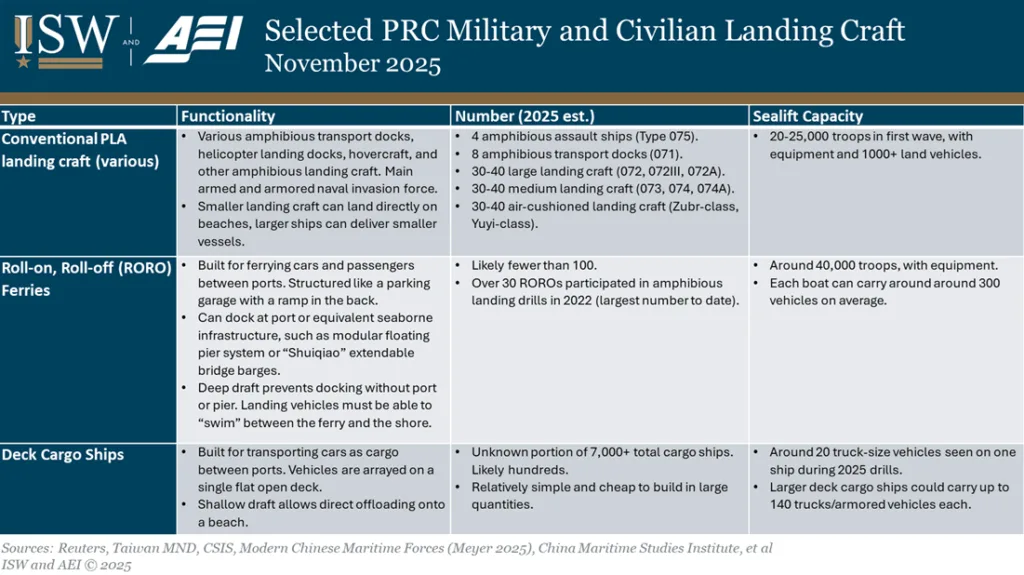
Reuters reported that PLA experimented with multiple types of civilian vessels in amphibious landing exercises in July and August 2025 to enhance its limited sealift capacity.[1] The exercise featured six roll-on, roll-off (RORO) ships and six deck cargo ships, both of which could support landing military vehicles at beaches. Satellite imagery from BlackSky Technology showed the cargo ships unloading vehicles onto a beach without using port facilities. The imagery also showed amphibious landing crafts approaching the beach. The PLA has used RORO ships to launch amphibious landing craft in past exercises, though the satellite imagery in this instance did not reveal which ships launched the craft.[2] The exercise separately included what Reuters assessed to be a self-propelled temporary pier system, which first debuted in 2021.
This activity reflects continued PRC preparations for a possible invasion of Taiwan. This is the first known instance of the PLA using civilian cargo ships to unload vehicles onto a beach in an exercise. The PRC debuted large barges with extendable piers that can offload vehicles and support amphibious landings in March 2025.[3]
The PLA has an estimated capacity to simultaneously move around 20,000 troops across the Taiwan Strait, which is well below the number that the PLA would require to invade Taiwan.[4] The PLA would likely need between 300,000 to over a million troops as well as their equipment in multiple waves of landings to seize control of Taiwan. Naval analyst Thomas Shugart estimated in 2022 that the PLA could increase its sealift capacity to 60,000 troops using RORO ships.[5] This estimate does not account for the other civilian vessels that could support an amphibious landing. CDOT-ISW cannot determine at this time exactly how many PRC commercial vessels could support amphibious operations. The PRC could likely expand its inventory of relevant civilian vessels further due to its immense shipbuilding industry.
Such civilian vessels are highly vulnerable, however, especially to the inexpensive, expendable weapons systems that Taiwan has prioritized acquiring. RORO and deck cargo ships do not have the same protection that the PLA vessels have. They will be especially vulnerable as they approach Taiwanese beaches, as they would enter the range of numerous short-range weapons systems and would be forced to cluster together due to the small number of viable landing sites in Taiwan. The sheer volume of civilian vessels that the PRC could deploy would still present a serious challenge to Taiwan, however, even if Taiwanese forces can destroy many of them.
Taiwan has focused on developing its drone capabilities in collaboration with foreign partners and establishing friendly supply chains to procure drones. Senior Taiwanese Foreign Affairs Ministry official Jiang Zhenwei announced on November 20 the establishment of a “drone diplomacy” initiative to bolster cooperation between the drone industries of Taiwan and partner countries. Jiang said that the initiative is meant to facilitate drone testing and training in Taiwan and deepen supply chain cooperation.[6] This comes after a senior Taiwanese delegation attended the Warsaw Security Forum in September 2025 to discuss growing defense cooperation between Taiwan and European states, especially regarding drones.[7]
Taiwan has separately worked to bolster its military resilience and readiness. Taiwanese officials inaugurated a new low-earth-orbit satellite training base on November 20. This helps Taiwan enhance communications redundancy, especially as the PRC has threatened to cut Taiwanese undersea cables.[8]
The Taiwanese National Defense Ministry separately announced sweeping command changes, which are likely part of Taiwanese President Lai Ching-te’s effort to modernize the Taiwanese military and increase defense spending. Taiwanese media reported that the command changes affected around 40 senior officers and three Army corps.[9] Liu Jen-yuan, who is currently the Presidential Strategic Adviser and former Air Force commander, will replace Pai Hung-hui as deputy national defense minister as well.[10]
Some personnel changes reflect the National Defense Ministry emphasis on convincing the Legislative Yuan (LY) to increase defense spending. The ministry filled the position of Public Relations Office director, which has been vacant for around a year and is responsible for interfacing between the ministry and LY.[11] Army Chief of Staff Lieutenant General Chen Chien-Yi stayed in his position unexpectedly, which is notable since he has been helping convince the LY to increase defense spending.[12]
The CCP has further escalated its pressure against Japan in response to Japanese Prime Minister Sanae Takaichi saying that a war over Taiwan could threaten Japanese security. The CCP is trying to coerce Takaichi into retracting her statement and deter other countries from tying their security to that of Taiwan. The PRC postponed a trilateral summit with the Japanese and South Korean cultural ministers in Macao that was scheduled for November 24 and blamed Takaichi for the diplomatic tensions.[13] PRC authorities and private organizers have separately cancelled or postponed several Japanese movies and concerts featuring Japanese artists.[14] PRC Premier Li Qiang refused to meet with Takaichi on the sidelines of the G20 summit in Johannesburg from November 22 to 23 despite Japanese officials expressing openness to bilateral engagement.[15] The PRC Foreign Affairs Ministry spokesperson said that Takaichi must retract her statement as a prerequisite to dialogue.[16] This activity comes as the CCP has imposed other forms of diplomatic, military, and economic pressure on Japan in recent days.[17]
The CCP has suggested that it could impose further pressure unless Takaichi retracts her statement. The PRC Commerce Ministry threatened additional economic measures.[18] The PRC embassy in Japan posted on X on November 21 that it has the right to take military action against Japan without United Nations Security Council approval, citing the enemy state clauses of the UN Charter.[19] The embassy ignored the fact that the UN General Assembly determined that the enemy state clauses were obsolete in 1995.[20] Such rhetoric is meant to intimidate Tokyo rather than an indication that the PRC is preparing to attack Japan.
The CCP coercion of Japan could undermine US influence in the Indo-Pacific. The CCP seeks to demonstrate its ability to impose tremendous pressure on states that align with the United States and Taiwan. This pressure could impede US efforts to build a coalition of partners that promote regional stability and constrain PRC aggression. The CCP may be emboldened to use coercion more aggressively against the United States and its regional partners in the future if it concludes that its pressure against Japan has been effective.
PRC state media signaled support for independence movements on Japan’s Ryukyu islands as part of the CCP coercion of Tokyo. The state-run Global Times published an editorial on November 19 arguing for “Ryukyu Studies” at PRC universities, noting that Fujian Normal University recently launched the first-ever Ryukyu Studies program in the PRC.[21] The op-ed called on the state to include such studies in its “endangered disciplines” program, which is an initiative to promote declining academic fields across the country. The op-ed emphasized the historical connection between the PRC and Ryukyu islands and rejected Japanese control of the territory.[22] The op-ed also suggested that the United States and Japan are preparing to involve the Ryukyu islands in a potential military conflict against the PRC.[23] Another PRC outlet framed the discussion about the independence of the Ryukyu islands as connected to Takaichi’s comments about Taiwan.[24]
This PRC rhetoric threatens Japanese sovereignty and may be part of a long-term effort to erode Japanese control of the Ryukyu islands. PRC officials and state media have long questioned Japanese control of the islands during previous periods of heightened tensions between Beijing and Tokyo. Nevertheless, PRC universities launching Ryukyu Studies programs could set informational conditions, especially legal conditions, over the long term for the CCP to undermine Japanese territorial integrity and fuel secessionist sentiments on the archipelago. The PRC has previously used historical maps and archeological evidence from past Chinese polities to support legal arguments for its claims to disputed features in the South China Sea.[25] That could in turn jeopardize the US military position in the Indo-Pacific, as the United States maintains a significant force presence at Okinawa in the Ryukyu islands.[26] Recent polls indicate that around 70 percent of Okinawans are dissatisfied with the heavy US military presence there but only around three percent support independence from Japan.[27]
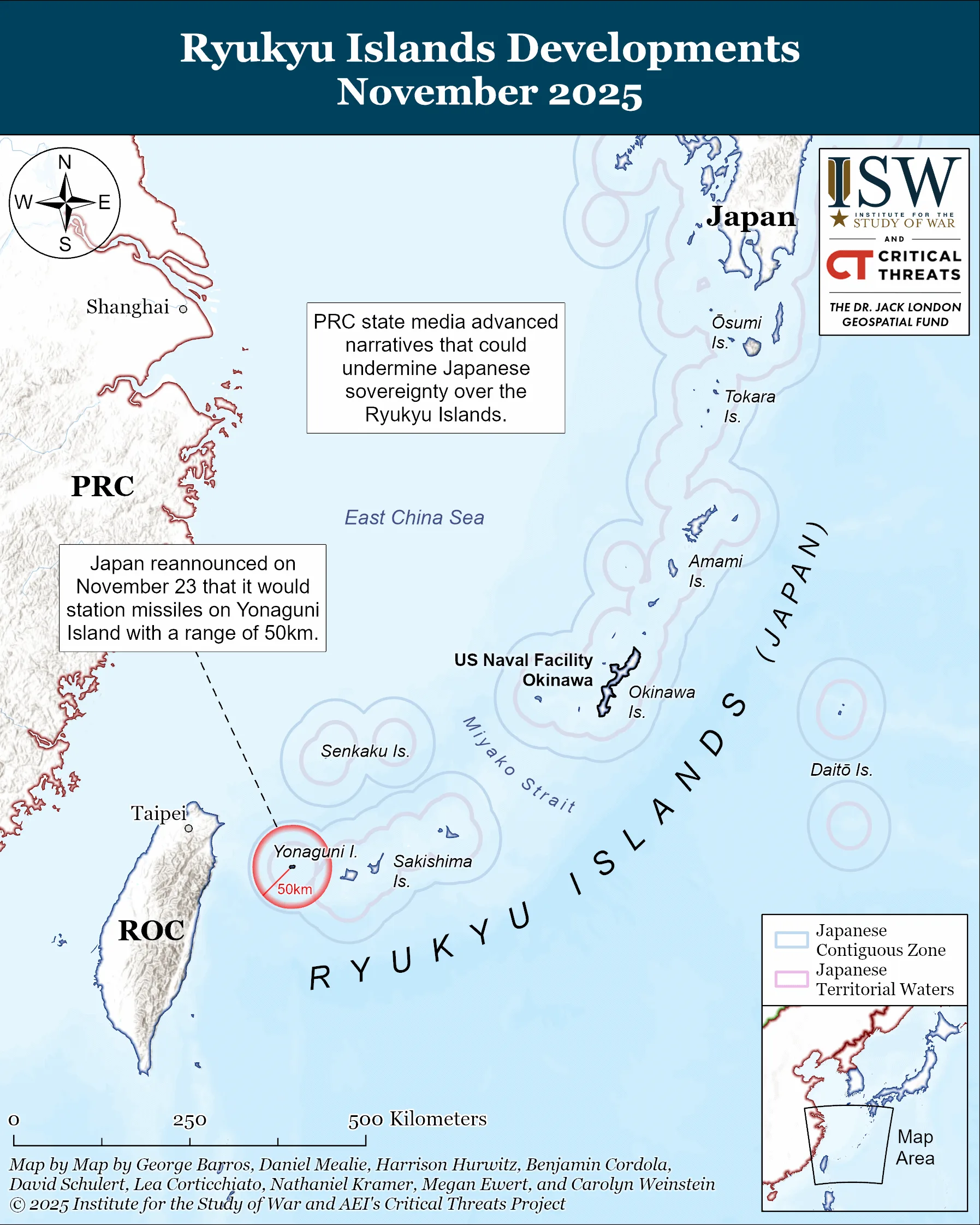
The PRC expressed objections to Japan’s export and deployment of missiles. Japan exported domestically produced Patriot surface-to-air missile interceptors to the United States for the first time since Japan loosened export restrictions in 2023.[28] Japan was only permitted to export components of foreign-licensed defense products prior to the 2023 revision. The United States requested the export to replenish its stockpile, which was used to provide systems to Ukraine. Japanese Defense Minister Shinjiro Koizumi also confirmed that Japan will advance plans to deploy medium-range surface-to-air missiles to Yonaguni Island, which is 110 kilometers east of Taiwan.[29] Plans to deploy Type 03 Chu-SAMs were originally proposed by former Defense Minister Gen Nakatani in January 2025, which will further reinforce Japan’s southwestern islands.[30]
Foreign Affairs Ministry spokesperson Mao Ning accused Japan of accelerating its rearmament by exporting offensive weapons and seeking to facilitate nuclear technology sharing.[31] Mao claimed that right-wing forces in Japan are violating the pacifist constitution.[32]
Key Takeaways
- PLA modernization: The PLA experimented with using civilian vessels in an amphibious landing exercise in August 2025 to enhance its limited sealift capacity. Such civilian vessels are highly vulnerable, especially to the weapon systems that Taiwan has prioritized acquiring.
- Taiwanese defense: Taiwan has focused on developing its drone capabilities in collaboration with foreign partners and establishing friendly supply chains. Taiwan has separately worked to bolster its military resilience and readiness.
- PRC-Japan tensions: The CCP has further escalated against Japan in response to Japanese Prime Minister Takaichi saying that a war over Taiwan could threaten Japanese security. The CCP is trying to deter Japan and others from tying their security to that of Taiwan.
- PRC-Japan tensions: PRC state media signaled support for independence movements on Japan’s Ryukyu islands as part of the CCP coercion of Tokyo. This PRC rhetoric threatens Japanese sovereignty and may be part of an effort to erode Japanese control there.
Cross-Strait Relations
Taiwan
The Taiwan High Prosecutors’ Office on November 18 indicted a PRC national and six retired or active-duty Taiwanese military personnel for spying on behalf of the CCP and providing classified information to the PRC.[33] The Taiwan Ministry of Justice Investigation Bureau noted that this is the first case since 2015 that an individual from the PRC personally traveled to Taiwan to develop the intelligence networks as opposed to remotely working with local collaborators.[34] These charges carry a minimum sentence of five years in prison.[35] The PRC national, Ding Xiaofu, is from Hong Kong and traveled to Taiwan on behalf of the Nanning Work Station of the Political Department of the PLA Central Military Commission to develop a network of informants to collect classified information and spy on the Taiwanese military.[36] Ding first recruited the retired Lieutenant Colonels Wang Wenhao and Tan Chunming, then recruited active-duty personnel: Seargeant Major Lu Fang-chi, Major Staff Officer Yang Pochih, Yang’s sister Lieutenant Personnel Officer Yang Chienhui, and Yang’s brother-in-law Major Control Officer Chiu Hanlin.[37] More than 11.12 million NT dollars, or about 356,444 US dollars, were transferred to Taiwan to fund the operation.[38] Recruits were paid based on the value of each piece of intelligence..[39] The PRC MFA declined to comment on this case when asked. PRC espionage efforts undermine Taiwanese sovereignty and reduce trust within the Taiwanese populace about the effectiveness of its military.
The US Senate introduced the Six Assurances to Taiwan Act on November 20, which would codify long-standing US commitments to Taiwan. This Act further solidifies bipartisan US Congressional support for Taiwan and may improve Taiwanese perceptions of US support for Taiwan.[40] The Six Assurances are a series of semi-official commitments made by the Ronald Reagan administration to Taiwan in 1982, following a US-PRC joint communique linking the possibility of reducing US arms sales to Taiwan with PRC commitments to a peaceful resolution of the “Taiwan issue.”[41] The Six Assurances Act would ensure that subsequent administrations cannot alter the assurances without Congressional approval. The Six Assurances stipulate that:
- The United States did not set a date for ending arms sales to Taiwan
- The United States did not agree to consult with the PRC on arms sales to Taiwan
- The United States will not act as a mediator between the PRC and Taiwan
- The United States did not agree to revise the Taiwan Relations Act (TRA)
- The United States did not take any position on Taiwanese sovereignty
- The United States will not pressure Taiwan to negotiate with the PRC[42]
The US House Foreign Affairs Committee (HFAC) advanced the Six Assurances to Taiwan Act to a vote on September 18.[43] The US House of Representatives has not voted on this Act as of the time of writing. The House’s and Senate’s bills garnered strong bipartisan support and reflected continued Congressional objectives to provide material and political aid to Taiwan amid PRC aggression. The codification of the Six Assurances, while unlikely to change the current US posture or policy towards Taiwan, would make it more difficult for administrations to change US Taiwan policy. Taiwan’s opposition Kuomintang (KMT) and the PRC have been working to spread “America skepticism” throughout Taiwan, suggesting that US support for Taiwan is unreliable and contingent upon Taiwanese purchases of US weapons.[44] The codification of the Six Assurances and other pro-Taiwan policies symbolizes continued US support and may lead to a reduction in American skepticism within Taiwan.
China
The People’s Liberation Army Navy’s newest aircraft carrier Fujian conducted its first live-fire training since its November 5 commissioning. The training illustrated the potential structure of Fujian’s carrier task group and suggests a primarily anti-submarine configuration. The state-run PLA Daily reported that Fujian conducted the training alongside other Southern Theater Command (STC) Navy vessels on November 18.[45] The training included the launch of the J-35, J-15T, and J-15DT fighter aircraft and the EJ-600 airborne early warning aircraft.[46] Fujian is the only PLA aircraft carrier capable of launching large aircraft like the EJ-600, providing Fujian and its carrier task group with enhanced survivability on the open ocean.[47]
Fujian conducted the training alongside STC vessels Yan’an and Tongliao.[48] Yan’an is a Type-055 Renhai-class guided missile destroyer (DDG) and Tongliao is a Type-054A guided missile frigate (FFG).[49] Their inclusion in the exercises suggests that these types of vessels could form key components of Fujian’s carrier task group in future out-of-area deployments. The Type-055 DDG is designed for long-range missions due to its 7,000 nautical mile range that surpasses the US Navy’s Arleigh Burke-class DDG.[50] The Type-055 DDG would likely perform an escort role for Fujian due to its advanced radar, towed array active sonar, and anti-submarine capabilities, along with its ship-based armament of 112 vertical launch system cells that can fire surface-to-air missiles, anti-ship missiles, and land attack cruise missiles.[51] The Type-054A FFG would likely perform a screening role for Fujian and its destroyer complement, focusing on anti-submarine and anti-air operations to improve the survivability of the PLA’s larger vessels.[52] Tongliao is an upgraded version of the Type-054A equipped with an active sonar towed array that is more effective at pinpointing the exact location of undersea objects, such as US nuclear submarines, than other ships in its class equipped with passive sonar.[53] Combined training between Fujian, Yan’an, and Tongliao indicates that Fujian’s carrier task group will likely divide responsibility between the three different types of vessels, which minimizes Fujian’s vulnerability to undersea systems.
The structure of Fujian’s task group suggests the PLA may use it to offset US advantages in undersea warfare. The US Navy has a significant advantage in the stealth, range, and number of its nuclear submarines that pose a significant challenge to any PLAN effort to operate in the far seas during wartime.[54] The Hudson Institute, a US think tank, detailed how the PRC has aimed to insulate its near seas from undersea penetration through seabed sensors and modern corvettes designed for undersea detection and strikes within the PRC’s immediate waters.[55] These measures would not diminish the US’s undersea advantage in areas far from the PRC mainland, such as its critical sea lines of communication (SLOCs) in the Indian Ocean, however. The configuration of Fujian’s task group may allow it to defend these vulnerable SLOCs from undersea interdiction.
US President Donald Trump and CCP General Secretary Xi Jinping spoke by phone on November 24.[56] The PRC MFA stated that Xi highlighted the positive progress in US-PRC relations since the pair met in South Korea in October and that the two countries should maintain this momentum. Xi emphasized that Taiwan’s “return to China” is an important part of the post-Second World War international order, which the United States and China fought together against militarism and fascism.[57]
Trump focused on the success of bilateral trade negotiations, including the benefits for American farmers.[58] Trump stressed that the US-PRC relationship was strong because of the November 1 agreement to reduce tariffs, and stated that he would travel to Beijing in April 2026 at Xi’s invitation.
Xi’s emphasis on Taiwan comes amid a downturn in Japan-PRC relations following Japanese Prime Minister Sanae Takaichi’s suggestion that Japan could deploy its military against the PRC if it attempted to invade Taiwan. Continued deterioration in Japan-PRC relations over Taiwan could complicate US-PRC relations and derail cooperation over trade issues. The timing and focus of the call could signal the PRC’s intent to influence the United States to cede support for Taiwan and/or Japan out of a desire to preserve relations with the PRC in the near term. Trump and Takaichi spoke by phone on November 24, hours after Trump’s phone call with Xi. Takaichi stated that the two discussed a range of issues, including US-PRC relations and the phone call between Trump and Xi.[59]
Northeast Asia
Japan
See Topline Section
South Korea
The Lee Jae Myung administration co-sponsored a UN resolution on November 19 to condemn North Korea’s human rights violations.[60] The Lee administration joined the UN General Assembly (UNGA) Third Committee’s resolution to express concern over North Korea’s human rights situation along with 61 other members. The resolution voiced concerns about North Korea’s human rights abuses and its continued development of illegal nuclear weapons and missiles.[61] The UN first introduced the resolution in 2003 at the Commission on Human Rights and has placed it on the UNGA’s regular agenda since 2005. North Korea has not issued an official response to this year’s resolution, but Pyongyang released a statement criticizing the 2024 resolution as a “political provocation.”[62] South Korea abstained from the resolution between 2003 and 2005 and again in 2007. The Moon Jae-in administration also abstained from 2019 to 2022 to prioritize inter-Korean dialogue and relationship-building.[63]
The Lee administration’s decision to join the resolution signals the divergence between Lee’s approach on North Korea and that of the previous progressive administration. South Korea’s previous progressive administrations set dialogue with the North as a “core policy.” The Lee administration appears to maintain a two-track approach that responds firmly to North Korea’s illicit actions while keeping the door open for dialogue. Lee emphasized that Seoul must continue to pursue dialogue with Pyongyang to ease tensions at a November 24 press conference.[64]

[1] https://www.reuters.com/graphics/USA-CHINA/TAIWAN-INVASION/zjpqdekmlvx/
[2] https://news.usni.org/2022/09/28/chinese-launch-assault-craft-from-civilian-car-ferries-in-mass-amphibious-invasion-drill-satellite-photos-show
[3] https://understandingwar.org/research/china-taiwan/china-taiwan-weekly-update-march-27-2025/
[4] https://www.reuters.com/graphics/USA-CHINA/TAIWAN-INVASION/zjpqdekmlvx/
[5] https://warontherocks.com/2022/10/mind-the-gap-part-2-the-cross-strait-potential-of-chinas-civilian-shipping-has-grown/
[6] https://www.cna.com dot tw/news/aipl/202511200395.aspx
[7] https://understandingwar.org/research/china-taiwan/china-taiwan-weekly-update-october-10-2025/
[8][8] https://globaltaiwan.org/2025/06/taiwans-digital-vulnerabilities/
[9] https://def.ltn.com dot tw/article/breakingnews/5252049
[10] https://www.chinatimes dot com/realtimenews/20251120002689-260407?chdtv
[11] https://www.storm dot mg/article/11082672
[12] https://udn dot com/news/story/10930/9153233?from=udn-catebreaknews_ch2
[13] https://www3.nhk.or dot jp/nhkworld/en/news/20251120_19/
[14] https://www.cnbc.com/2025/11/21/china-is-abruptly-canceling-japanese-music-concerts-as-tensions-simmer.html?msockid=09f1f7538b4e6ea80f75e24c8f4e60ab
[15] https://www.msn.com/en-xl/news/other/no-japan-china-talks-held-at-g20-takaichi-gets-fresh-warning-from-beijing/ar-AA1QZQ1E?ocid=BingNewsSerp
[16] https://www.mfa.gov dot cn/web/wjdt_674879/fyrbt_674889/202511/t20251124_11758881.shtml
[17] https://www.aei.org/articles/china-taiwan-update-november-21-2025/
[18] https://www.mofcom.gov dot cn/xwfbzt/2025/swbzklxxwfbh2025n11y20r/index.html
[19] https://www.globaltimes dot cn/page/202511/1348768.shtml ; https://legal.un.org/repertory/art53.shtml ; https://legal.un.org/repertory/art77.shtml ; https://legal.un.org/repertory/art107.shtml
[20] https://docs.un.org/en/A/RES/50/52
[21] https://www.globaltimes dot cn/page/202511/1348542.shtml
[22] https://www.globaltimes dot cn/page/202511/1348542.shtml
[23] https://www.globaltimes dot cn/page/202511/1348542.shtml
[24] https://www.scmp dot com/news/china/diplomacy/article/3333468/chinese-state-media-calls-more-research-ryukyu-history-amid-row-japan
[25] https://www.rfa.org/english/news/afcl/afcl-cctv-south-china-sea-07042024025123.html ; https://asiatimes dot com/2018/04/for-weekend-chinas-new-map-aims-to-extend-south-china-sea-claims/
[26] https://www.voanews.com/a/in-japan-s-okinawa-china-tensions-prompt-changing-views-of-us-military-bases/7263357.html
[27] https://www.dw.com/en/okinawans-split-over-whether-us-bases-are-worth-the-burden/a-72598323 ; https://web.archive.org/web/20230416145308/https://www.okinawatimes.co.jp/articles/-/956771
[28] https://english.kyodonews dot net/articles/-/65236
[29] https://www.mod.go dot jp/j/press/kisha/2025/1123a_r.html
[30] https://www.msn.com/en-us/politics/international-relations/japan-reaffirms-plan-to-deploy-missiles-to-island-near-taiwan/ar-AA1R0u7D?ocid=BingNewsSerp
[31] https://www.mfa.gov dot cn/web/wjdt_674879/fyrbt_674889/202511/t20251121_11757685.shtml
[32] https://www.mfa.gov dot cn/web/wjdt_674879/fyrbt_674889/202511/t20251124_11758881.shtml
[33] https://www.mjib dot gov.tw/news/Details/1/1141
[34] https://www.mjib dot gov.tw/news/Details/1/1141
[35] https://www.taipeitimes dot com/News/taiwan/archives/2025/11/19/2003847474
[36] https://www.mjib dot gov.tw/news/Details/1/1141
[37] https://tw.news.yahoo dot com/%E4%B8%81%E5%B0%8F%E7%90%A5%E5%85%B1%E8%AB%9C%E7%B5%84%E7%B9%94%E6%A1%88-%E9%AB%98%E9%99%A2%E8%AB%AD%E4%BB%A47%E4%BA%BA%E7%BA%8C%E6%8A%BC3%E6%9C%88-%E6%A5%8A%E5%8D%83%E6%85%A7%E7%A6%81%E8%A6%8B%E8%A7%A3%E9%99%A4-141931475.html
[38] https://focustaiwan dot tw/society/202511180020
[39] https://news.ltn dot com.tw/news/society/breakingnews/5250460
[40] https://www.congress.gov/bill/119th-congress/senate-bill/3208/text
[41] https://www.ait.org.tw/u-s-prc-joint-communique-1982/
[42] https://www.congress.gov/crs-product/IF11665
[43] https://focustaiwan dot tw/politics/202509190013; https://understandingwar.org/research/china-taiwan/china-taiwan-weekly-update-september-26-2025/
[44] https://www.pf.org dot tw/tw/pfch/12-11138.html
[45] http://www.81 dot cn/yw_208727/16422681.html
[46] http://www.81 dot cn/yw_208727/16422681.html
[47] https://understandingwar.org/research/china-taiwan/china-taiwan-weekly-update-september-22-2025/
[48] http://www.81 dot cn/yw_208727/16422681.html
[49] https://www.oni.navy.mil/Portals/12/Intel%20agencies/China_Media/2024_Recce_Poster_PLAN_Navy__U__new2.jpg?ver=gLEmUaAtttQXpV9cL9g7YA%3d%3d
[50] Manfred Meyer, Modern Chinese Maritime Forces, Second Edition, 12.
[51] Manfred Meyer, Modern Chinese Maritime Forces, Second Edition, 12-13.
[52] https://www.naval-technology.com/projects/type-054a-jiangkai-ii-class-frigate/?cf-view
[53] https://www.usff.navy.mil/Community-Outreach/US-Navy-Stewards-of-the-Sea/Science-of-Sound/; https://odin.tradoc.army.mil/WEG/Asset/Type_054A_Class_(Jiangkai_II_Class)_Chinese_Frigate
[54] https://www.hudson.org/fighting-bastions-getting-noisier-sustain-us-undersea-advantage-submarine-bryan-clark-timothy-walton
[55] https://www.hudson.org/national-security-defense/submarines-will-not-solve-americas-eroding-undersea-advantage
[56] http://www.news dot cn/politics/leaders/20251124/9c9191096e0547a9a3f26e903fc6995e/c.html
[57] https://www.mfa dot gov.cn/zyxw/202511/t20251124_11759124.shtml
[58] https://truthsocial.com/@realDonaldTrump/posts/115605897178712132
[59] https://japan.kantei.go.jp/103/statement/202511/25kaiken.html
[60] https://ng.mofa.go dot kr/www/brd/m_4080/view.do?seq=376672&srchFr=&srchTo=&srchWord=&srchTp=&multi_itm_seq=0&itm_seq_1=0&itm_seq_2=0&company_cd=&company_nm=&pitem=10
[61] https://www.nknews.org/2025/11/un-committee-adopts-resolution-on-north-korean-human-rights-with-us-support/
[62] https://kcnawatch.org/newstream/1731056541-583103251/%EC%9C%A0%EC%97%94%EC%A3%BC%EC%9E%AC-%EC%A1%B0%EC%84%A0%EB%AF%BC%EC%A3%BC%EC%A3%BC%EC%9D%98%EC%9D%B8%EB%AF%BC%EA%B3%B5%ED%99%94%EA%B5%AD-%EC%83%81%EC%9E%84%EB%8C%80%ED%91%9C%EB%B6%80-%EA%B3%B5/
[63] https://www.humanrights.go dot kr/site/program/board/basicboard/view?menuid=001003001003004&boardtypeid=17&boardid=7608711; https://biz.chosun dot com/international/international_general/2025/11/20/UXA6JCC4UZHEROBPNPMGIJ36XE/
[64] https://news.jtbc.co dot kr/article/NB12272246?influxDiv=NAVER