
Toplines
The 2025 US National Security Strategy (NSS) deprioritizes the Indo-Pacific compared to previous NSSs and places economics at the center of the US-PRC relationship. The document, which the United States published on December 4, explicitly identifies the Western Hemisphere as the top priority, with Asia listed second. It focuses significantly less on strategic competition with the PRC compared to earlier iterations, including those under the first Trump administration and Biden administration.[1] It mentions the importance of preventing incursions by “non-Hemispheric competitors” into the Western Hemisphere, however, likely a reference to the PRC and other major US adversaries. The Asia section of the NSS focuses almost exclusively on the PRC and frames economics as the “ultimate stakes” in the relationship.[2] It stresses the importance of “rebalancing” the US-PRC trade relationship while maintaining a mutually beneficial economic relationship. It does not mention the PRC as a systemic challenger to the United States, however, which Beijing may interpret as a shift away from US-PRC competition.
The NSS broadly maintains continuity with past US policy on Taiwan and Indo-Pacific security. It emphasizes the importance of continued geopolitical and economic engagement in the region. It also prioritizes deterring conflict in the Taiwan Strait, “ideally by military overmatch,” and building US and allied capacity to counter a Taiwan invasion. It maintains what it calls the longstanding US declaratory policy on Taiwan, defined as “the United States does not support any unilateral change to the status quo in the Taiwan Strait.” This wording differs slightly from the Biden administration’s equivalent statement, softening the language from “oppose[s]” to “does not support” and omitting an explicit reference to the US non-support of Taiwanese independence.[3] The 2025 NSS frames the significance of Taiwan in terms of its location in the First Island Chain and its semiconductor industry.
The PRC Ministry of Foreign Affairs responded to the NSS on December 8 with a generic objection to the language on Taiwan while welcoming economic cooperation.[4] It reiterated its position that Taiwan is part of the PRC and a “red line” in US-PRC relations. It denied that there was any issue of “either side taking advantage of each other” economically and said that economic and trade cooperation should be the “ballast and engine” of US-PRC relations.
The NSS calls for US allies and partners to contribute more to collective security in the Indo-Pacific. The NSS includes “burden-sharing and burden-shifting” as one of its core principles.[5] The Asia section calls for Indo-Pacific countries, including Japan, South Korea, Australia, and Taiwan, to spend more on defense and contribute more to collective security. It also called for greater contributions from India to Indo-Pacific security. The document does not mention the Philippines, even though it stresses the importance of regional collaboration and deterrence to prevent a “potentially hostile power” from restricting passage through the South China Sea. The Philippines is the only US treaty ally in the South China Sea and the main target of PRC coercion over territorial disputes in the region. The NSS also called for wealthier US allies and partners to use their trade policies to “help rebalance China’s economy toward household consumption.”
US President Donald Trump has permitted Nvidia to export its advanced H200 semiconductors to the PRC, which will enable the PRC to significantly reduce the artificial intelligence (AI) gap with the United States and possibly enhance its military effectiveness. Trump announced the decision on December 8 and said that CCP General Secretary Xi Jinping responded “positively.”[6] US think tank Institute for Progress assessed that the H200 is approximately six times as powerful as the H20, previously the most advanced chip the United States exported to the PRC. Trump allowed Nvidia to export the H20 to the PRC in July 2025 after initially banning it. The H200 is only outclassed by Nvidia’s newest “Blackwell” chip, which is approximately 2.5 times as powerful as the H200.[7] The most advanced PRC-made chips can already outperform the H20 but not the H200.[8] The United States has restricted advanced chip sales to the PRC due to their critical role in training AI models that the PRC could use to surpass US AI capabilities.[9] The NSS highlights US advantages in innovation and emerging technology, such as AI, as crucial to the goals that the strategy seeks to realize.[10] Nvidia CEO Jensen Huang and other proponents of relaxing US semiconductor export restrictions argue that exporting advanced chips will improve US chipmaking capabilities and make the PRC reliant on US semiconductors.[11]
The People’s Liberation Army (PLA) will likely try to benefit from the importation of H200 chips, as it places significant emphasis on using AI to support operations and training.[12] The Wall Street Journal reported on December 9 that the H200 chips will undergo a “national security review” before exportation, but it is unclear how, or if, this would prevent their use in PRC AI development.[13]
The CCP has worked since 2014 to build its own chip industry and reduce its reliance on foreign supply chains and will very likely continue these efforts regardless of whether the United States exports the H200. The Cyberspace Administration of China (CAC) previously banned imports of the H20 and RTX Pro 6000D processors after US Commerce Secretary Howard Lutnick said in July 2025 that the United States aimed to make the PRC “addicted” to US semiconductor technology.[14] PRC tech company Huawei announced in September 2025 that it aimed to triple its domestic chip production in 2026.[15] PRC-produced semiconductors remain inferior to the most advanced US products, however.[16] The PRC views overreliance on US advanced semiconductors as a security risk and will continue to work toward self-sufficiency where it can.
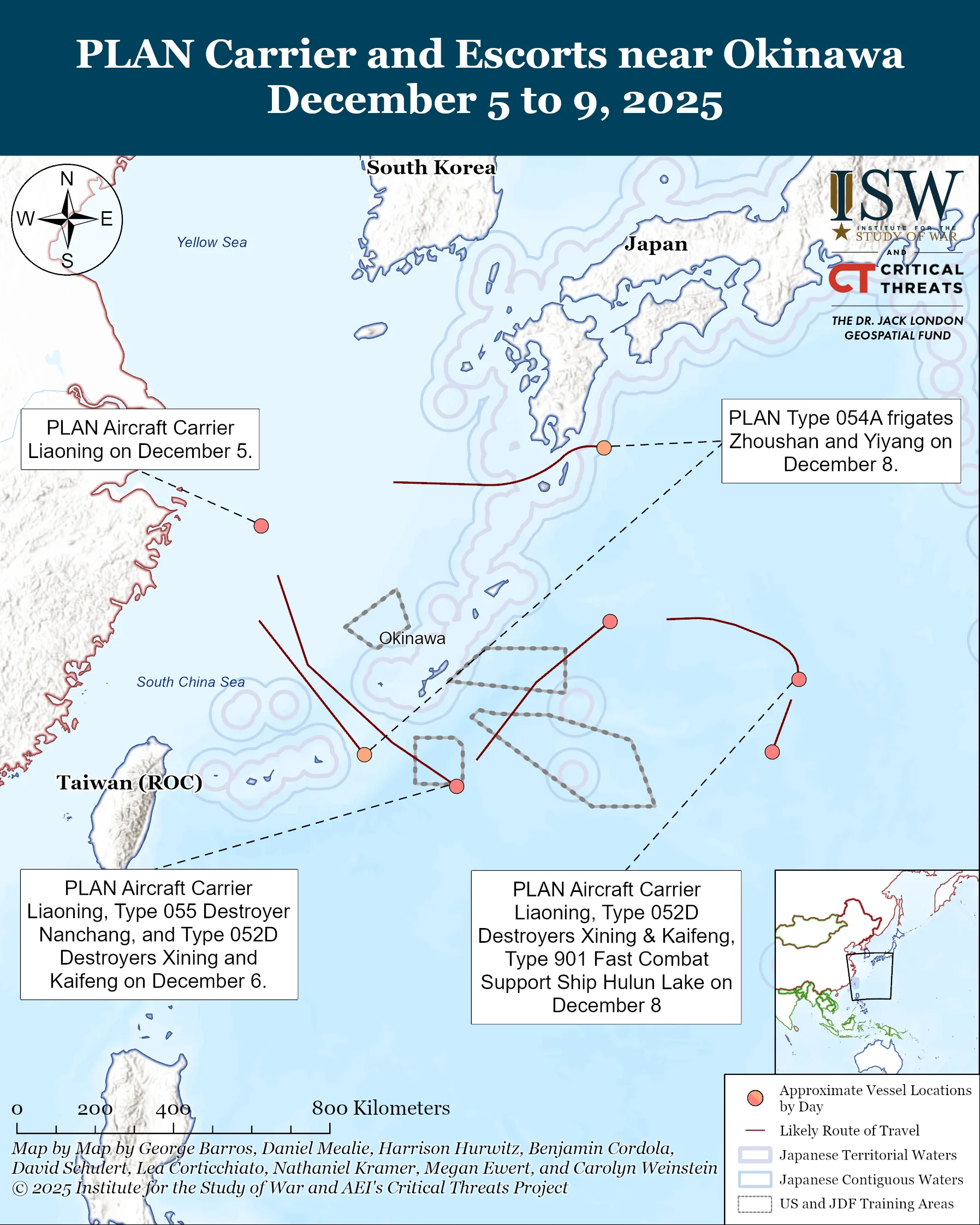
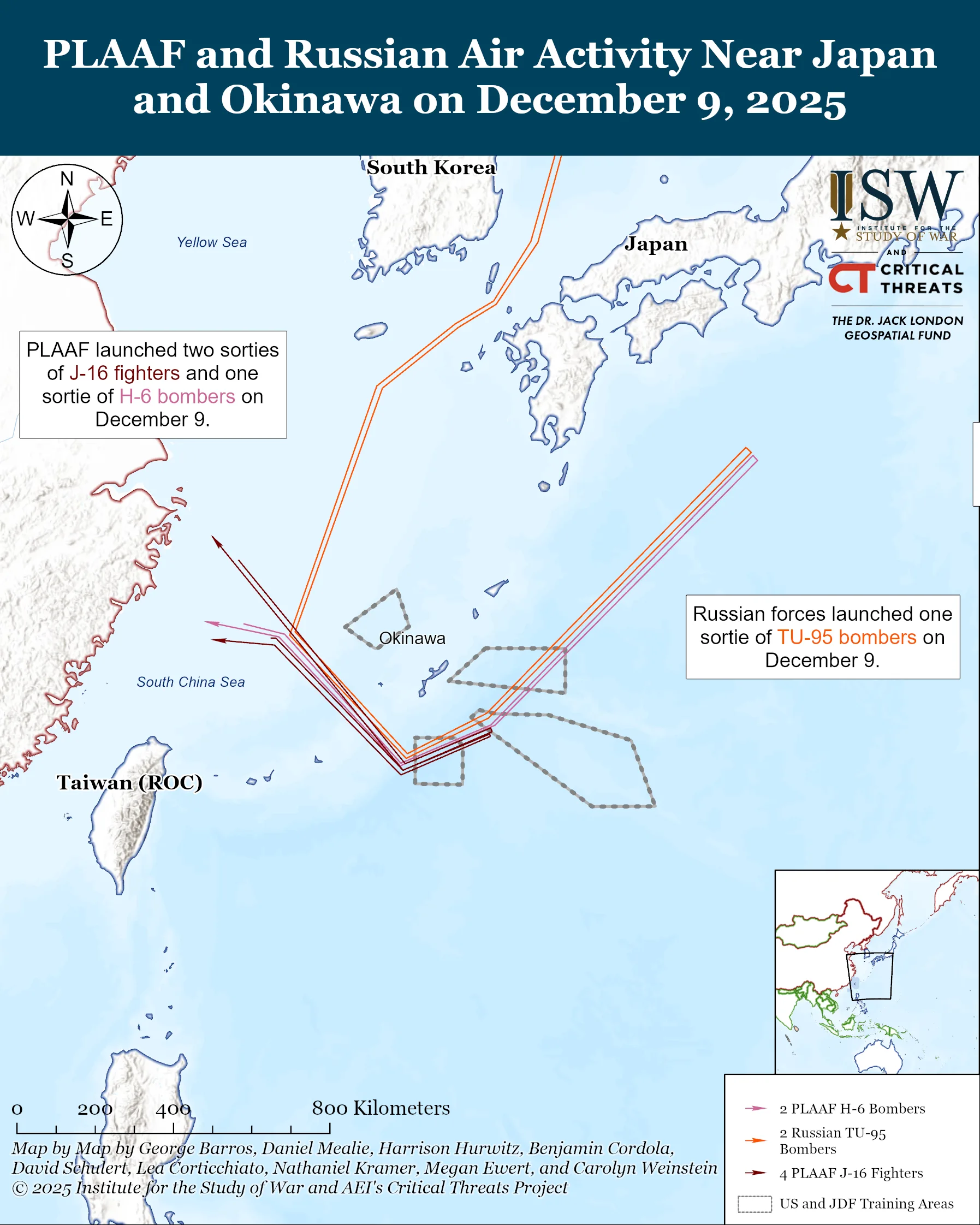
The PRC increased military activities around Japan as part of its intensifying coercion of Japan. The PLA Navy Type 001 aircraft carrier Liaoning has operated in the waters near the Okinawa Islands since December 5.[17] This is the fifth time a PLA carrier task group has operated beyond the First Island Chain in 2025.[18] Liaoning conducted approximately 50 launch and recovery cycles on December 6 and 7.[19] The Japan Air Self-Defense Force (JASDF) scrambled F-15 fighter aircraft in response. The Japan Ministry of Defense reported that a J-15 fighter aircraft launched from Liaoning locked its radar onto Japanese fighters twice on December 6 over international waters near Okinawa.[20] The radar lock-ons lasted approximately three minutes and 30 minutes, respectively. Two additional PLA Type 052D frigates sailed between Japanese islands toward the West Pacific on December 8.[21] Two PLA Air Force H-6 bombers and eight J-16 fighter aircraft also operated in the area and were joined by two Russian Tu-95 bombers on December 9.[22] The PLA frequently operates in the vicinity of Okinawa but rarely locks its radars on responding Japanese forces. The Japan Ministry of Defense criticized the lock-ons and summoned PRC Ambassador to Japan Wu Jianghao to lodge a formal protest.[23] The Liaoning task group also sailed through three US military and JSDF training zones for which the Japan Coast Guard had previously issued navigational warnings.[24] The PRC Ministry of Foreign Affairs and Ministry of National Defense insisted that Liaoning’s activities were fully compliant with international law and practice.[25] PRC officials dismissed Japan’s protest and accused JASDF aircraft of harassing the PLA.[26]Japan’s Ministry of Defense confirmed on November 24 that it will continue with its plans to deploy surface-to-air missiles on Yonaguni Island, located approximately 110km east of Taiwan, despite PRC protests.[27] The ministry announced on December 4 that it also plans to deploy an electronic warfare air defense unit on Yonaguni Island in 2026.[28] PRC state media Global Times released images showing the construction of military facilities on Mageshima Island, Japan’s second-largest uninhabited island.[29] The article noted that the construction may indicate Japanese intention to militarily intervene in a Taiwan contingency and framed the constructions on uninhabited islands as a replication of its militarist strategy during World War II.[30] The PRC has recently sought to undermine Japanese sovereignty over the Ryukyu Islands–the archipelago that includes Yonaguni, Mageshima, and Okinawa.[31] The PRC’s informational warfare and military activities around Japan are part of a broader, multi-pronged coercion effort that likely aims to continue pressure Japan until Takaichi retracts her remarks and to deter other countries from expressing support for Taiwan.[32] It is unlikely that Takaichi will retract her remarks, however.

Key Takeaways
- US-PRC relations: The 2025 US National Security Strategy deprioritizes the Indo-Pacific compared to previous iterations and places economics at the center of the US-PRC relationship. The strategy broadly maintains continuity with past US policy vis-à-vis Taiwan and regional security.
- US-PRC relations: US President Trump has permitted Nvidia to export its advanced H200 chip to the PRC, which will enable the PRC to significantly reduce the AI gap with the United States and possibly enhance its military effectiveness. The CCP will likely still try expanding its own chip industry and reducing its reliance on foreign supply chains.
- PRC-Japan tensions: The PLA deployed a carrier task group to the waters around Okinawa as part of its intensifying coercion of Japan. The CCP is trying to deter Japan from intervening in a war over Taiwan and other countries from explicitly tying their own security to that of Taiwan.
Cross-Strait Relations
Taiwan
Taiwanese National Security Bureau Director General Tsai Ming-yen said that eight countries made twelve transits of the Taiwan Strait as of December 3. Director General Tsai identified the United States, United Kingdom, France, Canada, Japan, Australia, New Zealand, and Vietnam.[33] Taiwan Strait transits by foreign militaries are often freedom of navigation operations (FONOPs) to assert navigation rights in international waters in opposition to PRC assertions of jurisdiction and control over the Taiwan Strait. The Vietnam transit is notable in that Vietnam is not a US ally unlike the other states listed. The Vietnamese government did not issue any official statements, and there was no public PRC government response to the transit, even though it typically denounces FONOPs. This suggests that the transit may not have been a FONOP and could potentially be attributed to PRC-Vietnam naval exchanges in Qingdao on December 1.[34]
Below is a table of all Taiwan Strait transits in 2025. US transits have notably decreased—there were 15 in 2020 and only three in 2025 so far.
| Transit Date | Country/Countries | Ship Name(s) | Ship Type(s) |
|---|---|---|---|
| February 5 | Japan | JS Akizuki | Destroyer |
| February 10–12 | United States | USS Ralph Johnson and USNS Bowditch | Destroyer and Survey Ship |
| February 16 | Canada | HMCS Ottawa | Frigate |
| April 23 | United States | USS William P. Lawrence | Destroyer |
| June 12 | Japan | JS Takanami | Destroyer |
| June 18 | United Kingdom | HMS Spey | Offshore Patrol Vessel |
| September 6–7 | Canada | HMCS Ville de Quebec | Frigate |
| September 6–7 | Australia | HMAS Brisbane | Destroyer |
| September 12 | United States | USS Higgins | Destroyer |
| September 12 | United Kingdom | HMS Richmond | Frigate |
| November 5 | New Zealand | HMNZS Aotearoa | Oiler |
| Late 2025 | Vietnam | Unknown | Unknown |
February 5: https://japannews.yomiuri.co.jp/politics/defense-security/20250302-241168/
February 10–12: https://www.reuters.com/world/us-navy-confirms-routine-taiwan-strait-transit-2025-02-12/
February 16: http://www.81 dot cn/yw_208727/16369894.html
April 23: https://www.reuters.com/world/asia-pacific/chinas-military-says-monitored-us-warship-transiting-taiwan-strait-2025-04-24/
June 12: https://asia.nikkei.com/politics/defense/japan-destroyer-sails-through-taiwan-strait-after-china-jet-approach
June 18: https://www.reuters.com/world/china/china-condemns-british-warships-troublemaking-taiwan-strait-transit-2025-06-20/
September 6–7: https://www.reuters.com/world/china/china-criticises-canadian-australian-warships-transiting-taiwan-strait-2025-09-06/
September 12: http://eng.mod dot gov.cn/xb/News_213114/TopStories/16409410.html
November 5: https://www.reuters.com/world/china/new-zealand-navy-encountered-taiwan-warship-during-strait-transit-last-month-2025-12-09/
Late 2025: https://www.taiwannews dot com.tw/news/6258367
The PRC deported ten Taiwanese fraud suspects to the Taiwanese island of Kinmen without informing Taiwanese authorities. The unilateral PRC prosecution and deportation of Taiwanese suspects are likely intended to delegitimize the Taiwanese authorities, especially the ruling Democratic Progressive Party (DPP). Taiwan’s Liberty Times reported that PRC police deported the suspects on December 3 by placing them on a ferry to Kinmen.[35] Taiwanese authorities were informed of the deportation by the ferry operator, allowing police to detain the suspects upon arrival. The suspects had been arrested in Myanmar and Cambodia and extradited to the PRC despite being Taiwanese nationals. At least some of them had likely been kidnapped or otherwise forced by criminal gangs to work in Southeast Asian scam centers.
Two of the suspects had already served prison sentences in the PRC and were released upon arrival in Kinmen.[36] The other eight were wanted in Taiwan for fraud and money laundering, including four whom Taiwan had already sentenced and thus immediately transferred to prison in Kinmen, and another four whose cases Taiwan is still investigating.
The PRC detention of the Taiwanese suspects and its subsequent lack of communication with Taiwan are likely part of PRC “lawfare” tactics to claim jurisdiction over Taiwanese nationals and delegitimize the Taiwanese government. The PRC has convinced other countries to extradite Taiwanese criminals to the PRC on multiple occasions.[37] The PRC severed official contact with the Taiwanese government after the election of DPP president Tsai Ing-wen in 2016. Lower-level PRC and Taiwanese officials and personnel have coordinated some law enforcement matters since 2016, however.[38] The PRC may be more strictly enforcing its “no-contact” policy to de-legitimize the Taiwanese government since William Lai Ching-te’s presidential inauguration in May 2024, while simultaneously calling for a return to the cross-strait policies of the Kuomintang (KMT) Ma Ying-jeou administration.[39] The PRC insists that cross-strait relations must be based on the “1992 Consensus”–alleged CCP-KMT agreement that there is only one “China” and that Taiwan is part of “China.” The KMT interprets “China” to mean the Republic of China, while the DPP does not accept the “consensus.”
Taiwan’s ruling DPP may be altering its policy opposing nuclear power, allowing decommissioned power plants to be restarted. Reviving Taiwan’s nuclear power sector would improve Taiwan’s resilience against a PRC blockade. Taiwanese Premier and DPP politician Cho Jung-tai said on December 5 that the DPP still adheres to its “nuclear-free homeland” policy but is considering extending the deadline for realizing this goal beyond 2025.[40] The DPP has traditionally opposed Taiwan’s domestic nuclear power program, citing risks stemming from natural or geopolitical disasters and difficulty in storing nuclear waste.[41] The DPP has led efforts since taking power in 2016 to shut down Taiwan’s three nuclear power plants, the last of which was decommissioned in May 2025.[42] Taiwan’s Legislative Yuan (LY) passed legislation in May 2025 to allow the government to extend the licenses of nuclear power plants, effectively enabling Taiwan to begin the process of reopening its power plants.[43]
Taiwan’s Ministry of Economic Affairs approved a report from state-run energy company Taipower that found two of Taiwan’s three powerplants, Ma’anshan and Kuosheng, were fit to begin the restart process.[44] Minister of Economic Affairs Kung Hsing-min said that Ma’anshan could restart as early as 2028, given “favorable conditions,” but cautioned that international peer review could take up to six years.[45] The ministry asked Taipower to produce a plan by March 2026 for the restart of Ma’anshan and Kuosheng powerplants.
Taiwan’s energy security has diminished significantly since the decommissioning of its nuclear power sector. The DPP has been unable to substitute nuclear power with renewable energy and has instead increased reliance on imported liquified natural gas (LNG) and coal.[46] Approximately 97 percent of Taiwan’s energy is imported from overseas, leaving Taiwan’s energy sector acutely vulnerable to interdiction.[47] US think tank Foundation for the Defense of Democracies (FDD) estimated in an October 2025 wargame that Taiwan’s LNG reserves could be depleted in 11 days, leading to a 50 percent reduction in electricity production on the island.[48] US think tank Center for Strategic and International Studies (CSIS) likewise estimated in a 2023 wargame that a PRC blockade could, in a worst-case scenario, deplete Taiwan’s electricity production to 20 percent of pre-blockade levels.[49] The PLA has rehearsed movements simulating a blockade of Taiwan in several large-scale military exercises.[50]
Nuclear power accounted for approximately 15 percent of Taiwan’s energy production before Taiwan began shutting down its power plants in 2016.[51] Restarting two power plants would significantly increase the energy that Taiwan produces domestically, insulating a portion of Taiwan’s energy sector from overseas interdiction. Even a slight increase in Taiwan’s domestic energy production would make a PLA blockade of Taiwan more costly for the PRC and less likely to achieve rapid results.
The Taiwanese Ministry of the Interior issued a one-year ban on PRC social media platform RedNote (Xiaohongshu), effective December 5 for noncompliance with fraud investigations. RedNote likely poses national security concerns because it could allow the PRC to shape Taiwanese public opinion and collect data on Taiwanese users. The Taiwanese Ministry of Digital Affairs held a press conference on December 3, warning about the cybersecurity risks of PRC-based apps TikTok, RedNote, Weibo, WeChat, and Baidu, including their collection of biometric data and other sensitive information stored on phones.[52] Taiwan did not cite national security concerns in the ban order for RedNote, however. The Taiwanese Mainland Affairs Council (MAC) stated that the app was banned for being involved in 1706 fraud cases since 2024 that resulted in financial losses of more than 247.68 million New Taiwan dollars (7.91 million US dollars) and failing to cooperate with police.[53] Critics of the ban, such as KMT Legislator Huang Chien-hao, have questioned if fraud concerns are the actual motivation, given that other social media platforms, such as Telegram, have only had individual channels blocked.[54] Facebook, despite having the most fraud reports according to the MDA public fraud statistics, has not faced any blanket bans.[55]
RedNote is a PRC-based app that is legally required to store data in the PRC and allow the government access to the data. The platform is subject to CCP censorship.[56] Taiwanese authorities have security concerns over the CCP’s ability to influence Taiwanese individuals by spreading pro-CCP propaganda on the platform, and the app failed all 15 MODA cybersecurity inspection indicators.[57] These are similar issues that motivated the US efforts to ban TikTok. There are roughly three million RedNote users in Taiwan, with one million having joined within the past year.[58] This means approximately one out of eight individuals in Taiwan uses the RedNote app. The PRC Taiwan Affairs Office (TAO) Spokesperson Chen Binhua denounced the RedNote ban for “failing to meet cybersecurity standards” and said that it suppressed freedom and democracy in Taiwan.[59]
China
The PRC deployed 90-100 ships around the East China Sea, South China Sea, Yellow Sea, and Pacific the week of December 4. Australia monitored a PLA flotilla in the Philippine Sea amid this unprecedented PRC deployment. Reuters reported that Taiwanese National Security Bureau director-general Tsai Ming-yen called this a busy season for PRC deployments; Reuters reported that this year’s deployment surpassed its equivalent in December 2024, however.[60] Taiwan News cited an anonymous source who said that the PRC began sending ships at a high level after November 14 following Japanese Prime Minister Sanae Takaichi’s comment that Japan would defend Taiwan.[61]
The PLA deployment to Australia observed follows a PRC flotilla’s circumnavigation of Australia earlier in 2025 and could reflect the PRC intent to deter Australia’s cooperation with Japan, the United States, and other regional allies and partners. Australian Defence Minister Richard Marles reported on December 1 that Australia was tracking a fleet, whose presence was confirmed by Starboard Maritime Intelligence.[62] Newsweek reported that naval analyst Alex Luck identified the vessels Type 075 amphibious assault ship CNS Hainan, the Type 903A replenishment ship CNS Luomahu, the Type 055 destroyer CNS Yan’an, and an unknown Type 054A frigate.[63] Admiral David Johnson of the Australian Defense Force (ADF) also identified a “Yushen landing helicopter dock assault, a Renhai-class cruiser, a Jiangkai-class frigate, and Fuchi-class replenishment vessel” accompanying those four ships.[64] Australia deployed a P-8 maritime patrol aircraft to monitor the PRC presence.[65] PRC Ministry of Defense spokesperson Jiang Bin claimed the deployment is a training exercise not aimed at any specific countries.[66]
The PRC may intend to send a signal to Australia amid the PRC’s ongoing diplomatic spat with Japan. Australia and Japan held planned defense talks in Tokyo on December 7.[67] The PRC likely aims to coalition break and deter cooperation between Japan and Australia — both key US allies in the region. A PRC flotilla circumnavigated Australia following a PLA exercise in the Tasman Sea in spring 2025, illustrating as a means of intimidating Australia.[68] This circumnavigation followed an encounter between a PRC and Australian jet patrolling over the South China Sea in February 2025.[69] The PRC may deploy flotillas near Australia as a means of deterring what it views as Australian shows of support for Japan, including patrols or defense talks.
PRC arms sales declined in 2024 despite a global revenue surge for arms manufacturers. These drops in revenue were likely caused by delays in deliveries and cancellations of PRC military contracts due to anti-corruption purges in 2023. Corruption and arms production delays could compromise PLA readiness for war in the short term. The Stockholm International Peace Research Institute (SIPRI) reported on December 1 that PRC total military equipment sales declined by 10 percent in 2024, the largest year-on-year decline in the last decade.[70] The same report found that PRC share of global arms sales declined from 6.2 percent of global arms sales in the 2015-2019 period to 5.9 percent of global arms sales from 2020-2024.[71] The PRC was the only major arms-exporting country whose revenue declined in 2024. Six of the eight PRC firms in SIPRI’s top 100 defense companies saw reduced revenue. The PRC firms with the greatest revenue drops were the China North Industries Group Corporation (Norinco) and China Aerospace Science and Technology Corporation (CASC), whose revenues fell by 30 percent and 16 percent, respectively, compared to 2023. Norinco and CASC are state-owned conglomerates that are among the largest PRC arms manufacturers.
The drop in PRC weapons sales in 2024 was most likely driven by the fallout over high-level PRC corruption investigations and purges in 2023. The CCP conducted major anti-corruption purges that primarily targeted the PLA Rocket Force and entities involved in military procurement. For Norinco and CASC, sales in 2024 fell after anti-corruption investigations into the companies led to the cancellation or delay of both domestic and export arms contracts.[72] The slowdown in production of the largest PRC arms contractors will likely delay PLA modernization and leave some PLA units ill-equipped in the short term.
Northeast Asia
North Korea
The PRC omitted language in support of the denuclearization of the Korean Peninsula in a nuclear white paper published on November 27, likely reflecting the tacit PRC acceptance of North Korea as a nuclear weapons state. The PRC released a nuclear white paper for the first time since 2005 to highlight the 80th anniversary of the end of World War II. The PRC’s 2005 white paper explicitly endorsed “the denuclearization of the Korean Peninsula” but the 2025 version only pledged support for “peace, stability, and prosperity,” and a “political settlement” of the Korean Peninsula issue.[73] This rhetorical shift aligns with the PRC’s recent silence on denuclearization in recent high-level diplomacy, including the September 3 summit between CCP General Secretary Xi Jinping and Workers’ Party of Korea (WPK) General Secretary Kim Jong Un. Official readouts from the PRC-DPRK foreign minister-level talks on September 28 and PRC Premier Li Qiang’s meeting with Kim on October 10 similarly avoided the issue.[74] Xi also excluded any reference to denuclearization in public comments at his November 1 meeting with South Korean President Lee Jae Myung on the sidelines of the Asia-Pacific Economic Cooperation summit in South Korea.[75]
The PRC silence on denuclearization on the Korean Peninsula signals a tacit acceptance of North Korea’s nuclear status, contradicting the nonproliferation commitments outlined in the white paper. The PRC is unlikely to formalize this new position on North Korea’s nuclear program in the near term, but current trends could indicate a policy shift. The PRC may seek to divert US focus from the Taiwan Strait by tolerating heightened nuclear tensions on the peninsula.[76] This approach may reflect an effort to regain influence over Pyongyang as North Korea expands cooperation with Russia, potentially supplanting the traditional PRC role as North Korea’s main patron.[77] The Trump administration’s December 4 National Security Strategy (NSS) also omitted any mention of North Korea.[78] Kim has insisted that Washington abandon its demand to dismantle North Korea’s nuclear program as a precondition for engaging in talks. US exclusion of North Korea as a nuclear threat in the NSS could be interpreted by Kim as an acceptance of his demand regardless of US intentions. Eliminating calls for denuclearization can strengthen Kim’s bargaining power and raise the threshold for denuclearization talks between the United States and North Korea.
South Korea
South Korea is discussing the possibility of scaling back combined exercises with the United States as a conciliatory gesture to North Korea, while continuing to propose a role supporting dialogue between Washington and Pyongyang. North Korea is unlikely to respond positively to South Korea’s efforts. President Lee Jae Myung stated during the inaugural meeting of the presidential civilian advisory group, the Peaceful Unification Advisory Council, on December 2 that South Korea seeks dialogue with North Korea and will support US-North Korean dialogue.[79] Lee raised the possibility of reducing the scale of US-South Korea combined military exercises if Washington needs leverage over Pyongyang.[80]
South Korean Presidential National Security Advisor Wi Sung-lac announced on December 7 that Seoul will officially resume its efforts to open inter-Korean dialogue, though he denied that the administration would suspend or scale down the combined military exercise for leverage.[81] South Korean Unification Ministry spokesperson Yoon Min-ho said on December 8 that the combined military exercise could be adjusted in the future if certain conditions are met.[82] Chargé d’Affaires ad interim at the US Embassy in Seoul Kevin Kim expressed concerns to Minister Chung regarding the Lee administration’s proposal to reduce military exercises on November 25.[83]
The Lee administration has prioritized mitigating inter-Korean tensions while maintaining the long-term objectives of denuclearization and unification. South Korea will likely continue to send conciliatory signals to Pyongyang as part of its “two-track diplomacy” to encourage dialogue while simultaneously reinforcing US-South Korea military capabilities.
Southeast Asia
Philippines
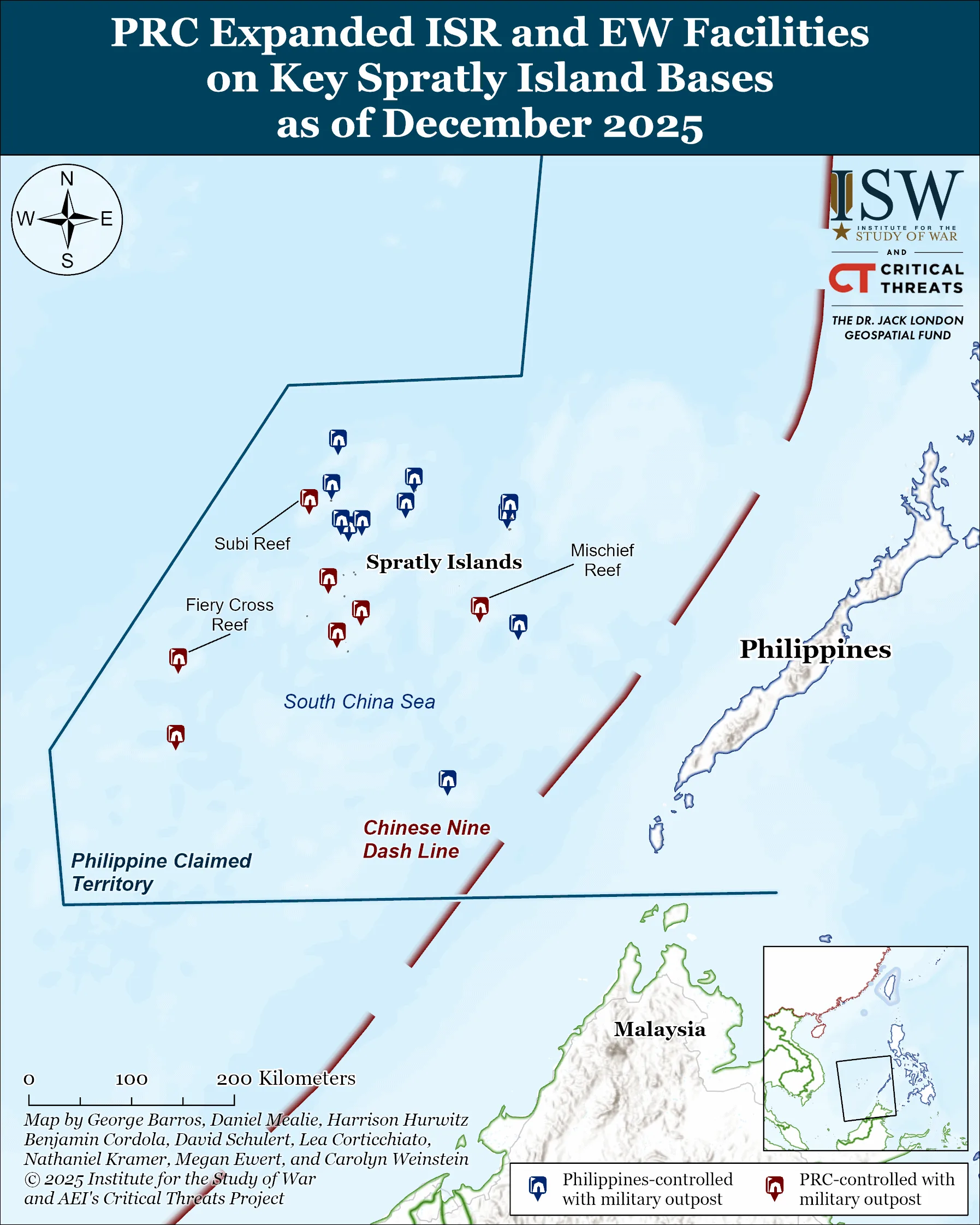
The Center for Strategic and International Studies (CSIS) Asia Maritime Transparency Initiative (AMTI) released new satellite imagery on December 2 showing that the PRC has upgraded intelligence, surveillance, and reconnaissance (ISR) and electronic warfare (EW) facilities on its three most heavily militarized outposts in the Spratly Islands since 2023.[84] AMTI noted the installation of antenna arrays, vehicles carrying possible EW equipment, and radomes on Subi Reef, Mischief Reef, and Fiery Cross Reef. The PRC aims to consolidate its control over the South China Sea and the land features within it, over which it claims sole sovereignty despite competing claims from the Philippines, Vietnam, Malaysia, and Taiwan. The PRC frequently deploys naval, coast guard, and maritime militia vessels to deny the Philippines access to disputed features in the Spratly Islands and obstruct resource exploitation by other countries.
Europe
French Prime Minister Emmanuel Macron’s visit to the PRC reflects European efforts to convince the PRC to pressure Russia to end the war in Ukraine. The PRC is unlikely to urge Russia to end the war, however. Macron visited the PRC from December 3-5 and met with Xi Jinping. The PRC and France signed multiple agreements relating to agriculture, climate, and the conflicts in Ukraine and the Middle East.[85] They released a joint statement that called for ceasefires in Ukraine and the Middle East called and solutions in line with international law.[86] Macron reportedly also urged the PRC to take steps to reduce the EU’s trade deficit, threatening to impose tariffs if this was not addressed.[87]
European leaders hope to pressure the PRC to oppose Russia’s war against Ukraine. Macron’s visit to the PRC largely centered on this issue; German Foreign Minister Johann Wadephul similarly said that the PRC has the greatest influence over Russia regarding negotiating an end to the war.[88] The PRC is a critical enabler of Russia’s defense industrial base and is unlikely to change its stance on Russia’s war in Ukraine. PRC Foreign Minister Wang Yi reportedly said during talks with the EU in July 2025 that the PRC could not accept a Russian loss in Ukraine.[89] The PRC also seeks to learn from the war, reportedly sending PLA officers to observe near the Russian frontlines.[90] These operational lessons could be applied to PLA war plans in Taiwan. The PRC benefits from US and European preoccupation with the Ukraine war and the persistent threat from Russia, which prevents the US-aligned coalition from focusing on the PRC. Beijing would likewise benefit from Russia remaining strong enough to support PRC war plans in Asia.[91] PRC MFA spokesman Lin Jian did not respond to a question on whether the PRC would put additional pressure on Russia to end the war during a December 5 press conference.[92]

[1] https://trumpwhitehouse.archives.gov/wp-content/uploads/2017/12/NSS-Final-12-18-2017-0905.pdf ; https://bidenwhitehouse.archives.gov/wp-content/uploads/2022/10/Biden-Harris-Administrations-National-Security-Strategy-10.2022.pdf
[2] https://www.whitehouse.gov/wp-content/uploads/2025/12/2025-National-Security-Strategy.pdf
[3] https://bidenwhitehouse.archives.gov/wp-content/uploads/2022/10/Biden-Harris-Administrations-National-Security-Strategy-10.2022.pdf
[4] https://www.mfa.gov dot cn/web/wjdt_674879/fyrbt_674889/202512/t20251208_11768723.shtml
[5] https://www.whitehouse.gov/wp-content/uploads/2025/12/2025-National-Security-Strategy.pdf
[6] https://truthsocial.com/@realDonaldTrump/posts/115686072737425841
[7] https://understandingwar.org/research/china-taiwan/china-taiwan-weekly-update-july-24-2025/; https://www.reuters.com/world/china/us-open-up-exports-nvidia-h200-chips-china-semafor-reports-2025-12-08/
[8] https://finance.yahoo.com/news/chinas-ai-chips-stack-against-125026021.html https://www.reuters.com/world/asia-pacific/how-chinas-ai-chips-stack-up-against-nvidias-h200-2025-12-09/
[9] https://understandingwar.org/research/china-taiwan/china-taiwan-weekly-update-july-24-2025/
[10] https://www.whitehouse.gov/wp-content/uploads/2025/12/2025-National-Security-Strategy.pdf
[11] https://www.fastcompany.com/91454509/nvidia-ceo-jensen-huang-meets-trump-republicans-ai-chips-china
[12] https://www.hudson.org/defense-strategy/xi-jinping-vision-artificial-intelligence-pla
[13] https://www.wsj.com/tech/ai/nvidia-ai-chips-to-undergo-unusual-u-s-security-review-before-export-to-china-5e73cd55?mod=china_news_article_pos3
[14] https://understandingwar.org/research/china-taiwan/china-taiwan-weekly-update-october-20-2025/
[15] https://www.bloomberg.com/news/articles/2025-09-29/huawei-to-double-output-of-top-ai-chip-as-nvidia-wavers-in-china;
[16] https://www.cnbc.com/2025/12/09/nvidia-can-sell-h200-ai-chip-to-china-but-will-beijing-want-them.html
[17] https://www.mod.go dot jp/js/pdf/2025/p20251209_04.pdf
[18] https://www.linkedin.com/posts/k-tristan-tang_update-on-pla-aircraft-carrier-operations-activity-7404184273550794752-rRsh?utm_medium=ios_app&rcm=ACoAACGE7vwBzsvoitWpBgMTUKsVuktyYNULv2s&utm_source=social_share_send&utm_campaign=copy_link
[19] https://www.mod.go dot jp/js/pdf/2025/p20251207_02.pdf
[20] https://www.mod.go dot jp/j/press/news/2025/12/6a.html
[21] https://www.mod.go dot jp/js/pdf/2025/p20251209_02.pdf
[22] https://www.mod.go dot jp/js/pdf/2025/p20251209_05.pdf
[23] https://www.mod.go dot jp/j/press/kisha/2025/1207a_r.html ; https://www.mofa.go dot jp/mofaj/press/release/pressit_000001_03067.html
[24] https://www1.kaiho.mlit.go dot jp/TUHO/vpage/visualpage.html ; https://x.com/WOHZxixjQdr34zy/status/1997861722514968734
[25] https://www.fmprc.gov dot cn/fyrbt_673021/jzhsl_673025/202512/t20251208_11768723.shtml ; HYPERLINK “http://www.mod.gov”http://www.mod.gov dot cn/gfbw/qwfb/16425812.html
[26] https://www.fmprc.gov dot cn/fyrbt_673021/jzhsl_673025/202512/t20251208_11768723.shtml ; http://www.mod.gov dot cn/gfbw/qwfb/16425812.html
[27] https://www.aei.org/articles/china-taiwan-update-november-25-2025/
[28] HYPERLINK “https://www.sankei”https://www.sankei dot com/article/20251204-J5K42KSGKJPDZAFNIIZAMBQVKA/
[29] https://www.globaltimes dot cn/page/202512/1349939.shtml
[30] https://www.globaltimes dot cn/page/202512/1349939.shtml
[31] https://understandingwar.org/research/china-taiwan/china-taiwan-update-november-25-2025/
[32]https://www.aei.org/articles/china-taiwan-update-november-21-2025/
[33] https://www.def dot ltn.com.tw/article/breakingnews/5266592
[34] https://english.news dot cn/20251201/8f040aaab761495e9d0e854fdb13c11a/c.html
[35] https://news.ltn.com dot tw/news/society/breakingnews/5267343
[36] https://www.taiwannews.com dot tw/news/6258266 ; https://news.ltn.com dot tw/news/society/breakingnews/5267343
[37] https://www.reuters.com/world/asia-pacific/cambodia-says-it-handed-over-arrested-taiwanese-china-2025-04-15/ ; https://www.reuters.com/article/china-taiwan-malaysia-idUSL4N1DV16E/ ; https://www.bbc.com/news/world-asia-36023738 ; https://www.reuters.com/article/us-taiwan-china-indonesia/taiwan-fumes-as-indonesia-sends-fraud-suspects-to-china-idUSKBN1AJ1NZ/?il=0
[38] https://understandingwar.org/research/china-taiwan/china-taiwan-weekly-update-march-15-2024/ ; https://www.rfa.org/english/news/china/taiwan-chinia-search-03142024030655.html
[39] https://understandingwar.org/research/china-taiwan/china-taiwan-weekly-update-april-12-2024/
[40] https://udn dot com/news/story/6656/9185028?from=udn-catebreaknews_ch2
[41] https://jamestown.org/taiwans-energy-policy-at-odds-with-economic-needs/; https://english.cw dot com.tw/article/article.action?id=4291
[42] https://www.bloomberg.com/news/articles/2025-12-02/taiwan-may-restart-nuclear-power-plant-in-2028-minister-says
[43] https://www.bloomberg.com/news/articles/2025-05-13/taiwan-opens-door-to-atomic-power-plant-restarts-in-policy-tweak
[44] https://focustaiwan dot tw/business/202511280014
[45] https://focustaiwan dot tw/business/202512010025
[46] https://globaltaiwan.org/2025/09/learning-from-tsai/
[47] https://understandingwar.org/research/china-taiwan/china-taiwan-weekly-update-october-20-2025/
[48] https://www.fdd.org/analysis/2025/11/17/chinese-coercion-of-taiwans-energy-lifelines-a-contest-taiwan-and-the-west-cant-afford-to-lose/
[49] https://www.csis.org/analysis/lights-out-wargaming-blockade-taiwan
[50] https://understandingwar.org/research/china-taiwan/china-taiwan-weekly-update-may-24-2024/
[51] https://www.neimagazine.com/news/taiwan-clears-path-to-restart-reactors/
[52] https://moda dot gov.tw/ACS/press/news/press/18104
[53] https://taiwannews dot com.tw/news/6258944; https://taiwannews dot com.tw/news/6260225;
https://www.scmp dot com/news/china/politics/article/3335386/taiwan-blocks-mainland-chinese-social-media-platform-rednote-citing-high-fraud-risk
[54] https://www.taiwannews dot com.tw/news/6260225
[55] https://www.fraudbuster dot digiat.org.tw/accessibility/index?listType=H
[56] https://www.cnn.com/2025/12/05/tech/taiwan-ban-china-xiaohongshu-intl-hnk
[57] https://www.ocac dot gov.tw/OCAC/Eng/Pages/Detail.aspx?nodeid=329&pid=81918674
[58] https://www.scmp dot com/news/china/politics/article/3335386/taiwan-blocks-mainland-chinese-social-media-platform-rednote-citing-high-fraud-risk
[59] http://www.gwytb dot gov.cn/xwdt/xwfb/wyly/202512/t20251210_12739701.htm
[60] https://www.reuters.com/world/china/china-massing-military-ships-across-region-show-maritime-force-sources-say-2025-12-04/
[61] https://www.taiwannews.com dot tw/news/6258901
[62] https://www.abc.net.au/news/2025-12-02/china-ship-flotilla-philippines-defence-force/106092522
[63] https://www.newsweek.com/satellite-imagery-reveals-chinese-naval-group-west-pacific-11155256
[64] https://news.usni.org/2025/12/05/australia-monitors-chinese-task-group-operating-in-philippine-sea
[65] https://www.scmp dot com/news/china/military/article/3335362/australia-high-alert-pla-naval-flotilla-philippine-sea-sails-south?module=top_story&pgtype=subsection
[66] http://www.mod.gov dot cn/gfbw/xwfyr/jt/16425488.html
[67] https://www.abc.net.au/news/2025-12-07/australia-and-japan-urge-calm-after-chinese-radar-locks-jets/106112526
[68] https://www.cnn.com/2025/03/06/asia/trump-china-warships-asia-pacific-analysis-hnk-intl; https://understandingwar.org/research/china-taiwan/china-taiwan-weekly-update-march-14-2025/
[69] https://www.defence.gov.au/news-events/releases/2025-02-13/statement-unsafe-unprofessional-interaction-peoples-liberation-army-air-force
[70] https://www.sipri.org/sites/default/files/2025-11/fs_2512_top_100_2024.pdf
[71]https://www.sipri.org/sites/default/files/2025-03/fs_2503_at_2024_0.pdf
[72] https://www.reuters.com/business/aerospace-defense/chinas-military-firms-struggle-corruption-purge-bites-report-says-2025-11-30/
[73] https://www.mfa.gov dot cn/web/ziliao_674904/zcwj_674915/200509/t20050901_7949796.shtml; http://www.mod.gov dot cn/gfbw/fgwx/16423994.html
[74] https://www.fmprc dot gov.cn/eng/wjbzhd/202509/t20250929_11719702.html; https://en.yna.co dot kr/view/AEN20251010000951315
[75] https://www.fmprc.gov dot cn/eng/xw/zyxw/202511/t20251101_11745458.html
[76] https://jamestown dot org/prc-russia-dprk-relations-grow-closer/?utm_source=All+Subscribers&utm_campaign=26c8b6771b-EMAIL_CAMPAIGN_2025_11_13_01_55_COPY_01&utm_medium=email&utm_term=0_-ec070470ee-458782474&mc_cid=26c8b6771b&mc_eid=a6faf3b3e6
[77] https://keia dot org/the-peninsula/north-koreas-strategic-play-in-an-era-of-great-power-confrontation/
[78] https://www.whitehouse dot gov/wp-content/uploads/2025/12/2025-National-Security-Strategy.pdf
[79] https://www.yonhapnewstv.co dot kr/news/MYH20251202192007Rso
[80] https://www.mk.co dot kr/news/politics/11482943
[81] https://www.bbc.com/korean/articles/cx2599y1vklo; https://www.yna.co dot kr/view/AKR20251207033500001
[82] https://www.koreatimes.co dot kr/southkorea/defense/20251208/adjusting-s-korea-us-joint-drills-may-be-discussed-if-conditions-are-met-unification-ministry; https://www.yna.co dot kr/view/AKR20251208064100504
[83] https://news.sbs.co dot kr/news/endPage.do?news_id=N1008356968
[84] https://amti.csis.org/chinas-spratly-isr-and-ew-upgrades/
[85] https://www.mfa.gov dot cn/web/ziliao_674904/1179_674909/202512/t20251205_11767576.shtml; https://www.mfa.gov dot cn/web/ziliao_674904/1179_674909/202512/t20251205_11767455.shtml; https://www.mfa.gov dot cn/web/ziliao_674904/1179_674909/202512/t20251205_11767572.shtml
[86] https://www.mfa.gov dot cn/web/ziliao_674904/1179_674909/202512/t20251205_11767572.shtml
[87] https://www.reuters.com/world/china/frances-macron-threatens-china-with-tariffs-over-trade-surplus-les-echos-2025-12-07/
[88] https://www.mfa.gov dot cn/web/wjdt_674879/fyrbt_674889/202512/t20251208_11768723.shtml
[89] https://www.cnn.com/2025/07/04/europe/china-ukraine-eu-war-intl
[90] https://www.reuters.com/world/chinese-nationals-fighting-russia-ukraine-are-mercenaries-us-officials-2025-04-11/
[91] https://understandingwar.org/research/russia-ukraine/seizing-the-initiative-against-russia-putting-the-united-states-in-control-2/
[92] https://www.mfa.gov dot cn/web/wjdt_674879/fyrbt_674889/202512/t20251205_11767615.shtml