By: Caitlin Forrest
Taliban militants’ military successes during their 2016 campaign,Operation Omari demonstrate requirements for U.S. policy in Afghanistan. TheANSF is incapable of securing major population centers like Lashkar Gah orKunduz cities or increasing government-controlled territory without significantU.S. support. The ANSF remains highly dependent on current levels of U.S.support to regenerate units and secure government-controlled territory.Resolute Support Commander General John Nicholson stated on September23 that the Afghan government controls or heavily influences 68- 70% of thepopulation, and Taliban militants control 10% of the population, leavingroughly a quarter of the country contested. The continued expansion ofungoverned spaces in Afghanistan allows global extremist networks like al Qaedaand ISIS and their allies to carve out sanctuaries from which to target theU.S. and its national security interests.
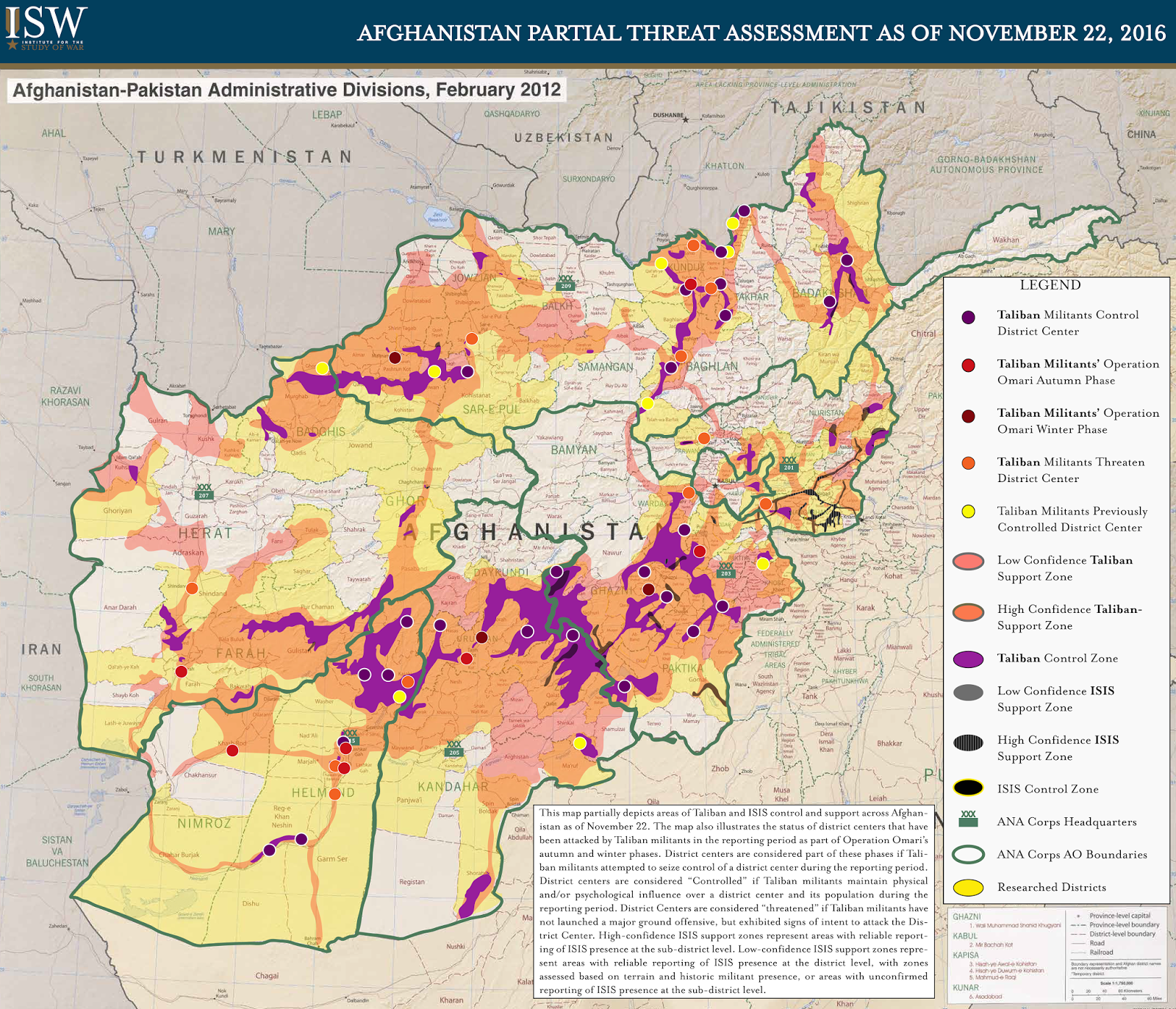
The ANSF is incapable of recapturing significant swaths ofTaliban-controlled territory at current levels of U.S. support. The Talibanoffensive, Operation Omari is still underway as of November 23. The summer offensivetransitioned into a new phase in September that ended when Taliban militantslaunched multiple concurrent offensives to seize four provincial capitals inOctober. The ANSF, with vital U.S. support, successfully prevented Taliban militants from capturing the provincial capitals of Helmand, Kunduz, Farah, andUruzgan during this phase. Taliban militant offensives nevertheless subvertedthe ANSF’s ability to seize territory from militants, allowing militants toexpand their territorial control and threaten remote districts outside of majorpopulation centers. Operation Omari did not culminate in October and iscontinuing into its third phase. Militants have expanded control in remoteareas of northern Sar-e Pul Province and threatened a district center inwestern Farah Province in November while the ANSF prepared to launch the secondphase of their 2016 counteroffensive in the eastern provinces. Taliban militants will attempt to besiege provincialcapitals in order to pin down the ANSF there through the winter.
U.S. training, assistance, and funding are essential to helping theANSF weather the loss of combat effectiveness from high operational tempo,significant casualties, and degradation of unit cohesion. The ANSF will reportedlyundergo a U.S.-ledforce regeneration during the upcoming 2016-2017winter season after incurring high casualties and defections. This regenerationwill limit the ANSF’s ability to go on the offensive during this winter season.Taliban militants will take advantage of the ANSF’s pause during regeneration to expandterritorial control and launch ground offensives against district centers.Taliban militants previously launched an aggressive offensive overthe 2015-2016 winter season in which they made significant gains in HelmandProvince. They will likely attempt to repeat similar successes during the upcoming 2016-2017 winter season while the ANSF rests and refits units.
Meanwhile,spoilers are undermining the U.S.-backed Afghan National Unity Government,weakening its ability to secure the country. Northern warlord and First Vice President Abdul Rashid Dostum is attempting to integrate his personal militias with the ANSF, which would impede U.S. operations in northern Afghanistan.Separately, the lower house of Parliament has dismissed several cabinet members in votes of no confidence between November 12 and November 23, which followed the missed deadlines for a Constitutional Loya Jirga and Parliamentary elections in September and October. The National Unity Government is incapable of closing the readiness gaps of the ANSF in the face of these compounding challenges despite continued U.S. support. Taliban militants and extremist networks like al Qaeda, ISIS, and the Haqqani Network will exploit the security gaps created by the volatile political environment in Afghanistan in order to reconstitute sanctuaries from which to target the U.S.,its allies, and its interests.
Correction: A city marker was incorrectly placed on the map that depicted Bakwah District Center, Farah Province as Taliban-Controlled. It has been removed as of February 8th, 2017. Taliban militants have significant area control in the district, but ISW does not assess that Taliban militants controlled the Bakwah District Center over the reporting period.


