By Jennifer Cafarella and Genevieve Casagrande
As talks of a ceasefire or “cessation of hostilities” take the headlines, Aleppo looms even larger as a key city in the 5-year Syrian civil war. Aleppo is not covered by any agreement for a ceasefire and regime and Russian forces are intensifying their attacks on this city under the pretext that the opposition forces consist largely of al Qaeda’s affiliate Jabhat al Nusra. The fall of Aleppo would be a devastating defeat for opposition forces, but even a long siege would be detrimental to U.S. interests as opposition forces would become more radicalized and Jabhat al Nusra would further cement its leadership role in northern Syria, effectively removing options to achieve American goals in northern Syria.
Below is the Conclusion from ISW’s recent paper “The Syrian Armed Opposition Forces in Aleppo.”
_______________
The U.S. has a short time frame in Aleppo to prevent the upcoming humanitarian catastrophe and preserve opposition groups the U.S. needs in order to destroy ISIS and Jabhat al Nusra in the long term. The Aleppo-based opposition remains relatively independent and therefore offers the U.S. a promising source of ground forces against Jabhat al Nusra in Northern Syria. Opposition groups that receive covert U.S. support are still among Aleppo’s powerbrokers and potential powerbrokers. The regime’s advance in Aleppo poses an existential threat to these opposition forces, however. Jabhat al Nusra will use the defense of Aleppo as a vehicle to overwhelm opposition groups that are acceptable to the West and entrench itself within the civilian population. The collapse of the opposition in Aleppo, either in a surrender to the regime or in a merger with Jahbat al Nusra and Ahrar al Sham during a siege, would remove options to achieve American objectives in northern Syria.
Russia is using the cover of a potential “cessation of hostilities” to set conditions for the collapse of U.S.-backed groups in Aleppo. There is very little to indicate that Russia,Iran, or the Syrian regime have any intention of halting their military campaign in northern Syria, despite this diplomatic overture. Russian Foreign Minister Sergey Lavrov has explicitly noted that Russia does not intend to halt its air campaign against “terrorists” in Syria.69 Russia exploits the West’s lack of understanding of the Syrian armed opposition to justify targeting a broad swath of groups that include powerbrokers that receive covert U.S. support. Russia’s objective is to eliminate the opposition in Aleppo that poses the greatest threat to Assad and undermine Western support of these groups under the cover of targeting “terrorists.” As such, the February 11 “cessation of hostilities” agreement is not a solution to the challenges the U.S. faces in Syria; it is a submission to Russia’s agenda.70
Syrian armed opposition groups are unlikely to agree to a “cessation of hostilities” under these conditions. No armed opposition group participated in the initial discussions. Aleppo-based groups have consistently refused to agree to localized “freeze zones” in the past on the grounds that they do not trust the Syrian regime to adhere to one.71 The current deal legitimizes this argument, as the deal is very clearly on Russia’s terms. The U.S. risks jeopardizing the prospects of achieving a negotiated settlement in Syria in the long term if it does not abandon this cessation of hostilities initiative. Jabhat al Nusra and other hardline groups will use this initiative – and the regime’s almost certain violation of it – as proof that Syrians should permanently abandon the negotiating table. American submission to Russia’s agenda in Syria thus directly undermines the requirements for American national security.
The situation in Aleppo requires American leadership and action. U.S.-trained opposition forces in the Northern Aleppo countryside are not alone strong enough to secure Aleppo City, for they are unlikely able to break through the regime’s new forward line of troops(FLOT) in the northern countryside. The U.S. does not need to consider drastic measures such as ground forces in order to have a major impact in Aleppo,however. It is possible to change the outcome of the fight in Aleppo and assist the humanitarian crisis that is unfolding through a few limited yet crucial steps.
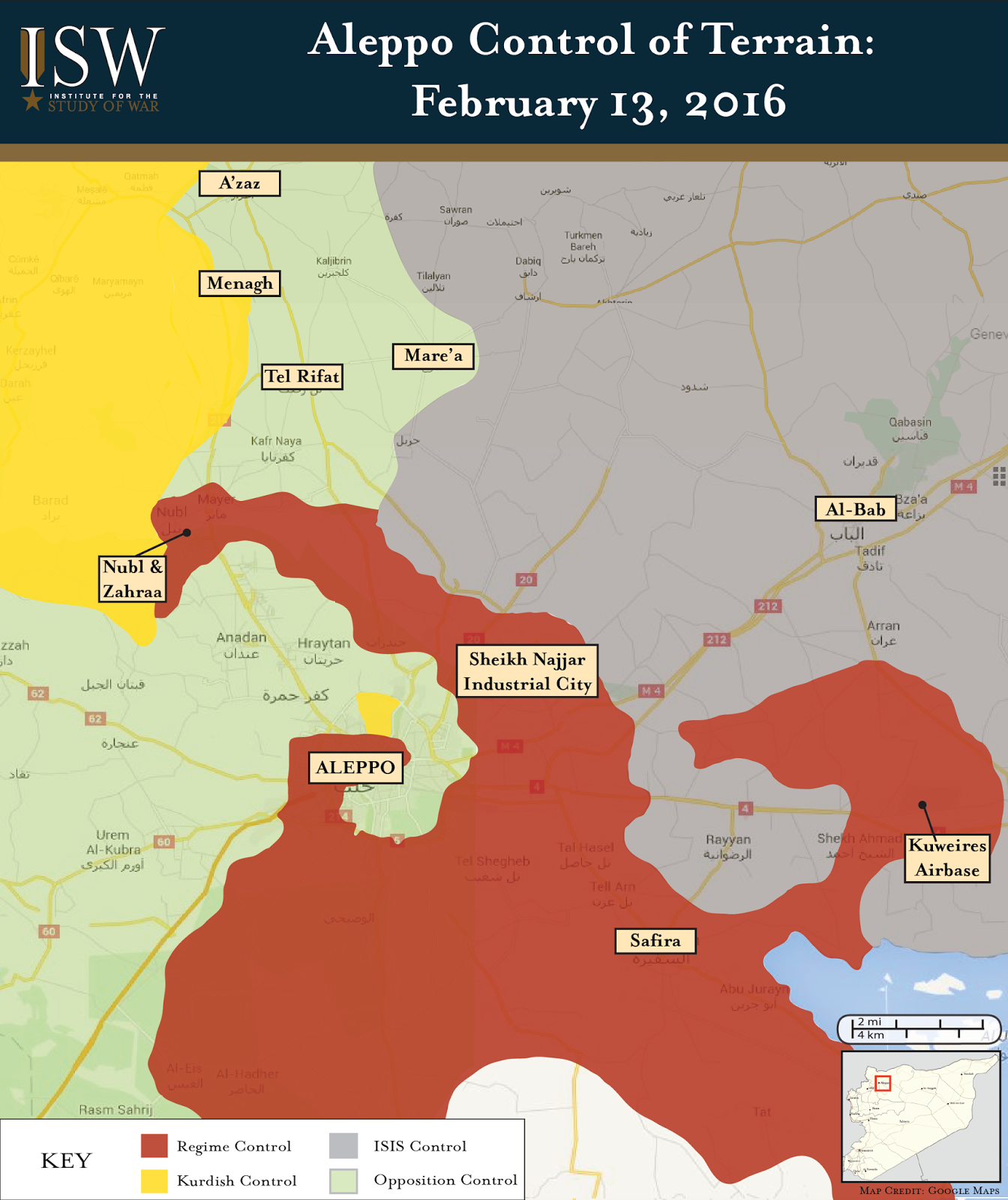
First, the U.S. could conduct humanitarian airdrops of supplies into opposition-held neighborhoods of the city in order to sustain both the opposition groups and the hundreds of thousands of civilians in opposition-held areas of Aleppo City to forestall a humanitarian catastrophe. Providing humanitarian aid to opposition groups in Aleppo increases their ability to endure the siege without submitting to Jabhat al Nusra’s leadership. The U.S. has the capability to do so from airbases in Turkey currently used for the anti ISIS campaign. Turkey would support such operations and almost certainly grant the use of its bases for them to preserve opposition groups in Aleppo, including those that already receive Turkish aid,in order to pursue regime change in Syria. Jabhat al Nusra would be able to access some of this aid, but the U.S. should not let Jabhat al Nusra’s presence in the city condemn the civilian population and opposition groups at risk. Any American intervention in Aleppo, even an airdrop of humanitarian supplies, will risk provoking Russia. Russia is very unlikely willing to rise escalation overAleppo, however, as it is not a core Russian strategic interest. U.S. policymakers are reportedly considering humanitarian airdrops, and should undertake them immediately.
Second, the U.S. should significantly increase the military and financial support to the non-Ahrar al Sham powerbrokers and potential powerbrokers examined in this report. The U.S. already provides aid on a limited scale to many of them. The U.S. should provide these groups with increased TOW anti-tank missile shipments in addition to increased shipments of light weapons, ammunition, and money to pay their fighters. The U.S. could do so from Turkey, where a covert U.S. program toprovide small numbers of TOW anti-tank missiles to vetted opposition groups isalready reportedly based.72 The U.S. can deliver these supplies quietly throughthe Bab al Hawa border crossing with Turkey west of Aleppo City. This isadvantageous because air dropping the supplies is more vulnerable to Russianinterdiction.
The provision of military suppliesin addition to humanitarian aid would preserve the powerbroker status of fourideologically viable powerbrokers (al Jabhat al Shamiya, Jaysh al Mujahideen,Feilaq al Sham, and Fawj al Awal) and increase their relative strengthvis-à-vis Ahrar al Sham. The increase in both military and humanitarian supportcould also transform all of the potential powerbrokers into powerbrokers byboth providing them more access to resources than smaller Aleppo based groupshave and closing the gap between powerbrokers and potential powerbrokers. Itwould also mitigate Jabhat al Nusra’s ability to coerce or exploit the weaknessof potential powerbrokers in order to absorb or transform them. It could evenbe sufficient to coalesce smaller opposition groups in Aleppo under theleadership of powerbrokers that are potential U.S. allies as opposed to alQaeda-allied Ahrar al Sham.
The U.S. should not make additionalsupport contingent upon a refusal by opposition groups to coordinate withJabhat al Nusra, because it is not a demand these groups can meet under currentmilitary conditions. The U.S. should instead adopt an approach to incentivizeand enable these groups to retain freedom of action and to withstand Jabhat alNusra coercion over the medium term while potentially growing stronger. Theseverity of the situation in Aleppo will likely prevent Jabhat al Nusra fromattacking these groups directly because doing so would greatly harm the group’simage. The upcoming siege of Aleppo thus offers the U.S. the opportunity tobuild future partners against Jabhat al Nusra by exploiting conditions in whichJahbat al Nusra’s freedom of action against Western clients is limited.
Third, The U.S. could also supportthe establishment of a humanitarian safe zone along the Turkish border. Turkeymay independently do so in order to address the flow of refugees that it cannotabsorb. A safe zone north of Aleppo could also provide Turkey with basing itcan use to deliver additional support to opposition forces in Aleppo City, suchas indirect fire. The U.S. could support this course of action with aerialoverflight to prevent the regime from attacking the safe zone, and couldleverage U.S.-trained forces operating near the Turkish border to help securethe zone and pressure the regime’s forward line of troops (FLOT).
Preventing the regime fromrecapturing Aleppo does not solve the many other challenges the U.S. faces in Syria; it merely buys some time and prevents a more dangerous future fromemerging. Jabhat al Nusra and opposition forces it leads will still hold terrain in Idlib Province that is sustained by access to the Turkish border even if Aleppo falls. Pro-regime forces are unlikely to clear this terrain in the near term, particularly if Turkey sustains its support to Idlib-based groups. Jabhat al Nusra and many opposition forces in Aleppo will likely fall back into Idlib Province and launch a sustained insurgency from that terrain if they lose in Aleppo City. The U.S. therefore will have to develop options to eliminate Jabhat al Nusra in Idlib in the future regardless of the outcome in Aleppo. Preserving a core cadre of opposition fighters in Aleppo would create an option to use those forces for future operations.
Read the full paper here.


