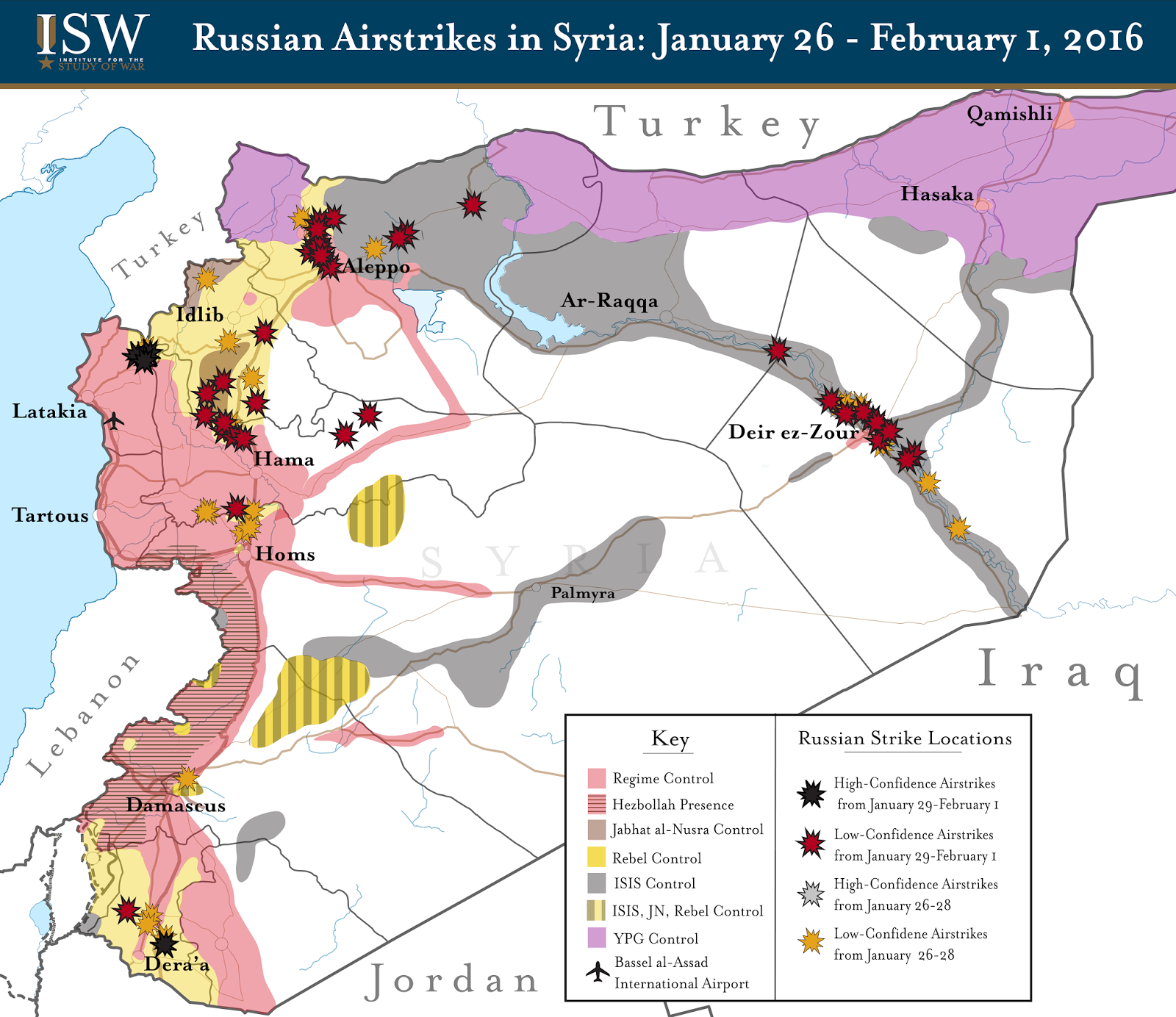
Key Takeaway: Russianwarplanes concentrated their airstrikes in opposition-held territory innorthwestern Aleppo Province in support of an ongoing regime offensive to severthe primary opposition ground line of communication (GLOC) from Aleppo City tothe Syrian-Turkish border. Pro-regime forces seized three villages in thenorthern countryside of Aleppo City on February 1 – 2, bringing the regimewithin five miles of linking with besieged regime forces in the towns of Nuboland Zahraa. The offensive marks the culmination of a series of Russian-backedshaping operations in Aleppo Province that began in October 2015. Anonymous U.S.defense officials confirmed that RussianSpetsnazspecial operations forces have also been working to enable the ongoing campaignin Aleppo Province. The isolation of Aleppo City would provide Syrian PresidentBashar al-Assad and his foreign backers with valuable leverage against theiropponents amidst ongoing UN-sponsored Geneva Talks to end the Syrian Civil War.The opposition High Negotiations Committee (HNC) condemned the advances northof Aleppo City on February 2 and reaffirmed that the opposition will notparticipate in the negotiations until the regime and its allies implementconfidence-building measures detailed in previous UN Security Councilresolutions, including an end to aerial bombardment on civilian targets. Russianonetheless attempted to portray itself as a constructive actor in thepolitical process. Russian Foreign Minister Sergey Lavrov announced that Russiahas agreed toinclude representatives from prominent Salafi-jihadist groups Jaysh al-Islam and Ahraral-Sham in negotiations on an individual basis despite previously condemningthe groups as terrorist organizations.
Russian Airstrikes in Syria: January 26 – February 1, 2016
By Genevieve Casagrande and Jodi Brignola
2/3/2016 UPDATE: Pro-regime forces backed by heavy Russian air support reestablished a supply line to the partially besieged Shi’a-majority towns of Nubl and Zahra’a northwest of Aleppo City. Opposition forces have denied access to the towns since seizing control of the northern Aleppo countryside in 2012. The regime’s advance severs the opposition-held ground line of communication (GLOC) from the Turkish border into Aleppo City, and positions pro-regime forces to complete the siege of opposition-held neighborhoods of Aleppo City.
Note: The map below surveys Russian airstrikes from January 26-February 1. The developments from today described above will be reflected in a new airstrikes map.
Meanwhile,a Russian Su-34bomber violated Turkish airspace on January 29 in the first reported airspace incursion sinceTurkey downed a Russian fighter jet in November 2015. The Russian Ministry ofDefense denied responsibility for the violation, terming the report “unsubstantiatedpropaganda”despite NATO confirmation. Russia later claimed to deploy advanced Su-35S airsuperiority fighters to its airbase at the Bassel al-Assad InternationalAirport in Latakia Province. The deployment of Russia’s most advanced fighter jets to Syria provides a new boost to its ability to provoke Turkey and assert its freedom of action along the southern flank of NATO.
The following graphic depicts ISW’s assessment of Russian airstrike locations based on reports from local Syrian activist networks, Syrian state-run media, and statements by Russian and Western officials. This map represents locations targeted by Russia’s air campaign, rather than the number of individual strikes or sorties.
High-Confidence reporting. ISW places high confidence in reports corroborated both by official government statements reported through credible channels and documentation from rebel factions or activist networks on the ground in Syria deemed to be credible.
Low-Confidence reporting. ISW places low confidence in secondary sources that have not been confirmed or sources deemed likely to contain disinformation.