By Genevieve Casagrande
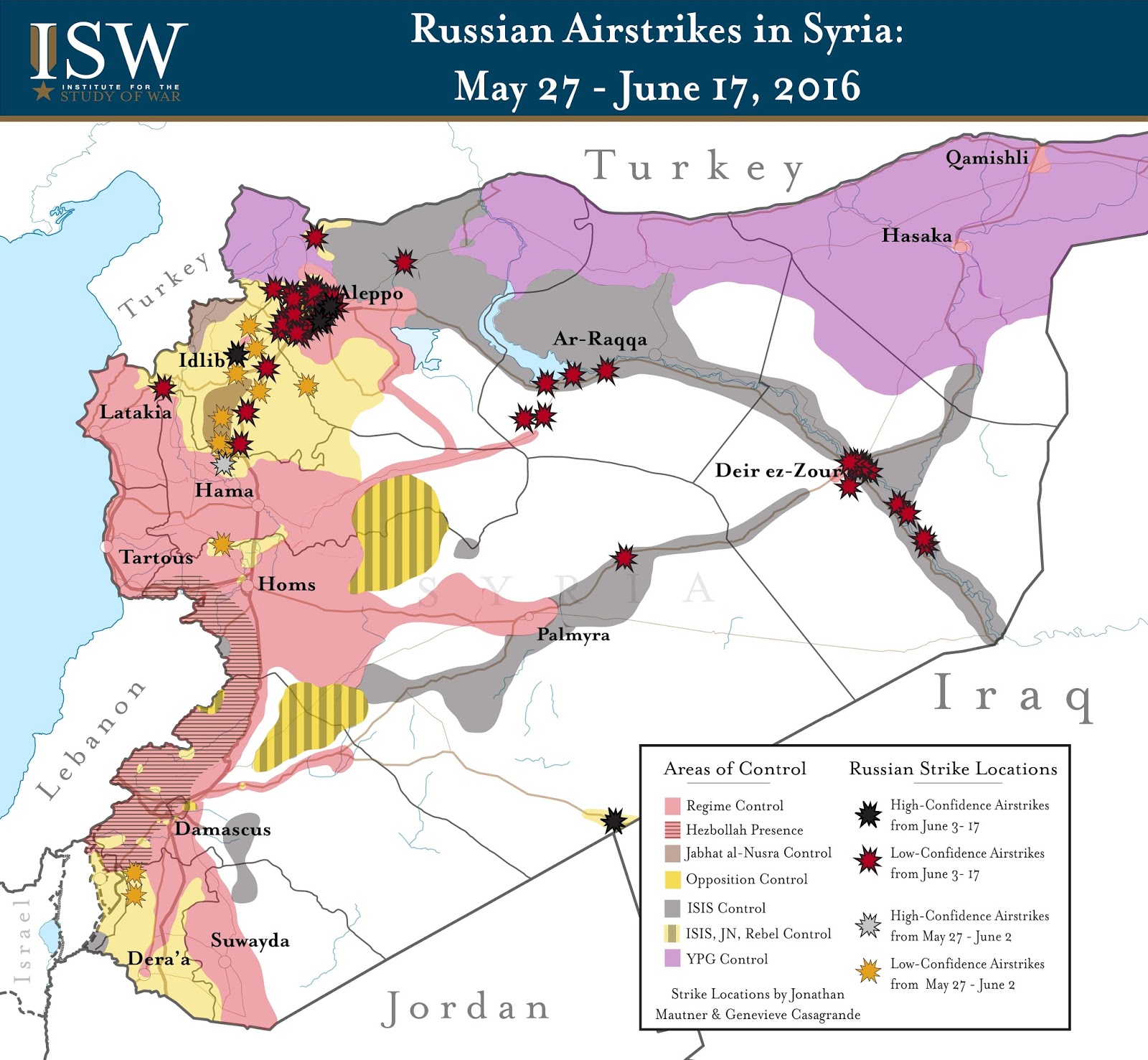
Russiahas escalated its air campaign in Syria in an effort to deter and undermineWestern military action. ISW assesses with high confidence that Russianairstrikes targeted areas held by the U.S.-backed New Syrian Army near the Syrian al Tanafborder crossing with Iraq on June 16. The U.S. trained and equippedthe New Syrian Army to fight ISIS in southeastern Syria. The U.S. sent jets tointercept and prevent additional attacks, but Russian warplanes returned to conduct a second strike against New Syrian Army positions whilethe American jets refueled, according to anonymous U.S. DefenseOfficials. Russia and the U.S. held a teleconference on June 18 to discussthe incident, during which Russia requested that the U.S. “sharecoordinates” of U.S.-backed opposition groups inSyria. The Russian Ministry of Defense announced that the two sides agreedto “[aim] to improve the coordination on fighting the terrorist organization inSyria,” but did not specify any new measures to prevent the targeting ofU.S.-backed groups. The strikes are a clear demonstration of Russia’swillingness to escalate with the U.S. and likelybelief that the U.S. will be unwilling to sufficiently counter the provocation.
The attack againstthe New Syrian Army follows an increased American military response to Russianactivity in Syria over recent weeks. The U.S.deployed the USS Harry S. Truman Carrier Strike Group onJune 3 to the Mediterranean Sea in order to conduct strikes against ISIS in Iraqand Syria and offset increased Russian naval capabilities in theMediterranean. Russia subsequently deployed long-range naval reconnaissance and anti-submarine warfareaircraft to theater, which local Syrian activistsdocumented in Aleppo Province on June 5. Russia also began to project forceinto Eastern Syria from June 5 – 17, intensifying its own aerial bombardment ofISIS-held terrain in ar-Raqqa and Deir ez-Zour Provinces. The U.S. hasnonetheless continued to conduct strikes against ISIS from theMediterranean. The U.S. also deployedthe Dwight D. Eisenhower Carrier Strike Group to theMediterranean on June 13, which will reportedly remainin the Mediterranean after the Truman returns to the U.S. in late June. Thedeployments of U.S. strike carrier groups are likely an effort to deter acontinued Russian buildup of air and naval anti-access/area denial (A2AD)capabilities in the Eastern Mediterranean.
Russia’s attacksagainst American-backed groups in Syria and the expansion of its air campaigninto ISIS-held terrain demonstrate that Russia will continue to changeconditions on the ground in Syria in order to undermine Americaninterests. Russian airstrikes during the firsttwo weeks of June increased to rates that “exceeded the pre-cessation of hostilities totals”in Aleppo Province, according to Director of the CIA John Brennan. In response,U.S. Secretary of State John Kerry stated on June 15 that the U.S. is not“going to sit there while Assad continues to offensively assault Aleppo and while Russia continues to support in that effort.”Russia nonetheless continued to bombard opposition-held areas in Aleppo Province amidst a temporary ceasefire agreement in Aleppo City from June 16 – 17. ISW assessed a totalof 14 Russian strike locations in the Aleppo area with low and high confidence during that time period. Russia’s claim to adhere to a ceasefire despite continuing its air campaign obfuscates its role in exacerbating the Syrian conflict. Russia’s violation of the ceasefire agreement demonstrates that it remains undeterred from continuing its campaign against the Syrian opposition despite American rhetoric threatening greater U.S. response.
The following graphic depicts ISW’s assessment of Russian airstrike locations based on reports from local Syrian activist networks, statements by Russian and Western officials, and documentation of Russian airstrikes through social media. This map represents locations targeted by Russia’s air campaign, rather than the number of individual strikes or sorties.
High-Confidence reporting. ISW places high confidence in reports corroborated by documentation from opposition factions and activist networks on the ground in Syria deemed to be credible that demonstrate a number of key indicators of Russian airstrikes.
Low-Confidence reporting. ISW places low confidence in reports corroborated only by multiple secondary sources, including from local Syrian activist networks deemed credible or Syrian state-run media.