By EllenStockert and the ISW Syria Team
Russia has reshaped its military campaign in Syria to constrain theU.S.’s current operations and future options. Russia deprioritized its airstrikesagainst opposition-held terrain in Western Syria following the announcement offour ‘de-escalationzones’brokered by Russia, Iran, and Turkey on May 6. Russia claimed this shift was a continuationof its supposed counter-terrorism campaign in Syria. Russia’s actual target forthis new operational phase is not ISIS or Al-Qaeda, but rather the U.S. and itspartners and allies.
Russia positioned pro-Bashar al-Assad regime forces to disrupt theU.S. in Syria under the guise of anti-ISIS operations. Russian airstrikessupported pro-regime forces in a major offensive in Eastern Aleppo Provincethat culminated with the seizure of Maskanah – the last urban center held byISIS in Aleppo Province – on June 4. These gains nonetheless placed thepro-regime coalition on the border between Aleppo and Ar-Raqqa Provinces within55 miles of Ar-Raqqa City. Russia, Iran, and the Assad regime could use thisregion as a base to disrupt ongoing U.S.-backed Syrian Democratic Forces (SDF) operations to seize Ar-Raqqa City from ISIS. Russiasimilarly reasserted its capabilities with cruise missile strikes against ISIS logistics positionsnear Palmyra in Eastern Homs Province on May 31. The Russian Navy’s MediterraneanTask Force simultaneously conducted exercises with Russian Marines off theSyrian coast. Russia’s actions in Eastern Aleppo Province, Homs Province, andthe Mediterranean demonstrate Russia’s resolve to compete with and undermine U.S.influence throughout Syria.
Russia continued to leverage partnerships with local forces inorder to maximize the impact of its air campaign in Syria. Russian airstrikes targeted U.S.-backed opposition groupsJaysh Asoud al Sharqiya and the Ahmed Abdo Martyrs Brigade near the ZazaJunction in the Badia region of Eastern Homs Province on May 31. Pro-regimeforces advanced throughout April and May towardthe joint U.S.-Syrian opposition base at Tanaf on the Syrian-Iraqi border untilU.S. airstrikes on May18and halted pro-regime forces from further incursion into an established “de-confliction”zone. The U.S. conducted additional strikes against pro-regime forces nearTanaf on June6and June 8. Pro-regimeadvances near Tanaf could impede U.S. freedom of movement along theSyrian-Iraqi border and deter potential U.S. operations against ISIS launched from Eastern Deir ez-Zour Province. Russia has alsoresumed air support for pro-regime ground efforts in Dera’a City in SouthernSyria despite the ‘de-escalation zone’ agreement brokered by Russia,Iran, and Turkey in Dera’a Province. Pro-regimeforces reportedly deployed from Aleppo City and Damascus toDera’a City between May 29 – 31. Russia and the pro-regime coalition may attemptto use the deployment to Dera’a City to consolidate pro-regime control overSouthern Syria and block potential U.S.-Jordanian mobilization along the Syrian-Jordanian border.
Russia also advanced political efforts to constrain potential U.S. action in Syria. Russian officials met with representatives from Iraq,Iran, and the Assad regime in Moscow on May 21 to discuss terrorism and cooperation on Syrian-Iraqi border security. An Iraqi partnership with the Russia-Iran-Assad axis would undermine U.S.-Iraqi relations and open the door to greater Russian influence in Iraq. U.S. and Jordanian officials reportedly met with Russian representatives in Amman, Jordan, to discuss a de-escalation zone along the Syrian-Jordanian border. The expansion of Russian influence along Syria’s borders will put Russia and the U.S. in greater competition in Southern and Eastern Syria. The U.S. risks losing opposition partners and influence by partnering with Russia and must not misconstrue Russian air and missile strikes against ISIS as an indicator of Russian reliability in Syria.
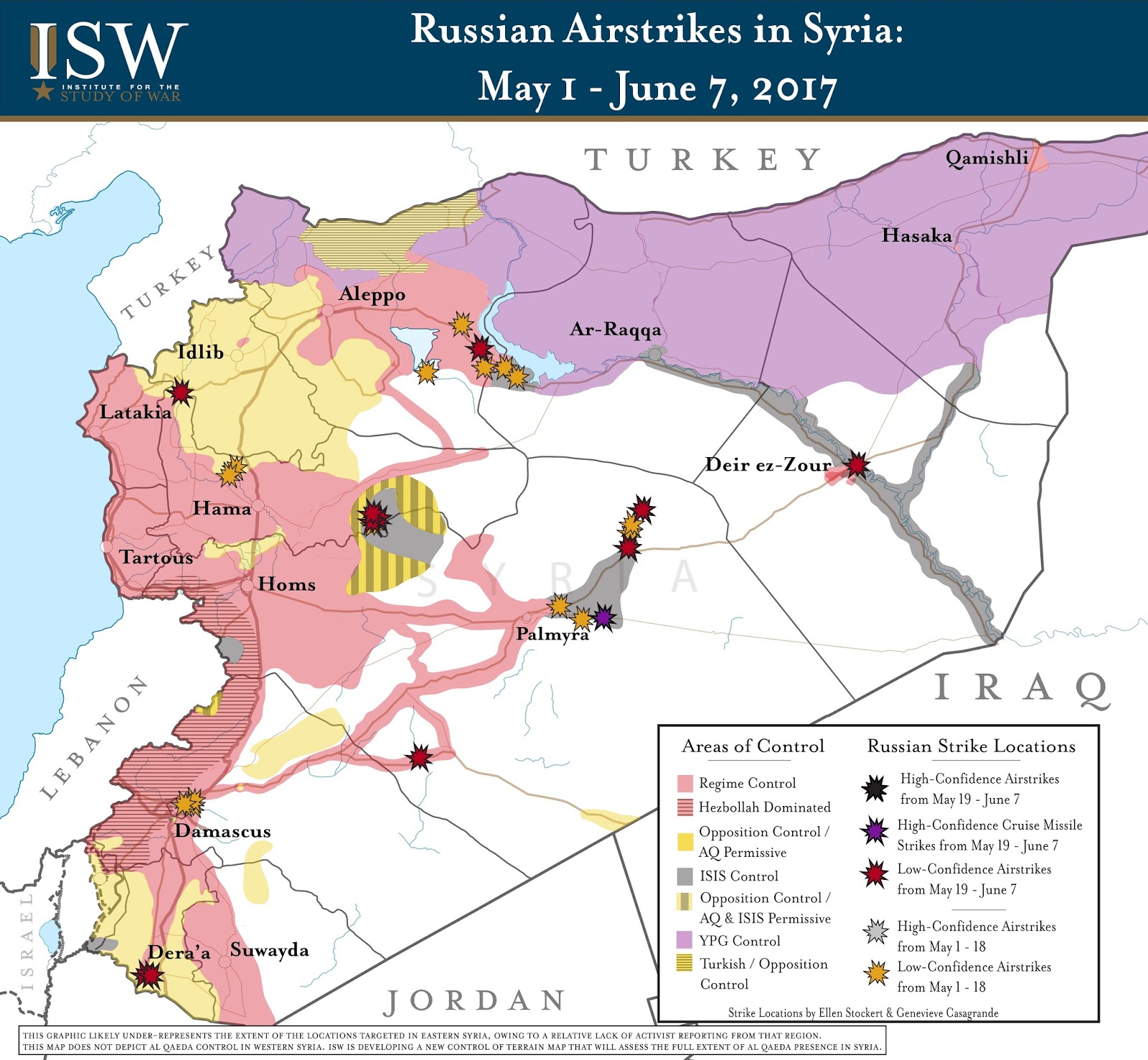
The following graphic depicts ISW’s assessment of Russian airstrike locations based on reports from local Syrian activist networks, statements by Russian and Western officials, and documentation of Russian airstrikes through social media. This map represents locations targeted by Russia’s air campaign, rather than the number of individual strikes or sorties. The graphic likely under-represents the extent of the locations targeted in Eastern Syria, owing to a relative lack of activist reporting from that region.
High-Confidence Reporting. ISW places high confidence in reports corroborated by documentation from opposition factions and activist networks on the ground in Syria deemed to be credible that demonstrate a number of key indicators of Russian airstrikes.
Low-Confidence Reporting. ISW places low confidence in reports corroborated only by multiple secondary sources, including from local Syrian activist networks deemed credible or Syrian state-run media.