By Patrick Martin, Emily Anagnostos, and Rachel Bessette
Key Take-Away: Sadrist Trend leader Muqtada al-Sadr is attempting to launch a de-facto coup against Iraqi Prime Minister Haidar al-Abadi. The Sadrist Trend’s protests in the Green Zone constitute an attempt to seize control of the government process and limit the ability of the government to physically access the Green Zone. Supporters of Muqtada al-Sadr have stormed the Green Zone and the parliament building and they are refusing to leave. Some members are setting up tents, indicating that Sadrists will attempt a sit-in in the Green Zone itself. The Sadrists have not mobilized formal military forces. They have, however, prevented Iraqi leaders from accessing government buildings and forced members of the Council of Representatives (CoR) to leave the Green Zone,attacking several of them as they left. Sadrist demonstrators in the predominantly Shi’a southern provinces have also stormed offices of the rival Dawa Party, to which PM Abadi and former PM Nouri al-Maliki belong. There is potential for intra-Shi’a violence; security forces and Iranian proxy militias,rivals to the Sadrist Trend, deployed to Baghdad’s southern belts to secure the area during the commemoration of the death of the Imam al-Kadhim, a major Shi’aholiday. Meanwhile, security forces could clash with demonstrators or attempt to forcibly evict them from public spaces. This could also lead to further instability, while the possibility of an attempted ISIS attack against either pilgrims or demonstrators remains high.
ISW has tracked developments leading up to this state of affairs. Additional source materials can be accessed here.
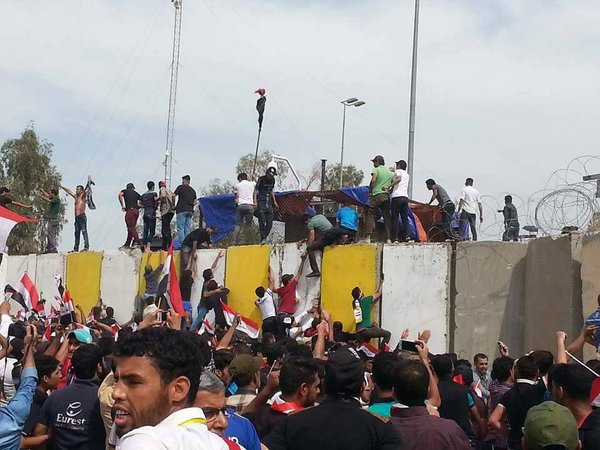
[Above: Supporters of Muqtada al-Sadr clamber over and collapse blast walls around the Green Zone on April 30 during the Sadrist riot.]
The April 30 CoR Session Fails to Reach Quorum
The Council of Representatives (CoR) was scheduled to convene on April 30 in the presence of PM Abadi in order to continue voting on candidates for the cabinet reshuffle. A CoR member from the Islamic Supreme Council ofIraq’s (ISCI) political party, Mowatin, stated that PM Abadi would announce the change of fivemore ministers in the session for the Ministries of Oil, Trade, Industry,Transportation, and Construction. However, the session failed to meet quorum.The Sadrist Trend-affiliated Ahrar Bloc and the Kurdistan Alliance blocs did not attend the session, nor did any of the members of the rumpparliament, the opposition bloc within the CoR dominated by supporters of former Prime Minister Nouri al-Maliki, PM Abadi’s rival, and the leader of the Wataniya Bloc, Iyad Allawi. The Sadrist Al-Ahrar Bloc boycottedthe session, claiming that the cabinet reforms were being pursued along partisan quota lines. Meanwhile, the Kurdish parties claimed that they supported the reforms but rejected the change of any Kurdish ministers in the Cabinet, as they have demanded throughout the reform process. When the session failed to make quorum, CoR Speaker Salimal-Juburi initially postponedthe session for two hours to allow CoR members to arrive. Juburi soon announcedthat the session would be postponeduntil May 10, attributing the lack of quorum to the closure of roads in Baghdaddue to security protocol surrounding the commemoration of the Imam al-Kadhim, amajor Shi’a holiday, in Baghdad.
In response, Sadrist Trend leader Muqtada al-Sadr announcedthat he and the Sadrist Trend would suspendparticipating in political action for two months. Sadr has been supportive ofPM Abadi’s reforms in the past. Specifically, Sadr and PM Abadi have supportedthe creation of a technocratic government. PM Abadi has submitted on multipleoccasions a list of technocrats as nominations for the new cabinet. Only fiveout of 22 were selected during theApril 26 CoR session.
Sadrists Storm the Green Zone and the CoR Building
Sadr has since raised the stakes. He stated in a televisedspeech that he was “waitingfor the great popular uprising and the major revolution to stop the marchof the corrupt.” His followers stormed the Green Zone, prompted by his statement.Shortly before the start of the rioting, Sadr reportedly met with GrandAyatollah Alial-Sistani, the supreme religious authority in Iraq. The details of themeeting are not clear, but Sistani may have sought to restrain Sadr andforestall any outsized response. Alternatively, Sadr may have informed theNajaf religious establishment of his plans. In either case, the meeting, if itdid take place, was important, but Sadr likely did not coordinate the Green Zone storming with the religious establishment.
The Sadrist riot devolved into violence. Sadrists stormed the Green Zone and later the parliament building and damaged the main CoR assemblyhall. They did not appear to clash with the Kurdish force assigned to protect the CoR.Sadrist demonstrators also attacked the head of the Fadhila Bloc, AmmarTuamah, as he exited the area, along with AramSheikh Muhammad, the Kurdish Deputy CoR Speaker. Kurdish media reported thatKurdish CoR members Ila Talabani, Erez Abdullah, Ribawar Taha, Rankin Abdullah,and two others were trapped inside CoR building by rioters, but were evacuated by senior Sadrist Trendmember Hakim al-Zamili, though his presence did not stop Sadrists from assaulting Ila Talabani’svehicle. CoR Speaker Juburi strongly denouncedattacks on CoR members. The violence forced PM Abadi and Speaker Juburi toevacuate temporarily. However, PM Abadi later returned under the heavyprotection of his security detail and the Counter-Terrorism Service (CTS) to inspectthe damage the rioters caused to the CoR building.
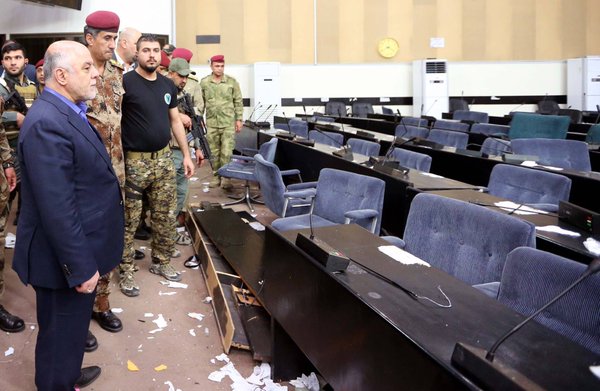
[Above: Prime Minister Haidar al-Abadi inspectsdamage done by rioting Sadrists to the Council of Representatives main roomon April 30.]
Sadr likely intended for the demonstrators to storm the Green Zone and the CoR building. He had stated this intent in a speech on February 26 in Baghdad’s Tahrir Square, warning that the Iraqi people would storm the Green Zone if reforms failed. On April 29, Kadhim al-Issawi, Sadr’ssecurity chief, ominously warned that “They continue to impose on your will. Tomorrow is the date. If they do not respond, then destiny is in your hands. (Approximate translation)” Pro-Sadr social media also warned on April 29 that they were “off to the Green [Zone], we will depart shortly.” An aspect of the April 30 riot was therefore planned.
Security Forces Respond
Security forces have made no move to evict the demonstrators. In fact, a source in Sadr’s office stated that Sadr’s militia forces were coordinating with the security forces to control the demonstrations. Although the joint Iraqi Security Forces (ISF) and Sadrist force began moving protesters out of the CoR building, they have not evicted them from the Green Zone. Sadr also appears to be keeping his hundreds of supporters in the Green Zone, where they have amassed in force, particularly around the Grand Celebration Square. Sadr’s supporters also freely collapsed blast walls around the Green Zone as part of the riot. Previously, Baghdad Operations Command (BOC) forces neglected to control Sadrist demonstrators on March 18, allowing large numbers of them to approachthe Green Zone for the beginning of the first sit-in in front of the Green Zone gates.
The crisis has sparked panic among the government and political blocs outside of the Sadrist Trend. President Fuad Masoum called for an emergency meeting of the three presidencies – Masoum, Speaker Juburi, and PM Abadi – on May 1 along with the leaders of political blocs to find a solution to the crisis. The leaders of the pan-Shi’a political formation of the National Alliance, meanwhile, met at the home of National Alliance chairman Ibrahim al-Jaafari, a pro-Iranian figure who is a possible candidate for the premiership, to discuss solutions to the crisis. Speaker Juburi has reportedly contactedthe heads of political blocs to find a solution. PM Abadi strongly demanded that demonstrators not encroach on public or private property or on the grounds of state institutions, but reaffirmed the right of peaceful demonstrations. He also reassuredIraq that the situation was under the control of the security forces.
Sadrists Riot in the Green Zone
Over the course of Saturday evening, the security forces have attempted to control the situation with mixed success. Prior to the storming of the Green Zone, the security forces closed the entrances to the city and declared a state of emergency. They did not move against the demonstrators. Later in the evening, the situation changed. Security forces completely closed al-Hasnein Square and al-Hasnein Bridge south of the Green Zone in the upscale Jadiriyah neighborhood. Reports also emerged that security forces used tear gas and “heavy gunfire” at demonstrators near the July 14 Suspension Bridge south of the Green Zone. BOC spokesperson Brig. Gen.Saad Maan stated that security forces are authorized to use force to deter attacks on property and civilians.
The Sadrist demonstrators stated a variety of demands consistent with their nationalist platform. Some were expectedly anti-American. There were isolated incidents of damaging American flags. Sadr himself called Vice President Joe Biden’s visit on April 28 “suspicious”and requested that the government avoid receiving any similar visits. In addition, many demonstrators called for expelling Iran, chanting “Iran,out, out!” as well as denunciations of Qassim Suleimani, the head of the Iranian Revolutionary Guard Corps(IRGC) – Quds Force and Iran’s foremost powerbroker in the region. Other chants attacked Iranian proxy leader Qais al-Khazali, one of Muqtada’s rivals; former Prime Minister Nouri al-Maliki;and Hanan al-Fatlawi, one of Maliki’s most vocal allies within the CoR and a prominent leader of the rump parliament movement. These calls indicate frustration with pro-Iranian elements in the government and a rejection of Iranian attempts to mediate a solution.
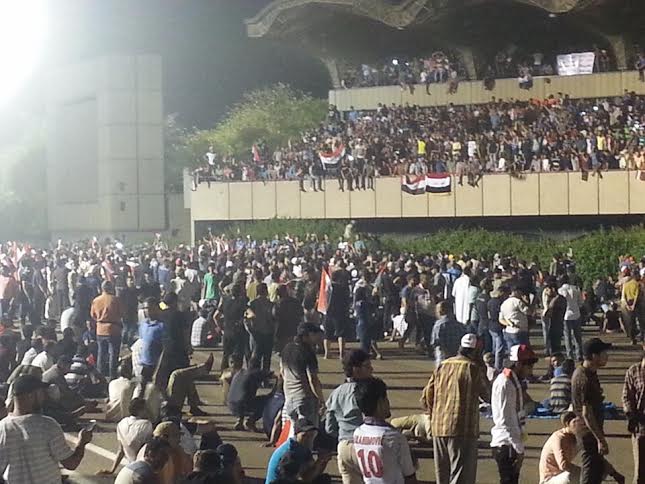
[Above: Sadrists mass in the Green Zone’s Grand Celebration Square on the evening of April 30.]
Sadrists Riot in the Southern Provinces
Meanwhile, Sadr’s supporters in smaller numbers began rioting across the southern provinces, specifically targeting the Dawa Party of Nouri al-Maliki. The governor of Karbala,a Dawa Party member, reportedly fled the area following Sadrist demonstrators’ storming of the Karbala government building. Other reports claimed that Sadrists stormed the headquarters of the Dawa Party in al-Nasiriyah in Dhi Qar Province and al-Diwaniyah in al-Qadisiyah Province, removing and smashing pictures of Maliki. Sadrists also stormed the headquarters of the Fadhila Bloc in Diwaniyah and the Diwaniyah government building before heading to the ISCI headquarters. Security forces in Muthanna and Maysan Provinces,meanwhile, went into high alert and emphasized the protection of party facilities. Instability in the south, an area that does not have a strong ISF presence, will stretch the security forces even thinner and provide additional opportunities for instability and violence.

[Above: Sadrist demonstrators attack a Dawa Party headquarters in Diwaniyah and tear down a poster of Dawa Party leader and former Prime Minister Nouri al-Maliki on April 30.]
Security Threats
The security situation in Baghdad could deteriorate further if the demonstrations do not de-escalate, as many Popular Mobilization members were withdrawing to Baghdad to conduct clearing operations in the southern Baghdad Belts area to address a growing ISIS threat in the area. The Defense Ministry had announced, with very poor timing, the start of clearing operations against ISIS cells in areas south of Baghdad led by the 17th Iraqi Army (IA) Division, a formation currently tasked with providing security in Baghdad and the surrounding belts area, with the participation of Popular Mobilization fighters. These areas south of Baghdad, including northern BabilProvince, have recently experienced a deteriorated security situation due toISIS attacks, particularly following the detonation of a massive Vehicle-borneImprovises Explosive Device (VBIED)on March 6 that killed at least 60 people and wounded at least 70 others, andseveral attempted attacks overthe past week. Several Iranian proxy militias, including the BadrOrganization and Kata’ibSayyid al-Shuhada, deployed to the southern Baghdad Belts area for theoperation, though BadrOrganization political bloc leader Qassim al-Araji stated that the forceswere only for the clearing operation and would not enter Baghdad, collide withdemonstrators, or involve themselves in intra-Shi’a fighting. However, oneunconfirmed report posted pictures and suggested that Federal Police, theGolden Division, and Iranian proxy militia Kata’ib Hezbollah were in the area “in case ofan emergency.”
Meanwhile, there is a risk of an ISIS attack on Sadristdemonstrators. Thousands of Shi’a pilgrims have been entering Baghdad tocommemorate the death of the Imam al-Kadhim, a major Shi’a holiday falling on May 3. This had already prompted the security forces to restrict access in manyareas of Baghdad.ISIS had already taken advantage of the situation by launching a VBIED attack in the predominantlyShi’a Nahrawan area, southeast of Baghdad, on April 30 prior to the start ofthe demonstrations, killing at least 23 people and wounding at least 48 others.Other attacks included IEDattacks on April 29 targeting pilgrims at a railway station south ofBaghdad, though the attack was foiled. If security continues to deteriorate,then the demonstrations could stretch the security forces thin and expose thecivilian population to an ISIS spectacular attack.
The security operation south of Baghdad appeared to betargeted at clearing ISIS from the area in order to protect pilgrims. However,the concentration of militia and security forces coincides dangerously with thestart of the Sadrist demonstrations. The presence of Iraqi Shi’a militias,specifically Iranian proxy rivals of Sadr, in the Baghdad area is extremelydangerous. There is a high potential for violence between Iranian-backedmilitias and Sadrist security details and protesters if they encounter oneanother. Iran will likely order its proxies to avoid engaging with Sadristelements in order to prevent a further escalation of the situation, but violenceremains a possibility. Violence could also occur between the Sadrists and partyelements, security forces, or militias in the southern provinces ifdemonstrators continue to attack party facilities and government buildings.
Implications
While the Sadrists dispersed to some extent as the nightwore on, some set up tents in the Green Zone, signaling a likely sit-in at Grand Celebration Square. Sadr’s office stated that demonstrations would “wash away” the political quotas system and corruption from the government, and his call for a “popularuprising” is threatening to Iraq’s stability. Sadr could keep his supporters in the Green Zone and further compromise the area’s security while pressuring the political blocs to bend to his will and vote in a technocratic cabinet. However,the political blocs’ resistance to abandoning their control of their cabinet seats is making the political situation untenable. Sadr may continue to obstruct the work of the government until he can secure a full cabinet reshuffle. However, the other political blocs, and Maliki in particular, may try and retaliate. They may try and convince PM Abadi to unleash the security forces on the Sadrist demonstrators in order to re-establish order, a scenario that could see Sadrists clashing violently with the ISF. Worse, party-linked or Iranian proxy militias could begin clashing with Sadrists, particularly if the demonstrators continue to try and attack party headquarters in the southernprovinces.
The three presidencies – PM Abadi, Speaker Juburi, and President Masoum – are slated to meet on May 1 with political bloc leaders to find a solution to the crisis. It is unclear if the Sadrist Trend will join,but Sadr is likely to try and use the force of the demonstrations to muscle concessions out of PM Abadi and the political blocs. Sadr will likely call off his supporters for another CoR session at some point, but he is unlikely towithdraw his supporters from the Green Zone without concrete concessions. Thepolitical crisis is likely to continue, and security threats remain potent. Meanwhile,the Sadrist opposition to U.S., as well as Iranian, participation in any attempt to mediate the political crisis will limit the U.S.’s ability to influence events, as the Sadrists could become even more agitated if the U.S.conducts high profile outreach against their wishes. Meanwhile, the Sadrists’fierce opposition to Maliki and the Dawa Party threatens to further undermine the country’s stability; Maliki is unlikely to back down from the challenge that Sadr has issued and may find a way to retaliate, possibly through force or by massing his own, admittedly smaller, cadre of supporters in counter-protests.
It is unclear if Maliki will be able to use a judicial ruling to his advantage; although Maliki has been able to force the judiciaryto rule in his favor during crises, it has remained distant during recent events. Notably, the judiciary issued a statement on April 18 that it would not rule on the events of the CoR, including on the constitutionality of CoR sessions. This indicates that it was not willing to expose itself with a controversial statement in favor of Maliki’s supporters within the rump parliament movement. A judicial ruling thus remains a diminished, though still possible, method of retaliation by Maliki against Sadr.
The situation is unstable enough to put the U.S. Embassy on alert, and the U.S. must prepare a contingency plan in case the situation spirals out of control. Iraq’s political crisis has reached dangerous new heights that pose a serious threat to the stability of the government, and in the worst case scenario could also threaten U.S. forces. Negotiations will continue among political leaders and the current unrest is likely to reduce as the initial rioting burns out. Nevertheless, if the political blocs cannot come to an agreement, or if violence or an ISIS spectacular attack against the demonstrators occurs, the situation could collapse even further. The U.S. must be prepared for the worst case scenario that sees the political crisis leading to violence in Baghdad and the potential collapse of PM Abadi’s government and deploy diplomatic or military assets in order to mitigate the possibility of an even more disastrous state of affairs.


