By Christopher Kozak and ISW Syria Team
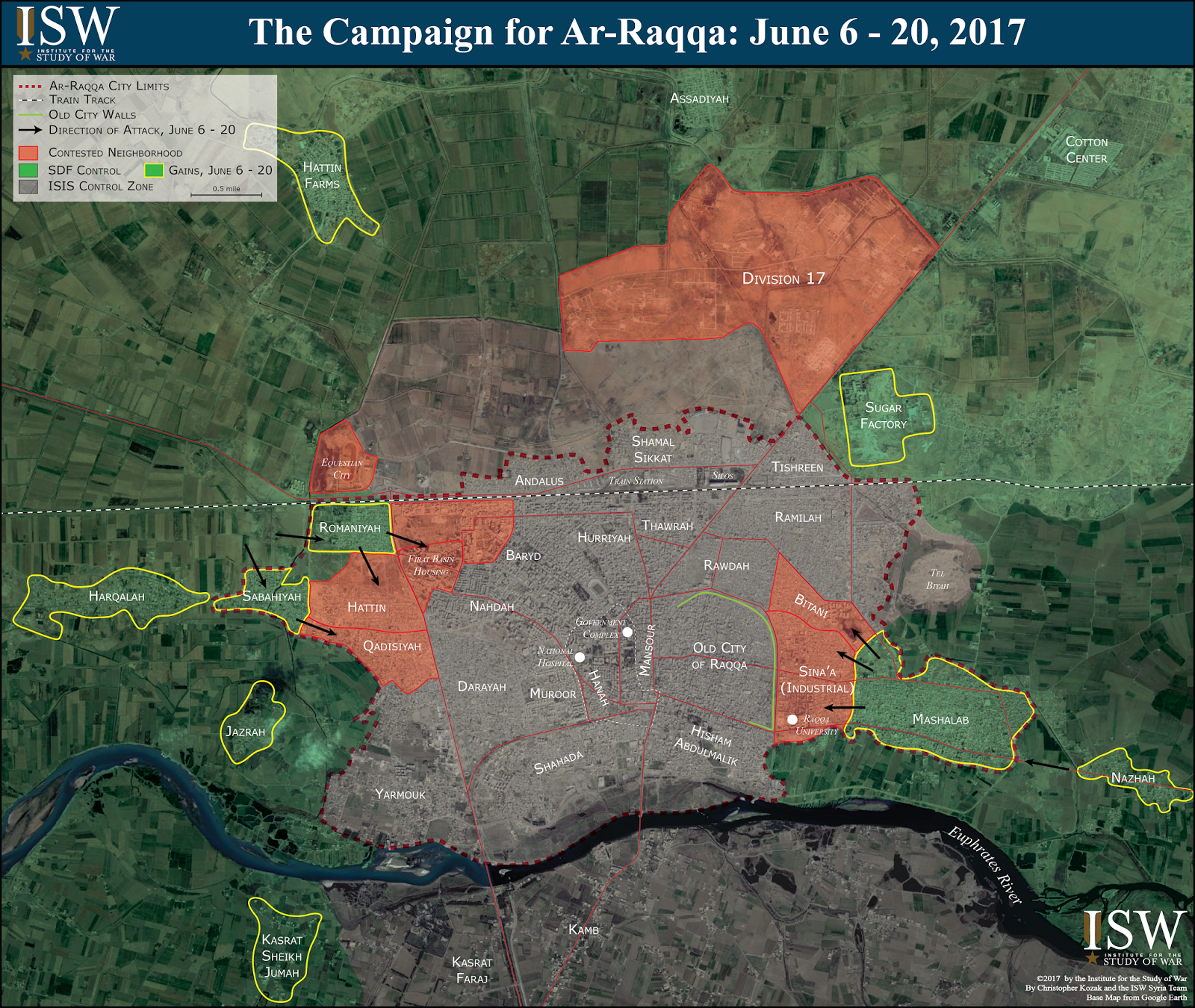
The U.S. Anti-ISIS Coalition and Syrian Democratic Forces (SDF) beganoperations to clear ISIS from Ar-Raqqa City in NorthernSyria on June 6. This urban combat phase marks the culmination of successful shapingoperations conducted over the last eight months to isolate Ar-Raqqa City under OperationEuphrates Wrath. These operations included the seizure of the TabqaDam in Western Ar-Raqqa Province on May 10. Ar-RaqqaCity is currently isolated along its three axes with only limited water trafficto the south across the Euphrates River. The fight for the city willnonetheless prove difficult. ISIS retains at least2,500 fighters in the city behind an elaborate systemof berms, tunnels, improvised explosive devices, and other defenses “verysimilar” to its posture in Mosul, Iraq. ISIS’s forces areintermingled with an estimated 50,000to 100,000 civilians, raising the complexity andrequirements of ongoing clearing operations. ISIS has thus far mounted a kinetic defense, ceding some outlying districts in favor of raids, ambushes, sleepercells, and suicide attacks as the group falls back towards the dense urban coreof Ar-Raqqa City. The capability of the SDF – a coalition of irregular forcesdominated by the Syrian Kurdish YPG – to sustain its offensive and overcomethese challenges remains doubtful despite expansive support from the U.S.Anti-ISIS Coalition.
The campaign for Ar-Raqqa City also faces significant challenges beyondthe urban fight. Continued U.S. support to the YPG risks alienating local SunniArabs whose support will be required to secure and govern the city over thelong term against the threat posed by ISIS, Al-Qaeda, and other Salafi-Jihadistgroups. The local population’s long-standing ethnicand political grievances will not beaddressed by the participation of Sunni Arabs in the Syrian Arab Coalition(SAC) or Raqqa CivilianCouncil – both of which locals view as mere puppets ofthe YPG in Northern Syria. The decision to back the YPG in Ar-Raqqa City also furthersa widening divide between the U.S. and Turkey in Syria. Turkey views with deepsuspicion the institutional links between the YPG and the Kurdistan Workers’Party (PKK), a designated Foreign Terrorist Organization that is currentlywaging an active insurgency in Southern Turkey. Turkish President Recep Erdoganmounted a failedlobbying campaign to convince both U.S.President Donald Trump and former U.S. President Barack Obama to halt their supportfor the SDF in Northern Syria in favor of opposition groups backed by Turkey.Turkey retains the capability to launch a major cross-borderintervention against the YPG along the Syrian-Turkish Border- particularly at the border town of Tel Abyad in Northern Ar-Raqqa Province.Turkey nonetheless will likely eschewany intervention over the near term andinstead hope that the YPG weakens itself through a sustained engagement inAr-Raqqa City. The Russo-Iranian Coalition also remains poised to exploit any setbacks suffered by the SDF in Ar-Raqqa City. Forces loyal to Syrian President Bashar al-Assad advanced into regions directly abutting the SDF in Tabqa in Western Ar-Raqqa Province on June 13. The U.S. later shot down a Syrian Arab Air Force fighter jet after the aircraft dropped munitions near positions held by the SDF near Tabqa on June 18. Russia, Iran, and Assad likely intend to block further gains by the SDF near Ar-Raqqa City as part of a wider effort to constrain the U.S. Anti-ISIS Coalition in Eastern Syria that began in May 2017.
ISIS ultimately will not suffer a fatal blow in Ar-Raqqa City. Intelligence officials and local activists report that the group has already relocated the majority of its leadership, media, chemical weapons, and external attack cells south of Ar-Raqqa City to the town of Mayadin in Deir ez-Zour Province in Eastern Syria. The SDF and U.S. Anti-ISIS Coalition as well as the Russo-Iranian Coalition both cannot easily access this terrain – located deep along the Euphrates River Valley – with their current force posture. ISIS stands to retain safe haven for the indefinite future despite the loss of its ‘de facto’ capital. The fall of Ar-Raqqa City will be symbolic – but it will not be decisive.