
Key Takeaways
The localized Kherson Oblast ceasefire officially ended on November 1 and appears to have led to the successful evacuation of up to 800 civilians while providing sorely needed humanitarian aid to Oleshky and surrounding settlements. Ukrainian Human Rights Commissioner Dmytro Lubinets and Russian Human Rights Commissioner Yana Lantratova announced that the ceasefire, which started on October 27, ended on November 1 and that both Russia and Ukraine respected their ceasefire commitments.[1] Despite initial reporting that raised concerns over whether or not evacuees would be able to freely choose where to evacuate to (Russia or Ukraine, or to stay in Oleshky), it appears as though most residents were able to make their choice without pressure from Russian or Ukrainian authorities.[2] Lubinets emphasized during a press conference on November 2 that the evacuation route from Kherson Oblast ran through Crimea, Krasnodar Krai, and Belarus because the Ukrainian military determined this was the safest route to reach Ukraine and noted that evacuees did not have to go through Russian “filtration” (the coercive screening that Russia imposes on Ukrainian civilians in occupied areas in order to determine pro-Ukrainian affiliations and collect their personal data) as part of the evacuation process.[3]
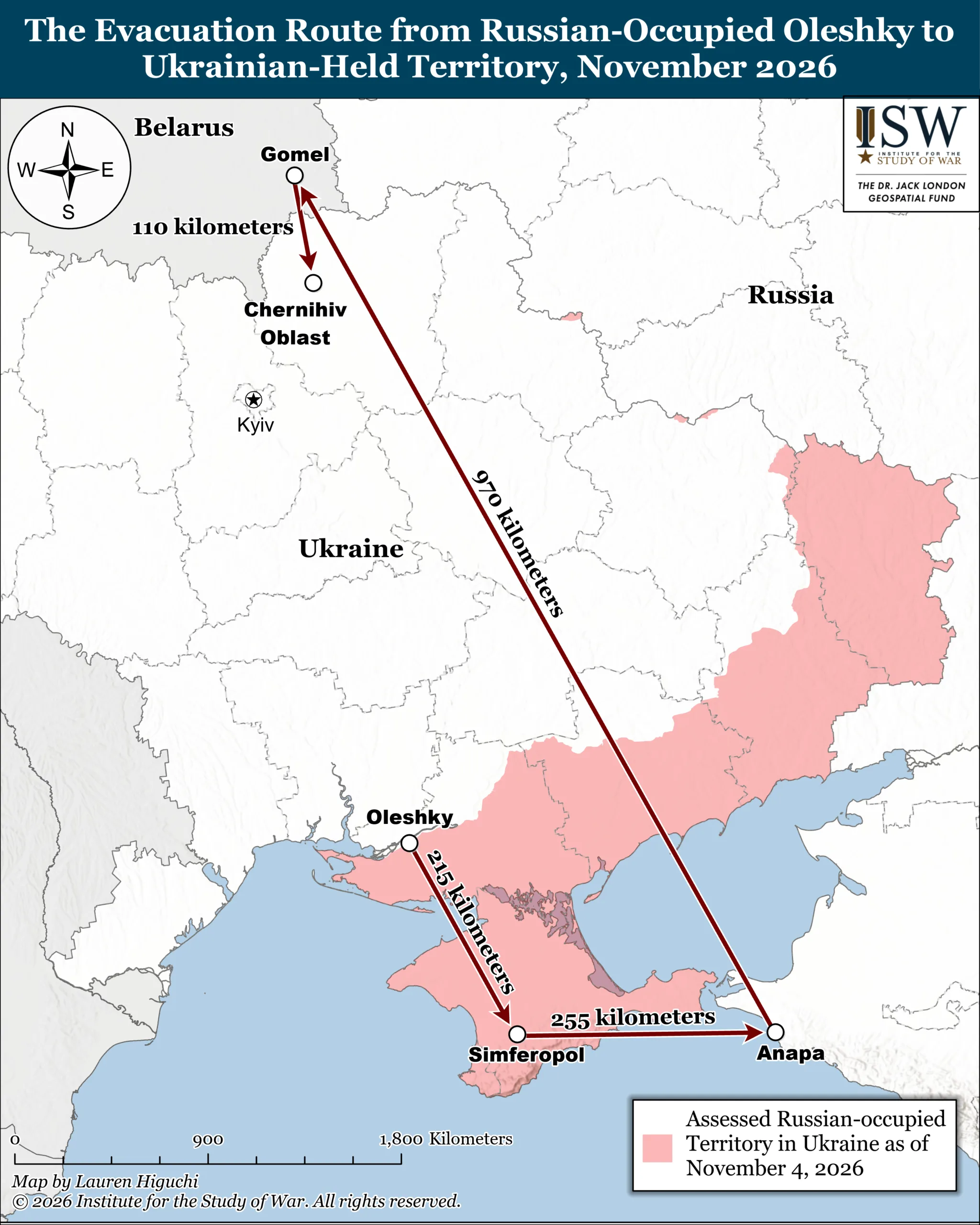
Although official sources have not yet confirmed evacuation numbers, it appears as though more residents chose to evacuate to Ukraine than to Russia. First Lady Melania Trump reported on November 1 that the ceasefire enabled the evacuation of nearly 800 people from the Oleshky area but did not specify the numbers that went to Russia versus Ukraine.[4] US outlet Newsmax, the only American outlet allowed into Oleshky to cover the ceasefire, reported that 15 evacuation buses left Oleshky — 11 bound for Ukraine and 4 bound for Russia.[5] Kherson City Council Deputy Oksana Pohomiy stated that out of the 4 buses bound for Russia, only two terminated their route there, while the other two brought evacuees to locations within Russian-occupied Ukraine.[6] Pohomiy claimed that only two families evacuated to Russia, and the Kyiv Post reported that a total of 10 people decided to go to Russia, whereas the vast majority elected to return to Ukrainian-held territory.[7] Lantratova claimed that a family with seven children evacuated from Oleshky to Krasnodar Krai, where the older children will soon begin school.[8] Russian media reported that evacuees to Russia will stay in temporary accommodation centers (TACs) in occupied Crimea, Rostov Oblast, and Krasnodar and Stavropol krais, where they will receive psychological evaluation, medical care, and assistance with Russian documentation and paperwork.[9]
Russian and Ukrainian reporting suggests that between 1,000 and 2,000 people may have chosen to remain in the Oleshky area after the ceasefire.[10] Some residents expressed fears of going through Russian filtration while evacuating, while others were unwilling to part with their long-time homes or their pets.[11] Elderly residents with mobility issues or individuals with various illnesses or injuries made the decision to stay behind, fearing the physical toll of the long evacuation voyage.[12] The ceasefire facilitated the successful delivery of sorely needed humanitarian aid into the Oleshky area — providing food, water, medicine, fuel, and medical equipment for the residents who have decided to remain.[13] The ceasefire also provided for demining operations in the Oleshky area, which will make movement temporarily safer. Ukrainian military sources have raised concerns, however, that Russian forces used the ceasefire to reinforce their positions along the Dnipro River, and the re-militarization of the area following the ceasefire is likely to present renewed dangers to remaining residents.[14]
Russia’s continued occupation of the Oleshky area will exacerbate the vulnerability of the residents who decided not to evacuate. Russia’s nearly five-year-long occupation of Oleshky and its surrounding settlements created the conditions of total deprivation that generated the need for the ceasefire in the first place.[15] The last food delivery into the area prior to the ceasefire was on May 26.[16] Lack of adequate medical supplies and destroyed medical facilities in Oleshky led to a critical sanitary crisis.[17] Russian soldiers of the Black Sea Fleet and Airborne forces (VDV), who were deployed in the Oleshky area, perpetrated abuses against the civilian population, including instances of reported killings and sexual violence.[18] Five days’ worth of humanitarian aid delivered into the area will be consumed quickly, and the culture of civilian abuse within the Russian military will not abate as a result of the ceasefire. Russian officials are likely also counting on a decline in international attention on Oleshky following the ceasefire and will be able to perpetrate crimes of occupation with greater impunity. Addressing and reversing the conditions of Russian occupation will require longer-term and more durable humanitarian solutions.
Russia is highly likely to use the success of the Oleshky ceasefire for narrative effect, particularly vis-à-vis the Trump administration. The Kremlin has particularly capitalized on Melania Trump’s previous efforts to advocate for the repatriation of deported Ukrainian children to ingratiate itself with the Trump administration in the hopes of using the bilateral relationship to secure favorable concessions from the United States in future negotiations.[19] Russia is similarly likely to use the Oleshky ceasefire as evidence of its supposed humanitarianism and willingness to negotiate in order to secure similar concessions in upcoming negotiations efforts, including during the scheduled Russia-US-Ukraine trilateral talks in Abu Dhabi. Russian Human Rights Commissioner Yana Lantratova is also likely to use her involvement in the ceasefire to pose herself as a legitimate and visible actor in the human rights and humanitarian space, which is notable given she is under US and international sanctions for her role in the war in Ukraine.[20] Lantratova is also directly implicated in Just Russia Party head Sergei Mironov’s illegal adoption of a deported Ukrainian child.[21] Lantratova’s attempt to use the ceasefire to launder her reputation is noteworthy given Ukrainian insider reporting that Melania Trump has invited both Lantratova and Ukrainian Human Rights Commissioner Dmytro Lubinets to the White House to discuss the Oleshky ceasefire on November 5.
The Oleshky ceasefire ultimately emphasizes that Moscow clearly has the capability, but not the will, to stop its destructive invasion of Ukraine. The humanitarian crisis that necessitated the Oleshky ceasefire was entirely a result of Russian occupation policy in a destroyed and deprived frontline settlement. Russia turned down at least three official humanitarian ceasefire proposals between May and September 2026 before accepting the Melania Trump-brokered deal in October.[22] Russia was clearly aware of the devastation that Oleshky was facing as a result of its occupation, but focused its efforts on blaming Ukraine for the situation as opposed to remedying it.[23] Russia’s acceptance of the US-brokered ceasefire deal in late October and its adherence to the ceasefire terms for five full days emphasizes that Russian diplomacy and humanitarianism is chiefly a matter of will. Russia had the capability to stop the suffering in Oleshky but ultimately prolonged the suffering until the Kremlin exercised limited political will to accept the limited ceasefire. Russia similarly had the capability to accept the myriad ceasefire and diplomatic proposals that Ukraine has laid out in recent years but lacked the will to do so. Oleshky represents the fact that the Russian invasion can be halted immediately, but that Russia’s continued intransigence is the ultimate obstacle to any good-faith negotiation processes.[24]

[1] https://t.me/dmytro_lubinetzs/12976; https://t.me/lantratovaDOBRO/16129
[2] https://www.vesti dot ru/ns/lantratova-v-aleshkakh-my-udostoverilis-lyudi-mogli-vyekhat-kuda-khoteli; https://x.com/NEWSMAX/status/2117267388076838965
[3] https://www.rbc dot ua/rus/news/chomu-zhiteliv-oleshok-evakuyuvali-cherez-1793628328.html; https://t.me/RBC_ua_news/210765
[4] https://x.com/MELANIATRUMP/status/2117033555863949706
[5] https://x.com/NEWSMAX/status/2117267388076838965
[6] https://espreso dot tv/viyna-z-rosiyeyu-z-oleshkiv-do-rosii-viikhali-lishe-dvi-simi-pogomiy-rozpovila-kudi-naspravdi-poikhali-chotiri-avtobusi#goog_rewarded
[7] https://espreso dot tv/viyna-z-rosiyeyu-z-oleshkiv-do-rosii-viikhali-lishe-dvi-simi-pogomiy-rozpovila-kudi-naspravdi-poikhali-chotiri-avtobusi#goog_rewarded; https://www.kyivpost dot com/analysis/88969
[8] https://www.kp dot ru/online/news/7250075/; https://t.me/lantratovaDOBRO/16132
[9] https://tass dot ru/obschestvo/28257931; https://t.me/admkrai/57702; https://tass dot ru/obschestvo/28272903; https://tass dot ru/obschestvo/28273541
[10] https://war dot obozrevatel.com/ukr/section-war/news-skilky-lyudey-lyshylos-v-okupovanykh-oleshkakh-nazvano-tsyfru-02-11-2026.html#goog_rewarded; https://www.kyivpost dot com/post/88919; https://tass dot ru/obschestvo/28250069
[11] https://www.kyivpost dot com/analysis/88969; https://www.facebook.com/reel/1817216219311774/?cft[0]=AZh-kJWKn6tAW-dsBdxasI8GfNElSrPKV_V7wKmDxN3pC6AzKv-qyGMNsLK-zyGHlDIY0DJsk7pih0_IUVw0EAsrnISRD5J5NEk23uKmQCSSUgMD5lsHLLQj54CCS0Lb4Bl-8xec17twJpkHwUltvJO8cA7VfBzpEjf8INDatQ5yLIxY5OIx3qcO7R5ESE-rpdqJLIk&tn=%2CO%2CP-R; https://x.com/NEWSMAX/status/2117267388076838965
[12] https://www.bbc.com/ukrainian/articles/c6rryp75q89xo
[13] https://www.pravda.com dot ua/news/2026/11/02/8060879/; https://x.com/alexsalvinews/status/2117741467838058633
[14] https://t.me/GeneralStaffZSU/42763; https://news.sky.com/video/exclusive-russian-military-used-oleshky-ceasefire-to-reinforce-military-positions-around-city-13606796
[15] https://understandingwar.org/research/russia-ukraine/oleshky-how-russia-governs-through-humanitarian-decline/
[16] https://ukraine.ohchr.org/en/Desperate-situation-for-civilians-trapped-in-frontline-areas-says-UN-Human-Rights-Ukraine
[17] https://www.youtube.com/watch?v=UiqEax-Ojh8; https://intent.press/en/news/society/2026/oleshky-has-been-without-food-and-medicine-for-over-a-month-the-humanitarian-situation-is-critical/
[18] https://lifeinwar dot com/publications/prirecheni-na-smert-yak-vizhivayut-i-vmirayut-u-peretvorenih-na-zonu-smerti-v-oleshkah-i-goliy-pristani; https://www.slidstvo dot info/news/slidstvo-info-vstanovylo-rosiyskykh-viyskovykh-iaki-mozhut-buty-prychetnymy-do-humanitarnoi-katastrofy-v-oleshkakh/; https://t.me/andriyshTime/53405
[19] https://understandingwar.org/research/russia-ukraine/russia-is-turning-deported-ukrainian-children-into-bargaining-chips/
[20] https://www.opensanctions.org/entities/Q108757245/
[21] https://www.nytimes.com/2026/05/18/world/europe/russia-ukraine-children-kidnapping.html
[22] https://understandingwar.org/research/russia-ukraine/oleshky-how-russia-governs-through-humanitarian-decline/
[23] https://understandingwar.org/research/russia-ukraine/russian-occupation-update-september-24-2026/; https://understandingwar.org/research/russia-ukraine/russian-occupation-update-october-8-2026/
[24] https://understandingwar.org/research/russia-ukraine/russian-offensive-campaign-assessment-august-14-2026/; https://understandingwar.org/research/russia-ukraine/russian-offensive-campaign-assessment-june-29-2026/; https://understandingwar.org/research/russia-ukraine/russian-offensive-campaign-assessment-july-15-2025/; https://understandingwar.org/research/russia-ukraine/russian-offensive-campaign-assessment-may-10-2025/; https://understandingwar.org/research/russia-ukraine/russian-offensive-campaign-assessment-april-21-2025/; https://understandingwar.org/research/russia-ukraine/russian-offensive-campaign-assessment-april-18-2025/; https://understandingwar.org/research/russia-ukraine/russian-offensive-campaign-assessment-march-13-2025/; https://understandingwar.org/research/russia-ukraine/russian-offensive-campaign-assessment-october-12-2026/