
Click here to read ISW National Security Fellow Karolina Hird’s new special report examining and debunking Russian efforts to use deported Ukrainian children as bargaining chips in negotiations with the United States.
Key Takeaways
- Russian officials continue to personally sponsor trips intended to Russify Ukrainian children.
- Russia continues efforts to impose Kremlin-approved educational standards on occupied Ukraine.
- Russia is setting conditions to scale up the illegal mobilization of residents of occupied Ukraine.
- Russia continues the construction of the Voin military patriotic training center for youth in occupied Mariupol.
- Russia is using a battalion comprised of former Ukrainian soldiers to train Ukrainian children in drone operation and other tactical and technical skills.
- Russian law enforcement retaliated against a delegation of Crimean Tatars who travelled to Moscow to advocate for the release of several Crimean Tatar women currently in Russian detention.
- Russian state-owned and government entities continue funneling investments into industrial and economic projects in occupied Ukraine.
- Russian federal censor Roskomnadzor is further blocking access to Telegram and WhatsApp in occupied Ukraine.
- Russia continues efforts to reconstruct occupied Mariupol in its own image.
Deportation and Forcible Transfer of Ukrainian Citizens, Including Children
Russian officials continue to personally sponsor trips intended to Russify Ukrainian children. Russian Liberal Democratic Party (LDPR) Head and Duma Deputy Leonid Slutsky posted footage on October 31 of thirty children from occupied Mariupol visiting Moscow as part of a trip which the LDPR organized.[1] Slutsky stated that the trip “helped children from Donbas feel part of Russia’s vast cultural space” and that it is important for children from occupied Ukraine to visit Russia to feel that “they are part of a large and united country.” Russian state outlet Pervyi Kanal posted a short film on October 31 showing the story of a 12-year-old girl from occupied Donetsk Oblast who travelled to Moscow to meet with Kremlin-appointed Commissioner for Children’s Rights Maria Lvova-Belova.[2] The footage depicts the girl visiting a Russian Orthodox Church with Lvova-Belova and then attending a 10-day “social rehabilitation” program for children from occupied Ukraine at the Berezovaya Roshcha sanatorium on the outskirts of Moscow. The Russian “Country for Children” charitable foundation organized the girls’ trip to Moscow. Such trips, although not explicitly intended to permanently resettle Ukrainian children in Russia, expose children to Russian culture and ideologies and are therefore a powerful tool of Russification and indoctrination.
Sociocultural Control
Russia continues efforts to impose Kremlin-approved educational standards on occupied Ukraine. Russian First Deputy Minister of Education Alexander Bugayev claimed on October 30 that education protocol in occupied Ukraine has fully transitioned to “Russian standards.”[3] The Ukrainian Almenda Center for Civil Education reported that since September 1, Russian occupation authorities have intensified Russification efforts in schools in occupied Ukraine using next textbooks and “patriotic” education models.[4] Almenda found that at least 592,400 children are studying in Russian-controlled schools in occupied Ukraine. Despite the Russian Ministry of Education’s efforts to standardize the teaching of Russian history, culture, and values in Ukrainian classrooms, reporting from a Ukrainian partisan source suggests that Moscow continues to observe persistent support for Ukraine amongst school children, particularly in occupied Kherson Oblast.[5] Coerced compliance with Russian educational standards does not seem consistent throughout occupied Ukraine, which may challenge aspects of Russia’s occupation calculus.
Militarization of Occupied Areas
Russia is setting conditions to scale up the illegal mobilization of residents of occupied Ukraine. Russian President Vladimir Putin signed a law on November 4 that will allow Russian military conscription administrative processes to occur year-round, as opposed to the current system of semi-annual spring and autumn conscription cycles.[6] The new conscription law will also apply to occupied Ukraine, allowing Russia to scale up its illegal mobilization processes that have been occurring in occupied territories since 2022 or 2014.[7] The Ukrainian Resistance Center reported on October 31 that Russian occupation authorities have already begun year-round conscription processes in occupied areas and have instructed military enlistment offices to compile lists of 18 to 50-year-old men for conscription in occupied Melitopol.[8] Law enforcement services in occupied Melitopol have begun conducting door-to-door checks to verify residents’ addresses, especially targeting men working in manual labor professions, as they can be quickly mobilized into the Russian army and deployed to rear positions without formal military training.
Ukrainian outlet Suspilne reported on October 30 that Russia has long used occupied Crimea as a testing ground for forced mobilization mechanisms under occupation.[9] Crimean Human Rights Group Head Olha Skrypnyk reported that Russia’s previous bi-annual fall and spring conscription efforts mobilized around three thousand local Crimean residents each, and that Russian occupation authorities would also force some of the conscripts to sign “voluntary” contracts with the Russian Ministry of Defense (MoD) to obscure the scale of forced mobilization in Crimea. Skrypnyk noted that the pace of forced recruitment of Crimean men since 2022 has decreased as Russian authorities prefer to conduct broader-reaching mobilization campaigns in Zaporizhia, Kherson, Donetsk, and Luhansk oblasts in order to present the situation in occupied Crimea as somewhat normal. Human rights advocates estimate that Russia-appointed occupation authorities have drafted or mobilized over 45,000-50,000 Crimean residents since 2014, compared to an estimated 210,000 in Donetsk and Luhansk oblasts since 2022 alone.[10]
Russia’s illegal mobilization efforts likely serve a dual purpose. First, they allow Russia to address its manpower shortages without alarming its domestic population. Second, Russia instrumentalizes mobilization as a tool to suppress anti-occupation sentiment and resistance by incentivizing compliance with the occupation regime. These mobilization efforts also constitute a gross violation of international law. Russia continues to disregard Article 51 of the Fourth Geneva Convention, which prohibits the occupying power from forcibly conscripting civilians from occupied territories into its armed forces.[11]
Russia continues the construction of the Voin military patriotic training center for youth in occupied Mariupol. Voin’s occupied Donetsk Oblast branch director Alexander Kamyshov told Kremlin newswire TASS on November 1 that the Voin military-sports training and patriotic education center in occupied Mariupol will be open year-round after construction finishes in 2026.[12] The Mariupol Voin center will accommodate 300 children and include a tactical shelter, drone training area, indoor gym, a “shooting gallery”, sports training facilities, a helicopter training tower, onsite residences, and a dining hall.[13] Kamyshov told TASS on November 3 that the occupied Donetsk Oblast branch of Voin increased its audience tenfold in 2025, reaching 3,000 participants.[14] ISW previously reported that Voin training camps are primarily intended to teach Ukrainian children basic military skills, such as small arms fire, tactical first aid, and drone operation, under the supervision of Russian veterans and active military personnel.[15] ISW continues to assess that Voin is a critical component of Russia’s broader militarization and indoctrination efforts in occupied Ukraine that are geared towards preparing Ukrainian children for service in the Russian military.[16] There are currently three branches of Voin centers in occupied Ukraine aside from the one under construction in occupied Mariupol, located in Henichesk, Berdyansk, and Luhansk City.[17]
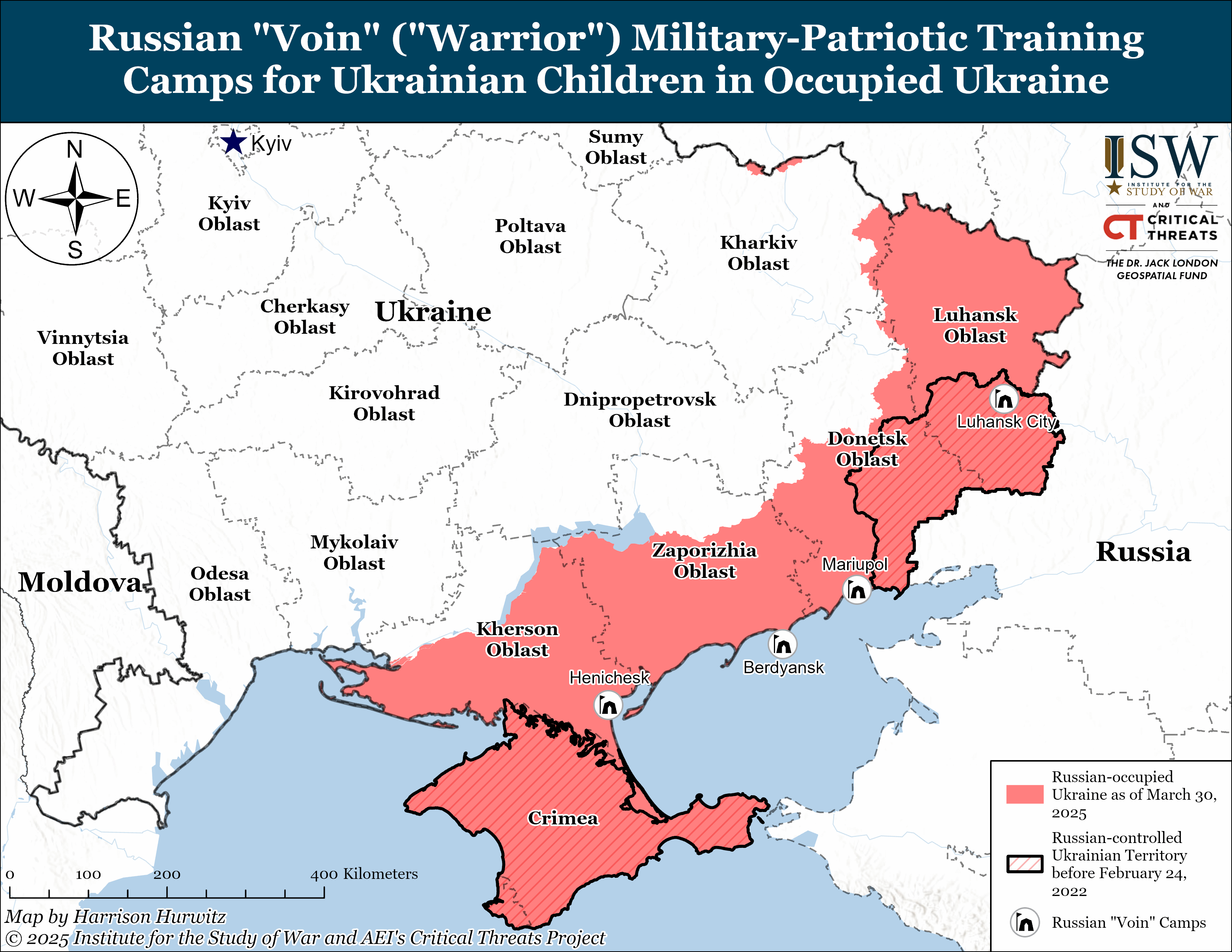
Russia is using a battalion comprised of former Ukrainian soldiers to train Ukrainian children in drone operation and other tactical and technical skills. Occupied Donetsk Oblast-based outlet Donetsk News Agency (DAN) reported on November 1 that one of its correspondents visited the Rubikon training ground in occupied Donetsk Oblast and observed a five-day youth training course on firearm use, tactical medicine, and drone operation. Russian veterans, including those of the Pyatnashka International Volunteer Brigade, are instructors at the training ground. DAN claimed that members of the Maksim Krivonos Battalion, many of whom allegedly defected from the Ukrainian military, comprise a majority of the instructor core. The Mariupol Specialized Construction College reported on November 5 that it sent a student contingent to the Rubikon training ground to participate in the five-year course alongside Russian veterans and members of the Maksim Krivonos Battalion.[18] Ukrainian outlet Suspilne published an investigation into the Maksim Krivonos Battalion on August 21, which found that the unit is predominantly staffed by Ukrainian prisoners of war (POWs) who Russian forces captured between 2023-2024.[19] Suspilne noted that it is very difficult to determine which servicemembers are participating in combat operations against Ukraine voluntarily due to the inherently dangerous and coercive nature of being taken as a POW, but emphasized that the use of POWs to serve in the military of the aggressor state is a war crime. Russia is likely using the Maksim Krivonos Battalion to train Ukrainian youth in part for propagandic purposes, as many prominent members of the battalion publicly advocate their anti-Ukrainian and pro-Russian views.[20] The battalion also provides Ukrainian children with tangible military training, supporting Russian efforts to prepare Ukrainian children for future service in the Russian military.[21]
Administrative and Bureaucratic Control
Nothing significant to report.
Occupation Administration Mismanagement and Internal Dynamics
Nothing significant to report.
Physical and Legal Repressions
Russian law enforcement retaliated against a delegation of Crimean Tatars who travelled to Moscow to advocate for the release of several Crimean Tatar women currently in Russian detention. Crimea-based human rights organization Crimean Solidarity reported that a delegation of 16 Crimean Tatars arrived in Moscow on October 31 after a multi-day minibus trip to submit a petition for the release of four Crimean Tatar women who received over 6,500 signatures.[22] The petition was in reference to the October 15 Federal Security Service (FSB) arrests of four women near Sevastopol on unfounded allegations of “extremism.”[23] Russian law enforcement stopped the delegation while en route to Moscow five separate times, during which Russian police and the Ministry of Internal Affairs harassed and detained members of the delegation for hours at a time.[24] The treatment of peaceful Crimean Tatar activists is consistent with the Russian state’s policy of repressive brutality towards the Crimean Tatar community, and additionally indicative of the restrictions on freedom of movement of Crimean Tatars within both occupied Crimea and Russia.
Economic and Financial Control
Russian state-owned and government entities continue funneling investments into industrial and economic projects in occupied Ukraine. Russian state-owned bank Promsvyazbank (PSB) announced on October 30 that it will provide a 1.1 billion rubles ($13.5 million) investment loan for the modernization of the Bilorichenska coal mine in occupied Luhansk Oblast.[25] PSB noted that the Bilorichenska mine is a leading coal mine in the area, supplying 40 percent of thermal coal for occupied Luhansk Oblast. The PSB loan will be provided at a preferential rate that is unique to investment in occupied areas of Ukraine. This loan, and any economic profit that it stimulates from the mine, provides PSB with a direct revenue stream to profit from Russia’s occupation of Luhansk Oblast. Russian Prime Minister Mikhail Mishustin additionally announced on October 30 that the Russian government will allocate 1 billion rubles ($12 million) in preferential loans to residents of the free economic zone (FEZ) in occupied Crimea in order to “increase the attractiveness” of Crimea to investors.[26] ISW has previously assessed that Russia is investing so heavily in industrial, economic, and financial assets in occupied Ukraine in order to generate tangible profit from its occupation. Russian officials, state-owned enterprises, and government entities all stand to benefit from this extractive investment strategy.
Information Space Control
Russian federal censor Roskomnadzor is further blocking access to Telegram and WhatsApp in occupied Ukraine. Occupied Crimea-based Russian telecommunications operator Volna Mobile announced on October 29 that it is restricting access to Telegram and WhatsApp messengers in accordance with Russia’s Federal Service for Supervision of Communications, Information Technology and Mass Media (Roskomnadzor) measures.[27] Russian state outlet RBK reported on October 30 that users experienced issues accessing the messengers.[28] Roskomnadzor previously announced on October 21 that it is partially restricting access to WhatsApp and Telegram to “counter criminals” and announced blocking of voice calls in August 2025.[29] A Russian milblogger claimed on October 30 that Roskomnadzor is requesting Russian regional communications service operators to restrict access to Telegram because scammers and Russia-labeled terrorists use it, but that the restrictions do not prevent actual scammers from using other fraudulent methods and instead inhibit coordination between Russian military units.[30] Volna Mobile later denied reports of restricted access to WhatsApp and Telegram on October 29 and claimed that its earlier press release referred to possible restrictions that Roskomnadzor announced on October 21.[31] Volna Mobile claimed that Telegram experienced a temporary outage, which was why users in occupied Crimea experienced issues accessing the messenger. Roskomnadzor claimed on October 30 that it was not restricting access to Telegram and WhatsApp in occupied Crimea.[32] Ukrainian outlet Suspilne reported that the incident could have been a “rehearsal” for future restrictions or a false start.[33]
Roskomnadzor restrictions on Telegram and WhatsApp are likely intended to force residents of occupied areas to switch over to the Kremlin-controlled MAX messenger, granting Russian authorities even greater control over the information space in occupied areas. Russian opposition outlet Meduza reported on November 2 that Russian communications service providers will stop transmitting SMS and calls with authorization codes for registering new WhatsApp and Telegram users, effectively making it more difficult for users to register with those platforms in the first place.[34] Volna Mobile’s press service recommended that residents of occupied Crimea download the Kremlin-controlled MAX messenger, and Russian authorities continue to promote the app.[35] Suspilne reported that Russian authorities designed the MAX messenger for centralized user tracking and that Russian intelligence services have access to user data.[36]
Infrastructure and Development Projects
Russia continues efforts to reconstruct occupied Mariupol — a city which Russia’s invasion of Ukraine and its occupation policies have largely destroyed — in its own image. Vasily Novokhatko, a project manager of the St. Petersburg-based Modul-Center construction company, reported to Kremlin newswire TASS that repair and restoration work at the Mariupol Drama Theater is “more than 80 percent complete.”[37] The Mariupol occupation administration plans to open the theater as early as December.[38] Russia notably destroyed the theater on March 16, 2022, when Russian forces dropped two heavy bombs on the theater as civilians, including children, sheltered inside.[39] Those sheltering in the theater clearly wrote the word “children” in Russian outside the theater in an attempt to safeguard themselves from the attack, which may have killed up to 600 people.[40] Amnesty International and other human rights organizations have classified Russia’s attack on the theater as a clear war crime.[41] Russian reporting on the reconstruction of the drama theater completely ignores these well-established facts and is consistent with the wider Russian effort to cover up its crimes in Mariupol by presenting the city as somehow better off under Russian occupation. Occupation officials continue efforts to highlight other construction projects, such as two newly renovated hotels, in order to add to the image of a new and improved Mariupol.[42]

[1] https://t.me/slutsky_l/4010
[2] https://t.me/malvovabelova/5927
[3] https://tass dot ru/obschestvo/25493431
[4] https://almenda.org/osvita-yak-instrument-rosijskoyi-propagandy-shho-zminylos-dlya-uchniv-na-tot-z-1-veresnya/
[5] https://t.me/yellowribbon_ua/12533
[6] https://meduza dot io/news/2025/11/04/putin-podpisal-zakony-o-kruglogodichnom-prizyve-i-privlechenii-rezervistov-na-sluzhbu-v-mirnoe-vremya; http://publication dot pravo.gov.ru/document/0001202511040014; https://understandingwar.org/research/russia-ukraine/russian-offensive-campaign-assessment-november-4-2025/
[7] https://t.me/sprotyv_official/7900
[8] https://t.me/sprotyv_official/7900
[9] https://suspilne dot media/crimea/1151652-hto-moze-organizovue-viizd-abo-oformlue-bron-ak-rosia-v-krimu-provodit-castkovu-mobilizaciu-na-postijnij-osnovi/
[10] https://suspilne dot media/crimea/1151652-hto-moze-organizovue-viizd-abo-oformlue-bron-ak-rosia-v-krimu-provodit-castkovu-mobilizaciu-na-postijnij-osnovi/; https://www.lemonde.fr/en/international/article/2025/10/22/hundreds-of-thousands-of-ukrainians-are-forcibly-conscripted-by-russia-s-army_6746688_4.html
[11] https://mfa dot gov.ua/en/news/komentar-mzs-shchodo-tak-zvanogo-vijskovogo-prizovu-rf-ukrayinskih-gromadyan-na-timchasovo-okupovanih-teritoriyah-ukrayini
[12] https://tass dot ru/obschestvo/25518585
[13] https://tass dot ru/obschestvo/25518585 ; https://understandingwar.org/research/russia-ukraine/russian-occupation-update-september-8-2025/
[14] https://tass dot ru/obschestvo/25527265
[15] https://understandingwar.org/research/russia-ukraine/russian-occupation-update-march-31-2025/
[16] https://understandingwar.org/research/russia-ukraine/russian-occupation-update-may-19-2025/ ; https://understandingwar.org/research/russia-ukraine/russian-occupation-update-september-8-2025/
[17] https://understandingwar.org/map/russian-voin-warrior-military-patriotic-training-camps-for-ukrainian-children-in-occupied-ukraine/
[18] Source accessed via archive: https://archive.ph/geDn1
[19] https://suspilne dot media/1096158-znikli-bezvisti-u-bataljoni-krivonosa-ak-rosia-voue-ukrainskimi-vijskovopolonenimi/
[20] https://suspilne dot media/1096158-znikli-bezvisti-u-bataljoni-krivonosa-ak-rosia-voue-ukrainskimi-vijskovopolonenimi/
[21] https://understandingwar.org/research/russia-ukraine/russian-occupation-update-september-11-2025/; https://understandingwar.org/research/russia-ukraine/russian-occupation-update-october-23-2025/; https://understandingwar.org/research/russia-ukraine/russian-occupation-update-august-21-2025/
[22] https://www.facebook.com/crimeansolidarity/posts/pfbid02xFqLtriBD9iPVAXx5jrbiFM9MDTdZMfgEdacm8cnubwyjzBeiiQxeAF4BPdxvyCl; https://www.facebook.com/crimeansolidarity/posts/pfbid025zC9aAqUM8dpyRQKeFr4S4YE4HyCc8hnvawyZQDED2HCJR3nYXB1UcW68peWeFXil
[23] https://understandingwar.org/research/russia-ukraine/russian-occupation-update-october-23-2025/
[24] https://ua.krymr dot com/a/news-delegatsiya-krymskykh-tatar-povernulasia-moskva-podacha-6-5-tysyach-pidpysiv-zvilnennia-politviazniv/33580187.html; https://www.facebook.com/crimeansolidarity/posts/pfbid024hvuGMcj4PBumgtou88PRuSYbxKCtF7JzLGjbmpo9e4HPuugZgXvMaSEDBrutPXil; https://www.facebook.com/crimeansolidarity/posts/pfbid0DoXR4fe7SbC7AVuWyXTcDoccLB8QBrJWp97QGoSar6T6RUqY5dDyf8KEbmmdS8sXl; https://www.facebook.com/crimeansolidarity/posts/pfbid031Zf5tt4iBLayUHLfbjq1tKv1zk5GpqQbbb7fmKvcZCmzoL8JxSG35G9nQ64PFSuil; https://www.facebook.com/crimeansolidarity/posts/pfbid0mAkHpi1rDxfnQybov2NTwN1XfNdN8Mgzm8nFzStWyZh2VDmHqUS6czfpHktPgnt8l; https://www.facebook.com/crimeansolidarity/posts/pfbid0vVLVGgK9p5N8ShTb4NiLfMadKLFGT4uowZxLDJG5muQnDUxg9c9rei65SizKiEZjl; https://www.facebook.com/reel/1227818459106420
[25] https://tass dot ru/ekonomika/25503015
[26] https://tass dot ru/ekonomika/25501715
[27] https://www.rbc dot ru/technology_and_media/30/10/2025/69034b519a7947dbb24af3d9;
https://meduza dot io/news/2025/10/30/v-anneksirovannom-krymu-chastichno-ogranichili-rabotu-telegram-i-whatsapp;
https://suspilne dot media/crimea/1154720-rosiani-obmezuut-robotu-telegram-i-whatsapp-u-krimu-ak-zalisatisa-na-zvazku/
[28] https://www.rbc dot ru/technology_and_media/30/10/2025/69034b519a7947dbb24af3d9
[29] https://www.rbc dot ru/politics/22/10/2025/68f8b08c9a7947cd6de9b5da ;
https://www.rbc dot ru/politics/13/08/2025/689c8c7c9a79479b1087586d
[30] https://t.me/dva_majors/82338
[31] https://volnamobile dot ru/news/529
[32] https://t.me/tass_agency/346437
[33] https://suspilne dot media/crimea/1154720-rosiani-obmezuut-robotu-telegram-i-whatsapp-u-krimu-ak-zalisatisa-na-zvazku/
[34] https://meduza dot io/news/2025/11/02/whatsapp-vsled-za-telegram-predlozhil-rossiyanam-ispolzovat-pochtu-dlya-vhoda
[35] https://suspilne dot media/crimea/1154720-rosiani-obmezuut-robotu-telegram-i-whatsapp-u-krimu-ak-zalisatisa-na-zvazku/;
[36] https://suspilne dot media/crimea/1154720-rosiani-obmezuut-robotu-telegram-i-whatsapp-u-krimu-ak-zalisatisa-na-zvazku/;
https://www.rbc dot ru/technology_and_media/30/10/2025/69034b519a7947dbb24af3d9
[37] https://tass dot ru/obschestvo/25502225
[38] https://t.me/mariupolrada/30962
[39] https://www.amnesty.org/en/latest/news/2022/06/ukraine-deadly-mariupol-theatre-strike-a-clear-war-crime-by-russian-forces-new-investigation/
[40] https://apnews.com/article/Russia-ukraine-war-mariupol-theater-c321a196fbd568899841b506afcac7a1
[41] https://www.amnesty.org/en/latest/news/2022/06/ukraine-deadly-mariupol-theatre-strike-a-clear-war-crime-by-russian-forces-new-investigation/; https://apnews.com/article/Russia-ukraine-war-mariupol-theater-c321a196fbd568899841b506afcac7a1
[42] https://tass dot ru/ekonomika/25519133


