
Warning: The Kremlin is setting conditions to generate possibly violent protests to remove Moldovan President Maia Sandu from power following the September 28 Moldovan parliamentary elections. Recent polling within Moldova suggests that the pro-Western Party of Action and Solidarity (PAS), which currently holds the majority in parliament, may lose its majority in the upcoming elections and that no other parties or blocs will gain a clear majority.[1] Polls indicate that much will hinge on the significant number of still undecided voters and the diaspora vote (whose opinions the polls do not track) such that the probable election results remain unclear at this time. Russia has been using Kremlin-linked Moldovan politicians and other actors to set conditions to generate post-election protests regardless of the election’s outcome. Russian intelligence officers have reportedly been training Moldovans on how to stage provocations and turn protests violent. The Kremlin may intend to generate violent protests to try to remove Moldovan President Maia Sandu from power. The Russians may seek to generate a Kremlin-initiated mirror-image of the spontaneous pro-European 2014 Euromaidan protests in Ukraine that drove pro-Russian Ukrainian President Viktor Yanukovych from office. ISW offers this assessment as a warning of a possible high-impact event of indeterminate probability. The Kremlin may not pursue this course of action or may try to pursue it and fail.
Potential Russian-Instigated Protests After the Election
Russia’s Foreign Intelligence Service (SVR) absurdly claimed on September 23 that NATO is planning to invade Moldova, likely to stimulate fear and anti-European, anti-Ukrainian sentiment within Moldova, as well as to provide justification for Russian aggressive activities. The SVR claimed that “Brussels Eurobureaucrats” are ready to deploy troops and occupy Moldova.[2] The SVR claimed that NATO forces are concentrating near the Moldovan border and that NATO is preparing a “landing” from Odesa Oblast, Ukraine, in order to intimidate Transnistria (the Russian-occupied parastate in eastern Moldova). The SVR claimed that the first groups of French and British forces had already arrived in Odesa Oblast for the “landing.” The SVR claimed that NATO exercises in Romania have “repeatedly” practiced this scenario and that NATO could conduct the alleged invasion after the September 28 elections. The SVR claimed that European officials are worried that Brussels and Chisinau are preparing to “grossly falsify” the election results, forcing “desperate” Moldovans to “take to the streets to protect their rights.” The SVR claimed that Sandu will then request that European troops deploy to Moldova to “force Moldovans to accept dictatorship.” The SVR claimed that Brussels may introduce troops into Moldova weeks after the election, possibly on November 30, during the Transnistrian Supreme Council elections.
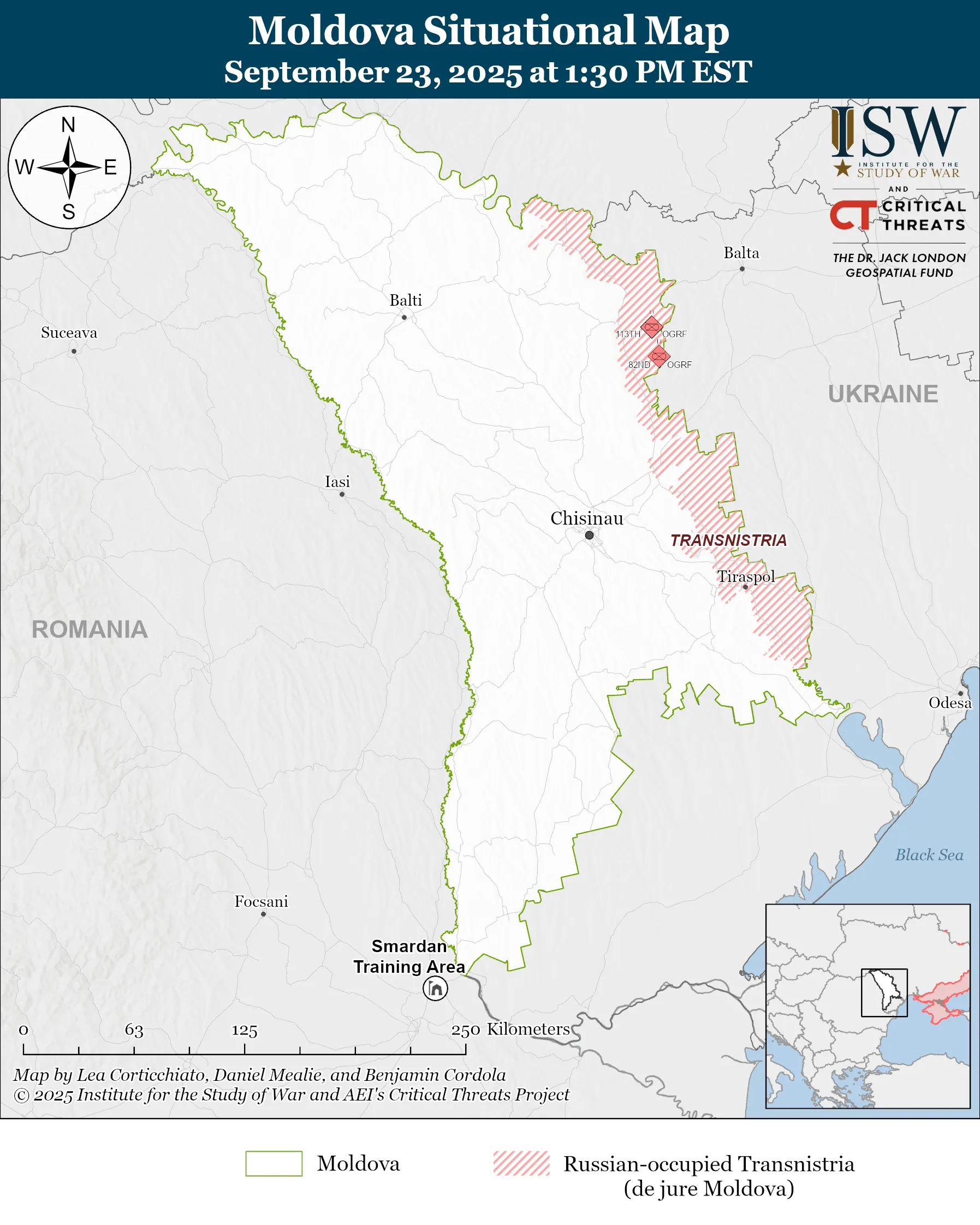
The SVR is deliberately misrepresenting the presence of British and French soldiers in Romania for regular NATO exercises, such as the Steadfast Dart exercises in early 2025 at the Smardan Training Area in Galati, Romania (right near the Romanian-Moldovan-Ukrainian border).[3] NATO will soon hold its Dacian Fall 2025 exercises from October 20 to November 13 in Romania and Bulgaria.[4] The preplanned exercises will include French forces, and one of the training sites will be the Smardan Training Area. Russia will likely continue to misrepresent the presence of NATO troops in Romania for Dacian Fall 2025 to claim that NATO is preparing to invade Moldova on November 30.
The Kremlin is attempting to preemptively blame Moldovan authorities for the active measures that Russia itself is likely planning to conduct. The SVR likely included claims that protests in Moldova will occur spontaneously in order to conceal Russia’s own preparations to ignite violent protests. Russian intelligence services have reportedly been training Moldovans in Serbia to stage provocations and destabilize Moldova. Chief Prosecutor of the Moldovan Prosecutor’s Office for Combating Organized Crimes and Special Cases Victor Furtuna reported on September 22 that a group of mostly young citizens systematically traveled to Serbia to receive training from foreign instructors in destabilization and provocation measures, including training on how to evade arrest and use firearms.[5] Director of Moldova’s Intelligence and Security Service Alexandru Musteata added that a person “who presented himself on behalf of a Russian special service” directly coordinated the trainings and that an officer from Russian General Staff’s Main Directorate (GRU), who has previously organized subversive activities in the EU, Asia, and Africa, coordinated “destabilizing actions in the electoral context.” Musteata stated that Moldovan authorities suspect Kremlin-linked Moldovan politician Ilan Shor of financing the operation with funding from Russia. Musteata stated that the GRU officer used Telegram channels connected to Shor to contact Moldovans. Moldovan General Police Inspectorate Head Viorel Cernauteanu added that Russian citizens also trained some people on Moldovan territory. Furtuna noted that the people received about 400 euros (about $472) for their participation.
Kremlin documents from Spring 2025 also reportedly outlined plans to stage violent provocations in Moldova. Bloomberg reported on September 22 that it viewed documents from the Russian Presidential Administration finalized in Spring 2025 that outlined Russia’s plans and goals for its campaign to interfere in the upcoming Moldovan parliamentary elections.[6] The documents reportedly noted that the Kremlin aimed to create the perception of a competitive contest in order to decrease support for Sandu and PAS – in line with ISW’s September 5, 2025, assessment.[7] Bloomberg reported that the tactics outlined in the documents included recruiting young men from sports clubs and criminal networks to stage violent provocations during the election, as well as protests after the vote. Russian plans reportedly include demonstrations calling for Sandu to resign should PAS lose the election or to paint the results as tainted should PAS win. Bloomberg reported that two European officials stated that it was “almost certain” that Russia intended to follow through with most of the plans outlined in the documents.
The SVR may also be preparing to blame Moldova or the West for Russian false flag attacks against Transnistria. The SVR claimed that European authorities are planning armed provocations against Transnistria and the Russian forces stationed in Transnistria in order to fabricate an excuse to occupy Moldova.[8] Russia likely conducted false flag provocations against Transnistria that it attempted to blame on Ukraine in the past.[9] Russia may do so again in the future and try to blame Chisinau or NATO.
The Kremlin appears to be conducting an organized information operation, injecting narratives about election annulment into the Moldovan information space in order to set conditions for violent protests. Romania annulled its November 2024 presidential election after Romanian intelligence found evidence of foreign – likely Russian – interference.[10] Igor Dodon, a Kremlin-linked Moldovan politician who served as president in 2016 to 2020 and who leads a party within the Patriotic bloc running in the upcoming parliamentary elections, called on September 5 for Moldovans to participate in protests on September 29 (the day after the elections) in order to prevent Chisinau from annulling the elections in the event of a Patriotic bloc victory or to demand an annulment should Moldovan authorities falsify the results.[11] Dodon reiterated these calls in an interview with Russian state outlet RIA Novosti on September 21, when he also claimed that Sandu may try to rig the elections.[12] Shor similarly claimed on September 22 to RIA Novosti that Sandu is preparing for a “Romanian scenario” and will announce the cancellation of the election results should PAS face defeat at the polls.[13] Shor claimed that Sandu will use the EU, Moldovan security force, and Moldovan courts to “force” the cancellation on Moldova. Shor also claimed on September 28 in an interview with Russian state outlet Rossiya 24 that PAS is preparing to conduct “massive fraud.”[14] Dodon’s and Shor’s claims about alleged fraud aim to delegitimize the Moldovan government and democracy. Dodon and Shor discussed a possible annulment without any clear antecedent in Moldova; however, Moldovan authorities have not discussed annulling elections. The Kremlin appears to be using its proxies in Moldova to purposefully inject these narratives into the Moldovan information space. The Kremlin is setting conditions to justify anti-Sandu protests, no matter the results of the elections – either protests ostensibly to prevent the Sandu government from annulling the results should PAS lose or protests to demand an annulment should PAS win.
The Kremlin may plan to use artificially instigated protests against the Sandu government following the elections to try to remove Sandu from power. Russia will likely frame any staged protests in Moldova as an organic civilian response to the election results or as a response to the actions of Moldovan authorities. Kremlin-linked actors have a history of paying protestors in Moldova. Shor has organized many such protests in past years – most recently offering Moldovan citizens $3,000 per month to participate in an “indefinite” tent protest in Chisinau starting on August 16.[15]
Shor’s ties to the Kremlin are increasing even though he failed to turn the Fall 2024 Moldovan election and referendum in the Kremlin’s favor.[16] Russian President Vladimir Putin appeared publicly on September 4 with Shor, Russian state-owned bank Promsvyazbank (PSB) Chairperson and CEO Petr Fradkov, and Russian state-owned development corporation Vneshekonombank (VEB) Head Igor Shuvalov at the launch of an A7 office in Russia’s Far East.[17] A7 is a Shor- and PSB-owned company that provides cross-border settlement platforms for sanctions evasion schemes.[18] A7 is tied to several US-sanctioned cryptocurrency exchanges, and Russian-funded troll networks on social media are reportedly using cryptocurrency and PSB accounts to pay people to post disinformation on social media ahead of the Moldovan elections.[19] PSB and VEB have ties to Shor and Dodon.[20]
Recent reports that Russian intelligence is training Moldovans to turn protests violent suggest that the Kremlin plans for the protests to escalate and grow. The Presidential Administration documents that Bloomberg noted that the Kremlin’s goals in Moldova are to undermine PAS at the polls and to ultimately remove Sandu from power.[21] Kremlin-linked Moldovan politicians may claim after the elections that Sandu had plans to “force” Moldovan authorities to annul the elections and plans to allow European troops to enter Moldova in order to call for investigations into or an indictment against Sandu. The Moldovan Constitution allows a majority of at least two-thirds of the parliament to indict the president should the president commit an offense, at which point the Supreme Court would decide on the president’s removal from power.[22] The parameters of the parliamentary coalition that will most likely have to form following the elections are still unclear, given the uncertainty about the probable election results. PAS risks not being able to gain an outright majority, however, and the two Kremlin-linked electoral blocs will likely try to form a coalition either just with each other or with other parties as well.[23] It is unclear if Kremlin-linked Moldovan politicians would be able to garner the support of two-thirds of parliament to indict Sandu.
The Kremlin may plan to use artificial protests to push more parliamentarians to support an indictment. The Kremlin may hope that large-scale violent protests will create discontent among parliamentarians – even those from PAS – over the government’s response to the protests. The Kremlin may also intend to launch information operations to influence Moldovans themselves to call for Sandu’s removal, purportedly before she has the chance to call in European troops to respond to the protests (as the SVR baselessly alleged Sandu plans to do). Such an information operation would be a sophisticated use of reflexive control, as Russia itself would have had a hand in instigating the very protests calling for Sandu’s removal. Reflexive control is a Soviet concept defining the process of transferring the bases for decision-making from one opponent to another.[24] That is, pushing Russia’s opponents to make decisions that actually benefit Russia – in this case, pushing Moldovans to make decisions that help the Kremlin achieve its objective of removing Sandu.
Russia has been laying the groundwork for its claims about an alleged Western invasion of Moldova and election annulment for weeks. The SVR’s September 23 claims about a NATO invasion of Moldova through Ukraine follow similar claims from July 2025, when the SVR alleged that NATO was preparing to involve Moldova in a possible NATO-Russia war and is turning the “once peaceful” Moldova into a military testing ground.[25] The SVR further claimed that NATO is planning to transfer NATO troops to Russia’s borders via Moldova and that NATO will use Moldovans as “cannon fodder.” The SVR likely published its July allegations in order to lend legitimacy to its more specific September claims and to create the facade that Russia is collecting a growing amount of intelligence about NATO’s alleged plans to invade Moldova.
Russia has also been conducting information operations, spreading narratives in recent weeks related to the SVR’s claims. The Moldovan Center for Independent Journalism’s Mediacritica platform reported on September 16 that it analyzed 70 Telegram channels with the largest audiences in the Moldovan information space and with previously documented histories of spreading disinformation between September 1 and 12.[26] Mediacritica identified several narratives that the channels were spreading, including claims that Moldova and Ukraine, with guidance from newly arrived British experts, were secretly discussing a possible military intervention in Transnistria and that Sandu could cancel the elections. Dodon claimed on September 21 to RIA Novosti that Europe wants to use Moldova as “cannon fodder” in a conflict against Russia and that Sandu and Moldovan authorities may create destabilization in Transnistria to push Moldova into an “active military phase.”[27] The Kremlin appears to have orchestrated an organized information campaign that uses different methods and actors to disseminate narratives supporting claims about a Western invasion of Moldova or Sandu’s plans to annul the elections in the event of a PAS defeat.
The Kremlin’s Last-Ditch Efforts to Sway Voters
The Kremlin is also trying to use the SVR’s alarmist claims to influence the vote in the final days before the elections. The SVR notably chose to claim that NATO forces will invade Moldova through Odesa Oblast – as opposed to through Moldova’s longer western border with NATO member Romania.[28] The SVR also claimed that NATO’s alleged invasion plans stem from Europe’s desire to demonstrate “courage and determination” after its plans to deploy troops to post-war Ukraine under the Coalition of the Willing “slipped.” The SVR alleged that Europe is trying to take advantage of “the weak,” including “small Moldova.” The SVR aims to instill fear and anti-Western sentiment in Moldovan voters in order to hurt the pro-Western PAS at the polls. Claims about Ukraine’s role in this alleged invasion plan aim to spark anti-Ukrainian – and subsequently anti-PAS – sentiment as Sandu’s government has strongly supported Ukraine throughout Russia’s full-scale invasion. The SVR also intends to degrade European efforts to support postwar Ukraine in the eyes of Moldovans. The SVR is trying to frame the Coalition of the Willing’s efforts to provide Ukraine with security guarantees to prevent renewed Russian aggression as a facade to cover up Europe’s plans to militarily overtake states like Ukraine and Moldova.
The SVR’s claims are also attempting to garner support for Kremlin-linked electoral blocs that are running on platforms that call for strengthening Moldovan neutrality. Pro-Russian Moldovan parliamentarians have tried in the past to pass laws on the neutrality clause in the Moldovan Constitution that would have limited Moldova’s ability to cooperate with NATO or NATO states, support Ukraine, or act as a transport hub for security assistance to Ukraine, and the Kremlin may aim for a pro-Russian parliament to pass such a law in the future.[29] Kremlin-linked politicians within both the Patriotic and Alternative blocs are currently campaigning on platforms calling for the strengthening of the neutrality clause.[30] The SVR’s claim that NATO intends to invade Moldova aims to foster anti-NATO and pro-neutrality sentiment, garner support for the Patriotic and Alternative blocs in the elections, and rally popular support for a law about the neutrality clause in the future.
Conclusion
The Kremlin is crafting more sophisticated campaigns than it has in the past, using its traditional election interference tactics in new, layered ways. The Kremlin’s apparent preparations to be able to react to a number of scenarios following the September 28 vote show how its election interference efforts in Moldova are adaptable and becoming more sophisticated. Russia’s possible use of reflexive control techniques to push Moldovans to call for Sandu’s removal also suggests a new layer of sophistication. Russia is constantly learning and applying lessons it has learned from each previous election cycle – not only in Moldova but in other states as well. ISW continues to assess that the Kremlin is using information gleaned from its influence and interference campaigns targeting Ukraine, Romania, and Georgia to tailor its campaign to the situation in Moldova in 2025.[31] Russia’s use of information operations or paid protestors is not new, but the Kremlin is constantly refining the tactics in its interference playbook.
Russia’s dedication of valuable resources to its efforts to interfere in Moldova’s elections shows that the Kremlin maintains its long-term strategic objectives in Moldova even as Russia’s war in Ukraine continues. The war in Ukraine is eating up a significant portion of Russia’s time, resources, and attention, but the Kremlin’s objectives in the former Soviet space extend beyond Ukraine. Russia’s 2025 intensification of its interference efforts in Moldova demonstrates how the Kremlin has not given up on its aim of reestablishing its influence over Chisinau – an objective Russia has pursued since the 1990s. The fact that the Kremlin is pursuing these efforts in Moldova while also waging its war against Ukraine indicates the importance the Kremlin places on reestablishing its influence over former Soviet states beyond Ukraine. The Kremlin will try to influence future Moldovan elections no matter the results on September 28 – just as victories by pro-Western parties and candidates in Moldova in years past have not stopped Russia.

[1] https://understandingwar.org/research/russia-ukraine/russia-continues-efforts-to-regain-influence-over-moldova/; https://watchdog dot md/wp-content/uploads/2025/09/Sondaj-socio-politic-Septembrie-2025.pdf; https://agora dot md/2025/09/08/sondaj-despre-parlamentare-patru-formatiuni-politice-ar-avea-cele-mai-mari-sanse-de-a-obtine-fotolii-in-legislativ
[2] http://svr dot gov.ru/smi/2025/09/evropa-gotovitsya-okkupirovat-moldaviyu.htm
[3] https://shape dot nato.int/steadfast-dart/media-centre/news/building-the-base-how-the-british-and-romanian-teams-work-together-to-prepare-the-training-area
[4] https://english dot mapn.ro/cpresa/6577_nato-conducts-%E2%80%9Cdacian-fall-2025%E2%80%9D-multinational-exercise-in-romania-and-bulgaria
[5] https://www.zdg dot md/stiri/dezordini-in-masa-pregatite-de-doi-ofiteri-ai-serviciilor-ruse-in-moldova-si-serbia-74-de-persoane-retinute-au-fost-ridicate-arme-si-munitii-persoanele-erau-racolate-prin-grupul-sor/
[6] https://www.bloomberg.com/news/articles/2025-09-22/moldova-elections-russia-s-plan-to-hack-the-vote
[7] https://understandingwar.org/research/russia-ukraine/russia-continues-efforts-to-regain-influence-over-moldova/
[8] http://svr dot gov.ru/smi/2025/09/evropa-gotovitsya-okkupirovat-moldaviyu.htm
[9] https://understandingwar.org/research/russia-ukraine/russian-offensive-campaign-assessment_17-7/
[10] https://understandingwar.org/research/russia-ukraine/likely-kremlin-backed-election-interference-against-romania-threatens-bucharests-continued-support-for-ukraine-and-nato/
[11] https://ipn dot md/en/patriotic-bloc-announces-protests-immediately-after-election/
[12] https://ria dot ru/20250921/dodon-2042999702.html
[13] https://ria dot ru/20250922/moldaviya-2043632155.html
[14] https://www.vesti dot ru/article/4699102
[15] https://understandingwar.org/research/russia-ukraine/russia-continues-efforts-to-regain-influence-over-moldova/; https://www.bbc.com/news/world-europe-65952878 ; https://www.nytimes.com/2023/09/24/world/europe/moldova-russia-ukraine-war.html; https://www.dw.com/en/pro-russian-group-pays-protesters-in-moldova/a-63446784
[16] https://understandingwar.org/research/russia-ukraine/russia-poses-long-term-threats-to-moldovas-european-integration-beyond-the-october-elections-2/
[17] https://www.rbc dot ru/industries/news/68b95f7c9a794704be52c421
[18] https://understandingwar.org/research/russia-ukraine/russia-continues-efforts-to-regain-influence-over-moldova/
[19] https://www.zdg dot md/stiri/video-george-simion-sprijinit-de-armata-digitala-a-kremlinului-oamenii-voteaza-pentru-unul-dar-altul-castiga/; https://understandingwar.org/research/russia-ukraine/russia-continues-efforts-to-regain-influence-over-moldova/; https://www.bbc.com/russian/articles/cy8rryd12p3o
[20] https://understandingwar.org/research/russia-ukraine/russia-continues-efforts-to-regain-influence-over-moldova/
[21] https://www.bloomberg.com/news/articles/2025-09-22/moldova-elections-russia-s-plan-to-hack-the-vote
[22] https://www.constcourt dot md/public/files/file/Actele%20Curtii/acte_en/MDA_Constitution_EN.pdf
[23] https://understandingwar.org/research/russia-ukraine/russia-continues-efforts-to-regain-influence-over-moldova/
[24] https://understandingwar.org/research/cognitive-warfare/a-primer-on-russian-cognitive-warfare/; https://understandingwar.org/research/russia-ukraine/denying-russias-only-strategy-for-success-2/
[25] https://understandingwar.org/research/russia-ukraine/russia-continues-efforts-to-regain-influence-over-moldova/
[26] https://mediacritica dot md/primele-2-saptamani-de-campanie-pe-telegram-asocieri-cu-gestapo-scenariul-georgiei-si-amenintari-cu-anularea-alegerilor/
[27] https://ria dot ru/20250921/dodon-2042999702.html
[28] http://svr dot gov.ru/smi/2025/09/evropa-gotovitsya-okkupirovat-moldaviyu.htm
[29] https://understandingwar.org/research/russia-ukraine/russia-continues-efforts-to-regain-influence-over-moldova/
[30] https://understandingwar.org/research/russia-ukraine/russia-continues-efforts-to-regain-influence-over-moldova/
[31] https://understandingwar.org/research/russia-ukraine/russia-continues-efforts-to-regain-influence-over-moldova/