
Key Takeaways
- Russia’s use of first-person view (FPV) drones to strike mainly civilian targets in the Ukrainian near rear is indicative of a pervasive culture within the Russian Armed Forces that seeks to both weaponize and institutionalize intentional civilian harm as a purposeful tool of war.
- Russian drone adaptations and innovations increase the potential for civilian harm and blur the traditional lines between military and civilian targets.
- The tactics and practices that Russia is developing through its widespread use of FPV drone strikes on civilian targets in near-rear areas are exportable and may be easily recreated by other malign actors in both state and non-state actor conflicts and are likely to fundamentally shape the interplay between military operations and civilian life in future wars.
Introduction
Technological innovation and adaptation have defined the last nearly four years of Russia’s war in Ukraine. Both Russia and Ukraine have integrated evolving technologies into their offensive and defensive arsenals, optimizing their respective forces for protracted positional warfare.[1] Unmanned systems, be they aerial, ground-based, or water-based, have proliferated to a massive degree on both sides of the battlefield. Despite the relatively equal distribution of unmanned systems amongst Russian and Ukrainian forces, Russian forces are disproportionately using these systems to exact harm on Ukrainian civilians.[2] Russia’s near-nightly long-range drone strikes, for example, often strike critical infrastructure in Ukraine’s rear, dramatically degrading quality of life and access to basic necessities throughout large parts of the country as they are meant to do. Russian tactical drone strikes on civilians and civilian infrastructure along the frontline have become so pervasive that observers have described the process as a “hunt” or a “human safari.”[3]
Russia has notably pioneered the use of tactical drones in strikes on civilians and civilian infrastructure in the so-called “kill-zone” — the area within 15-20 kilometers from the frontline where the saturation of tactical strike and reconnaissance drones poses an elevated risk to any personnel or equipment operating within.[4] Many of the unmanned systems that are pervasive in the kill-zone are first-person view (FPV) drones, which are small and relatively cheap drones that are operated remotely via live video feed by a pilot wearing a virtual reality headset. FPV drones either operate in a “kamikaze” mode (effectively crashing into a target), a reconnaissance mode, or drop munitions on targets below.[5]
Russian and Ukrainian forces alike began using FPV drones on the battlefield in late 2022, and by 2023 FPV drones had become an indispensable tactical system for both militaries. Both sides began attempting to integrate and institutionalize FPV drones in their respective force structures in 2023, and Ukraine created the Unmanned Systems Forces in early 2024 to formally integrate drone operations into its wider force structure.[6] The Russian Rubikon Center for Advanced Unmanned Technologies, also created in 2024, has particularly exemplified Russian efforts to integrate drones, including FPVs, into the Russian concept of operations and disseminate these lessons throughout the wider force.[7] Russia and Ukraine have both significantly scaled up their respective domestic production of FPV drones, reflecting the central role these systems play in each side’s tactical arsenal. Russia, for example, produced around two million FPV drones in 2025, whereas Ukraine produced closer to three million.[8]
FPV drones should theoretically enable their operators to exercise greater care in distinguishing between civilian and military targets, because the operator can see exactly what target they are approaching and hitting in real-time. Russian FPVs, however, hit clearly civilian targets with such frequency that the practice has been termed a “human safari.” Russia’s human safari campaign in southern Ukraine has received particular attention, with a United Nations inquiry concluding that these tactics amount to war crimes and crimes against humanity.[9] Despite the relatively equal levels of FPV drone proliferation amongst both Ukrainian and Russian forces, Russian forces conduct drone strikes against civilians significantly more than Ukrainian forces.[10] While many of these FPV strikes against civilians may seem random and indiscriminate, Russian forces appear to be purposefully targeting civilians and civilian infrastructure to accomplish distinct military objectives. This trend suggests that the Russian military is using FPV drones to weaponize civilian harm as an intentional tool of war.
This paper will examine the ways in which Russia’s pervasive use of FPV drones to strike clearly civilian targets is indicative of a deliberate Russian offensive strategy and military culture — merging the intentional generation of civilian harm with discrete military objectives. This research focuses specifically on FPV drones, because these systems enable the operator to see the target they are striking in real time and therefore have different operational requirements and outcomes from more traditional unmanned systems. The paper will examine the implications of this practice on the frontline areas Russian FPVs are targeting, analyze the integration of intentional civilian harm into Russia’s wider operational battlefield air interdiction (BAI) template, and forecast how these FPV tactics are exportable to other malign actors. The paper concludes that Russia’s institutionalization of these FPV strike tactics will become a commonplace feature of future conflicts, involving either Russia or other state or non-state actors, and will therefore require updated and innovated conceptions of civilian protection in times of war.
Methodological Note
ISW created a dataset of confirmed FPV drone strikes against civilian targets to support this research. This dataset is drawn from statements made by Ukrainian local and oblast-level officials, including local prosecutor general’s offices, law enforcement officials, and emergency services. ISW selected these sources because these Ukrainian government and law enforcement entities have rigorous identification, investigation, and reporting processes for such strikes.[11] ISW only collected posts from officials that specified an FPV strike and specifically defined some sort of civilian target. The dataset is current as of December 2025 and encompasses data from August 2025 to December 2025. This dataset is intended to be an illustrative sample set and not an exhaustive list of every single Russian FPV drone strike against a civilian target that occurred during the August to December 2025 time period. Many such strikes may not have been reported or did not rise to the verification threshold from Ukrainian official sources.
Key Terms and Concepts
- First person view (FPV) drone: Small, cheap, commercially available short-range unmanned aerial systems piloted via a live onboard video feed.
- Tactical drone: An unmanned aerial system, not necessarily an FPV, used at the tactical level of war to support frontline combat operations through reconnaissance, targeting, fire correction, or strike functions up to 25 kilometers in range.
- Operational drone: An unmanned aerial system used at the operational level of war that conducts reconnaissance, strikes, and interdiction efforts at 25 to 100 kilometers.
- Near rear: The area immediately behind the forward line of troops (FLOT) that sustains combat operations but is within range of tactical level fires.
- Kill-zone: The area immediately near the frontline where a mass of tactical strike and reconnaissance drones pose an elevated risk to any equipment or personnel that enters the area.
- Civilian infrastructure: Infrastructure intended solely for civilian use and essential to civilian life, including housing, healthcare, education, utilities, and civilian transportation not employed for military purposes.
- Dual-use infrastructure: Infrastructure that serves both civilian and military functions, such as roadways, transportation, energy, or communications systems, whose targeting risks significant civilian harm.
- Military infrastructure: Infrastructure designed exclusively to support military operations, including bases, depots, command facilities, training sites, and dedicated logistics nodes.
- Battlefield air interdiction (BAI): The use of airpower to strike targets in the operational rear behind the frontline to impact battlefield operations in the near term.
Analysis
Impacts on Civilian Life in Near-Rear Areas
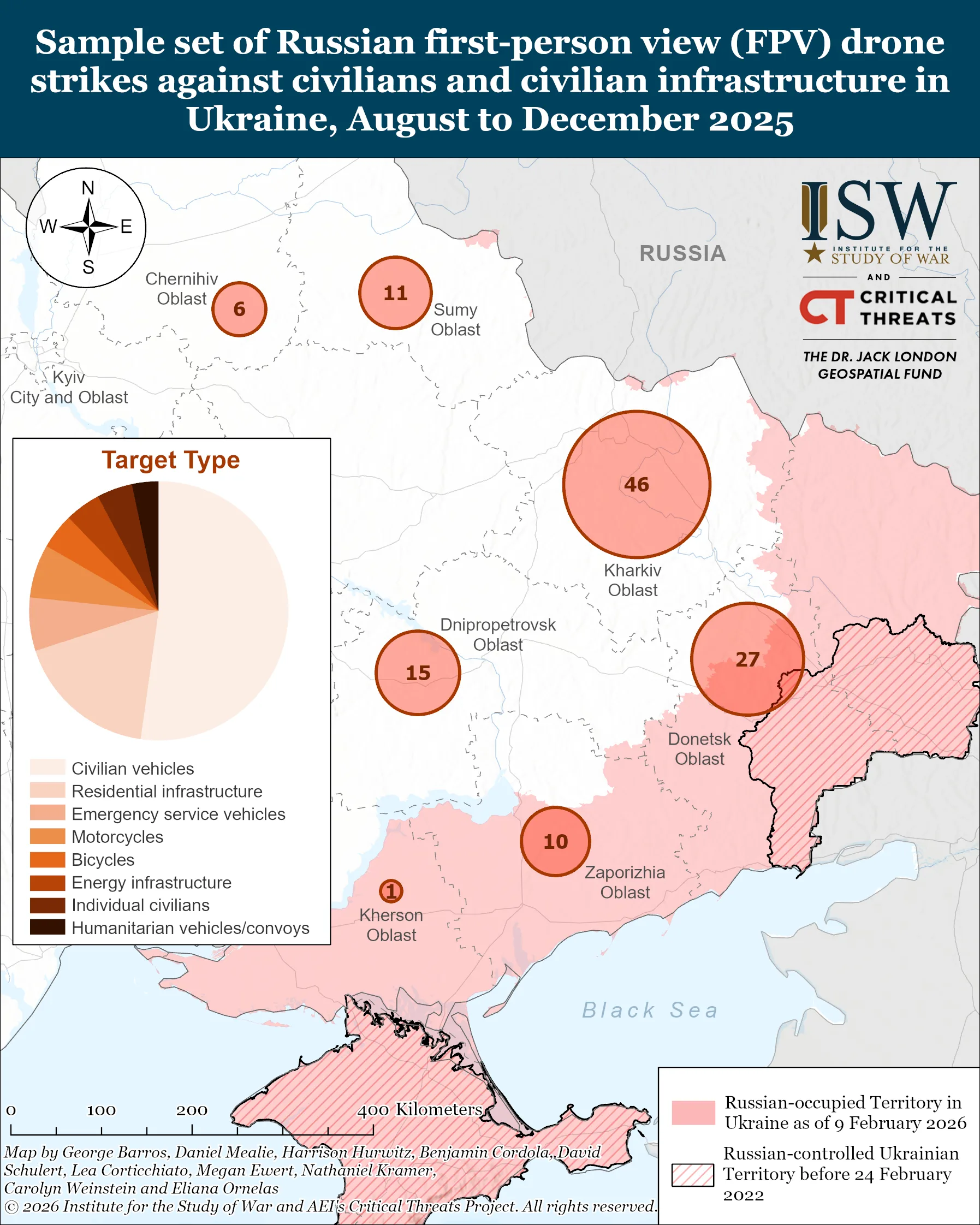
Russian forces are conducting near-rear FPV strikes on a range of civilian targets across the entire Ukrainian theater. While the majority of the “human safari” discourse since 2024 has focused on Russian FPV strikes on civilian targets along the Dnipro River in southern Ukraine, ISW’s analysis shows that this practice is not geographically isolated and is in fact pervasive across the entire frontline in Ukraine. During the August to December 2025 timeframe, ISW identified 47 FPV strikes against civilian targets in Kharkiv Oblast; 27 in Donetsk Oblast; 11 in Sumy Oblast; 6 in Chernihiv Oblast; 15 in Dnipropetrovsk Oblast; 10 in Zaporizhia Oblast; and one in Kherson Oblast. ISW has observed substantial evidence of extensive Russian FPV strikes against civilians in Kherson Oblast, despite the fact that this reality was not reflected in the limited sample set.[12] The concentration of FPV strikes in Kharkiv and Donetsk oblasts largely mirrors the pace of offensive operations in the theater — Russian forces are concentrating offensive efforts in the nexus area between Kharkiv-Luhansk-Donetsk oblasts and in western Donetsk Oblast near the Ukrainian Fortress Belt and the Pokrovsk area. This offensive concentration may in part correlate to the increased number of FPV strikes in these corresponding areas, as the Russian military command has prioritized deploying manpower and equipment, including tactical drones and drone units, to these sectors of the frontline.
The set of civilian targets ISW identified is diverse across the entire theater, but can generally be categorized as individual civilians (individuals generally walking along roads or open spaces); moving or stationary four-wheeled civilian vehicles (including cars and buses); residential infrastructure (individual homes or apartment blocks); emergency service vehicles (fire services, ambulances, police cars); energy infrastructure (including utility repair infrastructure); clearly marked humanitarian vehicles or convoys; motorcycles; and bicycles.
A primary goal of these FPV strikes is to make civilian life in near-rear areas untenable. Ukrainian civilians living in near-rear areas across the entire frontline have described a pervasive fear that a drone might strike at any time.[13] This constant sense of fear, exacerbated by the high levels of drone saturation in low-altitude air space, creates an impression that civilians cannot leave their homes to fulfil even the most basic tasks, such as picking up food, water, or collecting pension payments. Frequent Russian FPV strikes against residential infrastructure, including instances of FPV drones flying directly into the windows of homes and apartment buildings, also solidifies the sense that civilians are not safe in their own homes.[14] FPV strikes against emergency services and first responders significantly complicate rescue efforts following Russian missile or drone strikes — instilling fear amongst first responders and civilians who require their aid.[15] The frequent targeting of humanitarian aid and evacuation vehicles also contributes to a sense of hopelessness and isolation in near-rear areas.
The instillation of fear is not a side-effect of Russian FPV strikes — it is their precise intention. Russian FPV strikes against civilian targets in the near rear are intended to render civilian life untenable in order to drive civilians out of frontline-adjacent areas. The Independent International Commission of Inquiry on Ukraine submitted the results of an investigation to the United Nations (UN) Secretary General on October 21, 2025 that found that Russian short-range drone strikes in frontline areas of Ukraine are part of an intentional and coordinated policy and have “created a coercive environment compelling thousands to flee.”[16] The purposeful depopulation of near-rear areas facilitates tactical Russian frontline advances, as it is relatively easier for Russian forces to infiltrate or advance into empty settlements. The UN Commission concluded that these short-range strikes constitute crimes against humanity, such as murder and forcible population transfer, due to their persistent creation of civilian harm.
Civilian Harm as a Component of Russia’s Battlefield Air Interdiction Campaigns
Intentional and indiscriminate civilian harm has become a core component of Russia’s wider battlefield air interdiction (BAI) efforts. BAI is the use of airpower to strike targets in the near rear of the frontline to impact battlefield operations in the immediate term.[17] BAI is premised on the isolation of the battlespace from critical logistics routes in the rear and traditionally focuses on military and dual-use infrastructure. Both Russian and Ukrainian forces have begun operationalizing short- to mid-range drone strikes to generate BAI effects since the second half of 2025. Drone operators of the Russian Rubikon Center for Advanced Unmanned Technologies have become particularly critical in the Russian execution of its BAI campaigns in Ukraine.[18] Rubikon Center drone strikes against Ukrainian ground lines of communication (GLOCs) began to generate BAI-like effects and enable Russian ground advances in eastern Ukraine, including around the hotly contested town of Pokrovsk, in August 2025.[19] Russian forces, however, have adopted a particular approach to BAI that rests on perpetrating indiscriminate civilian harm and killing, which stands in opposition to BAI’s traditional focus on military and dual-use infrastructure. Russian FPV drone strikes against civilians are a core component of this approach to BAI.
The majority of civilian targets represented in ISW’s FPV drone strike dataset are civilian vehicles, including cars, buses, bikes, scooters, and motorcycles, moving along roadways. Roadways are properly considered to be dual-use infrastructure, which Ukrainian armed forces do use for logistics purposes, but Russian FPV strikes appear to disproportionately target civilian vehicles on these roadways rather than the roadways themselves. The technical specifics of FPV drones should enable drone operators to visually see and distinguish between military transport and civilian vehicles, but Russian forces frequently hit clearly civilian vehicles on roadways — indicating intentionality.[20] Ukrainian officials routinely have to restrict civilian access to roads and highways due to the elevated risk of Russian drone strikes on these routes, which has the effect of further isolating frontline and near-rear communities and inhibiting vital civilian logistics functions.[21] Persistent Russian strikes on emergency vehicles also inhibit first responders from traveling to the sites of previous strikes and carrying out life-saving medical care.
The intended depopulation effect of FPV strikes in the near rear also supports Russian BAI efforts. BAI leverages strikes in the near and mid-rear to isolate the battlespace and accomplish frontline effects. Purposeful FPV strikes intended to drive civilians away from their homes in near-rear areas generate a specific frontline effect — they make these areas and settlements generally easier for Russian forces to infiltrate or advance into or otherwise exert control over. Russia’s BAI campaign purposefully isolates frontline communities in order to support military objectives by shaping the wider battlespace.
Russian efforts to adapt and innovate their FPV capabilities to optimize BAI campaigns significantly scale up the potential for civilian harm beyond frontline communities and near-rear areas. Russian forces began employing “mothership drones” at scale since at least August 2025 to greatly extend the range at which FPV drones can operate. Russian mothership drones transport smaller FPV drones deeper into the Ukrainian rear, overcoming range limitations and potential electronic warfare (EW) interference.[22] Russian forces used mothership drones to strike Zaporizhzhia City (about 45km from the frontline) in August 2024 and a civilian dormitory in Kharkiv City (over 35km from the frontline) in October 2025.[23] Russian forces also began targeting Ukrainian vehicles, including civilian ones, traveling on highways 25 to 100 kilometers from the frontline using Molniya-2 FPVs equipped with Starlink terminals in January 2026.[24] ISW reported in early February 2026 that Russian forces have also begun using Gerbera drones, which have a range of 300 to 600 kilometers, as mothership drones for FPVs — which will significantly extend the range at which Russian forces can threaten civilians in the Ukrainian deep rear. Russian drone adaptations have allowed Russian forces to strike civilian targets even further in the Ukrainian rear, further blurring the line between military and civilian objectives.
The integration of civilian harm into Russia’s BAI doctrine is a clear violation of international legal principles. International humanitarian law rests on three foundational principles when it comes to the issue of civilian harm in combat: distinction between civilians and combatants; proportionality in the use of force; and military necessity bounded by humanitarian considerations. Russia’s use of FPV drones to strike civilian targets as part of its BAI campaign violates the requirement to strike defined military objectives. The systematic targeting of residential infrastructure, civilian transportation routes, and first responders undermines the principle of distinction. Russia’s use of FPV drones — drones that specifically enable the operator to see the target in real time —suggests that Russian forces are aware that they are causing civilian casualties, which further renders the FPV campaign against civilian infrastructure indiscriminate. The persistent incorporation of civilian harm into Russia’s execution of BAI campaigns indicates that civilian harm is not incidental to Russia’s military objectives but rather a core component of Russia’s operational approach to BAI — elevating these violations to a pattern of unlawful conduct as opposed to individual ad hoc indiscretions. The Rubikon Center’s involvement in executing BAI campaigns, including its perpetration of strikes against civilian infrastructure, suggests that the Russian military is seeking to institutionalize these practices into a formal part of the Russian force structure. These FPV strikes therefore likely constitute various war crimes (such as the war crimes of attacking civilians, civilian infrastructure, and medical/humanitarian infrastructure) and various crimes against humanity (such as the crimes against humanity of murder and forcible population transfer).[25]
The proliferation of FPV drone strikes against civilians and the integration of these strikes into Russia’s wider BAI template are emblematic of a culture within the Russian Armed Forces that legitimizes and encourages the intentional generation of civilian harm as a method of warfighting. Persistent FPV strikes against civilian targets are a uniquely Russian phenomenon — not a simple consequence of drone saturation throughout the theater. The United Nations Human Rights Council (UNHRC) found that 95 percent of the civilian harm resulting from drone strikes in January 2025 occurred in Ukrainian-held territory, despite relative parity in drone saturation between Ukrainian and Russian forces.[26] The fact that these types of drone strikes are occurring throughout the entire theater suggests that these practices are not siloed within specific drone units or other Russian formations — they are more likely institutionalized throughout the entire Russian force. Different Russian groupings of forces are responsible for the units conducting tactical FPV strikes across the theater, meaning that these practices are not unique to any one unit.
Russian milblogger discourse surrounding such FPV strikes seeks to justify intentional civilian harm in the wider Russian information space, further suggesting that these strikes are part of the Russian military culture and modus operandi. These informational justifications often come from Russian drone units themselves. The Fobos drone group (70th Motorized Rifle Division, 18th Combined Arms Army, Southern Military District), which is operating in the Kherson direction, has posted frequent warnings to its official Telegram channel telling civilians living in frontline areas to “avoid” moving around frontline settlements in cars or on bicycles or risk facing drone strikes and claiming that “any vehicle” that in the kill-zone area is a “legitimate target.”[27] Russian milbloggers have termed the kill-zone the “red zone” in their online discourse and frequently claim that any movement in the “red zone” constitutes a legitimate military target.[28] This blanket warning is of course inconsistent with international legal requirements on targeting but seeks to legitimize even strikes on clearly civilian targets in the kill-zone. A November 2025 report by Ukrainian organization Truth Hounds found that Russian milbloggers frequently invoke the concept of the “red zone” to justify any and all attacks in the near rear, including those against civilians.[29]
Russian milbloggers consistently weaponize dehumanizing rhetoric when discussing FPV strikes against civilian targets, incorporating such rhetoric into Russia’s wider military narrative. In one instance, a prominent milblogger with over 50,000 subscribers posted FPV footage in October 2025 showing a drone dropping a munition on a civilian near their home in Kherson Oblast.[30] The footage shows the civilian drop to the ground and writhe in pain. The milblogger posted a caption with the video calling the civilian a “pig” and boasting that they bled out for 15 minutes before dying. Milbloggers frequently use similar derogatory terms for Ukrainians when posting videos of deadly FPV strikes in an attempt to dehumanize and depersonalize the strikes and justify them. The ultimate effect is that milblogger reporting on FPV strikes has normalized this practice within the Russian informational narrative. This normalization has a direct bearing on Russian military culture. Milblogger dissemination of this type of footage may also be a distinct war crime of “outrage upon personal dignity,” according to a United Nations commission report from May 2025.[31]
Forecasts
Russia has developed a set of easily learnable and implementable tactics, techniques, and procedures (TTPs) for FPV strikes on civilians and civilian infrastructures which other state and non-state malign actors can adopt in future conflicts. This dynamic will fundamentally change the landscape of future wars and illuminates a new set of requirements for safeguarding civilian lives and infrastructure in drone-dense combat environments. Russia has a well-established history of weaponizing civilian harm as a weapon of war, including but not limited to its mass bombing campaigns against civilian infrastructure in both Chechen wars, the Russian Air Force’s “carpet bombing” campaign and systematic targeting of bread lines and hospitals during the Syrian Civil War, and persistent long-range strikes against critical energy infrastructure in Ukraine during the coldest winter months.[32]
FPV drones have acted as a decisive technological enabler in Russia’s purposeful merging of intentional civilian harm and its pursuit of military objectives and have allowed Russian forces to develop and iterate on FPV operation TTPs in near-real time. Russian forces have notoriously used “human safari” style FPV strikes in Kherson Oblast for the secondary purposes of testing the performance of tactical drone systems and training drone operators.[33] The phenomenon of using FPV strikes on civilians to train and test drones and operators is not unique to Kherson Oblast, however, given the prevalence of FPV strikes against civilian infrastructure along the entire frontline. Russian FPVs are hitting a diverse set of civilian targets, ranging from static infrastructure to small and rapidly moving vehicles such as motorcycles. Each of these civilian objects requires different drone operation TTPs, as the requirements for a drone operator to successfully maneuver a drone through a small window in an apartment complex are distinct from the operation requirements to drop a munition on, or fly into, a moving car. While accomplishing the aforementioned effects of instilling fear in civilian populations in near-rear areas, these FPV strikes also allow Russian drone operators to practice and develop drone operation TTPs that they can then apply to strikes on military objects on the frontline. FPV drones have granted Russian forces a specific medium through which Russian forces can exact civilian harm while also refining drone operation TTPs in near-real time.
Malign non-state and state actors across the globe can adopt the TTPs that Russia has developed through its use of FPV strikes against Ukrainian civilian targets. FPV drones are cheap, commercially available, and relatively easy to operate, meaning that the barrier to entry for FPV drone operation is much lower than it is for other drone systems. Various West African and Sahelian terrorist, separatist, and mercenary groups have begun using FPV drones for reconnaissance and strike functions in their respective areas of operation.[34] Nigerian Silafi-jihadist militant organization Boko Haram, for example, recently began displaying its use of the Chinese LSRC XT808 FPV quadcopter.[35] The XT808 is listed at less than $100 on most online retailers and is evidently easy to procure commercially. ISW has not yet observed evidence of Boko Haram’s use of the XT808 in combat, but Russian forces have frequently used similar small quadcopter FPVs in Ukraine for reconnaissance and strike purposes, when operating them in a “kamikaze” mode.[36] Al-Queda’s Sahelian affiliate Jama’at Nusrat al Islam wa al Muslimeen (JNIM) conducted its first-ever FPV strike on Djibo Town, Burkina Faso, in February 2025, and the Rwandan-backed M23 rebel group in the Democratic Republic of the Congo (DRC) has begun using fiber-optic FPV drones in combat in South Kivu Province.[37] Burkinabe forces are also likely using Chinese DJI Matrice 30T FPV drones, which is particularly noteworthy given the close military ties that the Burkinabe junta shares with Russia.[38] The Islamic State used one-way attack (kamikaze) drones in a complex attack on an airport in Niamey, Niger, on January 28, 2026.[39] It remains unclear if the Islamic State-used FPV drones as one-way attack drones, but the Niamey airport strike highlights the diversification of drone capabilities among certain African terror groups. The proliferation of FPV drones in these African conflict areas is likely to enable both state and non-state actors to inflict more intentional civilian harm, akin to the Russian FPV drone model in Ukraine.
The People’s Republic of China (PRC) can draw lessons from Russia’s use of FPV drones against civilian targets in Ukraine — particularly the coercive, psychological, and battlespace-shaping effects — and adapt these lessons in a potential invasion of Taiwan. Russia’s use of FPV drones has demonstrated how low-cost, easy-to-operate, attritable drones can generate tactical battlefield benefits in tandem with efforts to systematically terrorize civilians and disrupt daily life. These tandem effects are likely to be very relevant in the case of a PRC invasion of Taiwan. The People’s Liberation Army (PLA) and Chinese military analysts have been closely observing the war in Ukraine and are increasingly implementing lessons learned into the PRC’s military planning for future operations.[40] PLA planners and analysts have identified FPVs as a critical technological enabler on the battlefield in Ukraine, and the PLA has begun integrating FPV drone operation into combat training scenarios.[41] In the case of an invasion of Taiwan, the PLA could use FPV-enabled civilian harm to amplify psychological pressure on the Taiwanese population in an effort to compel capitulation or depopulation of the island. The PLA could also use FPV drones to complicate dual-use logistics routes in a way that causes disproportionate civilian harm while also inhibiting the defensive abilities of the Taiwanese army. Russia’s FPV campaign in Ukraine therefore provides the PRC with a tactical precedent that can generate significant operational effects.
Russia is very likely to institutionalize the practice of using FPV drones to generate civilian harm for tactical battlefield effects as a durable feature of its future military operations, including a potential future Russia-NATO conflict. The Russian military has recently undertaken several dedicated efforts to formalize drone units and drone operations into its wider force structure, including through its creation of the Unmanned Systems Forces (USF) and the Rubikon Center for Advanced Unmanned Technologies. FPV drone strikes against civilian targets are persistent across the entire theater, suggesting some level of doctrinal integration as opposed to more temporary ad hoc technological innovation. Russia is likely to employ similar FPV campaigns in future conflicts, including a potential confrontation with NATO, in order to harass civilian populations in Europe, destabilize logistics in the rear and near-rear, and shape the battlespace through civilian targeting. Russia’s use of FPV drones against civilian targets in Ukraine is therefore a prototype for future conflicts, underscoring the acute requirement for NATO and Taiwanese military planners to reassess civilian protection measures in the rear as central components of wider deterrence and defense planning.

[1] https://understandingwar.org/wp-content/uploads/2025/10/The-Russian-Military-Forecasting-the-Threat.pdf
[2] https://ukraine.ohchr.org/en/In-Ukraine-Short-Range-Drones-Become-Most-Dangerous-Weapon-for-Civilians-UN-Human-Rights-Monitors-Say; https://truth-hounds.org/wp-content/uploads/2025/11/killzone-how-russian-drones-are-devastating-the-river-dnipros-right-bank.pdf
[3] https://understandingwar.org/research/russia-ukraine/russian-drone-innovations-are-likely-achieving-effects-of-battlefield-air-interdiction-in-ukraine/; https://www.chathamhouse.org/publications/the-world-today/2025-12/human-safari-russian-drones-targeting-ukraines-civilians
[4] https://texty.org dot ua/projects/116021/20-kilometers-of-the-gray-zone-the-front-line-has-become-blurred/
[5] https://truth-hounds.org/wp-content/uploads/2025/11/killzone-how-russian-drones-are-devastating-the-river-dnipros-right-bank.pdf
[6] https://understandingwar.org/research/russia-ukraine/russian-efforts-to-centralize-drone-units-may-degrade-russian-drone-operations-2/
[7] https://understandingwar.org/wp-content/uploads/2025/10/The-Russian-Military-Forecasting-the-Threat.pdf; https://understandingwar.org/research/russia-ukraine/russian-drone-innovations-are-likely-achieving-effects-of-battlefield-air-interdiction-in-ukraine/; https://understandingwar.org/research/russia-ukraine/russian-partial-battlefield-air-interdiction-enabled-recent-russian-advances-in-pokrovsk/
[8] https://kyivindependent.com/russia-aims-to-produce-2-million-fpv-drones-in-2025-ukrainian-intelligence-says/; https://kyivindependent.com/ukraine-on-track-to-receive-total-of-3-million-fpv-drones-in-2025/
[9] https://www.ohchr.org/sites/default/files/documents/hrbodies/hrcouncil/coiukraine/a-80-497-advance-unedited-version-en.pdf
[10] https://ukraine.ohchr.org/en/In-Ukraine-Short-Range-Drones-Become-Most-Dangerous-Weapon-for-Civilians-UN-Human-Rights-Monitors-Say; https://truth-hounds.org/en/cases/killzone-how-russian-drones-are-devastating-the-river-dnipros-right-bank/
[11] https://www.gp.gov.ua/storage/files/9/%D0%BD/13/WarCrimes%20Results%202025_Public.pdf; https://www.lemonde.fr/en/international/article/2024/02/23/ukraine-seeks-justice-with-unprecedented-investigations-into-war-crimes_6551728_4.html
[12] https://x.com/oko_gora_tg/status/2016252231012778065
[13] https://www.ft.com/content/31b630b3-2639-456c-ba50-3caea7a9b2b5; https://www.nytimes.com/2026/01/28/world/europe/kherson-ukraine-drones-russia.html; https://www.lemonde.fr/en/international/article/2025/10/01/war-in-ukraine-the-daily-lives-of-kherson-residents-who-live-underground-threatened-by-russian-drones_6745961_4.html
[14] https://t.me/nikrda/95
[15] https://suspilne dot media/kharkiv/1090458-u-kupansku-e-rajoni-v-aki-cerez-nebezpeku-ne-idut-pracivniki-dsns-i-policii-rva/
[16] https://docs.un.org/en/A/80/497
[17] https://www.airuniversity.af.edu/Portals/10/AUPress/Papers/CP_0017_MCCAFFREY_BATTLEFIELD_AIR_INTERDICTION.PDF; https://understandingwar.org/research/russia-ukraine/russian-drone-innovations-are-likely-achieving-effects-of-battlefield-air-interdiction-in-ukraine/
[18] https://understandingwar.org/research/russia-ukraine/russian-drone-innovations-are-likely-achieving-effects-of-battlefield-air-interdiction-in-ukraine/; https://understandingwar.org/research/russia-ukraine/russian-partial-battlefield-air-interdiction-enabled-recent-russian-advances-in-pokrovsk/
[19] https://understandingwar.org/research/russia-ukraine/russian-drone-innovations-are-likely-achieving-effects-of-battlefield-air-interdiction-in-ukraine/; https://understandingwar.org/research/russia-ukraine/russian-partial-battlefield-air-interdiction-enabled-recent-russian-advances-in-pokrovsk/
[20] https://suspilne dot media/donbas/1131524-rosijski-vijska-vperse-vdarili-fpv-dronom-na-optovolokni-po-kramatorsku-poskodzena-avtivka/; https://t.me/istories_media/10497
[21] https://www.facebook.com/vadym.filashkin/posts/2227243127749021?ref=embed_post
[22] https://www.cnn.com/2025/11/22/europe/russia-rubicon-unit-drone-revolution-ukraine-intl-cmd
[23] https://suspilne dot media/kharkiv/1137882-rosiani-zbilsuut-kilzonu-za-dopomogou-droniv-oficer-povitranih-sil-pro-udar-imovirnogo-fpv-drona-po-harkovu/; https://t.me/gnilayachereha/33966; https://t.me/bezbaidy/21229; https://t.me/insiderUKR/105203
[24] https://understandingwar.org/research/russia-ukraine/russian-offensive-campaign-assessment-january-29-2026/
[25] https://truth-hounds.org/wp-content/uploads/2025/11/killzone-how-russian-drones-are-devastating-the-river-dnipros-right-bank.pdf
[26] https://ukraine.ohchr.org/en/In-Ukraine-Short-Range-Drones-Become-Most-Dangerous-Weapon-for-Civilians-UN-Human-Rights-Monitors-Say
[27] https://t.me/Fobos_herson/143857; https://t.me/Fobos_herson/143864; https://t.me/Fobos_herson/143790; https://t.me/Fobos_herson/143900
[28] https://t.me/osvedomitell_alex/31464; https://t.me/osvedomitell_alex/31385; https://t.me/osvedomitell_alex/31363
[29] https://truth-hounds.org/en/cases/killzone-how-russian-drones-are-devastating-the-river-dnipros-right-bank/
[30] GRAPHIC: https://t.me/osvedomitell_alex/30005
[31] https://www.ohchr.org/en/press-releases/2025/05/un-commission-concludes-russian-armed-forces-drone-attacks-against-civilians
[32] https://understandingwar.org/wp-content/uploads/2025/04/The20Russian20MilitaryE28099s20Lessons20Learned20in20Syria_0.pdf; https://understandingwar.org/research/russia-ukraine/russian-air-campaign-against-civilians/; https://www.nytimes.com/2019/10/13/world/middleeast/russia-bombing-syrian-hospitals.html; https://www.theguardian.com/world/2022/mar/24/how-russia-is-using-tactics-from-the-syrian-playbook-in-ukraine
[33] https://www.ft.com/content/31b630b3-2639-456c-ba50-3caea7a9b2b5; https://understandingwar.org/research/russia-ukraine/russian-partial-battlefield-air-interdiction-enabled-recent-russian-advances-in-pokrovsk/
[34] https://westafricamaps.com/en/analysis/military-fpv-drone-a-growing-threat-in-west-african-conflicts
[35] https://x.com/natsecboogie/status/2008889951493189947; https://x.com/secmxx/status/2008821905059725502
[36] https://www.hrw.org/feature/2025/06/03/listen-run-hide/how-russia-uses-quadcopter-drones-hunt-kill-kherson
[37] https://sentrycs.com/the-counter-drone-blog/from-surveillance-to-strikes-the-escalating-drone-threat-in-africa/; https://www.military.africa/2025/08/fiber-optic-fpv-drones-emerge-on-african-battlefields/
[38] https://westafricamaps.com/en/analysis/military-fpv-drone-a-growing-threat-in-west-african-conflicts
[39] https://www.criticalthreats.org/analysis/boko-haram-nigeria-tplf-ethiopia-red-sea-drc-m23-rwanda-isis-niger-saf-rsf-sudan-africa-file-february-6-2026
[40] https://understandingwar.org/wp-content/uploads/2025/06/The20Strengthening20China-Russia20Nexus.pdf; https://jamestown.org/autonomous-battlefield-pla-lessons-from-russias-invasion-of-ukraine/
[41] https://www.armyrecognition.com/news/army-news/2025/chinas-army-adopts-advanced-fpv-drone-tactics-reflecting-modern-warfare-lessons-from-ukraine; https://jamestown.org/autonomous-battlefield-pla-lessons-from-russias-invasion-of-ukraine/; https://www.defenseone.com/ideas/2024/12/how-china-adopting-battlefield-lessons-ukraine/401694/