
Ukraine is actively challenging the positional character of the war that has dominated the battlefield since 2023. Russian battlefield gains are approaching net zero, while Ukrainian forces are setting conditions potentially to break out of positional warfare by reintroducing limited elements of mechanized maneuver at the tactical level. Ukraine has re-secured an overall drone advantage and fielded systems capable of disrupting Russian forces throughout their operational depth in support of planned Ukrainian offensive or defensive ground operations. Neither Russia nor Ukraine can conduct operational maneuvers yet, however. Ukraine’s success in blunting Russian advances and reversing Russian gains in some sectors of the line, in tandem with Ukraine’s limited reintroduction of elements of tactical mechanized maneuver, may nevertheless mark the beginning of a new phase of the war. Combat in Ukraine will likely become less positional and feature more tactical maneuver until Russia’s innovation cycle renders Ukraine’s current operational concepts ineffective. Ukraine likely has a unique and time-constrained opportunity to exploit its current initiative while Russian forces remain vulnerable. Ukraine’s partners should expand their support to these Ukrainian efforts at a moment when Russia is reeling from both battlefield setbacks and Ukraine’s deep strike campaign with the aim of forcing Russian President Vladimir Putin to reevaluate his approach to this conflict.
The character of the war has been of a positional nature since late 2023, with neither side being capable of conducting operational maneuver. The partially transparent drone-dominated battlefield has forced belligerents to disperse their forces within the kill zone — the expanding area (currently within 15-25 kilometers from the frontline) where the saturation of tactical strike and reconnaissance drones poses an elevated risk to any personnel or equipment operating within.[1] Neither Russia nor Ukraine has been able to mass infantry or heavy equipment within 30 kilometers of the frontline necessary to achieve operational breakthroughs, though Russian forces have attempted occasional abortive battalion-, company-, and platoon-sized mechanized assaults over the years.[2] Russian forces’ main form of offensive maneuver since 2025 has been infiltration, usually conducted by small groups of one to three infantrymen who attempt to use cover, concealment, and subterranean infrastructure to infiltrate the kill zone and into the tactical rear of Ukrainian positions.[3] These Russian infiltrators attempt to reach predetermined rally points in Ukrainian positions’ tactical rear and consolidate positions from which a Russian force (usually squad-sized but sometimes larger) can then attempt a frontal assault against a Ukrainian strongpoint. Thinly manned Ukrainian positions, usually anchored on strongpoints in prepared field fortifications and windbreaks, are thus intermingled with Russian strongpoints as Russian forces bypass Ukrainian positions via infiltration. The result is a pointillist frontline in which Russian and Ukrainian positions are intermixed in the kill zone, where both sides’ unmanned aerial vehicles (UAVs) hunt each other relentlessly, and neither side holds a contiguous frontline. The persistent drone threat coupled with legacy crewed weapons, artillery, and prepared defenses in depth — a system that ISW has dubbed the “tactical reconnaissance strike complex” (TRSC) — makes operational maneuver extremely difficult, but not impossible.[4]
Russia’s major attempt to restore operational maneuver to the battlefield made slow progress in 2025 but has been largely ineffective. The Russian command attempted to restore operational maneuver to the battlefield through a concept of operations leveraging intermediate-range drones to interdict Ukrainian logistics at operational depth.[5] ISW dubbed this phenomenon partial battlefield air interdiction (BAI) effects, with BAI referring to the use of airpower to strike targets in the near rear of the frontline to impact battlefield operations in the near term.[6] The concept sought to deny Ukraine the ability to sustain frontline forces and conduct redeployments or rotations, enabling a gradual attrition of those Ukrainian forces until they are surrounded or destroyed. Russia’s Rubikon Center for Advanced Unmanned Systems pioneered techniques to dynamically strike Ukrainian logistics at operational depth to hollow out Ukrainian tactical positions starting in early 2025 during Russia’s counteroffensive in Kursk Oblast.[7] By mid-2025, the Russian military command and the Rubikon Center developed a partially effective operational template that achieved a type of slow operational maneuver, demonstrated through the way in which Russian forces managed to seize Pokrovsk through a 22-month campaign by systematically disrupting Ukraine’s main logistics routes sustaining Pokrovsk’s frontline defenders.[8] This form of maneuver fundamentally relied on tactical dismounted infantry attacks across long periods of time, however, and failed to achieve effective operational maneuver.[9] It also generated only modest territorial gains at exorbitant human and material costs.[10] The fall of Pokrovsk has not enabled further Russian maneuvers, and the frontline in the Pokrovsk direction has changed only tactically since Winter 2025.
The effectiveness of Russia’s BAI approach as an operational concept to enable maneuver began to decline in late 2025. Ukraine undertook an effective campaign to kill Rubikon drone operators starting no later than August 2025, greatly degrading Rubikon’s effectiveness by early 2026.[11] Rubikon is also likely losing its initial effectiveness as it struggles with the need to rapidly expand, which is likely degrading the quality of its training and recruits.[12] Rubikon elements embedded within the various Russian groups of forces likely also find their effectiveness constrained by the overall quality of the commands and troops under and alongside whom they are operating. The Kremlin’s recent efforts to ramp up the establishment of the Russian Unmanned Systems Forces (USF) and recruit university students could further suggest that Russia needs to expand Rubikon’s capabilities across the theater but lacks the skilled personnel to do so, since Rubikon was originally an elite unit staffed by innovators and professionals.[13]
Open data on Russia’s battlefield performance indicates that the character of the war is shifting in favor of Ukrainian forces, at least for now. Russian forces’ rates of advances are stagnating while Ukrainian forces are employing novel tactics and operational concepts in efforts to break out of positional warfare. It remains too early to tell whether Ukrainian forces will successfully restore maneuver to the battlefield, however.
Russia’s rate of advance is plummeting during the Russian Spring-Summer 2026 offensive. Russian forces’ daily rate of advance in 2025 was 13.2 square kilometers km per day.[14] Russian advances across the theater have dropped to an average of 2.9 square kilometers per day in the first four months of 2026, excluding the areas in which Russian forces are conducting infiltration missions, whereas Russian forces advanced at a rate of 9.76 square kilometers per day in the first four months of 2025.[15] Including infiltrated areas brings the Russian rate of advance to about 4.6 square kilometers per day between January 1, 2026 and May 21, 2026 — still less than half the Russian daily average in the same period of 2025.
Russia is losing more soldiers to make fewer gains, with monthly Russian casualty rates reportedly outpacing monthly recruitment since December 2025. Russia’s monthly casualty rates reportedly have exceeded its recruitment rates since December 2025.[16] Bloomberg reported on February 11, citing Western officials, that Russia sustained about 9,000 more battlefield casualties than it was able to replace in January 2026 after years of Russia’s recruitment rate meeting or exceeding its loss rate.[17] Ukrainian USF Commander Major Robert “Magyar” Brovdi reported that Russia’s recruitment rate in March 2026 was below its loss rate on the battlefield for the fourth month in a row (since December 2025).[18] Ukraine’s “I Want to Live” initiative reported on April 6 that the Russian Ministry of Defense (MoD) recruited fewer soldiers in the first three months of 2026 than it would need to be on track to meet its 2026 recruiting target of 409,000 contract soldiers.[19] The initiative reported that the Russian MoD would need to recruit 1,100-1,150 soldiers a day to meet its annual recruiting target, but was only able to recruit an average of 940 contract soldiers a day in the first three months of 2026. Ukrainian Defense Minister Mykhailo Fedorov stated on May 5 that Ukrainian forces reached their objective of inflicting casualties greater than Russia’s recruitment rate in April 2026 and set a new objective of inflicting around 50,000 Russian casualties per month — a target that Ukraine is on track to meet for the month of May 2026.[20]
Ukraine is starting to regain more ground than it is losing for the first time since 2023. Ukrainian forces liberated more territory than they lost in the last two weeks of February 2026 for the first time since the Summer 2023 counteroffensive.[21] Russian forces suffered a net loss of 116 square kilometers of territory in April 2026.[22] Ukrainian Commander-in-Chief General Oleksandr Syrskyi stated on May 15 that precise Ukrainian strikes, the destruction of Russian reserves, and constant pressure on Russian assault units have allowed Ukrainian forces to increasingly seize the tactical initiative and force Russian forces to react to a Ukrainian-defined operational tempo.[23] Syrskyi did not provide absolute figures but noted that the number of Ukrainian offensive actions exceeded those of Russian forces as of May 14, which may indicate that Ukraine is contesting the initiative at the tactical level and engaging in more active counterattacks. Russian forces have still gained more ground than Ukrainian forces in the first five months of 2026, but the fact that Ukrainian forces outperformed Russian forces in some considerable time periods is a noteworthy inflection upending the main pattern that has dominated the war since 2023.
Ukraine’s recent counterattacks feature unique characteristics and deviate from key trends that defined the positional character of the war since 2023.
Ukraine is conducting a pattern of more frequent mechanized counterattacks at the tactical level for the first time since 2023. Ukrainian forces notably employed armored vehicles in frontline attacks in the Oleksandrivka direction that managed to project mechanized equipment 19 kilometers behind previously observed Russian positions in March 2026.[24] Ukrainian forces, as of May 24, are currently conducting tactical mechanized counterattacks in the Borova direction that have placed Ukrainian mechanized equipment at least two to five kilometers behind previously observed Russian positions.[25] The Ukrainian counterattacks in the Borova direction are still ongoing as of May 24, 2026, and it is too early to assess their effectiveness. All the same, the employment of mechanized equipment within the kill zone is a significant feat given that deploying mechanized equipment this close to the Russian drone kill zone was categorically impossible in 2025. Ukraine’s ability to bring mechanized equipment close to and into the Russian drone kill zone indicates that Ukrainian forces are experimenting with ways to overcome Russia’s drone defenses and TRSC. ISW has argued since 2023 that restoring maneuver requires disrupting and suppressing the enemy’s TRSC locally and temporarily to create a moving envelope that lets friendly forces advance.[26]
Ukraine’s recent offensive and defensive operations since the start of 2026 have achieved strategic and operational effects across the theater. Ukraine’s counterattacks in the Oleksandrivka direction notably disrupted Russian campaign plans for the Spring-Summer 2026 offensive. The counterattacks created cascading operational and strategic effects against Russia’s ongoing Spring-Summer 2026 offensive against the Fortress Belt, which has forced Russia to choose between defending against Ukrainian counterattacks or allocating manpower and resources to priority sectors.[27] The Russian military command likely laterally redeployed elite airborne (VDV) and naval infantry units from the Pokrovsk direction and the Dobropillya tactical area in eastern Ukraine to the southern frontline, likely in part to respond to Ukrainian gains in the Zaporizhia and Dnipropetrovsk directions, for example.[28]
There is no single reason why Ukraine has managed to achieve these successes, but rather a combination of mutually supporting factors. Ukraine’s operational art has matured. Ukrainian commanders are achieving positive results by employing a more sophisticated campaign design that includes better shaping operations; intensifying Ukraine’s intermediate-range strike campaign to degrade Russian forces at operational depth; and achieving tactical drone supremacy in space and time to support tactical maneuvers. Ukrainian forces further exploited SpaceX’s blocking of Starlink for Russian users to catalyze battlefield successes built on good foundations, but the Russian forces’ loss of Starlink was not the monocausal reason why Ukrainian forces now have an edge.
Ukraine’s Shaping Operations Have Matured
The Ukrainian command’s operational planning is maturing. The Ukrainian military’s investment in operational-level staff, structures, and data infrastructure, while far from complete, is making a difference. Ukraine began transitioning to a corps system in early 2025, enhancing command and control and operational planning capabilities for Ukrainian forces.[29] The Ukrainian Ministry of Defense made the Delta battlefield management software — a system that fuses drone feeds, battlefield sensors, and weapons systems into a common operating picture in real-time — mandatory across all units in August 2025, enabling better awareness, planning capabilities, and thinking about Russian operational weaknesses.[30] Delta’s wide-scale adoption, coupled with Ukraine’s maturing corps structure, has enabled Ukrainian commanders to improve their operational planning, and the Ukrainian planning staff are clearly thinking about how to attack critical vulnerabilities in Russia’s operational machinery.
Ukraine’s early 2026 counterattacks in the south were successful likely due to better planning and preparation of the battlefield. Available data analyzed by ISW indicates that Ukrainian forces are thinking more holistically about Russian operational vulnerabilities, and Ukrainian forces are taking time to shape the battlefield and set conditions ahead of better-scoped maneuvers. Ukraine is conducting more cogent planning and shaping operations to support combined arms maneuver at the tactical level. Ukrainian planning staff appear to be thinking about how to leverage intermediate-range strikes into shaping operations to set the stage to enable tactical mechanized maneuver — a topic examined in more depth below. Ukrainian forces are massing effects and discovering novel ways to establish temporary tactical drone dominance in time and space to achieve tactically decisive effects. Russian forces’ abrupt loss of Starlink also supported Ukrainian operations, but it is not the primary reason for the shift in battlefield dynamics. Neither side has yet demonstrated the ability to conduct an operational maneuver, but the Ukrainian military is working towards achieving several of the prerequisites necessary to break out of positional warfare and has seized the initiative.
Suppression and Destruction of Enemy Air Defenses (SEAD / DEAD)
Ukraine has been conducting a coherent campaign to suppress and destroy Russian air defenses since late 2025, in order to shape the battlefield as part of more sophisticated campaign planning. Suppression and destruction of enemy air defenses (SEAD / DEAD) refer to tasks to destroy or temporarily degrade surface-based enemy air defenses by destructive or disruptive means in order to let friendly aircraft operate safely. In the Ukraine war context, this includes both manned and unmanned aircraft used for reconnaissance and strikes. Ukrainian troops have always prioritized attacking Russian air defense systems, but notably intensified their strikes, primarily with drones, against Russian ground-based air defenses and radars in late 2025. Dutch open-source project Oryx visually confirmed on January 1, 2026 that Ukrainian forces destroyed 77 Russian surface-to-air-missile (SAM) systems and 23 radar stations in 2025, and the Ukrainian General Staff reported that Ukrainian forces struck 55 Russian air defense systems during Winter 2025–2026.[31] The Ukrainian Tochnyi OSINT group reported that Ukrainian forces conducted at least 492 strikes against air defense infrastructure and 433 strikes against anti-access / area denial (A2AD) assets between June 2025 and March 2026.[32] ISW has collected visual evidence to assess that Ukrainian forces have conducted no fewer than 107 strikes against Russian ground-based air defense systems and radars since November 2025, of which 89 are geolocated.
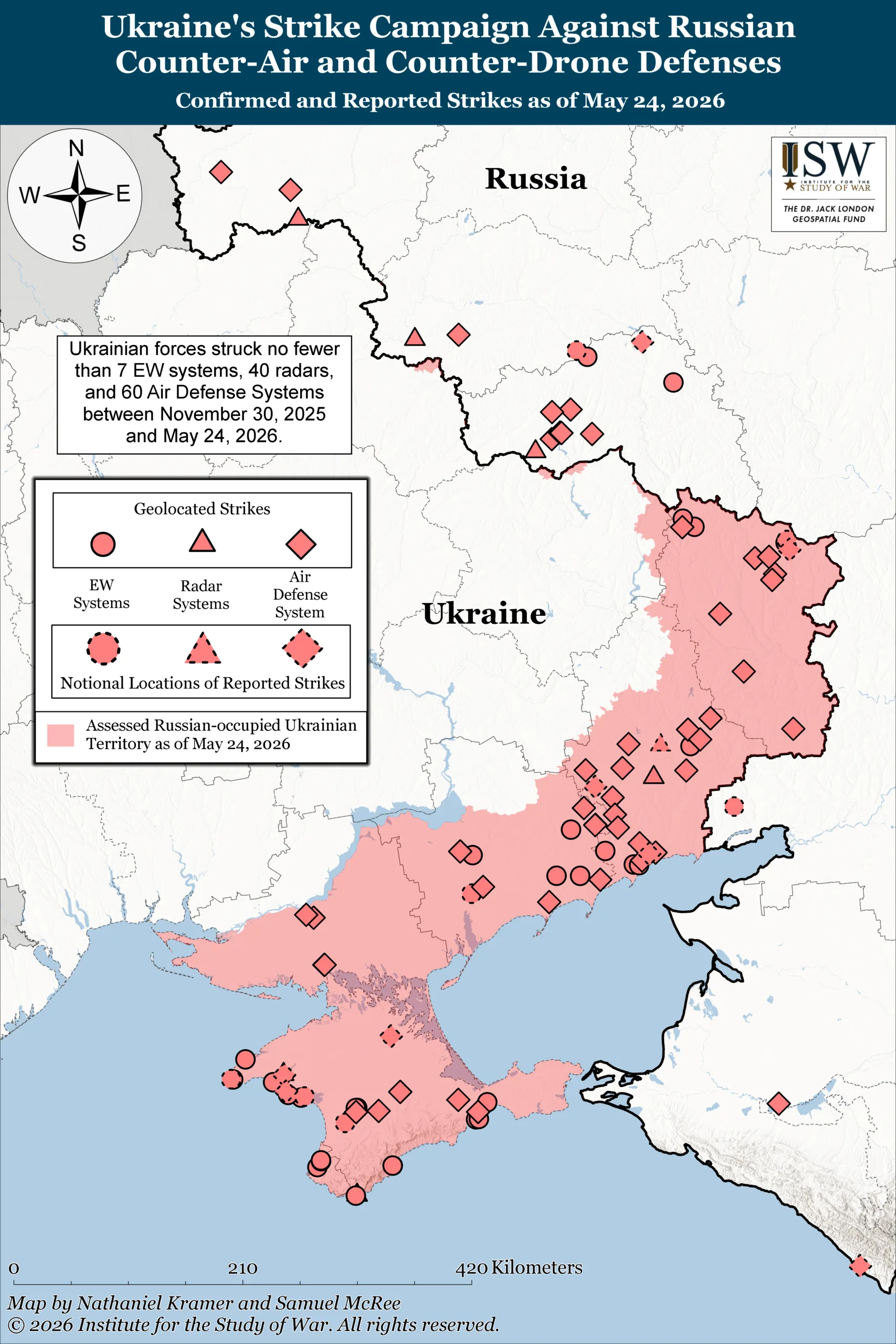
Ukraine’s degradation of the Russian air defense network through concentrated strikes against radars and air defense systems allows subsequent Ukrainian strikes to target other valuable assets in the Russian rear, enhancing the reach of Ukraine’s mid-range strike campaign, enabling Ukrainian forces to launch a higher volume of drones and larger drones deeper into airspace over Russian-controlled terrain. Airpower is a core aspect of combined arms warfare, and Ukraine is setting conditions to allow Ukrainian unmanned and manned aircraft to control the skies for a limited time in designated areas at least.
Intensified Intermediate-Range Strikes
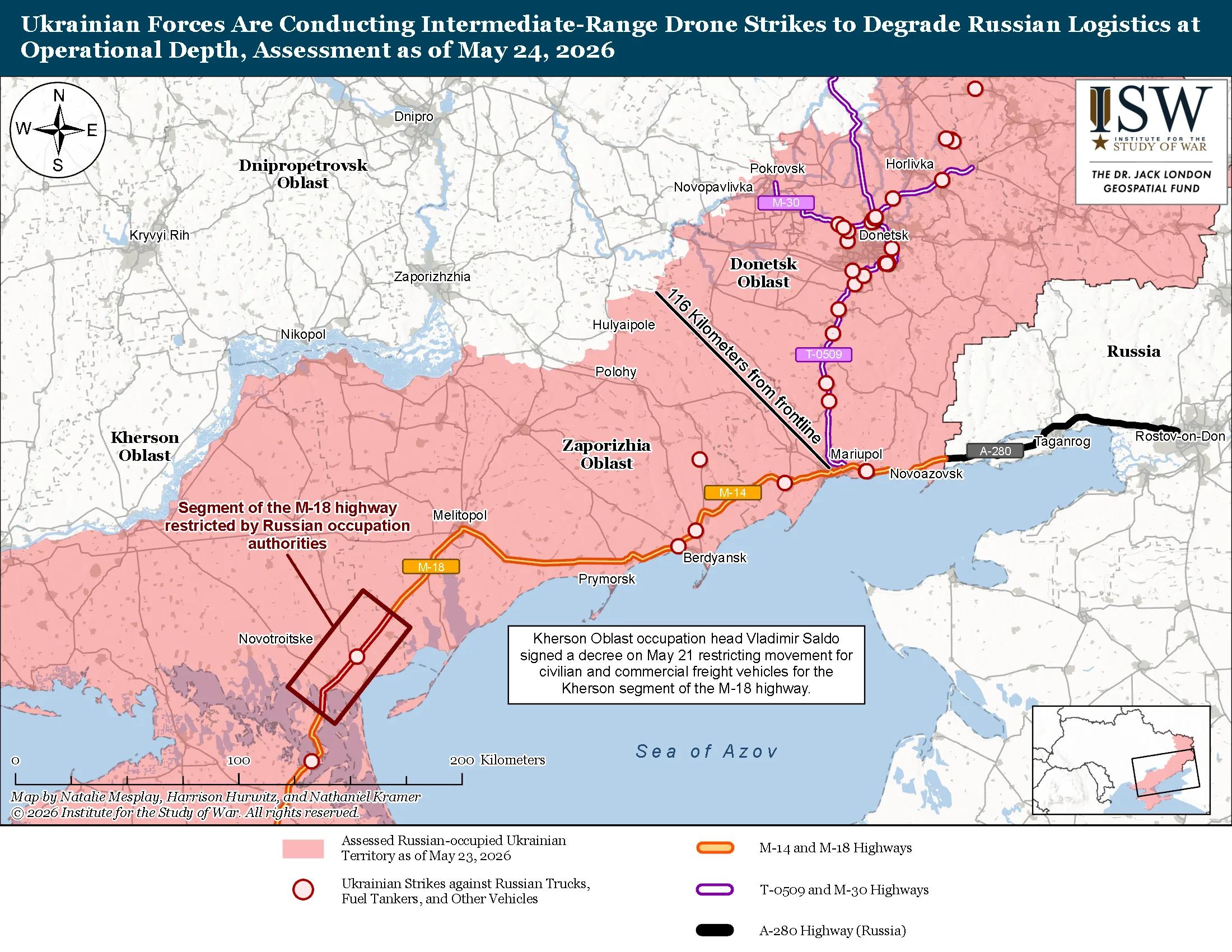
Ukraine significantly intensified its intermediate-range strike campaign against dynamic targets in Spring 2026 in order to degrade Russian logistics at operational depths ahead of a planned Ukrainian maneuver. Ukrainian forces notably began in May 2026 to interdict key Russian ground lines of communication (GLOCs) in occupied Donetsk, Zaporizhia, and Kherson oblasts, particularly along the T-0509 Mariupol-Donetsk City highway (also called the H-20 highway) and the M-14 highway (which Russian occupation officials denote as the R-280 highway), which together with the M-18 highway, connects Russia with occupied Crimea. The T-0509 supplies Russian forces operating along the frontline north of Mariupol and further northeast, supporting the ongoing Russian offensive against Ukraine’s Fortress Belt. The M-14 and M-18 highways connect Rostov-on-Don, Rostov Oblast with occupied Crimea via occupied Mariupol, Berdyansk, and Melitopol and along the Sea of Azov.[33] Geolocated footage published in early May 2026 showed Ukrainian forces dynamically targeting tanker trucks and other military transport vehicles along the T-0509 and in and near Mariupol with UAVs at distances exceeding 100 kilometers from the frontline.[34] Russian officials and milbloggers notably reported in mid- to late May 2026 that Ukrainian drones were increasingly targeting Russian vehicles and logistics along the M-14 highway at distances of over 160 kilometers from the frontline.[35] Geolocated footage published in May 2026 similarly shows Ukrainian forces striking at least 35 Russian trucks and other vehicles near highways, including along the M-14 and M-18 highways in occupied Crimea, and Zaporizhia and Kherson oblasts, and the highways near Donetsk City.[36] Ukrainian forces also have been increasingly targeting GLOCs near Donetsk City and 40 to 50 kilometers from the frontline in Dnipropetrovsk Oblast in late 2025 and Spring 2026.[37]
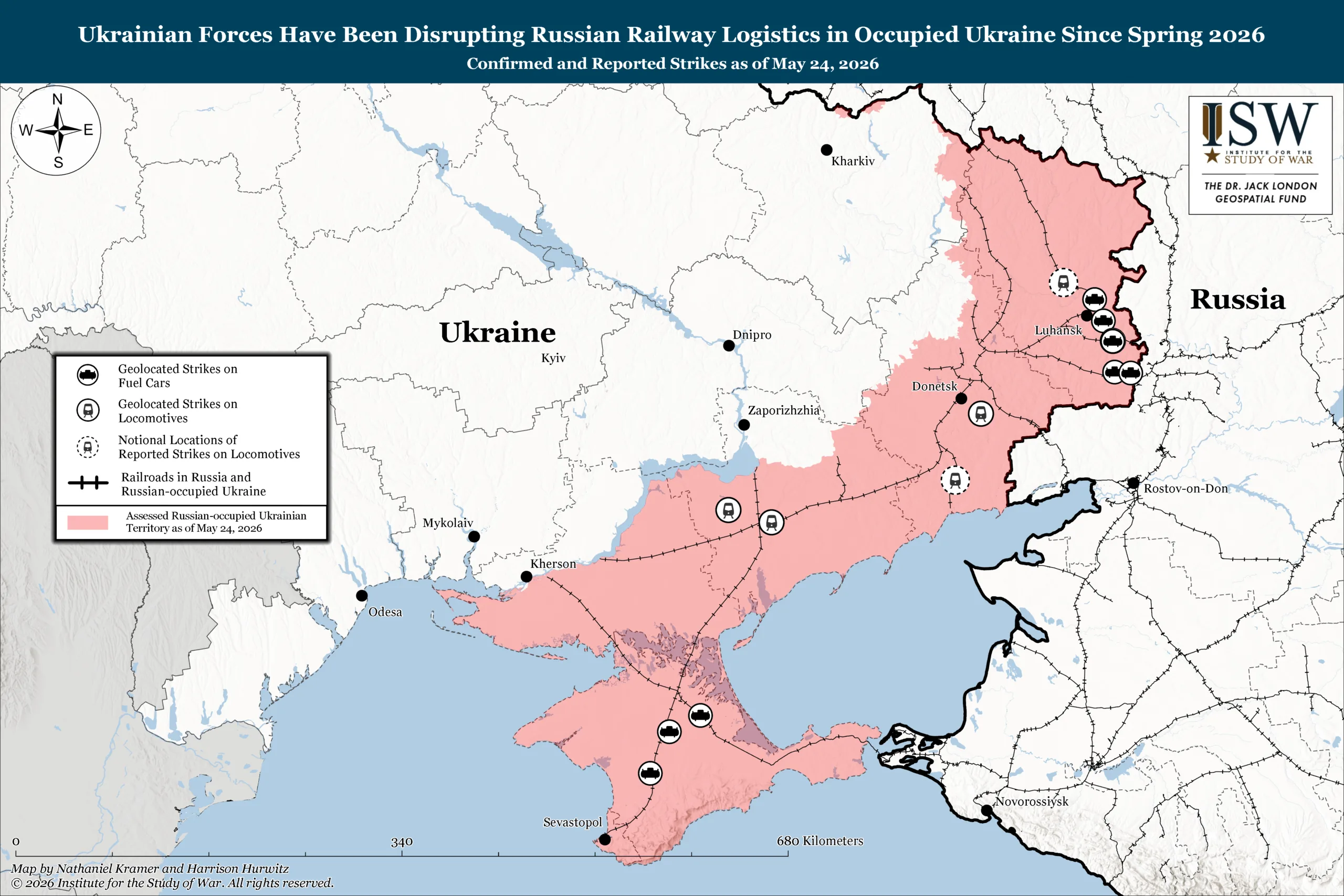
Ukrainian forces started actively disrupting Russian railway logistics in occupied Ukraine and Russian western regions in Spring 2026. Geolocated footage published in March and April 2026 shows guided Ukrainian drones damaging or striking at least 10 freight trains and rail fuel tankers, predominantly in occupied Luhansk Oblast.[38] Ukrainian forces also targeted Russian trains in occupied Donetsk and Zaporizhia oblasts, and Russian officials recently accused Ukraine of striking a freight train in Lgovsky Raion, Kursk Oblast near the Ukraine-Russia international border.[39] Russia is heavily reliant on its railway network for operational logistics, and a successful Ukrainian campaign against freight trains and fuel tankers can further degrade Russia’s ability to bring heavy equipment, fuel, and other materiel closer to the battlefield. Russia’s state-owned Russian Railways company has been facing a major crisis since 2025 due to critical shortages of personnel and locomotives, which could further impact the Russian defense industrial base’s outputs and their deliveries to the frontlines.[40]
Ukrainian intermediate-range strikes are already achieving notable operational effects, including degrading Russia’s ability to use the key Russian highway connecting Russia to occupied Crimea and GLOCs around Donetsk City. Kherson Oblast occupation governor Vladimir Saldo signed a decree on May 21 introducing restrictions on civilian truck movements along the M18 highway (which Russian occupation officials denote as R-280 highway).[41] One milblogger assessed that Ukrainian forces were threatening to cut the Russian land bridge to occupied Crimea.[42] The Ukrainian 1st Azov National Guard Corps similarly announced on April 16 that the corps interdicted all Russian GLOCs around Donetsk City.[43] The Ukrainian 1st Azov National Guard Corps added that it is flying drones along highways connecting Donetsk City with Zuhres, Andriivka, Starobesheve, Horlivka, Lysychansk, and the Donetsk City ring road (all between 25 and 60 kilometers behind the frontline). A Russian milblogger implied that Ukrainian forces successfully paralyzed Russian logistics and civilian traffic along the occupied M-30 Horlivka-Panteleymonivka-Yasynuvata-Donetsk City highway, which at its closest is 35 kilometers away from the active frontline.[44] The milblogger noted that Russian forces could no longer safely use the M-30 highway due to a persistent threat of Ukrainian UAVs with extended ranges and noted that Ukrainian forces are trying to recreate such conditions along the T-0509.[45]
Ukrainian forces decisively seized the initiative in intermediate-range strikes by fielding new technologies such as the US-made Hornet strike UAV, among other systems. The Hornet is a low-cost, fixed-wing one-way attack drone with a 150-kilometer range that is part of the drone partnership between Ukraine and US-based Swift Beat LLC.[46] Ukrainian sources reported using Hornet strike UAVs to patrol roads and interdict GLOCs near the Mariupol-Berdyansk-Melitopol highway in early to mid-May 2026, and Russian officials claimed they first observed Ukrainian forces using Hornet UAVs in March 2026.[47] Russian sources also recorded Hornet UAVs operating in the Belgorod, Kostyantynivka, Dobropillya, and Pokrovsk directions in Spring 2026.[48] Geolocated footage published in early April 2026 also reportedly showed Ukrainian forces using a Hornet UAV to strike a Russian counterbattery radar system near Kamyanka (about 35 kilometers behind the frontline).[49] Russian milbloggers overwhelmingly attributed recent Ukrainian successes in interdicting Russian GLOCs to Hornet UAVs, claiming that the Hornet’s artificial intelligence (AI) capabilities and Starlink satellite connectivity allow the drone to operate in jammed environments, at extended ranges, and amidst Russian internet blocks.[50] Russian milbloggers also observed that Russian electronic warfare (EW) is ineffective against Hornet drones, and that Russia will need to drastically scale up production of radars, develop a unified battlefield situational system, deploy more drone interceptors, and form mobile task forces to counter Ukraine’s strikes against Russian logistics.[51] One Russian milblogger assessed that Russia will be unlikely to adapt to the Hornet threat within the next six to 12 months, implying that Ukraine may have the technological advantage on the battlefield over the coming months.[52]
Tactical Drone Supremacy
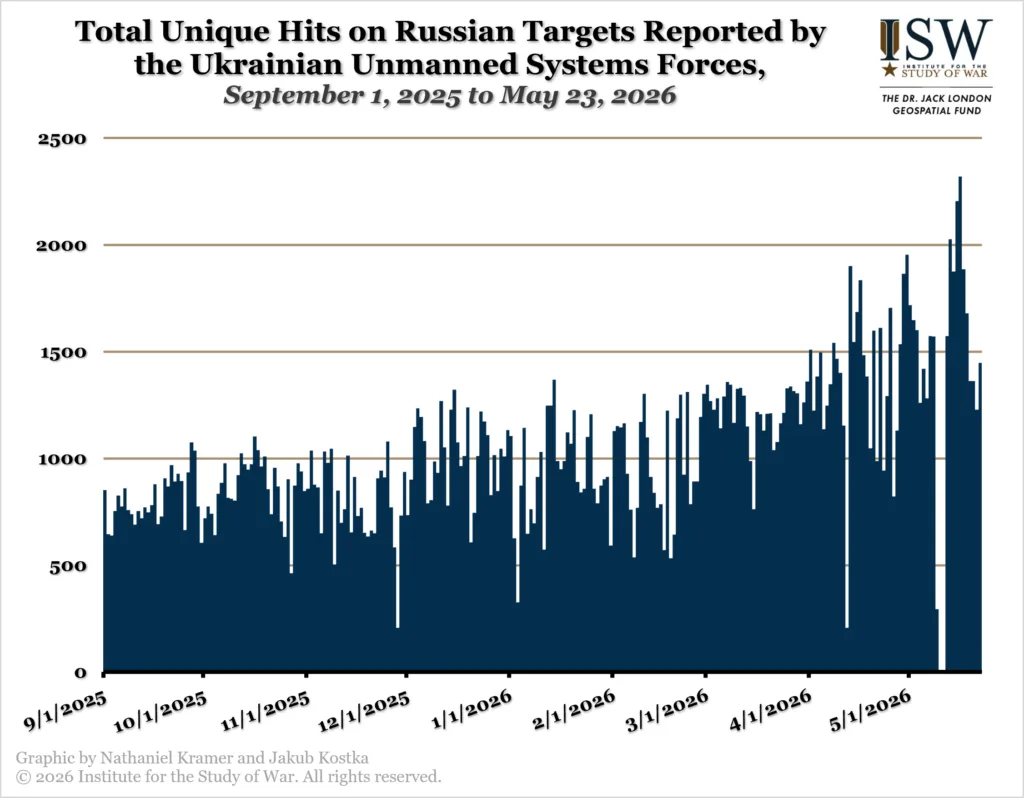
Ukrainian forces are achieving temporary tactical drone overmatch in some frontline sectors, which is slowing Russian offensive operations by degrading the effectiveness of Russian shaping operations. Ukrainian Presidential Office Deputy Head Colonel Pavlo Palisa stated in April 2026 that Ukrainian forces have broadly regained numerical drone superiority over Russian forces on the frontline and now have 1.3 strike drones to every one Russian strike drone.[53] Palisa noted that Russian forces do maintain the quantitative advantage in some areas where they are concentrating offensive operations, however. A Russian milblogger claimed that Ukrainian forces achieved tactical drone dominance by surging 300-400 drones in a small area simultaneously in a tactical exploitation sector with a depth of 20 kilometers during Ukraine’s counterattacks in Dnipropetrovsk Oblast in February 2026.[54] Russian milbloggers similarly have been signaling since at least December 2025 that significant quantities of Ukrainian drones have been impeding Russian operations in Kostyantynivka and in the Dobropillya directions.[55] A Russian milblogger implied that elements of the Russian tactical interdiction campaign, such as strikes against Ukrainian drone operator positions and warehouses, are no longer generating the desired effects, judging by the abundance of Ukrainian drones in the air.[56] The tactical drone overmatch is also likely enabling Ukrainian forces to pursue more strikes against Russian targets. The Ukrainian USF battlefield strike data from September 1, 2025, through May 23, 2026, suggests that Ukrainian total unique hits on Russian targets have steadily increased, even reaching over 2,000 strikes each day on May 13, 15, and 16 (see chart below).[57]
Ukrainian forces likely managed to operate mechanized vehicles close to Russian positions because Ukrainian forces degraded Russian tactical drone defenses in the exploitation sector ahead of the maneuver phase. ISW previously argued that establishing at least local and temporary drone dominance is a key prerequisite for disabling the Russian tactical reconnaissance strike complex to restore maneuver to the battlefield.
Ukrainian forces likely achieved tactical drone overmatch in certain frontline sectors after degrading Russia’s drone capabilities in late 2025 to early 2026 — primarily by suppressing drone launch positions and increasingly intercepting Russian tactical UAVs. Ukrainian forces began to target Russian drone operators and UAV launch and control points in the immediate and intermediate rear since at least late 2025. ISW observed dozens of geolocated videos and Ukrainian reports showing Ukrainian forces targeting Russian drone launch positions and storage facilities throughout 2026 and across the entire theater.[58] Geolocated footage published on May 14 by the Ukrainian 7th Rapid Reaction Corps, for example, reportedly showed Ukrainian forces striking Molniya fixed-wing drone launch points in central Pokrovsk.[59] Ukrainian forces also targeted Gerbera and Shahed-type drone crews and launchers near the occupied Donetsk City Airport (between 45 and 65 kilometers behind the frontline) with UAVs and cruise missiles starting in late Fall 2025 and particularly in March-April 2026.[60] The Ukrainian USF battlefield strike data from September 1, 2025 through May 23, 2026 also suggests that Ukrainian forces have been progressively intensifying strikes against Russian drone launch positions since December 2025.[61] Ukrainian forces targeted 117 drone launch positions during one 24 hour period in May 2026 (see chart below).[62]
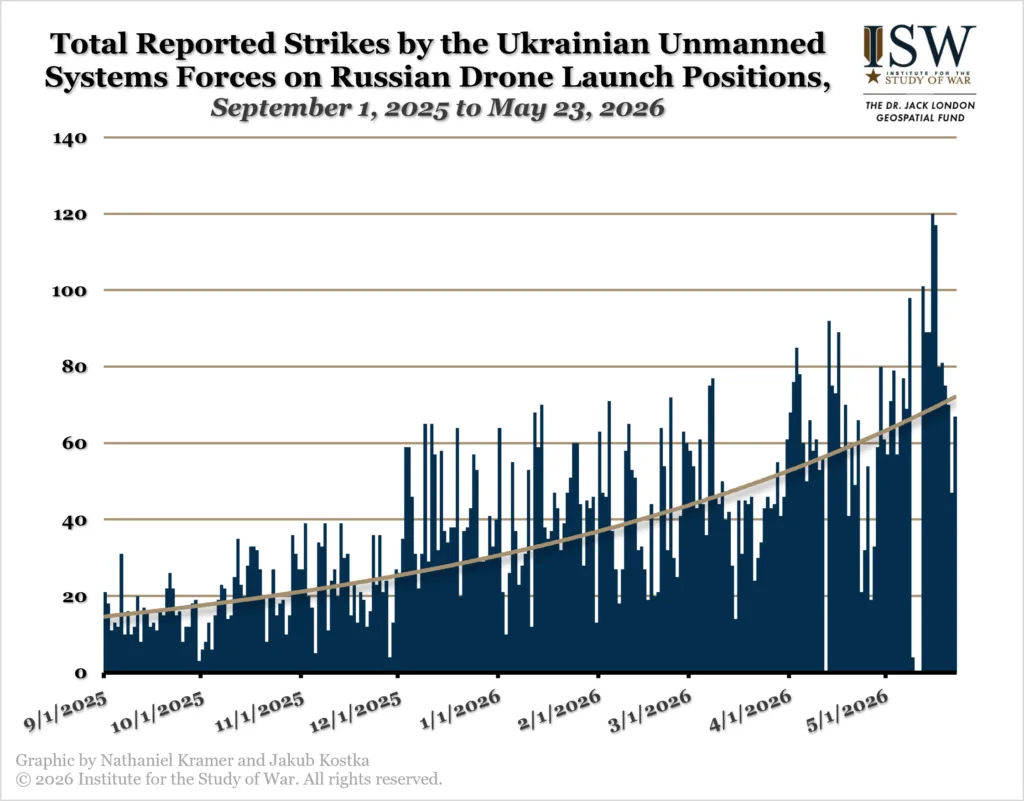
The increased Ukrainian targeting of Russian drone crews and launch positions is at least in part the result of Ukrainian forces adjusting their tactics and target prioritization. The Ukrainian 7th Rapid Reaction Corps recently jointly announced with USF elements on May 18 that they will prioritize increasing the number of drone sorties exclusively tasked with targeting Russian artillery and drone launch positions.[63] Drone operators and launch positions are essential for drone-based capabilities, and degrading drone control points and killing drone pilots can render sectors of the frontline unprotected.
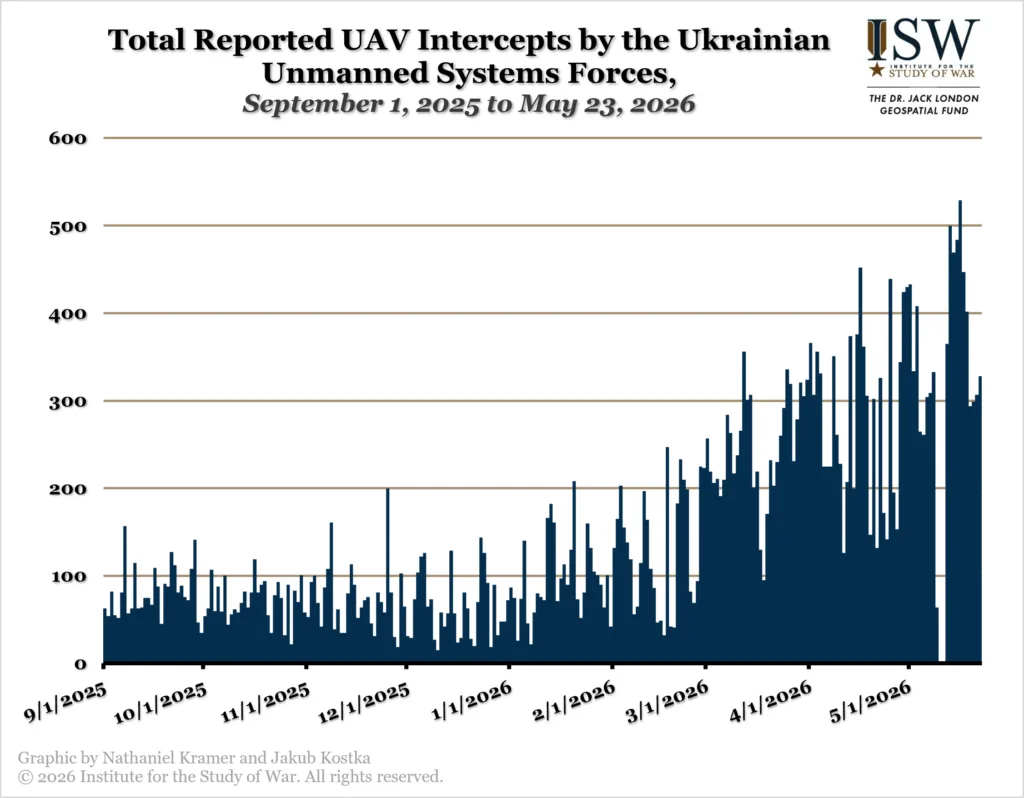
Ukrainian forces are also intercepting more tactical drones, which is likely further undermining Russian forces’ ability to repel Ukrainian mechanized drives and contest the initiative at low altitudes. USF data from September 1, 2025 through May 23, 2026 suggests that Ukrainian forces began intercepting more UAVs along the battlefield starting in Spring 2026 (see chart below).[64] Interceptor drones have important tactical battlefield implications as Russian forces rely on drones to disrupt Ukrainian defenses, which, in turn, enables Russian advances and prevents Ukrainian advances.
Starlink
SpaceX’s surprise cutoff of Starlink to Russian forces operating in Ukraine on February 1 exacerbated Russian command and control problems and further enabled Ukrainian counterattacks. Russian forces’ surprise loss of Starlink was not the main enabling factor for Ukraine’s successful counterattacks in Winter-Spring 2026, however. Ukraine’s months of preparation of the battlefield and good planning set the conditions for successful counterattacks. Russian forces’ loss of Starlink was a strong catalyst that supported Ukraine’s attacks, but Ukraine had already been planning the counterattacks well before it was clear that Russian forces would lose Starlink and commenced the operation no later than January 29, days before Russian forces’ access to Starlink was cut.[65] Russia’s command and control was already degraded by the Kremlin’s deliberate throttling of the Telegram messenger app, even before Russian forces lost Starlink.[66] The surprise loss of Starlink has also indirectly furthered the Ukrainian effort to disrupt Russian drone operations, as the loss of Starlink forced Russian drone operators to use more conspicuous antennas that were more easily identifiable and strikable, further reducing Russian drone crews’ survivability and degrading Russia’s ability to dominate the kill zone.[67]
Ukraine’s degradation of Russian forces at operational depth, combined with tactical-level drone overmatch is likely creating vulnerabilities in the Russian lines. Ukraine is exploiting the current characteristics of the drone-dominated pointillist battlefield: force dispersion, positional warfare, the inability to mass logistics in the tactical rear, and critical reliance on tactical drones for defense, offense, force protection, and sustainment. Russian forces have settled into a concept of operation and battle rhythm optimized for the dispersed positional nature of the war. The Russian concept of operations assumes that Russian forces can continue pushing infantry infiltrators forward while maintaining consistent drone capabilities to support Russian infiltrations and deny Ukrainian forces the ability to degrade Russian forces in depth. Ukraine’s tactical successes in Dnipropetrovsk and Zaporizhia oblasts are likely the result of the planning and shaping efforts that have eroded the core foundations on which Russia has built its current method of positional warfare. By achieving tactical drone dominance, preventing force accumulation in tactical areas, attritting Russian forces in the kill zone, and degrading Russian logistics and sustainment in depth, Ukraine has been able to create conditions under which Russian forces’ grip over frontline positions is vulnerable to well-planned and well-executed attacks.
Forecast: Ukraine’s intermediate-range strike campaign is likely far from its zenith, assuming continued support from Ukraine’s partners, and will likely intensify over 2026 as Ukraine fields new weapons capable of striking Russia’s operational rear. Ukraine is developing several new intermediate-range strike vehicles that will likely enter service in the near future. Ukrainian drone operators began using a variant of the FP-2 fixed-wing drone that can fire unguided S-8 aviation rockets while being remotely piloted at operational depths for the first time in May 2026.[68] Ukrainian Defense Minister Mykhailo Fedorov announced on May 18 that a Ukrainian defense company developed and tested Ukraine’s first domestically produced guided glide bomb with a payload of 250 kilograms and an unspecified range of ”dozens of kilometers”, which is now ready for combat use.[69] Ukraine’s SEAD / DEAD campaign may enable Ukrainian fixed wing aircraft to fly closer to the frontline and at higher altitudes to enable the Ukrainian glide bomb to drop heavy ordinance on critical hardened targets in Russia’s operational rear. Russian milbloggers have expressed concern that Ukrainian forces may be able to fully automate Swift Beat’s Hornet drones within the next six to 12 months (about December 2026 to March 2027).[70] Ukraine is testing launching the Hornet drone from a weather balloon from an altitude of eight kilometers that drifts over 40 kilometers into Russian-controlled airspace to extend the max range of the Hornet to around 300 kilometers.[71]
Conclusion
The war in Ukraine is competitive and far from stalemated. Ukrainian forces are out-innovating Russian forces in both military technologies and in applying these new technologies in effective operational concepts that can help Ukrainian forces break out of positional warfare. Ukraine is employing mechanized equipment in tactical maneuvers in ways that were impossible 12 months ago. Russia’s ability to conduct infiltration missions will likely continue to degrade as Ukraine’s intermediate-range strike campaign pushes Russia’s logistics and forward operating bases further away from the frontlines, reducing resourcing to sustain infantry tasked with infiltration missions. Ukraine may be able to scale these effects if resourced properly by international partners. Ukraine’s advantage in intermediate-range strikes is notably not permanent, and Russia will very likely eventually develop countermeasures to mitigate Ukraine’s advantages. Ukraine’s international partners thus have a rare and temporary opportunity to help Ukraine exploit favorable battlefield dynamics while Ukraine has the upper hand.
Ukraine may soon invalidate Russian President Vladimir Putin’s theory of victory, on the other hand. It is not inconceivable that Russian forces’ daily rate of advance may hit net zero in the coming years (or even months), given that Russian forces are currently advancing and infiltrating only three to five square kilometers per day – a significant decrease from Russia’s daily rate this time last year. ISW has long argued that Putin’s theory of victory assumes that Russian forces will be able to win an attritional war, provided that Russian forces continue gradual creeping advances indefinitely.[72] Ukraine’s complete halting of Russian advances would invalidate Putin’s theory of victory and impose difficult decisions on the Kremlin. Ukraine’s partners, who all aim to bring this war rapidly to a conclusion on acceptable terms, should lean into this moment of potential Ukrainian advantage to force Putin to reevaluate his position and realize that he has no plausible expectation of achieving his aims by continuing the war.

[1] https://texty.org dot ua/projects/116021/20-kilometers-of-the-gray-zone-the-front-line-has-become-blurred/ ; https://understandingwar.org/research/future-of-war/ukraine-and-the-problem-of-restoring-maneuver-in-contemporary-war/
[2] https://understandingwar.org/research/russia-ukraine/russian-offensive-campaign-assessment_4-8/; https://understandingwar.org/research/russia-ukraine/russian-offensive-campaign-assessment_14-4/; https://understandingwar.org/research/russia-ukraine/russian-offensive-campaign-assessment_30-4/; https://understandingwar.org/research/russia-ukraine/russian-offensive-campaign-assessment-october-14-2025/; https://understandingwar.org/research/russia-ukraine/russian-offensive-campaign-assessment-december-23-2025/; https://understandingwar.org/research/russia-ukraine/russian-offensive-campaign-assessment_3-8/; https://understandingwar.org/research/russia-ukraine/russian-offensive-campaign-assessment-october-14-2025/; https://understandingwar.org/research/russia-ukraine/russian-offensive-campaign-assessment-april-19-2026/
[3] https://understandingwar.org/research/russia-ukraine/russian-partial-battlefield-air-interdiction-enabled-recent-russian-advances-in-pokrovsk/
[4] https://understandingwar.org/research/future-of-war/ukraine-and-the-problem-of-restoring-maneuver-in-contemporary-war/
[5] https://understandingwar.org/research/russia-ukraine/russias-quest-to-intensify-the-theater-wide-battlefield-air-interdiction-campaign-against-ukraines-logistics/; https://understandingwar.org/research/russia-ukraine/russian-partial-battlefield-air-interdiction-enabled-recent-russian-advances-in-pokrovsk/; https://understandingwar.org/research/russia-ukraine/russian-drone-innovations-are-likely-achieving-effects-of-battlefield-air-interdiction-in-ukraine/
[6] https://understandingwar.org/research/russia-ukraine/russian-partial-battlefield-air-interdiction-enabled-recent-russian-advances-in-pokrovsk/; https://understandingwar.org/research/russia-ukraine/russian-drone-innovations-are-likely-achieving-effects-of-battlefield-air-interdiction-in-ukraine/; https://understandingwar.org/research/russia-ukraine/russias-quest-to-intensify-the-theater-wide-battlefield-air-interdiction-campaign-against-ukraines-logistics/
[7] https://understandingwar.org/research/russia-ukraine/russian-drone-innovations-are-likely-achieving-effects-of-battlefield-air-interdiction-in-ukraine/; https://understandingwar.org/research/russia-ukraine/russian-offensive-campaign-assessment-july-7-2025/
[8] https://understandingwar.org/research/russia-ukraine/russian-offensive-campaign-assessment-december-5-2025/; https://www.washingtonpost.com/opinions/interactive/2025/pokrovsk-ukraine-russia-war/; https://www.rferl.org/a/pokrovsk-battle-update-russian-drones-target-ukrainian-logistics/33624838.html; https://understandingwar.org/research/russia-ukraine/russian-drone-innovations-are-likely-achieving-effects-of-battlefield-air-interdiction-in-ukraine/; https://understandingwar.org/research/russia-ukraine/russian-partial-battlefield-air-interdiction-enabled-recent-russian-advances-in-pokrovsk/
[9] https://understandingwar.org/research/russia-ukraine/russian-partial-battlefield-air-interdiction-enabled-recent-russian-advances-in-pokrovsk/
[10] https://understandingwar.org/research/russia-ukraine/russian-offensive-campaign-assessment-april-8-2025/; https://understandingwar.org/research/russia-ukraine/russian-offensive-campaign-assessment-november-5-2025/
[11] https://www.ukrinform dot net/rubric-ato/4028579-ukrainian-forces-destroy-russian-uav-command-post-and-ammo-depot-in-donetsk-region.html; https://understandingwar.org/research/russia-ukraine/russian-offensive-campaign-assessment-december-31-2025/; https://www.facebook.com/watch/?v=2656162064761337; https://t.me/ukr_sof/2627
[12] https://www.svoboda.org/a/tayna-rubikona-bpla-spetsnaz-v-parke-patriot-/33531165.html; https://www.bbc.com/russian/articles/cgqgyg7zp22o
[13] https://understandingwar.org/research/russia-ukraine/russian-offensive-campaign-assessment-march-25-2026/; https://understandingwar.org/research/russia-ukraine/russian-offensive-campaign-assessment-april-27-2026/; https://t.me/rusich_army/27531
[14] https://understandingwar.org/research/russia-ukraine/russian-offensive-campaign-assessment-december-31-2025/
[15] https://understandingwar.org/research/russia-ukraine/russian-offensive-campaign-assessment-may-2-2026/
[16] https://united24media dot com/war-in-ukraine/ukraine-continues-to-eliminate-more-russian-troops-than-russia-can-recruit-89000-in-3-months-17479
[17] https://www.bloomberg.com/news/articles/2026-02-11/russian-war-losses-now-exceed-recruitment-western-officials-say
[18] https://t.me/robert_magyar/2152
[19] https://x.com/hochuzhit_com/status/2041050969505435690
[20] https://t.me/zedigital/6784; https://armyinform dot com.ua/2026/05/05/myhajlo-fedorov-pyatyj-misyacz-pospil-rosiya-vtrachaye-bilshe-nizh-zdatna-mobilizuvaty/ ; https://armyinform dot com.ua/2026/05/05/rekordni-pokaznyky-droniv-perehoplyuvachiv-194-pidrozdily-mayut-pidtverdzheni-zbyttya-shahediv/ ; https://armyinform dot com.ua/2026/05/05/shtaby-ppo-ta-logistyka-voroga-kilkist-midlstrajkiv-zrosla-vdvichi-za-misyacz/
[21] https://understandingwar.org/research/russia-ukraine/russian-offensive-campaign-assessment-march-3-2026/
[22] https://understandingwar.org/research/russia-ukraine/russian-offensive-campaign-assessment-may-2-2026/
[23] https://militarnyi dot com/uk/news/syrskyj-kilkist-nastupalnyh-dij-syl-oborony-pochala-perevyshhuvaty-rosijski/ ; https://www.youtube.com/watch?v=B9ZMEMKBWl0&t=1s
[24] https://x.com/99Dominik_/status/2031301689806839914?s=20; https://t.me/kyriienko_press/1455; https://t.me/ShalinW/16767; https://x.com/moklasen/status/2005414715183497673 ; https://x.com/juss_men/status/2051320741354688793; https://t.me/Osintpen/2658; https://x.com/ne_kotletka/status/2026331982079115383 ; https://t.me/creamy_caprice/11276
[25] https://x.com/moklasen/status/2057951308842197472; https://t.me/operationall_space/11627
[26] https://understandingwar.org/wp-content/uploads/2025/05/Ukraine20and20the20Problem20of20Restoring20Maneuver20in20Contemporary20War_final.pdf
[27] https://understandingwar.org/research/russia-ukraine/russian-offensive-campaign-assessment-may-16-2026/; https://understandingwar.org/research/russia-ukraine/russian-offensive-campaign-assessment-may-12-2026/; https://understandingwar.org/research/russia-ukraine/russian-offensive-campaign-assessment-march-14-2026/; https://understandingwar.org/research/russia-ukraine/russian-offensive-campaign-assessment-november-12-2025/; https://understandingwar.org/research/russia-ukraine/russian-offensive-campaign-assessment-january-13-2026/
[28] https://understandingwar.org/research/russia-ukraine/russian-offensive-campaign-assessment-march-7-2026/
[29] https://jamestown.org/ukraines-military-transitioning-to-corps-based-command-structure/
[30] https://mod.gov dot ua/news/bojova-sistema-delta-vprovadzhena-na-vsih-rivnyah-sil-oboroni-ukrayini
[31] https://understandingwar.org/research/russia-ukraine/russian-offensive-campaign-assessment-march-19-2026/
[32] https://tochnyi.info/2026/03/blinding-the-bear-and-pulling-its-fangs-ukraines-long-range-campaign-against-the-russian-air-defence/
[33] https://khogov dot ru/documents/ukaz-gubernatora-hersonskoj-oblasti-ot-21-05-2026-%E2%84%96-32-u-o-realizaczii-mer-predusmotrennyh-ukazom-prezidenta-rossijskoj-federaczii-ot-19-oktyabrya-2022-g-%E2%84%96-757-o-merah-o/
[34] https://understandingwar.org/research/russia-ukraine/russian-offensive-campaign-assessment-may-8-2026/; https://understandingwar.org/research/russia-ukraine/russian-offensive-campaign-assessment-may-11-2026/ ; https://x.com/moklasen/status/2052101122823774707; https://x.com/moklasen/status/2052469050060505535; https://x.com/moklasen/status/2052469046952526042; https://x.com/666_mancer/status/2052092339779469434; https://t.me/andriyshTime/57434
[35] https://t.me/voenkorKotenok/72321; https://understandingwar.org/research/russia-ukraine/russian-offensive-campaign-assessment-may-11-2026/; https://t.me/zhivoff/26333; https://t.me/romanov_92/53017; https://t.me/astrapress/112272; https://x.com/stratcomcentre/status/2053512126514253964?s=46; https://tass dot ru/proisshestviya/27449909
[36] https://x.com/99Dominik_/status/2057151021839728952; https://x.com/Zeldamices/status/2018706917019799845; https://t.me/WarInMyEyes/12564; https://x.com/99Dominik_/status/2020152817831293151; https://t.me/ivanfrankogroup/226; https://x.com/99Dominik_/status/2037532150078009541; https://t.me/ivanfrankogroup/230; https://t.me/WarArchive_ua/34935; https://t.me/azov_media/8228; https://x.com/blinzka/status/2045836545278525635; https://x.com/azov_media/status/2044673770015592755; https://x.com/blinzka/status/2045836540228534511; https://x.com/azov_media/status/2044673770015592755; https://x.com/blinzka/status/2045836540228534511; https://x.com/azov_media/status/2044673770015592755; https://x.com/blinzka/status/2045836540228534511; https://x.com/azov_media/status/2044673770015592755; https://x.com/blinzka/status/2045836540228534511; https://x.com/azov_media/status/2044673770015592755; https://x.com/99Dominik_/status/2052120833229729960; https://x.com/moklasen/status/2052101122823774707; https://t.me/andriyshTime/57434; https://ukr.warspotting.net/view/44593/; https://t.me/WS_videos/4033; https://x.com/azov_media/status/2052638206189814258; https://x.com/99Dominik_/status/2057097306176983154; https://t.me/exilenova_plus/20945; https://x.com/RALee85/status/2057793014932623818; https://x.com/clement_molin/status/2057796527381205297; https://t.me/spartan_ngu/3116; https://x.com/RALee85/status/2057793014932623818 ; https://x.com/clement_molin/status/2057796527381205297;https://t.me/spartan_ngu/3116; https://tass [dot] ru/proisshestviya/27449909; https://x.com/blinzka/status/2057206706128429520; https://x.com/hochu_dodomu/status/2057105904747618806 https://x.com/99Dominik_/status/2056802193777344959; https://t.me/luftwaffe422/915; https://x.com/moklasen/status/2056440988185317565; https://t.me/exilenova_plus/20817; https://x.com/blinzka/status/2057209035116470719; https://x.com/bayraktar_1love/status/2057117220472304079; https://x.com/blinzka/status/2057232523508290008; https://x.com/blinzka/status/2057232526255530413; https://t.me/exilenova_plus/20929; https://x.com/99Dominik_/status/2057151021839728952; https://x.com/moklasen/status/2057132006702567763; https://www.youtube.com/watch?v=OSFq4AZcVw8; https://t.me/k_2army/1199; https://x.com/Kukulkan415/status/2054973794846982508; https://t.me/ivanfrankogroup/237; https://t.me/WarArchive_ua/34935; https://t.me/azov_media/8228; https://x.com/blinzka/status/2045836540228534511; https://x.com/azov_media/status/2044673770015592755; https://x.com/blinzka/status/2045836545278525635; https://x.com/azov_media/status/2044673770015592755; https://x.com/blinzka/status/2045836540228534511; https://x.com/azov_media/status/2044673770015592755; https://x.com/moklasen/status/1988334843151995244; https://t.me/ivanfrankogroup/191; https://x.com/Kukulkan415/status/1999514776032919896; https://t.me/ivanfrankogroup/219; https://x.com/Kukulkan415/status/1999529219689177397; https://t.me/ivanfrankogroup/219; https://x.com/99Dominik_/status/2031279819783049460?s=20; https://t.co/UavVnQLJzU; https://x.com/99Dominik_/status/2037532150078009541; https://t.me/ivanfrankogroup/230; https://t.me/WarArchive_ua/34935; https://t.me/azov_media/8228; https://x.com/moklasen/status/2047656962960114076; https://x.com/moklasen/status/2057132006702567763; https://x.com/moklasen/status/2057132009428865175; https://t.me/exilenova_plus/19321; https://x.com/Kukulkan415/status/2054993842395312552; https://t.me/ivanfrankogroup/237; https://x.com/99Dominik_/status/2055662871401398460; https://t.me/exilenova_plus/20662; https://t.co/L6JS4Qe2q0; https://x.com/clement_molin/status/2058236033045496231; https://x.com/Exilenova_plus/status/2058447059209138638; https://x.com/99Dominik_/status/2058451080179007600; https://t.me/exilenova_plus/21124; https://x.com/99Dominik_/status/2058451080179007600; https://t.me/exilenova_plus/21124
[37] https://understandingwar.org/research/russia-ukraine/russian-offensive-campaign-assessment-april-8-2026/; https://understandingwar.org/research/russia-ukraine/russian-offensive-campaign-assessment-april-6-2026/; https://understandingwar.org/research/russia-ukraine/russian-offensive-campaign-assessment-march-28-2026/ ; https://understandingwar.org/research/russia-ukraine/russian-offensive-campaign-assessment-march-12-2026/ ; https://understandingwar.org/research/russia-ukraine/russian-offensive-campaign-assessment-december-15-2025/; https://understandingwar.org/research/russia-ukraine/russian-offensive-campaign-assessment-november-13-2025/; https://t.me/belarusian_silovik/70842
[38] https://x.com/99Dominik_/status/2032038652059037701; https://x.com/666_mancer/status/2032074817055170743?s=20; https://x.com/klinger66/status/2036216582850949576?s=20; https://t.me/robert_magyar/2117; https://x.com/moklasen/status/2038167224809070959; https://t.me/robert_magyar/2144; https://x.com/federicoborsar1/status/2040356128442269970; https://x.com/414magyarbirds/status/2040334115438809298; https://x.com/blinzka/status/2041795080856424634 https://x.com/PuenteUribarri/status/2041771611737481342; https://t.me/luftwaffe422/866; https://t.me/WarArchive_ua/35165; https://x.com/blinzka/status/2047366598986473564?s=20; https://t.me/robert_magyar/2271
[39] https://x.com/GirkinGirkin/status/2058531401989861695?s=20; https://t.me/Hinshtein/18237
[40] https://novayagazeta dot eu/articles/2025/07/04/off-the-rails-en
[41] https://t.me/SALDO_VGA/15506
[42] https://t.me/voenkorKotenok/72321
[43] https://t.me/azov_media/8228
[44] https://understandingwar.org/research/russia-ukraine/russian-offensive-campaign-assessment-may-11-2026/
[45] https://understandingwar.org/research/russia-ukraine/russian-offensive-campaign-assessment-may-11-2026/;m https://t.me/andriyshTime/57815
[46] https://euromaidanpress dot com/2026/05/22/russia-captures-hornet-ai-drone-that-ukraine-uses-to-cut-logistics-150-km-behind-front-without-software-that-makes-it-work/; https://defence-ua dot com/photo/scho_takogo_osoblivogo_v_seredini_drona_hornet_jakim_virizajut_rosijsku_logistiku_zvidki_vin_vzjavsja_ta_jaki_jogo_kljuchovi_osoblivosti-453.html
[47] https://x.com/azov_media/status/2052638206189814258; https://ria dot ru/20260304/ukraina-2078340784.html; https://www.kyivpost dot com/post/71273; https://militarnyi dot com/uk/news/azov-u-mariupoli-pochav-nyshhyty-rosijsku-logistyku-dronamy-hornet/; https://x.com/azov_media/status/2052638206189814258; https://t.me/andriyshTime/57434; https://armyinform dot com.ua/2026/05/08/azov-povertayetsya-do-mariupolya-drony-1-go-korpusu-ngu-byut-po-czilyah-okupantiv-navkolo-mista/; https://armyinform dot com.ua/2026/05/08/azov-atakuvav-okupantiv-v-mariupoli-bezpilotnyky-pryletily-v-chechnyu-dron-shuter-strim/; https://t.me/azov_media/8279
[48] https://t.me/motopatriot78/51584; https://t.me/voenkorKotenok/72321; https://understandingwar.org/research/russia-ukraine/russian-offensive-campaign-assessment-may-11-2026/; https://t.me/zhivoff/26333; https://t.me/nm_dnr/15274; https://t.me/Ghost_Malleus_Maleficarum/1331
[49] https://x.com/blinzka/status/2041959534516666684?s=20; https://x.com/bayraktar_1love/status/2041805751094583526?s=20; https://x.com/15obrar/status/2040808997100401132?s=20
[50] https://www.eadaily dot com/ru/news/2026/05/17/voenkory-byut-v-kolokola-znayushchie-it-sferu-rossiyskie-voennye-novye-opasnye-faktory; https://t.me/vysokygovorit/22927; https://t.me/notes_veterans/27754; https://t.me/notes_veterans/27755 ; https://t.me/rybar/80303 ; https://x.com/GirkinGirkin/status/2053507753398653352; https://t.me/romanov_92/53017 ; https://t.me/milinfolive/171948 ; https://t.me/dva_majors/92647
[51] https://t.me/notes_veterans/27754; https://t.me/notes_veterans/27755; https://t.me/dva_majors/92647
[52] https://x.com/GirkinGirkin/status/2053507753398653352; https://t.me/romanov_92/53017
[53] https://www.rbc dot ua/rus/news/okupovaniy-kilometr-donechchini-voroga-316-1775564047.html; https://suspilne dot media/vinnytsia/1284112-rf-rozgladae-bufernu-zonu-na-vinniccini-z-boku-pridnistrova-pavlo-palisa/; https://suspilne dot media/donbas/1284120-vtrati-rf-na-donbasi-zrosli-majze-vtrici-vid-pocatku-roku-palisa/
[54] https://t.me/belarusian_silovik/70844
[55] https://t.me/rusich_army/27244; https://t.me/rybar/75865
[56] https://t.me/dva_majors/89413
[57] https://t.me/robert_magyar/2358; https://t.me/robert_magyar/2346; https://t.me/robert_magyar/2362; https://sbs-group dot army/subdivision/usf_grouping
[58] https://t.me/WarArchive_ua/32229; https://t.me/ukr_sof/2279; https://x.com/Osinttechnical/status/2005186319576862985?s=20; https://t.me/robert_magyar/1787; https://x.com/ukrliberation/status/2019008999052460459; https://t.me/ukr_sof/2503; https://t.me/Osintpen/2509; https://t.me/The_Wrong_Side/27943; https://t.me/DniproOfficial/7165; https://t.me/ukr_sof/2548; https://t.me/DniproOfficial/7165; https://t.me/ukr_sof/2548; https://t.me/WarArchive_ua/33809; https://t.me/robert_magyar/2003; https://x.com/neonhandrail/status/2028059460015628671; https://t.me/exilenova_plus/16899; https://t.me/WarArchive_ua/34103; https://t.me/GeneralStaffZSU/35805; https://t.me/GeneralStaffZSU/35847; https://t.me/GeneralStaffZSU/35847; https://t.me/GeneralStaffZSU/35847; https://t.me/andriyshTime/53713; https://t.me/andriyshTime/53714; https://x.com/99Dominik_/status/2030988392209522698; https://x.com/NOELreports/status/2030961692075569524; https://x.com/blinzka/status/2030945834854932983; https://x.com/NOELreports/status/2030920765038559257
https://x.com/MikiValbuena/status/2031676139811360988; https://t.me/kyriienko_press/1463;
https://x.com/moklasen/status/2032802396259180810?s=20; https://x.com/SOF_UKR/status/2032799151662973251?s=20; https://x.com/moklasen/status/2032799584020214246?s=20; https://x.com/SOF_UKR/status/2032799151662973251?s=20
; https://t.me/DIUkraine/8080; https://t.me/kiber_boroshno/12726; https://t.me/WarArchive_ua/34525; https://x.com/blinzka/status/2037879240838844516; https://t.me/army_1usc/847; https://t.me/robert_magyar/2170; https://t.me/DniproOfficial/7406 https://t.me/army_1usc/872; https://t.me/WarArchive_ua/34752 ; https://x.com/blinzka/status/2041475071458349442; https://x.com/bayraktar_1love/status/2041472773994725801; https://t.me/WarArchive_ua/34789; https://t.me/robert_magyar/2186; https://t.me/WarArchive_ua/34789; https://t.me/robert_magyar/2186; https://x.com/blinzka/status/2041984068544270381?s=20; https://x.com/NOELreports/status/2041957202936631744?s=20; https://t.me/GeneralStaffZSU/37295; https://t.me/DniproOfficial/7439; https://t.me/GeneralStaffZSU/37295; https://t.me/DniproOfficial/7439; https://x.com/aroslav24470/status/2044730512678240589?s=20; https://t.me/robert_magyar/2215; https://x.com/ne_kotletka/status/2045570311714718069; https://t.me/army_1usc/889; https://x.com/klinger66/status/2048110054943957376; https://x.com/DPSU_ua/status/2047975494499360873; https://x.com/Kukulkan415/status/2052105237725319595; https://x.com/PuenteUribarri/status/2052053391077937309
[59] https://t.me/WarArchive_ua/35713; https://t.me/corps7DSHV/1444; https://t.me/corps7DSHV/1444
[60] https://understandingwar.org/research/russia-ukraine/russian-offensive-campaign-assessment-april-8-2026/; https://understandingwar.org/research/russia-ukraine/russian-offensive-campaign-assessment-april-6-2026/; https://understandingwar.org/research/russia-ukraine/russian-offensive-campaign-assessment-march-28-2026/ ; https://understandingwar.org/research/russia-ukraine/russian-offensive-campaign-assessment-march-12-2026/ ; https://understandingwar.org/research/russia-ukraine/russian-offensive-campaign-assessment-december-15-2025/; https://understandingwar.org/research/russia-ukraine/russian-offensive-campaign-assessment-november-13-2025/
[61] https://sbs-group dot army/subdivision/usf_grouping
[62] https://t.me/robert_magyar/2362
[63] https://t.me/corps7DSHV/1455; https://armyinform dot com.ua/2026/05/18/artyleriya-i-tochky-zapusku-droniv-7-j-korpus-dshv-ptahy-madyara-ta-lasars-group-posylyuyut-robotu-pid-pokrovskom/
[64] https://sbs-group dot army/subdivision/usf_grouping
[65] https://t.me/ua_dshv/8275; https://www.rbc dot ua/rus/news/bude-shchos-take-chogo-vorog-ochikue-velike-1773100140.html; https://www.pravda dot com.ua/articles/2026/03/10/8024699/
[66] https://cpj.org/2026/02/cpj-russias-telegram-throttling-another-step-toward-total-information-control/ ; https://www.nytimes.com/2026/02/10/world/europe/telegram-throttled-internet-russia.html ; https://understandingwar.org/research/russia-ukraine/russian-occupation-update-november-6-2025/ ; https://understandingwar.org/research/russia-ukraine/russian-occupation-update-november-6-2025/
[67] https://understandingwar.org/research/russia-ukraine/russias-quest-to-intensify-the-theater-wide-battlefield-air-interdiction-campaign-against-ukraines-logistics/
[68] https://t.me/robert_magyar/2367
[69] https://t.me/zedigital/6800
[70] https://understandingwar.org/research/russia-ukraine/russian-offensive-campaign-assessment-may-11-2026/ ; https://t.me/romanov_92/53008
[71] https://defence-blog.com/ukraine-tests-hornet-strike-drone-launched-from-aerostat/; https://defence-ua dot com/news/jak_droni_hornet_jaki_zakrivajut_rashistam_suhoputnij_koridor_u_krim_teper_litatimut_sche_dali_ta_sche_dovshe_zavdjaki_povitrjanim_kuljam-23031.html
[72] https://understandingwar.org/research/russia-ukraine/russian-offensive-campaign-assessment_7-6/