
Toplines
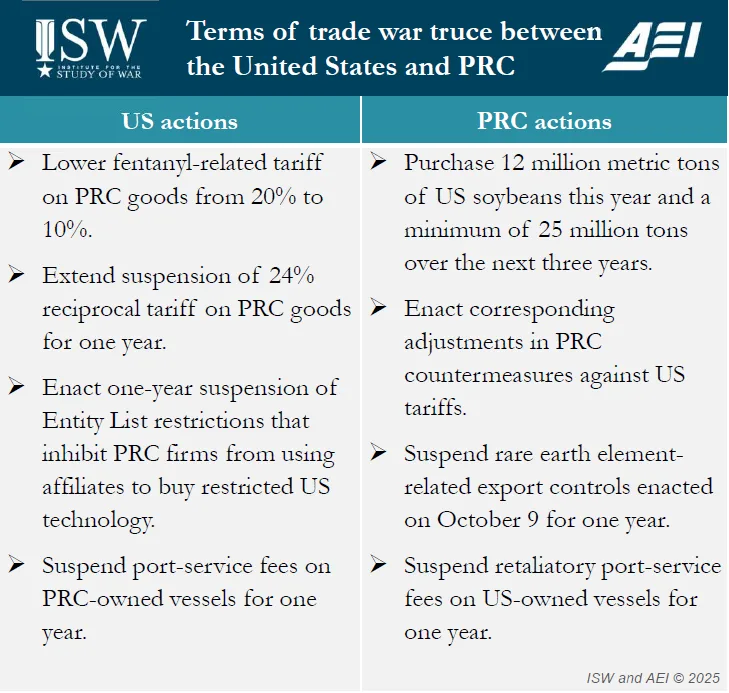
The PRC’s agreement to temporarily suspend export controls on rare earth elements is likely a short-term de-escalation measure amid its long-term strategic intent to inhibit US technological development. US President Donald Trump and CCP General Secretary Xi Jinping met in Busan, South Korea, at the Asia Pacific Economic Cooperation (APEC) summit on October 30 and finalized the terms of a trade truce.[1] A PRC Ministry of Commerce spokesperson confirmed in a press statement on October 30 that the PRC will place a one-year suspension on the rare earth element export controls that it enacted on October 9.[2] The pair also agreed to a range of de-escalatory trade measures covering PRC purchases of US soybeans, the mutual suspension of port-service fees, and the postponement of reciprocal tariffs.[3]
Rare earth elements are needed to produce everything from consumer electronics to auto manufacturing, semiconductors, and defense technology. US access to these elements is critical to national and economic security. The PRC holds approximately 70% of the market share in rare earth element mining and accounts for 70% of US rare earth imports as of 2024.[4] The PRC framed these export controls as a necessary measure to protect its national security interests and regulate dual-use goods. Rare earths are dual-use because of their applications for military and defense technology.[5]
The PRC is signaling that it is still committed to tight control over strategic resources tied to technological development, despite the temporary suspension in some export controls. The CCP has emphasized technological self-reliance and the development of “high-quality productive forces” as a national priority amid the current technological revolution.[6] The CCP’s proposed five-year plan for economic and social development from 2026 to 2030 highlighted maintaining the PRC’s control of strategic mineral resources as core to national security.[7]
Rare earth elements are one of these strategic mineral resources. The temporary suspension of export controls represents a tactical shift but does not indicate that the PRC has stopped pursuing its economic strategy. The suspension of export controls excludes previous restrictions on rare earth elements and critical mineral exports. The PRC’s reluctance to loosen restrictions on a broader basis indicates its permanent intention to restrict US access to rare earths and critical minerals to stifle its rival’s technological progress.
The CCP views dominance in emerging technologies as central to achieving its grand strategic objectives, including economic and military development in pursuit of great power status.[8] ISW assessed in July 2025 that the PRC would increasingly exploit its leverage over US demand for critical minerals and rare earth elements as technology becomes more important in US-PRC competition.[9]
Trump and Xi did not finalize a TikTok deal during their meeting. US Treasury Secretary Scott Bessent stated on October 26, after US-PRC trade talks in Malaysia, that the two countries “reached a final deal on TikTok” and it could be approved during the Trump-Xi meeting on October 30.[10] The PRC Commerce Ministry spokesperson stated that the PRC agreed “to work with the United States to properly resolve issues related to TikTok,” but offered no further details.[11] The PRC still needs to approve the proposed TikTok deal that would form a new joint venture corporation to oversee the US operations of TikTok. The United States had national security concerns due to the CCP’s influence over TikTok, including mining American users’ data and shaping public opinion through promoting certain content.
US Treasury Secretary Scott Bessent, US Trade Representative Jamieson Greer, PRC Vice Premier He Lifeng, and PRC trade negotiator Li Chenggang laid the groundwork for the Xi-Trump meeting during negotiations from October 24 to 26 in Malaysia. Bessent stated that the talks resulted in “a very successful framework for the leaders to discuss.”[12] The extent to which the leaders discussed TikTok and Taiwan is unknown, based on available information.[13]
US Secretary of State Marco Rubio laid similar groundwork in the days preceding Xi and Trump’s meeting. Rubio told reporters on October 25 that the United States would not abandon Taiwan in exchange for a favorable trade deal and spoke with PRC Foreign Minister Wang Yi in an October 27 call.[14]
PRC police announced a criminal investigation into Taiwanese legislator Puma Shen for “Taiwan Independence separatism.” PRC prosecution of such a high-profile Taiwanese political figure for “separatism” likely indicates an intensification of PRC lawfare efforts to discourage Taiwanese opposition to PRC annexation efforts. The Chongqing Municipal Public Security Bureau (PSB) announced that it was investigating Shen for establishing a “Taiwan Independence separatist organization” and “separatist crimes” on October 28.[15] Shen is a Taiwanese Democratic Progressive Party (DPP) legislator and the co-founder of Kuma Academy, a civil defense NGO that organizes training courses on topics including disaster response, first aid, and self-defense for Taiwanese citizens.[16] The PRC’s Taiwan Affairs Office (TAO) has repeatedly sanctioned Shen and his family members and named him on lists of “Taiwan Independence diehards” published in 2024 and 2025.[17] The TAO also sanctioned Shen’s father’s export company in June 2025, citing Shen’s “separatism” as the explicit reason for the sanctions.[18] TAO spokesperson Chen Binhua praised the Chongqing PSB’s investigation into Shen as a “just and necessary move to oppose Taiwan Independence separatism” on October 28.[19]
The PRC claims sovereignty over Taiwan and regularly accuses Taiwanese political leaders and opponents of PRC annexation of Taiwan of “separatism” (alternatively translated as “secessionism” or “splittism”), which is a criminal offense in the PRC.[20] The PRC published a set of judicial guidelines for prosecuting “Taiwan Independence diehards for crimes of separatism and inciting separatism” in June 2024. These guidelines specify recommended sentences for convicted “separatists,” including life imprisonment or the death penalty for “separatist ringleaders” and other “serious” cases.[21] The guidelines also allow PRC courts to try accused “separatists” in absentia.[22]
The PRC has convicted and imprisoned two Taiwanese people for “separatism” since the release of the guidelines. A PRC court sentenced Yang Chih-yuan, a Taiwanese citizen and minor political activist, to 9 years in prison for “separatism” in September 2024.[23] The PRC also sentenced publisher and longtime Taiwan resident Li Yanhe to three years in prison for “inciting separatism” in March.[24] PRC police secretly arrested both Yang and Li and held them incommunicado under the PRC’s “Residential Surveillance at a Designated Location” (RSDL) system before formally announcing their arrests months later.[25] United Nations experts and Special Rapporteurs have identified RSDL as a form of enforced disappearance that violates international human rights law.[26] The PRC Ministry for State Security (MSS) also issued a public “bounty” for information aiding the capture of several Taiwanese military officers that the PRC accused of conducting “separatist” psychological warfare online on October 10.[27]
Puma Shen is the most prominent Taiwanese figure who the PRC has publicly investigated for “separatism.” The PRC is likely attempting to intimidate Taiwanese political and civil society leaders into softening their public opposition to PRC efforts to annex Taiwan by threatening severe legal penalties for “separatism,” including the death penalty. The PRC likely also aims to bolster its claims of sovereignty over Taiwan and to erode the legitimacy of Taiwan’s government by prosecuting an active legislator for alleged “separatism.”
Taiwan plans to integrate unmanned systems warfare into its armed forces’ structure. The planned restructuring is likely inspired by Ukraine’s creation of an “unmanned systems forces” to improve the frontline use of unmanned systems. Taiwanese Defense Minister Wellington Koo stated before the Legislative Yuan’s (LY) Foreign Affairs and National Defense Committee on October 23 that the Ministry of National Defense (MND) plans to train and equip a separate unmanned systems brigade for each of Taiwan’s five combat zones.[28] Koo also announced that the 66th Marine Brigade will replace its armored and artillery regiments with specialized drone units.[29] Koo stated that the army’s restructuring efforts followed the principle of “technology replacing manpower and firepower replacing traditional forces” while aiming to create “lean organization[s], clear division of responsibilities, reasonable command hierarch[ies], and improved efficiency.”[30] Koo further noted that each combat zone will receive unmanned systems tailored to the tactical needs of each area.[31]
The formation of separate brigades for unmanned systems warfare suggests that the Taiwanese military is learning from the war in Ukraine and integrating drones into its national defense plans and force structure. Both Russia and Ukraine have integrated informal unmanned systems units since Russia invaded Ukraine in 2022 and have since established a separate “Unmanned Systems Forces” as separate services.[32] Creating separate unmanned systems formations within the formal force structure allows the units to scale and mass drone capabilities, including providing better coverage over larger operational areas and planning more sophisticated strike missions — including at deeper ranges — than individual drone units attached to infantry.[33]
The developments of separate drone formations can help a military organization like the Taiwanese military institutionalize approaches to drone warfare, scale drone production, and learn quickly from lessons in Ukraine. Both Russia and Ukraine frequently develop drone countermeasures that render enemy drones ineffective, only for the other side to adopt drone innovations that make those countermeasures obsolete.[34] The integration of drone units into regular military structures allows for centralization of materiel procurement and training processes, and formal integration of new technological innovations.[35] Formal drone units may serve as a conduit between Taiwan’s military and its defense industrial base to enhance the latter’s adaptability to rapid changes on the battlefield.[36]
Unmanned systems have come to define the war in Ukraine, and it is probable that they will play a key role in Taiwan’s defense.[37] Formal drone units are only one part of this equation, as infantry and armor also require smaller supporting regiments, companies, or platoons dedicated to the use of unmanned systems to be effective.[38]
PRC state media site Xinhua published two commentaries on October 26 and 27 on the benefits of unification that suggested “Patriots Governing Hong Kong” would provide a model for Taiwan’s integration into the PRC. This model is more constrictive of Taiwan’s autonomy than the “one country, two systems” framework. Xinhua debuted the new pseudonym “Zhong Taiwan” (钟台文) for both commentaries.[39] The articles reiterated language from the resolution designating October 25 as Taiwan Restoration Day, describing unification as a historical inevitability and Taiwan as an inalienable part of China.[40] The October 27 article made an economic case for unification, stating that Taiwan would join a “cross-strait common market” that allowed it to reap the benefits of the mainland’s economic progress.[41] The commentary further noted that, after unification, “Taiwan independence forces” would no longer use Taiwan’s budget for national defense, allowing for greater spending on the people.[42]
The October 27 article also outlined the political parameters for unification, stating that “Patriots governing Taiwan with a high degree of autonomy will be implemented.”[43] This is the first time an authoritative source has used this phrase regarding Taiwan.[44] The phrase “Patriots governing Hong Kong” gained prominence following the 2019–2020 protests against PRC administration of the region.[45] Hong Kong’s Legislative Council passed an electoral reform bill in May 2021 that expanded the legislature from 70 to 90 seats while cutting the number of directly elected seats from 35 to 20, transferring substantial authority to a 1,500-member Election Committee that could vet candidates for their allegiance to the PRC. [46] This effectively prevented pro-democracy opposition politicians from running for office in Hong Kong under the guise of ensuring the city was governed solely by “patriots.”[47]
The mention of “Patriots governing Taiwan” represents a shift away from the “one country, two systems” model in which Taiwan would purportedly retain some level of democratic self-governance. The PRC has typically touted the “one country, two systems” model as accounting for differences in political and economic realities between the PRC and Hong Kong.[48] The PRC Ministry of Foreign Affairs officially claims that the “one country, two systems” principle will inform unification between Taiwan and the mainland.[49] The October 27 Xinhua commentary suggests, however, that the PRC aims to pursue a more aggressive unification policy that would see Taiwan forfeit its autonomy immediately upon integration with the PRC.
Key Takeaways
- Trump-Xi meeting: The PRC’s agreement to temporarily suspend export controls on rare earth elements is likely a short-term de-escalation measure amid its long-term strategic intent to inhibit US technological development.
- Trump-Xi meeting: Trump and Xi did not finalize a TikTok deal during their meeting.
- PRC lawfare: PRC police announced a criminal investigation into Taiwanese legislator Puma Shen for “Taiwan Independence separatism.” PRC prosecution of such a high-profile Taiwanese political figure for “separatism” likely indicates an intensification of PRC lawfare efforts to discourage Taiwanese opposition to PRC annexation efforts.
- Taiwanese military modernization: Taiwan plans to integrate unmanned systems warfare into its armed forces’ structure. The planned restructuring emulates Ukraine’s creation of the Unmanned Systems Forces to improve the use of unmanned systems.
- Taiwan’s autonomy: PRC state media site Xinhua published two commentaries on October 26 and 27 on the benefits of unification that suggested “Patriots Governing Hong Kong” would provide a model for Taiwan’s integration into the PRC. This model is more constrictive of Taiwan’s autonomy than the “one country, two systems” framework.
Cross-Strait Relations
Taiwan
The Taiwan High Court sentenced retired ROC Army Lieutenant General Kao An-kuo to seven years and six months in prison for planning an armed overthrow of the government and spying for the PRC. Kao is the highest-level military officer convicted of spying for the PRC and attempted to recruit active-duty military personnel for information-gathering and surveillance efforts in Taiwan.[50] The Taiwan High Prosecutors Office indicted Kao in January 2025. The Taiwanese High Court also sentenced Kao’s girlfriend to six years and ten months in prison for facilitating communication between Kao’s cell and the PRC.[51] The Taiwan High Court ruled that Kao was politically motivated, while the four people whom he recruited were financially motivated. The High Court sentenced his four recruits to lesser sentences due to their financial motives, with sentences ranging from two and a half to six years.[52]
PRC Taiwan Affairs Office (TAO) Spokesperson Chen Binhua claimed that the DPP sentenced Kao for political reasons. [53] High Court judges are approved by the Personnel Review Committee of the Judicial Yuan as opposed to being direct political appointees, so Chen’s statement is incorrect.
The PRC designated October 25 as “Taiwan Restoration Day” as part of an effort to undermine the historical basis of Taiwan’s sovereignty and reshape Chinese history to support the PRC’s assertion that Taiwan is an inseparable part of China. The standing committee of the PRC’s National People’s Congress approved a resolution on October 24 that designated October 25 as the holiday.[54] The decision commemorates the return of Taiwan to Chinese sovereignty in 1945 following its 50-year Japanese occupation.[55] The PRC resolution described the restoration as “an important link in the chain of historical facts and legal principles that establishes Taiwan as a part of China.”[56] PRC state media outlet Xinhua released a commentary on October 24 that outlined the PRC’s historical argument for the “irreversible unity” between China and Taiwan.[57] The commentary cited the 1943 Cairo Declaration, the 1945 Potsdam Declaration, the 1945 restoration of Taiwan to “Chinese sovereignty” and the 1971 UN Resolution 2758 that declared the PRC as the representative of China at the UN to argue that the PRC, the inheritor of sovereignty over China, also has legitimate sovereignty over Taiwan.[58] The commentary further stated that efforts by the “DDP authorities” to realize the “de-Sinicization” of Taiwan contradict these historical events.[59]
The CCP held a commemorative event on October 25 for restoration day. Minister of the CCP’s United Front Work Department Li Ganjie and member of the Politburo Standing Committee Wang Huning led the event. Taiwanese media reported that Wang made a specific case to Taiwan regarding the benefits of unification, stating that it would improve Taiwan’s economic development, energy and resource security, infrastructure development, security, and foreign relations.[60] Taiwan’s Mainland Affairs Council responded to Wang’s speech, stating that cross-strait relations are a product of “systemic differences” between authoritarianism and democracy.[61]
Taiwan’s Kuomintang (KMT) and the Taiwan People’s Party (TPP) led efforts to establish October 25 as a national holiday for Taiwan’s retrocession in May 2025.[62] Democratic Progressive Party (DPP) Secretary-General Hsu Kuo-yung faced criticism from the KMT and TPP for stating that there was no such thing as a “Taiwan retrocession day” on September 9, 2025.[63] PRC media outlet Global Times referenced Hsu’s remarks in an October 23 article discussing the October 25 holiday, stating that historical facts refute the “DPP authorities[‘]” efforts to reshape Chinese history.[64] Former Taiwanese President and KMT politician Ma Ying-jeou similarly criticized the DPP on October 25 for failing to recognize the holiday, suggesting this indicated the DPP’s “pro-Japan” sympathies.[65] The KMT does not acknowledge that Taiwan Restoration Day grants the PRC sovereignty over Taiwan, however.[66]
The establishment of the October 25 holiday, followed by a concentrated media campaign to advance the PRC’s historical narrative, is part of broader PRC efforts to revise the historical record in a manner favorable to its claims to sovereignty over Taiwan. The PRC has never controlled Taiwan in its history, nor has the Chinese Communist Party (CCP).[67] The PRC attempts to obfuscate this fact by conflating Chinese sovereignty in 1945, before the existence of the PRC, with its position as the sole representative of China in the United Nations. It also aims to take advantage of an existing fracture in Taiwanese politics regarding the status of Taiwan Restoration Day. These efforts are intended to frame unification as a historical imperative while undermining the basis for Taiwan’s de facto sovereignty.
Taiwan’s Coast Guard Administration (CGA) announced a special budget exceeding NTD $29.5 billion (approximately USD $900 million).[68] The proposal represents a major step in modernizing Taiwan’s maritime defense capabilities amid intensifying PRC gray-zone activities. The CGA announced the details of its budget proposal on October 25, but the budget is part of a larger special budget proposal to strengthen Taiwan’s resilience that the Executive Yuan approved in September. The special budget is currently under review by the Legislative Yuan. The CGA’s budget initiative focuses on expanding the CGA fleet, improving surveillance and communications infrastructure—including AI-assisted command systems and infrared imaging sensors—and enhancing interagency coordination to safeguard maritime sovereignty.
The budget stipulates that the Ocean Affairs Council (OAC), the CGA’s parent agency, will construct 40 new coast guard vessels as part of a nine-year modernization program, including 12 ships of 2,000 tons, 14 of 300 tons, and 14 of 100 tons, all featuring all-steel hulls for improved speed, endurance, and collision resistance. Vessels of these sizes are relatively small; the Taiwanese Navy’s Cheng Kung-class frigates have a displacement of 4,100 tons, and DARPA’s USX-1 Defiant unmanned vessel is 180ft long and 240 tons.[69] [70]The OAC said the new vessels will replace aging patrol craft and strengthen Taiwan’s capacity to respond to incursions by PRC coast guard, maritime militia, and research ships. The special budget also allocates NTD $10.3 billion to upgrade cybersecurity and communications, NTD $6.8 billion for unmanned vehicle systems, and NTD $8.7 billion for coastal defense reinforcement. The Agriculture Ministry will subsidize the installation of Automatic Identification Systems (AIS) on approximately 5,000 small fishing vessels, ensuring comprehensive fleet tracking and enhanced identification of foreign intrusions into Taiwan’s Exclusive Economic Zone (EEZ).[71]
The CGA’s modernization initiative aligns with broader Taiwanese efforts to respond to PRC incursions. These incursions aim to degrade Taiwanese threat awareness and attenuate military resources. The China Coast Guard (CCG) vessels have reportedly carried out regular incursions into Taiwan-administered waters around the Kinmen Islands since February 2024 and began similar incursions around Taiwan’s Pratas (Dongsha) Islands in February 2025. The CCG ships frequently disable AIS transponders to conceal movements and test Taiwan’s law enforcement response. The CGA has also reported small-scale infiltration by PRC nationals using inflatable boats or swimming, which it said could be a low-cost effort to exploit radar blind spots and test Taiwan’s coastal defense readiness.[72] The CGA has responded with heightened enforcement and deterrence measures. Since January, the CGA has implemented twin-ship escort operations and conducted 159 intercepts of Chinese fishing vessels, detaining 12 small craft engaged in illegal operations.[73] The CGA has also coordinated revisions to submarine cable laws—mandating AIS integrity, banning illegal anchoring, and increasing penalties for violations following PRC-linked sabotage incidents. The CGA also upgraded equipment, shipborne surveillance systems, and enforcement protocols to counter escalating gray-zone tactics since February 2024.[74]
Azerbaijan excluded Taiwan from an annual conference, possibly under pressure from the PRC. The PRC has long sought to limit Taiwan’s diplomatic efforts with other states and bar Taiwan from participating in international organizations. The International Association of Judges (IAJ) expressed support for Taiwan after Azerbaijan blocked Taiwanese delegates’ attendance from an annual conference. The head of the Taiwanese delegation, High Court Judge Lin Yi-lun, traveled to Azerbaijan but was denied entry. Five other judges canceled their trips because they never received entry permits.[75] The Taiwanese Judges Association of the Republic of China (JAROC) reportedly stated that the IAJ regrets Taiwan’s exclusion.[76] IAJ stated it would ensure future conference locations permit all judges’ attendance to prevent further exclusion.[77]
JAROC did not specifically accuse the PRC of undue influence, but Taiwan’s exclusion resembles previous PRC efforts to block Taiwan from participation in multilateral groups.[78] The PRC systemically pushes for Taiwan’s exclusion from international organizations, including the United Nations, Pacific Islands Forum, and other multilateral bodies.[79] This aligns with its strategy to delegitimize and isolate Taiwan from its allies, partners, and other states.
IAJ’s statement exemplifies efforts to counteract Taiwan’s exclusion from multilateral organizations. The PRC will likely continue to push for Taiwan’s exclusion from international bodies as a means of eroding Taiwan’s network of international support.
China
The PLA Daily published an editorial likely intended to warn PLA personnel against challenging the Communist Party’s control of the military and, by extension, Party Secretary Xi Jinping’s martial authority. The editorial suggests that the expulsion of nine seniormost generals from the CCP on October 17 stemmed from worries about political and ideological loyalty in the PLA. The editorial, titled “Firmly Defend the Political Character of the People’s Army,” stated that the October 17 purge preserved the political nature and purpose of the PLA.[80] The editorial also emphasized in multiple places that the PLA is the armed wing of the Communist Party rather than the state. The editorial stated that history indicated the necessity of “revolutionary political forging” and “ideological and political training” in the military. The editorial added that the party’s anti-corruption effort is linked to the Party’s “absolute leadership” over the army and is a “major political struggle.” The editorial stressed the centrality of General Secretary Xi Jinping to the Party and, by extension, the military. The editorial finally urged senior cadres to use corrupt officials as “negative examples” to ensure their own proper conduct.
Four of the nine generals purged on October 17 (Miao Hua, He Hongjun, Qiu Shutong, and Yuan Huazhi) were political commissars. Political commissars enforce political discipline and party loyalty in the PLA.[81] A PLA Daily editorial on October 18 accused He Weidong, Miao Hua, and He Hongjun of undermining the CMC Chairman Responsibility System that provides Xi Jinping with absolute authority over the military.[82] The PRC increased its oversight of military publications in February 2025 after several military-affiliated organizations published articles in support of collective leadership and intra-party democracy, which are ideas that contradict the Chairman Responsibility System and Xi’s centralization of power since 2012.[83] The stress that the editorial placed on ideological formation and the centrality of Xi Jinping to the Communist Party suggest that the decision to expel several top generals from the military stemmed from a concern for the PLA’s ideological loyalty to Xi. The October 24 editorial’s discussion of the purges likewise indicates that they were intended to deter military personnel from mounting any further ideological challenges to the absolute authority of Xi Jinping and the Party’s control over the military.
Northeast Asia
Japan
The PRC objected to Japanese Prime Minister Sanae Takaichi’s plan to accelerate Japan’s defense buildup. Takaichi pledged to raise defense spending to 2% of Japan’s GDP by March 2026 during her first major policy address to the National Diet on October 25.[84] Her statement marks a major acceleration in Japan’s 2% defense spending goal, which was originally set for Japanese fiscal year 2027 (ending on March 31, 2028).[85] Takaichi expressed support for military expansion and cited concerns about the military activities of the PRC, DPRK, and Russia. She also declared that her government would revise Japan’s 2022 National Security Strategy by the end of 2026, which is notable because Japan usually revises its strategy approximately once every ten years.[86] Takaichi added that the PRC is an important neighbor but expressed concerns related to economic security.[87] Takaichi also plans to loosen defense export restrictions and provide more government support to Japan’s defense industry.[88]
Japan-PRC relations are not likely to improve under the Takaichi administration. PRC Ministry of Foreign Affairs (MFA) spokesperson Guo Jiakun criticized Takaichi’s speech and reiterated the PRC’s opposition to Japan’s increasing defense budget and arms exports.[89] Xi Jinping has not yet sent a customary congratulatory message to Takaichi since she was sworn in, despite having congratulated Yoshihide Suga, Fumio Kishida, and Shigeru Ishiba when they became prime minister.[90] Guo claimed that the PRC has already made “appropriate arrangements” in accordance with diplomatic practices, however.[91] Guo also declined to comment on whether Xi will meet with Takaichi on the sidelines of the Asia-Pacific Economic Cooperation summit.[92]
Japanese Prime Minister Sanae Takaichi and US President Donald Trump pledged to elevate the US-Japan alliance into a “new golden age” on October 28.[93] Takaichi and Trump also signed an agreement on critical minerals and rare earths to secure supplies and increase investment in mining and processing during Trump’s visit to Japan as the second stop of his Asia trip.[94] Takaichi spoke to Trump by phone before the in-person meeting and reiterated that the US-Japan alliance is her top foreign and security policy priority. Takaichi added that Japan is an “indispensable partner” for the US’ strategy on the PRC and the Indo-Pacific.[95] Trump praised Takaichi and described the US as Japan’s strongest ally.[96]
The PRC interprets the US-Japan alliance as a “cold war relic” and will likely perceive Takaichi and Trump’s increased commitment to the alliance as an attempt to undermine the PRC’s regional interests and influence.[97] PRC MFA spokesperson Guo Jiakun urged the US and Japan to be “conducive to regional peace and stability” as they upgrade their bilateral relations and security cooperation.[98]
North Korea
North Korea fired several short-range ballistic missiles (SRBM) from Pyongyang toward a target in North Korea on October 22, marking the first missile launch since South Korean President Lee Jae Myung took office in June.[99] South Korea’s Joint Chiefs of Staff (JCS) called the launch a “provocation” and added that an unspecified number of missiles flew “around 350 km” (217 miles).[100] North Korean state media Korean Central News Agency (KCNA) claimed on October 23 that its Missile Administration “successfully” tested a “new weapon system,” adding that “two hypersonic projectiles” launched from Ryokpho District in Pyongyang hit the target point on Kwesang Peak in Orang County, North Hamgyoung Province.[101] KCNA photos showed the missiles striking a circular target, reportedly demonstrating “precision” strike capabilities. Seoul-based news outlet NK News stated the weapon is likely to be either the “new Hwasong-11E SRBM equipped with a hypersonic glide vehicle” or “a variant of the Hwasong-11C SRBM.”[102]
North Korea’s first missile test-launch under the Lee administration came a week before the Asia-Pacific Economic Cooperation (APEC) forum in South Korea, attended by US President Donald Trump and his expected summit with South Korean President Lee Jae Myung. North Korea has previously fired missiles during high-level US officials’ visit to South Korea, such as when North Korea launched two SRBMs the day before former Vice President Kamala Harris’ trip to the demilitarized zone in 2022.[103] North Korea’s missile launches ahead of or during a high-level exchange between the United States and South Korea could aim to protest close United States-South Korea cooperation, which it views as a security threat. North Korea could be testing SRBM capabilities to advance its goals of fielding more “effective tactical nuclear weapons” targeting South Korea and the United States. North Korea is enhancing SRBM accuracy by fielding them on the Russian frontlines against Ukraine. Ukrainian military sources reported that the accuracy of North Korean SRBMs improved from 1 to 3 kilometers in 2023 to within 50 to 100 meters by 2025, attributing the advancement to Russian assistance.[104]
North Korea’s missile launch underscores policy divergence with the Lee administration. Lee has focused on de-escalation measures on the Korean Peninsula, emphasizing the new administration’s shift from former President Yoon Suk-yeol’s “hardline” approach against North Korean provocation.[105] The Ministry of Unification under Lee has sought to reduce the scale of military exercises near the demilitarized zone, remove propaganda loudspeakers, and propose peaceful coexistence as the unification goal.[106] North Korea is focused on enhancing its strike capabilities against South Korea rather than engaging in peace talks, however. Workers’ Party of Korea (WPK) General Secretary Kim Jong Un likely views normalized inter-Korean relations as disruptive to his nuclear weapons development objectives and unhelpful to efforts aimed at securing sanctions relief.
North Korea has intensified criticism of the United States and showcased strong ties with Russia days ahead of Trump’s visit to South Korea and rejected Trump’s calls for dialogue for denuclearization. North Korea has intensified anti-United States rhetoric as Trump called for dialogue with Kim during his upcoming trip to South Korea.[107] North Korea has simultaneously showcased its ties with Russia ahead of Trump’s visit to South Korea. North Korean Foreign Minister Choe Sun Hui also visited Russia and blamed the United States and its allies for “heightened tensions on the Korean Peninsula” in a joint statement with Russian Foreign Minister Sergei Lavrov.[108] Choe also met with Putin and discussed North Korea-Russia relations. Kim has meanwhile refused to respond to Trump’s calls for dialogue with North Korea.
Pyongyang is unlikely to engage in talks unless it believes Washington has abandoned its denuclearization goals — a condition Kim set for dialogue during his September 21 speech at the Supreme People’s Assembly.[109] North Korea claims its nuclear development as a matter of sovereignty and national security. North Korea has highlighted Russia’s implied support for its nuclear program, such as when the Russian Ministry of Foreign Affairs said on October 28 that it supported North Korean “measures” to “safeguard the country’s sovereignty.” North Korea may seek alternative ways to gain international recognition as a nuclear state, cement its nuclear status as non-negotiable, and weaken Washington’s longstanding commitment to certifiable, irreplaceable, and verifiable denuclearization goals. North Korea may also be reluctant to risk compromising ties with Russia by renewing diplomacy with the United States. Russia is receiving arms and troop support from North Korea for its war in Ukraine, and US efforts to resume talks with North Korea may hinder such cooperation. North Korea and Russia’s joint condemnation of the United States as a destabilizing force, along with Choe’s participation in the security forum in Minsk, indicates their continued alignment — making diplomacy between Washington and Pyongyang unlikely.[110]
South Korea
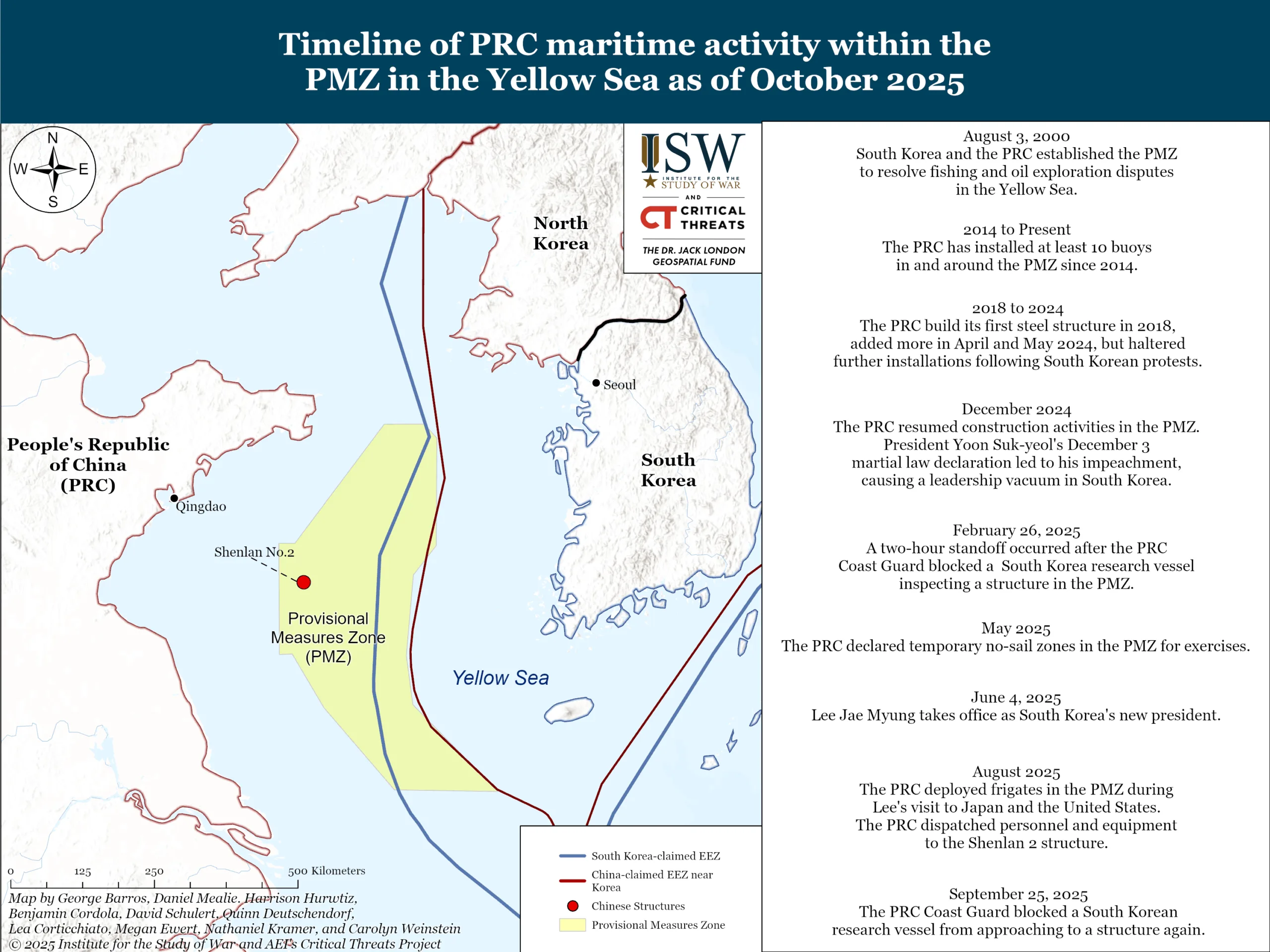
The South Korean Chief of Naval Operation Admiral Kang Dong-gil said that the PRC is establishing illegal structures in territorial waters in the Yellow Sea, which is probably part of an effort to illegally extend the PRC’s territorial waters in the Yellow Sea.[111] The PRC recently deployed a rubber boat, oxygen tanks, and personnel to one of its structures.[112] Kang stated that the PRC “is not complying with international law” regarding its illegal installation of structures within the Yellow Sea Provisional Measures Zone (PMZ) at the National Defense Committee audit on October 23. The PMZ is an area where the PRC and South Korean exclusive economic zones overlap. South Korea and the PRC agreed to designate the overlapping area as a PMZ in 2000 to regulate activities other than fishing. He further warned about the possibility of the PRC utilizing the structures as a foundation for territorial claims. Kang noted that South Korea lacks the naval bandwidth to respond to increasing PRC naval activities in the Yellow Sea over the last two decades.[113] The number of PRC naval activities in the area increased from 110 times in 2017 to 360 times in 2023 and 330 times in 2024.[114] The PRC has already dispatched its naval vessels into the South Korean jurisdictional sea area 260 times in 2025.[115] South Korean Democratic Party legislator Yi Byeong-jin released a photograph on October 22 showing personnel and equipment aboard one of the PRC structures, Shenlan 2, in August. The photograph identified five individuals alongside an oxygen tank, a diving suit, and a rubber boat.[116] Yi suggested that the PRC’s activities may be part of broader efforts to claim large areas of the Yellow Sea as PRC territorial waters like the PRC has already done in the South China Sea with its Nine-Dash Line. Yi noted that diving suits are not typically used in maritime fishing to support his assessment.[117]
The PRC has installed three structures that it claims are for fishing purposes within the PMZ. The PRC Coast Guard has twice blocked a South Korean research ship from approaching the structures in 2025, once in February and again in September.[118] The two sides established a joint committee to discuss the PMZ issue in April 2025. South Korea has deployed monitoring buoys in the PMZ, presumably to monitor illegal PRC activity.
The illegal PRC structures and growing presence of PRC naval forces in the Yellow Sea signal Beijing’s continued will to expand its influence into the territorial waters and EEZs of other countries in contravention of established international law. The PRC continues to claim that it supports international law and UN decisions, but these moves clearly demonstrate that the PRC disregards international laws that do not support PRC objectives. The PRC has moved to expand its activities despite diplomatic engagement between the two sides. The PRC may extend its territorial waters further into the Korean Peninsula and Japan by claiming the structure as an inhabited reef, which the PRC has already done to impose its Nine-Dash Line in the South China Sea.[119] Beijing’s efforts to limit and gain PRC control over parts of the South Korean EEZ demonstrate that Beijing’s efforts to build better relations with South Korea are not based on goodwill or respect for South Korea’s international rights.[120]
Europe
A version of this text appeared in the October 23 Russian Offensive Campaign Assessment.[121]
The People’s Republic of China (PRC) and Indian oil companies are reportedly significantly reducing direct purchases of Russian oil in the short term, and the European Union (EU) passed its 19th sanctions package against Russia, primarily targeting the Russian energy sector. Reuters reported on October 23, citing multiple trade sources, that major PRC state oil companies — including PetroChina, SinoPec, CNOOC, and Zhenhua Oil — suspended purchases of seaborne Russian oil “at least in the short term” following the October 22 US sanctions against Russian state oil company Rosneft and the private Russian oil company Lukoil.[122] Trade sources told Reuters that Rosneft and Lukoil sell most oil to the PRC indirectly by going through intermediaries, but that PRC refiners are more likely to pause buying to assess the impact of sanctions. The trade sources stated that independent PRC refiners would still likely seek to purchase Russian oil despite the sanctions. Bloomberg and Reuters reported on October 23 citing refineries and industry sources that Indian oil refineries will significantly cut Russian oil imports due to the US sanctions.[123] An industry source told Reuters that India’s cut of Russian oil imports will be “massive” but not total or immediate as Indian refineries will still import some barrels of Russian crude oil through intermediaries.[124]
The EU sanctions package bans Russian liquefied natural gas (LNG) imports into the EU beginning in January 2027 for long-term contracts and within six months (by April 23, 2026) for short-term contracts.[125] The package also targets tankers assessed to be part of the Russian shadow fleet, a United Arab Emirates (UAE) entity that serves as a conduit for the Russian shadow fleet by circumventing EU sanctions, and four PRC oil refineries. The EU also sanctioned Russian financial institutions and operators from the UAE and the PRC that supply military and dual-use goods to Russia. The EU imposed additional travel restrictions and authorization requirements for Russian diplomats and sanctioned 11 individuals involved in the illegal deportation, abduction, and militarized education of Ukrainian children.

[1] https://www.mfa dot gov.cn/zyxw/202510/t20251030_11743847.shtml
[2] http://www.news dot cn/world/20251030/dd3984dcc50b4c13bab9d2849da6e1b3/c.html
[3] https://www.bloomberg.com/news/articles/2025-10-30/bessent-says-china-to-buy-12-million-tons-of-soybeans-this-year
https://www.globaltimes dot cn/page/202510/1346945.shtml
https://www.reuters.com/world/china/us-halt-entity-restrictions-one-year-after-trump-xi-meeting-bessent-says-2025-10-30/
http://www.news dot cn/world/20251030/dd3984dcc50b4c13bab9d2849da6e1b3/c.html
[4] https://pubs.usgs.gov/periodicals/mcs2025/mcs2025-rare-earths.pdf
[5] https://www.mofcom dot gov.cn/zwgk/zcfb/art/2025/art_6cb42957741440c6984de696b70df9ae.html
[6] https://www.gov dot cn/yaowen/liebiao/202510/content_7045444.htm
[7] https://www.gov dot cn/zhengce/202510/content_7046052.htm
[8] https://www.gov dot cn/yaowen/liebiao/202510/content_7045444.htm
[9] https://understandingwar.org/research/china-taiwan/china-taiwan-weekly-update-july-24-2025/
[10] https://www.nytimes.com/2025/10/26/us/politics/trump-xi-tiktok-deal-bessent.html;
https://apnews.com/article/china-tiktok-trump-bytedance-jinping-f9d15903dd1b9bd92602838a79088710
[11] https://www.mofcom dot gov.cn/xwfb/xwfyrth/art/2025/art_c42035acf50846ffb9fb4761ee224faf.html
[12] https://www.reuters.com/world/china/ustr-greer-says-trade-talks-with-china-moving-toward-agreement-leaders-review-2025-10-26/
[13] https://www.npr.org/2025/10/30/nx-s1-5590754/trump-china-xi-meeting-lowers-tariffs
[14] https://www.state.gov/releases/office-of-the-spokesperson/2025/10/secretary-rubios-call-with-chinas-director-of-the-office-of-the-ccp-central-foreign-affairs-commission-and-foreign-minister-wang-yi-2; https://www.bloomberg.com/news/articles/2025-10-25/rubio-says-us-will-not-change-taiwan-policy-for-china-trade-deal
[15] http://www.news dot cn/tw/20251028/0c50b738426348728204d7ebc212b4df/c.html
[16] https://globaltaiwan.org/2022/09/taiwans-bottom-up-approach-to-civil-defense-preparedness/
[17] https://www.aei.org/articles/china-taiwan-weekly-update-october-18-2024/; https://understandingwar.org/research/china-taiwan/china-taiwan-weekly-update-october-18/; https://newbloommag dot net/2025/04/01/tw-independence-thugs-list/; https://en.people dot cn/n3/2025/1029/c90000-20383296.html
[18] https://focustaiwan dot tw/cross-strait/202506050009
[19] http://www.gwytb.gov dot cn/m/fyrbt/202510/t20251028_12730831.htm
[20] https://www.globaltimes dot cn/page/202507/1337452.shtml ; https://www.chinalawtranslate.com/en/criminal-law-2021/?__cf_chl_tk=UBVlEjFqM9BfwKqsl2dZB0mOXzDlzlul1bO5.3DNIkQ-1761756467-1.0.1.1-Q..lplw7FSfbTlFVPPj6Pjo8.S4RWUpk8k5Wv20h66I#gsc.tab=0
[21] https://www.reuters.com/world/china/china-issues-guidelines-criminal-punishment-diehard-taiwan-separatists-2024-06-21/; https://www.chinalawtranslate.com/en/taiwan-independence/#gsc.tab=0; http://www.news dot cn/tw/20240621/7e14dff6f5554a7bafb7a388228b9e82/c.html
[22] https://www.chinalawtranslate.com/en/taiwan-independence/#gsc.tab=0; http://www.news dot cn/tw/20240621/7e14dff6f5554a7bafb7a388228b9e82/c.html
[23] https://time.com/7018490/taiwan-independence-activist-china-prison-sentence-separatism-yang-chih-yuan/
[24] https://apnews.com/article/taiwan-publisher-china-incitement-separatism-li-yanhe-6fe887c4dfcc2f718071a8110e85cb59
[25] https://thediplomat.com/2023/05/more-taiwanese-nationals-arrested-on-political-charges-in-china/
[26] https://www.ohchr.org/en/press-releases/2020/03/china-un-experts-gravely-concerned-enforced-disappearance-three-human-rights?LangID=E&NewsID=25735
[27] https://www.aei.org/articles/china-taiwan-weekly-update-october-20-2025/; https://understandingwar.org/research/china-taiwan/china-taiwan-weekly-update-october-20-2025/
[28] https://www.cna.com dot tw/news/aipl/202510230097.aspx
[29] https://lis.ly.gov dot tw/lydbmeetr/uploadn/114/1141023/201.pdf
[30] https://www.chinatimes dot com/realtimenews/20251023002909-260407?chdtv
[31] https://www.cna.com dot tw/news/aipl/202510230097.aspx
[32] https://www.csis.org/analysis/why-ukraine-establishing-unmanned-forces; https://www.fdd.org/analysis/2024/12/20/russia-announces-plans-to-form-unmanned-systems-forces/; https://understandingwar.org/research/russia-ukraine/russian-efforts-to-centralize-drone-units-may-degrade-russian-drone-operations-2/
[33] https://www.fdd.org/analysis/op_eds/2025/02/14/ukraine-bets-on-unmanned-systems-with-expansion-of-best-drone-units/; https://understandingwar.org/research/russia-ukraine/russian-efforts-to-centralize-drone-units-may-degrade-russian-drone-operations-2/
[34] https://www.csis.org/analysis/chapter-9-technological-evolution-battlefield; https://understandingwar.org/research/russia-ukraine/russian-drone-innovations-are-likely-achieving-effects-of-battlefield-air-interdiction-in-ukraine/
[35] https://www.csis.org/analysis/why-ukraine-establishing-unmanned-forces
[36] https://www.csis.org/analysis/why-ukraine-establishing-unmanned-forces
[37] https://www.aei.org/research-products/report/a-defense-of-taiwan-with-ukrainian-characteristics-lessons-from-the-war-in-ukraine-for-the-western-pacific/
[38] https://www.army.mil/article/284138/tactical_reconnaissance_strike_in_ukraine_a_mandate_for_the_u_s_army
[39] http://www.news dot cn/tw/20251027/ef0da96fb3c94b1e9a4e95ba62c1d3c3/c.html; http://www.news dot cn/tw/20251026/da540477b27e4878893f95379272292d/c.html
[40] http://www.news dot cn/tw/20251027/ef0da96fb3c94b1e9a4e95ba62c1d3c3/c.html; http://www.news dot cn/tw/20251026/da540477b27e4878893f95379272292d/c.html
[41] http://www.news dot cn/tw/20251027/ef0da96fb3c94b1e9a4e95ba62c1d3c3/c.html
[42] http://www.news dot cn/tw/20251027/ef0da96fb3c94b1e9a4e95ba62c1d3c3/c.html
[43] http://www.news dot cn/tw/20251027/ef0da96fb3c94b1e9a4e95ba62c1d3c3/c.html
[44] https://www.scmp dot com/news/china/politics/article/3330466/chinas-state-media-reveals-patriots-rule-taiwan-reunification-economic-incentives
[45] Kwong, Ying-Ho. 2025. “Electoral Overhaul Under the Principle of ‘Patriots Governing Hong Kong’: Implications for Pro-China Governing Coalition Re-Building.” Problems of Post-Communism, April, 1–14. doi:10.1080/10758216.2025.2483326.
[46] https://www.reuters.com/world/asia-pacific/patriots-rule-hong-kong-sweeping-pro-beijing-electoral-rules-passed-2021-05-27/
[47] https://www.theguardian.com/world/2023/dec/09/its-just-a-show-hong-kong-voters-expected-to-stay-away-as-patriots-only-local-elections-loom
[48] https://www.mfa.gov dot cn/eng/zy/jj/zggcddwjw100ggs/gg/202406/t20240606_11377967.html
[49] https://www.mfa.gov dot cn/eng/zy/wjls/3604_665547/202405/t20240531_11367561.html
[50] https://www.taipeitimes dot com/News/taiwan/archives/2025/10/23/2003845982
https://understandingwar.org/research/china-taiwan/china-taiwan-weekly-update-january-30-2025/
[51] https://www.taiwannews dot com.tw/news/6226513; https://udn dot com/news/story/7321/9092024?from=udn_ch2_menu_v2_main_index
[52] https://www.focustaiwan dot tw/cross-strait/202510230019; https://www.taiwannews dot com.tw/news/6226513; https://udn dot com/news/story/7321/9092024?from=udn_ch2_menu_v2_main_index
[53] http://www.gwytb dot gov.cn/xwdt/xwfb/wyly/202510/t20251024_12730291.htm
[54] http://www.news dot cn/tw/20251024/93dcffd88b0540788a8d0eff405b0e91/c.html
[55] http://www.news dot cn/tw/20251024/93dcffd88b0540788a8d0eff405b0e91/c.html
[56] http://www.news dot cn/tw/20251024/93dcffd88b0540788a8d0eff405b0e91/c.html
[57] http://www.news dot cn/tw/20251024/a00519c8379a4d42a282d8a7e5fc26dc/c.html
[58] http://www.news dot cn/tw/20251024/a00519c8379a4d42a282d8a7e5fc26dc/c.html
[59] http://www.news dot cn/tw/20251024/a00519c8379a4d42a282d8a7e5fc26dc/c.html
[60] https://udn dot com/news/story/124638/9095636
[61] https://focustaiwan dot tw/cross-strait/202510250016
[62] https://focustaiwan dot tw/politics/202505090016
[63] https://www.taipeitimes dot com/News/taiwan/archives/2025/09/19/2003844062
[64] https://www.globaltimes dot cn/page/202510/1346361.shtml
[65] https://www.facebook.com/MaYingjeou/posts/pfbid0RUQJiiPsqwxZHrUzMrCV56FJQwyrVVsHmw9GA8Hh5eGVLvNVtLJ6fcDXSnt5VaH7l?rdid=Um191010NX7Tf31B#
[66] https://www.cna.com dot tw/news/aipl/202510250139.aspx
[67] https://focustaiwan dot tw/cross-strait/202507230020
[68] https://www.cna dot com.tw/news/aipl/202510250042.aspx
[69] https://www.epochtimes dot com/b5/23/3/16/n13951242.htm
[70] https://def.ltn dot com.tw/article/breakingnews/4970193
[71] https://news.ltn dot com.tw/news/politics/paper/1723669
[72] https://www.scmp dot com/news/china/military/article/3311039/taiwans-coastguard-asks-more-surveillance-funds-after-mainland-boats-breach-defences
[73] https://www.newsweek.com/chinese-ships-expelled-from-disputed-waters-10832408
[74] https://news.ltn dot com.tw/news/politics/paper/1729406
[75] https://www.taipeitimes dot com/News/front/archives/2025/10/28/2003846214
[76] https://www.taipeitimes dot com/News/front/archives/2025/10/28/2003846214
[77] https://www.taiwannews.com dot tw/news/6228844; https://www.jaroc.org dot tw/topic/news/view/417
[78] https://focustaiwan dot tw/politics/202510170013
[79] https://www.abc.net.au/news/2025-09-12/pacific-backs-taiwan-in-regional-forum-despite-chinas-opposition/105768946; https://www.reuters.com/world/china/taiwan-says-china-trying-create-legal-basis-attack-with-un-resolution-2025-10-01/
[80] http://www.mod.gov dot cn/gfbw/jmsd/16417117.html
[81] https://understandingwar.org/research/china-taiwan/china-taiwan-weekly-update-october-24-2025/
[82] http://www.81 dot cn/szb_223187/szbxq/index.html?paperName=jfjb&paperDate=2025-10-18&paperNumber=01&articleid=965124
[83] https://www.cac dot gov.cn/2025-02/08/c_1740714184323988.htm
[84] https://japan.kantei.go dot jp/104/statement/202510/24shoshinhyomei.html
[85] https://www.nippon dot com/en/japan-data/h02457/
[86] https://japan.kantei.go dot jp/104/statement/202510/24shoshinhyomei.html
[87] https://japan.kantei.go dot jp/104/statement/202510/24shoshinhyomei.html
[88] https://www.straitstimes dot com/asia/east-asia/pm-takaichi-moves-to-unleash-japans-long-stifled-defence-industry
[89] https://www.mfa.gov dot cn/web/wjdt_674879/fyrbt_674889/202510/t20251024_11740195.shtml
[90] https://mainichi dot jp/english/articles/20251023/p2g/00m/0na/083000c
[91] https://www.mfa.gov dot cn/web/wjdt_674879/fyrbt_674889/202510/t20251024_11740195.shtml
[92] https://www.mfa.gov dot cn/web/wjdt_674879/fyrbt_674889/202510/t20251029_11743157.shtml
[93] https://www.whitehouse.gov/briefings-statements/2025/10/implementation-of-the-agreement-toward-a-new-golden-age-for-the-u-s-japan-alliance/
[94] https://www.whitehouse.gov/briefings-statements/2025/10/united-states-japan-framework-for-securing-the-supply-of-critical-minerals-and-rare-earths-through-mining-and-processing/
[95] https://www3.nhk.or dot jp/nhkworld/en/news/20251026_01/
[96] https://thehill.com/homenews/administration/5575762-trump-meets-japan-prime-minister-takaichi/
[97] https://www.scmp dot com/news/china/diplomacy/article/3272512/cold-war-relic-china-takes-aim-us-japan-alliance-under-american-nuclear-umbrella
[98] https://www.fmprc.gov dot cn/fyrbt_673021/jzhsl_673025/202510/t20251028_11742415.shtml
[99] https://www.nknews dot org/2025/10/north-korea-launches-ballistic-missile-first-in-five-months-jcs/
[100] https://www.chosun dot com/politics/diplomacy-defense/2025/10/22/5I6NTFXZLFESTJLU2GNH3GLF6E/
[101] https://www.nknews dot org/2025/10/north-korea-says-it-successfully-test-launched-new-hypersonic-missiles/
[102] https://www.nknews dot org/2025/10/north-korea-says-it-successfully-test-launched-new-hypersonic-missiles/
[103] https://www.bbc dot com/korean/news-63059686
[104] https://www.reuters dot com/business/aerospace-defense/ukraine-sees-marked-improvement-accuracy-russias-north-korean-missiles-2025-02-06/
[105] https://news.kbs.co dot kr/news/view.do?ncd=8118673
[106] https://www.yna.co dot kr/view/AKR20250807079500504; https://www.yna.co dot kr/view/AKR20250806027400504; https://news.kbs.co dot kr/news/view.do?ncd=8388884
[107] https://www.washingtonpost dot com/politics/2025/10/27/trump-asia-trip/
[108] http://en.kremlin dot ru/events/president/news/78308
[109] https://www.pressian dot com/pages/articles/2025092207084098979
[111] https://www.yna.co dot kr/view/MYH20251024000800038
[112] https://www.mbn.co dot kr/news/politics/5148813
[113] https://www.joongang.co dot kr/article/25376281
[114] https://www.chosun dot com/politics/diplomacy-defense/2025/04/30/L6BORM27NZG6XP5GIXMDGUDKU4/
[115] https://www.segye dot com/newsView/20251010509396
[116] https://www.yonhapnewstv.co dot kr/news/MYH202510230626320h8
[117] https://www.yna.co dot kr/view/AKR20251022133100704?input=1195m
[118] https://www.chosun dot com/politics/diplomacy-defense/2025/06/27/I7RHSNQCOFFS3EFNPXTMPVUIOA/; https://beyondparallel.csis.org/korea-china-standoffs-in-the-pmz/
[119] https://www.aei.org/a-south-china-sea-strategy/
[120] https://www.newsis dot com/view/NISX20251027_0003378966; https://understandingwar.org/research/china-taiwan/china-taiwan-weekly-update-may-30-2025/; https://www.youtube.com/watch?v=5sw-aVUYsCA&t=1330s
[121] https://understandingwar.org/research/russia-ukraine/russian-offensive-campaign-assessment-october-23-2025/
[122] https://www.reuters.com/business/energy/china-state-oil-majors-suspend-russian-oil-buys-due-sanctions-sources-say-2025-10-23/?utm_source=braze&utm_medium=notifications&utm_campaign=2025_engagement
[123] https://www.bloomberg.com/news/articles/2025-10-23/russian-oil-supply-to-india-set-to-fall-to-near-zero-sources; https://www.reuters.com/business/energy/indian-refiners-review-russian-oil-contracts-after-us-sanctions-source-says-2025-10-23/
[124] https://www.reuters.com/business/energy/indian-refiners-review-russian-oil-contracts-after-us-sanctions-source-says-2025-10-23/
[125] https://www.consilium.europa dot eu/en/press/press-releases/2025/10/23/19th-package-of-sanctions-against-russia-eu-targets-russian-energy-third-country-banks-and-crypto-providers/; https://t.me/sotaproject/104553; https://x.com/kajakallas/status/1981247936177545661