
Toplines
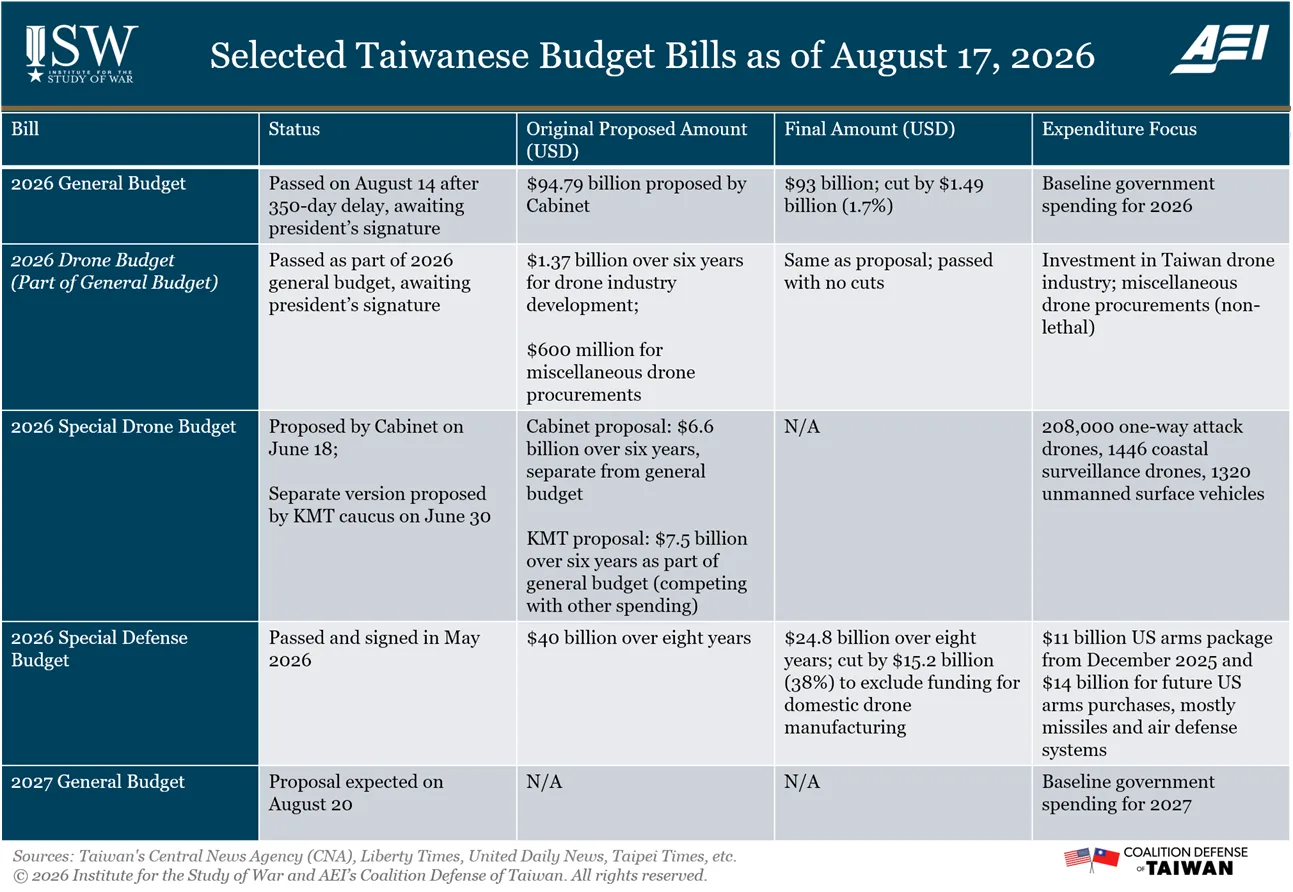
Taiwan’s opposition-controlled Legislative Yuan (LY) passed the 2026 general budget after nearly a year-long delay and approved the Cabinet’s full $2 billion drone budget with no cuts. This drone budget is separate from a larger special budget for drone procurement that the LY is still debating. The LY passed a NT$2.99 trillion ($93 billion USD) general budget on August 14, a record 350 days after the Cabinet submitted the budget proposal, and 266 days since the start of the year that the budget was meant to cover.[1] The 2026 budget passed less than a week before the Cabinet is due to unveil its 2027 general budget proposal.[2] The LY cut the Cabinet’s initial budget proposal by around 1.7 percent, or NT$48 billion ($1.5 billion USD).[3] All 51 lawmakers of the ruling Democratic Progressive Party (DPP) voted against the cuts, which included a 2.5 percent reduction in proposed spending on military equipment and facilities, a 60 percent cut in special allowances for heads of government agencies, and a 50 percent cut to discretionary media policy and publicity budgets. The opposition Kuomintang (KMT) and Taiwan People’s Party (TPP) approved a NT$44.2 billion ($1.38 billion USD) Ministry of Economic Affairs budget to develop Taiwan’s drone industry, along with NT$19.2 billion ($600 million USD) in procurement budgets for various other Cabinet agencies.[4] The KMT previously threatened to freeze drone spending but reconsidered after confirming that the requested budget items did not overlap with other drone spending requests.[5]
The budget delay is due to partisan divide within Taiwan’s government, resulting in institutional gridlock since 2024. Taiwan’s 2024 national elections elected William Lai Ching-te of the DPP president but gave the KMT and Taiwan People’s Party (TPP) a joint opposition majority in the LY. The opposition has blocked the DPP’s agenda and passed bills that Lai opposes.
The LY’s passage of the drone procurement budget without cuts is a rare instance of cross-partisan unity on defense-related spending, even though this drone budget is not for the defense ministry. A much larger defense bill that would fund specific military procurements remains under discussion, however. The LY initially cut proposed funding for domestic drone development from a special defense budget passed on May 8, instead electing to use that budget only to pay for US arms purchases. The three major parties are still debating a separate six-year special drone procurement budget, including a NT$210 billion ($6.6 billion USD) Cabinet proposal to build an arsenal of 208,200 one-way attack drones, 1,446 coastal reconnaissance drones, and 1,320 Unmanned Surface Vehicles (USVs).[6] The drone budget that passed on August 14 includes funding for the development of Taiwan’s drone industry and miscellaneous procurement for various Cabinet agencies but does not specifically fund any lethal military drones.
Philippine President Ferdinand Marcos Jr. stated on August 14 that the Philippines would not allow any country to launch attacks from Philippine territory during an invasion of Taiwan. The Philippines is likely seeking to balance maintaining energy ties with the PRC with defending its territorial claims in the South China Sea and Philippine Sea. Marcos stated at a press briefing on August 10 that the PRC had misinterpreted his statement where he said that the Philippines would inevitably be involved in a potential conflict over Taiwan.[7] Marcos emphasized that the Philippines wishes to avoid war with any country, but a war over Taiwan would pull in the Philippines “kicking and screaming.”[8] Marcos told reporters on August 14 that “there will be no attacks on anyone from the Philippines” when asked if the Philippines would allow the US military to launch offensive actions from Philippine bases in the event of a PRC invasion of Taiwan.[9] Marcos stated that allowing any country to launch attacks from Philippine territory is contrary to the Philippines’ interest in defending its territory and maintaining peace and stability in the region.[10] Marcos also stated that Philippine cooperation with Taiwan is “purely commercial” and takes place within the context of the Philippines’ one-China policy.[11] The Philippines does not recognize Taiwan as a sovereign state under this policy, but maintains trade, investment, and tourism links with Taiwan.[12]
Marcos also stated that the Philippines is seeking a “reset” in its relations with the PRC, and that joint Philippine-PRC oil and gas exploration during his term is “certainly” a possibility as the Philippines seeks new sources of oil and gas.[13] Marcos declared a state of national energy emergency on March 24 in response to energy supply disruptions caused by Iran’s closure of the Strait of Hormuz.[14] The Philippines is largely dependent on oil imports from Gulf countries and refined petroleum products from the PRC and other East Asian countries.[15] The Philippines and the PRC signed an initial memorandum of understanding (MoU) on joint oil and gas exploration in 2018, and initial plans for joint oil extraction involved a PRC state-owned oil firm extracting oil from areas in the South China Sea claimed by the Philippines and the PRC in exchange for a 40 percent share of the profits.[16]
The Philippines is likely attempting to placate the PRC on the issue of Philippine support for Taiwan to seek greater energy cooperation and trade with the PRC during a period of significant energy supply disruptions. Joint Philippine-PRC energy exploration in the South China Sea and Philippine Sea could make the Philippines more dependent on the PRC for vital energy supplies and give the PRC greater leverage over the Philippines on other issues, such as dictating its relationship with Taiwan or territorial disputes in the South China Sea.
The PRC will likely use Taiwan’s 2026 local elections as a testing ground for election interference operations and as a barometer of the PRC’s ability to influence Taiwanese politics and public opinion prior to the 2028 election. Taiwanese President William Lai Ching-te stated at a DPP Central Committee meeting in Kaohsiung on August 12 that the PRC was attempting to interfere with Taiwan’s local elections.[17] Lai cited what he described as instances of fake news and fake polling data emanating from the PRC attempting to influence the outcome of the Kaohsiung mayoral election.[18] Taiwanese government officials, DPP politicians, and US-based think tanks have accused the PRC of significant meddling in Kaohsiung’s 2018 mayoral elections which saw KMT member Han Kuo-yu take the seat.[19] The PRC may be conducting a similar disinformation campaign to support a KMT victory in Kaohsiung and to gauge how disinformation tactics can impact the outcome of Taiwanese elections.
The PRC likely targets Taiwan’s local elections to prepare for larger influence campaigns ahead of Taiwan’s national elections and to place PRC-friendly candidates in key local governments throughout Taiwan. Taiwan’s local elections receive far less scrutiny than its national elections, which may afford the PRC greater opportunities to influence their outcome.[20] Candidates’ stances on cross-Strait issues are also less relevant to local electoral politics than national-level positions, allowing more PRC friendly candidates to gain success in unexpected areas by focusing on local issues.[21]
The PRC likely views the success or failure of its 2026 election interference campaign as a key indicator of the success of its overall Taiwan policy. DPP-aligned media outlet Liberty Times published an article on August 10 that cited unnamed Taiwanese security officials who claimed that the CCP had set several key objectives for PRC Taiwan policy in the near-term.[22] The sources stated that these objectives were outlined during the CCP’s summer retreat at Beidaihe, which began on August 3.[23] The unnamed sources stated that one of the CCP’s goals was to elect “patriotic forces” in Taiwan in 2026, and noted that the PRC’s ability to shape such an outcome was a key barometer for the impact of the PRC’s Taiwan policy on Taiwanese politics and public opinion.[24] A lackluster KMT performance in the 2026 local elections could, as a result, drive a significant shift in the PRC’s Taiwan policy away from clandestine political influence, if the CCP calculates that its overarching objective of securing unification with Taiwan is no longer served by that method.
Key Takeaways
- Taiwanese General Budget: Taiwan passed its 2026 general budget on August 14 after almost a year-long delay and less than a week before Taiwan’s 2027 budget is set to be revealed. The budget approved the full $2 billion drone budget, marking a rare instance of partisan agreement on defense spending. This drone budget is separate from a previously announced special budget for drone procurement, which is still under debate.
- Philippine-PRC Relations: Philippine President Ferdinand Marcos Jr. said on August 14 that the Philippines would not allow any country to launch attacks from Philippine territory during an invasion of Taiwan. Marcos also stated that the Philippines was hoping to reset its relations with the PRC and begin joint oil and gas exploration. The Philippines is likely attempting to placate the PRC to gain greater energy cooperation and trade with the PRC during a period of significant energy disruption.
- PRC Election Manipulation in Taiwan: Taiwanese President William Lai Ching-te stated on August 12 that the PRC was attempting to interfere with the Kaohsiung mayoral election using fake news and fake polling data. The PRC will likely use Taiwan’s 2026 elections to prepare for larger influence campaigns during Taiwan’s 2028 national elections and to gauge the effectiveness of PRC information operations.
Cross-Strait Relations
Taiwan
Suspected PRC hackers targeted Taiwan in a “first-of-its-kind,” largely end-to-end autonomous, cyberattack against Taiwanese government critical infrastructure, signaling continued advancements in PRC cyberwarfare against Taiwan. Suspected PRC hackers are alleged to have used open-source code from the artificial intelligence (AI) proxy systems Hermes and OpenClaw to build an autonomous hacking tool that behaved like a coordinated cyber team.[25] The tool simultaneously deployed up to eight autonomous agents which mapped 21 Taiwanese government systems over four days in early July, compromised at least 85 government user accounts, extracted more than 2,500 personnel records, and then expanded the attack to Taiwan’s Nuclear Safety Commission and at least seven energy companies.[26] The agents divided the search for targets among themselves, researched vulnerabilities in Taiwanese systems, and changed tactics when blocked by the Taiwanese government.[27] Internal communications data linked to the hack used simplified Chinese, which is used in the PRC, while data recovered from the target was written in traditional Chinese, which is used in Taiwan.[28] The number of attacks by the PRC’s internet army on Taiwan’s critical infrastructure increased to 2.63 million attacks per day in 2025, a 6 percent increase from 2024 and more than double the 1.23 million attacks per day in 2023. These attacks target critical infrastructure including power grids, emergency relief and hospitals, and communications systems.[29]
These attacks are likely to continue, increasing in frequency and complexity, requiring Taiwan to significantly advance its cybersecurity infrastructure. This attack is the latest iteration of the PRC’s “hybrid warfare” strategy, in which the PRC wages daily military drills near Taiwan in coordination with disinformation campaigns and cyberattacks to paralyze Taiwan.[30] Taiwan’s Ministry of Digital Affairs stated that the government would strengthen its overall defense capabilities based on the characteristics of this attack.[31]
Taiwan is cooperating with the United States to produce unmanned underwater vehicles (UUV) to enhance Taiwan’s maritime security. A large number of capable UUVs could improve Taiwan’s maritime domain awareness and ability to deny sea control of the Taiwan Strait to the PLA during an invasion. US defense tech startup Vatn Systems and Taiwan’s main arms producer the National Chung-Shan Institute for Science and Technology (NCSIST) signed an MoU on August 11.[32] The MoU outlined future cooperation between the two parties on the development of AI-enabled command and control, deployment of autonomous UUVs, and establishment of a UUV supply chain and maintenance system in Taiwan.[33] The MoU specifically mentioned plans to deploy Vatn’s S12 autonomous UUV in Taiwan.[34] The S12 is a cheap, mass-producible system that can be equipped with a 200-pound warhead, has an operating range of over 370 kilometers, and can operate at depth between 100 and 300 meters, according to Vatn.[35]
A system like the S12 could enhance Taiwan’s security against PRC gray zone threats and an outright PLA invasion, if NCSIST pursues the plans outlined in the MoU. The S12 is designed to be modular and can be equipped for different missions based on Taiwan’s operational needs.[36] Large numbers of UUVs equipped for undersea reconnaissance missions could detect malign activity around its undersea cables and keep tabs on PLA Navy (PLAN) and China Coast Guard (CCG) vessels operating around Taiwan. Taiwan could alternatively use large numbers of small UUVs to prevent the PLA from securing sea control of the Taiwan Strait during a conflict.
The Vatn-NCSIST MoU is an illustration of the importance of US support for Taiwan’s defense. Taiwan has pursued several domestic UUV initiatives of systems that are larger than the S12 and designed to be survivable.[37] Vatn provides Taiwan with a UUV option that is focused on mass rather than survivability, an approach that may be more suited to a high-intensity conflict with the PRC.[38] The role of UUVs in a sea denial campaign is largely untested, as the war in Ukraine has largely seen the use of unmanned aerial vehicles (UAV) and USVs in sea denial roles.[39] Taiwanese cooperation with US defense companies, particularly those focused on the cutting edge of unmanned systems warfare, could prove critical in developing novel systems for a future conflict, as a result.
US Coast Guard instructors began conducting a training course with Taiwan’s Coast Guard Administration (CGA) amid an increase in CCG coercion and expansion of PRC “law enforcement” operations around Taiwan. The CGA announced that the US-Taiwan training course began on August 10 and will cover small boat operations, risk management, vessel berthing techniques, emergency response, personnel rescue at sea, and maritime patrols.[40] The training course will run until August 21 and is the latest instantiation of the 2021 MoU on Establishing the Coast Guard Working Group (CGWG) to strengthen US-Taiwan coast guard cooperation.[41] The CGA said that it hopes future training can teach its personnel to use new technologies including UAVs, USVs, and UUVs to strengthen maritime surveillance and law enforcement.[42] The CGA announced the training course two weeks after US and Taiwanese officials disclosed that they had held a combined coast guard patrol at an unspecified date in the summer of 2026.[43] The US and Taiwanese coast guards’ public disclosures of cooperation serve as a signal of unity in the face of the PRC campaign to expand Beijing’s jurisdiction in the waters surrounding Taiwan, most recently including permanent CCG patrols east of Taiwan, a civilian “law enforcement” mission, and scientific surveys in the waters east of Taiwan.[44]
China
A US federal court convicted a PRC national on August 10 for attempting to illegally export US military communications technology to the PRC. The PRC seeks to acquire advanced US and NATO military technology by circumventing arms export controls. Dingwei Chen and an unnamed PRC co-conspirator attempted to illegally purchase 10 export-controlled US military satellite modems and radios on behalf of a PRC firm between March and October 2025.[45] The PRC firm also sought to purchase electronic countermeasure (ECM) systems designed for the US B-1 bomber.[46]
The PRC co-conspirator contacted a US subsidiary of a Swiss arms manufacturing firm to purchase and export the modems and ECM systems.[47] The US firm told the co-conspirator that the US firm’s bank had closed its account because the US firm could not prove that it had obtained licenses for exporting the modems to the PRC.[48] Chen and the PRC co-conspirator subsequently proposed paying for the modems with the Tether cryptocurrency to avoid detection by US authorities.[49] PRC intelligence agencies often use Tether and other cryptocurrencies to pay their informants overseas, likely to maintain deniability and avoid detection by banks and law enforcement.[50]
The PRC likely aims to identify vulnerabilities in US and NATO military technology that the PLA could exploit to deter or defeat the United States or NATO-armed militaries in a potential conflict. The PRC likely also seeks advanced US and NATO satellite communications technology to improve the PLA’s military capabilities.[51] The PRC has observed Ukraine’s effective use of Starlink against invading Russian forces and has prioritized developing a domestic low earth orbit satellite constellation to provide the PLA with similar capabilities.[52] PRC spies attempted to intercept France’s Starlink communications in January and Norwegian satellite communications in May.[53]
Southeast Asia
Philippines
See Toplines.
Oceania
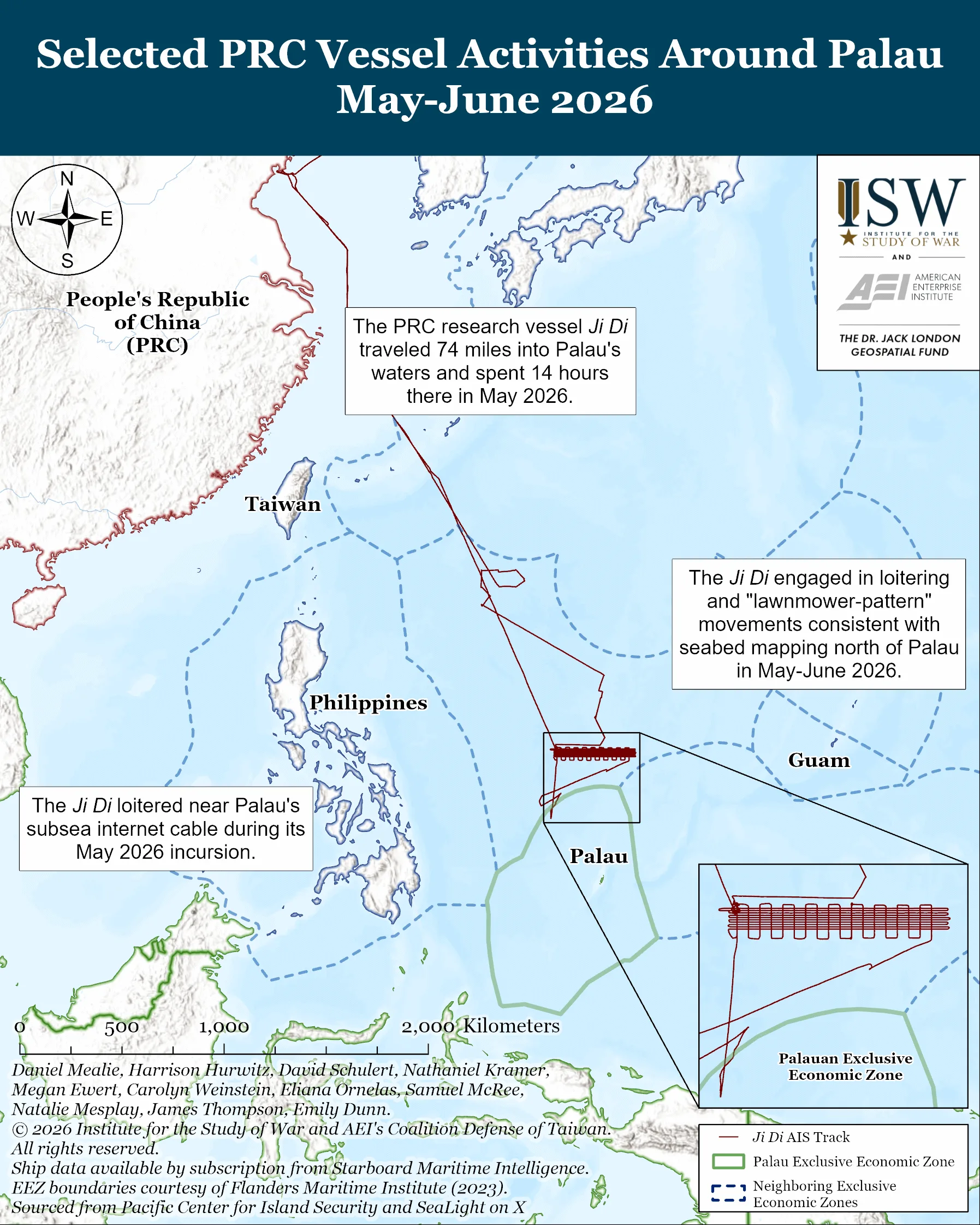
PRC vessels are sailing using a “lawnmower” pattern near Palau and Guam. These sailing patterns are consistent with previous seabed mapping activity and could indicate a PRC effort to gather information relevant to submarine warfare. ABC Australia reported on August 12 that a PRC research vessel conducted movements suggesting efforts to gather bathymetric data near Palau.[54] The PRC research vessel Ji Di, originally designed for polar research expeditions, conducted “lawnmower” back-and-forth movements near Palau from May 14 to 27 before entering Palau’s exclusive economic zone (EEZ) and loitering near its undersea internet cable in the final days of May.[55] Ji Di then approached within 600 nautical miles of Guam in early June, possibly mapping underwater territory critical to US submarine routes on the way to the South China Sea and Taiwan.[56] ISW-CDOT has reported on likely PRC subsea mapping on both sides of Guam and the Northern Marianas Islands, beginning as early as 2024.[57]
Palau has accused the PRC of multiple instances of harassment and coercion due to Palau’s recognition of Taiwan over the PRC. Palauan President Surangel Whipps Jr. accused the PRC of “weaponizing” tourism against Palau over its decision to recognize Taiwan in 2024 and accused the PRC of a major cyberattack against Palau in the same year.[58] PRC research vessels have made several unapproved incursions into Palau’s EEZ in recent years.[59] Whipps told ABC Australia that the most recent PRC incursion into Palau’s EEZ took place in July 2026, shortly after the PRC test-fired a ballistic missile into the Pacific, although ABC Australia could not confirm this.[60] PRC seabed mapping, carried out by ostensibly civilian research vessels, could provide the PRC with bathymetric data potentially relevant to a naval conflict under the guise of conducting scientific research.[61]
The PRC denied New Zealand’s accusations that the PRC was attempting to install surveillance-equipped space infrastructure in New Zealand. The New Zealand Security Intelligence (NZSIS) Service released its fourth Security Threat Environment report, which outlined regional security issues, on August 13.[62] New Zealand named the PRC as the main threat actor conducting espionage “at scale” in New Zealand and accused PRC state-linked lab Purple Mountain of attempting to build ground-based space infrastructure in New Zealand that the PRC could use to collect intelligence.[63] The report stated that Purple Mountain’s relationship with the PRC government “means they could be compelled to pass on any data collected” but in this case would have passed intelligence “willingly.”[64] NZSIS reported that it uncovered the attempt, which relied on a local company unaware of the potential intelligence risks, and prevented it.[65] The PRC Embassy denied NZSIS’s accusations on August 14.[66]
New Zealand is a member of the Five Eyes intelligence-sharing network alongside the United States, Australia, Canada, and Britain. New Zealand’s Five Eyes counterparts have historically criticized it for taking a more conciliatory approach to its relationship with the PRC, namely via trade. New Zealand has opposed PRC policies in the Pacific in recent years, including a controversial deal the PRC struck with the Cook Islands, a self-governing island in free association with New Zealand, in 2025. New Zealand’s shifting stance on the PRC could indicate its increasing alignment with broader Five Eyes policies, including efforts to shore up counterintelligence against the PRC.

[1] https://www.taiwannews.com dot tw/news/6421765
[2] https://www.reuters.com/world/china/taiwans-2027-defence-spending-rise-16-official-media-reports-2026-08-09/
[3] https://udn dot com/news/story/124984/9692249
[4] https://www.taipeitimes dot com/News/front/archives/2026/08/14/2003862498
[5] https://www.taipeitimes dot com/News/front/archives/2026/08/14/2003862498 ; https://news.ltn.com dot tw/news/politics/paper/1766552
[6] https://understandingwar.org/research/china-taiwan/china-taiwan-update-july-24-2026/ ; https://focustaiwan dot tw/politics/202606180012 ; http://news.usni.org/2026/06/24/taiwan-budget-calls-for-6-6b-for-attack-drones-unmanned-surface-vessels
[7] https://www.reuters.com/world/china/philippines-marcos-says-china-misinterpreted-his-comments-taiwan-2025-08-11/
[8] https://www.reuters.com/world/china/philippines-marcos-says-china-misinterpreted-his-comments-taiwan-2025-08-11/
[9] https://pco.gov dot ph/media-interview/qa-with-president-ferdinand-r-marcos-jr-at-the-foreign-correspondents-association-of-the-philippines-focap-presidential-luncheon/
[10] https://pco.gov dot ph/media-interview/qa-with-president-ferdinand-r-marcos-jr-at-the-foreign-correspondents-association-of-the-philippines-focap-presidential-luncheon/; https://www.abs-cbn dot com/news/nation/2026/8/14/marcos-ph-will-not-be-a-launch-pad-for-us-attacks-if-china-invades-taiwan-2347; https://www.taipeitimes dot com/News/taiwan/archives/2026/08/14/2003862502; https://globalnation.inquirer dot net/334849/marcos-on-ph-china-taiwan-tensions
[11] https://pco.gov dot ph/media-interview/qa-with-president-ferdinand-r-marcos-jr-at-the-foreign-correspondents-association-of-the-philippines-focap-presidential-luncheon/; https://www.abs-cbn dot com/news/nation/2026/8/14/marcos-ph-will-not-be-a-launch-pad-for-us-attacks-if-china-invades-taiwan-2347
[12] https://www.pna.gov dot ph/articles/1257594
[13] https://pco.gov dot ph/media-interview/qa-with-president-ferdinand-r-marcos-jr-at-the-foreign-correspondents-association-of-the-philippines-focap-presidential-luncheon/; https://www.rappler dot com/philippines/ferdinand-marcos-jr-joint-exploration-china-west-sea/
[14] https://www.reuters.com/business/energy/philippine-president-declares-energy-emergency-over-middle-east-conflict-risk-2026-03-24/
[15] https://pia.gov dot ph/news/how-the-strait-of-hormuz-closure-affects-our-oil-prices/
[16] https://amti.csis.org/a-philippine-china-deal-on-joint-development-in-the-making/; https://www.abs-cbn dot com/news/08/08/19/china-plan-to-split-oil-exploration-60-40-ok-with-duterte-if-ph-gets-bigger-share
[17] https://news.ltn.com dot tw/news/politics/breakingnews/5538177
[18] https://www.cna.com dot tw/news/aipl/202608130131.aspx
[19] https://www.cfr.org/articles/taiwan-local-elections-are-where-chinas-disinformation-strategies-begin; https://www.taiwannews.com dot tw/news/6272798; https://www.cfr.org/articles/how-china-interfering-taiwans-election; https://www.nytimes.com/2018/11/22/world/asia/taiwan-elections-meddling.html
[20] https://www.cfr.org/articles/taiwan-local-elections-are-where-chinas-disinformation-strategies-begin
[21] https://www.cfr.org/articles/how-china-interfering-taiwans-election; https://www.taiwannews.com dot tw/news/6272798; https://www.cfr.org/articles/taiwan-local-elections-are-where-chinas-disinformation-strategies-begin
[22] https://news.ltn.com dot tw/news/politics/breakingnews/5534370
[23] https://www.reuters.com/world/china/china-cues-start-leaders-secretive-beidaihe-summer-retreat-2026-08-03/
[24] https://news.ltn.com dot tw/news/politics/breakingnews/5534370
[25] https://udn dot com/news/story/7331/9686812?from=udn-ch1_breaknews-1-cate4-news; https://moda dot gov.tw/ACS/press/news/press/20394?utm; https://www.ft.com/content/7d2ab3e0-9085-48f6-b38a-d90260d58795?syn-25a6b1a6=1
[26] https://udn dot com/news/story/7331/9686812?from=udn-ch1_breaknews-1-cate4-news; https://www.ft.com/content/7d2ab3e0-9085-48f6-b38a-d90260d58795?syn-25a6b1a6=1
[27] https://www.ft.com/content/7d2ab3e0-9085-48f6-b38a-d90260d58795?syn-25a6b1a6=1
[28] https://udn dot com/news/story/7331/9686812?from=udn-ch1_breaknews-1-cate4-news; https://www.ft.com/content/7d2ab3e0-9085-48f6-b38a-d90260d58795?syn-25a6b1a6=1
[29] https://news.pts dot org.tw/article/789011; https://www.ft.com/content/7d2ab3e0-9085-48f6-b38a-d90260d58795?syn-25a6b1a6=1
[30] https://www.theguardian.com/technology/2026/aug/13/taiwan-ai-assisted-cyber-attacks-overseas
[31] https://moda dot gov.tw/ACS/press/news/press/20394?utm
[32] https://www.prnewswire.com/news-releases/vatn-systems-and-taiwans-ncsist-sign-agreement-to-explore-undersea-autonomy-for-maritime-defense-302847536.html
[33] https://www.scmp dot com/news/china/military/article/3364328/taiwan-teams-us-start-underwater-drones-boost-islands-defences?module=perpetual_scroll_0&pgtype=article; https://www.taiwannews.com dot tw/news/6422375; https://mna.mnd.gov dot tw/news/detail/?UserKey=7b005f91-f9f5-4426-9025-a1801f07b927
[34] https://www.scmp dot com/news/china/military/article/3364328/taiwan-teams-us-start-underwater-drones-boost-islands-defences?module=perpetual_scroll_0&pgtype=article
[35] https://www.vatn.com/skelmir-s12-medium-auv-drone
[36] https://www.vatn.com/skelmir-s12-medium-auv-drone
[37] https://www.twz.com/news-features/our-best-look-at-taiwans-new-drone-submarine; https://www.hisutton.com/Taiwan-Black-Whale-XLUUV.html; https://www.autonocion dot com/us/Taiwan-drone-submarine-America/
[38] https://www.understandingwar.org/wp-content/uploads/2025/04/A20Defense20of20Taiwan20with20Ukrainian20Characteristics_0.pdf
[39] https://digital-commons.usnwc.edu/cgi/viewcontent.cgi?article=1003&context=preprints
[40] https://www.cga.gov dot tw/GipOpen/wSite/ct?xItem=168748&ctNode=10590&mp=9990&utm The
[41] https://www.taiwannews.com dot tw/news/6422184 ; https://www.cga.gov dot tw/GipOpen/wSite/ct?xItem=168748&ctNode=10590&mp=9990&utm
[42] https://www.cga.gov dot tw/GipOpen/wSite/ct?xItem=168748&ctNode=10590&mp=9990&utm
[43] https://news.usni.org/2026/07/29/u-s-reveals-coast-guard-cooperation-with-taiwan
[44] https://understandingwar.org/research/china-taiwan/china-taiwan-update-july-10-2026/ ; https://understandingwar.org/research/china-taiwan/china-taiwan-update-august-14-2026/ ; https://understandingwar.org/research/china-taiwan/china-taiwan-update-june-12-2026/ https://understandingwar.org/research/china-taiwan/china-taiwan-update-july-31-2026/
[45] https://www.justice.gov/opa/pr/chinese-national-pleads-guilty-trying-obtain-us-military-equipment; https://www.courtlistener.com/docket/71544362/1/united-states-v-chen/
[46] https://www.courtlistener.com/docket/71544362/1/united-states-v-chen/
[47] https://www.courtlistener.com/docket/71544362/1/united-states-v-chen/
[48] https://www.courtlistener.com/docket/71544362/1/united-states-v-chen/
[49] https://www.justice.gov/opa/pr/chinese-national-pleads-guilty-trying-obtain-us-military-equipment; https://www.courtlistener.com/docket/71544362/1/united-states-v-chen/
[50] https://www.taipeitimes dot com/News/front/archives/2026/05/07/2003856894; https://www.taipeitimes dot com/News/taiwan/archives/2025/11/12/2003847072; https://www.justice.gov/usao-dc/media/1445291/dl?inline; https://www.wsj.com/world/asia/taiwan-military-china-spy-network-a56ec8da; https://www.ekathimerini dot com/news/1294752/alleged-spy-for-china-was-under-scrutiny-for-over-a-year-prior-to-arrest/; https://www.ertnews dot gr/eidiseis/ellada/ypothesi-kataskopeias-stis-fylakes-korinthou-o-54xronos-sminarxos-edose-tria-onomata-zito-syggnomi-apo-tin-patrida/
[51] https://news.err dot ee/1608148489/court-sentences-estonian-marine-scientist-to-prison-for-spying-for-china; https://www.usafe.af.mil/News/Article-Display/Article/3670096/chinese-attempts-to-recruit-us-nato-service-members-as-advisors-prompts-ramstei/
[52] https://www.aei.org/commentary/china-taiwan-update-may-1-2026/; https://understandingwar.org/research/china-taiwan/china-taiwan-update-may-1-2026/
[53] https://www.aei.org/commentary/china-taiwan-update-may-15-2026/; https://understandingwar.org/research/china-taiwan/china-taiwan-update-may-15-2026/
[54] https://www.abc.net.au/news/2026-08-13/chinese-research-vessels-spark-alarm-in-palau/107001038
[55] https://x.com/SeaLightFound/status/2063156171998187748
[56] https://x.com/SeaLightFound/status/2063156171998187748
[57] https://understandingwar.org/map/prc-seabed-surveying-around-guam-2024-present/
[58] https://apnews.com/article/palau-china-surangel-whipps-beijing-pacific-influence-045ec0a4f8e67e48d2a4adf0cbd13918
[59] https://x.com/SeaLightFound/status/2063156171998187748
[60] https://www.abc.net.au/news/2026-08-13/chinese-research-vessels-spark-alarm-in-palau/107001038
[61] https://www.wsj.com/world/asia/china-is-mapping-the-seabed-to-unlock-a-new-edge-in-warfare-c8ac5180
[62] https://www.abc.net.au/news/2026-08-14/china-denies-espionage-foreign-interference-in-new-zealand/107040130
[63] https://www.abc.net.au/news/2026-08-13/chinese-state-linked-observatory-sought-nz-site-spy-agency-says/107034742; https://www.nzsis.govt.nz/assets/NZSIS-Documents/New-Zealands-Security-Threat-Environment-2026.pdf
[64] https://www.nzsis.govt.nz/assets/NZSIS-Documents/New-Zealands-Security-Threat-Environment-2026.pdf
[65] https://www.nzsis.govt.nz/assets/NZSIS-Documents/New-Zealands-Security-Threat-Environment-2026.pdf
[66] https://www.abc.net.au/news/2026-08-14/china-denies-espionage-foreign-interference-in-new-zealand/107040130