
Toplines
North Korea is unlikely to accept US President Donald Trump’s engagement outreach unless the United States changes its policy on North Korean denuclearization. US President Donald Trump said on August 16 that he instructed the US Department of Defense (DoD) to reduce combined military exercises with South Korea.[1] Trump stated that such exercises are costly for the United States and that they send an “inappropriate and hostile” signal to a country that is “unthreatening and respectful,” referring to North Korea.[2] The United States and South Korea initially planned to hold the combined Ulchi Freedom Shield (UFS) exercise from August 17 to 27.[3] The South Korean Joint Chiefs of Staff (JCS) announced on August 19 that the United States and South Korea will cancel the second half of the 2026 UFS upon the US’ request.[4] The exercise will end on August 21. South Korean Defense Minister Ahn Gyu-baek said the exercise will continue throughout the year, however, despite the DoD claims that the exercise had been canceled.[5] The South Korean Lee Jae Myung administration said it hopes the relationship between Trump and Workers’ Party of Korea (WPK) General Secretary Kim Jong Un will lead to dialogue with South Korea contributing as a “pacemaker.”[6] The United States previously scaled down the combined exercises with South Korea under Trump’s first term in 2018 following the first United States-North Korea summit in Singapore.[7]
Trump claimed on August 17 that Kim responded to his August 16 message but did not provide further details.[8] WPK Director of General Affairs Kim Yo Jong, a Kim Jong Un’s sister, said on August 19 that the reduction of UFS is meaningless since it does not change the exercise’s “provocative and aggressive” nature.[9] Kim Yo Jong rejected Trump’s statement that Trump and Kim communicated while reiterating that Kim has positive personal feelings toward Trump. Kim Yo Jong added that North Korea’s security policies and nuclear posture will continue regardless of the two leaders’ personal relations.[10]
Trump’s directive to scale down the exercises comes after North Korea denounced the United States and South Korea on August 14 for conducting the UFS exercise.[11] This marks the first time Trump has announced a policy action regarding North Korea during his second term. Trump’s previous efforts to engage North Korea primarily involved commenting on his personal ties with Kim Jong Un and signaling his willingness to talk, which North Korea did not respond to. Kim instead expressed openness to dialogue with the United States on the condition that the US accept the regime’s nuclear status during the WPK’s Ninth Party Congress in February 2026. Trump has not yet announced any changes to US policy on North Korean denuclearization, however, and Kim is unlikely to agree to dialogue in exchange for a partial reduction of combined exercises. Kim likely expects the US to change its policy on North Korean denuclearization and may demand that the United States omit any language concerning denuclearization during a potential summit. The Lee administration likely welcomes Trump’s renewed engagement efforts, given that its “peaceful coexistence” policy with North Korea has centered on goodwill gestures.
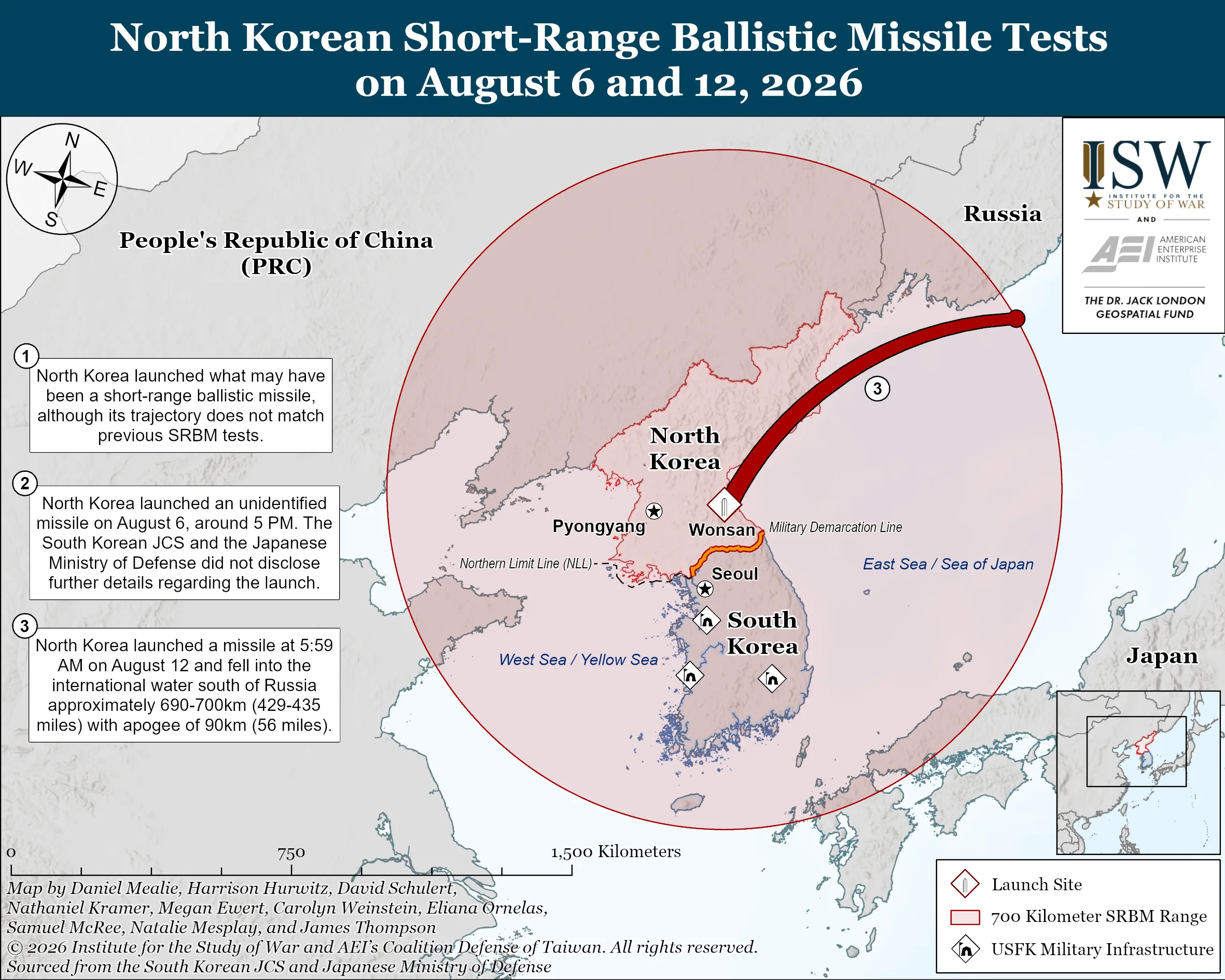
North Korea may have tested new missile technologies, including a new ballistic missile. North Korea has not reported its two recent missile launches to the public, which is a rare departure from previous launches. North Korea launched a missile with an unidentified range from Wonsan toward the East Sea/Sea of Japan on August 12.[12] The JCS and the Japanese Ministry of Defense stated that the missile flew northeast approximately 690-700 km (429-435 miles).[13] The August 12 launch followed an earlier missile test on August 6, marking two consecutive launches within a single week.[14] Neither Seoul nor Tokyo disclosed technical details for the August 6 launch.[15] North Korean state media remained silent after both launches, which departs from Pyongyang’s standard reporting on its missile launches the following morning.[16]
Pyongyang’s consecutive launches likely serve as a political demonstration against reinforced US-South Korea-Japan trilateral security cooperation. The two launches coincided with the US-South Korea UFS combined military exercises, which started on August 17, and Japan’s July 29 Tomahawk cruise missile test.[17]
Pyongyang’s continued media blackout and the irregular trajectory of the August 12 missile test also suggest that North Korea may have tested a missile system with a range between its existing short-range ballistic missiles (SRBM) and medium-range ballistic missiles (MRBM). The August 12 missile reportedly reached an apogee of 90 km, significantly higher than the 50-60 km apogee of recent North Korean SRBM launches and the standard SRBM flight profile.[18] Flight apogees naturally rise as ranges extend. North Korea is possibly developing a new missile designed to evade South Korea and the United States’ missile defense systems. South Korea’s indigenous Long-range Surface-to-Air Missile (L-SAM), which is expected to be deployed by 2027, intercepts targets at altitudes of 50-60 km, while the US Forces Korea (USFK)’s Terminal High Altitude Area Defense (THAAD) battery intercepts at 150-200 km.[19] Fielding a diversity of missiles with different trajectories in the same strike could also complicate US and South Korean missile interception.[20] North Korea will likely withhold public statements on the potential new missile system until testing results satisfy Pyongyang’s target objective. Japanese media outlet Kyodo News reported on June 20 that North Korean ballistic missiles have achieved significantly higher terminal accuracy by incorporating Russian technical feedback and combat experiences, citing an unnamed Ukrainian Intelligence official.[21] Pyongyang’s recent launches may also aim to validate improvements in effective range and precision.
North Korea is likely planning to aid Russia’s petrochemical sector to support its war in Ukraine in return for Russian investment in North Korean infrastructure. North Korean support could help insulate Russia’s petrochemical supply from future Ukrainian strikes but is unlikely to alleviate Russian shortages in the near term. Japanese media outlet Kyodo News reported on August 12 that an unnamed Ukrainian intelligence source stated that Russia agreed to support the construction of a refinery in North Korea capable of producing 300,000 tons of aviation fuel and diesel annually.[22] The agreement was struck between North Korean Foreign Minister Choe Son-hui and Russian Foreign Minister Sergei Lavrov when the two met in July, according to Kyodo News’ Ukrainian sources.[23] Kyodo News also reported that Russia would receive 25,000 tons of petroleum products annually from North Korea in return for its investment.[24] Ukraine has executed a major strike campaign over the past year against Russian petrochemical facilities and oil infrastructure, leading to fuel shortages and inflated gasoline prices across Russia.[25] Russia is likely seeking to diversify its petroleum industry and develop petroleum sources outside the range of Ukrainian strikes to solve its mounting shortages. The new North Korean facility is unlikely to be operational soon, however, and is a long-term investment for future energy security rather than a near-term fix.
Russian investment in North Korea’s energy sector could significantly benefit North Korea’s economy. Energy production is a major limiting factor in North Korean economic growth, including its military industry.[26] North Korea could improve its energy independence and possibly create a surplus for export by increasing its petroleum capacity.[27] North Korea could continue to use its isolated position far from Ukraine and its willingness to supply critical materials for Russia’s war to encourage further Russian investment in North Korea’s economy. Further Russian investment in North Korean projects intended to support Russian war efforts could create a dynamic wherein North Korea’s economy largely depends upon continued conflict or outright Russian victory, encouraging North Korea to continue providing support to Russia to prevent it from being forced to settle for a compromise peace with Ukraine.
Key Takeaways
- North Korea-US Relations: US President Donald Trump instructed the DoD to reduce US-South Korea combined exercises to avoid sending a “hostile” signal to an “unthreatening” country, referring to North Korea. North Korea remains unlikely to accept Trump’s overtures for dialogue as the United States has not changed its stance towards North Korean denuclearization, however.
- North Korea Military Development: North Korea conducted another missile launch on August 12, following a launch on August 6. North Korea has remained silent on the launches, however, deviating from its normal messaging practices. The trajectory of the August 12 missile and Pyongyang’s silence could indicate that North Korea is testing new missile technologies with a range between its existing SRBM and MRBM systems and is waiting until the missiles perform up to standard to announce their existence.
- North Korea-Russia Cooperation: North Korea may be constructing a new refinery capable of producing 300,000 tons of fuel annually in exchange for Russian investment in North Korean infrastructure. North Korea likely seeks to improve its energy independence and gain economic benefits from trade with Russia. North Korean support could help shield Russia’s petrochemical supply chains from future Ukrainian strikes but is unlikely to alleviate Russian fuel shortages in the short term.
North Korean Domestic Politics
Nothing significant to report.
North Korean Military Developments
North Korea is continuing to expand its cyber operations beyond stealing private corporations’ financial assets and information to include infiltrating US federal government systems. Federal Bureau of Investigation (FBI) Deputy Assistant Director Todd Hemmen revealed during a July 28 conference that the FBI identified a North Korean remote information technology (IT) worker employed by a US federal agency.[28] Hemmen did not disclose specific details of the ongoing investigation but noted that North Korean deceptive employment schemes are occurring within federal agencies, as previously witnessed in the private sector.[29] Hemmen added that North Korea-affiliated IT workers incorporated artificial intelligence (AI) into their operations.[30] US-based media outlet Federal News Network reported on August 10 that a Maryland man received a 15-month prison sentence in 2025 for employing a North Korean national. This individual allowed a People’s Republic of China (PRC)-based North Korean IT worker to participate in a software development contract for the Federal Aviation Administration (FAA).[31] The US Justice Department announced on December 4 that this North Korean worker also secured contracts with at least 13 US entities, gaining remote access to sensitive US government systems.[32]
North Korea’s access to sensitive federal systems may also allow Pyongyang to conduct extortion, phishing, blackmail, and disinformation campaigns on federal employees. Pyongyang would also be able to gain direct access to structural vulnerabilities and internal security protocols governing federal networks, given that most North Korean remote IT workers work in software development. ISW-CDOT assessed that North Korean IT workers exploit AI tools and hire US nationals as brokers to launch secondary cyberattacks.[33] The US Department of Homeland Security Cybersecurity and Infrastructure Security Agency issued an emergency directive on August 12 mandating federal agencies to patch critical Microsoft operating system vulnerabilities that the North Korean hacking group Lazarus actively weaponized.[34] Advanced AI capabilities and other cyber tactics enable North Korean IT workers to conceal their identities and conduct real-time deceptive operations. ISW-CDOT also assessed that North Korean cyber actors are likely increasingly targeting sub-organizations of South Korean government bodies due to their weaker security defenses compared to core ministerial agencies.[35] North Korean IT personnel appear to be carrying out similar efforts in the United States.
North Korea is likely increasingly fielding nuclear-capable weapons on the frontline with South Korea, which could increase the risk of nuclear escalation. North Korea likely aims to complicate adversary efforts to detect and neutralize its nuclear armament and diversify its conventional strike capability. South Korean government-run think tank the Korea Institute of National Unification published a report on August 5 that analyzed over 150 North Korean military activities around the Military Demarcation Line (MDL) since 2024.[36] The report found that North Korea was increasingly fielding nuclear-capable systems alongside conventional tube artillery with frontline artillery units, including Hwasong-11 tactical ballistic missiles and the 600 mm multiple launch rocket system (MLRS).[37] The report further stated that the integration of nuclear-capable systems within tactical-level artillery units would lower the threshold for nuclear retaliation, as border incidents would involve North Korean nuclear forces.[38] ISW-CDOT has assessed that North Korea codified a more decentralized nuclear command and control (NC2) structure that allows WPK General Secretary Kim Jong Un to delegate release authority for nuclear weapons to increase the survivability of North Korea’s nuclear armament. A more decentralized NC2 structure alongside frontline deployments of tactical nuclear weapons will likely result in a much lower North Korean nuclear threshold.
North Korea’s deployment of nuclear-capable systems with frontline artillery units could complicate US and South Korean efforts to pre-emptively thwart a nuclear strike. ISW-CDOT has assessed that North Korea is developing several nuclear-capable tactical systems, in part to impose targeting dilemmas on South Korean forces during a nuclear escalation.[39] South Korea’s “kill chain” deterrence concept calls for pre-emptive precision strikes to neutralize North Korea’s nuclear forces before they can launch their armaments.[40] Fielding tactical nuclear weapons across frontline platforms could force South Korea to expand its list of possible targets during a nuclear escalation and create uncertainty as to which hybrid platforms are carrying nuclear weapons. This dynamic could also make South Korea hesitant to target hybrid systems during a conventional conflict for fear of triggering a nuclear retaliation.
North Korean deployment of systems capable of ranging the whole depth of South Korea could also reflect changing North Korean artillery doctrine that increasingly emphasizes strikes at the operational and strategic levels rather than the tactical level. Unmanned systems have increasingly taken over the role of precision strikes at the tactical level in the war in Ukraine.[41] Tube artillery remains critical for striking high-value targets at long ranges but may not be required to provide mass fires across the frontline in a conflict characterized by unmanned systems. Tube artillery systems may also struggle to get in range of their targets without placing themselves at high risk of enemy drone attack.[42] North Korea may benefit from increasingly relying on unmanned systems for tactical fires because it lacks precision artillery systems.[43] North Korea’s development and deployment of increasingly long-range rocket and tactical missile systems could, as a result, reflect an intention to shift its artillery corps’ role from tactical fires towards longer-range missions, such as targeting critical transportation hubs and industrial centers throughout South Korea. The extent to which North Korea aims to integrate unmanned systems into its frontline units to provide reconnaissance and fire support at the tactical level remains unclear, however.
North Korea is likely aiming to develop a major naval base at Munchon to support its ambitions for a green-water navy. Significant investment in basing and sustainment infrastructure suggests North Korea may prioritize its East Sea Fleet for future naval expansion. NK News reported on August 10 that it obtained satellite imagery that showing workers’ camps constructed near an unfinished naval base at Tapchon Bay, Munchon, North Korea.[44] Extensive work was done on the base between 2015 and 2018, after which development on the facility was frozen.[45] ISW-CDOT previously assessed that North Korea would likely have to construct naval basing architecture, including the facilities at Munchon, to support the development of a surface fleet.[46] WPK General Secretary Kim Jong Un has stated his ambition to produce over 12 guided-missile destroyers and possibly an equivalent number of 10,000-ton guided-missile cruisers by 2030.[47] North Korea currently possesses two 5,000-ton guided-missile destroyers, and lacks major naval basing and sustainment facilities to make a large surface fleet effective.[48]
Significant investments in naval basing and sustainment capabilities could indicate that Kim intends for North Korea’s surface fleet to conduct a wide range of missions beyond supporting North Korea’s nuclear deterrent. North Korea has publicized its destroyers’ nuclear cruise missile launching capability and may be pursuing a 10,000-ton surface combatant to support ballistic missile launches.[49] North Korea would likely only invest in enhanced naval basing and sustainment facilities if North Korea intends to use its surface fleet in roles that require high-intensity, long-range deployments, suggesting a role beyond simply adding another nuclear launching platform to North Korea’s nuclear arsenal.
North Korea’s decision to expand the facility at Munchon may also indicate that North Korea is prioritizing its East Sea Fleet for future naval expansion. Kim praised the “geopolitical advantage” of Munchon’s location in 2024, likely referring to its location on the East Sea — a critical waterway for South Korean and Japanese shipping through the Strait of Tsushima.[50] The East Sea also gives the Korean People’s Army Navy (KPAN) greater freedom of maneuver than the West Sea due to its size. The East Sea’s greater depth is also more conducive to North Korean submarine operations, particularly if it aims to prevent a nuclear-armed submarine from being easily detected.[51] These advantages, alongside the decision to invest in completing the Munchon Base, could indicate that North Korea will prioritize its East Sea Fleet for future surface and undersea platforms.
North Korean Foreign Relations
North Korea is failing to yield the economic benefits of increased Russian tourism despite heavy promotions of North Korean trips and resorts to Russian tourists. Seoul-based media outlet NK News said Russian visitors to North Korea saw a year-on-year decline in the first half of 2026, citing Russian tour operators who said North Korea attracted only 3,623 Russian visitors in the first half of 2026 and that the tour operators are not expecting a leap in those numbers in the near term.[52] North Korean- and Russian-based tour groups have heavily promoted North Korea’s Wonsan Kalma mega-resort to Russian tourists, although this does not appear to have significantly changed Russian tourism rates.[53]
North Korea is seeking economic benefit through increased trade relations and tourism with Russia in exchange for North Korea’s military assistance during the war in Ukraine, which does not appear to be materializing. ISW-CDOT recently reported that a record-high 9,985 Russian nationals visited North Korea in 2025, with 5,075 traveling for tourism purposes.[54] This decline comes despite recent encouragement from North Korea and Russia to increase Russian tourism to North Korea, including several tour packages from Vladivostok-based travel agency Vostok Intur, as well as continued participation by Russian students in North Korea’s Songdowon International Children’s Camp.[55]
North Korea is attempting to gain foreign currency by ameliorating Russian labor shortages caused by the war in Ukraine. Russian media outlets Tsargrad and Ostorozhno Novosti reported that Russia is attracting North Korean female workers with higher wages to offset labor shortages, a continuation of North Korean labor migration trends to Russia, which ISW has previously reported.[56] Tsargrad and Ostorozhno Novosti released a video showing North Koreans described as overseas laborers traveling to Russia.[57] The outlets reported that the workers will work on assembly lines, in sewing workshops, in kitchens, and in agriculture.[58] The outlets reported that the average monthly wage for North Korean female workers is around $1,800, much higher than the $33 monthly income the average worker earns in North Korea after wage reform in 2023.[59] The mayor of Orenburg, Russia, in contrast, recently stated that Orenburg was having trouble recruiting North Korean workers to work as groundskeepers because the salaries offered for Orenburg groundskeepers at $690 per month were supposedly only half or a third of what North Koreans were earning at home, a claim experts cited by NK News disputed.[60]
Migrant labor could provide a significant source of foreign currency for North Korea, as the North Korean state apparatus takes most of the wages earned by North Korean migrant laborers.[61] The Russian employers quoted in these reports clearly show a preference for North Korean migrant laborers across sectors, reportedly due to their work ethic — this preference may lead Russian employers to offer more competitive wages, which would ultimately benefit the North Korean government the most.[62]
North Korea highlighted on August 15 its historical ties with Russia in fighting against Japan during celebrations of the 81st anniversary of Korea’s liberation from Japanese colonial rule. WPK General Secretary Kim Jong Un paid tribute to Soviet soldiers killed in the 1945 Soviet-Japanese War on August 14 at the Liberation Monument.[63] Kim replied on August 16 to Russian President Vladimir Putin’s message commemorating Korea’s liberation day, praising Soviet soldiers who fought against Japan during Japanese colonial rule of Korea.[64] North Korea and Russia likely displayed strong bilateral ties and their shared history of fighting Japan to signal a coalition countering United States-led security policies in Northeast Asia. North Korea historically uses the day to intensify criticism of Japan’s historical colonial rule and equate that with Japan’s current military modernization.[65]
North Korean Cognitive Warfare
North Korea seeks to hinder South Korea’s development of a nuclear-powered attack submarine (SSN) by accusing South Korea of seeking to acquire nuclear weapons. North Korean First Vice Minister of the Ministry of Foreign Affairs Jang Kum Chol said on August 12 that South Korea’s SSN project threatens regional peace by causing a “regional nuclear race.”[66] Jang added that North Korea must develop counter-capabilities to enable assured retaliation against South Korea, emphasizing the need for North Korea to prioritize its naval modernization.[67] South Korean Ministry of Foreign Affairs spokesperson Park Doo-soon denied Jang’s accusations on August 13, stating that South Korea’s SSN development complies with the international nonproliferation treaty (NPT) framework.[68] SSNs use nuclear reactors fueled by enriched uranium, requiring the International Atomic Energy Agency (IAEA) to conduct regular inspections of nuclear facilities to ensure reactor fuel is not diverted or further enriched into weapons-grade material. The South Korean Ministry of National Defense (MND) announced plans to codify South Korea’s nonproliferation commitment in legislation on July 29, likely to alleviate potential concerns that South Korea may seek nuclear latency through the project.[69]
North Korea is increasingly intensifying its opposition to South Korea’s SSN development. North Korea first publicly denounced the project in November 2025 following the United States-South Korea announcement of their SSN cooperation.[70] Jang’s August 12 statement marked the first public response from a senior North Korean official, indicating a stronger response than its previous criticism. North Korea’s characterization of South Korea’s SSN development as a nuclear proliferation issue also aligns with the PRC’s narrative.[71] PRC Foreign Minister Guo Jiakun urged the United States and South Korea to fulfill their nuclear nonproliferation obligations following the bilateral announcement on the SSN construction.[72] North Korea and the PRC may strengthen their alignment in opposition to the project once South Korea and the United States advance negotiations on securing the nuclear fuel supply, which could require US congressional review. North Korea likely seeks to prevent South Korea from operationally deploying submarines capable of countering its growing sea-based deterrent. South Korean SSNs may serve to track North Korean submarines and strengthen the existing kill chain concept.[73]
Inter-Korean Relations
South Korean President Lee Jae Myung is seeking multilateral discussions to terminate the Korean War armistice system, despite having deliberately scaled back some efforts of his “peaceful coexistence” policy amid his declining approval ratings. North Korea will most likely continue its hostile posturing toward South Korea regardless of Lee’s efforts. Lee introduced a practical three-pillar blueprint for peaceful coexistence, urging Pyongyang to engage in multilateral dialogues with the goal of replacing the current armistice system with a permanent peace structure.[74] This is Lee’s first mention of his goal and proposed methodology to change the armistice system.[75] Lee did not specify the participants in such a dialogue, but stated the peace structure framework would involve South and North Korea, the United States, and the PRC.[76] The US-led United Nations Forces, North Korea, and the PRC signed the Armistice Agreement in 1953, which established a ceasefire rather than a legal end to the war.[77] Lee omitted specific operational roadmaps for achieving peaceful coexistence, which he had explicitly highlighted in his 2025 Liberation Day speech, possibly reflecting some change in his conceptualization of the policy.[78] Lee outlined concrete measures to resume inter-Korean dialogue, including suspending anti-North Korean leaflet and loudspeaker broadcasts, restoring the 2018 inter-Korean Comprehensive Military Agreement, and expanding civilian exchanges in his 2025 speech.[79]
Lee will likely avoid contentious conciliatory inter-Korean initiatives to prevent political controversy and decreasing his domestic support, even as he maintains the strategic objective of peaceful coexistence. Korean survey firm Gallup Korea reported on August 14 that Lee’s approval rating dropped to 44 percent, Lee’s lowest rating since inauguration, with Lee’s disapproval ratings exceeding approval ratings for the first time.[80] South Korean media outlet Korean Broadcasting System (KBS) revealed that 83.9 percent of respondents surveyed from July 30 to August 3 held negative views toward North Korea.[81] KBS also reported that 69 percent of respondents acknowledge the “peaceful coexistence” policy, although the vast majority lacked awareness of its specific contents.[82] Lee may restructure his inter-Korean strategy and avoid expanding politically divisive initiatives amid declining support for the administration. Lee’s shift from emphasizing bilateral dialogue and trust-building measures in 2025 to proposing multilateral discussions in 2026 appears to reflect Lee’s recognition of North Korea’s complete disinterest in inter-Korean bilateral engagement. North Korea has designated South Korea as a hostile enemy state since WPK General Secretary Kim Jong Un proclaimed the hostile two-state framework in 2023 and subsequently codified it into North Korea’s constitution.[83] US media outlet Radio Free Asia (RFA) reported that Pyongyang recently intensified ideological education across the KPA to foster greater hostility towards Seoul, citing undisclosed sources in North Korea.[84] The source also claimed that North Korea has not abandoned unification but rather indoctrinated its troops to prepare for conquering South Korea by force.[85] Seoul will likely continue seeking to facilitate direct US-North Korea dialogue while leveraging diplomatic channels with Beijing to encourage North Korean participation in multilateral discussions.[86]
South Korea may be attempting to prevent the United Nations Command (UNC) from pursuing what South Korea may perceive as an assertion of US jurisdiction over the Demilitarized Zone (DMZ), likely because South Korea fears strengthened UNC authority will hinder South Korea’s peaceful coexistence policy. JoongAng Ilbo reported on August 13 that the UNC is reviewing the establishment of a new brigade to enforce the Korean War Armistice Agreement and conduct security operations in the Joint Security Area.[87] The commander of the UFSK also commands the UNC. The UNC cited the need to enhance command and control, coordination, and support functions along the DMZ to create a new brigade.[88] The UNC added that the brigade reflects an organizational restructuring rather than an expansion of power. South Korean Defense Minister Ahn Gyu-baek said on August 14 that the UNC and South Korea have agreed not to pursue the plan, however.[89] The UNC has not confirmed Ahn’s claim as of time of writing.[90]
South Korea may view the proposal as the US attempting to expand authority over the DMZ, despite the UNC’s clarification that it would not expand its infrastructure, capabilities, or operational mandates along the DMZ. The South Korean government has repeatedly issued protests to the UNC for denying senior South Korean officials access to the DMZ.[91] The UNC asserted its exclusive authority to control access to the DMZ under the 1953 Armistice Agreement in December 2025 after South Korea introduced legislation allowing the South Korean government to approve civilian entry into the DMZ without UNC authorization.[92] The South Korean Ministry of Unification (MOU), in particular, sought to secure South Korea’s independent use of the DMZ for non-military purposes to carry out MOU-led projects such as the DMZ Peace Trail and Peace Connection Train.[93] The Lee Jae Myung administration may see South Korea’s limited control over the DMZ as an impediment to advancing core policy ideas. The South Korean MND may worry about any organizational restructuring in the USFK ahead of the wartime operational control (OPCON) transition. The UNC denied the proposal’s relevance to the OPCON transition, however.
The South Korean MOU may be emboldened to continue pushing its more conciliatory North Korea policy as US President Donald Trump signals his desire for diplomatic engagement with Pyongyang. The MOU announced on August 15 that it would seek public discussion on the need for the South Korean military to abandon calling North Korea a “principal enemy,” as well as changing South Korea’s official terminology for North Korea to North Korea’s official title, the “Democratic People’s Republic of Korea,” or North Korea’s preferred terminology “Joseon.”[94] The South Korean MND defined North Korea as South Korea’s principal enemy in its 2026 Defense White Paper.[95] The MOU proposed using the term “threat” for the White Paper instead but did not reach an agreement with the MND.[96] Former progressive Presidential administrations under Roh Moo-hyun and Moon Jae-in used the term “threat” to refer to North Korea.[97] The MOU said the terminology change is necessary to advance South Korea’s “peaceful coexistence” policy toward North Korea since the Kim regime is unlikely to respond to South Korea’s engagement efforts while being called an enemy.[98] Trump cited his relationship with WPK General Secretary Kim Jong Un on August 16 while directing a substantial reduction in the ongoing US-South Korea UFS combined military exercises.[99] The Wall Street Journal further reported on August 18 that Trump is actively pursuing a bilateral summit with Kim in the fall.[100]
The MOU will likely expand its conciliatory initiatives to align with Trump’s efforts to deescalate hostile messaging. The MOU will also position itself as an active peacemaker in prospective US-North Korea dialogue as the Lee administration continues to request Washington’s engagement with Pyongyang. The MOU seeks to build trust and signal to Pyongyang that Seoul remains a viable negotiating partner. The MOU’s North Korea policy has repeatedly caused disagreements and disputes with the MND, Ministry of Foreign Affairs, and National Security Advisor Wi Sung-lac, however, causing President Lee Jae Myung to intervene in December 2025.[101] The MOU’s policy also triggered a conflict with the UNC. The MOU backed legislation called the “DMZ Law” to bolster the ministry’s administrative jurisdiction over the DMZ, which the UNC currently manages.[102] The UNC, which typically refrains from commenting on host-nation domestic politics, raised public concern over the MOU-led DMZ Law in January and subsequently unveiled plans in August to establish a dedicated security brigade to reinforce its jurisdiction.[103] Trump’s pivot toward engagement, however, may align with the MOU’s long-standing objectives, including the reduction of US-South Korea combined military exercises and broader deescalation measures. The MOU will likely aim to gain a central role and leadership as Seoul’s primary diplomatic “pacemaker” counterpart for any future Trump-Kim summits.
South Korean Domestic Politics
Nothing significant to report.
Counter-North Korean Coalition Building Efforts
South Korea will consider military contribution in US operations in Iran after Trump ordered a scale-down of combined exercises with South Korea. Trump claimed in his August 16 post that South Korea refused to help the United States on the denuclearization of Iran.[104] Trump repeated the claim on August 17 that South Korean President Lee Jae Myung turned down his request in a phone call.[105] Trump said it is “strange” that South Korea is not going to help a “very easy military operation in Iran” although the United States is guarding South Korea from WPK General Secretary Kim Jong Un.[106] Trump earlier said Kim Jong Un is “unthreatening” and that combined exercises send an “inappropriate” signal, however.[107] A South Korean presidential office said on August 17 that South Korea and the United States are discussing ways to make “substantive and military contributions” to restore freedom of navigation in the Strait of Hormuz.[108]
This marked the first time South Korea explicitly mentioned potential military contribution to the Strait of Hormuz crisis in response to the US’ request.[109] South Korea has been reviewing possible avenues of cooperation with the United States to support freedom of navigation operations since July.[110] South Korean media outlet DongA Ilbo reported on July 29 that the South Korean National Security Council reviewed a list of military assets to prepare for deployment, while qualifying that the deployment is not imminent.[111] Lee will face heightened pressure to manage relations with the United States, as South Korea’s opposition bloc blamed him for causing a diplomatic fallout with the United States, and his approval ratings have steadily declined since April.[112] South Korea needs approval from the National Assembly for overseas deployment of military assets, however, which may delay the actual arrival of South Korean assets to Iran even if Lee agrees to support US operations.
The 2026 UFS exercise reflects the USFK’s growing role in the US Indo-Pacific strategy. The 8th US Army stated on August 14 that the UFS exercise would focus on modernizing the United States-South Korea alliance and shaping a security environment in Northeast Asia.[113] The 8th US Army added that the exercise would include training for the rapid distribution and preparation of Army Prepositioned Stocks-4, demonstrating the alliance’s ability to project combat power and secure key terrain within the First Island Chain (FIC).[114] Deterrence by denial in the FIC has been the focus of US Indo-Pacific strategy under the second Trump administration.[115] US Under Secretary of Defense for Policy Elbridge Colby emphasized developing resilient forces in Japan, the Philippines, and the Korean Peninsula as part of the US goal of convincing the PRC that aggression within the FIC is an unattractive option.[116]
The UFS has focused almost exclusively on the Korean Theater of Operations against North Korean contingencies, with the 8th US Army reinforcing distribution and readiness of local assets. A new framework expanded the USFK’s local focus to the Indo-Pacific region, likely to integrate South Korea into the broader defensive strategy and allow US operational flexibility and readiness across regional conflict zones.[117] USFK Commander Xavier Brunson previously proposed establishing South Korea as a “Regional Sustainment Hub” to conduct the maintenance, repair, and overhaul (MRO) of US military assets.[118] USFK’s expanded role in regional military readiness is expected to use South Korea as both a logistical and MRO hub during a potential contingency. Whether training related to this initiative was part of the reduction remains unclear, however.
The United States appears less willing than South Korea to focus on the wartime OPCON transition during the UFS. South Korean media outlet JoongAng Ilbo reported on August 10 that the United States informed South Korea that it plans to conduct Full Operational Capability (FOC) verification during the exercise, rejecting South Korea’s proposal to announce the OPCON process ahead of the exercise.[119] JoongAng Ilbo reported that the exercise will still carry out auxiliary evaluations of South Korea’s defense capabilities separate from the FOC. The JCS said on August 10 that a South Korean commander will not be leading the exercise.[120] A South Korean general has not exercised command of the combined UFS exercise since 2022.[121] Lee Jae Myung has prioritized OPCON transfer since taking office in June 2025. South Korean Defense Minister Ahn Gyu-baek reiterated on August 14 that South Korea will decide on a target year for OPCON transition by the end of 2026, likely during the annual United States-South Korea Security Consultative Meeting in October.[122] USFK Commander Xavier Brunson said “political expediency must not outpace conditions” during a US congressional hearing in April 2026 and projected early to mid-2029 as the likely period for the OPCON transition, however.[123] Whether South Korea can finalize a transition date within 2026 remains unclear without FOC verification during the UFS and the reduction of the UFS exercise.

[1] https://en.yna.co.kr/view/AEN20260817003500315; https://www.yna.co.kr/view/AKR20260817017500071?section=international/all; https://www.nytimes.com/live/2026/08/16/us/trump-news
[2] https://en.yna.co.kr/view/AEN20260817003500315; https://www.yna.co.kr/view/AKR20260817017500071?section=international/all; https://www.nytimes.com/live/2026/08/16/us/trump-news
[3] https://en.yna.co.kr/view/AEN20260817003500315; https://www.yna.co.kr/view/AKR20260817017500071?section=international/all; https://www.nytimes.com/live/2026/08/16/us/trump-news
[4] https://www.yna.co.kr/view/AKR20260819050351504?section=politics/all
[5] https://www.yna.co.kr/view/AKR20260819050351504?section=politics/all
[6] https://m-en.yna.co.kr/view/AEN20260817002800315?section=national/politics
[7] https://www.yna.co.kr/view/AKR20260817035100504?section=nk/news/politics
[8] https://www.reuters.com/world/china/trump-says-north-koreas-kim-has-responded-his-overtures-2026-08-17/
[9] https://nk.news1 dot kr/news/articles/6263675
[10] https://nk.news1 dot kr/news/articles/6263675
[11] https://www.nknews.org/2026/08/north-korea-warns-of-new-level-of-measures-ahead-of-us-rok-military-drills/
[12] https://www.nknews.org/2026/08/north-korea-appears-to-conduct-second-missile-test-in-a-week-japan/
[13] https://www.chosun.com/politics/diplomacy-defense/2026/08/06/3YOQ7QI35FFX7NRC52WZ5HXNWQ/; https://www.mod.go.jp/j/press/news/2026/08/12d.html
[14] https://www.nknews.org/2026/08/north-korea-launches-unidentified-projectile-toward-east-sea-jcs/
[15] https://www.nknews.org/2026/08/north-korea-launches-unidentified-projectile-toward-east-sea-jcs/; https://www.mod.go.jp/j/press/news/2026/08/06c.html
[16] https://www.news1.kr/nk/military/6257985
[17] https://www.voakorea.com/a/us-south-korea-to-hold-ulchi-freedom-shield-exercise-from-august-17-20260810/8184811.html; https://www.chosun.com/international/international_general/2026/07/30/X6CYRZEDYVA27D74KXFYYHCK5E/
[18] https://www.mod.go.jp/j/press/news/2026/08/12d.html; https://www.38north.org/2026/03/assessing-the-maneuverability-of-north-koreas-kn-23-hwasong-11a-srbm/; https://nonproliferation.org/preliminary-analysis-kn-23-srbm/
[19] https://www.joongang.co.kr/article/25251763 ; https://www.congress.gov/crs-product/IF12645; https://www.yna.co.kr/view/AKR20250116030100504
[20] https://www.csis.org/analysis/calculating-cost-effectiveness-russias-drone-strikes; https://www.csis.org/analysis/new-salvo-war
[21] https://www.47news.jp/14500179.html;https://www.joongang.co.kr/article/25438476 ; https://www.joongang.co.kr/article/25451190
[22] https://www.47news.jp/14780227.html
[23] https://www.47news.jp/14780227.html
[24] https://www.47news.jp/14780227.html
[25] https://understandingwar.org/research/russia-ukraine/russian-offensive-campaign-assessment-august-10-2026/; https://www.nbcnews.com/world/russia/second-wave-fuel-shortages-gas-stations-sweeps-russia-rcna592878; https://understandingwar.org/research/russia-ukraine/russian-offensive-campaign-assessment-august-13-2026/; https://understandingwar.org/research/russia-ukraine/russian-offensive-campaign-assessment-august-6-2026/
[26] https://www.ebsco.com/research-starters/power-and-energy/north-korean-energy-shortages;
[27] https://www.nknews.org/?p=969266; https://fpa.org/energy-security-north-korea-defiance-survival/ https://www.nknews.org/?p=969266;
[28] https://www.newsis.com/view/NISX20260812_0003746561; https://federalnewsnetwork.com/technology-main/2026/08/fbi-investigating-north-korean-remote-it-staffer-working-for-u-s-agency/
[29] https://federalnewsnetwork.com/technology-main/2026/08/fbi-investigating-north-korean-remote-it-staffer-working-for-u-s-agency/
[30] https://federalnewsnetwork.com/technology-main/2026/08/fbi-investigating-north-korean-remote-it-staffer-working-for-u-s-agency/
[31] https://federalnewsnetwork.com/technology-main/2026/08/fbi-investigating-north-korean-remote-it-staffer-working-for-u-s-agency/
[32] https://www.justice.gov/opa/pr/maryland-man-sentenced-conspiracy-commit-wire-fraud
[33] https://understandingwar.org/research/china-taiwan/korean-peninsula-update-july-7-2026/
[34] https://www.munhwa dot com/article/11609616
[35] https://understandingwar.org/research/china-taiwan/korean-peninsula-update-august-4-2026/
[36] https://www.kinu.or.kr/main/module/report/view.do?idx=132857&nav_code=mai1674786608
[37] https://www.upi.com/Top_News/World-News/2026/08/09/dmz-military-demarcation-line-nuclear-trigger/5621786318224/; https://www.kinu.or.kr/main/module/report/view.do?idx=132857&nav_code=mai1674786608
[38] https://www.kinu.or.kr/main/module/report/view.do?idx=132857&nav_code=mai1674786608
[39] https://understandingwar.org/research/china-taiwan/korean-peninsula-update-june-2-2026/
[40] https://www.cfr.org/articles/south-koreas-revitalized-three-axis-system
[41] https://www.csis.org/analysis/russian-blood-and-treasure-ballooning-costs-putins-war
[42] https://www.businessinsider.com/ukraine-drone-unit-special-munition-strike-blitz-russian-artillery-lasar-2026-7;
[43] https://mwi.westpoint.edu/why-north-koreas-artillery-threat-should-not-be-exaggerated/
[44] https://www.nknews.org/pro/north-korea-restarts-east-coast-naval-base-project-for-new-warships-submarines/
[45] https://www.nknews.org/pro/north-korea-restarts-east-coast-naval-base-project-for-new-warships-submarines/
[46] https://understandingwar.org/research/china-taiwan/korean-peninsula-update-july-28-2026/; https://understandingwar.org/research/china-taiwan/korean-peninsula-update-june-30-2026/
[47] https://www.janes.com/defence-intelligence-insights/defence-news/sea/north-korean-leader-calls-for-two-choe-hyon-destroyers-annually; https://kcnawatch.org/newstream/1782251300-869393945/comrade-kim-jong-uns-congratulatory-speech-at-commissioning-ceremony-of-destroyer-choe-hyon/
[48] https://understandingwar.org/research/china-taiwan/korean-peninsula-update-july-28-2026/
[49] https://understandingwar.org/research/china-taiwan/korean-peninsula-update-june-30-2026/
[50] https://www.nknews.org/pro/north-koreas-urgent-new-naval-base-project-actually-faced-decade-of-delays/?pk_vid=cd5cf86187a7673217867347941a2ef5; https://nautilus.org/esena/a-vessel-traffic-system-analysis-for-the-koreatsushima-strait/
[51] https://www.ebsco.com/research-starters/geography-and-cartography/yellow-sea; https://www.ebsco.com/research-starters/agriculture-and-agribusiness/sea-japan; https://www.usni.org/magazines/proceedings/2018/october/run-silent-run-shallow
[52] https://www.nknews.org/2026/08/russian-tourists-shun-north-korea-in-first-half-of-2026-data/
[53] https://www.nknews.org/2026/08/russian-tourists-shun-north-korea-in-first-half-of-2026-data/; https://www.nknews.org/2025/07/how-north-koreas-wonsan-kalma-mega-resort-wowed-its-first-russian-guests/; https://www.nknews.org/2026/04/north-korea-russia-break-ground-on-friendship-hospital-at-wonsan-resort/
[54] https://understandingwar.org/research/china-taiwan/korean-peninsula-update-july-28-2026/
[55] https://ria dot ru/20260726/kndr-2107018892.html; https://understandingwar.org/research/china-taiwan/korean-peninsula-update-july-28-2026/
[56] https://t dot me/ostorozhno_novosti/53300; https://tsargrad dot tv/news/samye-trudoljubivye-v-mire-v-rossiju-nachali-zavozit-brigady-zhenshhin-iz-kndr-insajder_1821128; https://tsargrad dot tv/news/v-rossiju-nachali-pribyvat-otrjady-zhenshhin-iz-kndr_1818373; https://understandingwar.org/research/russia-ukraine/russian-offensive-campaign-assessment-april-22-2025/
[57] https://t dot me/ostorozhno_novosti/53300; https://tsargrad dot tv/news/samye-trudoljubivye-v-mire-v-rossiju-nachali-zavozit-brigady-zhenshhin-iz-kndr-insajder_1821128; https://tsargrad dot tv/news/v-rossiju-nachali-pribyvat-otrjady-zhenshhin-iz-kndr_1818373
[58] https://t dot me/ostorozhno_novosti/53300; https://tsargrad dot tv/news/samye-trudoljubivye-v-mire-v-rossiju-nachali-zavozit-brigady-zhenshhin-iz-kndr-insajder_1821128; https://tsargrad dot tv/news/v-rossiju-nachali-pribyvat-otrjady-zhenshhin-iz-kndr_1818373
[59] https://tsargrad dot tv/news/samye-trudoljubivye-v-mire-v-rossiju-nachali-zavozit-brigady-zhenshhin-iz-kndr-insajder_1821128; https://t dot me/ostorozhno_novosti/53300; https://www.38north.org/2025/05/assessing-north-koreas-wage-reform-18-months-later-has-it-improved-lives-or-reinforced-state-control/
[60] https://www.nknews.org/2026/07/north-koreans-street-cleaners-too-expensive-to-hire-russian-mayor-claims/; https://1743 dot ru/news/84518 ; https://www.kommersant dot ru/doc/8813412?query=%D0%BA%D0%BD%D0%B4%D1%80
[61] https://www.nkinsider dot org/north-korea-and-its-money-making-overseas-workers/; https://www.rsc.ox.ac.uk/blog/the-paradox-of-north-korea2019s-overseas-labour-programme; https://2021-2025.state.gov/report-on-serious-human-rights-abuses-or-censorship-in-north-korea/
[62] https://tsargrad dot tv/news/v-rossiju-nachali-pribyvat-otrjady-zhenshhin-iz-kndr_1818373; https://tsargrad dot tv/news/samye-trudoljubivye-v-mire-v-rossiju-nachali-zavozit-brigady-zhenshhin-iz-kndr-insajder_1821128; https://t dot me/ostorozhno_novosti/53300; https://1743 dot ru/news/84518 ; https://www.kommersant dot ru/doc/8813412?query=%D0%BA%D0%BD%D0%B4%D1%80; https://understandingwar.org/research/russia-ukraine/russian-offensive-campaign-assessment-april-22-2025/
[63] https://www.nknews.org/2026/08/kim-jong-un-plays-up-soviet-war-sacrifice-ahead-of-liberation-day/
[64] https://www.yna.co.kr/view/AKR20260816006000504?section=nk/news/all
[65] https://www.nknews.org/pro/?p=2243631
[66] https://nk.news1.kr/news/articles/6257295
[67] https://nk.news1.kr/news/articles/6257295
[68] https://www.yna.co.kr/view/AKR20260813136400504?section=nk/news/all
[69] https://www.ytn.co dot kr/_ln/0101_202607291554258398
[70] https://www.hani.co dot kr/arti/politics/politics_general/1229977.html
[71] https://news.kbs.co dot kr/news/pc/view/view.do?ncd=8636264
[72] https://www.joongang.co dot kr/article/25378172; https://www.joongang.co dot kr/article/25378981
[73] https://understandingwar.org/research/china-taiwan/korean-peninsula-update-june-9-2026/
[74] https://www.yna.co.kr/view/AKR20260815027000001
[75] https://www.bbc.com/korean/articles/c8dnng97q9qo
[76] https://www.yna.co.kr/view/AKR20260815027000001
[77] https://www.archives.gov/milestone-documents/armistice-agreement-restoration-south-korean-state
; https://www.korea.kr/news/policyNewsView.do?newsId=148947640
[79] https://www.president.go.kr/speeches/D98WJ2gY?sSearchTxt=%EA%B4%91%EB%B3%B5%EC%A0%88
[80] https://www.gallup.co dot kr/gallupdb/reportContent.asp?seqNo=1653
[81] https://news.kbs.co.kr/news/pc/view/view.do?ncd=8638279
[82] https://news.kbs.co.kr/news/pc/view/view.do?ncd=8638279
[83] https://understandingwar.org/research/china-taiwan/north-koreas-9th-party-congress-signals-confidence-in-nuclear-deterrence-rejects-denuclearization-and-inter-korean-talks/
[84] https://www.rfa.org/korean/in-focus/2026/08/13/north-korea-soldier-ideological-education/
[85] https://www.rfa.org/korean/in-focus/2026/08/13/north-korea-soldier-ideological-education/
[86] https://www.yna.co.kr/view/AKR20260815027000001
[87] https://www.joongang.co dot kr/article/25453200
[88] https://www.joongang.co dot kr/article/25453200
[89] https://news.kbs.co dot kr/news/pc/view/view.do?ncd=8637689
[90] https://en.yna.co.kr/view/AEN20260814003400315
[91] https://www.yna.co.kr/view/AKR20251203168000504?section=search
[92] https://www.upi.com/Top_News/World-News/2025/12/17/korea-UNC-objects-South-Korea-bill-DMZ-civilian-access-control/1551765966987/
[93] https://www.news1.kr/nk/inter-korean/6260165
[94] https://www.donga dot com/news/Politics/article/all/20260815/134483077/1
[95] https://www.yna.co.kr/view/AKR20260618061751504
[96] https://www.voakorea.com/a/8162276.html; https://understandingwar.org/research/china-taiwan/korean-peninsula-update-june-23-2026/
[97] https://www.voakorea.com/a/8162276.html; https://understandingwar.org/research/china-taiwan/korean-peninsula-update-june-23-2026/
[98] https://www.voakorea.com/a/8162276.html; https://understandingwar.org/research/china-taiwan/korean-peninsula-update-june-23-2026/
[99] https://www.chosun.com/politics/diplomacy-defense/2026/08/19/DUFFTSTXXJBYHH34FCKERELSNE/
[100] https://www.wsj.com/world/asia/trump-pushes-for-kim-jong-un-meeting-this-year-2a9f9ae0?eafs_enabled=false
[101] https://understandingwar.org/research/china-taiwan/korean-peninsula-update-february-3-2026/; https://understandingwar.org/research/china-taiwan/korean-peninsula-update-april-7-2026/; https://understandingwar.org/research/china-taiwan/china-taiwan-update-december-23-2025/
[102] https://www.joongang.co.kr/article/25400997
[103] https://understandingwar.org/research/china-taiwan/korean-peninsula-update-february-3-2026/
[104] https://www.cnn.com/2026/08/16/middleeast/trump-south-korea-military-exercises
[105] https://thehill.com/homenews/administration/6033853-trump-south-korea-military-exercises-iran/
[106] https://thehill.com/homenews/administration/6033853-trump-south-korea-military-exercises-iran/
[107] https://www.cnn.com/2026/08/16/middleeast/trump-south-korea-military-exercises
[108] https://www.mk.co dot kr/news/politics/12129672
[109] https://www.mk.co dot kr/news/politics/12129672
[110] https://understandingwar.org/research/china-taiwan/korean-peninsula-update-august-4-2026/
[111] https://understandingwar.org/research/china-taiwan/korean-peninsula-update-august-4-2026/
[112] https://www.chosun dot com/english/national-en/2026/08/17/JUXVP653PRANJCO6V4ENONS2ME/
[113] https://en.sedaily dot com/politics/2026/08/14/us-eighth-army-says-ufs-drill-focuses-on-modernizing
[114] https://en.sedaily dot com/politics/2026/08/14/us-eighth-army-says-ufs-drill-focuses-on-modernizing
[115] https://understandingwar.org/research/china-taiwan/korean-peninsula-update-february-3-2026/
[116] https://understandingwar.org/research/china-taiwan/korean-peninsula-update-february-3-2026/
[117] https://en.yna.co.kr/view/AEN20260814006800315
[118] https://understandingwar.org/research/china-taiwan/korean-peninsula-update-april-28-2026/
[119] https://www.joongang.co.kr/article/25452316
[120] https://www.hankookilbo dot com/news/article/A2026080512570001293
[121] https://bemil.chosun dot com/site/data/html_dir/2022/08/25/2022082500786.html
[122] https://www.munhwa dot com/article/11607547
[123] https://www.koreaherald dot com/article/10724236