Key Takeaways
North Korea’s May 2026 constitutional amendments cemented the regime’s strategic posture. Workers’ Party of Korea (WPK) General Secretary Kim Jong Un used the revisions to codify the centrality of nuclear weapons to North Korea’s defense, sever any basis for engagement with South Korea, and free himself from the ideological constraints of Kim Il Sung’s and Kim Jong Il’s legacies.
Note on the North Korean Political System
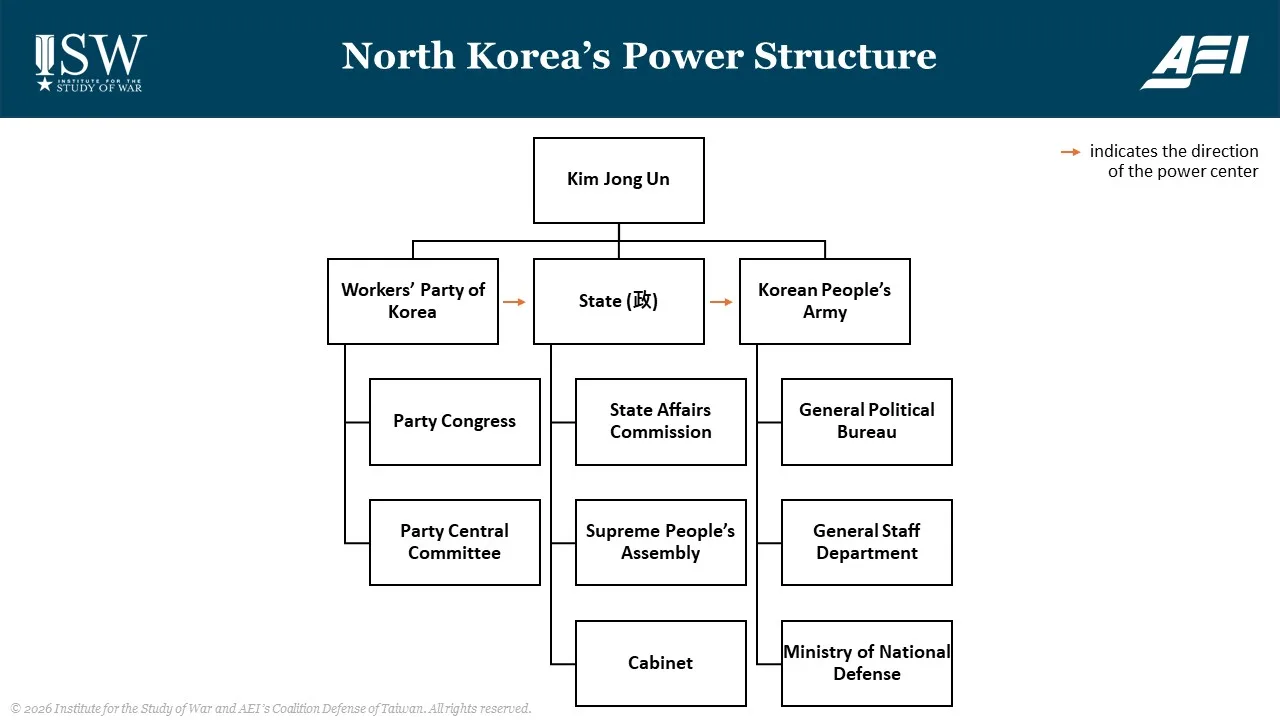
The following analysis introduces several complex political institutions and their interplay within the North Korean regime, which Kim Jong Un has structured and leveraged to maintain effective political control of the North Korean state. North Korea operates under a party-state system in which the ruling WPK determines the state’s primary policy direction, while a state institution encompassing the Supreme People’s Assembly (SPA), Cabinet, and Court carries out legislative, executive, and judicial functions, respectively.[1] Above them sits the State Affairs Commission (SAC), the superior policy-making organ.[2] Kim’s positions as the General Secretary of the WPK and the Chairman of the State Affairs Commission (SAC) consolidate his authority over both the party and state apparatus, enabling him to exercise ultimate control over national governance and policymaking.
New Development: Adoption of a Nuclear Command and Control Delegation Model
North Korea may be seeking to counter the deterrence effects of a South Korean or US decapitation strike during a nuclear escalation scenario by projecting credible retaliatory threats and institutionalizing a decentralized nuclear command-and-control (NC2) structure in the constitution. North Korea may also be pursuing a more decentralized NC2 architecture to ensure its increasingly dispersed nuclear forces remain effective. The South Korean Ministry of Unification (MOU) reported on May 6 that North Korea revised its constitution to give explicit command authority to the chairman of the State Affairs Commission (SAC) for the first time.[3] Previous constitutional language only granted the SAC chairman authority over “all the armed forces of the state,” without specifying the status of nuclear forces specifically.[4] The amendment also outlined the possibility of decentralizing North Korea’s NC2, stating that the SAC chairman should “delegate the authority to use nuclear forces to the national nuclear command-and-control organization.”[5] This marks the first time that North Korea has mentioned delegation in relation to its NC2 structure.[6]
North Korea may see delegating, and therefore decentralizing, NC2 authority as a way to mitigate negative effects on North Korean nuclear retaliation amidst the activation of South Korea’s “Kill Chain” and “Korea Massive Punishment and Retaliation” concepts. These concepts outline South Korean precision strikes against North Korean missile launchers and decision-making organs to deter and, if necessary, neutralize North Korea’s nuclear capabilities.[7] North Korea may have assessed that concentrating release authority for nuclear missiles with Kim is a critical vulnerability that could allow its adversaries to terminate its ability to effectively launch a nuclear attack in a single targeted strike.[8]
North Korea may be seeking avenues for decentralizing its NC2 as a combined result of its adversaries’ precision strike capability and its efforts to disperse its nuclear armament across platforms. ISW-CDOT has assessed that Kim is prioritizing survivability and mobility in developing North Korea’s nuclear arsenal.[9] Dispersing North Korea’s nuclear armament across platforms enhances survivability but also introduces heightened command and control challenges, particularly for North Korea’s strict politico-military hierarchy.[10] Dispersion alone does not necessitate a more decentralized NC2, but the risk of NC2 degradation that North Korea faces may have led it to conclude that delegation measures must be taken to ensure its more dispersed nuclear armament can remain effective following an adversary decapitation strike. Nuclear forces that remain mobile and move to remote areas to avoid destruction may be cut off from central command organs during an escalation scenario, thus preventing them from contributing to a nuclear response. Providing the option to delegate NC2 authority during a contingency is likely a necessary but insufficient step toward addressing the command-and-control difficulties that Kim’s dispersion efforts will bring.[11] North Korea will have to balance between Kim’s desire to maintain absolute control over North Korea’s military and its ability to effectively retaliate against a pre-emptive strike.
North Korea is highly unlikely to discuss denuclearization with the United States and South Korea as nuclear weapons become more essential to North Korea’s security. North Korea’s efforts to decentralize NC2 authority and disperse its nuclear armament present crucial challenges to South Korean and US deterrence and denuclearization efforts. Although Kim’s willingness to delegate authority in practice is not clear, South Korea and the United States will likely face a more dynamic North Korean nuclear force that is taking preliminary steps to prepare to operate under conditions of NC2 degradation. This enhanced deterrent could embolden North Korea to conduct more provocative actions on the Korean Peninsula if it calculates that traditional modes of US and South Korean deterrence can no longer credibly threaten its nuclear forces with complete annihilation. Hardening North Korean NC2 against adversary strikes also furthers the centrality of nuclear weapons to North Korea’s defense strategy, which North Korea enshrined in law in 2022. The central role of nuclear weapons in the stability of the North Korean state will likely render efforts to pressure North Korea to abandon its nuclear program futile, as Kim aims to connect North Korea’s nuclear program inextricably with North Korea’s existence as a sovereign nation.[12]
| Section | The 2023 Socialist Constitution [13] | The 2026 Revised Constitution [14] |
|---|---|---|
| State Institutions | Article 103: “The Chairman of the State Affairs Commission of the Democratic People’s Republic of Korea (DPRK) is the Supreme Commander of the armed forces of the DPRK and commands and directs all armed forces of the state.” | Article 89: “The Chairman of the State Affairs Commission of the DPRK is the Supreme Commander of the armed forces of the DPRK who commands and directs all armed forces of the state. Command authority over the DPRK’s nuclear forces belongs to the Chairman of the State Affairs Commission. The Chairman may also delegate authority to use nuclear forces to the state nuclear command organization.” |
[13] https://www.yna.co dot kr/view/AKR20260506104300504
[14] https://www.yna.co dot kr/view/AKR20260506104300504
Encapsulation of Existing Trends: Unification Abandonment, Departure from Historic Political Legacies, and Efforts to Reinvent North Korea’s Public Perception
North Korea abandoned its constitutional state goal of reunification with South Korea and instead defined North Korean territory as bordering South Korea, treating South Korea as a foreign state. Article 2 of the North Korean constitution newly states, “The territory of the Democratic People’s Republic of Korea includes the land bordering the People’s Republic of China and the Russian Federation to the north, and the Republic of Korea to the south, as well as the territorial waters and airspace established on that basis.”[15] North Korea deleted all references to reunification in the preamble, which had stated that the regime must “realize national reunification under the principles of independence, peaceful reunification, and great national unity.”[16]
The amendment reflects a formal codification of the “hostile two state” policy introduced by WPK General Secretary Kim Jong Un in December 2023.[17] North Korea in July 2023 abandoned the term “Nam-Joseon” (남조선, Southern Korea) to refer to South Korea and instead began referring to it as the “Republic of Korea (ROK).”[18] North Korea abolished key inter-Korean organizations since January 2024, including the National Committee for the Peaceful Reunification of the Fatherland, the National Economic Cooperation Bureau, and the Mt. Kumgang International Tourist Bureau.[19]
Article 2 codifies North Korea’s ongoing efforts to fortify the inter-Korean border. Kim Jong Un, on May 6, visited a munitions factory and ordered the expansion of long-range artillery capabilities along the “southern border,” targeting Seoul and the US Forces Korea (USFK) headquarters.[20] Kim directed on May 17 the militarization of the “southern border” during his meeting with Korea People’s Army (KPA) division and brigade-level commanders.[21] North Korea demolished inter-Korean railways, roads, and facilities as part of such efforts. North Korea likely intends to signal that it remains fully committed to severing inter-Korean ties and reject repeated South Korean proposals to revive inter-Korean tourism and economic cooperation. The militarization near the border, including increased deployment of military assets or troops, requires the South Korean forces to heighten military readiness correspondingly, undermining the South Korean Lee Jae Myung administration’s stated objective to de-escalate tensions near the border.[22] Lee removed propaganda loudspeakers, suggested the revival of a no-fly zone in the de-militarized zone (DMZ), and withdrew South Korean Guard Post troops to signal South Korean desire for de-escalation and engagement.[23]
North Korea likely seeks to invalidate South Korea’s demands for denuclearization by abandoning its unification goals. Whether North Korea would maintain this stance permanently remains unclear, but the constitutional codification signifies a durable institutionalization. South Korean engagement policy has traditionally rested on the premise that the Korean Peninsula remains one nation divided between two governments in the process of reunification. The South Korean government has defined inter-Korean relations as a special relationship between two separately governed parts of a divided Korean nation rather than as relations between two foreign states.[24] North Korea likely seeks to invalidate this framing and dismiss South Korean calls for denuclearization as external interference in North Korea’s sovereign affairs. Kim may also seek to deny information penetration into the regime that could occur as a result of cultural and economic exchanges with South Korea. North Korea’s rejection of dialogue with South Korea has coincided with statements on conditional openness to talks with the United States.[25] North Korean efforts to keep South Korea from engaging in security dialogues are likely intended to drive a wedge between the United States and South Korea. North Korea will likely find such reframing essential to justify the continued development of its nuclear program and seek international recognition as a nuclear state.
| Section | The 2023 Socialist Constitution [26] | The 2026 Revised Constitution [27] |
|---|---|---|
| Preamble | “The DPRK is a Juche socialist state embodying the state-building ideas and achievements of the great leader Comrade Kim Il Sung and the great leader Comrade Kim Jong Il.”[28] | “The Democratic People’s Republic of Korea is a people-centered socialist state representing the interests of the Korean people and struggle for the socialist cause.” |
| Preamble | “The DPRK strengthens the people’s power in the northern half of Korea, vigorously carries out the three revolutions in ideology, technology, and culture to achieve the complete victory of socialism, and struggles to realize national reunification under the principles of independence, peaceful reunification, and great national unity.” | “The DPRK strengthens the people’s power and enhances its functions and role while firmly adhering to the thorough implementation of the three revolutions in ideology, technology, and culture as the general line of socialist construction.” |
| Politics | Article 1: “The DPRK is an independent socialist state representing the interests of all the Korean people.” | Article 1: “The official name of our state is the DPRK.” |
| Politics | — | Article 2: “The territory of the DPRK includes the land bordering the PRC and the Russian Federation to the north and the ROK to the south, as well as the territorial waters and airspace established on that basis.” |
[26] https://www.yna.co dot kr/view/AKR20260506104300504
[27] https://www.yna.co dot kr/view/AKR20260506104300504
[28] https://www.britannica.com/topic/Juche
North Korea is signaling continuous research and development of military capabilities through advancements in science and technology, revitalization of the defense industry, and labor mobilization. North Korea added two new provisions under Chapter 4 of the Constitution on “National Defense.” Article 60 now mandates the state to develop “defense science and technology” and raise the “Juche-oriented, modernized, and scientific level” of North Korea’s defense industry. Juche, meaning “self-reliance” in Korean, is North Korea’s state ideology emphasizing political, economic, and military independence from external influence. Article 61 established a new requirement for the state to establish a “military-first atmosphere” and prepare its population “for resistance warfare.”
North Korea has consistently embraced ambitions to invest in science and technology in the defense sector to overcome technological obstacles it likely faces in advancing certain weapons systems. Kim introduced “science technology” as a key focus area for North Korean investment and policy to develop North Korea’s economy, national defense, and culture during the 7th WPK Congress in 2016.[29] South Korean think tank the Institute for National Security Strategy (INSS) assessed that North Korea sought investments in defense science technologies throughout 2016 and 2020, leading to advancements in its nuclear and missile programs.[30] Kim further directed the development of artificial intelligence (AI) and space technology to national defense during the 9th WPK Congress in 2026.[31]
North Korea likely seeks to codify the importance of defense modernization and sustaining current lines of efforts to advance its nuclear, missile, space, AI, unmanned systems, and cyber warfare capabilities. This codification may be a way for North Korea to signal its determination to defend against external pressure to stop is military modernization.[32] Article 61 enables North Korea to secure the resources required for expanding its defense industry and weapons production. The amendment demands the North Korean population participate in “jeon-min hang jeon” (全民抗戰, resistance warfare by every citizen), a term North Korea uses to encourage civilian mobilization during wartime.[33] North Korea is likely to utilize its population as a resource for all state efforts to resist external forces as part of its self-reliance policy.
| Section | The 2023 Socialist Constitution [34] | The 2026 Revised Constitution [35] |
|---|---|---|
| National Defense | — | Article 60: “The state develops defense science and technology and continuously raises the Juche-oriented, modernized, and scientific level of the defense industry.” |
| National Defense | — | Article 61: “The state establishes a military-first atmosphere throughout society and thoroughly prepares all people for resistance warfare.” |
[34] https://www.yna.co dot kr/view/AKR20260506104300504
[35] https://www.yna.co dot kr/view/AKR20260506104300504
WPK General Secretary Kim Jong Un may be seeking to elevate the role of the Chairman of the State Affairs Commission in the constitution as a dictatorial organ of the state and a means of legitimizing his governing base. Chapter 6, Section 1 of the constitution previously detailed the roles and responsibilities of the Supreme People’s Assembly (SPA), and was followed by the authorities of the SAC chairman in Section 2. The amendment reversed this order, possibly intending to signify the elevation of the SAC chairman over the SPA. Kim established the SAC as a new institution within the SPA in 2016, designating its role as a formal policy-making body of the country. Kim has primarily utilized the SAC as a counterpart for foreign governments in diplomatic settings and added “Chairman of the SAC” to his formal title alongside “WPK General Secretary.” The constitution redefined the SAC chairman as “the head of state representing the Democratic People’s Republic of Korea,” replacing the previous designation of “the supreme leader.” The amendment further expanded the powers of the SAC Chairman to include suspending, appointing, or dismissing SPA leadership or the Cabinet premier; vetoing laws adopted by the SPA; and receiving credentials from foreign diplomatic representatives.[36] The amendment also removed the SPA’s authority to summon the SAC chairman.[37]
North Korea mandates nationwide elections every five years to select 687 members of the SPA. North Korea uses a single-member district system, in which it elects one deputy per roughly 30,000 residents, resulting in 687 seats based on population. Elected SPA members elect the SPA leadership, including the Chairman of the SAC. The system remains authoritarian, however. It does not enable meaningful transfers of power or reflect democratic representation, as every electoral district allows one candidate to be registered, and voters cast ballots either in favor of or against the given candidate. North Korea received zero out of 40 for political rights in the 2025 Global Freedom Score, reflecting the absence of an electoral process, political pluralism and participation, and functioning of government.[38] North Korea forbids political dissent or challenges to the Kim regime’s authority, and operates a set of political prisons for those who violate North Korean law. North Korea previously allowed minor political parties to exist to give the illusion of political pluralism, but they have been systematically eliminated in recent years.[39]
The change in defining Kim as the “supreme leader” to “head of state” in the constitution likely signifies an effort to ground Kim’s governing legitimacy in what the regime portrays as a democratic process, rather than reliance on the cult of personality and hereditary lineage. Kim likely intends to strengthen a political system led by a dynastic totalitarian dictatorship that allows him to maintain his position of authority. The use of the title “head of state” in diplomatic settings likely serves to elevate the standing of Kim as a representative of North Korea beyond that of the ruling party, although the WPK remains Kim’s de facto source of power and control. These changes coincide with recent efforts to move away from propaganda centered on former North Korean leaders Kim Il Sung and Kim Jong Il, while promoting Kim Jong Un’s “people-first” principle. Kim may be seeking to portray his leadership as stemming from popular support by elevating the legitimacy of the SAC, while also depicting North Korea as a legitimate state in the international community.[40]
| Section | The 2023 Socialist Constitution[41] | The 2026 Revised Constitution[42] |
|---|---|---|
| State Institutions | Section 2: Chairman of the State Affairs Commission of the DPRK | Section 1: Chairman of the State Affairs Commission of the DPRK |
| State Institutions | Article 100: “The Chairman of the State Affairs Commission of the DPRK is the Supreme Leader representing the state.” | Article 86: “The Chairman of the State Affairs Commission of the DPRK is the head of state representing the DPRK.” |
| State Institutions | Article 104: Chairman’s powers included: 1. Direct overall state affairs. 2. Direct SAC affairs. 3. Promulgate SPA laws and major SAC decrees/decisions. 4. Appoint or dismiss major state officials. 5. Appoint or recall diplomatic representatives abroad. 6. Ratify or abrogate major treaties. 9. Exercise pardon authority. 10. Declare emergency, wartime status, and mobilization orders. 11. Organize and direct the National Defense Committee in wartime. | Article 90: Chairman’s powers include: 1. Direct overall state affairs. 2. During SPA recesses, suspend, appoint, or dismiss major state officials including the SPA Chairman and Premier. 3. Remove SPA deputies who have lost public trust. 4. Exercise veto power over laws, decrees, decisions, and directives adopted by the SPA or SPA Standing Committee if they do not conform to state development and people’s demands. 5. Confer state honors on persons with distinguished achievements. 6. Receive credentials of foreign diplomatic representatives. 7. Appoint or recall diplomatic representatives abroad. 8. Ratify or abrogate major treaties. 9. Exercise pardon authority. 10. Declare emergency, wartime status, and mobilization orders. 11. Organize and direct the National Defense Committee in wartime. |
| State Institutions | Section 1: Supreme People’s Assembly | Section 2: Supreme People’s Assembly |
| State Institutions | Article 91: SPA powers included: 5. Elect or recall the Chairman of the SAC. 6. Elect or recall the Chairman of the SPA Standing Committee. | Article 96: SPA powers include: 7. Elect or recall the SPA Chairman and Vice Chairman. |
[41] https://www.yna.co dot kr/view/AKR20260506104300504
[42] https://www.yna.co dot kr/view/AKR20260506104300504
Kim Jong Un’s reduced emphasis on inherited political legacies may allow Kim to pursue a unification policy not bound by traditional frameworks. North Korea removed most references to former North Korean leaders Kim Il Sung and Kim Jong Il from the preamble of the constitution.[43] Kim Il Sung’s name, in particular, appeared only once in the amended version, compared to 21 times in the 2023 constitution.[44] The removal aligns with North Korea’s efforts to reduce the emphasis on Kim Il Sung and Kim Jong Il in North Korean state propaganda in recent years. Kim Jong Un excluded Kim Il Sung and Kim Jong Il’s names for the first time at the 9th WPK Congress in February 2026.[45] Kim Jong Un also scaled down state celebrations for the previous leaders, including their birthdays.[46] ISW-CDOT previously assessed that Kim Jong Un has consolidated his authority independent of his predecessor’s legacies, accelerating the retirement of second-generation descendants of Kim Il Sung-era ”revolutionary” figures.[47] The shift has coincided with a promotion of the “people-first” principle, the main theme of North Korea’s current propaganda focus.[48] North Korea has used the “people-first” ideology to frame Kim’s domestic policies as being centered around improving living standards for ordinary North Koreans. The shift likely reflects a transition from the ideological framing the Kim regime has historically relied on to a new narrative introduced by Kim Jong Un.[49]
North Korea’s strategic reorientation since the 2019 Hanoi diplomatic breakdown has largely contradicted with constitutional demands anchored by Kim Il Sung and Kim Jong Il. North Korea has traditionally espoused a unified Korea under a socialist government as its primary national objective.[50] The 2026 constitutional amendments—including the new territorial definitions, removal of references to unification, and de-prioritization of past political legacies—likely functions to eliminate contradictions stemming from the current “hostile two states” policy.
The movement also aligns with Kim Jong Un’s broader efforts to redefine the basis of his regime’s legitimacy to one based on popular support, through what it portrays as a legitimate political process, by moving away from a propaganda strategy centered on the cult of personality during the Kim Il Sung and Kim Jong Il eras.
| Section | The 2023 Socialist Constitution[51] | The 2026 Revised Constitution[52] |
|---|---|---|
| Preamble | “The Democratic People’s Republic of Korea is a Juche socialist state embodying the state-building ideas and achievements of the great leader Comrade Kim Il Sung and the great leader Comrade Kim Jong Il.” | “The Democratic People’s Republic of Korea is a people-centered socialist state representing the interests of the Korean people and struggling for the socialist cause.” |
[51] https://www.yna.co dot kr/view/AKR20260506104300504
[52] https://www.yna.co dot kr/view/AKR20260506104300504
WPK General Secretary Kim Jong Un may be seeking to reduce the gap between unrealistic welfare promises and the state’s ability to deliver them by abandoning specific responsibilities in the constitution. The 2023 constitution stated in Article 25, Chapter 2 under “Economy,” that taxes have been “abolished” and North Korea provides “all conditions necessary for workers to eat, clothe, use, and live.” The 2026 amendments omitted any reference to tax abolition and replaced “eat, clothe, use, and live” with “provide affluent and civilized living conditions.” The 2023 constitution had also stated in Article 29 that North Korean workers know “no unemployment,” but removed that language in the amended version. This amendment also deleted the language on “universal free medical care system” in Article 56, Chapter 3 under “Culture,” of the 2023 constitution, instead replacing it with the “socialist public health system.”
These amendments under Chapter 2 and 3 largely reduced the state’s responsibility in terms of welfare, such as providing living goods, food, jobs, and health care. North Korea’s ability to deliver such welfare promises has been compromised due to economic difficulties since the 1990s.[53] A survey by the South Korean Ministry of Unification in 2024 reported that approximately 72 percent of North Korean defectors surveyed who escaped the country between 2016 and 2022 did not receive food rations from the state.[54] North Korea has promoted the construction of multiple large-scale farms, fisheries, hospitals, and community entertainment facilities as some of Kim Jong Un’s key economic achievements that put “people first” during the 9th WPK Congress, however. ISW-CDOT assessed that North Korea built the Sinuiju greenhouse farm—one of the farms described as Kim’s “gift” to the people—for propaganda purposes, as large portions of the facility remain nonoperational three months after the completion ceremony, according to satellite imagery from South Korean satellite imaging firm SI Analytics.[55] The omission of specific welfare promises likely reflects North Korea’s inability to materialize such promises due to economic realities.
It is unlikely that North Korea would abandon a socialist distribution system entirely. North Korea would likely continue to promote state-led welfare efforts in food production, residential conditions, and medical innovation, at least externally, aiding Kim’s propaganda strategy centered on the “people-first” ideology. North Korea likely intends to manage the disparity between its constitutionally guaranteed welfare rights and what the state is actually providing to minimize perceived hypocrisy. This aligns with Kim’s broader efforts to reinvent North Korea’s portrayal as a legitimate socialist system. North Korea remains one of the world’s lowest-performing countries in terms of measures of social welfare, being placed 149th out of 172 countries on the Social Progress Index in 2023.[56] The revision may also enable Kim to implement taxation in the future or signal an increasingly lax regulation on private economic activities—including local markets known as “Jangmadang”—for acquiring living goods instead of the reliance on state distribution.
| Section | The 2023 Socialist Constitution[57] | The 2026 Revised Constitution[58] |
|---|---|---|
| Economy | Article 25: “In our country, where taxes have been abolished, the growing material wealth of society is devoted entirely to improving the welfare of working people. The state provides all conditions necessary for workers to eat, clothe, use, and live.” | Article 22: “The growing material wealth of our country is devoted entirely to improving the welfare of working people. The state struggles to provide the people with affluent and civilized living conditions.” |
| Economy | Article 29: “Socialism is built through the creative labor of the working masses. In the DPRK, labor is the independent and creative labor of workers liberated from exploitation and oppression. The state ensures that labor by our workers, who know no unemployment, becomes more joyful and worthwhile through conscious enthusiasm and initiative for society, the collective, and themselves.” | Article 27: “Socialism is built through the patriotic enthusiasm and creative labor of the working masses. In the DPRK, labor is the independent and creative labor of workers. The state ensures that workers’ labor becomes more joyful and worthwhile through conscious enthusiasm and creative initiative for society, the collective, and themselves.” |
| Culture | Article 56: “The state consolidates and develops the universal free medical care system, strengthens the district doctor system and preventive medicine system, and improves material support for the health sector to protect people’s lives and improve workers’ health.” | Article 49: “The state consolidates and develops the socialist public health system, improves the quality of medical services, and strengthens the material and technical foundations of the health sector to protect people’s lives and improve workers’ health.” |
[57] https://www.yna.co dot kr/view/AKR20260506104300504
[58] https://www.yna.co dot kr/view/AKR20260506104300504

[1] https://nkinfo.unikorea.go dot kr/nkp/pge/view.do;jsessionid=btdDUNFBAG9z3qAwQeVbk5XVfZtExAnK2_BeRUCe.ins12?menuId=ORGNZ
[2] https://nkinfo.unikorea.go dot kr/nkp/pge/ps/ps.do?menuId=PO009
[3] https://www.yna.co dot kr/view/AKR20260506104300504
[4] https://www.yna.co dot kr/view/AKR20260506104300504
[5] https://www.yna.co dot kr/view/AKR20260506104300504
[6] https://www.yna.co dot kr/view/AKR20260506104300504
[7] https://www.csis dot org/analysis/south-koreas-offensive-military-strategy-and-its-dilemma
[8] https://wmdcenter.ndu.edu/Portals/97/Documents/Publications/NK-Nuclear-Command-and-Control_Report.pdf
[9] https://understandingwar.org/research/china-taiwan/north-koreas-9th-party-congress-signals-confidence-in-nuclear-deterrence-rejects-denuclearization-and-inter-korean-talks/
[10] https://www.cfr.org/backgrounders/north-koreas-power-structure
[11] https://wmdcenter.ndu.edu/Publications/Publication-View/Article/3159531/north-korean-nuclear-command-and-control-alternatives-and-implications/
[12] https://www.armscontrol.org/act/2022-10/news/north-korea-passes-nuclear-law
[13] https://www.yna.co dot kr/view/AKR20260506104300504
[14] https://www.yna.co dot kr/view/AKR20260506104300504
[15] https://www.yna.co dot kr/view/AKR20260506104300504
[16] https://www.yna.co dot kr/view/AKR20260506104300504; https://www.joongang.co dot kr/article/25426277
[17] https://www.bbc.com/korean/articles/c4nyjy7l859o
[18] https://www.yna.co dot kr/view/AKR20240223062900504
[19] https://imnews.imbc dot com/replay/2024/nwdesk/article/6563800_36515.html
[20] https://www.nknews dot org/2026/05/kim-jong-un-calls-for-modernizing-small-arms-production-at-latest-factory-tour/; https://understandingwar.org/research/china-taiwan/korean-peninsula-update-may-12-2026/
[21] https://www.yna.co dot kr/amp/view/AKR20260518004552504; https://understandingwar.org/research/china-taiwan/korean-peninsula-update-may-19-2026/
[22] https://www.korea dot kr/news/policyNewsView.do?newsId=148947640; https://www.hani.co dot kr/arti/politics/bluehouse/1240561.html
[23] https://www.korea dot kr/news/policyNewsView.do?newsId=148947640; https://www.hani.co dot kr/arti/politics/bluehouse/1240561.html
[24] https://www.bbc dot com/korean/news-45987373
[25] https://news.jtbc.co dot kr/article/NB12287195
[26] https://www.yna.co dot kr/view/AKR20260506104300504
[27] https://www.yna.co dot kr/view/AKR20260506104300504
[28] https://www.britannica.com/topic/Juche
[29] https://www.inss.re dot kr/publication/bbs/rr_view.do?nttId=410562&bbsId=rr&page=2&searchCnd=0&searchWrd=
[30] https://www.inss.re dot kr/publication/bbs/rr_view.do?nttId=410562&bbsId=rr&page=2&searchCnd=0&searchWrd=
[31] https://www.spnews.co dot kr/news/articleView.html?idxno=104842
[32] https://www.kinu.or dot kr/main/module/report/view.do?idx=132816&nav_code=mai1674786581
[33] https://www.rfa dot org/korean/in_focus/nk_nuclear_talks/warprep-05072019101116.html
[34] https://www.yna.co dot kr/view/AKR20260506104300504
[35] https://www.yna.co dot kr/view/AKR20260506104300504
[36] https://www.yna.co dot kr/view/AKR20260506104300504; https://www.jajusibo dot com/70111
[37] https://www.yna.co dot kr/view/AKR20260506104300504; https://www.jajusibo dot com/70111
[38] https://freedomhouse.org/country/north-korea/freedom-world/2025#PR
[39] https://understandingwar.org/research/china-taiwan/korean-peninsula-update-february-25-2026/
[40] https://www.dbpia.co dot kr/pdf/cpViewer?nodeId=T15918800
[41] https://www.yna.co dot kr/view/AKR20260506104300504
[42] https://www.yna.co dot kr/view/AKR20260506104300504
[43] https://www.yna.co dot kr/view/AKR20260506104300504
[44] https://www.dailynk dot com/20260515-3/
[45] https://understandingwar.org/research/china-taiwan/korean-peninsula-update-march-12-2026/; https://understandingwar.org/research/china-taiwan/korean-peninsula-update-april-22-2026/; https://chosunsinbo dot com/2026/02/30-349/; https://www.segye dot com/newsView/20260227510988
[46] https://understandingwar.org/research/china-taiwan/korean-peninsula-update-march-12-2026/; https://understandingwar.org/research/china-taiwan/korean-peninsula-update-april-22-2026/
[47] https://understandingwar.org/research/china-taiwan/korean-peninsula-update-march-12-2026/
[48] https://repo.kinu.or dot kr/bitstream/2015.oak/12497/3/2.%28%EA%B9%80%ED%9A%A8%EC%9D%80%29%20%EB%B6%81%ED%95%9C%EC%9D%98%20%EC%82%AC%EC%83%81%EA%B3%BC%20%EC%9D%B8%EB%AF%BC%EB%8C%80%EC%A4%91%EC%A0%9C%EC%9D%BC%EC%A3%BC%EC%9D%98%20%EC%97%B0%EA%B5%AC%2831_68%29_4%EA%B5%90%28%EC%B5%9C%EC%A2%85%29.pdf.
[49] https://www.tongilnews dot com/news/articleView.html?idxno=205227; https://repo.kinu.or dot kr/bitstream/2015.oak/12497/3/2.%28%EA%B9%80%ED%9A%A8%EC%9D%80%29%20%EB%B6%81%ED%95%9C%EC%9D%98%20%EC%82%AC%EC%83%81%EA%B3%BC%20%EC%9D%B8%EB%AF%BC%EB%8C%80%EC%A4%91%EC%A0%9C%EC%9D%BC%EC%A3%BC%EC%9D%98%20%EC%97%B0%EA%B5%AC%2831_68%29_4%EA%B5%90%28%EC%B5%9C%EC%A2%85%29.pdf; http://webzine.puac.go dot kr/tongil/sub.php?number=2187
[50] https://www.yna.co dot kr/view/AKR20210601170100504
[51] https://www.yna.co dot kr/view/AKR20260506104300504
[52] https://www.yna.co dot kr/view/AKR20260506104300504
[53] https://encykorea.aks.ac dot kr/Article/E0078757
[54] https://www.joongang.co dot kr/article/25227213
[55] https://understandingwar.org/research/china-taiwan/korean-peninsula-update-may-19-2026/
[56] https://www.rfa.org/korean/in_focus/human_rights_defector/humanitarian-05252023154536.html
[57] https://www.yna.co dot kr/view/AKR20260506104300504
[58] https://www.yna.co dot kr/view/AKR20260506104300504