
Introduction
The dramatic visit of US Central Intelligence Agency Director John Ratcliffe to Moscow in August 2026 brought much-needed attention to the increasing danger that Russian President Vladimir Putin could conduct a limited attack on a NATO state in the relatively near term and even while continuing to fight in Ukraine.[1] The reaction of most Baltic States to Ratcliffe’s trip and the resulting discussion and events has been largely to call for calm regarding a Russian invasion and a measured approach to other Russian threats.[2] Estonia and Latvia both reiterated that they have observed no evidence of the buildup of Russian forces near their borders that would be necessary for a full-scale invasion of their countries.[3] Those statements are correct — there is no such buildup, and a full-scale Russian invasion of a NATO state is extremely unlikely while Russia remains fully committed to war against Ukraine. But full-scale invasion is not Putin’s only option to conventionally escalate against a NATO state. He could conduct limited ground operations leveraging tactical- and operational-depth drones against one or more NATO states not for the purposes of conquering them or seizing territory, but rather with the aim of breaking the alliance by causing it to fail to activate and act appropriately on its Article 5 commitments.
Brief sketches of possible Russian actions along those lines have emerged in recent discussions, but scenarios for Russian action have not received the detailed analysis they deserve and require. This paper presents the setup and initial actions of one such scenario — a Russian limited attack on Narva, an Estonian border town near the Baltic Sea. Russian forces could seize other border towns, of course, and can pursue other scenarios including direct drone strikes on European targets as a number of European states, especially Poland, have recently been warning.[4] The purpose of studying a Narva scenario is not to suggest that the Russians will conduct this specific operation, although they have set limited conditions to do so already, but rather to explore in detail what such an attack might look like, how the Kremlin might seek to use it to advance its own domestic objectives and to break the alliance, and how the alliance should act both to deter and to defeat any such attack, whether at Narva or elsewhere. This scenario is notional — it is not an assessment or forecast that the Kremlin will conduct such an operation.
The urgency of this examination has been increased by the September 16, 2026 Russian action suspending movement on the Russian side of the border opposite Narva, which could be an indicator of preparations for such a Russian operation, although it could also be tied to the Estonian announcement that Tallinn will close Estonia’s border with Russia if Russian President Vladimir Putin orders an involuntary mobilization in Russia.[5]
The alliance certainly has the ability to deter and, if necessary, defeat a Russian operation of the sort described in this paper. It is not, at the moment, ready to do so at acceptable risk and cost, however. Ratcliffe’s visit along with other indications that Putin is seriously considering and preparing for options to test and even attack NATO make open and detailed discussion of scenarios such as this one urgent.
Scenario: Limited Russian Ground Incursion in Narva Backed by Russian Drone Elements Based in the Russian Federation
Objectives and Restraints
The objectives of this Russian effort would be:
- To create a situation of de facto war with NATO to use for internal mobilization purposes (and to justify a new involuntary reserve mobilization);
- To discredit Article 5 by conducting an actual act of aggression and causing NATO not to invoke or act effectively on Article 5 in response;
- To create a crisis within NATO with the subsidiary aims of
- Fracturing the alliance by creating divisions between the United States and Europe and among European member states — explicitly isolating the Baltic States within the alliance to the greatest extent possible;
- Distracting the alliance from supplying Ukraine and persuading it to reallocate resources to its own defense;
- Building support within Europe for Russia’s preferred Euroskeptic and NATO-hostile parties in the context of upcoming European elections by painting NATO and Brussels as having triggered a crisis and conflict with Russia;
- Create a crisis to offer to trade for concessions to be imposed on Ukraine—the Kremlin can offer to back down on Narva if Ukraine accedes to Russian demands, e.g.
Russian operations would be designed to avoid:
- The requirement to commit large numbers of Russian ground forces to any such effort in a way that would detract from the war in Ukraine;
- The emergence of a meaningful NATO offensive threat against Russia, specifically including one that would require the redeployment of Russian assets from Ukraine;
- Strengthening the alliance through anything that is widely perceived as a full-scale invasion of a NATO member state;
- Triggering a large buildup of NATO military power directly on Russian borders;
- Triggering NATO deep strikes against key targets in Russia; and
- Causing Ukraine’s supporters to increase supplies of advanced materiel and/or lift restrictions on the Ukrainian use of those already supplied.
It is important to note, however, that Putin is very capable of miscalculating how European leaders and NATO will respond. He may well conduct operations that he believes will lie below key thresholds for triggering the outcomes this scenario is designed to avoid, only to discover that European leaders have lower thresholds than he had thought.
Background and Setup
The Russians have largely set informational conditions to conduct an operation based around the fiction of a Narva People’s Republic at a moment of their choosing.[6] There would likely be a brief period in which Russian agents, openly and covertly, push a narrative of increasing Estonian oppression and mistreatment of Russian citizens in Estonia, as well as accusing Tallinn and NATO of preparing to conduct offensive operations against Russia itself or that Estonian aid to Ukraine is tantamount to direct Estonian participation in Ukrainian strikes against Russia, making Estonia a legitimate target (claims the Kremlin makes all the time). The Russian FSB also announced on September 16, 2026, a 10-day ban on movement along and on the Narva River, a ban on firearms in the vicinity of Narva on the Russian side, and a partial curfew.[7]
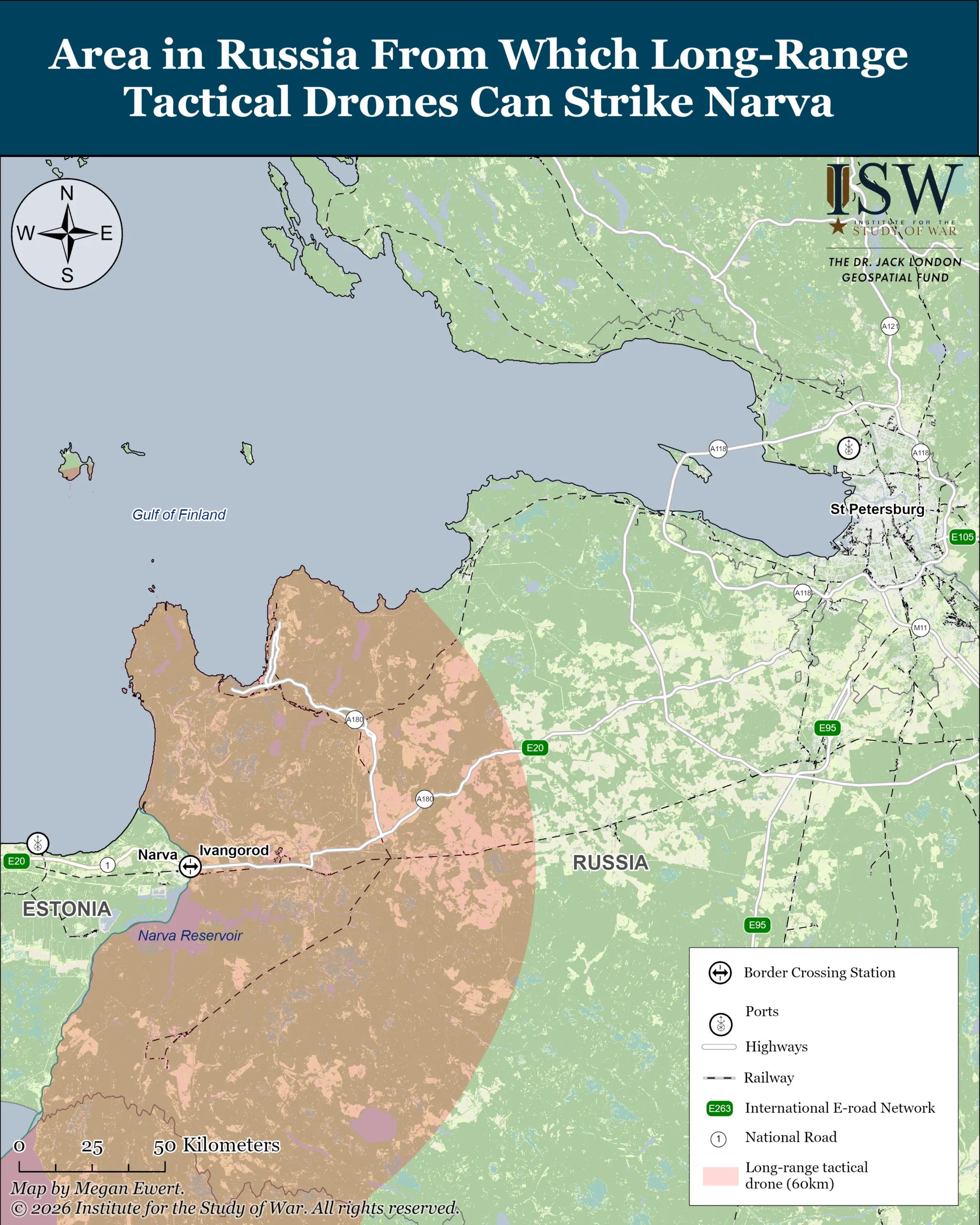
In preparation for this operation, the Russian military quietly concentrates FPV drone elements drawn from the Rubikon Center for Advanced Unmanned Systems and other largely elite Russian drone units within range of Narva and Johvi (the nearest Estonian military base, roughly 40km west of Narva) starting close to the border but echeloned deeply into the rear. The drone elements are equipped with long-range (60+km fiber-optics drones, Molniya fixed-wing drones, Lancet and Kub loitering munitions), and many shorter range (15-25 km) fiber-optic and radio-controlled drones. Drone units prepare hide positions in the arc along the Estonian border and echeloned back at least 60 km from the border (deeper if operational drone ranges support). Russian drone operators using Starlink-equipped drones are echeloned deep in the Russian interior. The Russian military also begins to build up a reserve of Geran and other long-range one-way attack drones for possible use against NATO positions, but the buildup is really only visible in a normal cyclic reduction in the tempo of Russian Geran strikes against Ukraine. (Russian forces reportedly already have stockpiles of Geran drones of various models that could be allocated to support this scenario.) There will be a period in which Geran launchers will need to be set up for (relatively) close-range mesh-network strikes, but the ranges bring that area well to the east of St. Petersburg. Repeater towers will need to go up on the Russian side if they are not already present, although the Russians may also attempt to use repeaters on ships in the Gulf of Finland. Russian ground forces, including Spetsnaz and elements of one or more Airborne or Naval Infantry brigades/regiments, would concentrate in small detachments with limited footprints. There is no large-scale, visible buildup of Russian ground forces in the vicinity of Narva or the Baltic States and specifically no large buildup of combat vehicles, as Kremlin plans do not include a significant ground operation in the area at this time and the Russians are confident that their drone elements and long-range strike capabilities supporting a small group of elite Russian infantry can defend against what limited offensive potential NATO has on the ground in the Baltics and Finland.
Indicators
The key indicators of Russian preparations for such an operation would include:
- Enhanced preparation of the information space, likely specifically including increasing accusations of Estonian persecution of its Russian minority. Preparation of the information space could also include accusations of increasing Estonian “aggression,” particularly if Estonia undertakes measures to secure its borders;
- Increased deployment of Russian drone forces in the greater Saint Petersburg area, including preparation of drone launch points in this area;
- Activation of repeater stations in Russia or in the Baltic Sea region;
- Movement of limited Russian ground forces into the Leningrad Military District;
- Increased Russian air defense preparations in the Leningrad Military District (although such preparations could also indicate increased efforts to defend against Ukrainian long-range strikes); and
- Activation of covert Russian networks in Estonia.
It may be difficult to observe with confidence most of these indicators if the Kremlin undertakes its preparations slowly and gradually rather than suddenly. Estonia and its allies must be very vigilant in seeking to observe small, gradual changes in the Russian force posture in Estonia’s vicinity and avoid focusing excessively on looking for preparations for a large-scale Russian conventional attack.
Scenario Assumptions
- That the Russians already have sufficient agents within Narva with access to the necessary weapons (mainly small arms) to conduct the limited operations described in the scenario;
- That Estonian/NATO forces in Estonia are not postured or positioned to defend against a scenario such as this one by preventing the initial seizures of terrain entirely, and are instead postured to conduct counterattacks that may come too late;
- That the Russians could order the operation to begin without alerting Estonian authorities in time to prevent the initial seizures; and
- That Estonian/NATO forces cannot, in fact, reliably defend against advanced and concentrated Russian FPV and Geran strikes as described in the scenario.
Scenario Assessments
- The Russians have sufficient drone elements deployed in Ukraine and in training in Russia that they can divert enough to accomplish the missions outlined in this scenario without notably compromising efforts in Ukraine, likely by downscaling operations in relatively stagnant areas of the front line for a time;
- NATO forces permanently positioned in the Baltics are not currently postured to pose a serious ground threat to Russia in the St. Petersburg area in immediate response to a Russian attack and in the face of a determined and prepared drone-based Russian defense relying on small numbers of Russian ground forces.
Scenario Highlights
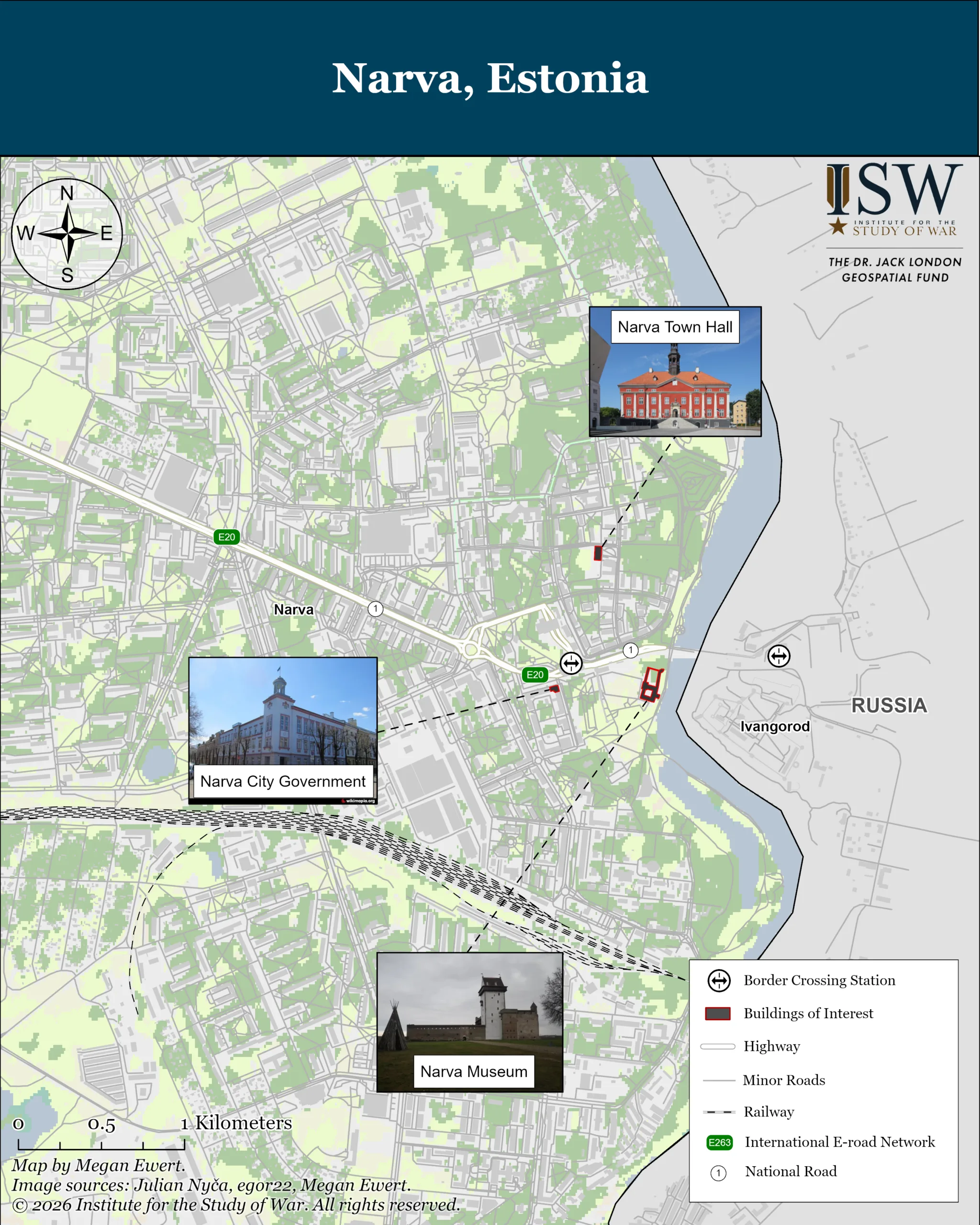
Russian agents already in position in Narva seize the Narva Museum, the Narva Town Hall, as many of the buildings in between as they can, and as much of the promenade and waterfront north and south of the bridge as they can and declare the establishment of the Narva People’s Republic (NPR). The Narva Museum is a relatively isolated structure that a relatively small group of militants supported by an intensive drone effort could likely hold for a considerable period against ground forces. It is also very close to the Narva Bridge, with the promenade on the other side (in which small, lightly armed groups could dig in quickly, supported by drone cover). The museum is easily destroyed by airpower or long-range strike, of course, for which reason the Russian agents would likely attempt to dig in dispersed defensive positions around it and along the waterfront that would be harder to destroy. But the Estonian requirement will be to reoccupy and regain full control of their territory, which Russian drone elements will attempt to contest regardless of the fate of Russian agents.
The Russian agents identify themselves (truthfully for once) as Russian citizens and call on Moscow to defend them against Estonian efforts to root them out. The request is immediately granted.
The Kremlin announces that Russian drone and air defense units have been assigned the task of defending the Russian citizens of the NPR from bases in Russia and that Russian military forces have not entered and will not enter Estonian territory unless Estonia escalates the crisis.
Estonian police and forces in the area try to clear the positions rapidly but come under small arms fire from NPR fighters (supported by Russian Spetsnaz and other special elements and ground forces prepositioned in Estonia and moving rapidly to cross the bridge from Russia) with infantry weapons but not fighting vehicles.
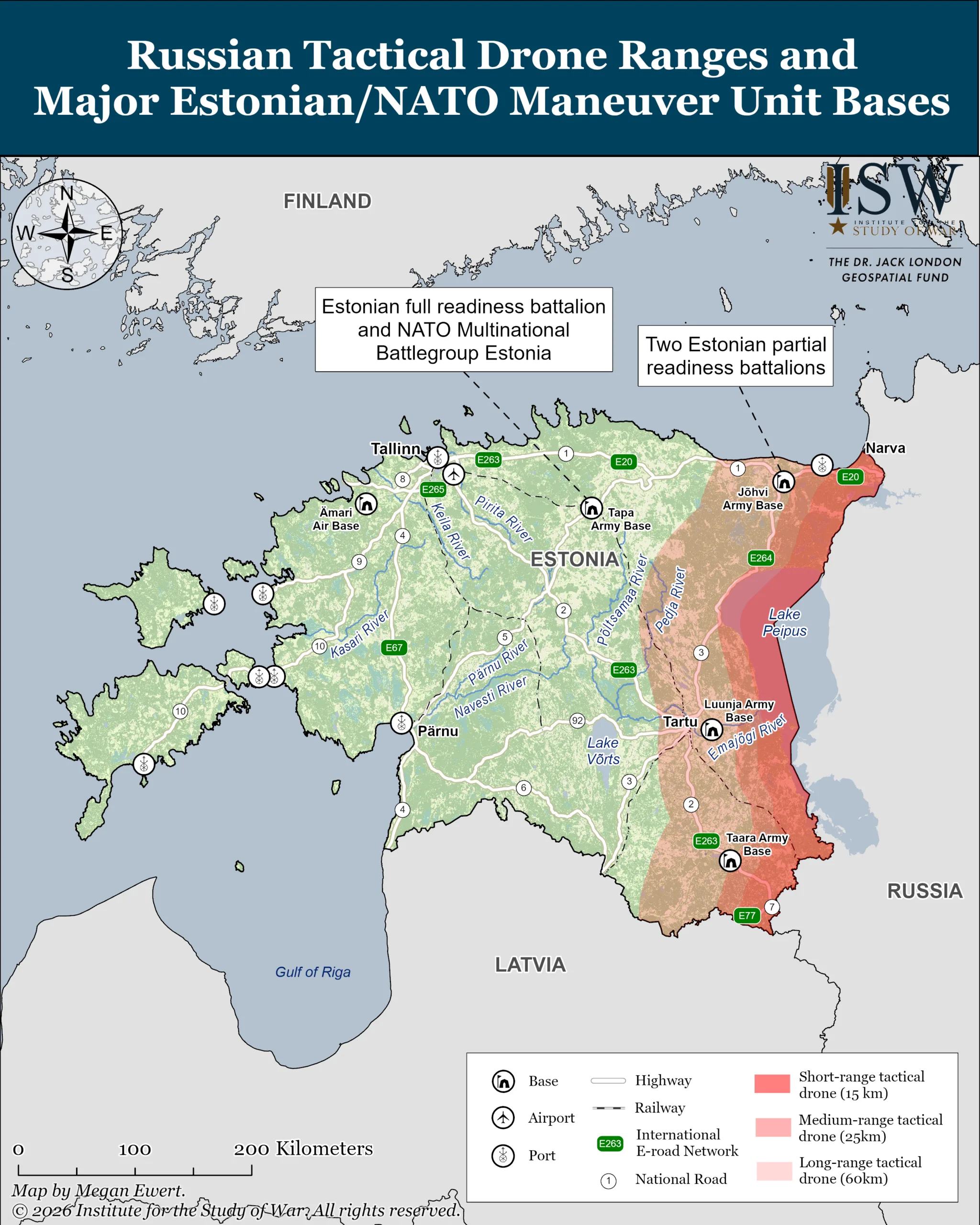
Russian drone elements based in Russia rapidly begin striking Estonian forces attempting to clear the positions, and the Russian elements in Narva operate their own tactical drones to good effect. The situation quickly becomes a localized stalemate as Estonian personnel immediately in the area are unprepared to defend against large volumes of Russian FPV strike drones, including fiber optic drones, protecting the NPR fighters.
The Kremlin calls for calm and de-escalation on the basis of Estonian recognition of the NPR’s claims to control all of Narva and demands that all Estonian military, police, and government personnel evacuate the territory. Moscow threatens to launch an expanded strike campaign against Estonian forces if fighting continues, and to further expand that strike campaign against any NATO state that involves itself in operations against the NPR.
The NPR and the Kremlin assert that the situation in Narva is an internal matter resulting from Estonia’s mistreatment of Russian citizens and denies that it constitutes a Russian attack on NATO. On the contrary, the Kremlin claims, it is a defensive measure in response to Estonian aggression.
Challenges This Scenario Poses to Estonia and NATO
Immediate Estonian/NATO Response
Assuming that the Russian agents can overcome and/or hold off local security forces, the combined Estonia-NATO force defending Estonia will need to respond to the area. The nearest Estonian military bases are in and near Johvi, approximately 40 km to the west. (Estonia has also begun construction of a company-sized military position in Narva itself, beginning with temporary accommodations in late 2026 planning to start construction of permanent facilities by February 2027, which will likely force a recalibration of Russian plans for this scenario but is not yet considered in this scenario).[8] One possible Russian mitigation could be to bring that garrison under heavy drone fire immediately, potentially claiming that the NPR elements are operating the drones). Russian drone operators can bring forces in Johvi under fire from the Russian side of the border from the first minutes of the operation and can interdict major and minor roads from Johvi to Narva, with an intensity proportional to the proximity to Narva itself. Russian Geran-style drones can attack all fixed bases in Estonia from the start of the operation or at any moment thereafter. Their ability to attack forces on the move will depend on proximity to Russian base-stations and repeaters but will likely remain high.
The initiation of this scenario will likely prompt the Estonian government and its allies in Estonia to try to begin moving forces toward Narva at once in what can rapidly turn into a kind of salt-lick operation for Russian drone operators. The Russian agents who initiate the scenario would be overcome relatively easily with small military forces, so the Russian challenge is to prevent those forces from getting to Narva. The Estonian/NATO challenge will be getting them there with acceptable losses.
Strategic Challenges for NATO
This scenario will immediately present a series of strategic challenges to the alliance.
Estonia will likely seek an Article 5 activation unless Tallinn has reason to believe that such a vote will fail, although Estonia might seek to force the matter even in that case. Estonia could, alternatively, avoid seeking Article 5 activation and instead seek help from individual NATO member states — but failing to seek Article 5 activation in the face of a clear Russian attack on NATO territory would also seriously damage the utility and significance of Article 5.
Russian cognitive warfare efforts seeking to portray the Russian attack as an internal matter resulting from Estonian persecution of its own Russian minority will likely fail to shape NATO policy but could become a distraction and cause delays.
A number of NATO states will likely be very hesitant to invoke Article 5 over a limited incursion, fearing the consequences of appearing to launch the alliance into a full-scale war with Russia. Russian cognitive warfare efforts are already playing on these fears and will intensify before and during the Russian attack.[9] Recent statements by Slovakian Prime Minister Robert Fico along these lines are concerning in this regard.[10]
Tensions between the US and European governments over their relative responsibilities for defending NATO territory and airspace, especially in the face of such a limited attack, may delay or preclude US involvement. Negotiations between the US and its European allies could lead to significant delays and hinder prompt votes and prompt military action. Russian cognitive warfare efforts will continue to focus on driving the wedge between the US and Europe even deeper.
Non-Estonian NATO forces in Estonia will force troop-contributing states to decide rapidly whether or not to support Estonian forces in repulsing the Russian attack, and may need to make such decisions before the North Atlantic Council has voted to invoke Article 5. Russian cognitive warfare efforts will focus on paralyzing such action.
Military and Operational Challenges for NATO
This scenario will present a series of complicated challenges and decisions to NATO military structures. Assuming that Estonia has not already prepositioned large numbers of drone interceptors, interceptor drones, advanced electronic warfare systems, and kinetic counter-tactical-drone systems in the immediate vicinity of Narva, both Estonia and NATO would be challenged to get such systems into place once Russian drone operators begin striking ground lines of communication into and through Estonia toward Narva. NATO states collectively may have sufficient amounts of such systems to handle the relatively small-scale scenario described above, but Russian interdiction efforts can disrupt or preclude them from arriving in the combat area even once a decision to send them has been taken.
The absence of sufficient counter-drone systems in the combat area will impose on NATO forces the requirement to target Russian drone operators in their dispersed hide positions in Russian territory and to deny Russian communications technology in Estonia (such as cutting Russian forces off from Starlink in Estonia as SpaceX did in Ukraine in 2026).[11] That requirement will interact with the political dynamics of an Article 5 debate and vote, as some member states will likely balk at the prospect of attacking Russian territory directly. The military challenge will also be very significant, however. Well-prepared hide positions are very difficult to identify rapidly, and NATO forces do not currently have their own highly trained and well-equipped drone units on par with those fielded by the Ukrainian and Russian militaries able to find and rapidly strike those positions.[12] NATO forces will likely default to using JDAMs and other conventional munitions to attack hide positions, assuming they can obtain political permission to do so. Russian drone operators using Starlink-equipped drones can be echeloned far from the physical area of operations, requiring coordination with SpaceX to rapidly enforce a whitelisting solution as SpaceX introduced in Ukraine in early 2026 to deny Russian forces’ ability to use Starlink in Estonia. The efficacy of such attacks will depend heavily on the number of hide positions, the rapidity with which NATO forces can find them and then strike them, the speed at which Russian forces can be deprived of Starlink, and the ability of Russian drone units to regenerate combat capability.
The Russians cannot prevent NATO 5th Generation aircraft from conducting precision strikes on their positions, but Russian air defenses in this area (the immediate environs of Saint Petersburg) would likely require the use of 5th Generation aircraft during the initial phases of aerial operations. The NATO military command in conjunction with the NAC would need to decide rapidly whether to conduct a full suppression of enemy air defense (SEAD) operation in order to permit non-stealthy aircraft to operate in this area, but such an operation would require striking targets in and near Saint Petersburg and would take some time to complete. If the NATO military command chooses to rely on 5th Generation aircraft to conduct all strike missions, then the number and rate of such strikes will be determined by the number of such aircraft immediately available and munitions available to maintain a high sortie rate. That question, in turn, makes the issue of US involvement in operations paramount, as only the US has a large enough inventory of such aircraft to maintain intensive operations against a large number of dispersed positions.
Recent discussions by the militaries of frontline NATO states have focused on their intention of conducting deep strike operations to repel Russian attacks, but such operations are very unlikely to have a material military effect on attacks such as the one considered in this scenario.[13] The Russian forces involved in a limited attack on Narva have a very small logistics footprint that long range strikes are very unlikely to destroy or disrupt. NATO capitals will also face considerable political pressure to avoid what the Russians will portray as an escalation by conducting strikes away from the immediate area of operations. Nor is there any solid basis for an assessment that limited NATO long-range strikes would force a Russian capitulation any more than the intensive Ukrainian long-range strike campaign has done. NATO could, of course, conduct a massive long-range strike campaign to cripple the Russian military in general, but the alliance is very unlikely to move rapidly to such a campaign in the face of an initially limited Russian attack.
Russian Escalation Options and Their Limitations
Russian forces have limited options to escalate this crisis in the short term. The Russian military is not prepared to conduct large-scale conventional ground operations against NATO forces, is not preparing to do so, and would be seriously challenged to do so while also prosecuting the full-scale invasion of Ukraine. Limited Russian ground forces could possibly initiate other small-scale incursions elsewhere in the Baltic States or against Poland, but their ability to do so without compromising the Kremlin’s priority efforts in Ukraine will likely be very constrained. The Kremlin is highly unlikely to successfully pressure Belarusian President Lukashenko to involve the small Belarusian military in offensive operations, though the threat of Belarusian forces could pin some NATO elements in place away from the Narva theater. A large-scale mobilization of Russia’s reserves, rumors of which have been circulating for some time, could in principle support such incursions as well as increasing Russian force levels in Ukraine.[14] But Russian mobilization and training practices are currently optimized for getting large numbers of civilians rapidly to front line units with very low levels of training.[15] Such forces would be unsuitable for operations against NATO states, a fact that would likely constrain the Kremlin to redirect experienced and likely elite combat forces from operations in Ukraine for the purpose. Such a redirection of experienced forces would likely have significant detrimental effects on Russian efforts in Ukraine, and the Kremlin will likely seek to avoid them.
Conventional Russian air and naval power is no serious match for NATO capabilities, especially if the US commits to the defense of the alliance. A significant Russian conventional air or maritime campaign would very probably increase the likelihood of US support to its European allies. It is far from clear, moreover, that a concerted effort by the European members of NATO would be insufficient to defeat such Russian operations as long as the US permitted them to use existing NATO command-and-control infrastructure.
The most probable Russian escalation measures would therefore rely on long-range strike drones of the Geran variety, possibly in conjunction with ground-launched ballistic missiles and very probably coordinated with an expanded campaign of sabotage and cyber attacks. NATO is currently unprepared to defend against large Geran strike packages, certainly over an extended period of time, and reported shortages of interceptors capable of defending against ballistic missiles could pose a serious challenge.
A significant Russian escalation along these lines, however, would very likely increase the willingness of NATO member states to engage in long-range strikes and even an air campaign over Russia to attack launchers. NATO long-range strike is very likely able to inflict serious damage on Russian ballistic missile launch systems and to degrade the ability of Russian forces to launch large Geran strike packages. The author does not have the basis to assess the likely effectiveness of NATO member states in defeating or responding to sabotage and cyber campaigns.
Any such Russian campaigns against NATO would materially detract from Russian efforts to defeat Ukraine, however, as Russia’s ability to produce Gerans and ballistic missiles is both limited and subject to NATO attack. The Kremlin is unlikely to choose such an escalation path unless its leadership becomes persuaded that this path will very likely break the alliance.
The calculations shaping possible Russian escalation scenarios are thus complex and, in general, daunting for the Kremlin as long as Russian leaders believe that NATO is likely to fight in a coherent fashion. Putin is very unlikely to choose military options against NATO that badly undermine his efforts in Ukraine unless he is confident that such military action will destroy the alliance or end European support for Ukraine. The danger to Putin of initiating a scenario along the lines described above, in fact, is the possibility that NATO will escalate in ways that compel him to choose between effective responses to NATO and continuing effective operations in Ukraine. This scenario is designed, however, precisely to minimize the risk that Putin will be forced to undermine his efforts in Ukraine.
Conclusion and Recommendations
NATO’s best option in this scenario is, of course, to deter it. The alliance as a whole retains superiority in escalation scenarios as long as the United States is fully committed to defending its European allies and Putin remains committed to the war against Ukraine. US commitment is, obviously, the primary variable in that calculation. The US should thus take every measure possible to demonstrate its commitment to its alliance obligations in the face of even limited Russian aggression of the sort described above. Strategic ambiguity invites Russian adventurism and significantly increases the odds that Putin might gamble on such a scenario hoping to invalidate Article 5 at a low cost and risk to himself. Discussions of the withdrawal of US forces from Europe at this time, regardless of their framing or of other messaging, undermine US credibility and therefore increase the likelihood of Putin initiating conflict with NATO.
European member states can also increase the likelihood of deterring scenarios such as this one by dramatically accelerating preparations to disrupt and to meet them symmetrically. Keys to such efforts include developing indigenous counter-drone capabilities including advanced electronic warfare systems, interceptor drones to defeat both tactical and long-range strike UAVs, kinetic counter-drone systems, and skilled drone units of their own that can rapidly identify and strike Russian drone operator positions.
Too much of the European defense discourse today focuses on options that would amount to escalation, particularly long-range strike, rather than on rapidly developing the kinds of symmetrical capabilities that Ukrainian forces have, although there are European efforts along those lines, to be sure. NATO member states must internalize the reality that, unattractive as escalation scenarios are to Putin, they are likely to be much more challenging for NATO states themselves from a political perspective. Russian cognitive warfare efforts will go all out to dissuade one or more states from voting to support long-range strikes into or air campaigns against Russian territory in such a scenario, and NATO should not rely on winning those fights in every member capital. The ability to defend against low-level scenarios such as those described above with tactical capabilities whose use does not require either the mobilization or the permission of the entire alliance is an essential component of deterrence as well as of defeat mechanisms.
But NATO must also internalize the challenges of moving such tactical capabilities to forward positions after the Russians have initiated attacks at a moment of their choosing. Russian drone units are highly effective at interdicting ground lines of communication unless their own operators can be regularly and rapidly located and eliminated. Front line states must not only rapidly field their own drone and counter-drone capabilities, but must also deploy them to their borders even in the face of the inevitable Russian accusations of NATO aggression and threat.
NATO must deter and, if necessary, defeat a limited Russian incursion such as this one at both the political and the military levels. If military conditions are properly set and necessary preparations are made in advance, then success in the political arena becomes much more likely. Clear statements that NATO will honor its defense commitments even against such limited attacks are needed, but so are clear preparations to do so at levels that do not impose massive political costs and risks on the alliance.

[1] https://www.politico.com/news/2026/08/26/cia-russia-nato-moscow-ratcliffe-01051848
[2] https://www.wsj.com/world/europe/the-baltic-country-calling-for-calm-in-the-face-of-russian-threat-afdcfa2f; https://eng.lsm dot lv/article/politics/president/20.05.2026-keep-calm-carry-on-examine-algorithms-says-latvian-president.a647989/
[3] https://vm dot ee/en/news/foreign-minister-tsahkna-estonias-threat-assessment-has-not-changed ; https://www.delfi dot ee/artikkel/120606361/lati-kaitsevae-juhataja-cia-juhi-venemaa-reisist-kui-oleks-marke-ohust-siis-ma-ei-istuks-siin
[4] Poland’s Tusk warns of Russian drone or rocket attacks on Europe | AP News
[5] Russian Offensive Campaign Assessment, Sept. 20, 2026 | ISW; https://balticflank.substack.com/p/curfew-on-russias-border-with-estonia
[6] https://understandingwar.org/research/defense-of-europe/the-russian-military-campaign-against-europe-defining-the-threat/; https://www.dw.com/en/does-the-estonian-city-of-narva-really-want-to-join-russia/a-76663710; https://euromaidanpress dot com/2026/03/17/narva-peoples-republic-estonia/; https://www.politico dot eu/article/how-a-fake-russian-story-became-a-real-problem-for-estonia/
[7] https://kingisepplo dot ru/index.php/pogranichnaya-zona.html; https://www.mk-lenobl dot ru/social/2026/09/16/v-slancevskom-i-kingiseppskom-rayonakh-proydet-profmeropriyatie-pogranichnikov.html
[8] https://news.err dot ee/1610045225/construction-of-defense-force-s-narva-base-will-start-this-year
[9] https://understandingwar.org/research/defense-of-europe/the-russian-military-campaign-against-europe-defining-the-threat/
[10] https://www.reuters.com/world/slovak-pm-fico-says-some-west-seek-war-between-russia-nato-2026-09-19/; https://www.facebook.com/reel/2624062444713051.
[11] https://understandingwar.org/research/russia-ukraine/russian-offensive-campaign-assessment-february-2-2026/
[12] https://www.wsj.com/politics/national-security/u-s-and-ukrainian-forces-went-head-to-head-in-an-exercise-ukraines-drones-won-cc3663d5; https://www.businessinsider.com/ukraine-beating-nato-teams-in-exercises-says-unsurprising-2026-6
[13] https://www.nato.int/en/news-and-events/articles/news/2026/07/07/allies-meet-strike-capability-requirements-with-multinational-initiatives; https://www.gov.uk/government/news/joint-statement-on-the-deep-precision-strike-capability-investment-initiative-8-july-2026
[14] https://understandingwar.org/research/russia-ukraine/russian-offensive-campaign-assessment-august-12-2026/; https://understandingwar.org/research/russia-ukraine/russian-offensive-campaign-assessment-july-29-2026/; https://understandingwar.org/research/russia-ukraine/russian-offensive-campaign-assessment-july-28-2026/; https://understandingwar.org/research/russia-ukraine/russian-offensive-campaign-assessment-july-22-2026/; https://understandingwar.org/research/russia-ukraine/russian-offensive-campaign-assessment-july-9-2026/
[15] https://understandingwar.org/research/defense-of-europe/the-russian-military-campaign-against-europe-defining-the-threat/