The Institute for the Study of War (ISW) and The Critical Threats Project (CTP) at the American Enterprise Institute are publishing daily updates to provide analysis on the war with Iran. The updates cover events from the past 24-hour period.
Note: ISW-CTP will pause publishing weekend updates starting on August 15, 2026. ISW-CTP may publish special updates on Saturdays and Sundays if events warrant, however.
Key Takeaways
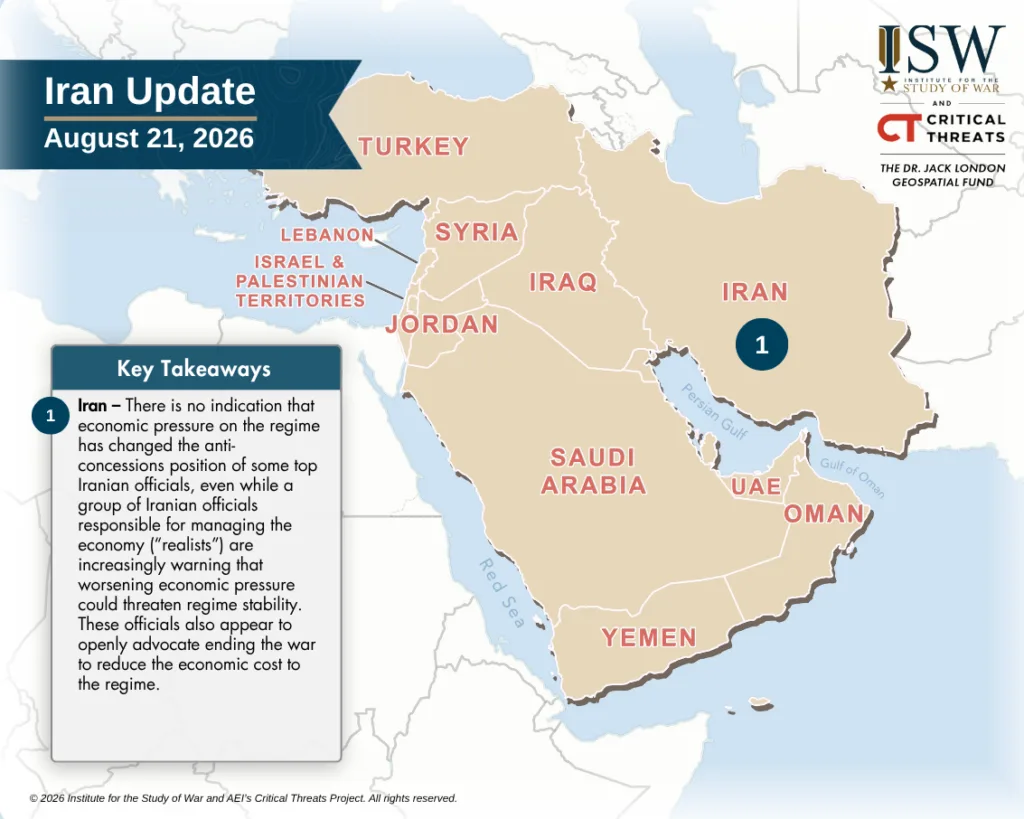
- There is no indication that economic pressure on the regime has changed the anti-concessions position of some top Iranian officials, even while a group of Iranian officials responsible for managing the economy (“realists”) are increasingly warning that worsening economic pressure could threaten regime stability. These officials also appear to openly advocate ending the war to reduce the economic cost to the regime.
- The failure of the US-Iran memorandum of understanding (MoU) appears to have further weakened the pro-concession, “realist” camp relative to Vahidi and other anti-concession officials.
- Regime decision-making may therefore take a long time to react, even as the economy gets much worse. Vahidi and other anti-concession officials appear to have a higher tolerance for domestic unrest because they may calculate that the regime can contain and suppress renewed protests without changing course.
- The People’s Republic of China (PRC) is resisting US efforts to economically isolate Iran, but Chinese economic engagement cannot offset the blockade if Iran cannot physically supply its largest oil customer.
Toplines
There is no indication that economic pressure on the regime has changed the anti-concessions position of some top Iranian officials, even while a group of Iranian officials responsible for managing the economy (“realists”) are increasingly warning that worsening economic pressure could threaten regime stability. These officials also appear to openly advocate ending the war to reduce the economic cost to the regime.[1] There appear to be two loose groups of Iranian leaders that have influence at this time. One, the pro-concessions or “realist” camp, is responsible for managing the economy and ostensibly answers to a voting constituency of everyday Iranians. These include Iranian President Masoud Pezeshkian and Parliament Speaker Mohammad Bagher Ghalibaf, among others. A second group, which includes Islamic Revolutionary Guards Corps (IRGC) Commander Major General Ahmad Vahidi, does not favor any concessions in negotiations and seeks full US surrender. This group is relatively stronger and more ideological.
Recent statements by “realist” officials show their view of the situation, which revolves around major concerns over economic hardship. Pezeshkian said on August 21 that the war must end at some point and argued that “it would be better to end it now,” while still adding that Iranians must be prepared to endure the ongoing economic hardship.[2] Ghalibaf similarly warned on August 21 that Iran cannot endure, regardless of its military strength, if its population is hungry and the country lacks financial circulation, economic growth, and domestic production.[3] Central Bank Governor Abdol Nasser Hemmati, another adherent to realist thinking, acknowledged on August 19 that Iranian oil exports had nearly ceased and that Iran faces foreign-exchange shortages, reconstruction costs, and increased youth unemployment.[4] Pezeshkian and Ghalibaf have generally favored negotiations, and their statements do not represent a major change in their positions.[5] Their focus on the war’s economic costs suggests that they seek to convince senior regime officials to end the war before worsening conditions threaten regime stability.
Pezeshkian, Ghalibaf, Hemmati, and other officials responsible for managing the economy appear more likely than Vahidi and other anti-concession officials to view economic deterioration as a reason to change policy. It is notable that these officials also must answer, at least ostensibly, to the electorate, whereas figures like Vahidi do not. Pezeshkian, Ghalibaf, and Hemmati’s ability to change Iran’s policy remains limited, however. ISW-CTP previously assessed that the faction around Vahidi continued to guide negotiation policy, while the more pro-concession group around Pezeshkian, Ghalibaf, and Foreign Affairs Minister Abbas Araghchi had less influence and primarily disagreed with Vahidi’s faction over how to achieve shared regime objectives.[6]
The failure of the US-Iran memorandum of understanding (MoU) appears to have further weakened the pro-concession, “realist” camp relative to Vahidi and other anti-concession officials. Pezeshkian had one notable success when he convinced Supreme Leader Mojtaba Khamenei to approve the MoU in June, in part by emphasizing the economic consequences of the blockade.[7] Iranian officials appear to believe that the MoU collapsed due to US subversion, not because of IRGC interference, and have repeatedly accused the United States of violating agreements and acting in bad faith.[8] This failure weakened the pro-concession argument that compromise with the United States would produce economic relief and strengthened the argument that the United States cannot be trusted, which the anti-concession camp can use to justify continued coercion rather than another agreement.[9] IRGC-affiliated Fars News reinforced this argument on August 21, criticizing Pezeshkian’s call to end the war and arguing that conciliatory positions signal weakness, encourage further attacks, and repeat the same mistake Iran allegedly made by showing flexibility before the two most recent wars.[10] The result of this dynamic is that the hardline, anti-concessions camp can use the perceived US “dishonesty“ to argue that the “realist,“ pro-concessions camp is being unrealistic in engaging with the United States. This enables the ascendant hardliners to continue to use force to enforce their preferred arrangement in the strait and to maintain maximalist demands rather than make concessions.[11]
Vahidi’s faction therefore remains in a stronger position to argue that continued pressure on the United States, rather than Iranian concessions, can secure the regime’s objectives. ISW-CTP assessed on August 17 that Vahidi’s group would likely accept an agreement that meets Iran’s demands (and complete US surrender) but would risk continued conflict rather than accept one that falls short of Iran’s maximalist demands.[12] The “realist,” pro-concession group favors an arrangement similar to the original MoU to end the war and secure economic relief, while Vahidi and his allies seek broader aims, including continued Iranian control of the strait. The anti-concession faction also demanded that the United States lift the naval blockade and sanctions, withdraw US military forces from around Iran, pay war reparations, release frozen Iranian assets, and cease attacks on Iran’s regional proxies.[13]
Regime decision making may therefore take a long time to react to economic deterioration, even as the economy gets much worse. Vahidi and other anti-concession officials appear to have a higher tolerance for domestic unrest because they may calculate that the regime can contain and suppress renewed protests without changing course. ISW-CTP continues to assess that Vahidi’s faction may tolerate substantial economic costs and potential unrest if doing so enables Iran to achieve its core objectives and may instead respond to instability by securitizing society and seeking alternative economic channels.[14] This greater tolerance for economic pain and unrest helps explain the anti-concession camp’s preference for sustained pressure over compromise. Second Deputy Parliament Speaker Hamidreza Haji argued on August 20 that rising oil prices means “we are [the regime] winning,” adding that negotiations should not simply seek to end the war, and called on Gulf states to pressure the United States to accept Iran’s conditions.[15] Ultra-hardliner Paydari (Stability) Front-affiliated Parliamentarian Mahmoud Nabavian similarly stated on August 21 that calls for peace under current conditions amount to “surrender.”[16] The Paydari Front is fully anti-negotiations, not just concessions. The pro-concessions faction appears to view worsening economic conditions as a reason to compromise before deteriorating economic conditions threaten regime stability, while the hardline anti-concessions and anti-negotiations factions appear willing to tolerate greater economic and domestic instability. Economic pressure could therefore become severe enough to threaten regime stability before the officials who currently dominate decision making conclude that Iran must make meaningful concessions.
The People’s Republic of China (PRC) is resisting US efforts to economically isolate Iran, but Chinese economic engagement cannot offset the blockade if Iran cannot physically supply its largest oil customer. The PRC rejected sanctions and pressure on August 20 as a solution and reiterated its opposition to unilateral sanctions after the United States called on Beijing to cooperate with its economic pressure campaign.[17] The PRC bought more than 80 percent of Iran’s exported oil before the recent war. Chinese refiners still appear willing to purchase Iranian crude, but Reuters reported on August 21 that the amount of Iranian oil available for September and October delivery has fallen sharply as cargoes already outside the blockade are sold and Iran struggles to replace them.[18] Some Chinese refiners are consequently turning to Brazilian and Iraqi crude.[19] Iranian decision makers will likely monitor whether the PRC and other trading partners resist US pressure, but foreign demand will provide diminishing relief if the blockade continues to restrict Iranian exports.
US and Partner Military Operations
Nothing significant to report.
Iranian Strike Campaign
Assessed Iranian War Aims:
- Secure international recognition of Iranian control over the Strait of Hormuz
- Degrade the US ability and willingness to continue the war
- Restore deterrence vis-à -vis the United States and its regional partners
- Divide the United States and Israel from the Arab states
Nothing significant to report.
US-Iran Negotiations
See topline section.
Iranian Domestic Affairs
See topline section.
Lebanon
The US Treasury re-designated Hezbollah as an IRGC Quds Force-affiliated group on August 20.[20] The US Treasury also sanctioned ten Hezbollah-affiliated individuals involved in an international money-laundering operation for the group to avoid US sanctions and obtain foreign currency on August 20.[21] A US official told Reuters on August 20 that the redesignation is intended to demonstrate that Hezbollah is operating on Iran and the IRGC Quds Force’s ”behalf.”[22] US Senior Advisor for Arab and African Affairs Massad Boulos stated that the redesignation also demonstrated US resolve to counter “terror financing networks“.[23] The US Treasury re-designation comes amid repeated reports in recent months that the IRGC has reorganized Hezbollah since 2024 to incorporate a decentralized command and control structure and fill command positions within the group’s units.[24] The Israel Defense Forces has killed multiple IRGC Quds Force officers advising Hezbollah in various roles throughout the current Israeli campaign in Lebanon since March 2.[25]
The Lebanese government is continuing to balance the need to disarm Hezbollah with the latent threat that Hezbollah poses. Lebanese Deputy Prime Minister Tarek Mirti told Emirati media on August 21 that the Lebanese government will not “back down” from implementing the Trilateral Framework Agreement, which includes disarming Hezbollah.[26] Mirti stated that the Lebanese government does not want to undertake any decisions that would require using force against Hezbollah, which could “endanger national unity.”[27] Senior Lebanese officials, including Lebanese President Joseph Aoun and Prime Minister Nawaf Salam, have repeatedly emphasized the need to maintain Lebanese stability and avoid violence with Hezbollah.[28] Aoun told Lebanese media about the necessity of ”cooperating with Hezbollah” to disarm the group on July 10, for example.[29] Aoun and Mitri’s caution is understandable, given the risks to Lebanese stability implicit in any violent flare-ups between the government and Hezbollah. Any disarmament efforts that rely on cooperating with Hezbollah will almost certainly fail, however, because Hezbollah will not disarm of its own volition.[30]
Iraq
Iranian-backed Iraqi militia Asaib Ahl al Haq is likely attempting to superficially comply with the Iraqi federal government’s disarmament initiative by handing over unarmed drones and other unspecified weapons. A source familiar with Iraqi militias claimed on August 21 that Asaib Ahl al Haq handed fewer than 10 unarmed drones and other unspecified weapons to the Iraqi disarmament committee on August 19.[31] The source stated that Asaib Ahl al Haq had stored these weapons in one of its headquarters in Yusufiyah District, Baghdad Province.[32] The report is consistent with Shia Coordination Framework officials’ July 9 claim that militias handed over “scrap” missiles and inoperable drones while retaining functional heavy weapons.[33] The unarmed drones and unspecified weapons that Asaib Ahl al Haq reportedly handed over to the committee almost certainly constitute a fraction of the militia’s total arsenal, however. The source added that Asaib Ahl al Haq did not hand over any missiles, even though the disarmament committee reportedly requires the militias to hand over short-range missiles.[34] Asaib Ahl al Haq controls several headquarters and bases across Iraq, at which the militia stores weapons including drones and missiles.[35] ISW-CTP has previously assessed that Asaib Ahl al Haq possibly announced its willingness to disarm in order to gain access to the 35,000 jobs in Iraq’s security establishment that Iraqi Prime Minister Ali al Zaydi has reportedly set aside for militia members willing to disarm.[36]
Arabian Peninsula
Nothing significant to report.

[1] https://understandingwar.org/research/middle-east/iran-update-special-report-april-18-2026/
[2] https://www.mehrnews dot com/news/6922951
[3] https://www.mehrnews dot com/news/6922785
[4] https://www.irna dot ir/news/86240378/
[5] https://www.criticalthreats.org/analysis/iran-update-special-report-july-11-2026
[6] https://understandingwar.org/research/middle-east/iran-update-special-report-july-28-2026/
[7] https://www.nytimes.com/2026/07/04/world/middleeast/iran-supreme-leader-funeral-divisions.html
[8] https://www.reuters.com/world/middle-east/iran-insists-right-control-shipping-strait-hormuz-after-ship-hit-near-oman-2026-06-26/ ;
https://www.leader dot ir/fa/content/28777 ;
https://en.mfa dot ir/portal/newsview/790842
[9] https://x.com/yarbatman/status/2082397962949312880?s=20
[10] https://farsnews dot ir/politics/1787340534690444247
[11] https://t.me/Tasnimnews/432816
https://x.com/shoaam_ir/status/2086084909488062483?s=20
[12] https://understandingwar.org/research/middle-east/iran-update-special-report-august-17-2026/
[13] https://x.com/shoaam_ir/status/2086084909488062483?s=20 ;
https://tasnimnews dot ir/fa/news/1405/05/20/3669144
[14] https://understandingwar.org/research/middle-east/iran-update-special-report-august-17-2026/
[15] https://farsnews dot ir/MaryamKarami/1787224100472755000
[16] https://x.com/nabaviantwt/status/2090720544723279977?s=20
[17] https://www.reuters.com/business/energy/iranian-oil-offers-chinese-buyers-fall-us-blockade-bites-sources-say-2026-08-21 ;
https://www.reuters.com/world/middle-east/us-treasury-secretary-bessent-hold-press-conference-iran-on-monday-2026-08-20/
[18] https://www.reuters.com/business/energy/iranian-oil-offers-chinese-buyers-fall-us-blockade-bites-sources-say-2026-08-21/ ;
https://www.reuters.com/world/middle-east/us-treasury-secretary-bessent-hold-press-conference-iran-on-monday-2026-08-20/
[19] https://www.reuters.com/business/energy/iranian-oil-offers-chinese-buyers-fall-us-blockade-bites-sources-say-2026-08-21/
[20] https://home.treasury.gov/news/press-releases/sb0611 ; https://sanctionssearch.ofac.treas.gov/Details.aspx?id=4697
[21] https://home.treasury.gov/news/press-releases/sb0611
[22] https://www.reuters.com/world/middle-east/us-targets-hezbollah-with-fresh-sanctions-emphasizes-ties-iranian-government-2026-08-20/
[23] https://x.com/US_SrAdvisorAF/status/2090538742129770732
[24] https://www.reuters.com/world/middle-east/how-irans-irgc-rebooted-lebanons-hezbollah-be-ready-war-2026-03-21/ ; https://www.mako dot co.il/pzm-magazine/Article-d68bcf56b36be91026.htm
[25] https://x.com/idfonline/status/2032047103006892283 ; https://x.com/AvichayAdraee/status/2032818929807016408
[26] https://www.skynewsarabia dot com/middle-east/1887338-متري-دول-مستعدة-لمساعدة-الجيش-اللبناني-المناطق-التجريبية
[27] https://www.skynewsarabia dot com/middle-east/1887338-متري-دول-مستعدة-لمساعدة-الجيش-اللبناني-المناطق-التجريبية
[28] https://x.com/ALJADEEDNEWS/status/2073663608269980151?s=20 ; https://x.com/LBpresidency/status/2071592126240952637?s=20 ; https://x.com/LBpresidency/status/2072203643822932280?s=20 ; https://www.almanar dot com.lb/article/990757/ ; https://www.naharnet dot com/stories/en/321198-what-will-aoun-tell-trump-about-hezbollah-s-weapons ; https://x.com/TheNationalNews/status/2074791339267666221
[29] https://www.naharnet dot com/stories/en/321198-what-will-aoun-tell-trump-about-hezbollah-s-weapons
[30] https://understandingwar.org/research/middle-east/iran-update-august-26-2025/ ; https://understandingwar.org/research/middle-east/iran-update-special-report-july-10-2026/
[31] https://shafaq dot com/ar/سیاسة/مسي-رات-محلية-و-يرانية-تفاصيل-تسليم-سلاح-عصا-ب-هل-الحق-للدولة-حصري
[32] https://shafaq dot com/ar/سیاسة/مسي-رات-محلية-و-يرانية-تفاصيل-تسليم-سلاح-عصا-ب-هل-الحق-للدولة-حصري
[33] https://understandingwar.org/research/middle-east/iran-update-special-report-july-10-2026/ ; https://almadapaper dot net/442723/
[34] https://shafaq dot com/ar/سیاسة/مسي-رات-محلية-و-يرانية-تفاصيل-تسليم-سلاح-عصا-ب-هل-الحق-للدولة-حصري
[35] https://ctc.westpoint.edu/irans-expanding-militia-army-iraq-new-special-groups/ ; https://www.washingtoninstitute.org/sites/default/files/pdf/PolicyFocus163-KnightsMalikTamimi-v3%281%29.pdf ; https://x.com/obretix/status/2032573490021224552 ; https://964media dot com/660887/
[36] https://understandingwar.org/research/middle-east/iran-update-special-report-july-10-2026/ ; https://shafaq dot com/ar/سیاسة/خاص-الزيدي-يقترح-مقايضة-سلاح-الفصا-ل-بمشاريع-ميركية ;https://shafaq dot com/ar/سیاسة/خاص-الزيدي-يقر-خطة-دمج-الفصا-ل-35-لف-فرصة-عمل-مقابل-تسليم-السلاح ; https://shafaq dot com/ar/%D8%B3%DB%8C%D8%A7%D8%B3%D8%A9/%D8%A8%D8%B9%D8%AF-%D8%A7%D9%84%D8%B9%D8%B5%D8%A7-%D8%A8-%D9%83%D8%AA%D8%A7-%D8%A8-%D8%A7%D9%84-%D9%85%D8%A7%D9%85-%D8%B9%D9%84%D9%8A-%D8%AA%D9%82%D8%B1%D8%B1-%D9%81%D9%83-%D8%A7%D9%84%D8%A7%D8%B1%D8%AA%D8%A8%D8%A7%D8%B7-%D8%A8%D8%AA%D8%B4%D9%83%D9%8A%D9%84%D8%A7%D8%AA-%D8%A7%D9%84%D8%AD%D8%B4%D8%AF-%D8%A7%D9%84%D8%B4%D8%B9%D8%A8%D9%8A ; https://shafaq dot com/ar/%D8%B3%DB%8C%D8%A7%D8%B3%D8%A9/%D8%B9%D8%B5%D8%A7-%D8%A8-%D9%87%D9%84-%D8%A7%D9%84%D8%AD%D9%82-%D8%AA%D8%A8%D8%A7%D8%B4%D8%B1-%D9%81%D9%83-%D8%A7%D8%B1%D8%AA%D8%A8%D8%A7%D8%B7%D9%87%D8%A7-%D8%A8%D8%A7%D9%84%D8%AD%D8%B4%D8%AF-%D8%A7%D9%84%D8%B4%D8%B9%D8%A8%D9%8A-%D9%88%D8%AA-%D8%B4%D9%83%D9%84-%D9%84%D8%AC%D9%86%D8%A9-%D9%84%D8%AD%D8%B5%D8%B1-%D8%A7%D9%84%D8%B3%D9%84%D8%A7%D8%AD ; https://understandingwar.org/research/middle-east/iran-update-special-report-june-2-2026/