
The Institute for the Study of War (ISW) and The Critical Threats Project (CTP) at the American Enterprise Institute are publishing updates Monday through Friday to provide analysis on the war with Iran. Most updates cover events from the past 24-hour period, whereas Monday updates also include events from the preceding weekend, collected after ISW-CTP’s 2:00 PM ET Friday data cutoff. ISW-CTP may publish special updates on Saturdays and Sundays if events warrant, however.
Key Takeaways
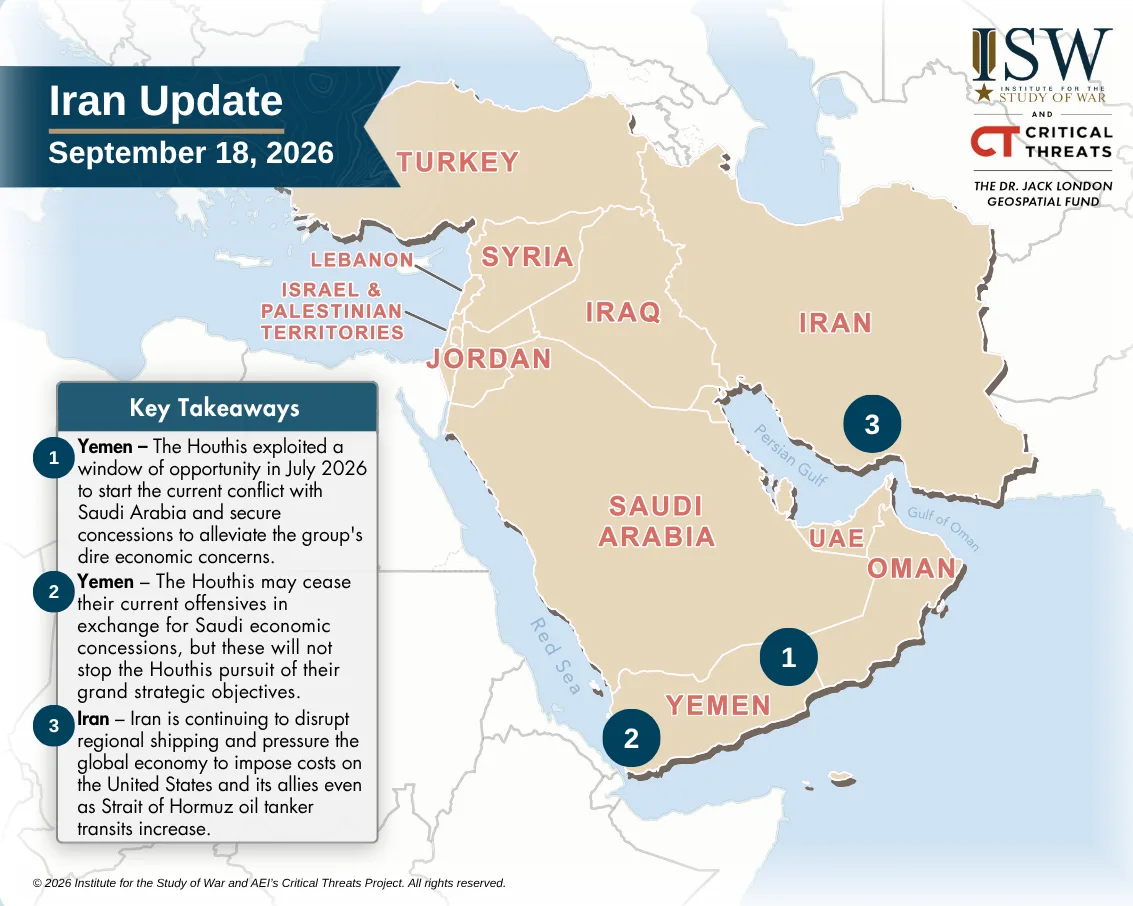
- The Houthis exploited a window of opportunity in July 2026 to resume their war with Saudi Arabia and secure concessions from Saudi Arabia that would alleviate the group’s dire economic situation. The Houthis, with Iranian backing and encouragement, sought to impose economic pressure on Saudi Arabia to accomplish their objectives because the group sees economic pressure as a useful lever that has previously forced Saudi capitulation to Houthi demands.
- The Houthis may decide to cease their present offensives in exchange for Saudi economic concessions. Addressing these concerns will not, however, satiate or moderate the Houthis. The Houthis view solidifying control over northern Yemen as a prerequisite to controlling at least all of Yemen.
- Pakistan may seek to exert leverage over Iran to restrain Houthi offensive activity against Saudi Arabia. The Houthis are an independent partner of Iran and may resist potential Iranian pressure to halt their campaigns, however.
- The Houthis likely seek to capture Marib Governorate in order to extract and export oil through the Red Sea, which could fund Houthi political and military activities, assuming export is possible.
- Iran has continued its efforts to disrupt regional shipping and pressure the global economy to impose costs on the United States and its allies, even as transits through the strait have increased relatively and oil prices remain low relative to Iranian hopes.
Toplines
The Houthis exploited a window of opportunity in July 2026 to resume their war with Saudi Arabia and secure concessions from Saudi Arabia that would alleviate the group’s dire economic situation. The Houthis resumed the war when they imposed a “blockade” on Saudi Arabia on July 20 after Saudi attempts to prevent Iranian Islamic Revolutionary Guards Corps (IRGC) advisors from landing in Sanaa, Yemen’s Houthi-controlled capital.[1] One Houthi strategic objective is to solidify and stabilize their rule over Houthi-controlled territory in northern and western Yemen, even while the Houthis seek to control all of Yemen at the grand strategic level. The Houthis have faced dire economic conditions in recent years as a result of their own actions — such as harassment of humanitarian organizations, which has resulted in a contraction of the humanitarian sector in northern Yemen — and external pressures.[2] The Houthis have sought to secure economic concessions from Saudi Arabia as part of an effort to solidify and stabilize their control in northern Yemen by addressing economic conditions.[3] Saudi Arabia has restricted vessels and aircraft from accessing Houthi-controlled ports and airports since 2015, which complicates Houthi attempts to obtain funding, military materiel, fuel, and daily goods.[4] The Houthis’ most frequently expressed objectives in the current conflict are accordingly primarily economic in focus, such as forcing Saudi Arabia to pay war reparations, financing Houthi officials’ salaries, and lifting controls on Houthi-held ports and airports.[5]
Addressing these concerns will not, however, satiate or moderate the Houthis. The Houthis view solidifying control over northern Yemen as a prerequisite to controlling at least all of Yemen (see below).
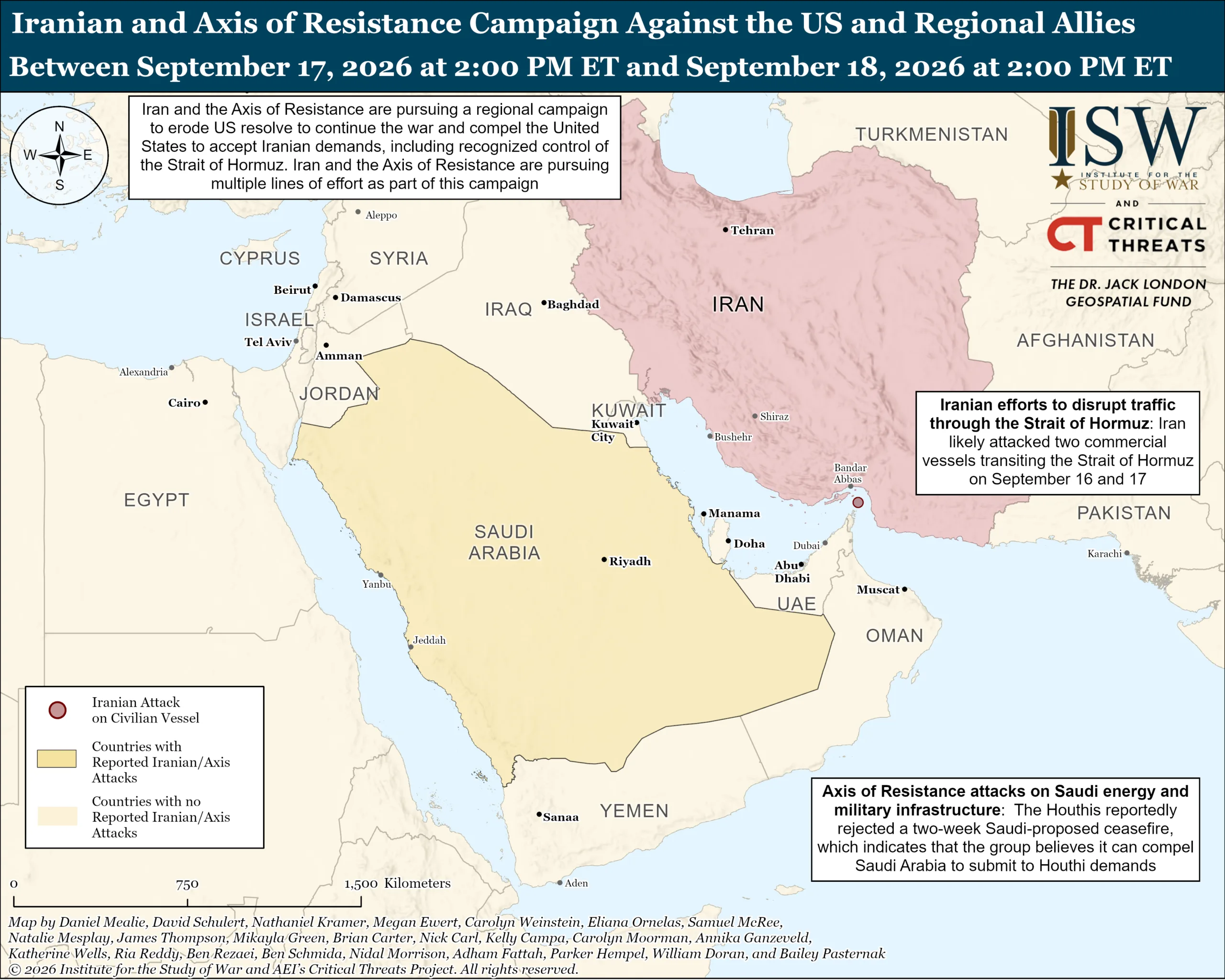
The Houthis, with Iranian backing and encouragement, sought to impose economic pressure on Saudi Arabia to accomplish their objectives because the group sees economic pressure as a useful lever that has previously forced Saudi capitulation to Houthi demands. The Houthis have long attacked Saudi infrastructure, and these attacks were ultimately one of the factors that compelled Saudi Arabia to reach a truce with the group in 2022.[6] The recent Houthi “blockade” on Saudi Arabia, which consisted of Houthi attacks on Saudi vessels in the Red Sea, largely failed to compel Saudi Arabia to surrender to Houthi demands, however.[7] This failure likely incentivized the Houthis to pursue alternative means of imposing costs on Saudi Arabia, most importantly by concentrating missile and drone strikes on Saudi oil infrastructure and conducting more significant military action within Yemen.[8]
The Houthis’ outspoken pursuit of objectives related to economic relief and Saudi activity in Yemen has not diminished the group’s focus on its grand strategic objective, which is to seize control over at least all of Yemen.[9] The Houthis institutionally subscribe to an ideology based on the Jaroudi school of Zaydi Shia Islam, which the group believes grants them a divine right to rule over not just Yemen, but also territories controlled by Saudi Arabia and beyond.[10] Recent and ongoing Houthi offensive campaigns against the internationally recognized Yemeni government on the Red Sea coastal plain, in eastern Yemen’s Marib Governorate, and surrounding the major city of Taiz support both the group’s nearer-term economic objectives and long-term control over all of Yemen.[11] The Houthis’ short-term economic objectives also set conditions for total Houthi control over Yemen, because some degree of economic stability is necessary for the Houthis to maintain control over Yemeni territory. The Houthis’ additional demand for Saudi Arabia to end its military activity in Yemen further supports this grand strategic objective because the Yemeni government is unlikely to survive without Saudi military support.
The Houthis may decide to cease their present offensives in exchange for Saudi economic concessions, but concessions will not stop the Houthis’ pursuit of their grand strategic objectives. Unspecified sources told Lebanese Hezbollah-aligned media on September 18 that Saudi Arabia offered the Houthis a two-week truce through Omani mediators, which the Houthis rejected.[12] The reported truce would have at least temporarily satisfied some Houthi demands, as it stipulated that Saudi would lift its controls on Houthi ports and airports for humanitarian purposes.[13] Humanitarian purposes could be insufficient for the Houthis, given their recent military successes. Saudi Arabia also reportedly sought to work toward a “comprehensive agreement” with the Houthis following the truce.[14] The truce could afford Saudi Arabia and Yemeni government-aligned forces both time and options to reconstitute ground forces and reorganize their campaigns against the Houthis, however.
The reported Houthi decision to reject the truce suggests that the group is either confident in its ability to extract additional concessions from Saudi Arabia or that it views its current tactical and operational situation to be difficult to defend, should major combat operations resume after a short-term ceasefire.[15] Saudi requests for a truce, if accurate, signal to the Houthis that their campaigns in Saudi Arabia and Yemen are eroding Saudi Arabia’s will to fight and that their modes of warfare can compel Saudi Arabia to submit to Houthi demands. The Houthis have also presumably observed the lack of international support for Saudi Arabia against the group, which will influence Houthi risk calculus. The reported Saudi request for a two-week truce with the Houthis comes amid a lack of international support for the Saudi offensive campaign in Yemen, even though the United States has continued to provide intelligence and targeting support to Saudi Arabia.[16] It is unclear how long the Houthis are willing and able to sustain their offensive campaigns against Saudi Arabia and Yemeni government-aligned forces, however. A prolonged, high-intensity conflict with Saudi Arabia and the Yemeni government across numerous fronts in Yemen would inflict significant costs on the Houthis, especially if the group fails to secure economic concessions.
Pakistan may seek to exert leverage over Iran to restrain Houthi offensive activity against Saudi Arabia. The Houthis are an independent partner of Iran and may resist potential Iranian pressure to halt their campaigns, however. The Financial Times reported on September 18 that Pakistani Army Chief Asim Munir has been in frequent contact with Iranian officials, including Foreign Minister Abbas Araghchi, in recent days to ask Iran to force the Houthis to stop their attacks on Saudi territory and oil infrastructure.[17] Pakistan is party to a mutual defense treaty with Turkey and Saudi Arabia, often called the “Mecca Pact,” which was ratified on August 7.[18] Munir reportedly referenced Pakistan’s “commitments” to Saudi Arabia — almost certainly referring to Pakistan’s Mecca Pact mutual defense obligations — in recent calls with Iranian officials.[19] Such insinuations in this context are implicitly threatening. Pakistani Defense Minister Khawaja Asif previously announced on September 17 that the “time has come” to implement the Mecca Pact in defense of Saudi Arabia.[20] Pakistani pressure on Iran does not guarantee that the Houthis end their offensive campaign against Saudi Arabia, however. The Houthis have repeatedly demonstrated since February 2026 that the group is primarily concerned with advancing its own objectives.[21] The Houthis are not an Iranian proxy, although their objectives often overlap with Iran’s strategic interests.[22] The Houthis did not support Iran following the start of the current conflict by threatening shipping in the Red Sea, even though Iran reportedly encouraged the group to do so, for example.[23]
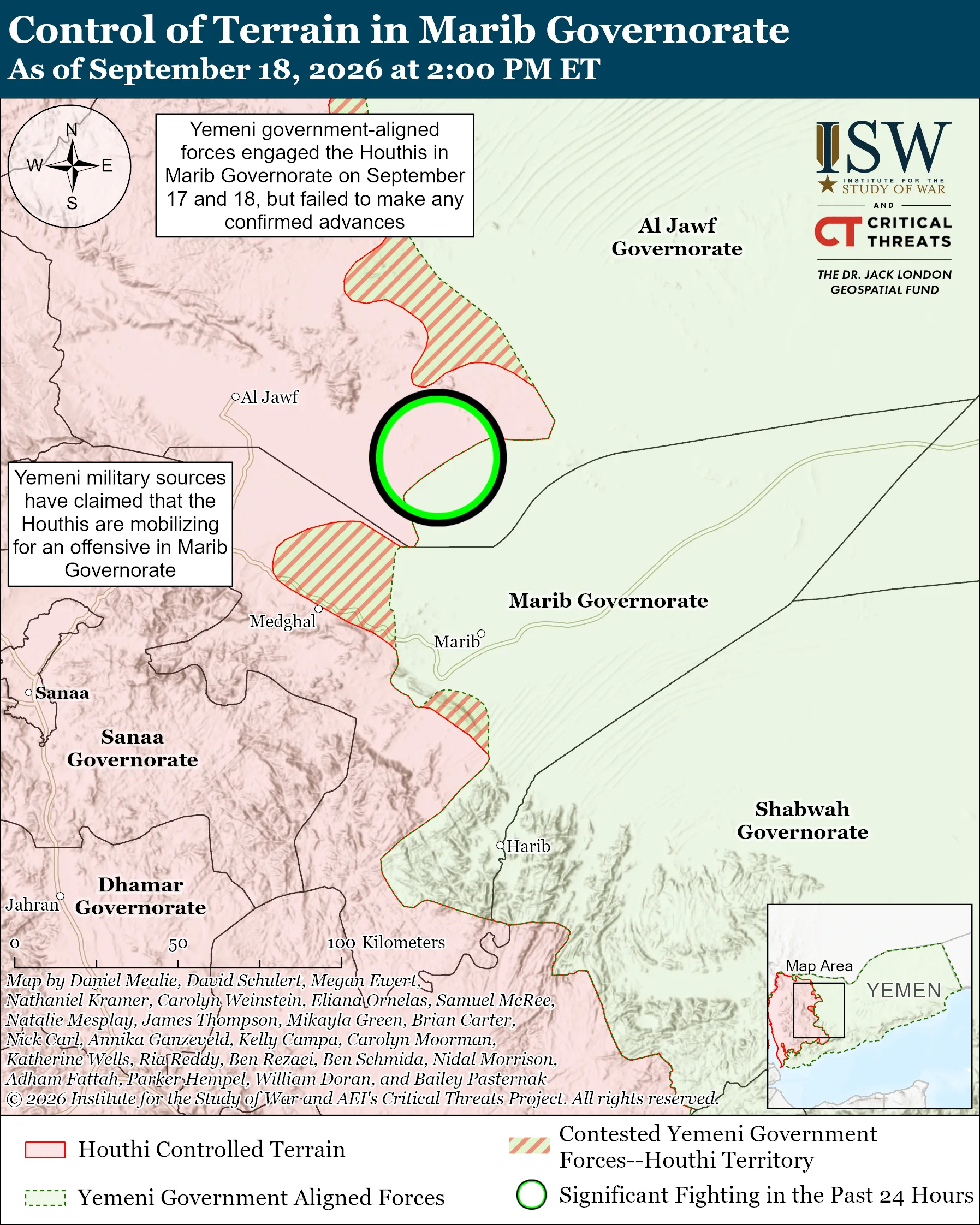
The Houthis likely seek to capture Marib Governorate in order to extract and export oil through the Red Sea, which could fund Houthi political and military activities, assuming export is possible. Houthi and Yemeni government-aligned forces have engaged each other in northern, western, and southern Marib Governorate in recent days amid broader Houthi offensives across Yemen.[24] ISW-CTP does not assess that the Houthis have made considerable advances against Yemeni government-aligned forces in Marib Governorate. Western and regional media reported on September 17 and 18 that the Houthis are preparing reinforcements for offensives to capture the entire province.[25] Yemeni government-aligned forces defending against the Houthis in Marib Governorate benefit from more effective military leadership and more defensible terrain than forces facing the Houthis’ Red Sea coastal plain offensive.[26] Marib Governorate possesses significant oil reserves, which the Houthis could extract to export from Hudaydah and other ports on the Houthi-controlled coastal plain.[27] Oil revenues, whether obtained through clandestine smuggling or formal contracts with foreign governments, would inject much-desired funding into Houthi-controlled territory and fund both Houthi governance and military activity.[28]
Iran has continued its efforts to disrupt regional shipping and pressure the global economy to impose costs on the United States and its allies even as transits through the strait have increased relatively and oil prices remain low relative to Iranian hopes. The price of oil remains high relative to pre-war prices, but the oil price changes have not affected US decision making in the current phase of the war as Iran hoped the prices would. Iran almost certainly launched two unspecified projectiles at two separate tankers in the Strait of Hormuz on September 16 and 17.[29] Independent sources did not attribute blame, but the IRGC Navy confirmed on September 17 that they struck one of the tankers as it “illegally” passed through the strait.[30] The United Kingdom Maritime Trade Operations (UKMTO) also reported a separate “security incident” on September 17, but did not provide additional clarification.[31] Iran has consistently claimed that vessel passages along the southern Omani route with US naval assistance are “illegal,” because the vessels do not follow Iranian-designated routes.[32] There is no legal basis for this claim, however.
Iran continues to attack transiting vessels using the southern route to give the appearance that Iran retains some control over the strait and the ability to disrupt shipping. It likely assesses these actions can still impact energy markets. Daily vessel transits through the southern route have nonetheless subsequently returned to 40 percent of their pre-war levels, with both daytime and nighttime vessel transits, with the help of successful US surveillance and demining operations, according to US officials speaking to Axios on September 15.[33] Saudi Arabia has also reportedly started diverting oil exports back through the strait. Saudi Arabia loaded around 60 million barrels at its eastern Port of Ras Tanura for September and October loadings with ship-to-ship transfers that transited through the strait, according to trade sources cited by Reuters on September 18.[34] Saudi Arabia’s diversion is mostly in response to Houthi threats to Saudi exports and shipping in the Red Sea, but it indicates that Saudi Arabia assesses that exporting through the Strait of Hormuz is currently comparatively safer than shipping through the Bab al Mandeb Strait or Red Sea. Saudi Arabia’s expansion of oil shipments through the Strait of Hormuz indicates that Iran is currently losing its ability to threaten shipping through the strait. Iran has failed to achieve its objective of maintaining oil prices over $200 US dollars, which Iran threatened at the start of its campaign against shipping in the strait in March to impose costs on the United States for its airstrike campaign on Iran, as oil prices have also not risen over $100 US dollars per barrel since May.[35]
Iran appears to be facing several operational constraints that are limiting its ability to control shipping through the strait, including constraints on its mine-laying capabilities and targeting cycles, following US airstrikes, however.[36] The deterioration of Iranian control over the strait, and its inability to affect the situation, indicates that Iran continues to face operational constraints despite its ability to fire a limited number of missiles, as ISW-CTP has previously assessed.[37] Individual attacks do not imply that Iran is facing no constraints; they only demonstrate that Iran can fire missiles despite the constraints.[38] These constraints are likely in part due to US airstrikes and in part due to US defensive actions taken to protect vessels transiting the strait. Iran would presumably attack the vessels transiting the strait if it could detect and shoot at them reliably. That Iran is failing to do so suggests it is constrained in some way.
US and Partner Military Operations
Nothing significant to report.
Iranian Strike Campaign
Assessed Iranian War Aims:
- Secure international recognition of Iranian control over the Strait of Hormuz
- Degrade the US ability and willingness to continue the war
- Restore deterrence vis-à -vis the United States and its regional partners
- Divide the United States and Israel from the Arab states
See topline section.
US-Iran Negotiations
Nothing significant to report.
Iranian Domestic Affairs
The Iranian regime appears to be expanding the scale of Basij mobilizations beyond the size of established Basij formations to build a broader population-based security and defense reserve that it can mobilize during unrest. The regime conducted a 313,000-person “Janfada” [self-sacrifice] exercise in Tehran Province on September 18, involving IRGC and Basij units and battalions.[39] The regime likely chose 313,000 for its religious symbolism, as 313 holds significance in Shia Islam as the number of followers expected to accompany Imam Mahdi upon his return.[40] The Basij is the IRGC’s nationwide paramilitary force and social network, which the regime has historically used for social control and to suppress domestic protests.[41] Basij Organization Commander Hossein Taeb said during the exercise that the regime is organizing hundreds of thousands of participants into defense units and training them for ground, air, and naval defense.[42] Taeb added that the regime plans to expand the reserve model nationwide to one million people and called the effort the “popularization of defense and security.”[43] Taeb’s description suggests that the regime is trying to convert a wider segment of the Iranian population that is currently not part of the formal regime security services or Basij into an organized reserve. This effort follows Supreme Leader Mojtaba Khamenei’s August 10 appointment of Taeb as Basij commander, when Mojtaba directed him to expand people-based security and intelligence networks, increase training, and strengthen neighborhood and social Basij structures.[44]
The regime likely has two related domestic objectives in expanding this kind of mass mobilization. The regime likely seeks to deter potential unrest by demonstrating that it can mobilize a large pro-regime presence on the streets and reinforce formal security forces during protests. The regime also likely seeks to strengthen cohesion among its own supporters by repeatedly organizing and training them and tying them more closely to the Basij and state security apparatus. The latter objective may become increasingly important as economic pressure affects the broader population, including Basij personnel and other regime-aligned constituencies. Iranian officials have recently warned that worsening livelihoods, unemployment, gasoline prices, and other economic pressures could trigger localized or nationwide unrest.[45]
The regime is also increasingly incorporating younger Iranians, including children, into this broader mobilization.[46] The regime has focused on re-ideologizing younger Iranians since former Supreme Leader Ali Khamenei launched the “Second Step of the Revolution” plan in 2019.[47] Recent public weapons training may push this effort beyond ideological indoctrination toward practical militarization. The regime has expanded military familiarization into more public settings by showing weapons training on state television and setting up public stations where pro-regime groups teach civilians how to handle rifles and other military equipment.[48]
The Supreme Leader’s Office recently appointed Ehsan Khandouzi, a pro-China and risk-averse economist who served as former President Ebrahim Raisi’s Economy Minister, to lead the Office’s strategic economic advisory committee.[49] The Office appointed Khandouzi to the Office’s Research Department Economic Committee on September 15.[50] This committee is responsible for providing the Supreme Leader with strategic assessments on the trajectory of Iran’s economy.[51] Khandouzi, in an X post in June 2025, also emphasized the need for Iran to cooperate with the People’s Republic of China (PRC) as Iran needs to secure funding for joint ventures, likely referring to the PRC-supported construction projects in Iran.[52] Khandouzi is also risk-averse when it comes to evaluating the economic and stability risks of different economic policies. Khandouzi cautioned in August 2026 against raising gas prices following December 2025-January 2026 protests and war with the United States, for example.[53] Khandouzi also warned about the Iranian Central Bank’s unregulated foreign currency production leading to high inflation in June 2023 during his tenure as Economy Minister.[54] Khandouzi’s appointment is notable considering the Central Bank’s decision to inject $500 million US dollars into Iran’s banking system. The Bank’s decision comes amid Iran facing a significant foreign currency shortage in part due to the US blockade’s prevention of Iranian oil exports — the regime’s highest source of revenue.[55] Iran’s inflation rate notably reached 84.4 percent in August.[56]
Lebanon
Nothing significant to report.
Iraq
Nothing significant to report.
Arabian Peninsula
Italian Defense Minister Guido Crosetto announced on September 17 that Italy is preparing to deploy warships to ensure safe passage for Italian commercial vessels through the Bab al Mandeb Strait.[57] Crosetto said that Italy will deploy a naval mission independently of the European Union to protect Italian vessels, according to Western and regional media on September 17.[58] Saudi media reported on September 18 that South Korea is considering expanding its naval presence in the Gulf of Aden to protect South Korean vessels and oil shipping routes.[59] The South Korean presence has been traditionally oriented against piracy.[60] These decisions suggest that some countries are attempting to safeguard their vessels amid the Houthis’ recent attempts to assert authority over the Bab al Mandeb, following the Houthi offensive on the Red Sea coastal plain between September 9 and 11.[61]

[1] https://www.reuters.com/world/middle-east/iran-flew-irgc-commanders-missile-gear-yemens-houthis-sources-say-2026-07-23/ ; https://saba dot ye/ar/news3746630.htm ; https://understandingwar.org/research/middle-east/iran-update-special-report-july-20-2026/
[2] https://www.aei.org/foreign-and-defense-policy/ending-us-support-to-the-saudi-led-coalition-will-not-end-the-war-in-yemen/ ; https://www.state.gov/reports/2022-country-reports-on-human-rights-practices/yemen/
[3] https://www.pbs.org/newshour/show/yemen-was-poor-before-but-the-war-just-finished-us
[4] https://alhurra dot com/en/19358 ; https://www.militarytimes.com/news/your-military/2015/03/30/saudi-led-forces-strike-yemen-rebels-blockade-ports/
[5] https://understandingwar.org/research/middle-east/iran-update-september-15-2026/ ; https://x.com/TvAlmasirah/status/2089422249862590886?s=20 ; https://sarabic dot ae/20260723/أنصار-الله-تحدد-شرطين-لإنهاء-التصعيد-مع-السعودية-1115450869.html ; https://t.me/army21ye/3691
[6] https://www.reuters.com/world/middle-east/yemens-houthis-say-they-attacked-saudi-cities-aramco-facilities-2021-11-20/ ; https://www.arabnews dot com/saudi-arabia/timeline-houthi-attacks-on-saudi-arabia-1510206
[7] https://understandingwar.org/research/middle-east/iran-update-special-report-july-20-2026/ ; https://t.me/army21ye/3588 ; https://t.me/army21ye/3656 ; https://understandingwar.org/research/middle-east/iran-update-september-8-2026/
[8] https://understandingwar.org/research/middle-east/iran-update-september-8-2026/ ; https://understandingwar.org/research/middle-east/iran-update-september-10-2026/
[9] https://www.reuters.com/world/middle-east/why-havent-houthis-irans-allies-yemen-stepped-into-war-2026-09-08/ ; https://www.merip.org/2018/01/how-the-houthis-became-shia/
[10] https://mei.edu/publication/ideological-underpinnings-houthis-red-sea-attacks/
[11] https://understandingwar.org/research/middle-east/iran-update-september-10-2026/ ; https://x.com/Alsakaniali/status/2100964869361009084 ; https://x.com/Yem_army_media/status/2100684389806178362?s=20
[12] https://www.al-akhbar dot com/NewspaperArticles/arab/904576/بعد-نصائح-أميركية-ومصرية-وتركية—-ابن-سلمان-يطلب-الحوار-مع
[13] https://www.al-akhbar dot com/NewspaperArticles/arab/904576/بعد-نصائح-أميركية-ومصرية-وتركية—-ابن-سلمان-يطلب-الحوار-مع
[14] https://www.al-akhbar dot com/NewspaperArticles/arab/904576/بعد-نصائح-أميركية-ومصرية-وتركية—-ابن-سلمان-يطلب-الحوار-مع
[15] https://www.al-akhbar dot com/NewspaperArticles/arab/904576/بعد-نصائح-أميركية-ومصرية-وتركية—-ابن-سلمان-يطلب-الحوار-مع
[16] https://www.axios.com/2026/09/16/us-houthi-oman-to-discuss-red-sea-crisis ; https://edition.cnn.com/2026/09/10/politics/us-military-support-saudi-arabia-houthi-iran-yemen ; https://apnews.com/article/yemen-saudi-houthis-shipping-oil-war-mecca-895320bde6dc589cebb628b63832c38a
[17] https://www.ft.com/content/dc6b63b3-2853-48eb-88cb-33b9c46d1a31?syn-25a6b1a6=1
[18] https://www.reuters.com/world/asia-pacific/saudi-arabia-turkey-pakistan-sign-joint-defence-deal-amid-regional-turmoil-2026-08-07/
[19] https://www.reuters.com/world/asia-pacific/saudi-arabia-turkey-pakistan-sign-joint-defence-deal-amid-regional-turmoil-2026-08-07/ ; https://www.ft.com/content/dc6b63b3-2853-48eb-88cb-33b9c46d1a31?syn-25a6b1a6=1
[20] https://islamabadpost dot com.pk/defence-minister-says-time-has-come-to-implement-makkah-pact-amid-houthi-attacks/
[21] https://understandingwar.org/research/middle-east/iran-update-september-17-2026/
[22] https://understandingwar.org/research/middle-east/iran-update-september-10-2026/
[23] https://www.wsj.com/world/middle-east/saudi-arabia-us-strait-of-hormuz-blockade-25fbd430 ; https://understandingwar.org/research/middle-east/iran-update-special-report-april-14-2026/
[24] https://x.com/Yem_army_media/status/2100684389806178362?s=20 ; https://x.com/Alsakaniali/status/2100997787907146061?s=20 ; https://x.com/Alsakaniali/status/2100971810321768805?s=20
[25] https://www.nytimes.com/2026/09/17/world/middleeast/yemen-houthis-marib.html ; https://www.skynewsarabia dot com/middle-east/1893019-المعركة-القادمة-مأرب-حشد-حوثي-ضخم-وتأهب-للقوات-الحكومية
[26] https://x.com/Alsakaniali/status/2100959323325141236?s=20 ; https://www.washingtonpost.com/world/interactive/2021/yemen-war-marib-houthis/
[27] https://www.washingtonpost.com/world/interactive/2021/yemen-war-marib-houthis/ ; https://understandingwar.org/research/middle-east/houthi-escalation-calculus-following-cautious-entry-into-the-iran-war/
[28] https://understandingwar.org/research/middle-east/houthi-escalation-calculus-following-cautious-entry-into-the-iran-war/
[29] https://x.com/UK_MTO/status/2100848859937161664?s=20; https://x.com/UK_MTO/status/2100855389034000842?s=20; https://www.google.com/finance/beta/quote/CLW00:NYMEX?sa=X&sqi=2&ved=2ahUKEwiGhb7Ft_iWAxUiEVkFHWDeMeAQ3ecFegQIJhAP
[30] https://t.me/farsna/462714
[31] https://x.com/UK_MTO/status/2100670708678271299?s=20
[32] https://x.com/PGSA_IRAN/status/2070252181647740953?s=20
[33] https://www.axios.com/2026/09/15/us-iran-boats-navy-drone-strait-hormuz; https://windward.ai/blog/iran-war-global-trade-and-energy-disruptions/
[34] https://www.reuters.com/business/energy/aramco-boost-exports-strait-hormuz-60-million-bbl-september-october-traders-say-2026-09-18/
[35] https://www.reuters.com/world/middle-east/combatants-mideast-war-trade-more-air-strikes-iran-clamps-down-dissent-2026-03-11/ ; https://www.google.com/finance/beta/quote/CLW00:NYMEX?sa=X&sqi=2&ved=2ahUKEwiGhb7Ft_iWAxUiEVkFHWDeMeAQ3ecFegQIJhAP
[36] https://www.nytimes.com/2026/08/31/us/politics/us-strikes-iran-new-naval-mine.html; https://understandingwar.org/research/middle-east/iran-update-august-31-2026/; https://understandingwar.org/research/middle-east/iran-update-september-14-2026/; https://www.isna dot ir/news/1405062315855/; https://t.me/defapress_ir/67557; https://x.com/CENTCOM/status/2099591186583371830; https://www.axios.com/2026/07/07/us-strikes-iran-hormuz-ship-attacks; https://www.criticalthreats.org/analysis/iran-update-september-4-2026; https://x.com/TreyYingst/status/2094854875154731098?s=20; https://understandingwar.org/research/middle-east/iran-update-august-31-2026/;
https://x.com/MartinKelly/status/2094129711483891783?s=20; https://understandingwar.org/research/middle-east/iran-update-september-9-2026/; https://www.reuters.com/world/middle-east/seafarer-oil-products-tanker-killed-incident-off-dubai-peninsula-says-2026-09-09/ ;
https://www.reuters.com/world/middle-east/iran-attacks-us-base-jordan-ships-near-hormuz-after-tankers-sunk-2026-09-09/
[37] https://understandingwar.org/research/middle-east/iran-update-september-1-2026/
[38] https://understandingwar.org/research/middle-east/iran-update-september-1-2026/
[39] https://www.tehrantimes dot com/news/530150/313-000-Janfada-for-Iran
[40] https://muslimhands.org.uk/islamic-resources/the-significance-of-the-number-313-in-islam
[41] https://www.aei.org/wp-content/uploads/2023/05/Pivot-to-Offense-How-Iran-Is-Adapting-for-Modern-Conflict-and-Warfare.pdf?x73875 P 5
[42] https://www.irna dot ir/news/86267065
[43] https://www.irna dot ir/news/86267065
[44] https://t.me/rahbar_ir/931
[45] https://x.com/IranIntl/status/2086980414325805426?s=20 ;
https://www.tasnimnews dot ir/fa/news/1405/06/02/3679041/ ;
https://www.tasnimnews dot ir/fa/news/1405/05/27/3674097/
[46] https://x.com/IranIntl/status/2100943041376755881?s=20 ;
https://www.iranintl.com/202609154968 ;
https://t.me/iribnews/361930 ;
https://t.me/iribnews/361895
[47] https://understandingwar.org/research/middle-east/the-days-of-the-iranian-regime-are-numbered/ ;
http://english.khamenei dot ir/news/6415/The-Second-Phase-of-the-Revolution-Statement-addressed-to-the
[48] https://www.iranintl.com/202609154968 ;
https://fararu dot com/fa/news/971652/ ;
https://www.bbc.com/persian/articles/c759vzyzy1eo ;
https://iranwire.com/en/news/157719-irgc-mobilizes-janfada-campaign-for-weapons-training-and-mass-military-drills/
[49] https://www.leader dot ir/fa/content/28861
[50] https://www.leader dot ir/fa/content/28861
[51] https://www.tabnak dot ir/fa/news/1394512
[52] https://x.com/Khandoozi_se/status/1934549509607997918?s=20
[53] https://x.com/Khandoozi_se/status/2090417107548725731?s=20
[54] https://www.tasnimnews dot ir/fa/news/1402/03/19/2908265/تحلیل-وزیر-اقتصاد-از-چرایی-علت-تورم-سیستم-بانکی-سال-ها-با-دست-و-دلبازی-خلق-پول-کرد; https://www.entekhab dot ir/fa/news/716815
[55] https://understandingwar.org/research/middle-east/iran-update-august-24-2026/; https://t.me/iribnews/358025; https://understandingwar.org/research/middle-east/iran-update-august-25-2026/
[56] https://iranwire.com/en/news/156819-irans-inflation-crisis-deepens-as-year-on-year-rate-hits-844-in-august/#google_vignette
[57] https://www.aljazeera dot com/economy/2026/9/18/italy-to-deploy-warships-to-protect-shipping-through-bab-al-mandeb ; https://www.reuters.com/world/italy-readies-navy-protect-its-shipping-amid-bab-el-mandeb-tensions-2026-09-17/
[58] https://www.aljazeera dot com/economy/2026/9/18/italy-to-deploy-warships-to-protect-shipping-through-bab-al-mandeb ; https://www.reuters.com/world/italy-readies-navy-protect-its-shipping-amid-bab-el-mandeb-tensions-2026-09-17/
[59] https://www.arabnews dot com/middle-east/south-korea-says-it-might-expand-middle-east-naval-unit-3002241
[60] https://www.arabnews dot com/middle-east/south-korea-says-it-might-expand-middle-east-naval-unit-3002241
[61] https://understandingwar.org/research/middle-east/iran-update-september-10-2026/ ; https://www.reuters.com/world/middle-east/yemens-houthis-reach-strategic-island-mouth-vital-shipping-lane-2026-09-11/