
The Institute for the Study of War (ISW) and The Critical Threats Project (CTP) at the American Enterprise Institute are publishing updates Monday through Friday to provide analysis on the war with Iran. Most updates cover events from the past 24-hour period, whereas Monday updates also include events from the preceding weekend, collected after ISW-CTP’s 2:00 PM ET Friday data cutoff. ISW-CTP may publish special updates on Saturdays and Sundays if events warrant, however.
Key Takeaways
- Iran’s apparent challenges in consolidating control over the Strait of Hormuz are likely driving the regional campaign that Iran is currently waging against the United States and its allies in the region. Iran’s proposal for the management of the strait, which attempts to formalize Iranian control in the strait, has generated significant resistance from other Persian Gulf littoral states. Iran is also attempting to overcome current operational constraints on its ability to control shipping in the Strait of Hormuz.
- Iranian regime media notably acknowledged that Iran’s control over the strait may be waning on September 14, which suggests that some factions within the regime recognize how Iran’s current constraints are impacting its ability to achieve its positive objectives.
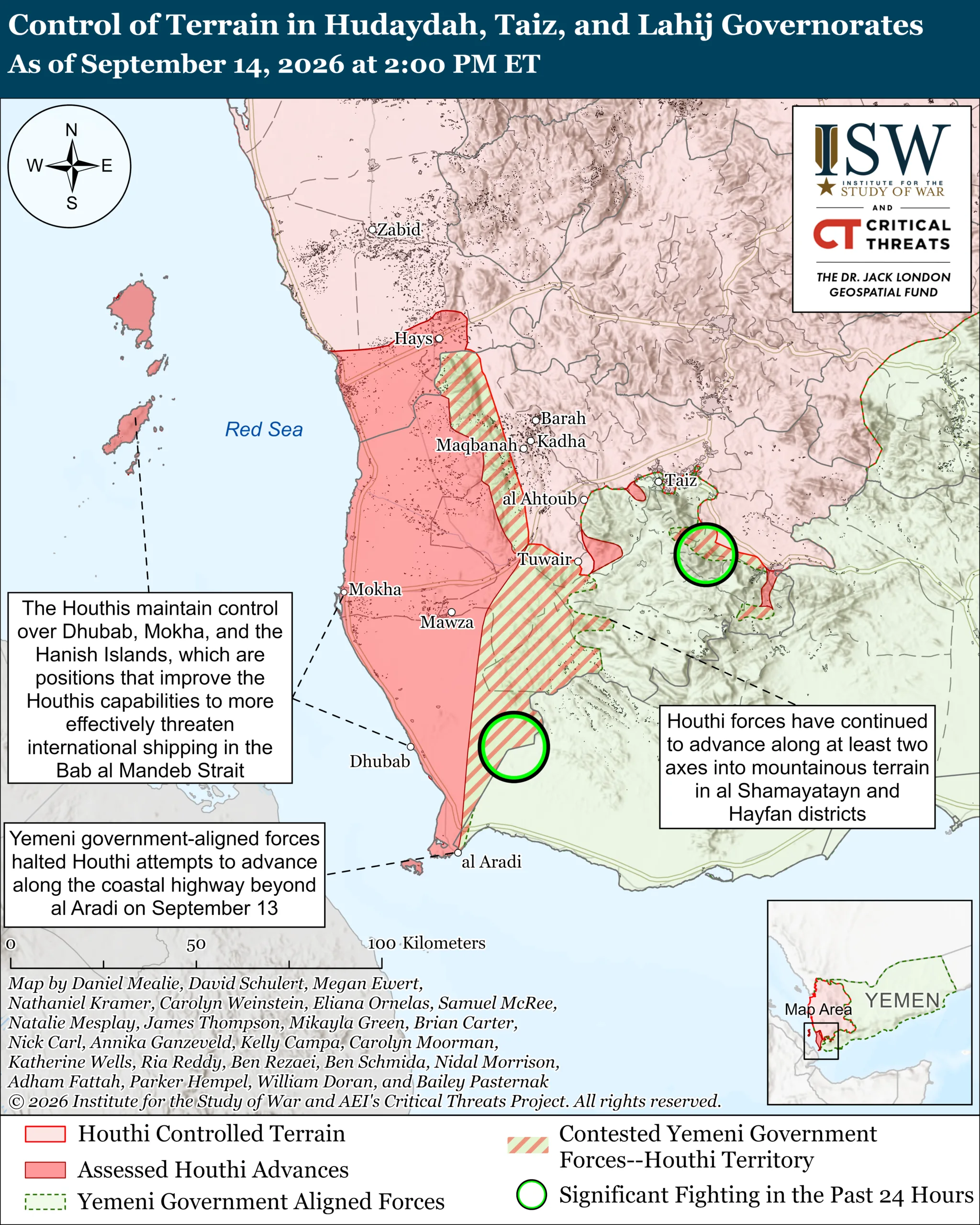
- Yemeni government-aligned forces appear to have halted Houthi advances south along Yemen’s Red Sea coastal plain since September 11. Sustained Houthi control of Dhubab, Mokha, and the Hanish Islands preserves the Houthis’ ability to threaten international shipping in the Red Sea.
- The Iraqi federal government has taken some recent steps to show that it is taking the threat posed by Iranian-backed Iraqi militias to other countries seriously, including closing border crossings with Iran. These actions are unlikely to stem the flow of Iranian arms to Iranian-backed Iraqi militias that the militias are using to conduct attacks on US regional assets and US allies as a part of Iran’s broader campaign in the US-Iran conflict.
- Iran is also reportedly prioritizing newly-formed, IRGC-directed Iraqi militia cells over Iran’s historic Iraqi partners to conduct operations against the United States and its allies in the region. Iran may be prioritizing support for these new militia cells due to command-and-control issues that Iran has reportedly faced with some of its historic Iraqi partners. Some Iraqi militias appear dissatisfied with Iran’s development of new networks in Iraq, however.
Toplines
Iran’s apparent challenges in consolidating control over the Strait of Hormuz are likely driving the regional campaign that Iran is currently waging against the United States and its allies in the region. Iran was required, under the memorandum of understanding (MoU), to negotiate an arrangement for the Strait of Hormuz with Oman.[1] Iranian Foreign Affairs Minister Abbas Araghchi stated that he was supposed to meet with Gulf officials in Oman on September 14 to present a formal plan for Iranian management and tolls in the strait with some Omani involvement.[2] Iran’s proposal, which attempts to formalize Iranian control in the strait, has generated significant resistance from other Persian Gulf littoral states. Bahrain refused to participate in the meeting until Iran stopped attacking regional energy infrastructure and both states restored relations, for example.[3] Saudi Arabia reportedly submitted amendments to Iran and Oman’s proposal over concerns that the proposed language could establish an unacceptable new status quo in the waterway, according to a Gulf official speaking to Axios.[4] The official is likely referring to Saudi objections over clauses that allow for Iran to selectively charge tolls against countries it deems hostile.[5] Saudi Arabia requested the indefinite postponement of the meeting, according to Iranian Foreign Affairs Ministry spokesperson Esmail Baghaei.[6] Baghaei implied that Saudi Arabia’s opposition to the meeting was over recent Houthi strikes against Saudi critical infrastructure and military bases.[7] Oman, Iran’s most amiable regional partner, also continues to oppose Iran’s proposal for ”mandatory fees” in the strait. Omani Foreign Affairs Minister Badr Al Busaidi confirmed on September 14 that the meeting was postponed in the interest of consensus.[8]
Iran is also attempting to overcome current operational constraints on its ability to control shipping in the Strait of Hormuz.[9] Recent US strikes have degraded Iranian coastal radars and surveillance equipment, mine-laying capabilities, and other systems that the IRGC has relied on to monitor and threaten commercial shipping.[10] The Islamic Revolutionary Guards Corps (IRGC) Navy falsely claimed on September 14 that a Panama-flagged vessel struck a mine as the vessel transited the strait’s southern route on September 12.[11] US Central Command (CENTCOM) rejected this claim and stated that Iranian forces fired a drone targeting a different stationary vessel off the coast of Oman.[12] The IRGC has repeatedly issued claims such as this in order to falsely imply that the strait retains a significant number of mines in the wake of CENTCOM’s announcement in late August that US forces had cleared mines in the strait.[13] Iranian regime media notably acknowledged that Iran’s control over the strait may be waning on September 14, which suggests that some factions within the regime recognize how Iran’s current constraints are impacting its ability to achieve its positive objectives.[14] IRGC-affiliated outlet Tasnim News Agency argued that the recent increase in the transit of oil through the strait calls into question the degree of Iran’s control over Iran’s primary economic and strategic leverage.[15]
The Iranian regime also aims to degrade the United States’ will to maintain the US naval blockade by attacks on US allies in the region and driving up oil prices as part of this campaign. The New York Times, citing Iranian and IRGC officials, reported on September 13 that Iranian officials have debated two primary ways to break the US naval blockade: return to negotiations or intensify attacks on US targets and commercial vessels, thereby raising oil prices.[16] The military approach that the New York Times described is consistent with ISW-CTP’s assessment on September 4 that Iran’s attacks on US naval forces may have reflected Iranian decisionmakers’ dissatisfaction with the trajectory of the war.[17] CENTCOM stated on September 13 that its forces have redirected 101 Iranian or Iran-affiliated commercial vessels as part of the US naval blockade, which continues to adversely affect Iran’s economy.[18]
Yemeni government-aligned forces appear to have halted Houthi advances south along Yemen’s Red Sea coastal plain since September 11. The Houthis have retained territory that can facilitate more effective Houthi targeting of shipping in the Red Sea. Recent direct fire engagements between Houthi and Yemeni government-aligned forces near Jabal Kahbub, which is located 30 kilometers inland from the Red Sea along the border between Taiz and Lahij governorates, indicate that government forces have halted Houthi attempts to advance further east along the coastal highway beyond the town of al Aradi.[19] The Houthis advanced into al Aradi, which is located along a peninsula that juts out in the Bab al Mandeb, on September 11.[20] Saudi or Yemeni government airstrikes have also contributed to the stabilization of Houthi-Yemeni government frontlines along the coastal plain near al Aradi. Yemeni government-aligned forces designated an area to coordinate fire against Houthi targets near Mocha and Dhubab cities on September 10 and have struck numerous Houthi frontline positions and supply lines between Mocha and Dhubab.[21] Airstrikes targeting the Houthis have inflicted “heavy casualties” and forced Houthi forces to redeploy along Yemen’s western Red Sea coast, according to Emirati media.[22]
The Houthis appear to have retained control over the majority of Yemen’s Red Sea coast. Sustained Houthi control of Dhubab, Mokha, and the Hanish Islands preserves the Houthis’ ability to threaten international shipping in the Red Sea. A DC-based Yemen analyst with sources in the internationally recognized Yemeni government told Emirati media on September 14 that Yemeni government-aligned forces have yet to fully secure territory along the Red Sea coast despite continued air support.[23] A London-based Yemen analyst reported that the Houthis withdrew from Perim Island on September 13.[24] ISW-CTP is unable to verify this claim as of this writing.
The Houthis may be attempting to outflank Yemeni government-aligned forces along the coastal plain by advancing south towards the Bab al Mandeb through Taiz Governorate’s mountainous terrain in southwestern Yemen. Direct fire engagements between the Houthis and Yemeni government-aligned forces near Jabal Khabub may reflect Houthi efforts to utilize mountainous terrain north of al Aradi in order to outflank Yemeni government-aligned forces near al Aradi. The mountainous terrain near Jabal Khabub could protect Houthi advances along the open coastal areas east of al Aradi from airstrikes or artillery fire. A Yemeni security source suggested to Emirati media on September 14 that the Houthis are operating in the mountains to “minimize their visible human presence” to avoid Saudi or Yemeni government-aligned airpower in the open coastal plain.[25] Saudi airstrikes on Houthi positions in open terrain since 2009 have forced Houthis to rely on mountainous terrain and terrain concealed by vegetation for movement.[26]
Houthi forces have advanced in areas of western and eastern Taiz Governorate near a Yemeni government-aligned ground line of communication (GLOC) that connects Taiz City and Aden City. Houthi forces have continued to advance east from al Waziyah District into al Shamayatan District since September 9, according to a DC-based Yemen analyst.[27] The Houthis also advanced westward beyond Hayfan City toward Bani Gazyi on September 14, according to Saudi media and a US-based Yemen analyst citing Yemeni government sources.[28] Houthi forces have recently infiltrated government-held areas in western Yemen by scaling steep mountainous terrain to attack isolated defensive positions in support of Houthi advances.[29] A US-based Yemen analyst Mohammad al Basha assessed that recent Houthi advances in Taiz Governorate could threaten Yemeni government-aligned supply lines in al Turbah, a town which connects Taiz City to Aden City.[30]
The Houthis conducted additional attacks against Saudi energy and military infrastructure since September 11 as part of their ongoing effort to coerce Saudi Arabia to meet Houthi demands. The Houthis’ attacks against Saudi energy and oil infrastructure seek to coerce Saudi Arabia to submit to the Houthis’ four primary objectives: ending Saudi military operations in Yemen, lifting the Saudi blockade of Houthi-controlled Yemeni ports and airports, coercing Saudi Arabia to pay Houthi civil servant salaries, and coercing Saudi Arabia to pay reparations to Yemeni civilians.[31] The Saudi Civil Defense issued numerous early warning alerts for Houthi projectiles over Abha, Khamis Mushait, Sharurah, and Taif in southwestern Saudi Arabia between September 11 and 14.[32] The Houthis claimed to launch drones and missiles targeting Saudi aircraft hangars, radar installations, runways, and ammunition depots at the King Khalid Air Base in Khamis Mushait on September 14.[33] Houthi officials have repeatedly stated in recent days that accepting Houthi demands for “peace” will be a less costly option for Saudi Arabia than further Houthi attacks.[34] The Houthis warned on September 14 that the group would respond to additional Saudi airstrikes launched from Khamis Mushait and Taif on September 14.[35]
The Iraqi federal government has taken some recent steps to show that it is taking the threat posed by Iranian-backed Iraqi militias to other countries seriously, including closing border crossings with Iran. These actions are unlikely to stem the flow of Iranian arms to Iranian-backed Iraqi militias that the militias are using to conduct attacks on US regional assets and US allies as a part of Iran’s broader campaign in the US-Iran conflict. Likely Axis of Resistance-affiliated actors based in Iraq struck Saudi Arabia’s East-West Pipeline and nearby pumping stations south of Medina, Medina Province, with a drone on September 10.[36] It is unclear if Iranian-backed Iraqi militias, Houthi fighters, or another actor conducted the attack. Saudi Arabia and unspecified regional partners reportedly assessed that the Houthis attacked Saudi Arabia in late July from Iraqi territory in coordination with the Iraqi militias and the IRGC.[37] Saudi Arabia announced that it will refrain from immediately responding to the attacks and would allow the Iraqi federal government to address the militias first.[38] An initial Iraqi federal government investigation into the September 10 attack accused Iranian-backed Iraqi militias of launching the drones from positions near the Iran-Iraq border in the desert of Maysan Province.[39] Iraqi army and Iranian-backed Popular Mobilization Forces (PMF) sources speaking to UK-based, Qatari media on September 13 similarly observed that the majority of attacks that Iranian-backed Iraqi militias have launched from Iraq in recent months originated from positions near the Iran-Iraq border.[40] Iran has smuggled various weapons, including missiles and drones, to its Iraqi partners through the Iran-Iraq border for decades, especially during the US-Israel-Iran War.[41]
The Iraqi federal government closed three Iran-Iraq border crossings on September 12 in response to the militia attacks in order to collect intelligence and determine the “violations and breaches” that occurred at the crossings.[42] The Iraqi federal government has already re-opened one of the southern crossings at Shalamcheh and is expected to re-open the others later this week.[43] The Iraqi federal government’s closure of these border crossings is unlikely to actually meaningfully stem the flow of weapons that Iran smuggles to the militias, given the years that Iran has invested in establishing smuggling networks that operate outside of official Iran-Iraq border crossings.
Iraqi Prime Minister Ali al Zaydi also launched an investigation into the Iraqi Army Maysan Operations Command that is responsible for the area from which the drone was launched.[44] Zaydi dismissed the Maysan provincial police chief.[45] It is unclear how effective these actions will be, given the extent to which Iranian-backed Iraqi actors in the Iraqi federal government and security establishment have previously interfered with Zaydi’s efforts to hold the militias accountable.[46]
The Iraqi federal government’s attempts to thwart militia activity come amid continued reports of coordination between the Iraqi militias and the Houthis as a part of Iran and the Axis of Resistance’s regional campaign against the United States and its allies. Unspecified sources told Iraqi media that unspecified actors, likely referring to the Iraqi militias and the Houthis, have reactivated a coordination mechanism between Axis of Resistance actors with the purpose of ending the “siege” on Iran by striking Gulf states.[47] The sources said that the coordination mechanism was initially formed in 2025 as part of a plan to overthrow the Syrian government.[48] The Houthis and Iraqi militias are already cooperating, as evidenced by Saudi and US airstrikes on Iraqi militia targets in late July that killed a senior Houthi member.[49] The Houthis also recently opened a new operational headquarters in an Iraqi militia stronghold.[50]
Iran is also reportedly prioritizing newly formed, IRGC-directed Iraqi militia cells over Iran’s historic Iraqi partners to conduct operations against the United States and its allies in the region. Two commanders from unspecified Iranian-backed Iraqi militias and one commander affiliated with the Islamic Resistance in Iraq told UK-based, Qatari media on September 13 that a small armed network operating under the command of senior IRGC Colonel Hamed Abdollahi has conducted multiple drone attacks in recent months.[51] The Islamic Resistance in Iraq is an Iraqi militia coalition that includes Kataib Hezbollah, Kataib Sayyid al Shuhada, Harakat Hezbollah al Nujaba, and Ansar Allah al Awfiya.[52] The United States sanctioned Abdollahi in 2011 for his part in the attempted assassination of then-Saudi Ambassador to the United States.[53] Saudi-owned, UK-based media described Abdollahi as IRGC Quds Force Commander Brigadier General Esmail Ghaani’s assistant for Iraq affairs.[54] The militia commanders said that Abdollahi’s armed network has conducted drone attacks targeting multiple sites in Erbil in Iraqi Kurdistan and at a former US base in Syria in March 2026.[55] This network also reportedly conducted the May 17 drone attack on the UAE’s Barakah power plant, the July 27 drone attacks on Saudi Arabia’s oil facilities, and the September 11 attack on Saudi Arabia’s East-West oil pipeline.[56] One militia commander added that Abdollahi has directed all available resources from existing militias to support his network and, in doing so, has given his network more resources than what Iran has provided to all “key” Iraqi militias “combined.”[57] Western media has reported in recent months on Iran’s use of IRGC-managed cells to conduct attacks but has not indicated that Iran is enabling some groups at the exclusion of others.[58]
Iran may be prioritizing support for these new militia cells due to command-and-control issues that Iran has reportedly faced with some of its historic Iraqi partners. Iranian-backed Iraqi militia Asaib Ahl al Haq attempted to assassinate former Prime Minister Mustafa al Khadimi in 2021, almost certainly against Iran’s orders, for example.[59] Iran has also pushed some of its unspecified Iraqi partners to focus on Iraqi politics and state capture instead of military operations in recent months, according to UK-based Amwaj media, possibly to obfuscate its involvement with the militias and reduce the risk of US sanctions on Iraq.[60] An Iraqi militia source said that Iran may instead support the military capabilities of new, non-PMF-affiliated militias instead.[61] Iran prioritizing the armament of these new networks supports this source’s hypothesis.
Some Iraqi militias appear dissatisfied with Iran’s development of new networks in Iraq. The three unspecified Iraqi militia commanders speaking to UK-based, Qatari media on September 13 described the members of Abdollahi’s network as “defectors, dissidents, and double agents.”[62] The commanders also said that the Iraqi militias have lost trust in the channels that link them to the IRGC.[63] The militia commanders specifically attributed much of their mistrust to Abdollahi.[64] The militia commanders noted that the relationship originally soured after the militias refused Abdollahi’s request for the militias to deploy to Syria to defend the Assad regime in Fall 2024.[65] The militias also blamed Abdollahi for creating inter-militia rifts when he ordered the militias to back former Prime Minister Mohammad Shia al Sudani for a second term, reportedly against the wishes of former Supreme Leader Ali al Khamenei.[66] The militia commanders said that current Supreme Leader Mojtaba Khamenei was to replace Abdollahi when Mojtaba entered office, but Abdollahi instead now reports directly to Ghaani. The commanders said that Abdollahi no longer needs Ghaani’s approval to act, which implies that Abdollahi has been acting under Ghaani’s orders until more recent days.[67] It is unclear if the views of these militia commanders reflect those held by all, or most of the Iraqi militias, however.
Iran’s support for militia attacks and Baghdad’s efforts to thwart these developments come as the United States continues to apply extreme financial pressure on the Iraqi federal government to disarm the Iraqi militias by September 30.[68] Two Iraqi government sources told Iraqi Kurdish news on September 14 that the United States warned Baghdad during Zaydi’s July 2026 visit to Washington, DC, that the United States could suspend monthly dollar transfers to the Iraqi federal government if the Iraqi militias do not surrender their weapons by September 30.[69] The Iranian-backed Iraqi militias that are closest with Iran and have been the most kinetically active notably continue to refuse to disarm.[70] Other Iranian-backed Iraqi militias are actively circumventing the federal government‘s attempts to disarm them, including by handing over inoperable weapons.[71] The United States cut off Iraq‘s access to its oil revenue, which sits in the US Federal Reserve, in April 2026 due to militia activity and only fully resumed the dollar shipments in July 2026.[72] About 90 percent of Iraq’s state budget comes from its oil revenue.[73]
US and Partner Military Operations
Nothing significant to report.
Iranian Strike Campaign
Assessed Iranian War Aims:
- Secure international recognition of Iranian control over the Strait of Hormuz
- Degrade the US ability and willingness to continue the war
- Restore deterrence vis-à -vis the United States and its regional partners
- Divide the United States and Israel from the Arab states
See topline section.
US-Iran Negotiations
Nothing significant to report.
Iranian Domestic Affairs
Nothing significant to report.
Lebanon
Nothing significant to report.
Iraq
See topline section.
Arabian Peninsula
See topline section.

[1] https://www.npr.org/2026/06/18/nx-s1-5863027/us-iran-trump-memorandum-of-understanding-full-text
[2] https://www.alaraby dot co.uk/politics/%D9%85%D9%82%D8%A7%D8%A8%D9%84%D8%A9-%D8%B9%D8%B1%D8%A7%D9%82%D8%AC%D9%8A-%D8%B3%D9%86%D8%B9%D8%B1%D8%B6-%D8%AE%D8%B1%D8%A7%D8%A6%D8%B7-%D8%A7%D9%84%D9%85%D8%B3%D8%A7%D8%B1-%D8%A7%D9%84%D8%AC%D8%AF%D9%8A%D8%AF-%D9%81%D9%8A-%D9%87%D8%B1%D9%85%D8%B2-%D8%A8%D8%A7%D8%AC%D8%AA%D9%85%D8%A7%D8%B9-%D8%B5%D9%84%D8%A7%D9%84%D8%A9 ; https://www.axios.com/2026/08/05/us-iran-strait-of-hormuz-deal-nears
[3] https://www.mofa dot gov.bh/en/statement-by-the-ministry-of-foreign-affairs-regarding-reports-of-a-proposed-ministerial-meeting-on-the-strait-of-hormuz
[4] https://x.com/BarakRavid/status/2099246085168357514
[5] https://x.com/BarakRavid/status/2099246085168357514
[6] https://www.irna dot ir/news/86263298
[7] https://www.irna dot ir/news/86263298
[8] https://www.iranintl.com/en/202606277973 ; https://x.com/badralbusaidi/status/2099474460617449480
[9] https://www.axios.com/2026/09/02/iran-tankers-hormuz-attacks-oil
[10] https://x.com/CENTCOM/status/2094916573920199143?s=20 ;
https://x.com/CENTCOM/status/2076495252454584794?s=20 :
https://x.com/CENTCOM/status/2074670840893870433?s=20 ;
https://x.com/CENTCOM/status/2070607101207232829?s=20
[11] https://www.isna dot ir/news/1405062315855/
[12] https://x.com/CENTCOM/status/2099591186583371830
[13] https://t.me/farsna/459686 ;
https://t.me/farsna/459138
[14] https://www.tasnimnews dot ir/fa/news/1405/06/22/3696044/7
[15] https://www.tasnimnews dot ir/fa/news/1405/06/22/3696044/7
[16] https://www.nytimes.com/2026/09/13/world/middleeast/iran-hard-liners-sabotaged-peace-deal.html
[17] https://www.criticalthreats.org/analysis/iran-update-september-4-2026
[18] https://x.com/CENTCOM/status/2099241057112170831?s=20
[19] https://x.com/TvAlmasirah/status/2099222752683036827 ;
https://x.com/alamalikah/status/2099239518301716830
[20] https://x.com/BashaReport/status/2098385535521767522 ; https://www.facebook.com/watch/?v=943450894895511
[21] https://x.com/Yemenarmyeng/status/2098102034301906956 ; https://x.com/spokespersonyem/status/2098452092641845426 ; https://x.com/Yemenarmyeng/status/2098507528631984413 ; https://x.com/Yemenarmyeng/status/2098859834518958118 ; https://x.com/Yemenarmyeng/status/2099241840709189742
[22] https://www.thenationalnews dot com/news/mena/2026/09/14/houthis-forced-to-redeploy-on-yemens-west-coast-after-heavy-strikes/
[23] https://www.thenationalnews dot com/news/mena/2026/09/14/houthis-forced-to-redeploy-on-yemens-west-coast-after-heavy-strikes/
[24] https://x.com/IbrahimJalalYE/status/2099497892276736148
[25] https://www.thenationalnews dot com/news/mena/2026/09/14/houthis-forced-to-redeploy-on-yemens-west-coast-after-heavy-strikes/
[26] https://ctc.westpoint.edu/houthi-war-machine-guerrilla-war-state-capture/
[27] https://x.com/bashareport/status/2097739244877885551?s=46 ;
[28] https://x.com/alarabiya/status/2099446618739061000?s=46
[29] https://x.com/BashaReport/status/2099269848547098712 ; https://x.com/MMY1444/status/2098834349785555421
[30] https://x.com/BashaReport/status/2098623825906696257?s=20
[31] https://understandingwar.org/research/middle-east/iran-update-september-10-2026/ ; https://x.com/TvAlmasirah/status/2089422249862590886?s=20 ; https://sarabic dot ae/20260723/أنصار-الله-تحدد-شرطين-لإنهاء-التصعيد-مع-السعودية-1115450869.html ; https://t.me/army21ye/3691
[32] https://x.com/ariel_oseran/status/2098835499259478162?s=20 ; https://x.com/SaudiDCD/status/2098834211155116227?s=20 ; https://x.com/SaudiDCD/status/2098579390326087844?s=20 ; https://x.com/SaudiDCD/status/2098580526600769554?s=20 ; https://x.com/SaudiDCD/status/2098522392477790512?s=20 ; https://x.com/SaudiDCD/status/2098525197032698274?s=20 ;
https://x.com/SaudiDCD/status/2098546489110704542?s=20 ; https://x.com/SaudiDCD/status/2098548586627715509?s=20 ;
https://x.com/SaudiDCD/status/2098547463866991102?s=20 ; https://x.com/SaudiDCD/status/2098548823173861539?s=20 ;
https://x.com/SaudiDCD/status/2099153633853980728?s=20 ; https://x.com/SaudiDCD/status/2099155484267651581?s=20 ;
https://x.com/SaudiDCD/status/2099153873160044864?s=20 ; https://x.com/SaudiDCD/status/2099155748169077189?s=20 ;
https://x.com/SaudiDCD/status/2099413877830164685 ; https://x.com/SaudiDCD/status/2099415690990043506 ;
https://x.com/SaudiDCD/status/2099414275399852513 ; https://x.com/SaudiDCD/status/2099415947417145548
[33] https://t.me/army21ye/3703
[34] https://x.com/TvAlmasirah/status/2098112664841113918?s=20 ; https://x.com/TvAlmasirah/status/2098472826655396030?s=20 ; https://x.com/abdusalamsalah/status/2098067706738032801
[35] https://t.me/army21ye/3708
[36] https://x.com/KSAMOFA/status/2098502379821830599 ; https://www.reuters.com/world/middle-east/yemens-houthis-reach-strategic-island-mouth-vital-shipping-lane-2026-09-11/
[37] https://www.reuters.com/world/middle-east/yemens-houthis-are-attacking-saudi-arabia-iraq-sources-say-2026-07-30/
[38] https://x.com/KSAmofaEN/status/2098534526352031782
[39] https://www.arabnews dot com/middle-east/iraq-finds-drone-launchers-near-iran-border-security-sources-3001417
[40] https://thenewregion dot com/posts/6507
[41] https://ctc.westpoint.edu/standing-with-iran-the-integrated-combat-performance-of-iraqi-militias-during-operation-epic-fury/
[42] https://www.iraqinews dot com/iraq/iraq-resumes-trade-through-border-crossings-with-iran/ ; https://almadapaper dot net/452526/
[43] https://www.iraqinews dot com/iraq/iraq-resumes-trade-through-border-crossings-with-iran/ ; https://almadapaper dot net/452526/
[44] https://www.shafaq dot com/ar/%D8%B3%DB%8C%D8%A7%D8%B3%D8%A9/%D8%A8%D9%82%D8%B1%D8%A7%D8%B1-%D9%85%D9%86-%D8%A7%D9%84%D8%B2%D9%8A%D8%AF%D9%8A-%D9%85%D8%B5%D8%AF%D8%B1-%D9%8A%D9%83%D8%B4%D9%81-%D8%B3%D8%A8%D8%A7%D8%A8-%D8%BA%D9%84%D8%A7%D9%82-%D9%85%D9%86%D8%A7%D9%81%D8%B0-%D8%A8%D8%B1%D9%8A%D8%A9-%D9%85%D8%AD%D8%A7%D8%B0%D9%8A%D8%A9-%D9%84-%D9%8A%D8%B1%D8%A7%D9%86-%D9%88%D9%81%D8%AA%D8%AD%D9%87%D8%A7-%D9%85-%D9%82%D8%AA%D8%A7-%D9%84%D8%B9%D9%88%D8%AF%D8%A9-%D8%A7%D9%84%D8%B9%D8%B1%D8%A7%D9%82%D9%8A%D9%8A%D9%86
[45] https://almadapaper dot net/452526/
[46] https://almadapaper dot net/452526/ ; https://almadapaper dot net/449191/ ; https://almadapaper dot net/449222/ ; https://shafaq dot com/ar/أمـن/القضا-العراقي-يبر-قياديا-بالحشد-من-تهمة-اغتيال-ضابط-المخابرات-نبراس-الفيلي ; https://aawsat dot com/العالم-العربي/المشرق-العربي/5308585-الحشد-يمنع-التحقيق-مع-مسؤول-شبكة-تهريب-صواريخ-ومسيّرات
[47] https://almadapaper dot net/452526/
[48] https://almadapaper dot net/452526/
[49] https://x.com/Alsakaniali/status/2082579742901837847
[50]https://english.aawsat dot com/arab-world/5301398-houthi-ties-iraqi-factions-deepen-operational-alliance
[51] https://thenewregion dot com/posts/6507
[52] https://www.washingtoninstitute.org/policy-analysis/profile-islamic-resistance-iraq
[53] https://home.treasury.gov/news/press-releases/tg1320
[54] https://aawsat dot com/العالم-العربي/الخليج/5301331-مصادر-غربية-تتحدث-عن-مقتل-ستة-مستشارين-إيرانيين
[55] https://thenewregion dot com/posts/6507
[56] https://thenewregion dot com/posts/6507
[57] https://thenewregion dot com/posts/6507
[58] https://www.reuters.com/world/middle-east/irans-revolutionary-guards-set-up-covert-iraqi-cells-attack-gulf-neighbors-2026-06-19/
[59] https://www.washingtoninstitute.org/policy-analysis/what-next-after-assassination-attempt-mustafa-al-kadhimi
[60] https://amwaj.media/en/article/what-s-left-unsaid-about-iran-s-influence-in-iraq
[61] https://amwaj.media/en/article/what-s-left-unsaid-about-iran-s-influence-in-iraq
[62] https://thenewregion dot com/posts/6507
[63] https://thenewregion dot com/posts/6507
[64] https://thenewregion dot com/posts/6507
[65] https://thenewregion dot com/posts/6507
[66] https://thenewregion dot com/posts/6507
[67] https://thenewregion dot com/posts/6507
[68] https://www.kurdistan24 dot net/en/story/939335/us-warns-iraq-disarm-militias-by-sept-30-or-dollar-transfers-stop
[69] https://www.kurdistan24 dot net/en/story/939335/us-warns-iraq-disarm-militias-by-sept-30-or-dollar-transfers-stop
[70] https://t.me/AbumujahidAlasaf/15 ; https://rudaw dot net/english/categories/iraq/958915 ; https://www.washingtoninstitute.org/policy-analysis/profile-islamic-resistance-iraq ; https://t.me/ElamAlmoqawama/1625 ; https://t.me/ElamAlmoqawama/1612 ; https://understandingwar.org/research/middle-east/iran-update-special-report-august-4-2026/
[71] https://www.alaraby dot co.uk/politics/العراق-لماذا-تتم-عملية-حصر-سلاح-الفصائل-سراً ; https://almadapaper dot net/442723
[72] https://www.wsj.com/world/middle-east/iraq-us-dollar-shipments-iran-eccef82f ; https://www.wsj.com/world/middle-east/u-s-blocks-iraqs-dollar-shipments-to-squeeze-its-iran-backed-militias-3270d5af
[73] https://www.reuters.com/business/energy/how-us-controls-iraqs-oil-revenues-2026-01-23/ ; https://www.imf.org/en/-/media/files/publications/cr/2025/english/1irqea2025001-source-pdf.pdf