
The Institute for the Study of War (ISW) and The Critical Threats Project (CTP) at the American Enterprise Institute are publishing updates Monday through Friday to provide analysis on the war with Iran. Most updates cover events from the past 24-hour period, whereas Monday updates also include events from the preceding weekend, collected after ISW-CTP’s 2:00 PM ET Friday data cutoff. ISW-CTP may publish special updates on Saturdays and Sundays if events warrant, however.
Key Takeaways
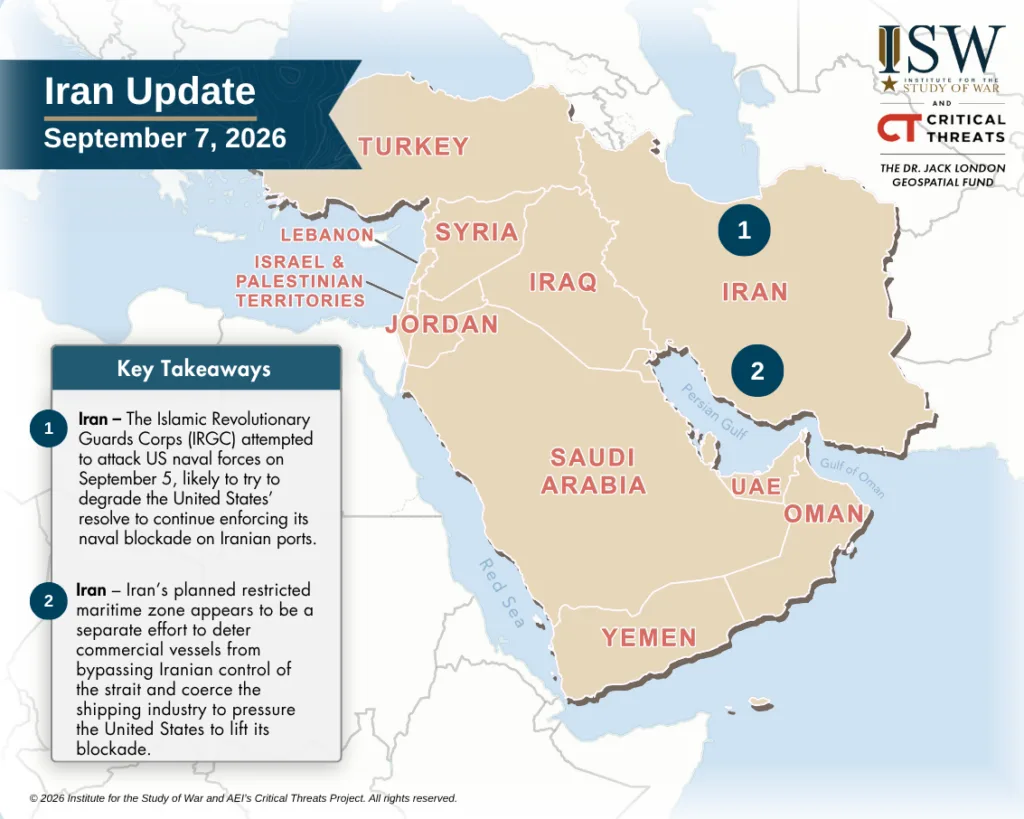
- The Islamic Revolutionary Guards Corps (IRGC) attempted to attack US naval forces on September 5, likely to try to degrade the United States’ resolve to continue enforcing its naval blockade on Iranian ports. The IRGC Aerospace Force announced on September 5 that it targeted a US aircraft carrier and destroyer because the vessels were enforcing the US naval blockade. US Central Command (CENTCOM) confirmed that Iran launched ballistic missiles at two US Navy warships but noted that the missiles did not hit the warships or cause any casualties.
- The IRGC may have also conducted the attack to deter US forces from facilitating the transit of commercial vessels through the strait amid indications that Iran may be facing constraints in its maritime surveillance, targeting, and mine-laying capabilities.
- Iran’s planned restricted maritime zone appears to be a separate effort to deter commercial vessels from bypassing Iranian control of the strait and coerce the shipping industry to pressure the United States to lift its blockade.
- Iran’s recent efforts to coerce the United States to lift its blockade may reflect growing regime concerns about the blockade’s impact on the Iranian economy. Iran has a growing incentive to find alternative ways to force the United States to end its blockade, including by raising the military costs of enforcement for the United States and increasing commercial costs for vessels that bypass Iranian control.
Toplines
The Islamic Revolutionary Guards Corps (IRGC) attempted to attack US naval forces on September 5, likely to try to degrade the United States’ resolve to continue enforcing its naval blockade on Iranian ports. The IRGC Aerospace Force announced on September 5 that it targeted a US aircraft carrier and destroyer because the vessels were enforcing the US naval blockade.[1] US Central Command (CENTCOM) confirmed that Iran launched ballistic missiles at two US Navy warships but noted that the missiles did not hit the warships or cause any casualties.[2] Iranian Supreme National Security Council (SNSC) Secretary Mohsen Rezaei claimed that Iran tested a new “destroyer missile” in the attack, but ISW-CTP cannot verify what type of system Iran used in the attack.[3] CENTCOM responded to the Iranian attacks by disabling two Iranian oil tankers and destroying a third, after which Iran claimed it attacked six commercial vessels.[4] There is no evidence that Iran conducted these attacks on civilian vessels, however. The Iranian Khatam ol Anbia Central Headquarters warned on September 5 that Iran would conduct more severe attacks on US military vessels if the United States maintains its blockade.[5] Rezaei separately claimed on September 6 that a successful Iranian strike on a US warship could inflict significant US casualties, likely to try to weaken the United States’ willingness to continue to enforce the blockade by highlighting the regime’s willingness to target and inflict harm on US naval forces.[6] Iran likely calculates that raising the military and political costs of enforcing the blockade will weaken US willingness to sustain it and ultimately pressure the United States to end the blockade, thereby improving Iran’s ability to assert its claimed control over the strait and reduce economic pressure on the regime.
The IRGC may have also conducted the attack to deter US forces from facilitating the transit of commercial vessels through the strait amid indications that Iran may be facing constraints in its maritime surveillance, targeting, and mine-laying capabilities.[7] US forces have helped commercial vessels transit the southern route of the strait, which has increased traffic through the strait and undermined Iran’s effort to compel vessels to use its illegal traffic separation scheme.[8] Recent US strikes have degraded Iranian coastal radars and surveillance equipment, mine-laying capabilities, and other systems that the IRGC has relied on to monitor and threaten commercial shipping.[9] Iran has consequently adopted less effective methods, including using fast attack craft to visually identify vessels and shore-based rocket launchers to deploy mines, in its efforts to control shipping in the strait.[10] Iran may have directly threatened US naval forces to deter these forces from supporting efforts to restore freedom of navigation in the Strait of Hormuz that undermine Iran’s claimed control of the strait.
Iran’s planned restricted maritime zone appears to be a separate effort to deter commercial vessels from bypassing Iranian control of the strait and coerce the shipping industry to pressure the United States to lift its blockade. Rezaei announced on September 6 that Iran will establish a “restricted zone” extending from the US blockade line south of the Strait of Hormuz to the Persian Gulf.[11] Rezaei said that vessels entering the zone must follow Iranian transit requirements and that Iran will place violators on a “sanctions list” and restrict their future passage through the strait.[12] Rezaei stated that the zone will remain in place for as long as the US naval blockade continues, directly linking the measure to Iran’s efforts to pressure the United States to lift its blockade.[13]
Iran appears to be trying to extend the geographic scope of rules and penalties it has already sought to impose on the shipping industry, rather than creating an entirely new system of transit regulations. Rezaei’s reference to a “sanctions list” likely refers to the Persian Gulf Strait Authority’s (PGSA) “non-compliant vessels list” rather than sanctions similar to US financial sanctions.[14] Vessels on this list can face fines, detention, or confiscation during future passages.[15] The “restricted zone” therefore appears to be an attempt to extend Iran’s existing coercive framework beyond the strait toward the US blockade line, but the transit regulations and penalties Iran intends to impose on vessels do not appear to have changed.
Iran could try to use the “restricted zone” framework to justify future vessel boardings, detentions, or seizures by framing them as consistent with Iranian maritime regulations. Iran could claim that a vessel violated its declared transit requirements and portray an IRGC boarding or seizure of a vessel as a legitimate enforcement mechanism under Iran’s interpretation of maritime law. Detaining or confiscating vessels would require Iran to use force. Rezaei clarified that Iran will not attack vessels in the “restricted zone” outside the strait but he did not rule out attacks or other coercive actions against vessels once they enter the strait.[16]
Iran’s recent efforts to coerce the United States to lift its blockade may reflect growing regime concerns about the blockade’s impact on the Iranian economy. Rezaei acknowledged on September 6 that commercial vessels continue to transit the strait with US assistance and indicated that Iran is trying to change this situation.[17] This comment is consistent with ISW-CTP’s September 4 assessment that Iranian decision-makers appear dissatisfied with the current status of the war because the United States is having some success in facilitating the flow of oil out of the strait and oil prices have plateaued below $100 per barrel in recent months.[18] These conditions undermine Iran’s efforts to use control of the strait and high global energy prices to increase pressure on the United States. The US naval blockade and recent strikes on Iranian tankers are also significantly limiting Iran’s ability to export oil, the regime’s main source of revenue. Energy firm Kpler reported on September 7 that Iranian crude oil stored on vessels outside the blockade has fallen from roughly 90 million barrels in mid-July to about 29 million barrels, for example.[19] US economic pressure has forced the regime to take steps that risk increasing public frustration toward the regime. The Iranian government announced that it will raise third-tier gasoline prices to 100,000 rials per liter beginning on September 8.[20] A previous fuel price increase in 2019 triggered large-scale protests across Iran.[21] The regime’s decision to increase third-tier gasoline prices reflects the difficult situation the regime is in as it tries to mitigate the impacts of US economic pressure while not taking drastic economic measures that could spur domestic unrest. These conditions highlight how Iran has a growing incentive to find alternative ways to force the United States to end its blockade, including by raising the military costs of enforcement for the United States and increasing commercial costs for vessels that bypass Iranian control.
US and Partner Military Operations
See topline section.
Iranian Strike Campaign
Assessed Iranian War Aims:
- Secure international recognition of Iranian control over the Strait of Hormuz
- Degrade the US ability and willingness to continue the war
- Restore deterrence vis-à -vis the United States and its regional partners
- Divide the United States and Israel from the Arab states
See topline section.
US-Iran Negotiations
Nothing significant to report.
Iranian Domestic Affairs
Nothing significant to report.
Lebanon
The Israel Defense Forces (IDF) conducted dozens of airstrikes that targeted Hezbollah fighters and infrastructure across southern Lebanon following five Hezbollah one-way drone attacks on Israeli forces in southern Lebanon, including Ali al Taher, between September 4 and 7.[22] Hezbollah has not claimed responsibility for the drone attacks at the time of this writing, however. It is possible that Hezbollah carried out these attacks in response to the IDF clearing Ali al Taher on September 3, but these attacks would represent a relatively small response relative to losing Ali al Taher, which was a significant command and control facility for the group.[23] ISW-CTP assessed on September 4 that Hezbollah would likely not attack Israeli territory in the near term in response to the IDF’s clearing of Ali al Taher.[24] A Hezbollah fighter separately wounded two IDF soldiers with small arms fire near Beaufort Castle in Nabatieh Governorate on September 7.[25]
The IDF is reportedly developing a plan to reduce its force presence in Lebanon and redeploy forces to a new security line south of the IDF’s current “Yellow Line” in southern Lebanon.[26] Israeli security sources told Israeli media on September 5 that the possible IDF force reduction and repositioning in this proposed plan would happen at an unspecified point after the IDF demolishes the Ali al Taher tunnel complex.[27] The IDF would reportedly redeploy to Israeli outposts located along the “Grey Line”—a newly proposed Israeli security line in southern Lebanon that extends between two and four kilometers within Lebanese territory along the Israel-Lebanon border.[28] The IDF’s “Yellow Line” currently extends between eight and 10 kilometers within Lebanese territory from the Israel-Lebanon border.[29] The security sources said that the proposed force reduction and redeployment plan has not yet been authorized by Israeli political leadership.[30] Israeli Defense Minister Israel Katz stated on September 4 that the IDF would redeploy to unspecified “appropriate” positions in Lebanon after completing its demolition efforts at Ali al Taher, but reiterated that the IDF will not withdraw from the “security zone” in southern Lebanon until Hezbollah is completely disarmed throughout Lebanon.[31]
Iraq
Nothing significant to report.
Arabian Peninsula
The Houthis likely conducted a ballistic missile attack targeting an oil refinery in Jizan, Saudi Arabia, on September 7.[32] Two unspecified sources told the Financial Times on September 7 that an unknown actor fired projectiles that struck the Saudi Aramco refinery in Jizan, which the Houthis have attacked several times since the group began to enforce its blockade on Saudi Arabia on July 20.[33] Satellite imagery from September 7 showed smoke and fires at the refinery after the likely Houthi attack, although Saudi Arabia has not acknowledged the attack and the Houthis have not claimed responsibility for the attack at the time of this writing.[34] Houthi media reported that Saudi Arabia conducted airstrikes and cruise missile attacks on unspecified locations in several Houthi-controlled Yemeni provinces on September 7, but it is unclear whether these strikes occurred before or after the attack on Jizan.[35] The Houthis have repeatedly attacked Saudi oil infrastructure to impose political and economic costs on Saudi Arabia to compel Saudi Arabia to end its kinetic campaign and accept Houthi demands.[36]
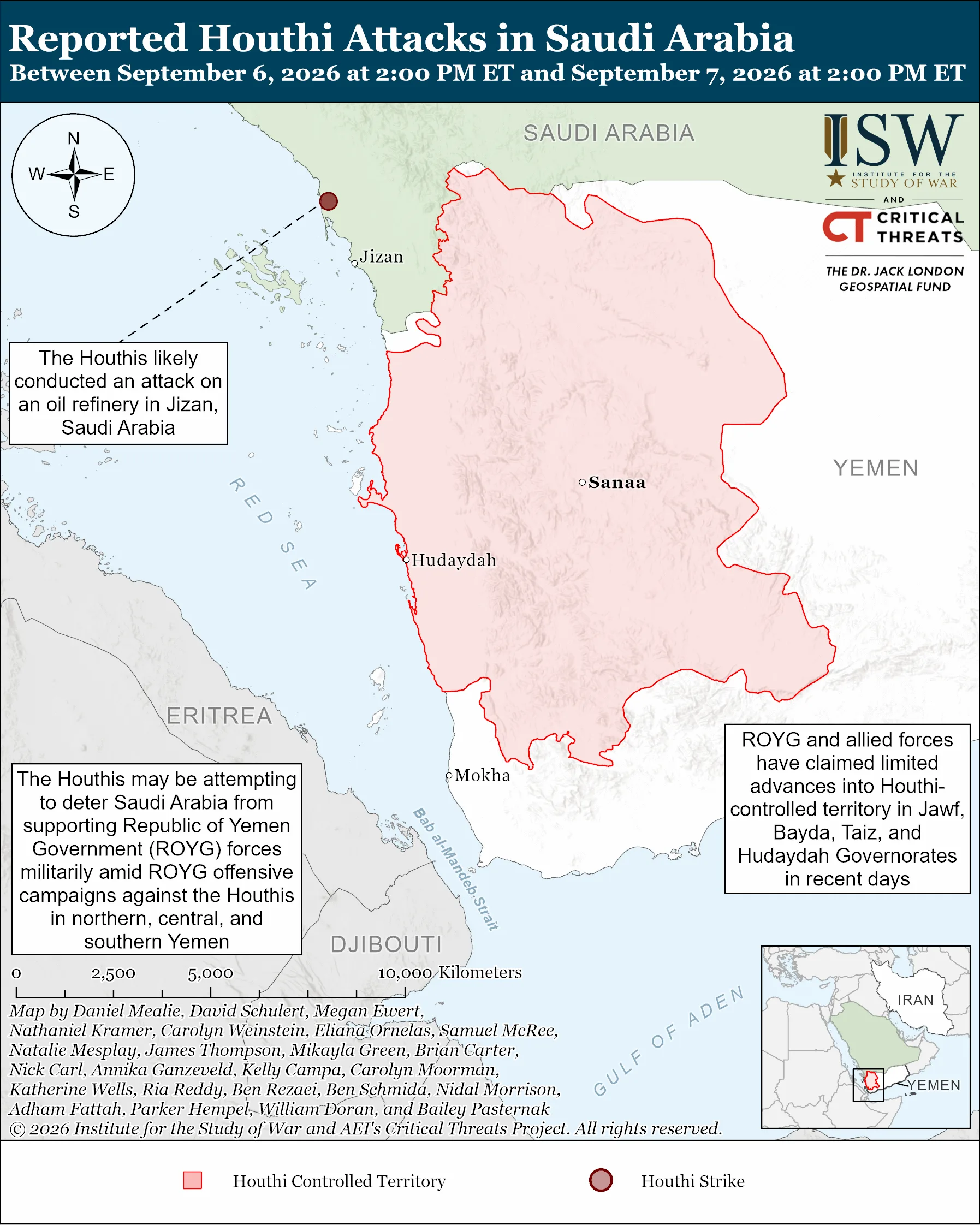
The Houthis may have targeted the Jizan refinery on September 7 to deter Saudi Arabia from supporting ongoing Republic of Yemen Government (ROYG) offensive campaigns against the Houthis in northern, central, and southern Yemen in the near term.[37] ROYG and allied Yemeni forces have engaged the Houthis on several fronts, with ROYG officials, Saudi media, and a Yemeni journalist reporting limited Saudi-backed advances into Houthi-controlled territory.[38] ROYG military media claimed on September 5 that ROYG forces advanced into and established control over Hays District in southern Hudaydah Province, but ISW-CTP cannot confirm this claim.[39]

[1] https://t.me/farsna/460401
[2] https://x.com/CENTCOM/status/2096231596449767452?s=20
[3] https://www.isna dot ir/news/1405061510435/
[4] https://x.com/CENTCOM/status/2096231596449767452?s=20 ;
https://www.bbc.com/news/articles/cj64rrne643o
[5] https://t.me/mehrnews/409499
[6] https://www.isna dot ir/news/1405061510435
[7] https://understandingwar.org/research/middle-east/iran-update-september-4-2026/
[8] https://www.axios.com/2026/08/19/hormuz-iran-oil-gulf-trump ; https://www.cnbc.com/2026/08/21/strait-hormuz-central-command-centcom-oil-iran-war.html
[9] https://x.com/CENTCOM/status/2094916573920199143?s=20 ;
https://x.com/CENTCOM/status/2076495252454584794?s=20 ‘
https://x.com/CENTCOM/status/2074670840893870433?s=20 ‘
https://x.com/CENTCOM/status/2070607101207232829?s=20
[10]https://x.com/MartinKelly/status/2094129711483891783?s=20 ;
https://www.nytimes.com/2026/08/31/us/politics/us-strikes-iran-new-naval-mine.html ;
https://understandingwar.org/research/middle-east/iran-update-august-31-2026/
[11] https://www.isna dot ir/news/1405061510435
[12] https://www.isna dot ir/news/1405061510435
[13] https://www.isna dot ir/news/1405061510435
[14] https://www.reuters.com/business/energy/iran-blacklists-more-ships-trying-sail-through-hormuz-govt-website-shows-2026-09-02/
[15] https://x.com/PGSA_IRAN/status/2091593525452558754?s=20
[16] https://www.isna dot ir/news/1405061510435
[17] https://www.isna dot ir/news/1405061510435
[18] https://understandingwar.org/research/middle-east/iran-update-september-4-2026/
[19] https://www.wsj.com/world/middle-east/irans-oil-dollars-are-drying-upand-plunging-it-deeper-into-crisis-21bae4bd?mod=middle-east_news_article_pos1
[20] https://www.isna dot ir/news/1405061610577 ;
https://www.mehrnews dot com/news/6939422)
[21] https://apnews.com/article/iran-subsidized-gasoline-price-increase-ec18d69bf4e977fefc9c92b8f8f62215
[22] https://x.com/manniefabian/status/2096846660252873141?s=20 ; https://x.com/manniefabian/status/2096925882761744662?s=20 ; https://x.com/fouadkhreiss/status/2096493036985254139?s=20 ; https://x.com/geo_lego_2/status/2096556108189978947?s=20 ; https://t.me/sameralhajali/12324 ; https://x.com/TVManar1/status/2096436383904629195?s=20 ; https://x.com/geo_lego_2/status/2096577635375538201?s=20 ; https://x.com/manniefabian/status/2096479733231857798?s=20 ; https://x.com/fouadkhreiss/status/2096622579280695435?s=20 ; https://t.me/moriahdoron/33377; https://x.com/MarioLeb79/status/2095948622760214937?s=20 ; https://x.com/MarioLeb79/status/2095949878958453237?s=20 ; https://x.com/MarioLeb79/status/2095953941171188198?s=20 ; https://x.com/MarioLeb79/status/2095956693817434382?s=20; https://x.com/MarioLeb79/status/2095966429627474068?s=20 ; https://x.com/MarioLeb79/status/2096282027238560015?s=20 ; https://x.com/MarioLeb79/status/2096285737230422431?s=20 ; https://x.com/MarioLeb79/status/2096641283901055346?s=20 ; https://x.com/MarioLeb79/status/2096899561495171485?s=20 ; https://x.com/MarioLeb79/status/2096908562207326405?s=20 ; https://t.me/sameralhajali/12222 ; https://t.me/sameralhajali/12223 ; https://t.me/sameralhajali/12227 ; https://t.me/MTVLebanoNews/84160 ; https://t.me/sameralhajali/12297 ; https://t.me/sameralhajali/12298 ; https://t.me/sameralhajali/12299 ; https://t.me/MTVLebanoNews/84174 ; https://t.me/sameralhajali/12305 ; https://t.me/sameralhajali/12307 ; https://t.me/MTVLebanoNews/84188 ; https://t.me/sameralhajali/12316; https://t.me/sameralhajali/12355 ; https://t.me/sameralhajali/12371 ; https://t.me/sameralhajali/12380 ; https://t.me/sameralhajali/12382 ; https://t.me/sameralhajali/12383 ; https://t.me/sameralhajali/12384; https://t.me/sameralhajali/12387 ; https://t.me/sameralhajali/12392; https://t.me/sameralhajali/12421 ; https://t.me/sameralhajali/12427 ; https://t.me/sameralhajali/12443 ; https://t.me/sameralhajali/12444 ; https://t.me/MTVLebanoNews/84347 ; https://t.me/sameralhajali/12449 ; https://t.me/sameralhajali/12451 ; https://x.com/idfonline/status/2095967595622965666 ; https://x.com/idfonline/status/2096438400316231972 ; https://x.com/idfonline/status/2096924516844810287 ; https://t.me/moriahdoron/33393
[23] https://understandingwar.org/research/middle-east/iran-update-september-4-2026/
[24] https://understandingwar.org/research/middle-east/iran-update-september-4-2026/
[25] https://t.me/moriahdoron/33392 ; https://x.com/CaptainElla1/status/2096948138254753965
[26] https://www.kan dot org.il/content/kan-news/defense/1096317/
[27] https://www.kan dot org.il/content/kan-news/defense/1096317/ ; https://x.com/kann_news/status/2096668358296932820
[28] https://www.kan dot org.il/content/kan-news/defense/1096317/ ; https://x.com/kann_news/status/2096668358296932820
[29] https://today.lorientlejour dot com/article/1546681/israel-is-reportedly-considering-reducing-its-buffer-zone-in-lebanon.html
[30] https://www.kan dot org.il/content/kan-news/defense/1096317/
[31] https://www.israelhayom dot co.il/news/defense/article/21353275 ; https://t.me/MTVLebanoNews/84197
[32] https://www.ft.com/content/9ffb0fb3-51f6-4aa8-9270-a949196bf441?syn-25a6b1a6=1
[33] https://www.ft.com/content/9ffb0fb3-51f6-4aa8-9270-a949196bf441?syn-25a6b1a6=1 ; https://understandingwar.org/research/middle-east/iran-update-special-report-july-21-2026/ ; https://x.com/john_marquee/status/2080890037558984957?s=20 ; https://x.com/MMY1444/status/2086341452062245037
[34] https://t.me/BenTzionM/8287 ; https://x.com/TvAlmasirah/status/2097010188587045024?s=20
[35] https://saba dot ye/ar/news3782713.htm?cid=1 ; https://saba dot ye/ar/news3782894.htm?cid=1
[36] https://understandingwar.org/research/middle-east/iran-update-august-24-2026/
[37] https://english.aawsat dot com/arab-world/5315745-new-battlefronts-yemen-leave-houthis-disarray ; https://x.com/Yem_army_media/status/2096275835468529748?s=20 ; https://x.com/Yem_army_media/status/2096965196778541419?s=20 ; https://x.com/Alsakaniali/status/2096852408827564199?s=20
[38] https://english.aawsat dot com/arab-world/5315745-new-battlefronts-yemen-leave-houthis-disarray ; https://x.com/Yem_army_media/status/2096275835468529748?s=20 ; https://x.com/Yem_army_media/status/2096965196778541419?s=20 ; https://x.com/Alsakaniali/status/2096852408827564199?s=20
[39] https://x.com/Yem_army_media/status/2096275835468529748?s=20