The Institute for the Study of War (ISW) and The Critical Threats Project (CTP) at the American Enterprise Institute are publishing daily updates to provide analysis on the war with Iran. The updates cover events from the past 24-hour period.
Key Takeaways
- Iran is pushing the United States to unfreeze a significant amount of Iranian financial assets and acknowledge Iranian control of the Strait of Hormuz as part of the United States-Iran memorandum of understanding (MoU). Doing so would leave Iran in a significantly stronger strategic position and could support its military reconstitution efforts.
- Iranian Parliament Speaker and Iran’s negotiating delegation head Mohammad Bagher Ghalibaf’s June 30 interview appears to be part of an effort to build intra-regime support for the MoU amid domestic backlash from the anti-negotiation camp. Ghalibaf argued that Iran will continue to collect fees from vessels transiting the Strait of Hormuz, implicitly arguing that the MoU supports Iranian claims of sovereignty over the strait.
- Iranian officials are openly discussing expanding their missile ranges beyond the long-held 2,000-kilometer limit. A senior political adviser to former Supreme Leader Ali Khamenei, Brigadier General Rasoul Sanaei Rad, said on July 1 that Ali Khamenei had previously issued “phased” guidance to increase missile range and then improve missile accuracy.
Toplines
Iran is pushing the United States to unfreeze a significant amount of Iranian financial assets and acknowledge Iranian control of the Strait of Hormuz as part of the United States-Iran memorandum of understanding (MoU). Doing so would leave Iran in a significantly stronger strategic position and could support its military reconstitution efforts. Iranian officials told Reuters that the Iranian delegation’s talks with Qatari officials in Doha on July 1 would focus on unfreezing $6 billion worth of Iranian financial assets and obtaining US recognition of Iranian sovereignty over the Strait of Hormuz.[1] The Iranian-Qatari meetings followed Qatari officials’ meetings with US Special Envoy to the Middle East Steve Witkoff and Jared Kushner in Doha on June 30 to establish the US negotiating position.[2] Iranian Deputy Foreign Affairs Minister for Legal and International Affairs Kazem Gharibabadi confirmed on July 1 that the talks in Doha aimed to accelerate the implementation of the ceasefire in Lebanon, lift the US blockade on Iran, and release Iranian frozen assets.[3] Gharibabadi noted that the United States and Iran have formed specialized working groups to monitor the MoU implementation but that these working groups have not yet started talks.[4] Gharibabadi later claimed that Iranian and Qatari officials reached an agreement to unfreeze 6 billion US dollars’ worth of Iranian financial assets to purchase and provide goods needed by Iran.[5] US and Qatari officials have yet to confirm Gharibabadi’s specific claim, but a US official denied that the United States had agreed to unfreeze Iranian funds to Israeli media on July 1.[6] US Vice President JD Vance stated on June 22 that Iran would use unfrozen assets to purchase US agricultural products, following quadrilateral Iran-US-Qatar-Pakistan talks in Switzerland on June 21.[7] Iranian media subsequently denied that Iran agreed to purchase US agricultural products, however.[8] A US official told Axios on July 1 that Witkoff and Kushner attempted to convince the Iranian side that their demand for tolls in the strait could disrupt the whole MoU and that a diplomatic agreement would financially benefit Iran more than collecting tolls.[9] The US official did not comment on recognizing Iran’s claims of sovereignty over the strait. Iranian Parliament Speaker and Iran’s negotiating delegation head Mohammad Bagher Ghalibaf highlighted how Iran intended to voice its concerns over the United States’ implementation of the MoU, including the demands for the US to fulfill Iran’s stipulations, at the Doha talks in an interview on June 30.[10] Ghalibaf also said that Iran did not plan to conduct actual negotiations in Doha.[11]
Ghalibaf’s June 30 interview appears to be part of an effort to build intra-regime support for the MoU amid domestic backlash from the anti-negotiation camp. Ghalibaf argued that Iran will continue to collect fees from vessels transiting the Strait of Hormuz, implicitly arguing that the MoU supports Iranian claims of sovereignty over the strait.[12] Ghalibaf claimed that the MoU stipulates that Iran will retrieve half of its 24 billion US dollars’ worth of frozen financial assets and that the Iranian Central Bank will use these funds “to purchase any goods it needs, at any price, and in any currency in the world.”[13] Islamic Revolutionary Guards Corps (IRGC) Commander Major General Ahmad Vahidi, who likely wields dominant influence over Iranian decision-making at the moment, has considered using the funds for military spending, according to mediators speaking to the New York Times on June 13.[14] Ghalibaf underlined in the interview the economic benefits of the MoU so far, including the lifting of the US naval blockade, which has allowed Iran to export over 40 million barrels of oil at a price 20 percent higher than before the war.[15]
The Pezeshkian administration has likewise tried to present Iranian leadership as unified in support of the MoU. Iranian President Masoud Pezeshkian emphasized that his administration has followed Supreme Leader Mojtaba Khamenei’s guidance and is aligned with the Iranian armed forces, implicitly referring to the IRGC and Vahidi, in a meeting with the Islamic Propaganda Coordination Council on July 1.[16] Vice President for Executive Affairs Mohammad Jafar Ghaem Panah, an adviser to Pezeshkian, separately published the names of 11 of the 12 Supreme National Security Council members who voted for the MoU on June 30, which included ultra-hardline political leader Saeed Jalili.[17] Ghaem Panah likely published this list to appeal to the ultra-hardline camp, which has been the most critical of negotiations so far.[18] Hardline regime elements still appear concerned that the negotiating delegation may cross Supreme Leader Mojtaba’s red lines, however. Sixty of 88 Assembly of Experts members, responsible for appointing and supervising the Supreme Leader, went so far as to issue a warning to negotiators not to violate Mojtaba’s “red lines,” in a 10-point statement on June 28.[19]
Iranian officials are openly discussing expanding their missile ranges beyond the long-held 2,000-kilometer limit. A senior political adviser to former Supreme Leader Ali Khamenei, Brigadier General Rasoul Sanaei Rad, said on July 1 that Ali Khamenei had previously issued “phased” guidance to increase missile range and then improve missile accuracy.[20] An Iranian Parliamentary National Security and Foreign Policy Committee member similarly said in October 2025 that Ali Khamenei had lifted all restrictions on Iran’s missile ranges and that Iran would expand its missile program “wherever it sees fit.”[21] Iran’s known longest-range missiles are the Emad, Sejjil, and Shahab-3, which all have a reported range of 2,000 kilometers.[22] Iran may seek to develop missiles that can reach more distant US positions after its failed attempt to strike a US military base in Diego Garcia. Iran fired two ballistic missiles targeting the base in March 2026, which is located approximately 3,700 kilometers from Iran’s southern border.[23] The attack marked the furthest-ever attempted Iranian missile strike, but one of the missiles failed in flight, and US forces intercepted the other.[24] Eighty-five Iranian parliamentarians also implicitly called for the development of intercontinental ballistic missile capabilities in a letter to Supreme Leader Mojtaba Khamenei on May 31.[25] The parliamentarians stated that Parliament will support Iran’s military forces and defense industry until Iranian missiles can reach the United States.[26]
US-Iran Negotiations
See topline section.
Maritime Activity in the Strait of Hormuz and Persian Gulf
Nothing significant to report.
US and Israeli Air Campaign
Nothing significant to report.
Iranian Domestic Affairs
See topline section.
Iran’s Axis of Resistance
Lebanese Hezbollah and the Israeli Campaign in Lebanon
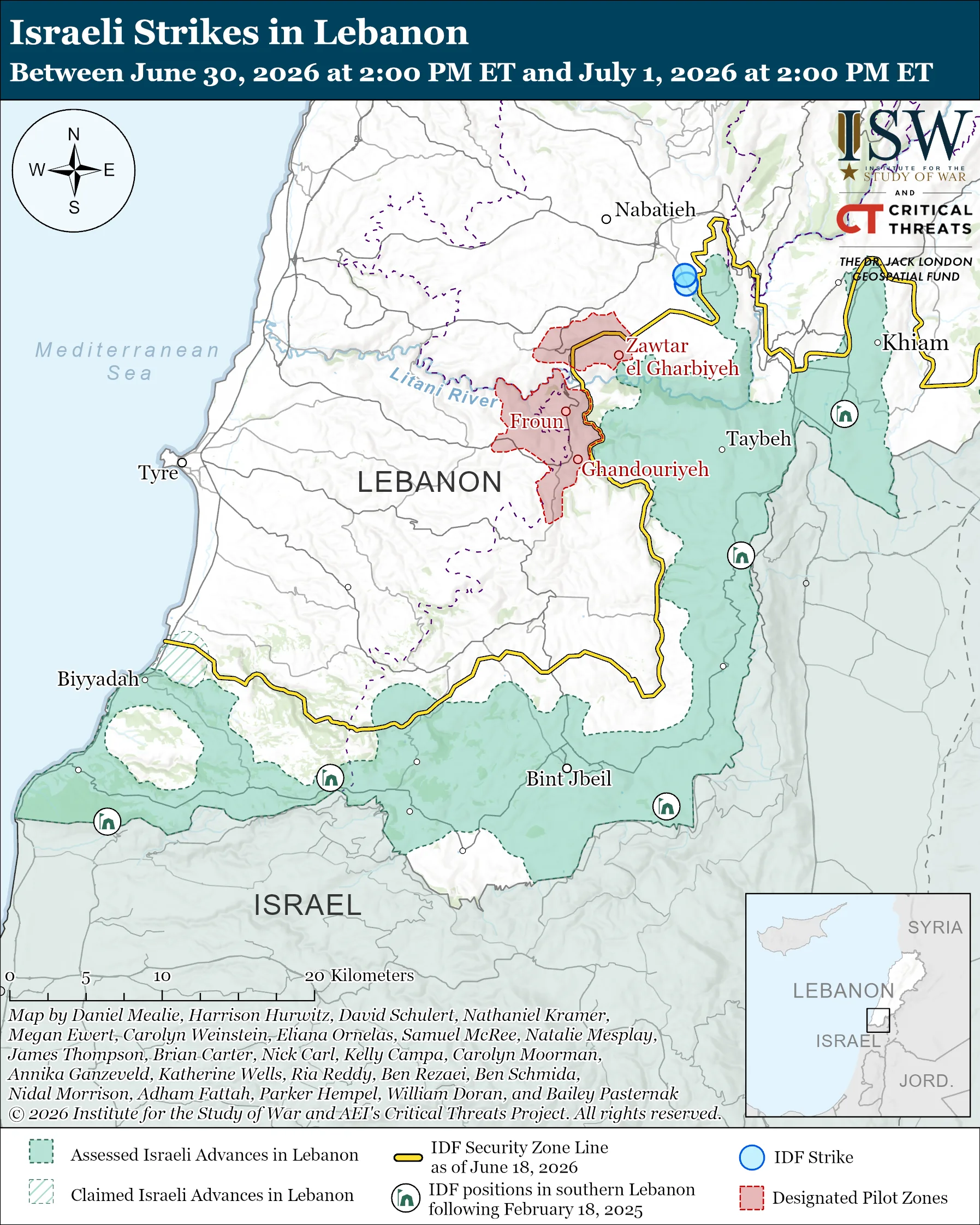
The Israel Defense Forces (IDF) has reportedly postponed its withdrawal from “pilot zones” in southern Lebanon until the IDF and Lebanese Armed Forces (LAF) establish a coordination mechanism and the LAF initiates efforts to disarm Hezbollah in the pilot zones, as required under the Trilateral Framework Agreement’s Security Annex.[27] Israeli media reported on June 29 that the IDF has postponed its withdrawal from the two pilot zones, surrounding Zawtar el Gharbiyeh, Nabatieh District, and territory surrounding Ghandouriyeh and Froun, Bint Jbeil District, until a “joint monitoring mechanism” is established between the IDF and LAF.[28] Israel and Lebanon agreed on June 26 in the Trilateral Framework Agreement’s Security Annex to a four-stage mechanism for the IDF and LAF to dismantle non-state armed groups in designated pilot zones in southern Lebanon.[29] The Annex’s model for disarming non-state groups in pilot zones closely resembles a “clear-hold-build” counterinsurgency strategy.[30] The Annex stipulates that Israel and Lebanon will establish the Military Coordination Group for Lebanon (MCG4L) to verify disarmament progress in southern Lebanon and operate as an indirect backchannel between the IDF and LAF.[31] Israeli sources said that the United States will vet the LAF soldiers who will participate in the MCG4L to ensure that Hezbollah does not receive sensitive information and that the MCG4L will operate as a “virtual [IDF-LAF] command center.”[32] Israeli security sources told Israeli media that there is currently no timetable for IDF withdrawal from the pilot zones and that the withdrawal “must be carried out properly.”[33] Israeli officials have repeatedly emphasized in recent days that the IDF will remain deployed to its security zone in southern Lebanon until Hezbollah is disarmed and no longer poses a threat to Israel.[34]
Other Axis of Resistance Activity
Unspecified Iraqi Shia Coordination Framework leaders refused Iraqi Prime Minister Ali al Zaydi’s request to arrest senior Iranian-backed Iraqi militia leaders as part of his recently launched anti-corruption campaign, according to Qatari media on July 1.[35] An unspecified source claimed that several framework leaders fear “security tensions” if the Iraqi federal government arrests senior militia leaders.[36] This report comes as Iraqi media reported on July 1 that the Iraqi government has not arrested any Iranian-backed Iraqi militia-affiliated figures despite their known ties to corrupt officials.[37] Iraqi authorities reportedly issued an arrest warrant for a prominent unspecified militia-affiliated official, however.[38] Iraqi Kurdish and Saudi media reported on June 30 that Hussein Moanes, a member of Iranian-backed Iraqi militia Kataib Hezbollah’s political wing, fled Iraq to an unknown country.[39] Zaydi’s anti-corruption campaign follows US pressure on Baghdad to dismantle Iranian-backed Iraqi militia-linked financial networks and combat corruption.[40]

[1] https://www.reuters.com/world/asia-pacific/us-iran-enter-technical-talks-secure-peace-deal-restart-shipping-2026-07-01/
[2] https://www.reuters.com/world/middle-east/us-envoy-witkoff-kushner-will-be-qatar-no-meeting-with-iran-qatari-official-says-2026-06-30/
[3] https://www.presstv dot ir/Detail/2026/07/01/771417/Iran-deputy-FM-holds-Doha-talks-with-Qatari-PM-says-MoU-working-groups-established
[4] https://t.me/farsna/445812
[5] https://t.me/Tasnimnews/427110
[6] https://x.com/AmichaiStein1/status/2072336797372162146
[7] https://apnews.com/article/us-iran-war-american-farmers-sanctions-frozen-assets-b86c166d146eb5555383f43a8c8bd505
[8] https://t.me/sepah_pasdaran/201914
[9] https://www.axios.com/2026/07/01/iran-talks-doha-tolls-strait-hormuz
[10] https://defapress dot ir/fa/news/844805
[11] https://defapress dot ir/fa/news/844805
[12] https://defapress dot ir/fa/news/844805
[13] https://t.me/farsna/445736
[14] https://www.wsj.com/world/middle-east/the-iranian-enforcer-driving-tehrans-hard-bargaining-with-the-u-s-b848e67c
[15] https://t.me/Nournews_ir/368669; https://www.cnbc.com/2026/07/01/iran-us-mou-negotiation-war-oil-exports-strait-of-hormuz-.html?utm_campaign=trueanthem&utm_content=main&utm_medium=social&utm_source=facebook
[16] https://t.me/Tasnimnews/427116
[17] https://defapress dot ir/fa/news/844805
[18] https://jahansanatnews dot ir/596005-اسامی-11-عضو-شورای-عالی-امنیت-ملی-که-رأی-م/
[19] https://understandingwar.org/research/middle-east/iran-update-special-report-june-29-2026/; https://www.irna dot ir/news/86194414
[20] https://www.iribnews dot ir/fa/news/5841110
[21] https://t.me/didebaniran/361306 ;
https://www.didbaniran dot ir/بخش-سیاسی-3/243949-بخشایش-اردستانی-عضو-کمیسیون-امنیت-ملی-رهبری-محدودیت-رد-موشکی-را-برداشته-اند-اگر-دولت-بتواند-ماه-شرایط-کشور-اعتراضات-را-مدیریت-کند-غربی-ها-خودشان-پیشنهاد-مذاکره-می-دهند-نظام-باید-به-هر-شکل-ممکن-از-دوره-ترامپ-عبور-کند
[22] https://missilethreat.csis.org/country/iran/
[23] https://www.wsj.com/livecoverage/iran-us-israel-war-updates-2026/card/iran-targeted-diego-garcia-base-with-ballistic-missiles-rb7MdZW1CfwRTauDYHOt?st=BEDGPY
[24] https://www.wsj.com/livecoverage/iran-us-israel-war-updates-2026/card/iran-targeted-diego-garcia-base-with-ballistic-missiles-rb7MdZW1CfwRTauDYHOt?st=BEDGPY
[25] https://www.asriran dot com/fa/news/1167942
[26] https://www.asriran dot com/fa/news/1167942
[27] https://www.kan dot org.il/content/kan-news/defense/1067876/ ; https://x.com/HibaNasr/status/2071617895331746115
[28] https://www.kan dot org.il/content/kan-news/defense/1067876/ ; https://x.com/IsraeliPM_heb/status/2070940344967893212?s=20
[29] https://x.com/HibaNasr/status/2071617895331746115 ; https://www.state.gov/releases/office-of-the-spokesperson/2026/06/trilateral-framework-between-the-united-states-of-america-the-state-of-israel-and-the-republic-of-lebanon/
[30] https://x.com/HibaNasr/status/2071617895331746115 ; https://understandingwar.org/research/middle-east/iran-update-special-report-june-29-2026/
[31] https://x.com/HibaNasr/status/2071617895331746115
[32] https://www.kan dot org.il/content/kan-news/defense/1067876/
[33] https://www.kan dot org.il/content/kan-news/defense/1067876/
[34] https://t.me/moriahdoron/32116 ; https://www.naharnet dot com/stories/en/321023-israel-defense-minister-says-troops-to-stay-indefinitely-in-lebanon-syria-gaza ; https://x.com/IsraeliPM_heb/status/2070940344967893212?s=20 ; https://x.com/IsraeliPM_heb/status/2071974716844187714 ; https://t.me/moriahdoron/32085
[35] https://www.alaraby dot co.uk/politics/علي-الزيدي-يطلب-غطاء-الإطار-لملاحقة-جهات-مسلحة-متورطة-بالفساد
[36] https://www.alaraby dot co.uk/politics/علي-الزيدي-يطلب-غطاء-الإطار-لملاحقة-جهات-مسلحة-متورطة-بالفساد
[37] https://almadapaper dot net/441503/
[38] https://almadapaper dot net/441503/
[39] https://www.kurdistan24 dot net/en/story/923066 ; https://www.alhadath dot net/2026/06/30/مصادر-تكشف-لـالعربية-عن-تفاصيل-جديدة-بقضية-الفساد-بالعراق
[40] https://understandingwar.org/research/middle-east/iran-update-special-report-june-29-2026/