
Toplines
Workers’ Party of Korea (WPK) General Secretary Kim Jong Un reaffirmed his commitment to nuclear program expansion in response to US and South Korean “provocation” during the WPK Ninth Central Committee’s Second Enlarged Plenary Meeting. Kim accused South Korea and the United States of worsening security on the Korean Peninsula and reaffirmed his intention to accelerate the expansion of North Korea’s nuclearization program with a 10,000-ton-class strategic guided missile cruiser during the meeting.[1] Kim reaffirmed that nuclear force expansion was the “most correct and only path,” criticized the United States-South Korea Nuclear Consultative Group (NCG), and directly named South Korea’s nuclear-powered attack submarine (SSN) development as a destabilizing provocation.[2] Kim has also directed new construction and modernization of munitions factories and naval bases, and called for the completion of southern border fortification projects.[3]
Kim has made it clear that he is not willing to negotiate with the United States and South Korea on the issue of denuclearization, particularly after Russian President Vladimir Putin’s recent support of North Korea’s nuclearization. The People’s Republic of China (PRC) has also taken an increasingly neutral stance on the issue, aligning itself closer with North Korea in a likely attempt to counterbalance Russian influence. Kim appears to be closing off any prospects for denuclearization or engagement with the United States and South Korea while appearing to demand South Korea’s unilateral concessions, including the abandonment of the NCG or South Korea’s SSN development.
North Korea will likely aim to improve its naval basing architecture to support Kim’s ambition to develop an ocean-going navy. North Korea may also pursue the development of a larger surface combatant to support a sea-launched ballistic missile capability. North Korea officially commissioned its first Choe Hyon-class guided missile destroyer with the West Sea Fleet on June 23.[4] Choe Hyon, the first vessel of the class, represents North Korea’s first significant step toward developing a navy that can operate beyond its coastal waters. Kim stated at Choe Hyon’s commissioning ceremony that the Korean People’s Army Navy (KPAN) would no longer be only responsible for coastal defense, but would become “capable of fully demonstrating our national strength in the open ocean thousands of kilometers away.”[5] This statement supports ISW-CDOT’s assessment that Kim seeks to develop a green-water navy that retains some coastal defense capability while also developing ocean-going surface combatants that can deploy beyond North Korea’s coastline.[6]
Kim acknowledged key KPAN shortcomings that will likely drive further naval modernization. North Korea lacks the extensive naval support architecture to sustain long-range deployments and service larger surface combatants.[7] Kim particularly lamented North Korea’s lack of large naval bases to support a future ocean-going capability.[8] Kim also encouraged the construction of modern frigates and support vessels to bolster the KPAN’s ability to deploy beyond North Korea’s waters.[9] North Korean naval modernization may shift toward developing requisite support facilities and vessels once it has developed enough large surface combatants to fulfill Kim’s ambitions for a green-water navy.
Kim is likely shifting his focus toward developing a 10,000-ton guided missile cruiser, twice the size of the Choe Hyon-class, to support a sea-based ballistic missile capability. Kim emphasized the development of such a vessel during Choe Hyon’s commissioning instead of discussing the construction of more guided missile destroyers.[10] North Korean state media has mentioned the development of a guided missile cruiser multiple times in June.[11] The Choe Hyon-class destroyer was likely originally designed to launch ballistic missiles, but changes to its missile armament since its launch indicate it now likely only carries cruise missiles.[12] Kim may be seeking to develop a larger surface combatant that can support ballistic missiles to enhance the nuclear deterrent capabilities of North Korea’s surface fleet.
Kim’s desire for a larger surface combatant will likely conflict with his efforts to improve the KPAN’s support facilities and smaller vessels. Kim correctly acknowledged that North Korea lacks the necessary sustainment infrastructure to support a large fleet of Choe Hyon-class destroyers. North Korea’s sustainment and support insufficiencies, as well as the burden to defend high-end surface combatants from air and submarine attack, will only compound with the development of a larger cruiser. The more the KPAN surface fleet expands, the more North Korea must work to develop replenishment-at-sea capability, coastal support facilities, and robust air defense and anti-submarine warfare platforms. North Korea will also likely struggle to design and produce a 10,000-ton combatant without external support, given the complexity required for such a platform to be effective.[13] It is unclear the extent to which either the PRC or Russia is willing to support such a project, although Russian technical assistance very likely aided the development of the Choe Hyon-class.[14]
North Korea is likely to accelerate the development of its nuclear weapons as South Korean President Lee Jae Myung seeks to balance both deterrence frameworks and engagement policy toward North Korea. The South Korean Ministry of Foreign Affairs (MOFA) on June 23 stated that the United States-South Korea cooperation on extended deterrence and South Korea’s SSN program is in response to North Korea’s nuclear capabilities.[15] Lee ordered on June 24 the Marine Corps unit on Yeonpyeong Island to maintain a posture capable of responding immediately and overwhelmingly to any “enemy provocation,” likely referring to North Korea.[16] North Korea shelled Yeongpyeong Island in 2010, killing four South Koreans.[17] South Korea’s Ministry of National Defense (MND) has also indicated plans to maintain its reference to North Korea as an “enemy” in the upcoming Defense White Paper, despite the South Korean Ministry of Unification (MOU)’s request to abandon the term in the document to maintain prospects of engagement.
South Korea’s statements reflect the Lee administration’s desire to maintain deterrence frameworks alongside its “peaceful coexistence” policy toward North Korea. Lee’s peaceful coexistence policy aims to reduce inter-Korean military tension. North Korea’s accusation that South Korea is escalating tensions through the NCG and SSN project renders Lee’s policy largely ineffective, however. South Korea likely views prospects for bilateral engagement with North Korea as unlikely at present given the Kim regime’s continued rejection of talks, making unilateral concessions highly costly for Seoul. Lee has instead urged US President Donald Trump to resume the United States-North Korea dialogue.[18] Lee has framed the denuclearization process as a United States-led initiative over the bilateral inter-Korean cooperation. Lee proposed a phased denuclearization outline to Trump on June 19 during a Group of Seven (G7) summit in France.[19] Lee said the US’ role in providing the Kim regime with a security guarantee is vital to the approach.[20]
The United States’s prospects or desire for engagement with North Korea on denuclearization negotiations remains uncertain, however. Trump has not yet suggested any shift in the US’s denuclearization objective in response to WPK General Secretary Kim Jong Un’s February 2026 statement indicating an openness to dialogue with Washington under the condition that it abandons its denuclearization demands.[21] The Trump administration in February 2026 approved United Nations (UN) proposals for providing humanitarian assistance in North Korea, while on June 25 extending a national emergency declaration due to North Korean threats.[22] North Korea is likely to further develop nuclear weapons and deepen military cooperation with Russia in the absence of dialogue with Seoul and Washington.
Key Takeaways
- North Korean Nuclear Expansion: North Korea used US-South Korea SSN development and discussions under the NCG to justify further expansion of North Korea’s nuclear program. North Korea is maintaining the necessity of nuclear weapons to its national security, and is working to further enhance its deterrence capabilities through naval advances and border fortifications.
- North Korean Naval Expansion: North Korea will likely work to improve its naval basing architecture to support the development of a green water navy and a new 10,000-ton guided missile cruiser. North Korea will likely face difficulties producing and sustaining larger surface combatants without PRC or Russian assistance.
- Inter-Korean Relations: The Lee Jae Myung administration appears to be attempting to balance pursuing deterrence and “peaceful coexistence” with North Korea, which may indicate that the Lee administration views engagement with North Korea unlikely at present. Fundamental disagreements on denuclearization will likely make engagement between North Korea, the United States, and South Korea unlikely given North Korean demands that the United States abandon its calls for denuclearization before dialogue can take place.
North Korean Domestic Politics
North Korea acknowledged its production and administrative underperformance related to industrial projects at the WPK Ninth Central Committee’s Second Enlarged Plenary Meeting held from June 20 to 22.[23] The Plenum designated coal production as the party’s strategic priority and a central effort to achieve its economic development targets. WPK General Secretary Kim Jong Un stated the necessity of modernizing North Korean mining infrastructure, improving living conditions for coal miners, and establishing central and local command centers for coal factories.[24] The Plenum also discussed measures to strengthen the administrative powers of local party committees. The WPK convened the Third Politburo Meeting on June 22 to finalize resolutions on modernizing the mining industry and strengthening local governance authorities.[25] The WPK convenes enlarged plenary meetings to review the progress reports from the first and second halves of the year based on the five-year policy framework introduced at the WPK Party Congress. The Ninth Party Congress, held in February 2026, centered around the stabilization and sustainment of economic growth and identified the coal industry—alongside metal, chemical, and heavy industries—as foundational to this development plan.[26]
North Korea is likely facing coal supply issues and policy implementation hurdles in certain sectors, despite offering an overall “positive” assessment of its first-half progress. North Korea is heavily reliant on coal. Coal accounted for over 50 percent of North Korea’s primary energy supply in 2021.[27] South Korea has assessed that North Korea’s outdated mining infrastructure is continuing to cause energy supply disruptions that are detrimental to its industrial output.[28] North Korea appears to be heavily relying on the “voluntary” mobilization of young North Koreans to work in coal mines. ISW-CDOT reported that Article 61 of North Korea’s Constitution, which mandates the North Korean population to prepare for “resistance warfare,” signaled efforts to utilize its population for industrial labor demands.[29] Global oil supply disruptions stemming from the conflict in Iran may further pressure North Korea to increase its reliance on coal in the near term.[30] North Korea’s coal shortage will likely affect the ability of its defense industrial base to meet manufacturing goals directed by Kim as part of the five-year defense development plan, including the expansion of warheads, construction of naval vessels, and production of missiles.[31]
The WPK Ninth Central Committee’s Second Session announced personnel changes that reinstated Jo Yong Won to central party politics, likely to resolve administrative challenges in policy implementation. The plenum removed Kim Jae Ryong as a Central Committee secretary and appointed Jo Yong Won as a Central Committee Secretary and the Director of the Organization and Guidance Department (OGD). Jo has served as the Chairman of the Supreme People’s Assembly (SPA) Standing Committee since February 2026, and the next SPA session will likely elect a new chairman. Jo served as both the Organization Secretary within the Secretariat and the Director of the OGD prior to his role as the Chairman of the SPA Standing Committee.[32] The Secretariat holds the authority to execute and direct subordinate organs responsible for implementing party policies. Each secretary oversees a specific portfolio—such as the economy, personnel, or military affairs. The Secretariat’s Organization Secretary and the OGD directorship would give Jo control over personnel appointments, ideological supervision, and policy guidance. The Chairman of the SPA Standing Committee is largely a ceremonial position, serving primarily as a counterpart to foreign high-level officials.[33]
Kim Jong Un’s appointment of Jo as the Organization Secretary and the OGD Director indicates efforts to correct internal disciplinary issues and better implement policy goals. The plenum’s adoption of the resolution on strengthening local governance authorities, alongside coal production issues likely signals administrative shortcomings in the execution of certain projects. Jo has been considered one of Kim’s close aides since he assumed power in 2012.[34] Jo’s reinstatement may also indicate that Kim seeks tighter oversight within the central party due to internal instability or corruption.[35] North Korean state media reported on June 23 that the party indicted Deputy Director of the General Political Bureau of the KPA Pak Hui Choi to legal authorities for investigation into corruption charges.[36] Kim Jong Un also raised the corruption issue among party cadres during his speech at the WPK Central Cadres Training School on June 2.[37]
North Korean Military Developments
North Korea may benefit from Russian technological advances that have improved the accuracy of its ballistic missiles. Ukrainian intelligence officials told Kyodo News on June 20 that Russian technological enhancements have significantly improved the accuracy of North Korea’s KN-23 and KN-24 ballistic missiles.[38] The officials stated that the missile-impact margin of error for both missiles had been reduced to between one and five meters, down from a margin of error of one to three kilometers in 2024.[39] The Ukrainian officials stated that, prior to the improvements, only 20 percent of North Korean missiles reached their targets, with many exploding mid-air before reaching the ground.[40] The accuracy improvements likely stem from improvements to the missiles’ inertial navigation system and the integration of real battlefield data from the war in Ukraine.[41]
North Korea may be able to integrate similar improvements based on the experience of the Russian military’s use of North Korean missiles in Ukraine. It is not clear whether Russia will provide similar technical assistance to North Korea’s own KN-23 and KN-24 missiles, but North Korea could leverage its assistance in Russia’s war in Ukraine for such support.[42]
Improvements to North Korean missile accuracy would significantly enhance the threat they pose to South Korea and US forces in the region. The KN-23 has a range of around 700 kilometers and follows a quasi-ballistic trajectory, making interception more difficult.[43] The KN-24 has a range of 400 kilometers, meaning both missiles can hit most of the Korean Peninsula and US military positions on the Peninsula.[44] Increasing the accuracy of North Korean missiles and limiting in-flight missile failure will decrease the number of missiles North Korea will have to allocate to each target of a missile strike to maximize the probability of a missile attack impacting its target. This, in turn, would allow North Korea to increase the number of targets it could reliably strike with its ballistic missiles.
North Korean Foreign Relations
Russian enterprises based in Siberia are flouting UN sanctions to sign cooperation agreements with North Korea across a variety of sectors, including energy and construction. Russia has become a key backer of the North Korean economy due to North Korean support for Russia’s war in Ukraine. A business delegation from the Russian Far East city of Khabarovsk visited North Korea from June 15 to 20 and signed agreements with North Korean counterparts, including North Korean construction materials manufacturers who explored setting up joint ventures.[45] Members of the Khabarovsk delegation said that North Korean companies may begin launching production facilities in Khabarovsk and selling agricultural goods to Russian grocery stores.[46] Russian oil industry representatives also found “common ground” with North Korea on the supply and processing of petroleum products.[47] Another delegation of companies from the Irkutsk region of Siberia held meetings in North Korea on June 25 and signed a cooperation agreement with the Pyongyang Chamber of Commerce.[48] The Irkutsk delegation sought to sell fuel, fertilizers, agricultural products, and construction services to North Korea.[49] The delegation included the liquefied natural gas company Vector, which is owned by a subsidiary of the Russian state oil corporation Rosneft.[50] Many of these agreements are either explicitly or very likely in violation of UN sanctions on North Korea, which restrict the sale of refined petroleum products and ban the sale of liquid natural gas to North Korea, prohibit any country from setting up joint ventures with North Korea, and forbid other countries from providing work authorizations to North Korean workers.[51]
Russia vetoed new UN sanctions on North Korea in 2022 and voted to end the UN panel of experts that monitored North Korea-related sanctions compliance in 2024.[52] Russia has also urged countries to end their unilateral sanctions against North Korea.[53] Russia-North Korea trade has almost certainly grown considerably since Russia’s full-scale invasion of Ukraine in 2022 due to North Korea’s material support for Russia’s war in Ukraine in increasingly brazen violation of sanctions, though both countries stopped publishing detailed trade data in the spring of 2022.[54] Russian trade data showed an increase in bilateral trade from $3.78 million in 2022 to $52.9 million between January and May 2024.[55] This number is still much lower than the official PRC-North Korea trade volume of $2.73 billion in 2025, but it exceeds pre-pandemic levels and excludes billions of dollars in North Korean munitions sales to Russia.[56] This number also likely excludes some sanctioned economic activities such as the oil trade and North Korea sending laborers to Russia, which both sides have reasons to conceal.
Songdowon International Children’s Camp in North Korea may accept PRC children for the first time in years, which would mark the first PRC tourism in North Korea since the COVID-19 pandemic. North Korea has appeared reticent to allow PRC tourism to resume, despite PRC efforts. Russian travel firm Vostok Intur reported that Songdowon would accept PRC children in July and August, which was repeated on PRC social media.[57] North Korean officials have not yet confirmed these reports, at time of writing. Songdowon hosts children from a number of visiting countries, including Russia, in part to promote positive views of North Korea.[58]
North Korea’s decision to reaccept PRC children could indicate the extent of its interest in deepening bilateral economic ties, specifically through tourism and cultural exchange. North Korea has historically been heavily economically reliant on the PRC, and Pyongyang’s reluctance to be overly reliant on Beijing again may influence its decision on resuming tourism ties. The PRC was North Korea’s top supplier of tourists before the COVID-19 pandemic and direct passenger trains between North Korea and the PRC only just reopened in Spring 2026.[59] North Korea may decide to resume international tourism in part to expand its sources of foreign currency.[60]
North Korean Cognitive Warfare
Nothing significant to report.
Inter-Korean Relations
North Korea is appearing to reinforce its military capabilities along the inter-Korean Military Demarcation Line (MDL), likely to support its hostile two-state framework. WPK General Secretary Kim Jong Un reiterated the push for the “fortification of the southern border” during his speech at the Enlarged Meeting of the Ninth Central Committee of WPK Second Plenum on June 23.[61] Kim revised the North Korean Constitution in March to define North Korea’s territory as only including the northern part of the Peninsula, identifying the southern part of the Peninsula as a separate state. North Korea’s designation of South Korea as a separate hostile state justifies its increased military presence along the Southern border.[62] The US satellite imagery firm Planet Labs reported on June 23 that North Korea recently extended its wire fences southward.[63] Voice of America reported June 24 that North Korea advanced the new fences significantly, with the closest fence to the border sitting only 82m (269 ft) north of the MDL.[64] North Korean border fences traditionally maintained a distance of at least 300m (984ft) to 1km (3,281ft) north of the MDL. South Korean National Assembly’s National Defense Committee lawmaker Kang Dae-sik revealed on June 21 that the KPA also cleared terrain to secure minefields just five to ten meters (16-33 ft) away from the MDL.[65] The KPA has systematically expanded its engineering operations within the Demilitarized Zone (DMZ) since Kim first proclaimed his hostile two-state framework in 2024.[66] The South Korean Joint Chiefs of Staff assessed that the KPA may also relocate its frontline Guard Posts (GPs) further south given the southward movement of the fences.[67]
Kim ordered a massive buildup of military assets along its southern border following the February WPK Party Congress, including the new 155mm howitzers and 170mm artillery systems, which can target Seoul and multiple US Forces Korea military assets.[68] ISW-CDOT previously assessed that these new artillery systems would modernize North Korea’s Cold War-era system of conventional artillery capabilities.[69] The military buildup near the DMZ operationalizes Kim’s hostile two-state rhetoric and reflects Pyongyang’s strategic determination to redefine inter-Korean relations. North Korea also appears to be securing leverage for future discussions regarding the delineation of the MDL. North Korea, South Korea, and the UN Command (UNC) maintain subtlety different views on the precise territorial dividing line between the two Koreas due to natural terrain shifts since the end of the Korean War in 1953.[70] North Korea may preemptively establish a military presence in areas just five to ten meters from the MDL to strengthen its position in future border discussions or to unilaterally solidify its territorial claims.
South Korean Ministry of National Defense Spokesperson Jeong Bit-na stated on June 23 that North Korea’s new fence construction constitutes a clear violation of the Korean War Armistice Agreement.[71] The UNC rejected this assessment, however.[72] The UNC clarified that North Korea’s activities, such as fence construction, road repairs, and land clearing, occurred north of the MDL in accordance with the civil administration clauses of the Agreement, and that the constructions were defensive measures that do not infringe the armistice.[73]
South Korean Domestic Politics
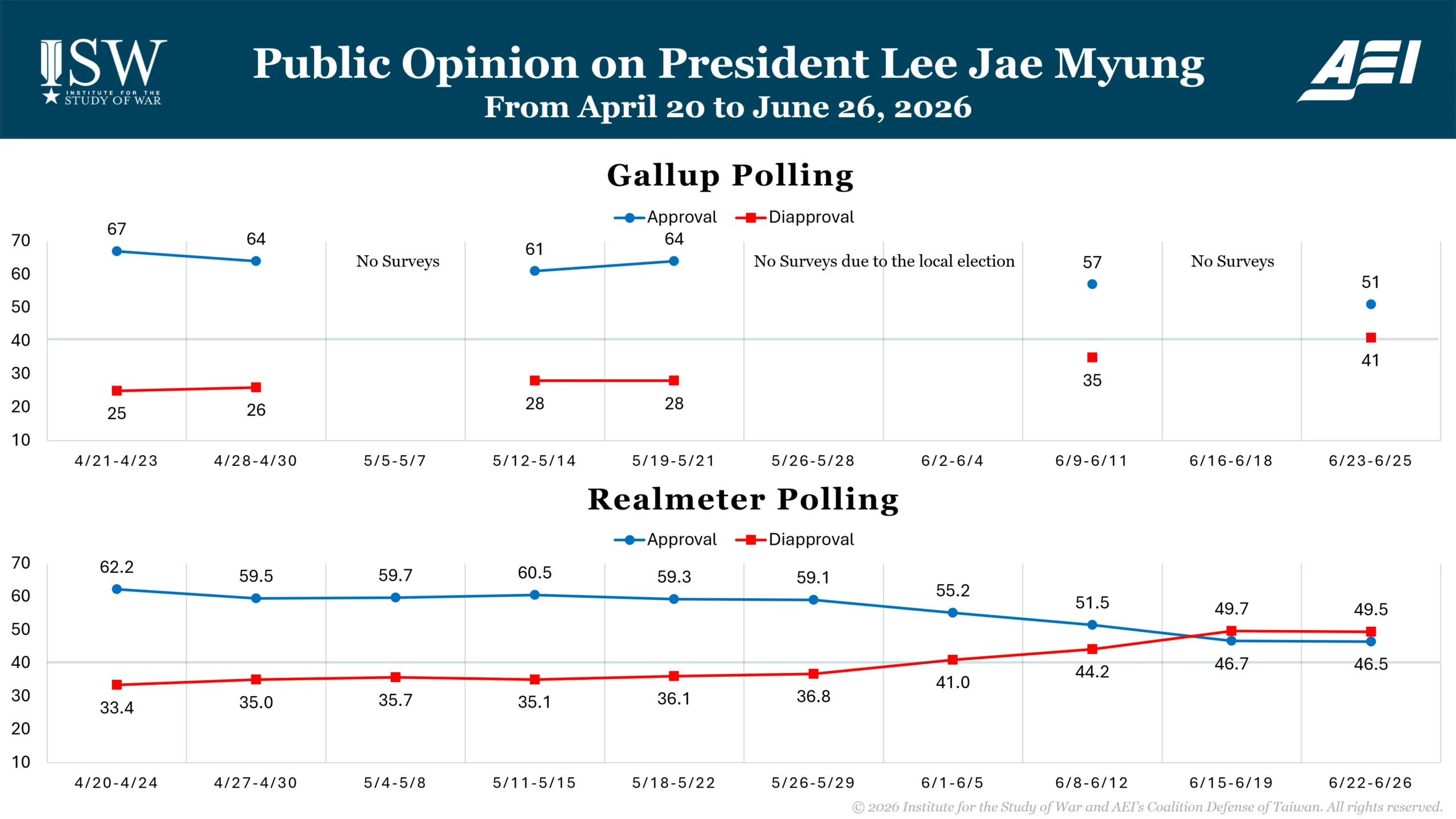
South Korean President Lee Jae Myung’s approval rating fell to its lowest level since his inauguration in June 2025, likely due to a greater focus on the South Korean economy and local elections. Realmeter reported that Lee reached his lowest approval rating, approximately 46.5 percent and a disapproval rate of 49.5 percent for the fourth week of June.[74] Lee maintained high approval rates steadily throughout May, making this sudden downward trend very notable.[75] The third week of June marked the first time since Lee’s inauguration that Realmeter reported Lee’s disapproval rating was higher than his approval rating.[76] Lee had an approval rating of 59.1 percent in the last week of May.[77] Realmeter reported that Lee’s approval rating has been steadily declining throughout June due to local election controversies, high inflation rates, the South Korean won (KRW) value dropping by about KRW 80 against the US dollar since April, controversy over prosecutors’ power to conduct supplementary investigations, and Democratic Party (DP) conflict over future leadership in the August convention.[78] Gallup reported that Lee’s approval rating was 51 percent and his disapproval rating was 41 percent in the fourth week of June, marking Lee’s lowest approval rating and highest disapproval rating by Gallup polling since Lee’s inauguration.[79] Gallup reported that Lee had a 64 percent approval rating in the third week of May, and faced a huge decline to 57 percent in the second week of June.[80] Lee’s supporters continued to view the Lee administration’s foreign and economic policies favorably.[81] Gallup reported that the local election controversy in June, the economy, and real estate market problems contributed to the high disapproval rate.[82] It seems the security issues that arose in June, such as the G7 summit and Strait of Hormuz vessels did not impact Lee’s approval ratings as much.[83]
Gallup and Realmeter also reported approval ratings for the South Korean political parties. Realmeter reported that 41 percent of ruling DP supporters and 42 percent of opposition People Power Party (PPP) supporters approve of the Lee administration.[84] Gallup reported that 41 percent of DP supporters and 27 percent of PPP supporters approved of the Lee administration in June.[85] Gallup reported that the DP’s approval of the Lee administration has been slowly declining to the 40 percent range since May, while the PPP’s approval of the Lee administration has increased slightly to the 20 percent range since the beginning of June.[86]
Counter-North Korean Coalition Building Efforts
South Korea and Japan have improved diplomatic and military ties under the Lee administration, but South Korea likely remains cautious about signing a bilateral military agreement due to lingering public sentiment over historical disputes. South Korean President Lee Jae Myung met with Japan-Korea Parliamentarians’ League Chairman Ryota Takeda in Seoul on June 26. Lee said that improving South Korea-Japan relations has become increasingly important amid evolving international dynamics. Takeda emphasized the need for Japan and South Korea, as “two middle powers,” to cooperate in stabilizing the international order based on their shared interest in countering North Korean threats. Takeda said on June 25 that he would propose signing an Acquisition and Compensation Agreement (ACSA) with South Korea during his meeting with Lee.[87] Reporting on the event did not include a discussion of the issue, however. Lee had told Japanese Prime Minister Sanae Takaichi on June 8 that the ACSA agreement with Japan would be “difficult” to achieve due to the domestic public sentiment stemming from Japan’s 1940-1945 colonization of Korea.[88]
South Korean Defense Minister Ahn Gyu-baek and Japanese Defense Minister Shinjiro Koizumi held talks on June 28 in Seoul. This marked the first Japanese defense minister visit to South Korea in 11 years. Ahn and Koizumi agreed to deepen exchanges and cooperation in areas such as artificial intelligence and technology, and to conduct joint search-and-rescue exercises. Japanese media outlet The Japan Times reported on June 28 that Koizumi declined to comment on whether the two countries discussed signing the ACSA.[89]
South Korea-Japan relations have improved since 2018, when historical tensions resulted in the deterioration of diplomatic ties.[90] Lee has maintained close diplomatic exchanges with Japanese Prime Ministers and has kept the United States-South Korea-Japan trilateral exercise frameworks unchanged since taking office in June 2025, despite concerns that Lee may reverse South Korea-Japan or United States-South Korea-Japan institutional frameworks agreed upon during the previous Yoon Suk-yeol administration. Lee was critical of closer cooperation between South Korea and Japan as the opposition party leader during the Yoon administration. Lee’s meeting with Takeda and the defense ministerial meeting failed to advance the ACSA, however, reflecting limited progress in making substantive improvements between the two militaries.

[1] https://www.reuters.com/world/asia-pacific/north-koreas-kim-says-country-exercise-its-position-nuclear-state-kcna-reports-2026-06-22/; https://kcnawatch.org/newstream/1782216276-306120751/report-on-enlarged-meeting-of-second-plenum-of-ninth-central-committee-of-wpk/ https://www.reuters.com/world/asia-pacific/north-koreas-kim-says-country-exercise-its-position-nuclear-state-kcna-reports-2026-06-22/; https://kcnawatch dot org/newstream/1782216276-306120751/report-on-enlarged-meeting-of-second-plenum-of-ninth-central-committee-of-wpk/
[2] https://www.nknews dot org/2026/06/kim-launches-campaign-to-end-north-korean-coal-industrys-backwardness/
[3] https://kcnawatch dot org/newstream/1782216276-306120751/report-on-enlarged-meeting-of-second-plenum-of-ninth-central-committee-of-wpk/; https://www.nknews dot org/2026/06/kim-launches-campaign-to-end-north-korean-coal-industrys-backwardness/
[4]https://www.nknews dot org/2026/06/kim-jong-un-commissions-north-koreas-largest-warship-vows-naval-expansion/
[5] https://www.nknews dot org/2026/06/kim-jong-un-commissions-north-koreas-largest-warship-vows-naval-expansion/
[6] https://understandingwar.org/research/china-taiwan/korean-peninsula-update-march-12-2026/
[7] https://www.chosun dot com/politics/north_korea/2026/06/24/52LAYUFGQ5DYHHHO5CHKJTM6J4/; https://www.nknews dot org/2026/06/kim-jong-un-commissions-north-koreas-largest-warship-vows-naval-expansion/
[8] https://www.nknews dot org/2026/06/kim-jong-un-commissions-north-koreas-largest-warship-vows-naval-expansion/
[9] https://www.nknews dot org/2026/06/kim-jong-un-commissions-north-koreas-largest-warship-vows-naval-expansion/; https://kcnawatch dot org/newstream/1782248809-593158378/%ec%8b%a0%ed%98%95%eb%8b%a4%eb%aa%a9%ec%a0%81%ea%b5%ac%ec%b6%95%ed%95%a8-%e3%80%8a%ec%b5%9c%ed%98%84%e3%80%8b%ed%98%b8-%ec%b7%a8%ec%97%ad%ec%8b%9d-%ec%84%b1%eb%8c%80%ed%9e%88-%ec%a7%84%ed%96%89
[10] https://www.yna.co dot kr/view/AKR20260624012352504?section=nk/news/all
[11] https://www.chosun dot com/politics/north_korea/2026/06/24/52LAYUFGQ5DYHHHO5CHKJTM6J4/
[12] https://www.yna.co dot kr/view/AKR20260624012352504?section=nk/news/all
[13] https://thedefensewatch.com/naval-maritime/north-korea-10000-ton-destroyer-plan/; https://www.navalnews.com/naval-news/2026/06/north-korea-commissions-first-guided-missile-destroyer-plans-cruiser/
[14] https://kyivindependent dot com/russia-north-korea-warships-failed-launch-06-2025/
[15] https://www.hankookilbo dot com/news/article/A2026062316040000852?dtypecode=pancode_politics
[16] https://www.nknews dot org/2026/06/lee-visits-island-north-korea-shelled-calls-for-deterrent-to-overwhelm-enemy/
[17] https://www.38north.org/2011/01/the-yeonpyeong-island-incident/
[18] https://www.yna.co dot kr/view/AKR20260619142000504?section=nk/news/all
[19] https://www.yna.co dot kr/view/AKR20260619142000504?section=nk/news/all
[20] https://www.yna.co dot kr/view/AKR20260619110800001?section=nk/news/all
[21] https://www.nknews dot org/?p=968144
[22] https://en.yna.co dot kr/view/AEN20260626010900315
[23] https://kcnawatch dot org/newstream/1782163277-898241577/%ec%9c%84%eb%8c%80%ed%95%9c-%ec%9a%b0%eb%a6%ac-%ea%b5%ad%ea%b0%80%ec%9d%98-%eb%b6%80%ea%b0%95%eb%b0%9c%ec%a0%84%ea%b3%bc-%ec%9a%b0%eb%a6%ac-%ec%9d%b8%eb%af%bc%ec%9d%98-%eb%b3%b5%eb%a6%ac%eb%a5%bc/
[24] https://kcnawatch dot org/newstream/1782163277-898241577/%ec%9c%84%eb%8c%80%ed%95%9c-%ec%9a%b0%eb%a6%ac-%ea%b5%ad%ea%b0%80%ec%9d%98-%eb%b6%80%ea%b0%95%eb%b0%9c%ec%a0%84%ea%b3%bc-%ec%9a%b0%eb%a6%ac-%ec%9d%b8%eb%af%bc%ec%9d%98-%eb%b3%b5%eb%a6%ac%eb%a5%bc/
[25] https://kcnawatch dot org/newstream/1782163277-898241577/%ec%9c%84%eb%8c%80%ed%95%9c-%ec%9a%b0%eb%a6%ac-%ea%b5%ad%ea%b0%80%ec%9d%98-%eb%b6%80%ea%b0%95%eb%b0%9c%ec%a0%84%ea%b3%bc-%ec%9a%b0%eb%a6%ac-%ec%9d%b8%eb%af%bc%ec%9d%98-%eb%b3%b5%eb%a6%ac%eb%a5%bc/
[26] https://www.sejong dot org/web/boad/1/egoread.php?bd=1&seq=12801
[27] https://nkinfo.unikorea.go dot kr/nkp/pge/view.do;jsessionid=VmZeOWIBuWYBOAo_8gzLBPgJCfeQS61Kz66dxEvU.ins22?menuId=MENU_50
[28] https://klri.re dot kr/Platform/data/09ec9743-de4a-4914-85db-267dc7b20188/477d2495-abcb-4dbb-a022-63c7291d2520
[29] https://www.aei.org/articles/special-report-north-koreas-constitutional-amendments-cement-the-regimes-strategic-posture/
[30] https://news.kbs.co dot kr/news/pc/view/view.do?ncd=8533177
[31] https://www.kida.re dot kr/cmm/viewBoardImageFile.do?idx=47004
[32] https://www.aei.org/articles/korean-peninsula-update-special-report-north-koreas-ninth-party-congress/
[33] https://nkinfo.unikorea.go dot kr/nkp/pge/view.do;jsessionid=VgrDKK0JCvaJCxiqUsHed1QpEk1NEpvCbKWdiHYN.ins22?menuId=PO007
[34] https://nkinfo.unikorea.go dot kr/nkp/prsn/view.do;jsessionid=2i2GAm4hBj-eoscQxQGCh-NiVNcY-L_7ymYQXH-e.ins22?menuId=PEOPLE_86&prsnMngNo=45158; https://news.kbs.co dot kr/news/pc/view/view.do?ncd=5127192
[35] https://www.rfa.org/korean/in-focus/2026/06/23/plenary-meeting-central-committee-north/
[36] https://www.yna.co dot kr/view/AKR20260623032151504
[37] https://www.newspim dot com/news/view/20260602000531
[38] https://english.kyodonews.net/articles/-/78307
[39] https://english.kyodonews.net/articles/-/78307
[40] https://english.kyodonews.net/articles/-/78307
[41] https://www.yna.co dot kr/view/AKR20260621007751009?section=nk/news/all
[42] https://asia.nikkei.com/spotlight/comment/china-and-north-korea-absorb-lessons-from-ukraine-s-evolving-battlefield
[43] https://missilethreat.csis.org/missile/kn-23/
[44] https://missilethreat.csis.org/missile/kn-24/
[45] https://www.nknews dot org/2025/06/russian-far-east-entrepreneurs-visit-north-korea-to-discuss-joint-ventures/
[46] https://www.nknews dot org/2025/06/russian-far-east-entrepreneurs-visit-north-korea-to-discuss-joint-ventures/
[47] https://www.nknews dot org/2025/06/russian-far-east-entrepreneurs-visit-north-korea-to-discuss-joint-ventures/
[48] https://www.nknews dot org/2026/06/russian-companies-court-north-korea-with-fuel-fertilizer-and-construction-bids/
[49] https://t.me/tpp_vs/2494
[50]
https://vs.tpprf dot ru/ru/news/609616/ ; https://www.nknews dot org/2026/06/russian-companies-court-north-korea-with-fuel-fertilizer-and-construction-bids/
[51] https://main.un.org/securitycouncil/en/s/res/2375-%282017%29 ; https://main.un.org/securitycouncil/en/s/res/2397-%282017%29 ;
[52] https://apnews.com/article/un-us-north-korea-russia-sanctions-monitoring-72f8cbac116dea7c795d9a3357fc45f3
[53] https://www.chosun dot com/english/world-en/2026/06/26/X3NARDAASZBFLPL2EK3B2TUH2Y/; https://www.yna.co dot kr/view/AKR20260625171300108?section=nk/news/all ; https://www.nknews dot org/2025/05/putin-xi-demand-end-to-sanctions-and-military-pressure-against-north-korea/
[54] https://www.csis.org/analysis/crink-economic-ties-uneven-patterns-collaboration
[55] http://pism.pl/publications/strategic-opportunism-north-koreas-alliance-with-russia-and-its-implications-for-europe
[56] https://www.wsj.com/articles/north-korean-russian-trade-rebounds-satellite-images-show-8423f37b ; https://www.reuters.com/world/asia-pacific/chinas-trade-with-north-korea-rises-22-january-february-ties-improve-2026-03-20/
[57] https://www.nknews dot org/2026/06/chinese-kids-set-to-visit-uk-sanctioned-north-korean-songdowon-camp-tour-firm/
[58] https://www.cnn.com/travel/north-korea-summer-camp-intl-hnk
[59] https://www.cnn.com/travel/north-korea-summer-camp-intl-hnk; https://asia.nikkei.com/business/travel-leisure/china-north-korea-passenger-rail-to-resume-after-6-year-hiatus
[60] https://understandingwar.org/research/china-taiwan/korean-peninsula-update-march-18-2026/
[61] https://kcnawatch dot org/newstream/1782167392-878134625/%ec%a1%b0%ec%84%a0%eb%a1%9c%eb%8f%99%eb%8b%b9-%ec%a4%91%ec%95%99%ec%9c%84%ec%9b%90%ed%9a%8c-%ec%a0%9c9%ea%b8%b0-%ec%a0%9c2%ec%b0%a8%ec%a0%84%ec%9b%90%ed%9a%8c%ec%9d%98-%ed%99%95%eb%8c%80%ed%9a%8c/
[62] https://understandingwar.org/research/china-taiwan/north-koreas-9th-party-congress-signals-confidence-in-nuclear-deterrence-rejects-denuclearization-and-inter-korean-talks/
[63] https://www.voakorea.com/a/mdl-satellite-imagery-062326/8164021.html
[64] https://www.voakorea.com/a/mdl-satellite-imagery-062326/8164021.html
[65] https://www.joongang.co dot kr/article/25438625
[66] https://www.yna.co dot kr/view/AKR20251127146800009; https://www.nknews dot org/2025/11/rok-military-says-it-responded-to-north-korean-armistice-violation-in-dmz/
[67] https://www.joongang.co dot kr/article/25438625
[68] https://understandingwar.org/research/china-taiwan/korean-peninsula-update-may-12-2026/
[69] https://understandingwar.org/research/china-taiwan/korean-peninsula-update-may-12-2026/
[70] https://www.joongang.co dot kr/article/25438625
[71] https://www.korea dot kr/briefing/policyBriefingView.do?newsId=156767669&pageIndex=1&srchType=&startDate=2025-06-29&endDate=2026-06-29&period=&srchWord=
[72] https://www.segye dot com/newsView/20260624516668
[73] https://www.unc.mil/Resources/Fact-Sheets/Article/4524832/unc-fact-sheet-dmz-armistice-enforcement-recent-dprk-activity/
[74] http://www.realmeter dot net/%ec%97%90%eb%84%88%ec%a7%80%ea%b2%bd%ec%a0%9c%ec%8b%a0%eb%ac%b8-%eb%a6%ac%ec%96%bc%eb%af%b8%ed%84%b0-6%ec%9b%94-4%ec%a3%bc-%ec%b0%a8-%ec%a3%bc%ea%b0%84-%eb%8f%99%ed%96%a5-%e6%9d%8e-%eb%8c%80-2/?ckattempt=1
[75] http://www.realmeter dot net/%ec%97%90%eb%84%88%ec%a7%80%ea%b2%bd%ec%a0%9c%ec%8b%a0%eb%ac%b8-%eb%a6%ac%ec%96%bc%eb%af%b8%ed%84%b0-6%ec%9b%94-4%ec%a3%bc-%ec%b0%a8-%ec%a3%bc%ea%b0%84-%eb%8f%99%ed%96%a5-%e6%9d%8e-%eb%8c%80-2/?ckattempt=1
[76] http://www.realmeter dot net/%ec%97%90%eb%84%88%ec%a7%80%ea%b2%bd%ec%a0%9c%ec%8b%a0%eb%ac%b8-%eb%a6%ac%ec%96%bc%eb%af%b8%ed%84%b0-6%ec%9b%94-4%ec%a3%bc-%ec%b0%a8-%ec%a3%bc%ea%b0%84-%eb%8f%99%ed%96%a5-%e6%9d%8e-%eb%8c%80-2/?ckattempt=1
[77] http://www.realmeter dot net/%ec%97%90%eb%84%88%ec%a7%80%ea%b2%bd%ec%a0%9c%ec%8b%a0%eb%ac%b8-%eb%a6%ac%ec%96%bc%eb%af%b8%ed%84%b0-6%ec%9b%94-4%ec%a3%bc-%ec%b0%a8-%ec%a3%bc%ea%b0%84-%eb%8f%99%ed%96%a5-%e6%9d%8e-%eb%8c%80-2/?ckattempt=1
[78]http://www.realmeter dot net/%ec%97%90%eb%84%88%ec%a7%80%ea%b2%bd%ec%a0%9c%ec%8b%a0%eb%ac%b8-%eb%a6%ac%ec%96%bc%eb%af%b8%ed%84%b0-6%ec%9b%94-4%ec%a3%bc-%ec%b0%a8-%ec%a3%bc%ea%b0%84-%eb%8f%99%ed%96%a5-%e6%9d%8e-%eb%8c%80-2/?ckattempt=1; https://www.kebhana dot com/cont/mall/mall15/mall1501/index.jsp; https://www.reuters.com/world/asia-pacific/south-koreas-lee-ballot-paper-shortage-hurts-reputation-model-democracy-2026-06-08/; https://www.yna.co dot kr/view/AKR20260629078451001?section=search; https://www.joongang.co dot kr/article/25440981
[79] https://www.gallup.co dot kr/gallupdb/reportContent.asp?seqNo=1645
[80] https://www.gallup.co dot kr/gallupdb/reportContent.asp?seqNo=1645
[81] https://www.gallup.co dot kr/gallupdb/reportContent.asp?seqNo=1645
[82] https://www.gallup.co dot kr/gallupdb/reportContent.asp?seqNo=1645
[83] https://www.gallup.co dot kr/gallupdb/reportContent.asp?seqNo=1645
[84] http://www.realmeter dot net/%ec%97%90%eb%84%88%ec%a7%80%ea%b2%bd%ec%a0%9c%ec%8b%a0%eb%ac%b8-%eb%a6%ac%ec%96%bc%eb%af%b8%ed%84%b0-6%ec%9b%94-4%ec%a3%bc-%ec%b0%a8-%ec%a3%bc%ea%b0%84-%eb%8f%99%ed%96%a5-%e6%9d%8e-%eb%8c%80-2/?ckattempt=1
[85] https://www.gallup.co dot kr/gallupdb/reportContent.asp?seqNo=1645
[86] https://www.gallup.co dot kr/gallupdb/reportContent.asp?seqNo=1645
[87] https://www.newspim dot com/news/view/20260625000825
[88] https://www.yna.co dot kr/view/AKR20260608102000001
[89] https://www.japantimes.co.jp/news/2026/06/28/japan/politics/shiinjiro-koizumi-japan-south-korea/
[90] https://www.iiss.org/publications/strategic-comments/2020/japansouth-korea/