
The Institute for the Study of War (ISW) and The Critical Threats Project (CTP) at the American Enterprise Institute are publishing daily updates to provide analysis on the war with Iran. The updates cover events from the past 24-hour period.
Key Takeaways
- Iran has continued to use force to try to deter the United States from undermining Iranian efforts to control the Strait of Hormuz. Iranian forces then conducted a drone attack against US positions in Bahrain on June 27. United Kingdom Maritime Trade Operations (UKMTO) subsequently reported on June 27 that an unspecified projectile struck a tanker off the coast of Oman.
- Iran’s strikes against Bahrain may be part of an ongoing Iranian effort to coerce the Gulf states to accept Iran’s control of the strait and deter them from supporting US efforts to undermine Iran’s control. The Iranian Foreign Affairs Ministry responded to the US retaliatory strikes against Iran on June 26 by warning Gulf states not to allow the United States to attack Iran from bases within their territory.
- The Israel-Lebanon-United States Trilateral Framework challenges Iranian and Hezbollah efforts to facilitate an Israeli capitulation in Lebanon and threatens Hezbollah’s existence as an armed group. The agreement seeks to disarm all non-state armed groups in Lebanon, particularly Hezbollah.
- Hezbollah is conducting an information operation to weaken the Lebanese government’s resolve to disarm Hezbollah by threatening renewed civil war in Lebanon if the government attempts to implement the framework agreement. Hezbollah has long leveraged the threat of renewed civil war to deter the Lebanese government from attempting to disarm the group.
- The Iranian regime likely views the framework agreement as contravening the Lebanon-related clause of the US-Iran memorandum of understanding (MoU) and may attempt to use the agreement as a pretext to further delay nuclear negotiations with the United States. ISW-CTP has repeatedly assessed that Iran has attempted to condition US-Iran nuclear negotiations on the United States compelling Israel to halt operations against Hezbollah in Lebanon and withdraw from Lebanese territory as part of its efforts to preserve Hezbollah and delay nuclear negotiations.
Toplines
Iran has continued to use force to try to deter the United States from undermining Iranian efforts to control the Strait of Hormuz. Iran conducted a drone attack targeting a Singapore-flagged cargo ship approximately eight nautical miles southeast of Dahit, Oman, on June 25.[1] A US official told the New York Times on June 26 that US forces struck four Iranian missile and drone storage facilities along the strait and on Qeshm Island in response.[2] Iranian forces then conducted a drone attack against US positions in Bahrain on June 27.[3] Bahraini air defenses intercepted one drone, while a second drone landed in a remote area.[4] United Kingdom Maritime Trade Operations (UKMTO) subsequently reported on June 27 that an unspecified projectile struck a tanker off the coast of Oman.[5] Iran likely attacked the vessel because it was presumably using the southern route along Oman’s coast to transit through the strait instead of Iran’s illegitimate traffic separation scheme (TSS).[6] The international community has recently attempted to circumvent Iran’s TSS, undermining Iranian efforts to establish control over the strait. The International Maritime Organization (IMO) and Oman announced a joint effort on June 23 to move hundreds of stranded vessels through the strait through a designated safe route along the Omani coast.[7] The IMO paused this effort on June 26 after Iran attacked the Singapore-flagged cargo ship on June 25, however.[8] The Joint Maritime Information Center (JMIC), which operates under the US-led Combined Maritime Forces, told UKMTO on June 27 that the southern route in the Strait of Hormuz has been expanded to accommodate simultaneous inbound and outbound traffic.[9] It is unclear whether the southern route described by the JMIC is distinct from the IMO-Omani route.
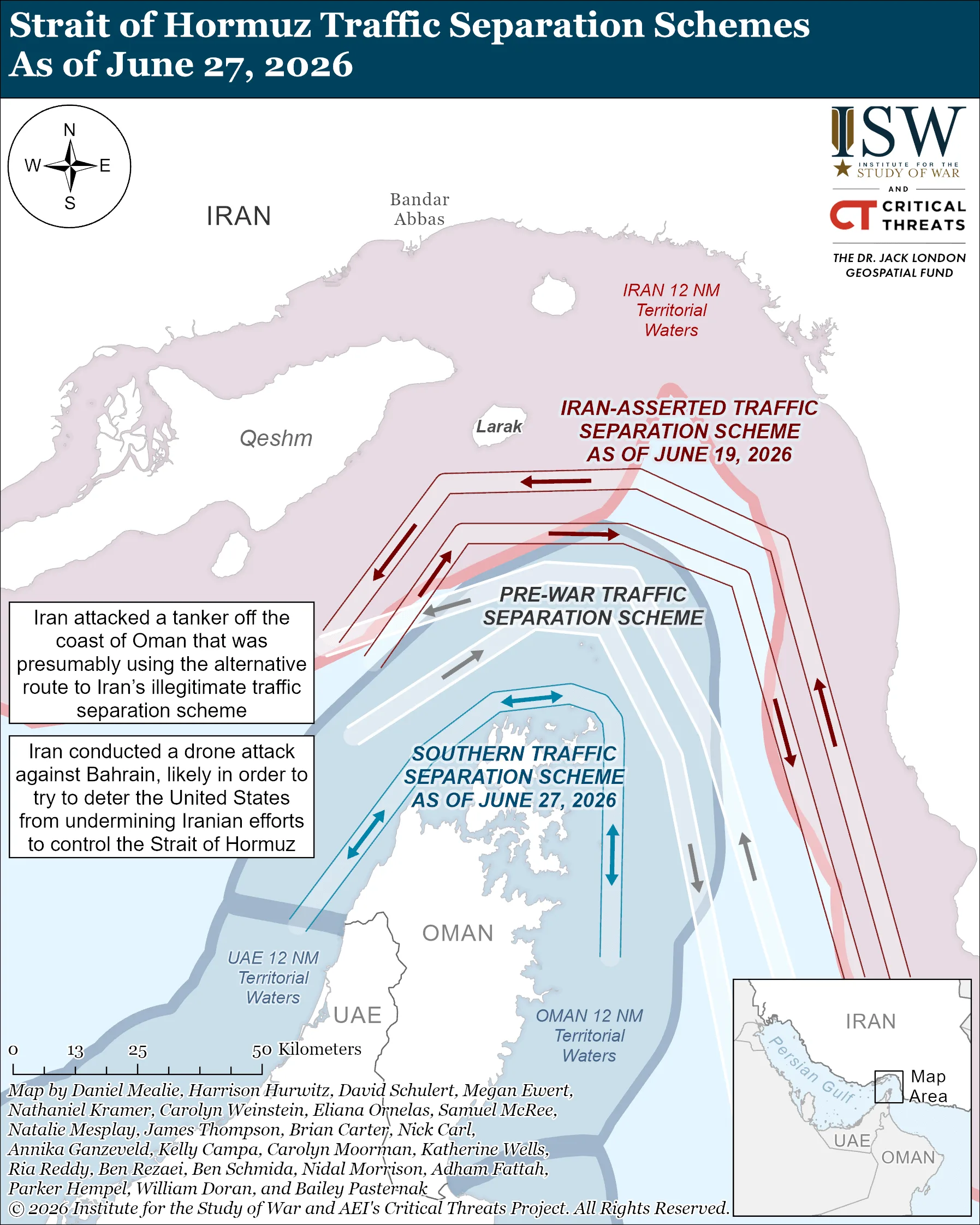
Iran’s strikes against Bahrain may also be part of an ongoing Iranian effort to coerce the Gulf states to accept Iran’s control of the strait and deter them from supporting US efforts to undermine Iran’s control. The Iranian Foreign Affairs Ministry responded to the US retaliatory strikes against Iran on June 26 by warning Gulf states not to allow the United States to attack Iran from bases within their territory.[10] Iran’s attack against Bahrain comes after the Gulf Cooperation Council (GCC) and the United States explicitly rejected on June 25 any Iranian attempts to assert control over the strait, including by charging tolls.[11] The Iranian Foreign Affairs Ministry called the US-GCC statement “interventionist, irresponsible, and provocative.”[12] Iran’s attack on Bahrain may have been, in part, intended to signal to the Gulf states that Iran could take military action against them if they support US efforts to undermine Iranian attempts to control the strait. Multiple Gulf states condemned Iran’s drone attack against Bahrain.[13]
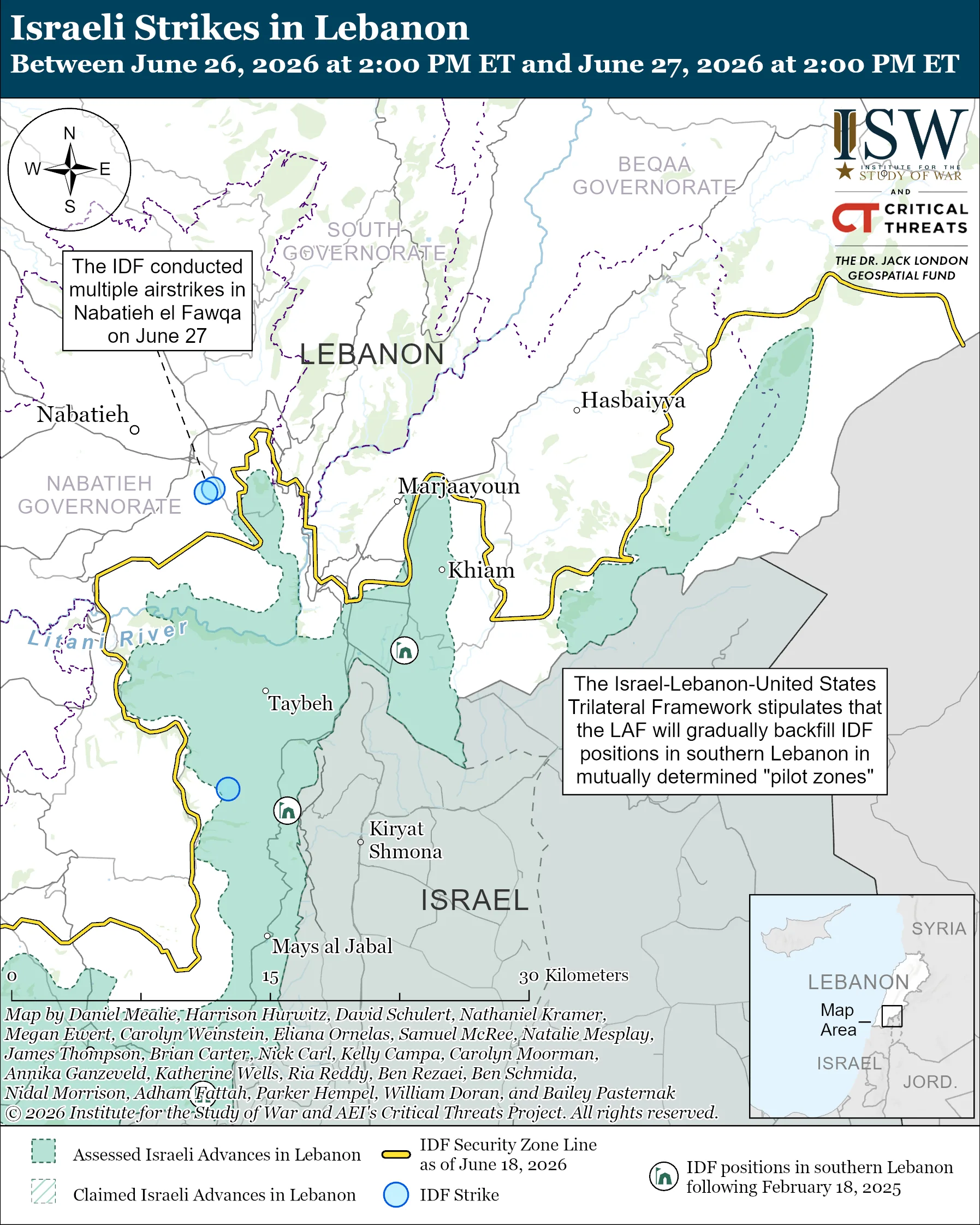
The Israel-Lebanon-United States Trilateral Framework challenges Iranian and Hezbollah efforts to facilitate an Israeli capitulation in Lebanon and threatens Hezbollah’s existence as an armed group. The US State Department released the full text of the framework agreement on June 26.[14] The agreement seeks the disarmament of all non-state armed groups in Lebanon, particularly Hezbollah.[15] The second and third clauses of the agreement confirm that the Lebanese Armed Forces (LAF) will “gradually” reassert control over all of southern Lebanon and that the Israel Defense Forces (IDF) will “progressively redeploy” out of mutually determined “pilot zones.”[16] These clauses assert that the LAF will assume full security responsibility for areas where armed groups have been successfully disarmed and dismantled, suggesting that the IDF’s withdrawal from Lebanon is contingent upon Hezbollah’s disarmament.[17] The fourth clause of the agreement emphasizes that the LAF will completely disarm all non-state groups and ensure that they possess “no armed capabilities anywhere in Lebanon,” which would include Hezbollah’s weapons north of the Litani River.[18] Hezbollah has long resisted disarmament north of the Litani River because the group has stockpiled much of its weapons in the Bekaa Valley.[19] The seventh clause of the agreement clarifies that Israel and Lebanon retain the right to self-defense, which similarly challenges Iran’s demand that the IDF cease all military activity in Lebanon.[20] The eleventh clause of the agreement stipulates that the United States and Lebanon will restrict the flow of unspecified funds to any entity affiliated with Lebanese non-state armed groups.[21] Such funds presumably include Iranian funding for Hezbollah. International media reported on June 17 that Iran would use potential economic relief gained from the memorandum of understanding (MoU) with the United States to fund and reconstitute Hezbollah.[22]
Israeli Defense Minister Israel Katz reiterated on June 27 that the IDF will maintain its “security zone” in southern Lebanon amid continued Israeli strikes on Hezbollah targets.[23] An Israeli military correspondent reported on June 27 that Katz lauded the “historic” deal between Israel and Lebanon but said that the IDF will not “entirely withdraw” from Lebanon and that Israeli forces will maintain their “security zone,” including the Beaufort Castle ridge area.[24] He also directed the IDF to prepare for a prolonged deployment in the “security zone” and to continue to protect northern Israel from Hezbollah attacks.[25] The IDF continued strikes on Hezbollah targets on June 27. Lebanese media reported multiple IDF airstrikes on Nabatieh el Fawqa, Nabatieh District, on June 27.[26] The IDF told Reuters that one of the strikes targeted an individual who posed a threat to IDF forces but did not provide further details.[27] Lebanese media separately reported an Israeli strike near Tallouseh, Marjaayoun District, on June 27.[28] A Hezbollah-aligned journalist also claimed on June 27 that the IDF had advanced toward the outskirts of Kfarchouba, Hasbaya District, but the IDF has not confirmed this report at the time of this writing.[29]
Hezbollah is conducting an information operation to weaken the Lebanese government’s resolve to disarm Hezbollah by threatening renewed civil war in Lebanon if the government attempts to implement the framework agreement. Hezbollah Parliamentarian Hassan Fadlallah denounced the tripartite agreement on June 26 and warned that attempts by the Lebanese government to implement the agreement could reignite civil war in Lebanon.[30] Fadlallah said that Hezbollah will retain its weapons and confront any Lebanese government action to disarm the group. Fadlallah also claimed that the LAF is militarily incapable of disarming Hezbollah.[31] Hezbollah supporters protested against the framework agreement in the Beirut area on June 26 and 27 in line with Fadlallah’s threat that the group would mobilize the Lebanese “street” to stop the government from implementing the agreement.[32] Hezbollah has long leveraged the threat of renewed civil war to deter the Lebanese government from attempting to disarm the group. Hezbollah Secretary General Naim Qassem threatened in August 2025 to organize mass anti-government protests and said that there would be “no life” in Lebanon if the LAF attempted to disarm Hezbollah, for example.[33] Other Hezbollah figures have attempted to delegitimize the framework agreement by deeming it unlawful and spreading disinformation about the agreement’s provisions. Hezbollah parliamentary bloc leader Mohammad Raad alleged that the tripartite agreement is a “cover up” for a permanent Israeli military presence in Lebanon, despite Israel’s affirmation in the agreement that it has no territorial ambitions in Lebanon.[34] Various Hezbollah officials, including Qassem, called the framework agreement unconstitutional and a violation of the sensitive, sectarian National Pact, which suggests that Hezbollah is trying to depict the agreement as both illegal and liable to inflame sectarian tensions.[35]
The Iranian regime likely views the framework agreement as contravening the Lebanon-related clause of the US-Iran MoU and may attempt to use the agreement as a pretext to further delay nuclear negotiations with the United States. Iranian state media claimed that the framework agreement is illegitimate because it exists separately from the MoU and US-Iran negotiations and preserves the IDF’s freedom of movement in Lebanon.[36] The Iranian Foreign Affairs Ministry issued a statement on June 27 that characterized continued Israeli military action in Lebanon as a violation of the first clause of the MoU, which stipulates the “immediate and permanent termination of military operations on all fronts, including in Lebanon.”[37] The Iranian regime likely views the framework agreement, which permits Israel’s continued ground presence until Hezbollah is completely disarmed and enables Israel to act against Hezbollah in self-defense, as contravening the first clause of the MoU.[38] Fadlallah claimed on June 26 that Iran would not sign any agreement with the United States until Israel withdraws from Lebanese territory entirely.[39] ISW-CTP has repeatedly assessed that Iran has attempted to condition US-Iran nuclear negotiations on the United States compelling Israel to halt operations against Hezbollah in Lebanon and withdraw from Lebanese territory as part of its efforts to preserve Hezbollah and delay nuclear negotiations.[40]
US-Iran Negotiations
Nothing significant to report.
Maritime Activity in the Strait of Hormuz and Persian Gulf
See topline section.
US and Israeli Air Campaign
Nothing significant to report.
Iranian Domestic Affairs
Nothing significant to report.
Iran’s Axis of Resistance
Lebanese Hezbollah and the Israeli Campaign in Lebanon
See topline section.
Other Axis of Resistance Activity
The Iranian-backed Popular Mobilization Forces (PMF) appointed Haqqi Ismail al Khalidi as the PMF Anbar Operations Command commander on June 24.[41] The PMF is an Iraqi state security service that includes multiple Iranian-backed Iraqi militias that answer to Iran instead of the prime minister.[42] Khalidi replaced Haider al Hammouri, who temporarily held the position after US-Israeli combined force strikes killed former PMF Anbar Operations Command Commander Dawai al Baiji in March 2026.[43] The PMF has also characterized Kataib Hezbollah-affiliated Qasim Musleh al Khafaji as the PMF Anbar Operations Command commander.[44] It is unclear how Khafaji and Khalidi’s responsibilities differ.

[1] https://x.com/UK_MTO/status/2070160682264269241
[2] https://www.nytimes.com/2026/06/26/world/middleeast/strait-of-hormuz-iran-attack.html
[3] https://www.nytimes.com/live/2026/06/27/world/us-iran-strikes-hormuz
[4] https://www.nytimes.com/live/2026/06/27/world/us-iran-strikes-hormuz
[5] https://x.com/UK_MTO/status/2070804115509190704/photo/1
[6] https://x.com/UK_MTO/status/2070804115509190704/photo/1
[7] https://www.imo.org/en/mediacentre/pressbriefings/pages/imo-accounces-evacuation-plan-in-strait-of-hormuz.aspx
[8] https://www.npr.org/2026/06/26/nx-s1-5871963/un-agency-pauses-evacuation-of-ships-through-strait-of-hormuz-after-attack-vessel ; https://x.com/UK_MTO/status/2070160682264269241
[9] https://x.com/UK_MTO/status/2070809278235963514/photo/1
[10] https://t.me/defapress_ir/62001
[11] https://www.state.gov/releases/office-of-the-spokesperson/2026/06/joint-statement-following-the-ministerial-meeting-of-the-united-states-and-the-gulf-cooperation-council-gcc/
[12] https://t.me/MFAIran/35625
[13] https://www.foxnews.com/world/gulf-countries-strongly-condemn-irans-drone-attack-bahrain-rising-tensions-threaten-mou
[14] https://www.state.gov/releases/office-of-the-spokesperson/2026/06/trilateral-framework-between-the-united-states-of-america-the-state-of-israel-and-the-republic-of-lebanon/
[15] https://www.state.gov/releases/office-of-the-spokesperson/2026/06/trilateral-framework-between-the-united-states-of-america-the-state-of-israel-and-the-republic-of-lebanon/
[16] https://www.state.gov/releases/office-of-the-spokesperson/2026/06/trilateral-framework-between-the-united-states-of-america-the-state-of-israel-and-the-republic-of-lebanon/
[17] https://www.state.gov/releases/office-of-the-spokesperson/2026/06/trilateral-framework-between-the-united-states-of-america-the-state-of-israel-and-the-republic-of-lebanon/
[18] https://www.state.gov/releases/office-of-the-spokesperson/2026/06/trilateral-framework-between-the-united-states-of-america-the-state-of-israel-and-the-republic-of-lebanon/
[19] https://www.cnn.com/2026/01/08/middleeast/hezbollah-disarmament-israel-lebanon-conflict-intl ; https://understandingwar.org/research/middle-east/weakening-hezbollah-requires-faster-international-support-to-lebanon/
[20] https://www.state.gov/releases/office-of-the-spokesperson/2026/06/trilateral-framework-between-the-united-states-of-america-the-state-of-israel-and-the-republic-of-lebanon/ ; https://t.me/defapress_ir/62001
[21] https://www.state.gov/releases/office-of-the-spokesperson/2026/06/trilateral-framework-between-the-united-states-of-america-the-state-of-israel-and-the-republic-of-lebanon/
[22] https://www.reuters.com/world/asia-pacific/after-war-losses-hezbollah-seen-gaining-iran-us-deal-2026-06-17/
[23] https://x.com/manniefabian/status/2070899557135782102 ; https://www.reuters.com/world/middle-east/israeli-drone-strike-hits-southern-lebanon-day-after-security-deal-2026-06-27/
[24] https://x.com/manniefabian/status/2070899557135782102
[25] https://x.com/manniefabian/status/2070899557135782102
[26] https://t.me/MTVLebanoNews/76206 ; https://t.me/sameralhajali/8204; https://t.me/sameralhajali/8206
[27] https://www.reuters.com/world/middle-east/israeli-drone-strike-hits-southern-lebanon-day-after-security-deal-2026-06-27/
[28] https://t.me/MTVLebanoNews/76177
[29] https://t.me/sameralhajali/8189
[30] https://t.me/sameralhajali/8183
[31] https://t.me/sameralhajali/8183 ; https://t.me/sameralhajali/8184
[32] https://t.me/sameralhajali/8184 ; https://x.com/MarioLeb79/status/2070608950366790086?s=20 ; https://x.com/MarioLeb79/status/2070633430770139578?s=20 ; https://almanar dot com.lb/article/982347/?s=tg
[33] https://www.reuters.com/world/middle-east/hezbollah-warns-lebanon-will-have-no-life-if-state-moves-against-it-2025-08-15/ ; https://understandingwar.org/research/middle-east/iran-update-august-15-2025/
[34] https://t.me/sameralhajali/8199 ; https://www.state.gov/releases/office-of-the-spokesperson/2026/06/trilateral-framework-between-the-united-states-of-america-the-state-of-israel-and-the-republic-of-lebanon/
[35] https://t.me/mmirleb/17618 ; https://t.me/sameralhajali/8194
[36] https://t.me/Nournews_ir/367595
[37] https://t.me/defapress_ir/62001 ; https://www.cnn.com/2026/06/17/middleeast/us-iran-war-mou-text-intl
[38] https://www.state.gov/releases/office-of-the-spokesperson/2026/06/trilateral-framework-between-the-united-states-of-america-the-state-of-israel-and-the-republic-of-lebanon/ ; https://www.cnn.com/2026/06/17/middleeast/us-iran-war-mou-text-intl
[39] https://t.me/sameralhajali/8184
[40] https://understandingwar.org/research/middle-east/iran-update-special-report-june-19-2026/
[41] https://al-hashed dot gov.iq/2026/06/24/%d8%a7%d9%84%d8%ae%d8%a7%d9%84%d8%af%d9%8a-%d9%82%d8%a7%d8%a6%d8%af%d8%a7-%d9%84%d8%b9%d9%85%d9%84%d9%8a%d8%a7%d8%aa-%d8%a7%d9%84%d8%ad%d8%b4%d8%af-%d8%a7%d9%84%d8%b4%d8%b9%d8%a8%d9%8a-%d9%81%d9%8a/
[42] https://understandingwar.org/research/middle-east/the-leadership-and-purpose-of-iraqs-popular-mobilization-forces/
[43] https://al-hashed dot gov.iq/2026/06/24/%d8%a7%d9%84%d8%ae%d8%a7%d9%84%d8%af%d9%8a-%d9%82%d8%a7%d8%a6%d8%af%d8%a7-%d9%84%d8%b9%d9%85%d9%84%d9%8a%d8%a7%d8%aa-%d8%a7%d9%84%d8%ad%d8%b4%d8%af-%d8%a7%d9%84%d8%b4%d8%b9%d8%a8%d9%8a-%d9%81%d9%8a/ ; https://al-hashed dot gov.iq/2026/03/24/%d8%a8%d9%8a%d8%a7%d9%86-%d9%85%d9%86-%d9%87%d9%8a%d8%a6%d8%a9-%d8%a7%d9%84%d8%ad%d8%b4%d8%af-%d8%a7%d9%84%d8%b4%d8%b9%d8%a8%d9%8a-5/
[44] https://al-hashed dot gov.iq/2026/03/24/%d8%a7%d9%84%d8%a3%d9%86%d8%a8%d8%a7%d8%b1-%d9%82%d8%a7%d8%b3%d9%85-%d9%85%d8%b5%d9%84%d8%ad-%d9%8a%d8%ac%d8%b1%d9%8a-%d8%ac%d9%88%d9%84%d8%a9-%d8%aa%d9%81%d9%82%d8%af%d9%8a%d8%a9-%d9%81%d9%8a/ ; https://al-hashed dot gov.iq/2026/03/18/%d9%82%d9%8a%d8%a7%d8%af%d8%a9-%d8%b9%d9%85%d9%84%d9%8a%d8%a7%d8%aa-%d8%a7%d9%84%d8%a3%d9%86%d8%a8%d8%a7%d8%b1-%d9%84%d9%84%d8%ad%d8%b4%d8%af-%d8%aa%d8%a4%d9%83%d8%af-%d8%b3%d9%84%d8%a7%d9%85%d8%a9/ ; https://understandingwar.org/research/middle-east/the-leadership-and-purpose-of-iraqs-popular-mobilization-forces/