
The Institute for the Study of War (ISW) and The Critical Threats Project (CTP) at the American Enterprise Institute are publishing updates Monday through Friday to provide analysis on the war with Iran. Most updates cover events from the past 24-hour period, whereas Monday updates also include events from the preceding weekend, collected after ISW-CTP’s 2:00 PM ET Friday data cutoff. ISW-CTP may publish special updates on Saturdays and Sundays if events warrant, however.
Key Takeaways
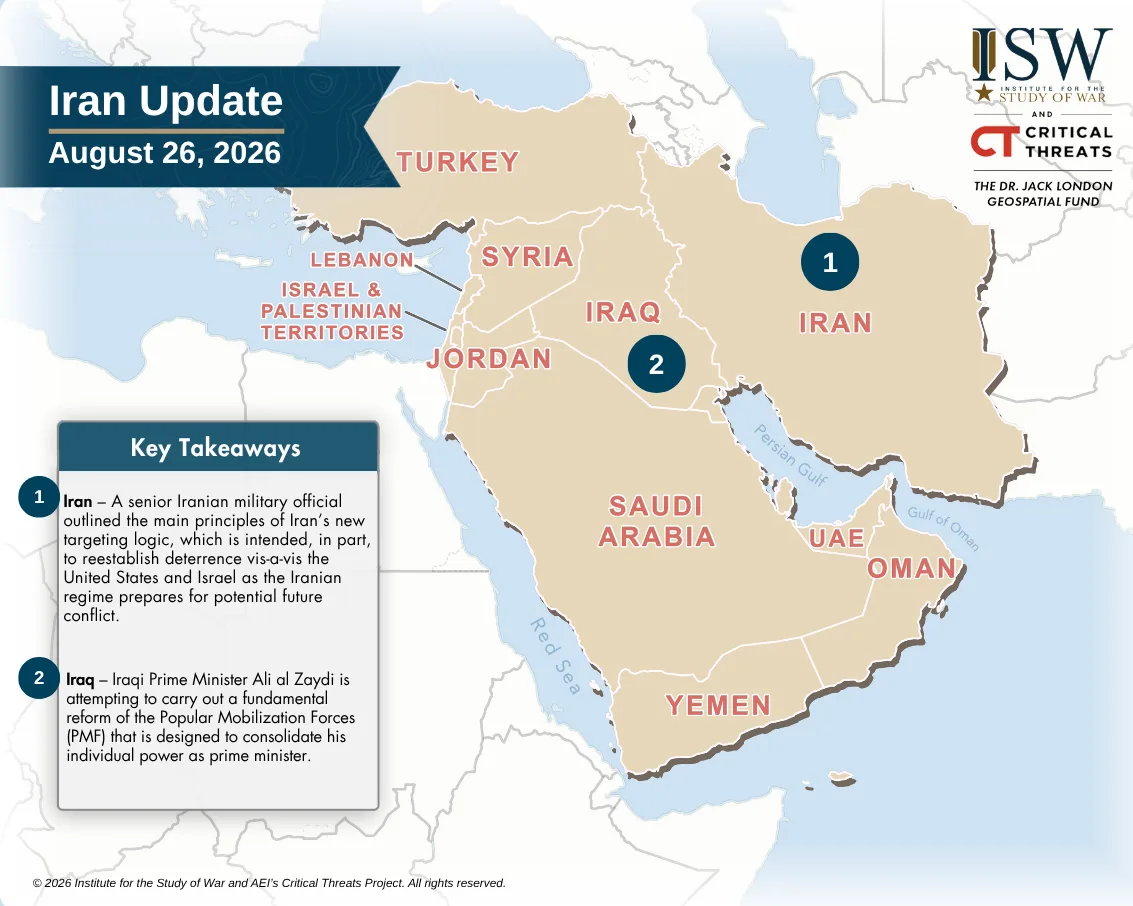
- A senior Iranian military official outlined the main principles of Iran’s new targeting logic, which is intended, in part, to reestablish deterrence vis-à-vis the United States and Israel as the Iranian regime prepares for potential future conflict. These principles include “rapid response[s]” to US and Israeli attacks, responding to individual strikes on Iranian territory with multiple strikes on various targets, preemptive strikes against US assets, and expanding the geographic scope of Iranian conflicts with the United States and Israel.
- Iraqi Prime Minister Ali al Zaydi is attempting to carry out a fundamental reform of the Popular Mobilization Forces (PMF) that is designed to consolidate his individual power as prime minister. Zaydi’s efforts to professionalize the PMF could fulfill US objectives regarding militia disarmament. The success of these reforms would depend on Zaydi’s ability to enforce them and appoint professional personnel to undertake institutional changes throughout the PMF.
- The Iraqi Parliament is unlikely to approve this draft PMF Law, however. The Parliamentary Security and Defense Committee is unlikely to approve the amended draft PMF Law, given that the committee includes parliamentarians from Iranian-backed Iraqi militia political wings that also control PMF brigades.
- Iranian opposition to any Iraqi federal government attempts to weaken the Iraqi militias could undermine Zaydi’s efforts to subordinate the PMF under himself, even if this draft law were to pass through the Iraqi Parliament.
Toplines
A senior Iranian military official outlined the main principles of Iran’s new targeting logic, which is intended, in part, to reestablish deterrence vis-à-vis the United States and Israel as the Iranian regime prepares for potential future conflict. Iranian Artesh Spokesperson Brigadier General Mohammad Akraminia conducted an interview with regime media on August 26 in which he explained Iran’s “new” military doctrine, which he described as a shift from “defensive” military action to “offensive” action.[1] Akraminia noted that this doctrinal shift emerged following the June 2025 12-Day War, which is consistent with statements from Iranian officials over the past year that Iran has shifted to an “offensive” and “proactive” military posture.
Akraminia laid out four key principles of Iran’s new targeting logic. Akraminia claimed that Iran’s new approach involves “rapid response” and that Iran responded to the start of US and Israeli operations in February 2026 “within two hours.”[2] The Iranian regime had struggled to respond quickly in previous rounds of conflict with Israel and the United States, including in the June 2025 War, when Israeli strikes on missile sites and dozens of Islamic Revolutionary Guards Corps (IRGC) Aerospace Force commanders disrupted Iran’s ability to respond.[3]
Akraminia stated that another element of Iran’s new targeting logic involves responding to individual strikes on Iranian territory with multiple strikes against various targets. ISW-CTP cannot confirm that Iran adopted this approach during the recent war, but this approach would be consistent with Iranian efforts to impose high costs on the United States and its regional partners and allies to degrade their willingness to continue the war and to coerce them to acquiesce to Iranian demands.
Akraminia claimed that Iran’s new doctrine includes preemptive strikes against US assets, which is consistent with recent statements from Iranian officials to Western media that Iran is considering taking preemptive action against the United States and regional countries. Akraminia cited Iran’s July 28 attack on the Muwaffaq Salti Airbase in Azraq, Jordan, after a four-day pause in strikes between the United States and Iran as an example of a preemptive strike. Akraminia claimed that US forces were “assembling personnel and equipment there to intensify attacks [against Iran].”[4] Unspecified Iranian officials similarly told the Wall Street Journal on August 16 that the IRGC has developed plans for potential “preemptive strikes.”[5] ISW-CTP assessed at the time that Iranian officials likely decided to publicize these plans to Western media to coerce the United States to surrender to Iranian demands as well as to restore deterrence vis-à-vis the United States and its regional partners.[6]
Akraminia lastly emphasized that the regime’s new military doctrine includes expanding a conflict’s geographic scope to encompass adversary interests across the region, including energy hubs, the Bab al Mandeb Strait, and undersea internet cables.[7] This statement also echoes what unspecified Iranian officials told the Wall Street Journal on August 16, specifically that the IRGC had reportedly devised plans for further escalation against the United States and its allies, including potential strikes on internet cables in the Persian Gulf.[8] Akraminia’s comments about expanding regional conflicts to the Bab al Mandeb Strait are consistent with the Iranian regime’s effort during the recent conflict to encourage the Houthis to conduct attacks on international shipping.[9] Iran also sent advisers to Yemen and monitored the deployment of missiles, drone launchers, and naval weapons along the Red Sea coast during the conflict.[10]
Iraqi Prime Minister Ali al Zaydi is attempting to carry out a fundamental reform of the Popular Mobilization Forces (PMF) that is designed to consolidate his individual power as prime minister. Zaydi recently reestablished the Office of the Commander in Chief of the Armed Forces, which places several security institutions, including the PMF, under his authority.[11] A senior Iraqi government source separately told UK-based, Qatari-owned media on August 25 that unidentified actors, likely referring to Zaydi administration officials, made several amendments to the draft PMF Law that aim to limit the PMF’s operational powers.[12] The Iraqi government has not published the text of the draft PMF Law or submitted the draft law to the Iraqi Parliament at this time. The draft PMF Law likely refers to the Popular Mobilization Authority Law that former Prime Minister Mohammad Shia al Sudani withdrew from Parliament in August 2025 due to US opposition to the law.[13] The legislation would have likely increased Iran’s influence in the Iraqi security establishment by formalizing key PMF structures, per a July 2025 version of the draft law.[14]
The senior Iraqi government source stated that the new amendments to the draft PMF Law eliminate provisions that make the PMF a “competitor” to the Iraqi Army.[15] The source stated that the amended draft law sets a retirement age of 60, which would force several current PMF leaders, including Popular Mobilization Commission Chairman Faleh al Fayyadh, to retire and enable Zaydi to make comprehensive changes to the PMF’s current leadership.[16] Zaydi has reportedly been considering “sweeping” leadership changes to the PMF, which could include appointing Iraqi Army and Counter Terrorism Service officers to PMF leadership positions.[17] Iraqi sources previously told UK-based, Qatari-owned media on August 12 that high-ranking Iraqi Army officers will be integrated into the PMF to assist with redistributing PMF fighters across brigades and provinces.[18] The replacement of senior PMF leaders with high-ranking Iraqi Army officers would in effect subordinate the PMF to the Iraqi Army. The Iraqi source speaking to UK-based, Qatari-owned media on August 25 similarly noted that the draft law aims to disperse PMF fighters to curb the existence of “factional blocs” within the PMF, likely referring to Iranian-backed Iraqi militia-controlled PMF brigades that do not answer to the prime minister.[19] These amendments highlight that Zaydi is attempting to dilute the power of the PMF, which would help consolidate his individual authority over this institution and as the Iraqi prime minister more broadly. The federal government could change these amendments or add new ones at any time before submitting the draft law to parliament.
Zaydi’s efforts to professionalize the PMF could fulfill US objectives regarding militia disarmament. The United States has applied intense financial pressure on Zaydi to disarm the militias due to militia attacks on US and foreign targets in Iraq and the region in recent months.[20] This US pressure provides Zaydi with political cover to attempt to reform the PMF, which some members of his Shia Coordination Framework coalition will likely oppose. Integrating the militias into the PMF and successfully implementing the reforms included in the reported draft law would probably address the United States’ core objectives concerning the militias, which include stopping militia attacks on US and allied targets in Iraq and the region as well as reducing Iranian influence in Iraq. An unidentified “high-ranking” source told Qatari media on August 25 that Zaydi discussed the PMF Law with unspecified US officials during his July visit to Washington, D.C.[21] The US officials reportedly expressed concern over some provisions of the draft law, but Zaydi emphasized that the law would regulate the status of PMF members and the PMF’s administrative structure.[22]
The success of these reforms would depend on Zaydi’s ability to enforce them and appoint professional personnel to undertake institutional changes throughout the PMF. The PMF has previously resisted Iraqi federal government attempts to reform the institution, such as under former Prime Minister Haider al Abadi’s administration. Zaydi’s efforts to reform the PMF will require him to appoint professional officers to senior PMF positions who incentivize good behavior, hold their subordinates accountable, and ensure adherence to the formal chain of command, thus professionalizing the organization. Zaydi is reportedly considering appointing Iraqi Army and Counter Terrorism Service officers to PMF leadership positions as part of his reform effort. Former Prime Minister Mustafa al Kadhimi executed similar reforms to the Iraqi National Intelligence Service to increase its efficiency and independence while serving as its head between 2016 and 2020.[23] Kadhimi then protected these gains as prime minister between 2020 and 2022 while reforming the security sector.[24]
The Iraqi Parliament is unlikely to approve this draft PMF Law, however. Parliamentary committees must review and approve draft laws before Parliament can convene and vote on the law.[25] The Parliamentary Security and Defense Committee is unlikely to approve the amended draft PMF Law, given that the committee includes parliamentarians from Iranian-backed Iraqi militia political wings that also control PMF brigades.[26] These parliamentarians would almost certainly oppose the draft law’s provisions that reduce PMF leaders’ privileges.[27]
Iranian opposition to any Iraqi federal government attempts to weaken the Iraqi militias could undermine Zaydi’s efforts to subordinate the PMF under himself, even if this draft law were to pass through the Iraqi Parliament. Sources close to the federal government told Iraqi media on August 26 that Iran has become less flexible on militia disarmament in recent weeks and has attempted to convince the federal government to push back its September 30 deadline to restrict arms to the state.[28] The sources assessed that Iran’s increased opposition to militia disarmament is due to stalled US-Iran negotiations and US economic pressure on Iran.[29] Iran has rejected militia disarmament for months, as corroborated during recent visits by IRGC Quds Force Commander Brigadier General Esmail Ghaani and Iranian Parliament Speaker Mohammad Bagher Ghalibaf to Baghdad.[30] The sources added to Iraqi media that additional Iranian officials, besides Ghaani and Ghalibaf, have also engaged with Iraqi officials on militia disarmament in recent weeks.[31]
Iran has reportedly presented alternatives to disarmament that have included the militias transferring heavy weapons to Iran or the PMF.[32] Even if Iran supports the transfer of weapons to the PMF, it likely opposes and would seek to undermine the amendments to the draft PMF Law outlined above given that those amendments, if successfully implemented, would weaken Iranian influence in the PMF. Iranian-backed Iraqi actors, including within the framework and members of Zaydi’s administration, have recently attempted to convince Zaydi to push back the September 30 deadline.[33] Zaydi’s security adviser and former Iraqi National Security Adviser Qasim al Araji, who is a member of the Iranian-backed Badr Organization, said on August 24 that the deadline is a “starting point” to restrict arms to the state.[34]
US and Partner Military Operations
Nothing significant to report.
Iranian Strike Campaign
Assessed Iranian War Aims:
- Secure international recognition of Iranian control over the Strait of Hormuz
- Degrade the US ability and willingness to continue the war
- Restore deterrence vis-à -vis the United States and its regional partners
- Divide the United States and Israel from the Arab states
See topline section.
US-Iran Negotiations
Nothing significant to report.
Iranian Domestic Affairs
Nothing significant to report.
Lebanon
Nothing significant to report.
Iraq
See topline section.
Arabian Peninsula
Nothing significant to report.

[1] https://www.mehrnews dot com/news/6926950
[2] https://www.mehrnews dot com/news/6926950
[3] https://understandingwar.org/research/middle-east/iran-update-june-26-2025/
[4] https://www.mehrnews dot com/news/6926950 ; https://understandingwar.org/research/middle-east/iran-update-special-report-july-29-2026/
[5] https://www.wsj.com/world/middle-east/iran-plan-escalate-war-cc657664?eafs_enabled=false
[6] https://understandingwar.org/research/middle-east/iran-update-special-report-august-17-2026/
[7] https://www.mehrnews dot com/news/6926950
[8] https://www.wsj.com/world/middle-east/iran-plan-escalate-war-cc657664?st=RXaQT6
[9] https://www.reuters.com/world/middle-east/iran-tells-houthis-close-red-sea-gateway-if-us-hits-power-network-sources-say-2026-07-16/
[10] https://www.wsj.com/world/middle-east/iran-plan-escalate-war-cc657664?st=RXaQT6
[11] https://shafaq dot com/en/Security/Unified-Iraqi-security-command-returns-after-12-years
[12] https://www.alaraby.co dot uk/politics/خاص-قانون-الحشد-الشعبي-يعاود-الظهور-معدلاً-أمام-البرلمان-العراقي
[13] https://www.rudaw dot net/sorani/middleeast/iraq/270820253
[14] https://www.rudaw dot net/Library/Files/Uploaded%20Files/07/NewFolder/175%20175%20175%20(1).pdf ; https://observeriraq dot net/%D8%B9%D8%B1%D8%A7%D9%82-%D8%A7%D9%88%D8%A8%D8%B2%D9%8A%D8%B1%D9%81%D8%B1-%D8%AA%D9%86%D8%B4%D8%B1-%D9%86%D8%B5-%D9%85%D8%B4%D8%B1%D9%88%D8%B9-%D9%82%D8%A7%D9%86%D9%88%D9%86-%D9%87%D9%8A%D8%A6%D8%A9/ ; https://understandingwar.org/backgrounder/iran-update-august-6-2025
[15] https://www.alaraby.co dot uk/politics/خاص-قانون-الحشد-الشعبي-يعاود-الظهور-معدلاً-أمام-البرلمان-العراقي
[16] https://www.alaraby.co dot uk/politics/خاص-قانون-الحشد-الشعبي-يعاود-الظهور-معدلاً-أمام-البرلمان-العراقي
[17] https://shafaq dot com/ar/سیاسة/خاص-الزيدي-يدرس-تغييرات-واسعة-في-قيادات-الحشد-الشعبي
[18] https://www.alaraby dot co.uk/politics/خاص-تغييرات-جوهرية-مرتقبة-داخل-الحشد-الشعبي-في-العراق
[19] https://www.alaraby.co dot uk/politics/خاص-قانون-الحشد-الشعبي-يعاود-الظهور-معدلاً-أمام-البرلمان-العراقي ;https://understandingwar.org/research/middle-east/the-leadership-and-purpose-of-iraqs-popular-mobilization-forces/
[20] https://www.wsj.com/world/middle-east/u-s-blocks-iraqs-dollar-shipments-to-squeeze-its-iran-backed-militias-3270d5af ; https://www.newarab dot com/news/us-sends-dollar-shipment-iraq-threatens-sanctions; https://shafaq dot com/ar/سیاسة/حصري-اميركا-تشترط-تفكيك-الفصا-ل-مقابل-تحرير-30-مليار-دولار-من-موال-صدام
[21] https://www.alaraby.co dot uk/politics/خاص-قانون-الحشد-الشعبي-يعاود-الظهور-معدلاً-أمام-البرلمان-العراقي
[22] https://www.alaraby.co dot uk/politics/خاص-قانون-الحشد-الشعبي-يعاود-الظهور-معدلاً-أمام-البرلمان-العراقي
[23] https://ctc.westpoint.edu/iraqs-new-regime-change-how-tehran-backed-terrorist-organizations-and-militias-captured-the-iraqi-state/ ; https://www.al-monitor.com/originals/2020/09/iraq-security-reform-pmu-iran.html ; https://x.com/mikeknightsiraq/status/1248215500536123392
[24] https://ctc.westpoint.edu/iraqs-new-regime-change-how-tehran-backed-terrorist-organizations-and-militias-captured-the-iraqi-state/ ; https://www.al-monitor.com/originals/2020/09/iraq-security-reform-pmu-iran.html
[25] https://iq.parliament dot iq/%D8%A7%D9%84%D9%86%D8%B8%D8%A7%D9%85-%D8%A7%D9%84%D8%AF%D8%A7%D8%AE%D9%84%D9%8A/
[26] https://baghdadtoday dot news/302887-.html ; https://ahlualhaq dot iq/index.php?page=details&id=7612&lang=en ; https://shafaq dot com/ar/سیاسة/عضو-بالدفاع-النيابية-لا-حاجة-لبقا-التحالف-ونطالب-ب-قرار-خدمة-العلم ; https://www.washingtoninstitute.org/policy-analysis/profile-badr-organization ; https://www.washingtoninstitute.org/policy-analysis/profile-asaib-ahl-al-haq-0
[27] https://www.alaraby.co dot uk/politics/خاص-قانون-الحشد-الشعبي-يعاود-الظهور-معدلاً-أمام-البرلمان-العراقي
[28] https://almadapaper dot net/450020/
[29] https://almadapaper dot net/450020/
[30] https://aawsat dot com/العالم-العربي/المشرق-العربي/5308866-قاليباف-يناقش-في-بغداد-خطة-إيرانية-لـإخفاء-سلاح-الفصائل ; https://alhurra dot com/32845 ; https://shafaq dot com/ar/سیاسة/حصري-قا-ني-يرسم-خطا-حمر-في-بغداد-لا-حصر-لسلاح-الفصا-ل-ولا-صدام-مع-الدولة ; https://shafaq dot com/ar/سیاسة/خاص-قا-ني-في-بغداد-لبحث-سلاح-الفصا-ل-ومسار-تصدير-النفط-عبر-هرمز
[31] https://almadapaper dot net/450020/
[32] https://almadapaper dot net/450020/
[33] https://t.me/alakhbar_news/93842 ; https://shafaq dot com/ar/سیاسة/وداعا-لـ30-يلول-ا-تلاف-المالكي-يلمح-لت-جيل-موعد-نزع-سلاح-الفصا-ل ; https://almadapaper dot net/449347/
[34] https://almadapaper dot net/450020/ ; https://www.arabnews dot com/node/2655697/middle-east