The Institute for the Study of War (ISW) and The Critical Threats Project (CTP) at the American Enterprise Institute are publishing updates Monday through Friday to provide analysis on the war with Iran. Most updates cover events from the past 24-hour period, whereas Monday updates also include events from the preceding weekend, collected after ISW-CTP’s 2:00 PM ET Friday data cutoff. ISW-CTP may publish special updates on Saturdays and Sundays if events warrant, however.
Key Takeaways
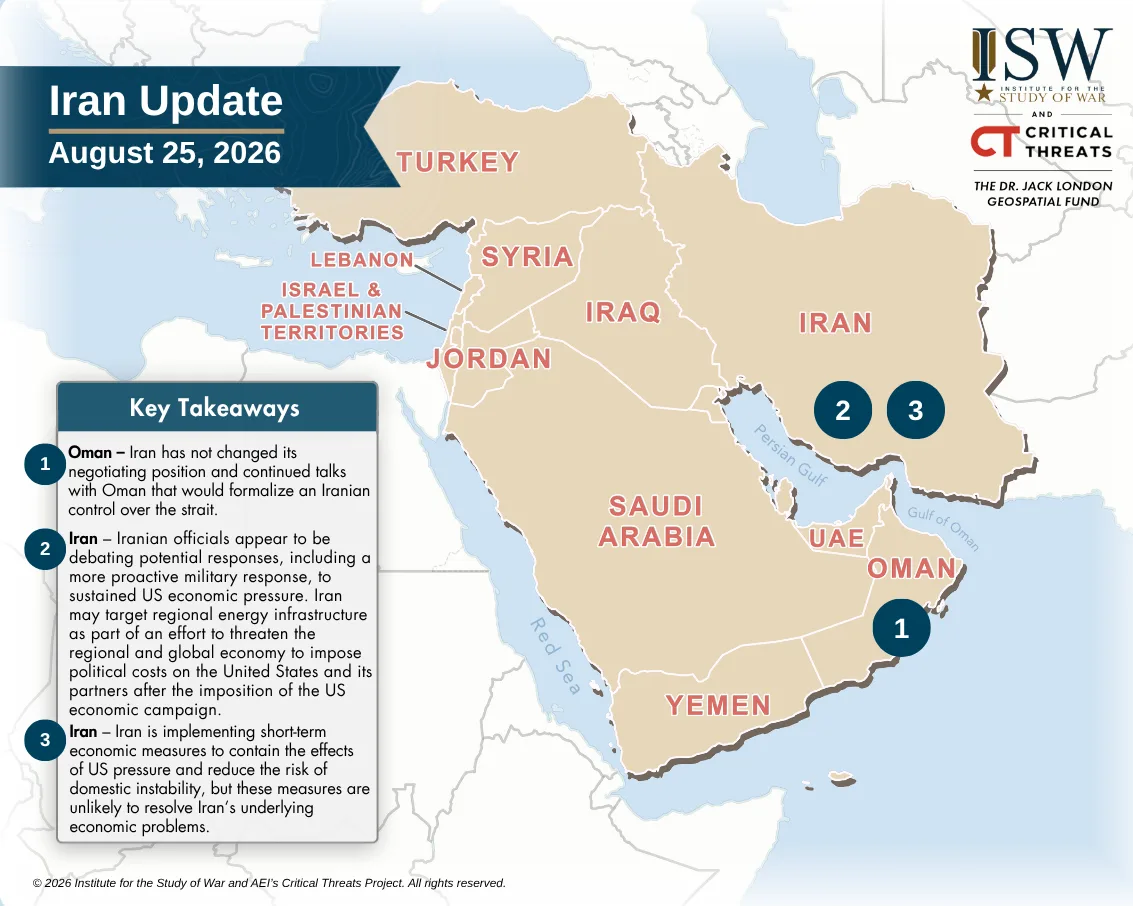
- Iran has not changed its negotiating position and continues to seek formal control over transit through the Strait of Hormuz as Pakistan tries to revive US-Iran negotiations. Iran has continued talks with Oman over transit arrangements that would formalize an Iranian role in controlling commercial traffic through the strait, which also demonstrates the lack of progress in talks.
- Iranian officials appear to be debating potential responses, including a more proactive military response, to sustained US economic pressure. Iran may target regional energy infrastructure as part of an effort to threaten the regional and global economy to impose political costs on the United States and its partners after the imposition of the US economic campaign. The regime is likely debating whether it should target regional energy infrastructure, however.
- Iran is implementing short-term economic measures to contain the effects of US pressure and reduce the risk of domestic instability, but these measures are unlikely to resolve Iran’s underlying economic problems.
Toplines
Iran has not changed its negotiating position and continues to seek formal control over transit through the Strait of Hormuz as Pakistan tries to revive US-Iran negotiations. Pakistani sources told Reuters on August 25 that there is “significant progress,” and some Iranian officials have expressed general willingness to reengage with the United States.[1] This Pakistani framing is unsurprising — a mediating party has a vested interest in ensuring mediation can occur — but the framing is at odds with reality. Iran’s negotiating team has, according to regime media, continued to emphasize to mediators that the United States must return to the original memorandum of understanding (MoU) and implement Clause 5, which Iran interprets as granting Iran the authority to determine transit arrangements in the strait.[2] That Iran communicated this to the mediators suggests that the mediators are only ferrying unchanged viewpoints between the two sides, not making progress towards a deal.[3]
Iran has continued talks with Oman over transit arrangements that would formalize an Iranian role in controlling commercial traffic through the strait, which also demonstrates the lack of progress in talks.[4] Omani Foreign Minister Badr al Busaidi said on August 25 that Iran and Oman could soon announce a temporary corridor through the strait and other arrangements to restore safe navigation.[5] The United States is continuing to take steps to undermine Iran’s efforts to control commercial traffic through the strait. The US Treasury Department warned on August 24 that companies could face sanctions or penalties if they comply with Iranian safe-passage requirements, including purchasing Iranian-linked insurance and services or complying with information requests.[6] The United States has also sought to keep commercial traffic moving without Iranian permission or fees, which creates a direct challenge to any Iranian influence or control over passage through the strait. US President Donald Trump stated on August 25 that the US Navy had cleared mines from international waters in the strait.[7] Two US officials confirmed that the US Navy cleared the traffic separation scheme between Iran and Oman.[8]
Iranian officials appear to be debating potential responses, including a more proactive military response, to sustained US economic pressure. Iranian Armed Forces General Staff-run outlet Defa Press argued on August 25 that Iran should move away from a reactive strategy in which it waits for an adversary to strike before responding and instead seizes the initiative by imposing costs during periods of pressure.[9] Defa Press argued that Supreme National Security Council Secretary (SNSC) Major General Mohsen Rezaei’s recent threats represent a shift from “reactive defense” toward “active deterrence and strategic initiative.”[10] Rezaei stated in an English-language post on X on August 23 that “if the economic war continues, not a single drop of oil will be exported — neither through the Strait of Hormuz nor from anywhere in the Persian Gulf.”[11] Rezaei added that Iran would regard any country’s participation in or support for the US economic campaign against Iran as an act of war.[12] Defa Press argued that Iran could impose costs beyond the economic domain in response to sanctions, the blockade, and restrictions on Iranian oil exports.[13]
Iran may target regional energy infrastructure as part of an effort to threaten the regional and global economy to impose political costs on the United States and its partners after the imposition of the US economic campaign. Iran would ultimately aim to compel the United States to stop its economic program before Washington accomplishes its objectives in this scenario. Iran has struggled to reliably strike moving vessels, but it can locate and target fixed infrastructure.[14] Axios reported on August 25 that more than 500 ships used the southern channel under US protection in the past 30 days, and Iranian drones or missiles hit only about 2 percent of them.[15] Iran may decide to strike or conduct cyberattacks against static regional energy infrastructure or US civilian infrastructure to impose costs on global energy markets and the US homeland.
The regime is likely debating whether it should target regional energy infrastructure, however. Defa Press did not identify specific targets or call for immediate military action.[16] Defa Press warned that action without an imminent threat could escalate the conflict, encourage coalition-building against Iran, and impose additional political and economic costs.[17] These warnings suggest that Iranian officials are still weighing the risks of this approach and that the approach remains under intra-regime debate. Former Vice President Mostafa Hashemitaba criticized proposals to target neighboring countries’ oil facilities on August 24 and warned that such attacks could have “serious consequences” for Iran, for example.[18] Iranian Supreme Leader’s website, the Voice of Iran, stated in an op-ed on August 23 that Iran could retaliate against states that participate in US economic restrictions and would target those countries’ interests.[19] The op-ed published an image of metal cages over reported Emirati fuel storage tanks, which is an implicit Iranian threat against Emirati energy infrastructure.[20]
Iran is implementing short-term economic measures to contain the effects of US pressure and reduce the risk of domestic instability, but these measures are unlikely to resolve Iran’s underlying economic problems. The regime appears to recognize that continued economic deterioration could threaten domestic stability. Some issues, like rising gas prices, could serve as serious flashpoints for discontent.[21] Iranian officials are relying on measures that can temporarily support liquidity, employment, and household purchasing power without requiring politically costly reforms.[22] It remains unclear how the regime will address the long-term economic challenges caused by the recent US economic campaign.[23] Iranian Economic Affairs and Finance Minister Ali Madani Zadeh stated on August 24 that Iran has prepared alternative financial and trade channels and that the government is prioritizing employment, production, and household livelihoods.[24] The Central Bank of Iran separately announced on August 25 an initial $500 million USD injection of foreign-currency banknotes into the banking system. Iranian authorities also imposed additional restrictions on individuals and entities involved in foreign-exchange and gold speculation.[25] These measures may temporarily improve liquidity and limit market pressure, but they do not address Iran’s broader foreign-currency, inflation, and energy problems.
US and Partner Military Operations
Nothing significant to report.
Iranian Strike Campaign
Assessed Iranian War Aims:
- Secure international recognition of Iranian control over the Strait of Hormuz
- Degrade the US ability and willingness to continue the war
- Restore deterrence vis-à -vis the United States and its regional partners
- Divide the United States and Israel from the Arab states
US-Iran Negotiations
Nothing significant to report.
Iranian Domestic Affairs
See topline section.
Lebanon
Nothing significant to report.
Iraq
Iranian-backed Iraqi Supreme Judicial Council President Faiq Zaidan met with several senior Iranian leaders in Tehran on August 25, reportedly to discuss bilateral judicial and legal cooperation between Iraq and Iran.[26] Zaidan and Iranian leaders also discussed recent US efforts to deepen Iran’s economic isolation.[27] Zaidan met with Iranian President Masoud Pezeshkian, Parliament Speaker Mohammad Bagher Ghalibaf, SNSC Secretary Rezaei, and Judiciary Chief Gholam Ejei in Tehran on August 25 to discuss bilateral cooperation, according to Iranian and Iraqi media.[28] Iraqi media also reported on August 25 that Zaidan told Ejei that Iraq condemns “economic terrorism” against Iran, which is a reference to the latest US sanctions on Iran.[29]
Rezaei and Zaidan also discussed Iran-Iraq coordination against anti-regime Kurdish groups in Iraq along the Iraq-Iran border.[30] UK-based Saudi media reported on August 25 that Rezaei called for a resolution to the problem of anti-regime Kurdish groups operating on the Iran-Iraq border.[31] Zaidan reportedly emphasized the need to ensure border security and to address the threat posed by “anti-Iranian groups” along the Iran-Iraq border, according to Iraqi media.[32] Iran has historically pressured the Iraqi federal government to address anti-regime Kurdish groups that Tehran views as a threat to regime stability.[33]
Iraqi Prime Minister Ali Zaydi, Shia Coordination Framework forces, and Iranian Supreme Leader Representative Mohsen Qomi reportedly met in Baghdad on August 24 to discuss recent Iraqi federal government arrests that have targeted Popular Mobilization Forces (PMF) members.[34] An informed source told Iraqi media on August 25 that the framework asked Zaydi not to use military forces to arrest PMF fighters and instead rely on the judiciary to issue arrest warrants.[35] The source added that framework leaders criticized arrests of PMF leaders and demanded that Zaydi prevent similar operations, which they viewed as provocative.[36] The PMF is an organization largely beholden to the framework and its leadership, so this stance is unsurprising.[37] It is extremely difficult for the government to arrest PMF members without the use of force, but it is also hard to keep PMF members in government custody after their arrest due to the political pressure coming from the framework to release those arrested. Zaydi’s meetings with Iranian and framework officials follow the federal government’s largely failed efforts to crack down on militia activity by force due to militia military strength and Iranian influence within Iraqi institutions.[38] Iranian-backed actors similarly impeded former Iraqi Prime Minister Mustafa al Kadhimi’s efforts to confront the militias.[39]
Office of the Commander-in-Chief of the Armed Forces Director Lieutenant General Abdul Amir al Shammari chaired a Baghdad Operations Command meeting on August 25 to discuss and review a “regional security plan” for Baghdad.[40] Zaydi merged several offices into the Office of the Commander-in-Chief of the Armed Forces on July 26[41] The office, which answers directly to Zaydi, now oversees the Interior and Defense ministries, the Counter Terrorism Service, the Iraqi National Intelligence Service, the PMF, border crossings, and military manufacturing.[42] The Baghdad Operations Command is the Iraqi Security Forces (ISF)’ operational headquarters responsible for security in Baghdad and in the surrounding area.[43] The meeting included representatives from the ISF, intelligence and security institutions, and the PMF.[44] Shammari reviewed implementation mechanisms for the “regional security plan,” explained areas of responsibility, and assigned duties to security forces and agencies during the meeting, according to Shammari’s statement.[45] The plan includes supporting local police agencies to enhance security and stability in Baghdad, intensifying unified intelligence efforts, and preventing the “militarization of the street,” among other aspects.[46] The initiation of this new security plan is notable given recent threats by Iranian-backed Iraqi militias to blockade the Green Zone in Baghdad, which houses the US Embassy and other Iraqi institutions, due to Iraqi federal government attempts to crack down on the militias.[47]
Framework actors are continuing their negotiation efforts between the Iraqi federal government and the Iraqi militias. A framework parliamentarian told Iraqi Kurdish media on August 25 that a framework committee, which includes Badr Organization head Hadi al Ameri and National State Forces Alliance head Ammar al Hakim, has begun talks with Kataib Hezbollah, Harakat Hezbollah al Nujaba, and Kataib Sayyid al Shuhada on disarmament.[48] These militias have been the most kinetically active in recent months, are historically closest with Iran, and have continuously refused to disarm.[49] The Islamic Resistance in Iraq, which is a coalition of Iraqi militias that includes the three militias, released a list of preconditions on August 17 that further indicated the militias have no intention to disarm.[50] Iraqi government spokesperson Haider al Aboudi confirmed on August 25 that September 30 is the “decisive date” to restrict arms to the state, despite efforts by some framework actors to postpone the deadline.[51]
Arabian Peninsula
Saudi Arabia is reportedly seeking to subsidize commercial vessel insurance costs to encourage and increase Saudi and international commercial shipping in the Red Sea amid the ongoing Houthi blockade on Saudi ports.[52] People familiar with the discussions told The Financial Times on August 24 that Saudi Arabia is in talks with London-based insurance brokers to establish a Saudi state-backed fund to subsidize ship insurance rates and provide more comprehensive coverage to ship owners operating in the Red Sea.[53] Commercial vessel insurance coverage and costs for vessels operating in the Red Sea have increased since the Houthis started the group’s blockade on Saudi ports on July 20.[54] Insurance brokerage firms have begun charging higher insurance rates and restricted coverage options in the Red Sea region due to increased risk of Houthi attacks in the Red Sea.[55]
Saudi Arabia likely aims to support commercial carriers, which must be able to turn a profit and be relatively low risk. This will help maintain Saudi Arabia’s ability to export oil and other goods to the global market at a sufficient level. Saudi Arabia has increasingly relied on Yanbu and other Saudi Red Sea ports to export oil and circumvent Iran’s control over the Strait of Hormuz.[56] Saudi oil exports via the Red Sea have increased to 3.5 million barrels per day, up from 120,000 barrels per day prior to the current war, according to The Economist on July 30.[57]

[1] https://www.reuters.com/world/china/iran-vows-retaliate-after-us-widens-sanctions-2026-08-25/
[2] https://t.me/Tasnimnews/440434 ;
https://www.nytimes.com/2026/06/17/us/politics/us-iran-agreement-deal-text.html
[3] https://t.me/Tasnimnews/440434
[4] https://www.cnbc.com/2026/08/25/iran-oman-strait-hormuz-oil.html?msockid=30d3844ec3ce64ce19939373c27865c3
[5] https://x.com/badralbusaidi/status/2092286447470686276?s=20
[6] https://ofac.treasury.gov/media/936751/download?inline
[7] https://truthsocial.com/@realDonaldTrump/posts/117156624974445904
[8] https://www.axios.com/2026/08/25/hormuz-mines-remove-oil-iran-trump
[9] https://defapress dot ir/fa/news/857463
[10] https://defapress dot ir/fa/news/857463
[11] https://x.com/ir_rezaee/status/2091601549931827456?s=20
[12] https://x.com/ir_rezaee/status/2091601549931827456?s=20
[13] https://defapress dot ir/fa/news/857463
[14] https://www.axios.com/2026/08/19/hormuz-iran-oil-gulf-trump
[15] https://www.axios.com/2026/08/25/hormuz-mines-remove-oil-iran-trump
[16] https://defapress dot ir/fa/news/857463
[17] https://defapress dot ir/fa/news/857463
[18] https://www.asriran dot com/fa/amp/news/1186654
[19] https://farsi.khamenei dot ir/others-report?id=63478
[20] https://farsi.khamenei dot ir/others-report?id=63478
[21] https://x.com/IranIntl/status/2091860882892476800?s=20 ;
https://x.com/IranIntl/status/2091685872760459304
[22] https://www.isna dot ir/news/1405060201626/ ;
https://www.iranintl.com/en/202608239193 ; https://apnews.com/article/iran-us-war-sanctions-blockade-fuel-economy-41ac797399040746c2caa76a409ae580 ;
[23] https://understandingwar.org/research/middle-east/iran-update-august-24-2026/
[24] https://www.irib-news dot ir/fa/news/5891984
[25] https://t.me/iribnews/358025
[26] https://shafaq dot com/ar/سیاسة/زيدان-العراق-لن-ينسى-دعم-يران-ويتضامن-معها-في-مواجهة-العدوان ; https://t.me/iribnews/358040 ; https://www.alsumaria dot tv/news/politics/574096/العراق-وايران-يبحثان-تبادل-الخبرات-والتنسيق-في-القضايا-القانونية-المشت ; https://www.alsumaria dot tv/news/politics/574092/رئيس-القضاء-يتباحث-مع-الرئيس-الإيراني-لتعزيز-التعاون-القضائي-والقانوني
[27] https://www.alsumaria dot tv/news/politics/574092/رئيس-القضاء-يتباحث-مع-الرئيس-الإيراني-لتعزيز-التعاون-القضائي-والقانوني; https://t.me/mehrnews/407415 ; https://964media dot com/711032/ ; https://shafaq dot com/ar/سیاسة/زيدان-العراق-لن-ينسى-دعم-يران-ويتضامن-معها-في-مواجهة-العدوان
[28] https://shafaq dot com/ar/سیاسة/زيدان-العراق-لن-ينسى-دعم-يران-ويتضامن-معها-في-مواجهة-العدوان ; https://t.me/iribnews/358040 ; https://www.alsumaria dot tv/news/politics/574096/العراق-وايران-يبحثان-تبادل-الخبرات-والتنسيق-في-القضايا-القانونية-المشت ; https://www.alsumaria dot tv/news/politics/574092/رئيس-القضاء-يتباحث-مع-الرئيس-الإيراني-لتعزيز-التعاون-القضائي-والقانوني
[29] https://shafaq dot com/ar/سیاسة/زيدان-العراق-لن-ينسى-دعم-يران-ويتضامن-معها-في-مواجهة-العدوان
[30] https://t.me/iribnews/358043 ; https://shafaq dot com/ar/سیاسة/زيدان-العراق-لن-ينسى-دعم-يران-ويتضامن-معها-في-مواجهة-العدوان
[31] https://aawsat dot com/شؤون-إقليمية/5310999-اعتقالات-الفصائل-على-طاولة-التحالف-الحاكم-في-بغداد
[32] https://shafaq dot com/ar/سیاسة/زيدان-العراق-لن-ينسى-دعم-يران-ويتضامن-معها-في-مواجهة-العدوان
[33] https://amwaj dot media/en/article/inside-story-will-irgc-pressure-on-kurds-backfire-on-tehran ; https://www.kurdistan24 dot net/ckb/story/225801
[34] https://shafaq dot com/ar/سیاسة/مام-عين-خامن-ي-ال-طار-للزيدي-لا-تكرر-اعتقالات-الحشد
[35] https://shafaq dot com/ar/سیاسة/مام-عين-خامن-ي-ال-طار-للزيدي-لا-تكرر-اعتقالات-الحشد
[36] https://shafaq dot com/ar/سیاسة/مام-عين-خامن-ي-ال-طار-للزيدي-لا-تكرر-اعتقالات-الحشد
[37] https://understandingwar.org/research/middle-east/the-leadership-and-purpose-of-iraqs-popular-mobilization-forces/
[38] https://shafaq dot com/ar/أمـن/الداخلية-العراقية-تعلن-غلاق-71-مقرا-وهميا-للحشد-الشعبي ; https://shafaq dot com/ar/ أمـن/محاصرة-مقر-فصيل-شيعي-مسلح-في-طراف-بغداد ; https://x.com/Tammuz_Intel/status/2080784147853750721 ; https://www.alaraby dot co.uk/politics/العراق-لماذا-تتم-عملية-حصر-سلاح-الفصائل-سراً ; https://almadapaper dot net/442723/
[39] https://www.nytimes.com/2021/05/27/world/middleeast/iraq-milita-arrest.html ; https://www.washingtonpost.com/world/middle_east/new-iraqi-leader-tries-to-rein-in-iran-backed-militias-but-task-proves-daunting/2020/07/02/4963bcaa-baea-11ea-97c1-6cf116ffe26c_story.html
[40] https://shafaq dot com/ar/أمـن/مكتب-القا-د-العام-اجتماع-موسع-لبحث-ال-من-المناطقي-في-بغداد
[41] https://www.shafaq dot com/ar/أمـن/افتتاح-مقر-مكتب-القا-د-العام-في-الخضرا-بتشكيل-جديد-يدمج-قيادات-منية-واستخبارية
[42] https://www.shafaq dot com/ar/أمـن/افتتاح-مقر-مكتب-القا-د-العام-في-الخضرا-بتشكيل-جديد-يدمج-قيادات-منية-واستخبارية
[43] https://understandingwar.org/wp-content/uploads/2024/02/Iraq20-20ISF20PMF20Orders20of20Battle_0_0.pdf pg 12, 14
[44] https://shafaq dot com/ar/أمـن/مكتب-القا-د-العام-اجتماع-موسع-لبحث-ال-من-المناطقي-في-بغداد
[45] https://shafaq dot com/ar/أمـن/مكتب-القا-د-العام-اجتماع-موسع-لبحث-ال-من-المناطقي-في-بغداد
[46] https://shafaq dot com/ar/أمـن/مكتب-القا-د-العام-اجتماع-موسع-لبحث-ال-من-المناطقي-في-بغداد
[47] https://almadapaper dot net/449191/
[48] https://www.kurdistan24 dot net/ar/story/934887/الحكومة-العراقية-تحدد-30-أيلول-موعدا-لحصر-السلاح-وترفض-استثناء-أي-فصيل-مسلح
[49] https://rudaw dot net/english/categories/iraq/958915 ; https://www.washingtoninstitute.org/policy-analysis/profile-islamic-resistance-iraq ; https://t.me/ElamAlmoqawama/1625 ; https://t.me/ElamAlmoqawama/1612 ; https://understandingwar.org/research/middle-east/iran-update-special-report-august-4-2026/
[50] https://t.me/AbumujahidAlasaf/15
[51] https://www.kurdistan24 dot net/ar/story/934887/الحكومة-العراقية-تحدد-30-أيلول-موعدا-لحصر-السلاح-وترفض-استثناء-أي-فصيل-مسلح ; https://shafaq dot com/ar/سیاسة/توافق-شيعي-سلاح-الفصا-ل-لى-مخازن-الحشد-مع-قرار-قانون-الخدمة-والتقاعد
[52] https://www.ft.com/content/fce79e4a-3979-4af9-b8e5-27aeb890e53b?syn-25a6b1a6=1
[53] https://www.ft.com/content/fce79e4a-3979-4af9-b8e5-27aeb890e53b?syn-25a6b1a6=1
[54] https://www.ft.com/content/fce79e4a-3979-4af9-b8e5-27aeb890e53b?syn-25a6b1a6=1 ;
[55] https://www.lloydslist.com/LL1158264/Marine-insurers-still-providing-charterers%E2%80%99-war-risk-cover-for-Saudi-linked-tonnage ; https://www.ft.com/content/fce79e4a-3979-4af9-b8e5-27aeb890e53b?syn-25a6b1a6=1
[56] https://www.reuters.com/world/middle-east/more-ships-change-course-red-sea-after-houthi-threats-shipping-data-shows-2026-07-22/
[57] https://www.economist.com/middle-east-and-africa/2026/07/30/saudi-arabia-is-locked-in-a-dangerous-stand-off-with-the-houthis