
Key Takeaways
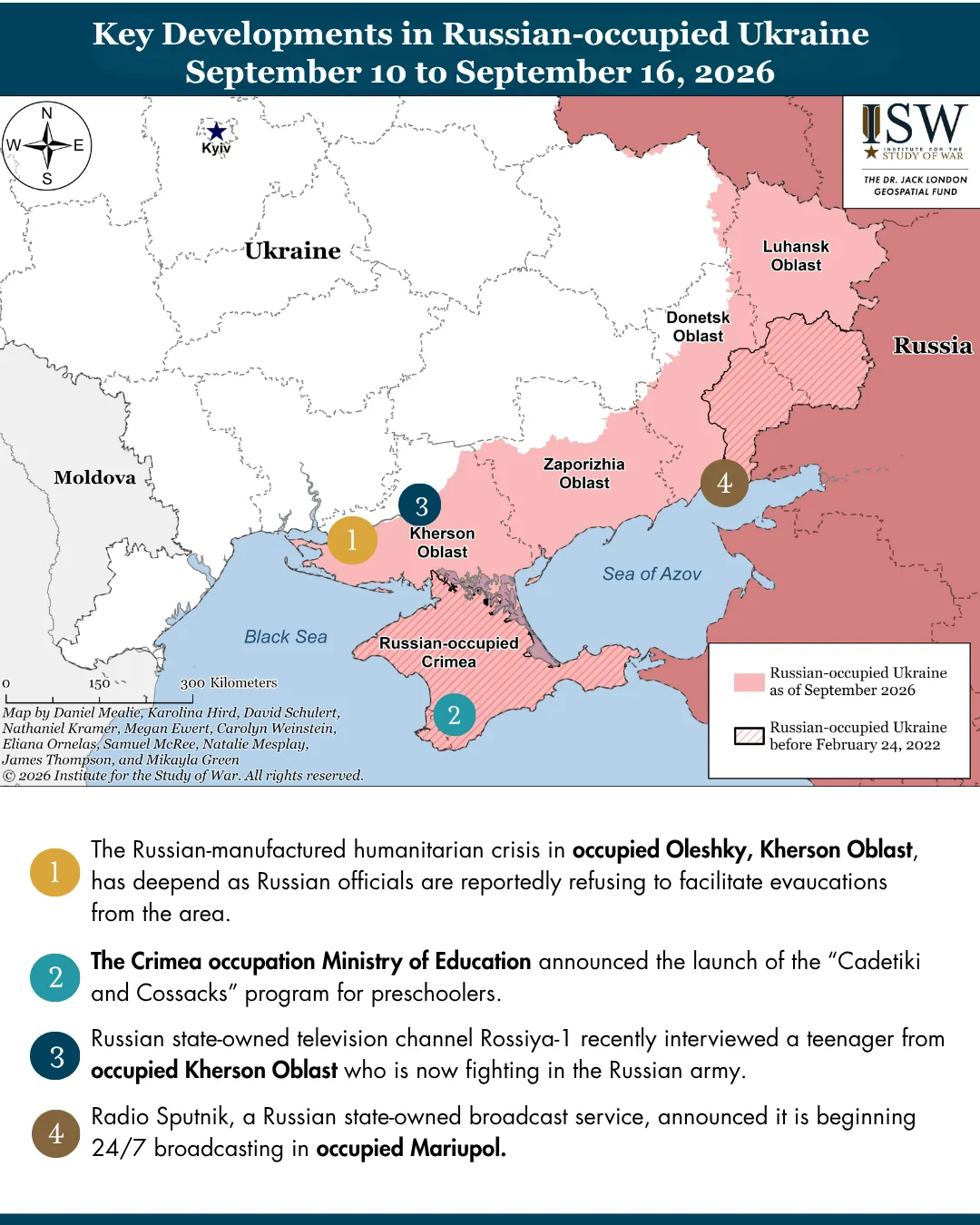
- Russian inaction and mismanagement have blockaded thousands of people in occupied Oleshky, Kherson Oblast and surrounding areas.
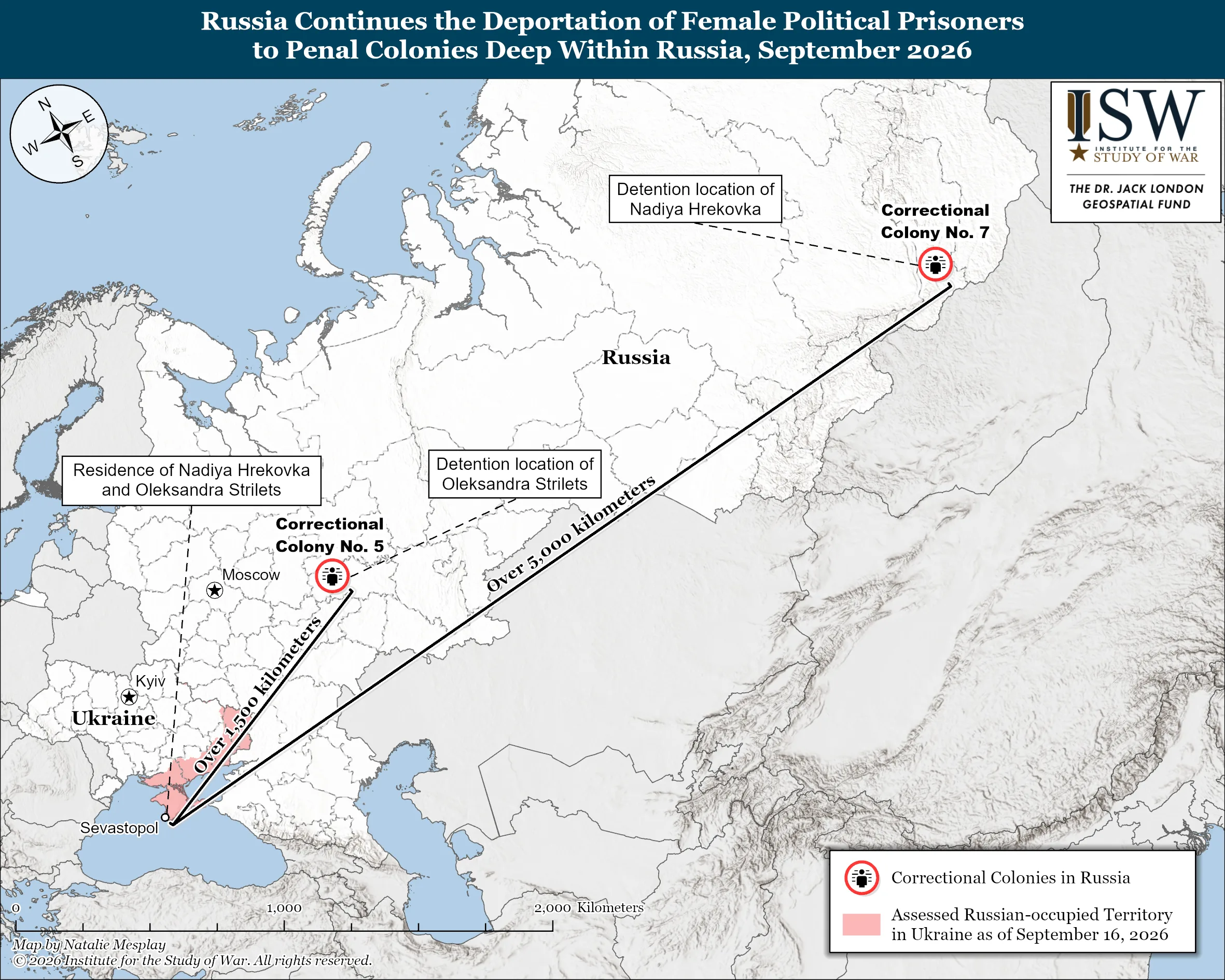
- Russia continues its illegal deportation of female Ukrainian political prisoners to penal colonies thousands of kilometers away from Ukraine. Russia’s harsh sentencing and frequent deportation of Crimean political prisoners, particularly women, have significant ramifications for the families and communities left behind.
- Russian state-owned television channel Rossiya-1 recently interviewed a teenager from occupied Kherson Oblast who is now fighting in the Russian army.
- Russia continues efforts to engrain military-patriotic programming in preschools in occupied Ukraine.
- The first stages of voting in the Russian State Duma elections have concluded in occupied Ukraine as occupation administrators continue to set conditions for a controlled and coerced United Russia victory.
- A prominent Crimean occupation official publicly advocated for using forced military service to punish residents for the perceived expression of pro-Ukrainian views.
- The Sevastopol occupation administration is expanding the institutionalization of punitive nationalization.
- Russia continues to expand the reach of state-controlled public broadcast media into occupied Ukraine.
Deportation and Forcible Transfer of Ukrainian Citizens, Including Children
Russia continues its illegal deportation of female Ukrainian political prisoners to penal colonies thousands of kilometers away from Ukraine. The Crimean Human Rights Group reported on September 10 that Russian authorities deported occupied Sevastopol resident Nadiya Hrekovka to Correctional Colony No. 7 in Ulan Ude, Republic of Buryatia (over 5,000 kilometers from Sevastopol).[1] The Russian Southern District Military Court sentenced Hrekovka to 22 years in prison on terrorism and treason charges on the allegation that she organized an explosive attack against servicemembers of the Black Sea Fleet.[2] Ukrainian sources stated that Hrekovka is being kept in conditions of deprivation and is given very limited access to communications with the outside world.
Russia’s harsh sentencing and frequent deportation of Crimean political prisoners, particularly women, have significant ramifications for the families and communities left behind. Russian independent newspaper Novaya Gazeta reported on September 11 that the 18-month-old daughter of Crimean political prisoner Oleksandra Strilets died the day after she was released from the hospital.[3] The Sevastopol City occupation court sentenced Strilets and her mother to 12 years in prison on treason charges in 2025 on the allegation that the women shared intelligence about the Russian military with Ukraine. Strilets appealed to the court for a deferment of her sentence given that her infant daughter, who had been born prematurely, was suffering from severe health issues. The court denied her appeal, and a Russian court later upheld her sentence in early 2026.[4] Russian authorities later deported Strilets to Correctional Colony No. 5 in Kozlovka, Chuvash Republic (1,600 kilometers from Sevastopol). Strilets’ imprisonment and deportation deprived her of her ability to care for her daughter. Russia has been deporting political prisoners, including women, from occupied Crimea to Russia since 2014 but has significantly intensified this practice since the 2022 full-scale invasion of Ukraine.[5] This practice is a central component of Russia’s use of coercive and punitive levers as a tool of occupation control, and is likely a violation of international human rights and humanitarian law.[6]
Sociocultural Control
Nothing significant to report.
Militarization of Occupied Areas
Russian state-owned television channel Rossiya-1 recently interviewed a teenager from occupied Kherson Oblast who is now fighting in the Russian army, highlighting the ways in which Russia’s occupation of Ukraine has succeeded in turning some Ukrainian youth into weapons against their home country. Rossiya-1 aired an exclusive interview on September 12 with Oleksandr Mustiatse, a 19-year-old originally from Krynky, Kherson Oblast, who is now serving in the Russian military.[7] The Ukrainian “Children of War” database listed Mustiatse as “missing” following the occupation of Kherson Oblast in 2022, meaning that the Ukrainian government had registered him as unaccounted for either due to the occupation or because he was removed or deported from his home.[8] Back to Ukraine, a Ukrainian initiative dedicated to tracking Russia’s militarization and Russification of Ukrainian children, reported in July 2026 that it found social media evidence that Mustiatse had joined the Russian military and posted an image of the teenager in bandages, apparently after being wounded in combat.[9] The Rossiya-1 interview shows Mustiatse in combat fatigues loading ammunition into a machine gun. Mustiatse stated that his family moved to Russia’s Krasnodar Krai after the invasion, and that he signed a volunteer contract with the Russian army in March 2026, a month after turning 18. Mustiatse also claimed that he has friends from occupied Kherson Oblast who are currently fighting for Russia in the Kherson area.
Mustiatse’s story is complex, in part because he claims that his family made the decision to move to Russia following the full-scale invasion. If verified, that would mean that his circumstances are different than those of the tens of thousands of children whom Russia has deported without parental consent and in violation of international law. Regardless of the circumstances of his relocation to Russia, however, Mustiatse’s experience is indicative of the way in which Russia indoctrinates and militarizes children and youth — both in Russia and in occupied Ukraine. Mustiatse and other teenagers like him have likely been exposed to intense pro-Russian and anti-Ukrainian propaganda, as well as overt military training programs, for nearly five years.[10]
Mustiatse’s story fits within a broader trend of Russia’s targeted indoctrination and militarization of Ukrainian teenagers, however. Other Ukrainian teenagers who have grown up in occupied Ukraine or have been deported to Russia have featured heavily in Russian pro-war and pro-occupation propaganda. The Back to Ukraine initiative identified three other such teenagers — the Chymbur brothers — who were similarly listed on the Children of War registry, and one of whom is now serving in Russian military intelligence.[11] Kremlin-appointed Commissioner on Children’s Rights Maria Lvova-Belova often talks about the teenager she adopted from Mariupol, including open discussions about how pro-Russian propaganda worked to completely change his personality and worldview.[12] The Wall Street Journal published a story in 2024 detailing how a Ukrainian teenager who Russia deported from occupied Kherson Oblast transformed from a pro-Ukrainian activist to a pro-Russian blogger.[13] Russia’s occupation of Ukraine is intended, in part, to turn young Ukrainians into the next generation of Russians, who can be mobilized in service of the Russian state or military.
Russia continues efforts to engrain military-patriotic programming in preschools in occupied Ukraine. The Crimea occupation Ministry of Education, Science, and Youth reported on September 4 that it launched the “Cadetiki and Cossacks” program for preschoolers in 13 schools across occupied Crimea.[14] Crimea occupation Minister of Education Valentina Lavrik emphasized that “the cultivation of patriotism and spiritual and moral values should begin in early childhood,” and that the Cadetiki and Cossacks program seeks to instill in preschoolers a “respect” for Russian history, culture, and traditions. The program also notably allows preschoolers to interact with older cadets from various military-patriotic training programs as well as representatives of Cossack organizations. The Russian government, including Russian President Vladimir Putin, has recently justified the increased institutionalization of Russification and militarization programs in schools for younger and younger students, to the point that the pro-Russian indoctrination pipeline now begins for children as young as three.[15]
Administrative and Bureaucratic Control
The first stages of voting in the Russian State Duma elections have concluded in occupied Ukraine as occupation administrators continue to set conditions for a controlled and coerced United Russia victory. Occupation officials and the heads of regional election commissions claimed that the first two stages of early voting (voting for Russian frontline servicemembers and for frontline communities) have concluded throughout occupied areas in advance of the September 18 to 20 unified voting days.[16] Early voting occurred under highly securitized and militarized conditions, to the further detriment to the freedom of the elections.[17] Reuters, for example, posted an image on September 15 showing an armed Russian soldier holding a ballot box as a woman nearby fills out voter documents in occupied Verbivka, Donetsk Oblast.[18] Occupation election officials also highlighted their efforts to maximize voter registration and turnout during both early voting and the upcoming unified voting days. Kherson Oblast occupation Election Commission head Marina Zakharova claimed that voter turnout was 47.2 percent as of September 14, and that election officials visited over 80,000 households to ensure people with lower mobility could vote at home.[19] Donetsk and Zaporizhia occupation election officials highlighted their use of the “Mobile Voter” mechanism, which allows voters to vote wherever they are on election day — not just at their legally registered residence.[20] Russia’s attempts to control election results via coercive measures, including at-home voting and the presence of armed personnel at voting places, are likely to all but assure that Putin’s ruling United Russia party wins both in occupied Ukraine and in Russia.[21]
Occupation Administration Mismanagement and Internal Dynamics
Russian inaction and mismanagement have blockaded thousands of people in occupied Oleshky, Kherson Oblast and surrounding areas. Ukrainian Oleshky Military Administration Head in exile Tetyana Hasanenko told Ukrainian broadcaster Suspilne on September 11 that there have been no food deliveries to Oleshky since May 26 and that the threat of constant drone attacks and unexploded mines is making movement within and out of the settlement effectively impossible.[22] Hasanenko reported that residents who managed to flee Oleshky are reporting that there are between three and four thousand people remaining in Oleshky, including children. The United Nations recently assessed that there were up to 6,000 civilians remaining in the wider area around Oleshky as of June 2026.[23] Hasanenko also emphasized a deteriorating sanitary situation, as people are unable to safely bury the bodies of the dead. The Ukrainian Resistance Center stated on September 14 that Russian forces and occupation authorities are preventing humanitarian missions and evacuations while blaming the situation on Ukraine.[24] Ukrainian Ombudsman Dmytro Lubinets reported on September 16 that Ukrainian and Russian officials previously agreed on the joint facilitation of an evacuation from Oleshky, but that the Russian side has since begun ignoring the agreement and is not assisting in any humanitarian actions.[25] The worsening situation in Oleshky is a direct consequence of Russian occupation policies — a combination of deliberately weaponized deprivation and bureaucratic mismanagement that has culminated in a blockade that has placed thousands at risk of disease, starvation, and abuse at the hands of Russian forces.[26]
Physical and Legal Repressions
A prominent Crimean occupation official publicly advocated for using forced military service to punish residents for the perceived expression of pro-Ukrainian views. Chairman of the Crimean occupation Public Chamber and a veteran of the Russian war in Ukraine Ilya Kazakov told Radio Krym on September 10 that the occupation administration should consider forming penal battalions comprised of “those who collaborate with the enemy.”[27] Kazanov suggested that the penal battalions could conduct logistics and engineering functions both on the frontline and in the rear and also proposed that the penal battalions could help “re-educate” such individuals. Russian and occupation courts have significantly intensified prosecutions against residents of occupied Ukraine for perceived collaboration with Ukraine, which is often a stand-in for pro-Ukrainian statements made on social media or small donations made to the Ukrainian armed forces via Ukrainian banking applications.[28] The prevalence of such cases likely would mean that Russian occupation authorities would have a broad manpower pool from which to fill these proposed battalions. These battalions, if created, would likely be a violation of international law, which prohibits Russia, as the occupying power, from forcing the population it occupies to serve in its armed forces.[29]
Economic and Financial Control
The Sevastopol occupation administration is expanding the institutionalization of punitive nationalization. Sevastopol occupation governor Mikhail Razvozhaev reported on September 15 that his administration adopted a resolution that effectively allows the occupation administration to seize properties from individuals and entities affiliated with Ukraine.[30] Razvozhaev listed four properties and five individuals who he claimed are “providing assistance” to the Ukrainian military or Ukrainian intelligence, and stated that their property and assets will be transferred to the Sevastopol occupation government’s budget. The Crimean occupation administration in particular has engaged in widespread punitive nationalization to strip Ukrainians of their property, likely generating billions of rubles in profit for local and regional budgets.[31]
Information Space Control
Russia continues to expand the reach of state-controlled public broadcast media into occupied Ukraine. Radio Sputnik, a Russian state-owned news agency and radio broadcast service, announced on September 15 that it will begin a 24-hour news broadcast in occupied Mariupol.[32] The Radio Sputnik broadcast will provide residents with “news and analysis programs,” and will broadcast on the same frequency as the “Novorossiya Today” program. Novorossiya Today is a joint initiative between Radio Sputnik and Ukraine.ru, which is part of the Rossiya Segodnya media group. Radio Sputnik also broadcasts elsewhere in occupied Donetsk Oblast, in occupied Luhansk Oblast, and in occupied Crimea.[33] The proliferation of Russian-controlled news, media, and broadcast networks is a critical component of Russia’s strategy to take control of the information space in occupied Ukraine.[34] Radio Sputnik, as well as Ukraine.ru, engage in explicitly pro-Russian and anti-Ukrainian messaging, furthering the narrative that occupied territories inherently belong to Russia.[35]
Infrastructure and Development Projects
Nothing significant to report.

[1] https://crimeahrg dot org/uk/zasudzhena-na-22-roki-nadiya-grekova-perebuva%d1%94-v-koloni%d1%97-suvorih-umov-u-buryati%d1%97/?fbclid=IwY2xjawUXdTpwZG9mBWV4dG4DYWVtAjEwAGJyaWQRMUVDR0NUSmtMTTliRFJFVnRzcnRjBmFwcF9pZBAyMjIwMzkxNzg4MjAwODkyAAEe00vlwUd_NZQgfLcNs4nZ9bPAdMFciyrTbZ04F8wu1HPaonb817gFUQtIHIY_aem_1uV1DBS-dR_-x3gp_bixuw
[2] https://suspilne dot media/crimea/1079587-nastav-cas-poborotisa-za-nei-istoria-nadii-grekovoi-aku-okupanti-zvinuvacuut-u-zamahu-na-rosijskogo-oficera/
[3] https://novayagazeta\ dot ru/articles/2026/09/11/diuimovochku-ubili
[4] https://understandingwar.org/research/russia-ukraine/russian-occupation-update-template-january-30-2026/
[5] https://understandingwar.org/research/russia-ukraine/russian-occupation-update-august-6-2026/; https://understandingwar.org/research/russia-ukraine/russian-occupation-update-may-29-2026/
[6] https://ihl-databases.icrc.org/en/ihl-treaties/gciv-1949
[7] https://ok dot ru/video/15836945517267
[8] https://childrenofwar.gov dot ua/
[9] https://www.threads.com/@backtoukraine/post/DbV0ShIl8vX; https://meduza dot io/feature/2026/08/10/proekt-back-to-ukraine-rasskazal-istoriyu-aleksandra-mustyatse-ukrainskogo-podrostka-stavshego-rossiyskim-soldatom ; https://x.com/MykolaKuleba/status/2082855193461334488
[10] https://www.google.com/goto?url=CAESngEB6zswFceGHTZNZPbolh-YkZ6BrNG0godfrBI11LUYInv5qrkoUD8iT4dmbMWnKNfJT_G27LVuHgLkS0_64DeuFB-QSsDZGfjPDypkf5BT_3Hj3F93ng_5wW8GIiJExDvij7GUb_KpAKF2tVMSUlYlrXC7eFt08DltzUDDUHBrFM2NP__97ID5rh8myw1vyMg5vEMEILNtYI_WF8Heyg; https://jamestown.org/russia-expands-youth-militarization-part-one/
[11] https://www.threads.com/@backtoukraine/post/Dba0o_gl7KH
[12] https://understandingwar.org/research/russia-ukraine/russian-occupation-update-october-23-2025/; https://understandingwar.org/research/russia-ukraine/russian-offensive-campaign-assessment_5-19/; https://t.me/stormdaily/59684; https://novayagazeta dot eu/en/articles/2026/08/10/russian-childrens-rights-commissioner-announces-teen-she-adopted-from-occupied-ukraine-will-study-to-become-prosecutor-en-news; https://www.pravda dot com.ua/eng/news/2025/10/21/8003736/
[13] https://www.wsj.com/world/ukraine-russia-propaganda-children-49ad9e09
[14] https://crimea-news dot com/society/2026/09/04/2059751.html
[15] https://understandingwar.org/research/russia-ukraine/russian-occupation-update-august-28-2025/; https://understandingwar.org/research/russia-ukraine/russian-occupation-update-september-10-2026/; https://almenda dot org/vpliv-na-najmenshix-yak-okupanti-na-tot-formuyut-rosijsku-identichnist-u-doshkilnyat/
[16] https://tass dot ru/obschestvo/28100031; https://xonews dot ru/news/v-hersonskoj-oblasti-472-izbiratelej-prinjali-uchastie-v-dosrochnom-golosovanii/; https://donetskmedia dot ru/20260914-golos-donbassa-kak-dnr-i-lnr-gotovjatsja-k-pervym-vyboram-v-gosdumu.media; https://t.me/SALDO_VGA/17400; https://t.me/razvozhaev/23849
[17] https://crimea.ria dot ru/20260914/vybory-v-krymu–kak-obespechat-bezopasnost-na-uchastkakh-1159375227.html; https://gazetacrimea dot ru/news/krym-gotovitsya-k-edinomu-dnyu-golosovaniya-chto-predusmotreno-dlya-bezopasnosti/
[18] https://www.reuters.com/pictures/pictures-day-september-15-2026-2026-09-15/7FTJUH6EABKIDJ4NYEBBLW26LM
[19] https://xonews dot ru/news/v-hersonskoj-oblasti-472-izbiratelej-prinjali-uchastie-v-dosrochnom-golosovanii/
[20] https://ria dot ru/vybory/mobilnyj-izbiratel/; https://tass dot ru/info/12039493
[21] https://understandingwar.org/research/russia-ukraine/russian-offensive-campaign-assessment-september-10-2026/; https://understandingwar.org/research/russia-ukraine/russian-offensive-campaign-assessment-september-5-2026/; https://understandingwar.org/research/russia-ukraine/russian-offensive-campaign-assessment-august-22-2026/
[22] https://suspilne dot media/kherson/1401472-ludi-vidcuvaut-sebe-prirecenimi-nacalnica-mva-pro-situaciu-v-oleskah-na-tot-hersonsini/
[23] https://ukraine.ohchr.org/en/Desperate-situation-for-civilians-trapped-in-frontline-areas-says-UN-Human-Rights-Ukraine
[24] https://sprotyv dot org.ua/oleshky-peretvoryly-na-pastku-a-trahediiu-vykorystovuiut-dlia-propahandy/
[25] https://t.me/dmytro_lubinetzs/12544
[26] https://understandingwar.org/research/russia-ukraine/russian-occupation-update-july-9-2026/; https://understandingwar.org/research/russia-ukraine/russian-occupation-update-april-2-2026/; https://understandingwar.org/research/russia-ukraine/russian-occupation-update-february-12-2026/; https://understandingwar.org/research/russia-ukraine/russian-occupation-update-august-6-2026/; https://understandingwar.org/research/russia-ukraine/russian-occupation-update-july-9-2026/; https://understandingwar.org/research/russia-ukraine/russian-occupation-update-may-14-2026/; https://understandingwar.org/map/russian-occupied-oleshky-kherson-oblast-faces-a-worsening-humanitarian-crisis-may-14-2026-at-130-pm-et/
[27] https://crimea-radio dot ru/kazakov-predlozhil-sozdavat-dlya-poso/; https://crimea24tv dot ru/content/kazakov-predlozhil-sozdavat-shtrafni/
[28] https://understandingwar.org/research/russia-ukraine/russian-occupation-update-june-18-2026/; https://understandingwar.org/research/russia-ukraine/russian-occupation-october-2-2025/; https://rm.coe.int/sg-inf-2026-23-en/48802da27d
[29] https://ihl-databases.icrc.org/en/ihl-treaties/gciv-1949/article-51
[30] https://t.me/razvozhaev/23850
[31] https://understandingwar.org/research/russia-ukraine/russian-offensive-campaign-assessment_9-5/; https://understandingwar.org/research/russia-ukraine/russian-offensive-campaign-assessment_20-21/; https://understandingwar.org/research/russia-ukraine/russian-occupation-update-december-11-2025/; https://understandingwar.org/research/russia-ukraine/russian-occupation-update-august-21-2026/
[32] https://radiosputnik dot ru/20260915/radio-1988813833.html; https://ria dot ru/20260915/mariupol-2117711530.html
[33] https://understandingwar.org/research/russia-ukraine/russian-occupation-update-may-12-2025/
[34] https://understandingwar.org/research/cognitive-warfare/the-kremlins-expanding-media-conglomerate/; https://understandingwar.org/research/russia-ukraine/russian-occupation-update-may-12-2025/
[35] https://ukraina dot ru/; https://ukraina dot ru/category_radio-novorossiya-segodnya/