
Toplines
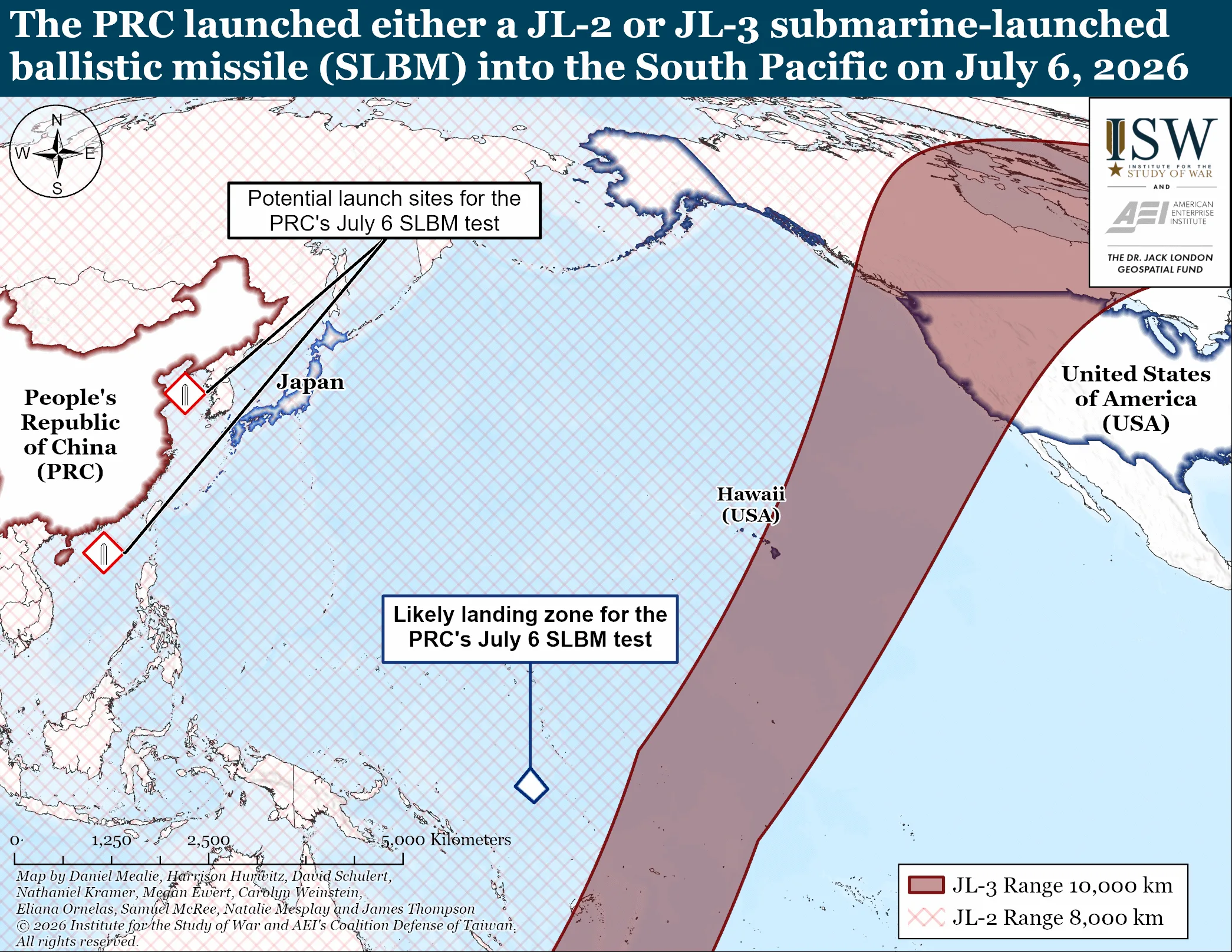
The PLA conducted a rare test of a submarine-launched ballistic missile (SLBM) in the South Pacific, likely to test and demonstrate its enhanced nuclear second-strike capability. PRC state media reported on July 6 that an unspecified ballistic missile nuclear submarine (SSBN) conducted a test of an SLBM.[1] The submarine may have fired the missile from the Bohai Sea or the South China Sea, based on PRC Maritime Safety Administration notices in both places on July 6. The missile landed between Tuvalu and the Gilbert Islands of Kiribati.[2] The PRC last tested a ballistic missile in the Pacific in 2024, which landed near French Polynesia, and has not publicly announced a test of an SLBM since 1982.[3] PRC state-owned tabloid Global Times speculated that the missile tested was a JL-3, a missile the PRC first unveiled during a September 2025 military parade that has a reported range of 10,000 kilometers.[4] PRC officials did not confirm the type of missile launched. Taiwanese National Security Council Secretary-General Joseph Wu stated it was likely a JL-2, however, which only has an 8,000-kilometer range.[5] The submarine that fired the missile was very likely a Type 09IV, the PLAN’s only known active model of SSBN.[6]
The PRC may have sought to test and demonstrate its ability to strike the United States with an SLBM from PRC internal waters. The PRC maintains a no-first-use (NFU) nuclear policy and has renounced the use of nuclear weapons against non-nuclear armed states.[7] ISW-CDOT has assessed that the PRC is enhancing its nuclear second-strike capability to ensure that an adversary first strike cannot fully destroy PRC nuclear forces.[8] The undersea leg of the PRC’s nuclear triad is particularly vulnerable to interdiction because its nuclear submarines must traverse several maritime chokepoints before deploying to the Pacific Ocean, increasing the probability of detection and destruction in wartime.[9] The US Department of Defense has assessed that the PRC may be aiming to develop submarine “bastions” within its internal waters — undersea areas fortified with sensors, sea mines, and other defenses –to increase the likelihood that its SSBNs could contribute to a retaliatory strike.[10] The JL-3’s increased range would allow the PRC to threaten the US mainland with its SSBNs without risking them in a far-seas deployment.
The PRC is likely seeking to expand and qualitatively improve its nuclear submarine fleet to enhance the deterrence effect of its nuclear triad. US Office of Naval Intelligence Commander Rear Admiral Michael Brookes stated in a March Senate testimony that the PRC could possess between 20 and 30 missile-armed nuclear submarines by 2040, a significant increase from its present inventory of 12 cruise and ballistic missile-equipped submarines.[11] An expanded submarine fleet and increased SLBM ranges would enhance the threat that the PRC’s nuclear forces pose to the US mainland.
Note: A portion of the following text appeared in the Iran Update Special Report on July 5, 2026.
The PRC may have agreed to pay “service fees” to Iran in exchange for passage through the Strait of Hormuz prior to the failure of the US-Iran ceasefire. The PRC has advocated for reopening the strait to free and safe passage but will likely be satisfied with any arrangement that allows cheap transit for PRC ships, regardless of whether Iran allows other countries unrestricted passage. Iranian Ambassador to the PRC Abdolreza Rahmani Fazli stated on July 4 that Iran will give the PRC “special considerations” when determining the cost of “service fees” because the PRC is a “friendly country.”[12] Fazli’s comment suggests that Iran may plan to discount the tolls that the PRC and other “friendly” countries must pay for their vessels to transit through the strait. The PRC Ministry of Foreign Affairs (MFA) did not confirm whether it accepted paying “service fees” in the Strait of Hormuz and instead gave a vague statement that the navigation issue should be “handled properly.”[13] PRC National People’s Congress Vice Chairman He Wei gave a similar statement to Iranian officials when he traveled to Iran as the main PRC envoy for the funeral of Supreme Leader Ali Khamenei on July 2 and 3.[14] He met with Iranian president Masoud Pezeshkian and Iranian Parliament Speaker Mohamed Bagher Ghalibaf during his visit.
PRC officials have repeatedly spoken against both the Iran war and the blockade of the Strait of Hormuz but have been ambiguous about whether Beijing would accept a system of tolls in the strait. The US Department of State stated on May 12 that US and PRC officials agreed that no country can be allowed to extract tolls in the Strait of Hormuz, following an April 30 phone call between US Secretary of State Marco Rubio and PRC Foreign Minister Wang Yi.[15] The PRC readout of that call did not mention the issue, however, and no PRC official has publicly opposed Iran charging tolls or other fees in the strait.[16] The PRC has been much more explicit, by contrast, on other issues including its opposition to “unilateral sanctions” on Iran, showing that it favors an Iran-friendly political solution to the conflict even if it faces increased shipping costs in the region.[17] The PRC’s core interest in the conflict is the resumption of oil and natural gas shipments from Iran and the Gulf States, which collectively accounted for over half of the PRC’s oil imports and around a third of its natural gas imports prior to the war.[18] The PRC also benefits from the war depleting US munitions, harming the United States’ reputation and alliances, and causing energy supply problems for US allies in the Indo-Pacific, however. The PRC has shown itself to be unwilling to take costly actions to facilitate an end to the war, including overtly pressuring Iran.
Key Takeaways
- PLA Missile Testing: The PLA conducted a test of an SLBM in the South Pacific on July 6. The PLA was likely testing and demonstrating its second-strike capabilities and ability to strike the United States from PRC internal waters.
- PRC-Iran Relations: The PRC may have agreed to pay “service fees” to Iran in exchange for passage through the Strait of Hormuz prior to the US-Iran ceasefire failure. The PRC has not made an official statement on Iranian tolls in the Strait, and likely would be satisfied with any solution that allows for the resumption of oil and natural gas shipments and safe passage for PRC ships.
Cross-Strait Relations
Taiwan
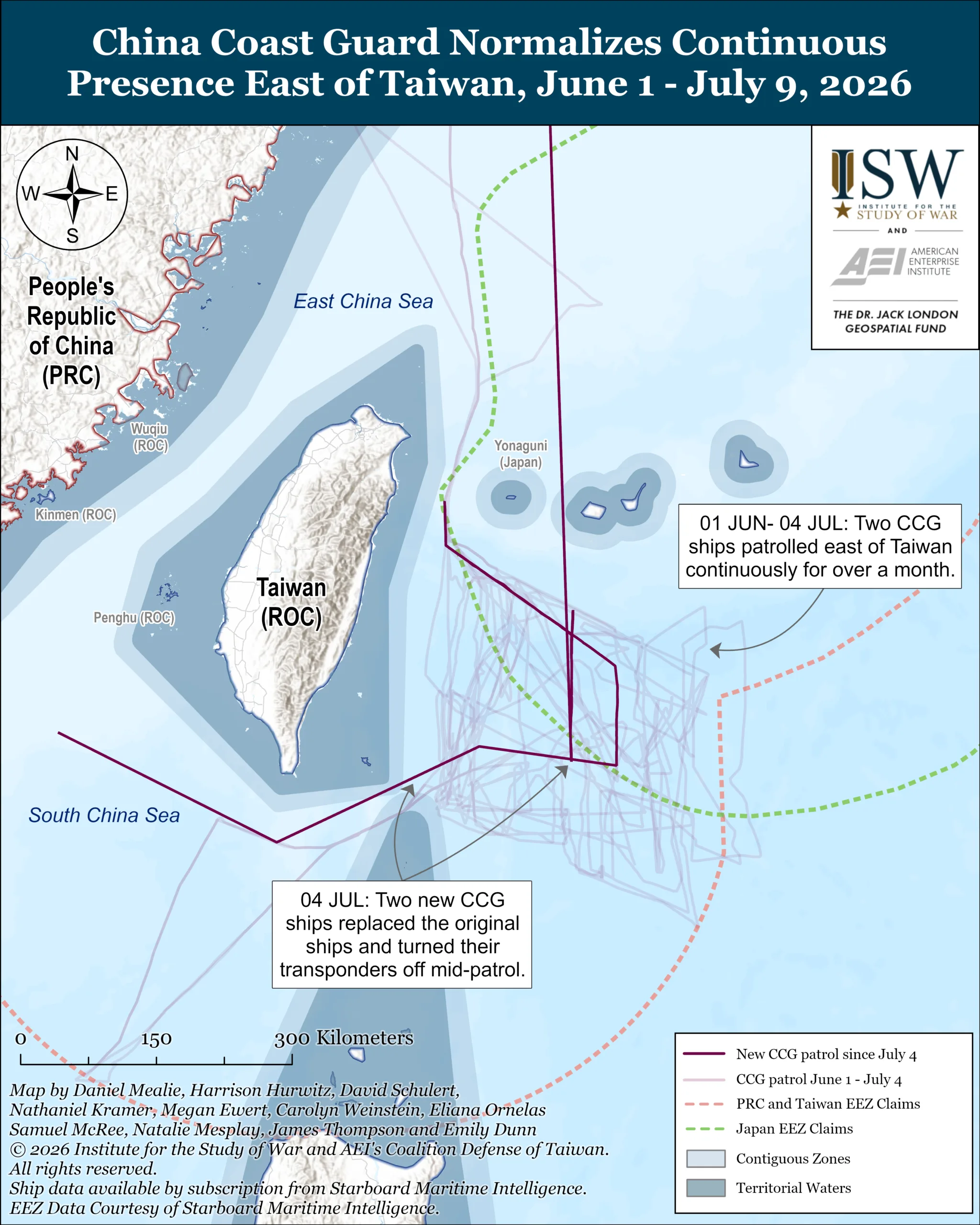
The PRC is very likely implementing permanent China Coast Guard (CCG) patrols east of Taiwan. CCG ships 2305 and 1401 arrived in the eastern part of Taiwan’s claimed Exclusive Economic Zone (EEZ) on July 4 to relieve CCG ships 2304 and 2502, which had been patrolling there continuously since June 1.[19] Ship-tracking data from Starboard Maritime Intelligence shows that the new ships began a patrol following a similar pattern to their predecessors but turned off their Automatic Identification Systems (AIS) after approximately 24 hours, making them harder to track. The CCG began patrolling the area ostensibly in response to Japanese Prime Minister Sanae Takaichi and Philippine President Ferdinand Marcos, Jr., agreeing on May 30 to begin boundary delimitation talks between the Japanese and Philippine EEZs, which also overlap with the PRC and Taiwan’s claims in the same area. The PRC also carried out a “marine environmental survey” and a civilian law enforcement patrol of the area in June, with the law enforcement ships hailing passing cargo vessels to assert PRC jurisdiction in the waters. The PRC will be able to more easily launch a quarantine or blockade of Taiwan on short notice by maintaining a CCG presence east of Taiwan, particularly if passing ships tacitly recognize and comply with PRC “law enforcement” in the area.
China
The PLA may be discussing a new domain of military strategy called “technological strategy,” that prioritizes the development of artificial intelligence (AI) algorithms and a technological ecosystem capable of creating asymmetric advantages in modern conflict. Official PLA newspaper PLA Daily published several articles between June 29 and July 2 that emphasized the role of AI algorithms in future great power conflict.[20] The PLA has long emphasized what it understands as the “intelligentization” of war, which describes the integration of emerging technologies with traditional warfighting systems, and has expressed interest in integrating AI into its kill chains and logistics infrastructure.[21] ISW-CDOT has previously assessed that the PLA may view contemporary conflicts as a transitional phase toward greater intelligentization, in which the locus of future conflict will be the belligerents’ competing data management systems.[22]
The PLA may be expanding its view of intelligentization beyond integrating AI into existing practices. A PLA Academy of Military Science researcher argued in a June 30 PLA Daily article that future “technological strategy” will center on the ability to manipulate, guide, suppress, and reconstruct intelligent networks to support large-scale combat operations.[23] The article further argues that the increased centrality of information technology to combat operations will allow the PRC to paralyze the enemy’s operational system by deceiving its information systems and AI algorithms.[24] Another PLA Daily article from July 1 suggested that PLA brigades were coordinating with civilian institutions to improve their data processing systems during a training exercise.[25] A June 30 PLA Daily article also emphasized the role of AI-enabled command and control to improve efficiency and reduce vulnerability to electromagnetic interference, possibly referring to the use of AI-controlled drones.[26] This discussion could indicate that the PLA is not only integrating AI into legacy systems and concepts but also developing new warfighting methods in the information domain.
ISW-CDOT has assessed that the PLA’s long-standing institutional assumptions on the impact that emerging technologies will have on the conduct of war likely skew its assessments of future warfare.[27] The PLA’s optimism about AI’s impact on the conduct of war has not entirely matched battlefield realities in Ukraine or the Middle East.[28] AI has served as an enabler for military operations in both conflicts, but thus far has not emerged as the primary center of gravity for their success or failure.[29] The PLA’s outlook on the future of war could skew its future force generation and design toward information-centric operations that prioritize disrupting enemy data collection, processing, and analysis while developing effective algorithms for the PLA’s own operations.
Taiwanese and Singaporean authorities are taking legal action against individuals for allegedly smuggling advanced Nvidia chips into the PRC in violation of US export controls. The PRC is illegally acquiring AI chips while prioritizing domestic manufacturing to reduce its reliance on imported chips and semiconductors. Taiwanese prosecutors searched the Taiwanese offices of US firm Super Micro, Super Micro’s Taiwanese distributor Albatron, and data center operator Chief Telecom on June 29 and are investigating six individuals for smuggling roughly $22 million USD worth of Nvidia chips into the PRC.[30] Taiwanese authorities found 50 sets of servers containing Nvidia GB300 chips and NTD $9 million (approximately $280,000 USD) in cash.[31] Singaporean authorities separately charged four individuals on July 1, three whom face fraud allegations for purchasing servers from Dell, Super Micro, and Asus to smuggle into the PRC, and two of whom face money-laundering charges.[32] Super Micro-affiliated individuals and customers have been involved in numerous US and Taiwanese investigations for smuggling advanced Nvidia chips into the PRC using falsified documents and otherwise helping the PRC circumvent US export controls.[33]
The PRC’s reliance on Western chips has limited its domestic AI development, though Beijing is adopting measures to bolster its domestic chip industry. Reuters reported on July 7 that PRC AI firm DeepSeek is in the early stages of developing its own AI chips, according to three anonymous informants.[34] Alibaba in May unveiled the Zhenwu M890 chip, which is three times more powerful than its predecessor, released just two years earlier.[35] Huawei also announced plans to launch the Kirin 2026 chip later this year, which vertically stacks circuit layers to improve performance and transistor density.[36] PRC chips still lag far behind Western counterparts in both production quantity and quality, however. The PRC soon may allow Alibaba, ByteDance, and DeepSeek to purchase a limited quantity of Nvidia H200 chips, which the US government approved for sale to the PRC in December 2025.[37]
The PLA may begin filling vacant seats on the Central Military Commission (CMC) in 2027 or earlier to replace purged top officers. The PLA promoted two officers, Zhang Shuguang and Wang Gang, to the rank of full general on July 3.[38] The PLA further elevated Zhang Shuguang to the new head of the CMC’s Discipline Inspection Commission, the military’s top anti-corruption body, replacing Zhang Shengmin.[39] Zhang Shengmin remains on the CMC as its vice chairman. Zhang Shuguang has an extensive record of service under Zhang Shengmin in the military’s anti-corruption system.[40] Wang Gang, former PLA Air Force (PLAAF) deputy commander, will additionally assume the role of PLAAF Commander.[41] CCP General-Secretary and CMC Chairman Xi Jinping presented the orders for Zhang Shuguang’s and Wang Gang’s promotions and took photos with the new generals alongside Zhang Shengmin at their promotion ceremony.[42]
Xi Jinping may be preparing to elevate Zhang Shuguang to a full seat on the CMC, though top PLA officials have not announced such plans at time of writing. PLA reforms in 2017 elevated then CMC discipline inspection chief Zhang Shengmin to CMC membership for the first time. Zhang Shengmin is currently the only member of the CMC besides Xi Jinping, following drastic purges of five CMC members and about half of the PLA’s senior officers since 2023 for perceived corruption or disloyalty.[43] Wang Gang is less likely to join the CMC than Zhang Shuguang, because the same 2017 PLA reforms removed service commanders from the CMC’s core ranks. Nikkei Asia speculated that new CMC members may be announced during the CCP’s National Party Congress in Autumn 2027.[44]
Northeast Asia
Japan
Japan is increasingly expanding its defense cooperation and exports to its Indo-Pacific partners and allies, likely in an effort to counter PRC regional aggression. Japanese Prime Minister Sanae Takaichi held talks with Indian Prime Minister Narendra Modi in New Delhi on July 2 and signed a memorandum to expand the two countries’ bilateral defense cooperation.[45] Takaichi and Modi agreed to launch the first co-development project between India and Japan: fitting Indian warships with a communications system known as UNICORN (Unified Complex Radio Antenna system, or NORA-50 integration mast). UNICORN consolidates numerous communication, radar, and surveillance antennas into a radar dome (radome) to reduce a ship’s radar cross-section, thus increasing its stealth.[46]
Philippine Defense Secretary Gilberto Teodoro Jr. separately announced on July 7 that Tokyo and Manila finalized an agreement to transfer five Japanese Abukuma-class destroyer escorts to the Philippine Navy.[47] This announcement demonstrates continued momentum of Japan-Philippine security cooperation, following Philippine President Ferdinand Marcos Jr. and Takaichi’s announcement of several bilateral defense agreements on May 28.[48]
Japan has been increasing its defense exports and coalition-building efforts across the Indo-Pacific region in recent years. Takaichi has been a major driving force in both developments since her election in October 2025. Takaichi’s defense reforms have included loosening longstanding restrictions on Japan’s ability to export defense equipment and implying that Japan may intervene in a Taiwan contingency – moves that triggered an ongoing PRC coercion and propaganda campaign against Japanese “militarism”.[49] Japan has also agreed to sell Mogami-class frigates to Australia, discussed a similar sale to New Zealand, and strengthened its military diplomacy and exchanges with South Korea since April 2026.[50] Continued cooperation between Japan and other militaries such as India and the Philippines will strengthen regional players’ abilities to combat PRC coercion in the Indo-Pacific.
Oceania
Australia signed a defensive alliance with Fiji that may expand into an Oceanian military regional alliance. Australian coalition-building efforts in the region since late 2025 may make the region more resilient against PRC political influence. Australia and Fiji signed the “Ocean of Peace Alliance” on July 6. The pact is Fiji’s first formal alliance and Australia’s fourth, including alliances with the United States, Papua New Guinea, and New Zealand.[51] The treaty stipulates that Australia and Fiji will establish visiting forces agreements and cooperative mechanisms to promote their security and regional stability, including a clause on mutual defense.[52] ABC Australia reported that while the Ocean of Peace Alliance is open to other Pacific nations, Australia would likely only extend the treaty to neighbors that have standing militaries: Tonga, Papua New Guinea, and New Zealand.[53] New Zealand Prime Minister Christopher Luxon said on July 9 that New Zealand would consider joining.[54]
Australia and Fiji also signed the Vuvale Union, a broad economic and security agreement based on Australian support and investment in Fiji.[55] The Vuvale Union established Fiji-Australia cooperation on transnational crime and illegal fishing, as well as integrated policing, defense, and border protection.[56]
Australia has emerged as a regional leader for initiating coalition-building efforts to counter PRC power projection in Oceania. Australia signed the Pukpuk mutual defense pact with Papua New Guinea (PNG) in 2025 — PNG’s first such alliance — which went into effect on July 8.[57] Australia and Vanuatu signed an agreement in June 2026 that forbade Vanuatu from hosting any foreign military bases.[58] Australian Prime Minister Anthony Albanese has also expressed interest in strengthening Australia’s bilateral relationship with the Solomon Islands, which signed a controversial security pact with the PRC in 2022.[59] Albanese on July 6 wrote on X (formerly Twitter) that “Australia and the Solomon Islands are stepping up [their] partnership,” referring to negotiations on a “new comprehensive treaty” between the two countries.[60]
The PRC gave a standard response to the Australia-Fiji deal during a regular press conference on July 6, urging Pacific pacts not to target third-party interests.[61] The PRC likely views Australia as a strategic competitor because it is the United States’ strongest ally in the South Pacific and a potential US coalition partner in defending Taiwan.
The PRC reportedly attempted to block Taiwan from establishing a representative office in Perth, Australia. The PRC is continuing its global campaign to impede Taiwanese diplomacy and international engagement. Australian media reported on July 3 that Taiwan submitted a proposal to Australia’s Department of Foreign Affairs and Trade to create a trade office in Perth. This trade office would serve as the equivalent of a Taiwanese diplomatic facility, as Australia does not officially recognize Taiwan.[62] Taiwan already has representative offices in Sydney, Melbourne, Brisbane, and Canberra.[63] The PRC sent a petition to Australia earlier in 2026 to block the establishment of the new office.[64]
The reports on the Perth office emerged weeks after Kenyan authorities reportedly blocked Taiwanese delegates from entering Kenya for the Our Oceans Conference in June.[65] Kenyan Principal Secretary for Foreign Affairs Korir Sing’oei stated on June 17 that Taiwanese passport holders would be denied entry to Kenya. Taiwanese government officials reported on July 1 that the Taiwanese public can still enter Kenya with a valid passport and Electronic Travel Authorization, however.[66]
The PRC regularly uses political, diplomatic, and economic inducements to block Taiwan’s engagement with other countries and participation in international organizations. The PRC also seeks to sway Taiwan’s few remaining diplomatic partners to switch their official diplomatic recognition from Taiwan to the PRC.
Russia
The PRC and Russia began annual combined naval exercises off Qingdao on July 6. The PRC’s Ministry of National Defense announced that the PRC and Russia would hold the “Joint Sea-2026” naval exercise from July 6 to July 13 in the waters and airspace near the PRC port city of Qingdao.[67] The drill is part of the annual cooperation plan between the two militaries. Some forces from both states will also conduct a joint maritime patrol in “relevant” areas of the Pacific Ocean following the exercise.[68]
The Joint Sea-2026 drills follow a recent PRC-Russian joint strategic aerial patrol near South Korea and Japan, which entered South Korea’s air defense identification zone.[69] These exercises may contribute to PRC capabilities for an amphibious invasion of Taiwan and improve interoperability with the Russian military, which may play a peripheral role in deterring or diluting Japan’s involvement in defending Taiwan.
New reports indicate that previously reported PRC covert military training of Russian forces received top-level approval from Russia and included sensitive chemical, biological, and radiological training. Two European officials confirmed that Russian Defense Minister Andrei Belousov personally approved the PRC’s covert military training of Russian forces in 2025, and that the training directly involved at least four Russian and PRC generals.[70] Classified Russian documents seen by Reuters detailed training courses including a three-week session on radiological, chemical, and biological protection and warfare training in Beijing in November 2025. [71] Images from the documents specifically detailed lectures on “chemical reconnaissance,” “radiation reconnaissance,” and protecting ventilation systems from contamination. [72]
ISW-CDOT has previously reported on the PRC’s covert military training of Russian forces, but previous reports only disclosed PLA training of Russian forces on drone operations, engineering, mines, and mine-clearing operations.[73] European leaders have expressed significant concern over these reports and their implications for the war in Ukraine, including reporting that several Russian military personnel who trained in the PRC were later deployed to Crimea and Zaporizhia Oblast in occupied Ukraine.[74] The two European officials who spoke to Reuters stated that the inclusion of radiological, biological, and chemical warfare training, as well as the involvement of such high-ranking individuals, indicated the strategic nature and importance of this cooperation for Russia and the PRC.[75]

[1] https://news.cctv dot cn/2026/07/06/ARTIBKVUIf2DPvoBSpAPnhjw260706.shtml
[2] https://x.com/josephwutw/status/2074121838410752035/photo/1; https://www.cnn.com/2026/07/06/china/china-tests-submarine-launched-ballistic-missile-intl-hnk-ml
[3] https://www.cnn.com/2026/07/06/china/china-tests-submarine-launched-ballistic-missile-intl-hnk-ml; https://www.andrewerickson.com/2026/07/chinas-nuclear-submarine-development-quest-strategy-saga-significance/
[4] https://www.globaltimes dot cn/page/202607/1365253.shtml; https://www.missiledefenseadvocacy.org/missile-threat-and-proliferation/todays-missile-threat/china/jl-3/; https://media.defense.gov/2024/dec/18/2003615520/-1/-1/0/military-and-security-developments-involving-the-peoples-republic-of-china-2024.pdf
[5] https://def.ltn.com dot tw/article/breakingnews/5497595?utm_campaign=STARK_related_v325&utm_source=DEF&utm_medium=relatedNews
[6] https://admiraltytrilogy.com/mcmf.php
[7] https://www.mfa.gov dot cn/eng/xw/wjbxw/202407/t20240723_11458632.html; https://armscontrolcenter.org/countries/china/
[8] https://understandingwar.org/research/china-taiwan/china-taiwan-update-june-5-2026/
[9] https://www.twz.com/sea/chinas-submarine-launched-ballistic-missile-test-in-the-pacific-is-a-big-deal
[10] https://media.defense.gov/2021/nov/03/2002885874/-1/-1/0/2021-cmpr-final.pdf
[11] https://news.usni.org/2026/03/05/chinese-navy-expanding-nuclear-attack-boat-fleet-and-missile-strike-capabilities-oni-commander-says
[12] https://t.me/Nournews_ir/370213 ; https://www.scmp dot com/news/china/diplomacy/article/3359478/irans-new-supreme-leader-mojtaba-khamenei-holds-positive-view-china-ambassador-says?module=top_story&pgtype=subsection
[13] https://www.fmprc.gov dot cn/fyrbt_673021/202607/t20260703_11974639.shtml
[14] https://www.globaltimes dot cn/page/202607/1365101.shtml
[15] https://www.reuters.com/world/china/china-us-agree-opposing-hormuz-tolls-state-department-says-2026-05-12/
[16] https://un.china-mission.gov dot cn/eng/zgyw/202605/t20260502_11904259.htm
[17] https://www.mfa.gov dot cn/fyrbt_673021/jzhsl_673025/202607/t20260701_11955763.shtml
[18] https://understandingwar.org/research/china-taiwan/china-taiwan-update-may-1-2026/
[19] https://www.cga.gov dot tw/GipOpen/wSite/ct?xItem=168306&ctNode=650&mp=999
[20] http://www.81 dot cn/yw_208727/16470598.html; http://www.81 dot cn/yw_208727/16470599.html; http://www.81 dot cn/yw_208727/16470916.html
[21] https://www.rand.org/pubs/perspectives/PEA4574-1.html
[22] https://understandingwar.org/research/china-taiwan/china-taiwan-update-june-18-2026/
[23] http://www.81 dot cn/yw_208727/16470598.html
[24] http://www.81 dot cn/yw_208727/16470598.html
[25] http://www.81 dot cn/yw_208727/16470916.html
[26] http://www.81 dot cn/yw_208727/16470599.html
[27] https://understandingwar.org/research/china-taiwan/lessons-learned-with-chinese-characteristics-understanding-the-limits-of-pla-efforts-to-adapt-to-contemporary-warfare/
[28] https://understandingwar.org/research/china-taiwan/china-taiwan-update-june-5-2026/
[29] https://www.militarytimes.com/news/your-military/2026/05/13/ai-tool-has-saved-a-lot-of-aircraft-in-epic-fury-afsoc-chief-says/; https://thehill.com/opinion/technology/5790157-ai-military-revolution-warfare/; https://www.rusi.org/explore-our-research/publications/commentary/hour-worked-what-midnight-hammer-teaches-about-ai-era-command; https://www.wsj.com/world/war-tech-change-c22ec6d6
[30] https://www.bloomberg.com/news/articles/2026-07-01/taiwan-detains-super-micro-workers-probing-smuggling-of-nvidia-chips-to-china; https://www.reuters.com/world/asia-pacific/super-micro-says-two-taiwan-staff-detained-probe-involving-its-ai-servers-2026-07-02/
[31] https://www.taipeitimes dot com/News/front/archives/2026/07/01/2003860027
[32] https://asia.nikkei.com/spotlight/society/crime/singapore-seizes-42m-home-in-nvidia-chip-smuggling-case
[33] https://www.justice.gov/opa/pr/three-charged-conspiring-unlawfully-divert-cutting-edge-us-artificial-intelligence; https://www.reuters.com/legal/government/taiwan-investigates-three-alleged-illegal-export-high-end-ai-servers-2026-05-21/ https://www.congress.gov/crs-product/R48642
[34] https://www.reuters.com/world/china/chinas-deepseek-developing-its-own-ai-chip-sources-say-2026-07-07/
[35] https://www.arise.tv/alibaba-unveils-powerful-new-ai-chip-as-china-pushes-to-reduce-dependence-on-nvidia/
[36] https://www.huaweicentral dot com/huawei-hybrid-bonding-for-kirin-2026-chipset/
[37] https://www.reuters.com/world/china/china-plans-let-top-ai-firms-buy-limited-amount-nvidia-h200-chips-information-2026-07-08/
[38] https://www.news dot cn/politics/leaders/20260703/e7a831d5766e4c9e89ca8b4c599e0625/c.html; https://www.youtube.com/watch?v=OninSsV1Qpk&t=134s
[39] https://www.scmp dot com/news/china/military/article/3359334/chinese-leader-promotes-2-generals-wake-military-anti-corruption-probe
[40] https://www.chinadailyhk dot com/hk/article/635906; https://www.scmp dot com/news/china/military/article/3359334/chinese-leader-promotes-2-generals-wake-military-anti-corruption-probe?module=perpetual_scroll_0&pgtype=article
[41] https://www.scmp dot com/news/china/military/article/3359334/chinese-leader-promotes-2-generals-wake-military-anti-corruption-probe
[42] https://www.youtube.com/watch?v=OninSsV1Qpk&t=134s; https://www.news dot cn/politics/leaders/20260703/e7a831d5766e4c9e89ca8b4c599e0625/c.html
[43] https://asia.nikkei.com/politics/defense/china-s-military-adds-2-generals-after-anti-corruption-purge-thins-ranks; https://understandingwar.org/research/china-taiwan/xi-jinpings-military-purges-leave-him-increasingly-powerful-but-isolated/
[44] https://asia.nikkei.com/politics/defense/china-s-military-adds-2-generals-after-anti-corruption-purge-thins-ranks
[45] https://asia.nikkei dot com/politics/international-relations/india-japan-unveil-1st-defense-codevelopment-pact-boost-ai-energy-ties
[46] https://idrw dot org/india-and-japan-to-jointly-develop-unicorn-mast-for-indian-warships/
[47] https://www.pna dot gov.ph/articles/1278871
[48]
https://understandingwar.org/research/china-taiwan/china-taiwan-update-june-5-2026/
[49]
https://asia.nikkei.com/politics/japan-s-new-pm/japan-s-takaichi-wades-into-taiwan-issue-breaking-with-past-governments
[50] https://apnews.com/article/australia-japan-frigates-contracts-mogami-3716bd636db875cc9576ae871816d201; https://english.kyodonews.net/articles/-/77017; https://english.kyodonews.net/articles/-/78815
[51] https://www.washingtonpost.com/world/2026/07/06/australia-fiji-china-defense-alliance/b723ed92-78f7-11f1-b194-f872dd4ec5aa_story.html
[52] https://www.dfat.gov.au/countries/fiji/ocean-peace-alliance-veitacini-treaty
[53] https://www.abc.net.au/news/2026-07-06/albanese-signs-major-new-treaty-fiji/106882252
[54] https://www.reuters.com/world/asia-pacific/new-zealand-consider-joining-australia-fiji-defence-alliance-pm-says-2026-07-09/
[55] https://www.minister.defence.gov.au/media-releases/2026-07-06/australia-fiji-sign-historic-vuvale-union-ocean-peace-alliance; https://www.taipeitimes dot com/News/front/archives/2026/07/07/2003860347
[56] https://www.dfat.gov.au/countries/fiji/fiji-australia-vuvale-union
[57] https://www.csis.org/analysis/how-historic-australia-png-pukpuk-treaty-could-reshape-pacific-security
[58] https://apnews.com/article/australia-vanuatu-china-treaty-military-base-02620b0d8bf6155b4fc09392408fbfdf
[59] https://www.msn.com/en-us/news/world/australia-vows-stronger-ties-with-solomon-islands-amid-china-concerns/ar-AA27m5VY?ctsrc=dgst&ocid=winp2fptaskbar&cvid=6a4cfadb39c242f19dfb27fd445e1dbb&ei=44
[60] https://x.com/AlboMP/status/2074270710512697823
[61] https://www.mfa.gov dot cn/web/wjdt_674879/fyrbt_674889/202607/t20260706_11975942.shtml
[62] https://thewest.com.au/politics/federal-politics/chinese-perth-control-beijing-urges-australia-to-block-establishment-of-an-unofficial-taiwan-consulate-in-wa-c-22460999
[63] https://www.taiwannews.com dot tw/news/6395479
[64] https://thewest.com.au/politics/federal-politics/chinese-perth-control-beijing-urges-australia-to-block-establishment-of-an-unofficial-taiwan-consulate-in-wa-c-22460999
[65] https://www.cna.com dot tw/news/aipl/202607010299.aspx
[66] https://focustaiwan dot tw/politics/202607020007
[67] http://www.mod dot gov.cn/gfbw/qwfb/16472013.html; https://www.xinhuanet dot com/20260706/c36d3163e7ad4a0f9c9f3ea1c15be55d/c.html; http://www.81 dot cn/yw_208727/16472014.html; https://tass dot ru/armiya-i-opk/27888311; https://www.kommersant dot ru/doc/8796988; https://ria dot ru/20260706/ucheniya-2102950868.html
[68] http://www.mod dot gov.cn/gfbw/qwfb/16472013.html; https://www.kommersant dot ru/doc/8796988; https://www.reuters dot com/world/china/china-russia-navies-hold-drills-off-china-coast-2026-07-05/; https://www.globaltimes dot cn/page/202607/1365158.shtml
[69] https://understandingwar.org/research/china-taiwan/china-taiwan-update-july-2-2026/
[70] https://www.reuters.com/business/aerospace-defense/russia-approved-secret-china-military-training-top-level-sources-say-2026-07-01/; https://udn dot com/news/story/7331/9606627
[71] https://www.reuters.com/business/aerospace-defense/russia-approved-secret-china-military-training-top-level-sources-say-2026-07-01/; https://www.163 dot com/dy/article/L15MHML90556C55L.html
[72] https://www.reuters.com/business/aerospace-defense/russia-approved-secret-china-military-training-top-level-sources-say-2026-07-01/
[73] https://understandingwar.org/research/china-taiwan/china-taiwan-update-june-26-2026/; https://understandingwar.org/research/china-taiwan/china-taiwan-update-may-22-2026/; https://understandingwar.org/research/china-taiwan/china-taiwan-update-may-29-2026/
[74] https://understandingwar.org/research/russia-ukraine/russian-offensive-campaign-assessment-may-19-2026/; https://understandingwar.org/research/china-taiwan/china-taiwan-update-may-29-2026/; https://understandingwar.org/research/china-taiwan/china-taiwan-update-june-26-2026/; https://www.scmp dot com/news/world/europe/article/3357208/eu-says-china-trained-russian-troops-bloc-weighs-tougher-stance-beijing
[75] https://www.reuters.com/business/aerospace-defense/russia-approved-secret-china-military-training-top-level-sources-say-2026-07-01/