The Institute for the Study of War (ISW) and The Critical Threats Project (CTP) at the American Enterprise Institute are publishing daily updates to provide analysis on the war with Iran. The updates cover events from the past 24-hour period.
Note: ISW-CTP will publish abbreviated updates covering developments in Iran on July 11 and 12. ISW-CTP will continue to publish full updates on weekdays.
Key Takeaways
- The United States and Iran are to resume talks following US strikes on Iran between July 8 and 9, but Iran’s negotiating position and war aims remain unchanged. Iran’s negotiating position and war aims include maintaining Iranian control over the Strait of Hormuz, preserving the Iranian nuclear program, and protecting Hezbollah.
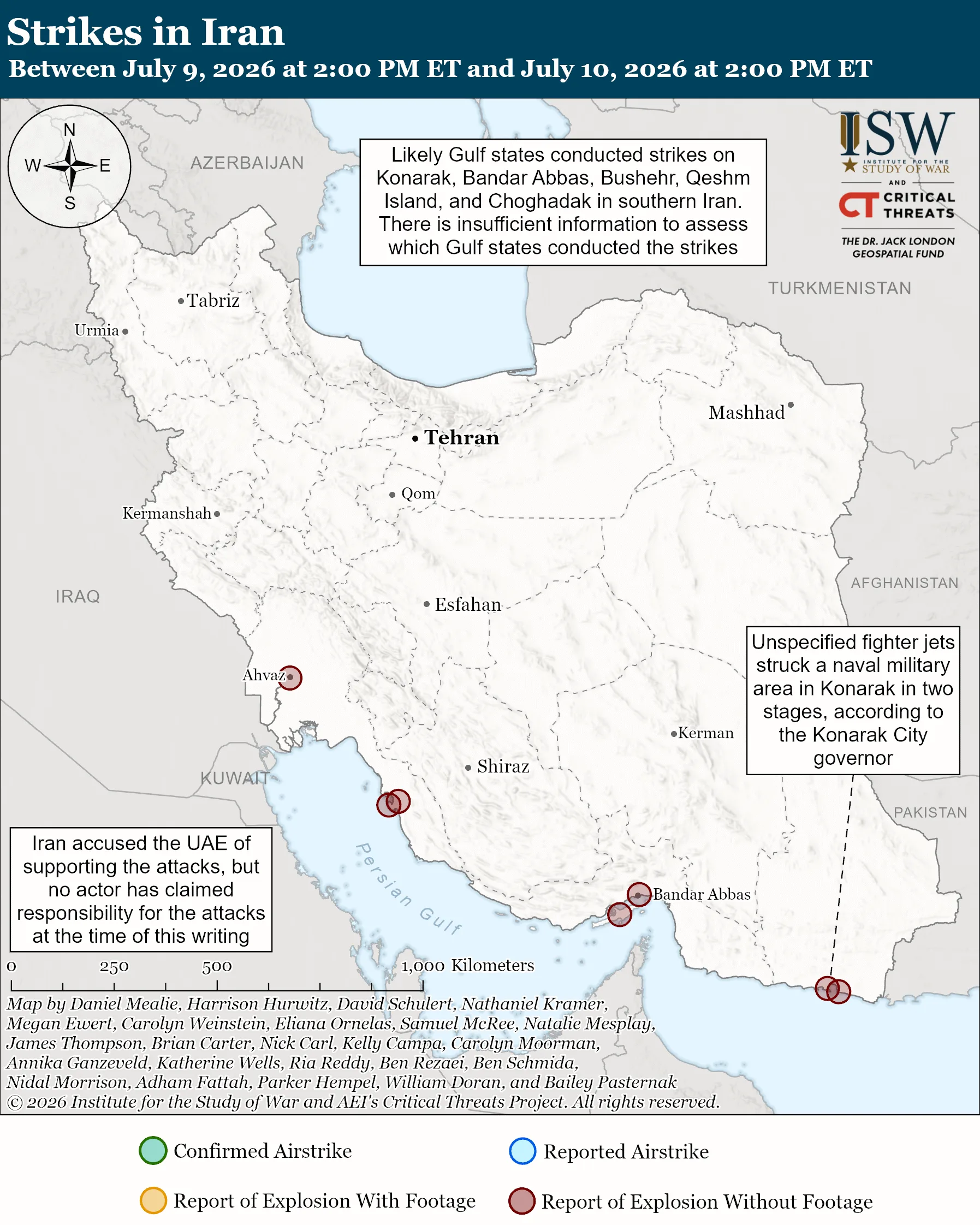
- Iran is attempting to deter the UAE and other Gulf states to prevent them from supporting efforts to end Iranian control of the strait. Likely Gulf states struck unspecified targets in Chabahar, Sistan and Baluchistan Province; Bandar Abbas and Qeshm Island in Hormozgan Province; and Ahvaz, Khuzestan Province, on July 9, according to an open-source intelligence account.
- The Gulf states are divided over how to respond to Iran’s recent attacks. Iran launched strikes against Kuwait, Bahrain, and Qatar on July 9 in response to US strikes on Iran intended to degrade Iran’s ability and willingness to control the strait.
- The United States and Iraq will reportedly sign an agreement under which the United States will invest in Iraq in return for Iraq curbing Iranian influence in Iraq. The Iraqi Prime Minister Ali al Zaydi will reportedly sign the agreement with the United States during his upcoming visit to Washington, DC, starting on June 15.
- The United States also continues to oppose militia-affiliated figures controlling the Iraqi federal government, amid continued Iraqi negotiations over the remaining Iraqi ministries to be filled. The June agreement reportedly requires Baghdad to remove militia-aligned figures from senior-level government positions.
- Iranian-backed Iraqi militias are reportedly attempting to circumvent the Iraqi federal government’s disarmament initiatives. Unidentified framework sources told Iraqi media on July 9 that unidentified militias are handing over “scrap” missiles or inoperable drones to the government but holding onto functional heavy weapons.
Toplines
The United States and Iran are to resume talks following US strikes on Iran between July 8 and 9, but Iran’s negotiating position and war aims remain unchanged. Iran’s negotiating position and war aims include maintaining Iranian control over the Strait of Hormuz, preserving the Iranian nuclear program, and protecting Hezbollah. US President Donald Trump stated on July 10 that the United States agreed to resume talks with Iran at Iran’s request, but that the United States now considers the ceasefire to be over.[1] Neither the memorandum of understanding (MoU) nor the recent rounds of talks between the United States and Iran have bridged the gaps on the key issues in the war, which include Iran’s control of the strait, Iran’s nuclear program, and Israeli operations in Lebanon.[2] Two senior Iranian sources told Reuters on July 8 that the Iranian regime considers its control over the strait to be “important leverage” and that giving up such control would be tantamount to “surrender.”[3] The sources added that Iran will not discuss its nuclear program unless the United States recognizes Iran’s control over the strait.[4] Iran has also not provided any specifics about what elements of its nuclear program it is prepared to discuss. Iran has previously also conditioned opening the strait and discussing its nuclear program on the cessation of Israeli operations against Hezbollah in Lebanon.[5]
Iran is attempting to deter the UAE and other Gulf states to prevent them from supporting efforts to end Iranian control of the strait. Likely Gulf states struck unspecified targets in Chabahar, Sistan and Baluchistan Province; Bandar Abbas and Qeshm Island in Hormozgan Province; and Ahvaz, Khuzestan Province, on July 9, according to an open-source intelligence account.[6] It is unclear which Gulf states attacked Iran based on the available information. Iranian officials and analysts have blamed the UAE for allegedly supporting US strikes against Iran, both during recent exchanges of fire between Iran and the United States and during the war.[7] Iranian Parliamentarian and National Security Commission member Esmail Kowsari accused the UAE on July 10 of conducting attacks against Iran and threatened to target the UAE’s maritime, rail, and air transport infrastructure in response.[8] An analyst close to the regime stated on July 10 that Iran should add the UAE to its “target bank” because the UAE is covertly seeking to undermine Iran’s control over the strait.[9] The regime likely calculates that it needs to adopt an aggressive approach against the UAE due to the UAE’s military support from the United States and Israel.[10]
The Gulf states are divided over how to respond to Iran’s recent attacks. Iran launched strikes against Kuwait, Bahrain, and Qatar on July 9 in response to US strikes on Iran intended to degrade Iran’s ability and willingness to control the strait.[11] Israeli media reported on July 10 that the UAE, Bahrain, and Kuwait are demanding stronger decisions against Iran through the Gulf Cooperation Council (GCC), including via an international arrangement for free transit that would be supplemented by an international military initiative to defend the strait.[12] The Israeli media report added that Oman and Qatar, who have both mediated the US-Iran talks, prefer that diplomatic talks continue.[13] Bahrain spearheaded the effort to pass a UN Resolution in March that would have authorized international naval efforts to ensure freedom of navigation in the strait.[14]
The United States and Iraq will reportedly sign an agreement under which the United States will invest in Iraq in return for Iraq curbing Iranian influence in Iraq. The Iraqi Prime Minister Ali al Zaydi will reportedly sign the agreement with the United States during his upcoming visit to Washington, DC, starting on June 15.[15] This report follows Iraqi and regional reports detailing a “June agreement” designed by Zaydi and US Ambassador to Lebanon and Iraq Tom Barrack during their meeting in Baghdad on June 15.[16] The agreement’s stipulations reportedly include that the Iraqi federal government will disarm Iranian-backed Iraqi militias and dismantle their financial networks.[17] The United States has urged the Iraqi federal government to pursue such reforms since 2025 but has increased its pressure due to militia involvement during the recent war.[18] The Iraqi federal government has taken some initial steps towards meeting these consistent US demands in recent weeks. Baghdad formed a disarmament committee as part of efforts to restrict weapons to the state in early June, and Iraqi officials have repeatedly stated that the end of September is the deadline for disarmament, which corresponds to when US-led international coalition forces will leave Iraq.[19]
The United States also continues to oppose militia-affiliated figures controlling the Iraqi federal government, amid continued Iraqi negotiations over the remaining Iraqi ministries to be filled. The June agreement reportedly requires Baghdad to remove militia-aligned figures from senior-level government positions.[20] Zaydi formed a government and entered office on May 14, but has not appointed several important ministers, including defense and interior.[21] The United States opposes the appointment of militia-aligned figures to important government roles, which complicates attempts to fill these ministries. Parties like Sadiqoun, which is Iranian-backed Iraqi militia Asaib Ahl al Haq’s political wing and won 27 seats in the 2025 elections, would typically be granted control of a ministry, for example.[22] The United States opposes the allocation of any ministerial portfolio to political parties tied to Iranian-backed Iraqi militias, even if the militias have announced their disarmament.[23] Iraqi political sources told regional media on July 10 that Zaydi’s administration will fill the remaining ministries following Zaydi’s visit to Washington, DC, starting June 15.[24] An unidentified framework leader told Iraqi media on July 8 that no militia member or person who participated in the recent war will receive any “executive position, even at the director-general level” in the Iraqi federal government.[25] Militia penetration into the Iraqi state is still a threat to US interests in Iraq, however, given a June 27 Iraqi media report that unspecified Iraqi political parties with militia wings plan to announce their separation from their affiliated militias as part of a plan to “covertly take [over]” Iraqi state institutions.[26]
Iranian-backed Iraqi militias are reportedly attempting to circumvent the Iraqi federal government’s disarmament initiatives. Unidentified framework sources told Iraqi media on July 9 that unidentified militias are handing over “scrap” missiles or inoperable drones to the government but holding onto functional heavy weapons.[27] Asaib Ahl al Haq and Kataib al Imam Ali are the only militias that have publicly announced their willingness to disarm, possibly to gain access to the 35,000 jobs in Iraq’s security establishment that Zaydi has reportedly set aside for militia members willing to disarm.[28] Both militias either conducted attacks or directly supported attacks on US and foreign targets in Iraq and the region during the war.[29] Kataib Hezbollah, Harakat Hezbollah al Nujaba, and Kataib Sayyid al Shuhada, all of which were the most kinetically active during the war and are closest to Iran, have continuously refused to disarm.[30] The framework sources said that eight functional ballistic missiles and hundreds of drones are the “sticking point” for disarming the militias.[31] This information is almost certainly incomplete because the Iraqi government has historically lacked accurate information on the number and types of militia weapons due to the covert nature of the militias, including those within the Iranian-backed Popular Mobilization Forces (PMF).[32] The militia attacks during the war also demonstrated the large number of missiles and drones the militias have access to via Iran and smuggling routes in Syria. This report of the militias resisting government pressure to disarm follows reports that Iran has urged its Iraqi partners not to hand their weapons over to the Iraqi state.[33]
It does not follow that Iran and its Iraqi partners will by default openly resist disarmament by deciding to operate their armed wings in the same manner they have in the past. These groups could decide to metamorphose into a new form while retaining their arms and/or influence. ISW-CTP continues to assess, therefore, that any Iraqi federal government attempt to disarm the militias and integrate them into the Iraqi security establishment that does not address the militias’ networks and allegiance to Iran will likely further embed Iranian influence within the Iraqi state.
US-Iran Negotiations
The United States is increasing its economic pressure on Iran’s shadow bank infrastructure, including Iranian Supreme Leader Mojtaba Khamenei’s personal financial network, in response to Iran’s renewed attacks on international shipping in the Strait of Hormuz.[34] The United States sanctioned eight individuals and six entities on July 10, including Dubai-based financier Ali Ansari, who oversees assets benefiting Mojtaba Khamenei, other regime elites, and the Islamic Revolutionary Guards Corps (IRGC).[35] The US Treasury Department also sanctioned Ansari-owned Smart Global Limited, three Iranian exchange houses, and two front companies that move or hold billions of dollars annually for sanctioned Iranian banks through shell-company networks.[36]
Maritime Activity in the Strait of Hormuz and Persian Gulf
Nothing significant to report.
US and Israeli Air Campaign
See topline section.
Iranian Domestic Affairs
Nothing significant to report.
Iran’s Axis of Resistance
Lebanese Hezbollah and the Israeli Campaign in Lebanon
Hezbollah appears to be deterring the Lebanese government from using force to disarm the group in southern Lebanon. President Joseph Aoun told Lebanese media on July 10 that he plans to discuss the necessity of “cooperating with Hezbollah” to disarm the group during his upcoming meeting with US President Donald Trump on July 21 in Washington, DC.[37] Aoun’s caution is warranted to some degree, given the risks implicit in any violent flare-ups between the government and Hezbollah. But any disarmament plan that relies on cooperating with Hezbollah will almost certainly fail, as Hezbollah will not disarm on its own accord.[38]
Hezbollah is actively attempting to make the Lebanese government more hesitant and cautious as it attempts to disarm the group, likely with the aim of ultimately preventing disarmament outright. Hezbollah leaders and Hezbollah-allied politicians have continued to assert that Hezbollah will remain armed in southern Lebanon and have threatened that attempts by the Lebanese Armed Forces (LAF) to disarm the group would cause civil war.[39] Unspecified sources told Lebanese media on July 6 that the LAF refuses to initiate an “internal confrontation” with Hezbollah because of the risk of starting a civil war with the group and fracturing the LAF.[40]
Other Axis of Resistance Activity
The Iraqi Supreme Judicial Council, which is headed by Iranian-backed Iraqi militia-linked judge Faiq Zaidan, announced on July 10 that it has developed a legal initiative with Iraqi Prime Minister Ali al Zaydi to reduce legal penalties for individuals facing corruption charges if they voluntarily return stolen public funds.[41] This initiative likely possesses significant accountability and enforcement gaps, however. The initiative appears to be a response to the Iraqi public’s dissatisfaction with anti-corruption investigations and their failure to recover stolen funds in recent years.[42] The Supreme Judicial Council said that the initiative will consist of the same legal procedures as a previous anti-corruption amnesty incentive adopted during a major embezzlement trial in 2022.[43] This incentive failed because the suspect fled Iraq and did not return stolen funds, which totaled over $5 billion, after the Iraqi government granted the suspect bail.[44] The initiative also follows a July 7 Saudi media report that members of the Shia Coordination Framework intend to “engineer” corruption trials and issue “settlements” for Iraqi officials facing corruption charges.[45] ISW-CTP assessed on July 8 that some framework members may be attempting to limit the scope of Zaydi’s ongoing anti-corruption campaign.[46]

[1] https://truthsocial.com/@realDonaldTrump/posts/116896167446779964
[2] https://understandingwar.org/research/middle-east/iran-update-special-report-may-25-2026-2/ ; https://understandingwar.org/research/middle-east/iran-update-special-report-june-14-2026/
[3] https://www.reuters.com/world/how-irans-golden-weapon-hormuz-became-bigger-priority-than-its-long-disputed-2026-07-08/
[4] https://www.reuters.com/world/how-irans-golden-weapon-hormuz-became-bigger-priority-than-its-long-disputed-2026-07-08/
[5] https://understandingwar.org/research/middle-east/iran-update-special-report-june-19-2026/
[6] https://x.com/no_itsmyturn/status/2075283070584799234?s=20 ; https://twitter.com/no_itsmyturn/status/2075290619002442124?s=20
[7] https://www.france24 dot com/en/iran-accuses-united-arab-emirates-of-being-active-partner-in-us-israeli-war
[8] https://apnews.com/article/iran-us-israel-war-hormuz-july-10-2026-4bf4fdd1f4d782ff08f60d152909faee
[9] https://x.com/Mostafa_Najafii/status/2075339543830487485?s=20
[10] https://www.axios.com/2026/04/26/israel-iron-dome-uae
[11] https://www.npr.org/2026/07/09/g-s1-132670/us-iran-strikes ; https://x.com/BDF_Bahrain/status/2075104564496208070?s=20
[12] https://www.israelhayom dot com/2026/07/09/pezeshkian-at-risk-of-ouster-as-israel-us-explore-ways-to-topple-irans-regime/
[13] https://www.israelhayom dot com/2026/07/09/pezeshkian-at-risk-of-ouster-as-israel-us-explore-ways-to-topple-irans-regime/
[14] https://apnews.com/article/strait-of-hormuz-iran-us-trump-israel-172e6f41b0e4af99881ca8ef2f69ed17
[15] https://almadapaper dot net/442723/
[16] https://almadapaper dot net/440334 ; https://www.alaraby.co dot uk/economy/خاص-وصول-دفعتين-من-الدولار-نقداً-إلى-بغداد-تزامنا-مع-زيارة-توم-براك
[17] https://almadapaper dot net/440334
[18] https://almadapaper dot net/410670/ ; https://www.newarab dot com/analysis/iraqs-elections-high-stakes-vote-amid-us-iran-tug-war ; https://www.state.gov/releases/office-of-the-spokesperson/2025/10/secretary-rubios-call-with-iraqi-prime-minister-mohammed-shiaa-al-sudani-2
[19] https://almadapaper dot net/437879/ ; https://rudaw dot net/english/categories/iraq/1078296
[20] https://almadapaper dot net/440334
[21] https://almadapaper dot net/442723/ ; https://www.longwarjournal.org/archives/2026/05/iraq-forms-new-government-with-only-14-of-23-ministers.php ;
[22]https://experience.arcgis.com/experience/e33475ade87c41a58795bd544c7c1179 ; https://www.washingtoninstitute.org/policy-analysis/minister-allocation-iraqs-new-government
[23] https://almadapaper dot net/437645/
[24] https://www.alaraby dot co.uk/politics/إرجاء-حسم-حكومة-الزيدي-لحين-عودته-من-واشنطن
[25] https://almadapaper dot net/442723/
[26] https://almadapaper dot net/441014/
[27] https://almadapaper dot net/442723/
[28] https://shafaq dot com/ar/سیاسة/خاص-الزيدي-يقترح-مقايضة-سلاح-الفصا-ل-بمشاريع-ميركية ;https://shafaq dot com/ar/سیاسة/خاص-الزيدي-يقر-خطة-دمج-الفصا-ل-35-لف-فرصة-عمل-مقابل-تسليم-السلاح ; https://shafaq dot com/ar/%D8%B3%DB%8C%D8%A7%D8%B3%D8%A9/%D8%A8%D8%B9%D8%AF-%D8%A7%D9%84%D8%B9%D8%B5%D8%A7-%D8%A8-%D9%83%D8%AA%D8%A7-%D8%A8-%D8%A7%D9%84-%D9%85%D8%A7%D9%85-%D8%B9%D9%84%D9%8A-%D8%AA%D9%82%D8%B1%D8%B1-%D9%81%D9%83-%D8%A7%D9%84%D8%A7%D8%B1%D8%AA%D8%A8%D8%A7%D8%B7-%D8%A8%D8%AA%D8%B4%D9%83%D9%8A%D9%84%D8%A7%D8%AA-%D8%A7%D9%84%D8%AD%D8%B4%D8%AF-%D8%A7%D9%84%D8%B4%D8%B9%D8%A8%D9%8A ; https://shafaq dot com/ar/%D8%B3%DB%8C%D8%A7%D8%B3%D8%A9/%D8%B9%D8%B5%D8%A7-%D8%A8-%D9%87%D9%84-%D8%A7%D9%84%D8%AD%D9%82-%D8%AA%D8%A8%D8%A7%D8%B4%D8%B1-%D9%81%D9%83-%D8%A7%D8%B1%D8%AA%D8%A8%D8%A7%D8%B7%D9%87%D8%A7-%D8%A8%D8%A7%D9%84%D8%AD%D8%B4%D8%AF-%D8%A7%D9%84%D8%B4%D8%B9%D8%A8%D9%8A-%D9%88%D8%AA-%D8%B4%D9%83%D9%84-%D9%84%D8%AC%D9%86%D8%A9-%D9%84%D8%AD%D8%B5%D8%B1-%D8%A7%D9%84%D8%B3%D9%84%D8%A7%D8%AD
[29] https://home.treasury.gov/news/press-releases/sb0458 ; https://ctc.westpoint.edu/wp-content/uploads/2026/06/CTC-SENTINEL-062026_cover-article.pdf pg 15
[30] https://rudaw dot net/english/categories/iraq/958915 ; https://understandingwar.org/research/middle-east/iran-update-special-report-april-10-2026/ ; https://www.washingtoninstitute.org/policy-analysis/profile-islamic-resistance-iraq ; https://t.me/ElamAlmoqawama/1625 ; https://t.me/ElamAlmoqawama/1612;
[31] https://shafaq dot com/ar/سیاسة/خاص-الزيدي-يقترح-مقايضة-سلاح-الفصا-ل-بمشاريع-ميركية ;https://shafaq dot com/ar/سیاسة/خاص-الزيدي-يقر-خطة-دمج-الفصا-ل-35-لف-فرصة-عمل-مقابل-تسليم-السلاح
[32] https://www.washingtoninstitute.org/sites/default/files/pdf/PolicyFocus163-KnightsMalikTamimi-v3%281%29.pdf#pdfjs.action=download, pp 58-59
[33] https://alhurra dot com/en/22220
[34] https://home.treasury.gov/news/press-releases/sb0558
[35] https://home.treasury.gov/news/press-releases/sb0558
[36] https://home.treasury.gov/news/press-releases/sb0558
[37] https://www.naharnet dot com/stories/en/321198-what-will-aoun-tell-trump-about-hezbollah-s-weapons ; https://x.com/TheNationalNews/status/2074791339267666221
[38] https://understandingwar.org/research/middle-east/iran-update-august-26-2025/
[39] https://almanar dot com.lb/article/1011097/?s=tg ; https://t.me/sameralhajali/8183 ; https://t.me/sameralhajali/8666 ; https://www.thenationalnews dot com/news/mena/2026/07/08/lebanon-accepts-us-invitation-for-direct-israel-talks-in-rome-after-initial-refusal/?utm_term=Autofeed&utm_medium=Social&utm_source=Twitter#Echobox=1783520037 ; ; https://www.state.gov/releases/office-of-the-spokesperson/2026/06/trilateral-framework-between-the-united-states-of-america-the-state-of-israel-and-the-republic-of-lebanon/
[40] https://www.annahar dot com/lebanon/326878/لقا-بري-وهيكل-رسائل-تتجاوز-الجنوب
[41] https://www.sjc dot iq/view-en.80168/ ; https://shafaq dot com/ar/سیاسة/القضا-العراقي-يوضح-مسار-سرقة-القرن-حكمنا-على-نور-زهير-بـ10-سنوات-والـعـفـو-عنه-مشروط-بموافقة-المالية ; https://www.washingtoninstitute.org/policy-analysis/four-us-designated-terrorist-groups-rush-support-judge-faeq-zaidan ; https://www.sjc dot iq/cv-president-en.php
[42] https://english.aawsat dot com/arab-world/5275206-iraq’s-‘heist-century’-returns-spotlight-5-billion-figure
[43] https://www.sjc dot iq/view-en.80168/
[44] https://english.aawsat dot com/arab-world/5275206-iraq’s-‘heist-century’-returns-spotlight-5-billion-figure
[45] https://aawsat dot com/العالم-العربي/المشرق-العربي/5293315-الحكومة-العراقية-تصطدم-بممانعة-سياسية-في-مكافحة-الفساد
[46] https://understandingwar.org/research/middle-east/iran-update-special-report-july-8-2026/