The Institute for the Study of War (ISW) and The Critical Threats Project (CTP) at the American Enterprise Institute are publishing updates Monday through Friday to provide analysis on the war with Iran. Most updates cover events from the past 24-hour period, whereas Monday updates also include events from the preceding weekend, collected after ISW-CTP’s 2:00 PM ET Friday data cutoff. ISW-CTP may publish special updates on Saturdays and Sundays if events warrant, however.
Key Takeaways
- Iran struck US and allied bases and assets in the region on September 1 in retaliation for US strikes on Iranian military targets, including radars, on the same day. The US Central Command (CENTCOM) strikes appeared to focus on assets that Iran uses to sense ships to strike.
- US strikes on radars will likely impose operational constraints on Iranian forces attempting to disrupt shipping in the strait. ISW-CTP previously assessed on August 31 that Iran was facing operational constraints on its ability to disrupt shipping in the strait.
- The Iranian attacks on August 30 and 31 indicate that Iran has some capacity to disrupt shipping through the southern route to exit the Strait of Hormuz. The three Iranian attacks on August 30 and 31 do not necessarily imply that Iran faces no constraints, only that it overcame them in those three instances. ISW-CTP will continue to monitor the rate of strikes and the tactical choices involved in each strike to evaluate whether Iran is facing tactical constraints as it attempts to disrupt shipping.
- Iranian President Masoud Pezeshkian may have sought military and economic aid for Iran during meetings with world leaders at the Shanghai Cooperation Organization (SCO) summit in Bishkek, Kyrgyzstan, on August 31 and September 1.
Toplines
Iran struck US and allied bases and assets in the region on September 1 in retaliation for US strikes on Iranian military targets, including radars, on the same day.[1] These radars could have been used to sense and then strike oil tankers in the Persian Gulf. The US Central Command (CENTCOM) said that the September 1 strikes against the radars “followed” Iranian attacks on three oil tankers and US forces and bases in the region.[2] ISW-CTP will provide further details on Iran’s September 1 retaliatory attacks on September 2. Senior Iranian military commanders threatened a military response on September 1 before the attacks, with the Islamic Revolutionary Guard Corps (IRGC) spokesperson specifically threatening Bahrain and Kuwait.[3]
The CENTCOM strikes appeared to focus on assets that Iran uses to sense ships to strike. US President Donald Trump told Fox News on September 1 that US forces struck an unspecified number of Iranian radars that Iran was attempting to rebuild.[4] Iran uses these radars to detect vessels transiting the strait.[5] CENTCOM noted that this followed the IRGC’s “attempted attacks” on commercial shipping in the strait, thus explicitly linking the attacks on shipping and the strikes.[6]
The Iranian attacks on August 30 and 31 indicate that Iran has some capacity to disrupt shipping through the southern route to exit the Strait of Hormuz. Multiple maritime intelligence and observer organizations reported that an unknown projectile struck an oil tanker and that three projectiles hit a very large crude carrier (VLCC), the Senegal Prosperity, on August 30 and 31, respectively.[7] Another shipping intelligence firm told Reuters that Iran hit a second VLCC at the same time it hit Senegal Prosperity on August 31.[8] Iranian regime media reported that this second vessel was using the southern route through the strait.[9] These attacks demonstrate that Iran retains some capacity to use its higher-end systems to target shipping through the Strait of Hormuz. Iran has been attacking vessels that use this route because it is an alternative route to the Iranian-controlled route in the northern part of the strait, undermining Iran’s perceived control over the strait.[10] US forces have been escorting vessels out of the Persian Gulf through this route, which has restored shipping to half of pre-war levels, according to US officials speaking to Axios on August 28.[11]
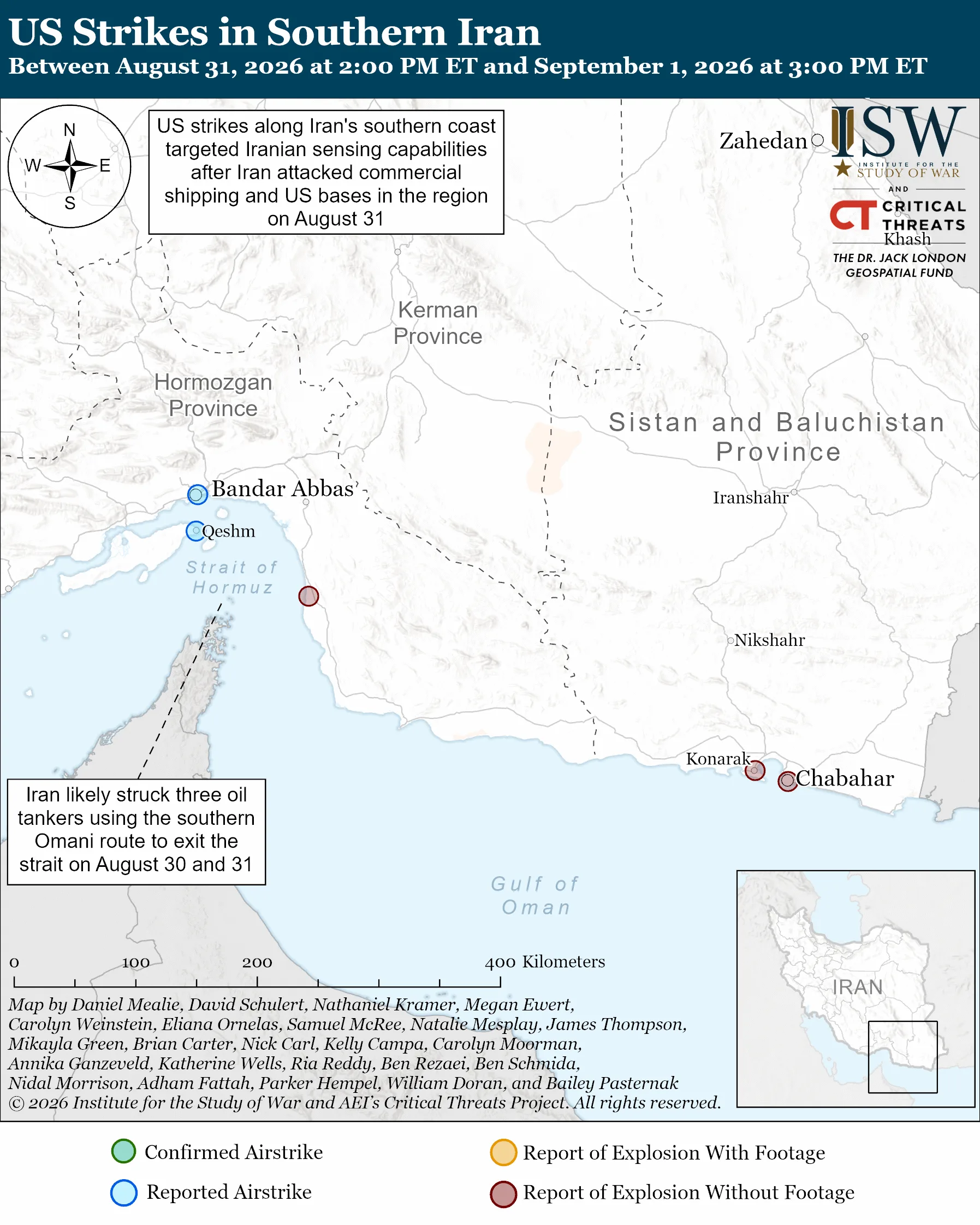
US strikes on radars will likely impose operational constraints on Iranian forces attempting to disrupt shipping in the strait. ISW-CTP previously assessed on August 31 that Iran was facing operational constraints on its ability to disrupt shipping in the strait.[12] Iran is having to adapt its operations to re-establish and re-cultivate international perceptions of Iranian control over the strait.[13] A risk advisory firm director noted on August 31 that the IRGC has been using fast attack craft (FAC) to help detect vessels going through the strait by visual recognition, for example, which is an extremely suboptimal method to find, fix, and finish a target at sea compared to radars and other purpose-built sensors.[14] That Iran must resort to these suboptimal techniques suggests that it is facing constraints.[15] CENTCOM’s August 30 strikes on mine-launching systems suggest that the IRGC Navy is increasingly relying on rocket launchers to deploy mines in the strait, which is also suboptimal compared to laying mines from a vessel.[16] The three attacks on August 30 and 31 do not necessarily imply that Iran faces no constraints, only that it overcame them in those three instances. ISW-CTP will continue to monitor the rate of strikes and the tactical choices involved in each strike to evaluate whether Iran is facing tactical constraints as it attempts to disrupt shipping.
US and Partner Military Operations
See topline section.
Iranian Strike Campaign
Assessed Iranian War Aims:
- Secure international recognition of Iranian control over the Strait of Hormuz
- Degrade the US ability and willingness to continue the war
- Restore deterrence vis-à -vis the United States and its regional partners
- Divide the United States and Israel from the Arab states
See topline section.
US-Iran Negotiations
Nothing significant to report.
Iranian Domestic Affairs
Iranian President Masoud Pezeshkian may have sought military and economic aid for Iran during meetings with world leaders at the Shanghai Cooperation Organization (SCO) summit in Bishkek, Kyrgyzstan, on August 31 and September 1. The SCO, which Iran joined in 2023 and sees as a mechanism to undermine the US-led international order, is a multilateral forum that was established by Eurasian countries, including China and Russia, to coordinate on political, military, and economic issues.[17] Pezeshkian and his delegation met with several world leaders, including Russian President Vladimir Putin, People’s Republic of China (PRC) President Xi Jinping, and Indian Prime Minister Narendra Modi.[18] Both official and unofficial readouts of these meetings are typically vague and do not necessarily reflect the content of the conversations.[19]
Pezeshkian may have spoken to these leaders about ways to fortify Iran’s military and economic options because of US-Israeli strikes on Iranian military assets during the war and the US economic campaign against Iran. Russia, for example, is a key Iranian partner and delivers military and non-military goods to Iran via the Caspian Sea.[20] Informed sources told anti-regime media on August 26 that the US blockade of Iranian ports, Ukrainian strikes on Russian refining infrastructure, and disruptions to the Caspian Sea supply route between Iran and Russia have restricted Iran’s refined gasoline imports, likely exacerbating Iran’s fuel crisis.[21] Significant disruptions to this key trade route for Iran may incentivize Pezeshkian to seek alternative ways to obtain those Russian goods in his conversations with Putin. The PRC accounts for about 90 percent of Iran’s oil exports.[22] The US naval blockade on Iranian ports and Iran’s control of the Strait of Hormuz have disrupted Iran’s ability to export oil and thus incentivize Pezeshkian to find alternative ways to export oil to Iran’s largest buyer.[23]
Lebanon
Nothing significant to report.
Iraq
The Iraqi Central Criminal Court sentenced Kataib Hezbollah member Amir Rahim Jabbar Lazem to 15 years in prison on August 30 for his involvement in kidnapping US journalist Shelly Kittleson in Baghdad in March 2026.[24] The Central Criminal Court operates under the Supreme Judicial Council, which also nominates the Central Criminal Court’s head.[25] An Iraqi Interior Ministry official told UK-based, Qatari-owned media on August 31 that Lazem is a member of a Kataib Hezbollah “special operations unit.”[26] The official added that the other Kataib Hezbollah members involved in Kittleson’s kidnapping remain at large.[27] Kataib Hezbollah released Kittleson on April 7 in exchange for the Iraqi federal government’s release of several imprisoned Kataib Hezbollah members.[28] The Central Criminal Court also sentenced two Kataib Hezbollah fighters to 15 years in prison on August 31 for a March 2026 rocket attack on the US Embassy in Baghdad, according to a leaked court document circulated by Iraqi media.[29] Likely Iranian-backed Iraqi militias fired rockets at the US Embassy in Baghdad on March 7.[30]
Iranian-backed Iraqi militia Asaib Ahl al Haq seeks to appoint the Popular Mobilization Commission (PMC) chairman, according to a senior framework leader who spoke to Iraqi media on September 1.[31] The PMC Chairman oversees the Popular Mobilization Forces (PMF), which is an Iraqi security service comprised of many Iranian-backed Iraqi militias that report to Iran instead of the prime minister.[32] This report comes as Asaib Ahl al Haq and its allies continue to accuse PMC Chairman Faleh al Fayyadh of prior knowledge of US-Saudi strikes on PMF targets, likely to create a political scandal that generates US pressure on Prime Minister Ali al Zaydi to fire Fayyadh.[33] It is unclear, however, whether Asaib Ahl al Haq’s accusations are accurate. Asaib Ahl al Haq’s reported aim to control the PMC Chairman position helps explain why the militia has called for Fayyadh’s removal since 2024.[34]
Arabian Peninsula
Nothing significant to report.

[1] https://x.com/PressTV/status/2094856072926274010?s=20; https://x.com/TreyYingst/status/2094854875154731098?s=20 ; https://t.me/VahidOnline/78140;
https://t.me/BenTzionM/8251
[2] https://x.com/CENTCOM/status/2094826294466810366?s=20 ; https://t.me/Tasnimnews/441452
https://www.axios.com/2026/08/30/us-iran-strike-hormuz-mines ; https://x.com/UK_MTO/status/2094796309194543128
[3] https://x.com/Irgcspeaker/status/2094839889590116651?s=20; https://x.com/Ebrahim_Zolfgri/status/2094837470500131310?s=20
[4] https://x.com/TreyYingst/status/2094854875154731098?s=20
[5] https://understandingwar.org/research/middle-east/iran-update-august-31-2026/
[6] https://x.com/CENTCOM/status/2094826294466810366?s=20
[7] https://www.ukmto.org/-/media/ukmto/products/update-092-jmic-advisory-note-01-september.pdf?rev=0f1bb3938b3c4f28a67bdf5057256c46; https://www.reuters.com/business/energy/two-tankers-carrying-saudi-oil-attacked-strait-hormuz-2026-09-01/
[8] https://www.reuters.com/business/energy/two-tankers-carrying-saudi-oil-attacked-strait-hormuz-2026-09-01/
[9] https://t.me/iribnews/359044
[10] https://understandingwar.org/research/middle-east/iran-update-august-31-2026/
[11] https://www.axios.com/2026/08/28/trump-iran-hormuz-war-oil?utm_campaign=mrf-utm_campaign=editorial&utm_source=x&utm_medium=owned_social&utm_source=twitter&utm_medium=social&mrfcid=202608286a867bc10d1a9d7f61ec0f77
[12] https://understandingwar.org/research/middle-east/iran-update-august-31-2026/
[13] https://understandingwar.org/research/middle-east/iran-update-august-31-2026/
[14] https://x.com/MartinKelly/status/2094129711483891783?s=20; https://understandingwar.org/research/middle-east/iran-update-august-31-2026/
[15] https://understandingwar.org/research/middle-east/iran-update-august-31-2026/
[16] https://x.com/CENTCOM/status/2093131928023023729?s=20; https://understandingwar.org/research/middle-east/iran-update-august-31-2026/
[17] https://www.uscc.gov/research/shanghai-cooperation-organization-testbed-chinese-power-projection ; https://en.mfa dot ir/portal/newsview/652127/The-Islamic-Republic-of-Iran-becomes-9th-member-of-the-Shanghai-Cooperation-Organisation
[18] https://t.me/MID_Russia/89523 ; https://president dot ir/fa/165602 ; https://www-mea-gov-in dot translate.goog/press-releases?dtl/41718/Prime_Ministers_meeting_with_the_President_of_Iran_on_the_sidelines_of_SCO_Summit&_x_tr_sl=en&_x_tr_tl=hi&_x_tr_hl=hi&_x_tr_pto=sge
[19] https://t.me/MID_Russia/89523 ; https://president dot ir/fa/165602 ; https://www-mea-gov-in dot translate.goog/press-releases?dtl/41718/Prime_Ministers_meeting_with_the_President_of_Iran_on_the_sidelines_of_SCO_Summit&_x_tr_sl=en&_x_tr_tl=hi&_x_tr_hl=hi&_x_tr_pto=sge
[20] https://t.me/defapress_ir/60002 ; https://www.nytimes.com/2026/05/09/world/middleeast/caspian-sea-iran-russia.html
[21] https://www.iranintl.com/en/202608262106 ; https://www.theguardian.com/world/2026/aug/31/iran-economy-crisis-usa-launches-sanctions-inflation-trump
[22] https://www.uscc.gov/research/china-iran-fact-sheet-short-primer-relationship
[23] https://www.cnbc.com/2026/08/28/navy-blockade-iran-oil-exports-sanctions-trump.html
[24] https://www.alaraby.co dot uk/entertainment_media/السجن-15-عاماً-لعضو-بكتائب-حزب-الله-لخطف-صحافية-أميركية-في-العراق ; https://x.com/shellykittleson/status/2094408178041565646 ; https://understandingwar.org/research/middle-east/iran-update-special-report-march-31-2026/
[25] https://www.chathamhouse.org/2023/12/tackling-iraqs-unaccountable-state/03-exploring-iraqs-key-accountability-mechanisms
[26] https://www.alaraby.co dot uk/entertainment_media/السجن-15-عاماً-لعضو-بكتائب-حزب-الله-لخطف-صحافية-أميركية-في-العراق
[27] https://www.alaraby.co dot uk/entertainment_media/السجن-15-عاماً-لعضو-بكتائب-حزب-الله-لخطف-صحافية-أميركية-في-العراق
[28] https://understandingwar.org/research/middle-east/iran-update-special-report-april-7-2026/ ; https://t.me/centerkaf/5615
; https://www.nytimes.com/2026/04/07/world/middleeast/shelly-kittleson-journalist-iraq.html
[29] https://www.alaraby.co dot uk/politics/العراق-السجن-لعنصرين-من-كتائب-حزب-الله-لمهاجمتهما-السفارة-الأميركية ; https://x.com/husham_ali1/status/2094459970536226820
[30] https://www.reuters.com/world/middle-east/katyusha-rockets-target-us-embassy-baghdad-security-sources-say-2026-03-07/
[31] https://almadapaper dot net/450918/
[32] https://understandingwar.org/research/middle-east/the-leadership-and-purpose-of-iraqs-popular-mobilization-forces/
[33] https://964media dot com/704803/ ; https://x.com/alssaanetwork/status/2084646817199779931; https://understandingwar.org/research/middle-east/iran-update-special-report-august-4-2026/
[34] https://www.washingtoninstitute.org/policy-analysis/qais-al-khazali-calls-faleh-al-fayyads-removal-pmf-chairman