
Iranian Supreme Leader Mojtaba Khamenei appointed top military leaders in early August, empowering a new cadre of hardline figures from the Islamic Revolutionary Guards Corps (IRGC).[1] The appointments are part of a larger turnover in Iranian military leadership driven by US and Israeli decapitation strikes in 2025 and 2026.[2] The newly ascendent figures are just as aggressive and uncompromising — if not more so — than their predecessors. They form the new nucleus of Iranian decision-making and bring their own ideas and tendencies to the intra-regime discourse. An understanding of these figures is therefore critical to thinking about the new Iranian regime. This piece examines those individuals — Ahmad Vahidi, Hossein Taeb, Mohammad Ali Jafari, Mohammad Bagher Ghalibaf, Mohsen Rezaei, and Ali Abdollahi Ali Abadi — to help inform future analysis on Iranian behavior.
Many of the newly empowered figures are close allies of Mojtaba and engineered his selection as supreme leader in March 2026. Vahidi, Taeb, Jafari, and Ghalibaf reportedly pressured members of the Assembly of Experts — the regime body responsible for choosing the supreme leader — to pick Mojtaba, in some cases threatening assembly members and their families.[3] Mojtaba has since returned the favor by elevating these figures and other key IRGC officers into positions of power.
This has effectively brought a specific faction of especially dangerous, repressive, and corrupt IRGC figures to the top of the regime and granted them even greater influence than they already had. As discussed below, the IRGC figures now dominating Iranian decision-making have abetted the worst regime behaviors over the decades. They have overseen foreign terror operations, brutal protest crackdowns, and the abuse of their positions to enrich themselves and those close to them. Though Iran will certainly remain a strategic threat to the United States and its partners for the foreseeable future, the fundamental shape and character of that threat will change as these new figures take personal control of the regime.
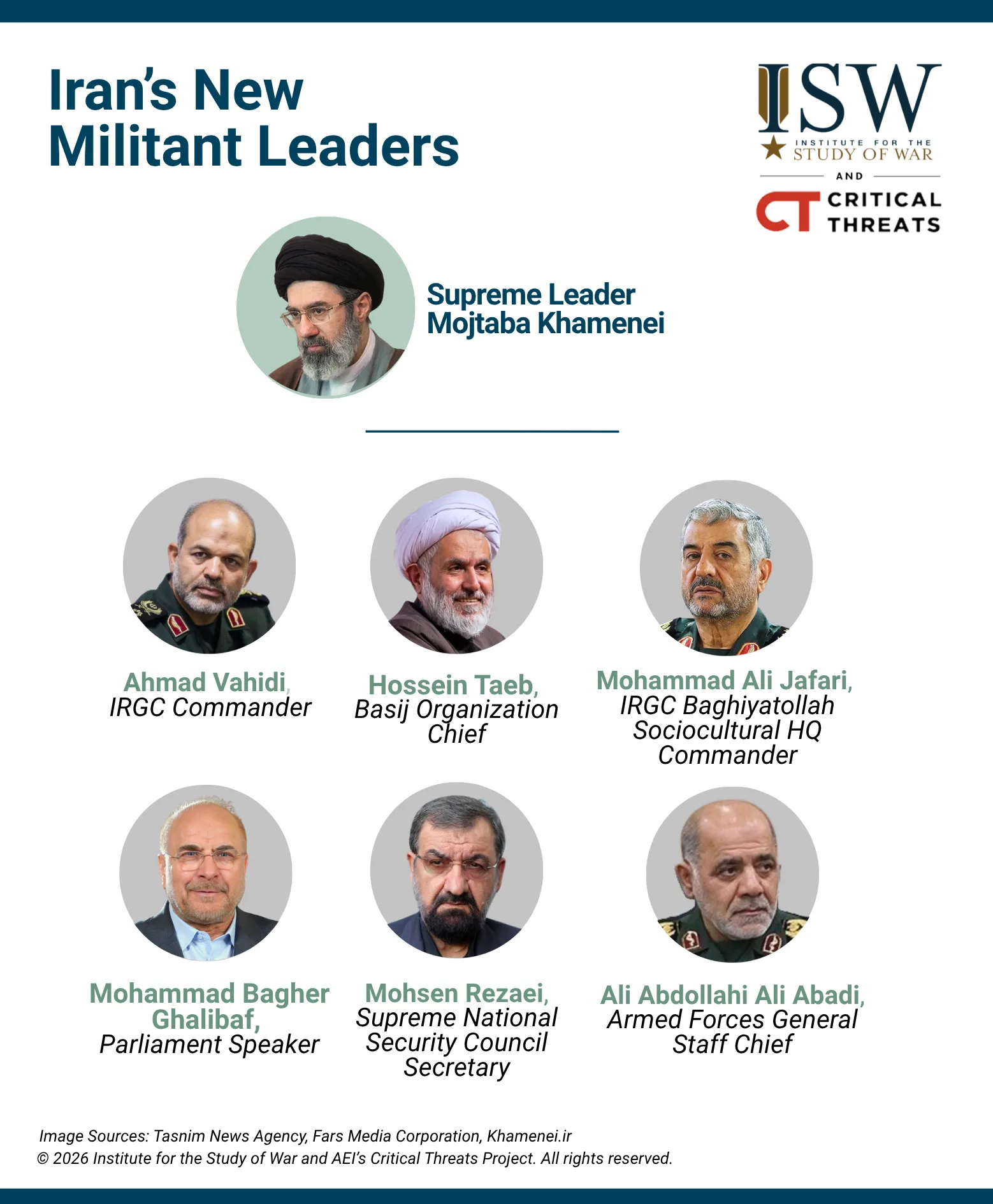
Ahmad Vahidi
Vahidi has served as IRGC commander since March 2026 and has a long history of supporting some of the vilest regime behaviors domestically and abroad.[4] Vahidi joined the IRGC around the outset of the Iran-Iraq War, serving in its intelligence service.[5] Vahidi quickly rose through the ranks, becoming the IRGC intelligence chief after only a few years.[6] Vahidi organized the intelligence service into several divisions, including those for Lebanon, the Arabian Peninsula, Afghanistan, and special operations, among others.[7] Vahidi gave special attention to Lebanon and was one of the five Iranian figures who played a key role in the establishment of Lebanese Hezbollah in the early 1980s.[8] Vahidi was implicated in the Hezbollah attack on the US Marine Barracks in 1983, killing hundreds of American service members and wounding many more.[9]
Vahidi’s “successful service” in Lebanon paved the way for him to become the first commander of the IRGC Quds Force — the service responsible for clandestine operations and support to foreign militias — in 1988.[10] The Quds Force was the organizational successor of the intelligence service that Vahidi led previously.[11] In his role as Quds Force commander, Vahidi expanded the reach of the IRGC and oversaw terror attacks on foreign soil, including the bombing of a Jewish cultural center in Argentina in 1994.[12] The International Criminal Police Organization issued a Red Notice — a non-binding arrest warrant — for Vahidi in 2007 for his involvement in the attack.[13]
Vahidi has been extensively involved in domestic repression in more recent years. Vahidi served as interior minister, overseeing the Law Enforcement Command (LEC) during the Woman, Life, Freedom Movement in 2022-23.[14] Vahidi was responsible for “brutal actions” against protesters, including the use of lethal force.[15] Vahidi also served as the IRGC deputy commander during the most recent round of large-scale protests in December 2025 and January 2026, during which the regime killed tens of thousands of citizens over just a few days.[16] These experiences demonstrate Vahidi’s deep commitment to the revolution and readiness to use extreme violence against large numbers of civilians to preserve it.
Vahidi has played a dominant role in Iranian decision-making in more recent months, becoming an IRGC commander at the beginning of the war and driving Iranian efforts to control the Strait of Hormuz.[17] Vahidi has overseen the IRGC missile and drone attacks across the Middle East and opposed more pragmatic Iranian officials, such as President Masoud Pezeshkian, from compromising with the United States.[18] Vahidi was likely involved in the decision to recall the Iranian negotiating team from Islamabad during the first round of talks in April 2026, reportedly because negotiators “deviated” from their mandate.[19] If Vahidi was involved, it reflects efforts to enforce a hardline, uncompromising negotiating position.
Mojtaba formalized the appointment of Vahidi to IRGC commander in August 2026, bestowing on him the rank of major general and instructing him to enhance Iranian deterrence and prepare for “powerful offensive operations against the enemy.”[20] The unusual Iranian emphasis on offensive operations has supplied Vahidi a mandate to focus on power projection, preemptive operations, and other means to threaten US and partner interests abroad.
Hossein Taeb
Mojtaba appointed Hossein Taeb as Basij Organization chief, empowering a close ally and notoriously hardline figure with extensive experience in domestic repression.[21] The Mojtaba-Taeb relationship dates back to their time in the Habib Ibn Mazaher Battalion of the IRGC 27th Mohammad Rasoul Ollah Division during the Iran-Iraq War.[22] Mojtaba and Taeb have been close since then and collaborated on several occasions, such as during the crackdown on the Green Movement in 2009.[23] Taeb was Basij chief at the time as well, overseeing the use of extreme violence against protesters.[24] Then-Supreme Leader Ali Khamenei soon thereafter appointed Taeb to lead the newly established IRGC Intelligence Organization, which he led from 2009 to 2022.[25] The IRGC Intelligence Organization under Taeb was responsible for monitoring domestic discontent, threatening and arresting political dissidents, suppressing protest activity, and combating “Western cultural infiltration and moral offenses.”[26] Taeb also used his experience in domestic repression to help the Bashar al Assad regime crush protests at the onset of the Syrian civil war.[27]
Like Vahidi, Taeb has been involved in terror operations abroad in his capacity as IRGC Intelligence Organization chief. He has been implicated in plots to harm Israeli officials and civilians, including a plan to kidnap and attack Israeli diplomats and tourists in Turkey in 2022.[28] Then-Supreme Leader Ali Khamenei dismissed Taeb after the failed operation in Turkey and the continued Israeli assassination of prominent Iranian officials.[29]
The appointment of Taeb to again lead the Basij marks his return to prominence. Mojtaba, in appointing Taeb, instructed him to develop a “popular intelligence network . . . and use new technologies for popular confrontation against enemy threats.”[30] Iranian state media interpreted this mandate as meant to expand the role of the Basij in monitoring the population through local intelligence networks.[31] Taeb is uniquely well-suited for this task given his unique experience in the Basij and IRGC Intelligence Organization and overseeing collaboration between them. The IRGC Intelligence Organization under Taeb collaborated closely with the Basij to collect information on citizens and potential political opposition.[32]
Mohammad Ali Jafari
Jafari is another major IRGC figure close to Mojtaba, though he has not yet received any new official appointment. Jafari is a prominent Iranian military thinker who has led doctrinal change and adaptation over his career. Jafari is best known for developing Mosaic Defense, which is the operational concept and reorganization plan that the IRGC prepared to defend against a potential US ground invasion.[33] Jafari developed Mosaic Defense in response to the US invasions of Afghanistan and Iraq in 2001 and 2003, respectively, and would later institutionalize the concept when he became IRGC commander in 2007.[34] Mosaic Defense involves the decentralization of the IRGC Ground Forces, embedding its formations in population centers and preparing them for a guerrilla defense against invading American forces.[35]
Jafari played a prominent role in domestic repression during his tenure as IRGC commander from 2007 to 2019. He declared that the primary mission of the IRGC was to confront “internal threats” in his first speech as IRGC commander.[36] He proceeded to focus on preparing the IRGC for protest crackdowns, coopting the distribution of IRGC ground units across Iranian cities and towns as part of Mosaic Defense to position those units to use extreme violence against protesters. Jafari also oversaw the integration of Basij paramilitary elements into the IRGC Ground Forces and the expansion of the IRGC’s involvement in local politics and socio-cultural affairs.[37] The IRGC under Jafari brutally suppressed the Green Movement in 2009 and the Dey Protests in 2017-18.
Jafari led the IRGC through the peak of its intervention in the Syrian civil war, where the IRGC demonstrated a nascent capacity for expeditionary ground operations.[38] The IRGC Ground Forces — in collaboration with the IRGC Quds Force — deployed division and brigade elements to Syria to integrate with the Syrian Arab Army and other pro-Assad and Iranian-backed militias.[39] The IRGC ground units assumed a leading role in the defense of the Assad regime and the fight against the Islamic State and other Syrian opposition groups.[40] The IRGC ground deployments peaked around 2015-16.[41] This episode marked the first major combat operations that the IRGC Ground Forces conducted since the Iran-Iraq War.[42]
Jafari has focused further on socio-cultural engineering and political interference since the end of his tenure as IRGC commander. Then-Supreme Leader Ali Khamenei appointed Jafari as commander of the IRGC Baghiyatollah ol Azam Socio-Cultural Headquarters in 2019, tasking him with countering enemy “soft war.”[43] Iranian officials use that term to refer to the use of non-military tools, such as information operations, to reduce public support for the regime and corrupt Iranian society with Western and liberal values. The IRGC socio-cultural headquarters under Jafari has produced and disseminated regime propaganda, organized pro-regime events, and interfered in elections to advantage hardline candidates.[44] Such interference manifested as intimidating voters, mobilizing regime supporters to vote, and manipulating in-person ballots.[45] Jafari has also worked with Taeb to ensure their desired electoral outcomes.[46] Jafari has thus eroded the already extremely thin veneer of a democratic process in Iran, paying little-to-no regard for the popular preferences.
Jafari has advocated for a hardline negotiating position since the war began. He has argued that Iran should refrain from negotiations until the United States meets several preconditions, such as stopping Israeli operations against Lebanese Hezbollah, lifting sanctions, paying war reparations, and recognizing Iranian sovereignty over the Strait of Hormuz.[47] Jafari has essentially argued for the United States to surrender and concede on all of the core Iranian demands before negotiations even occur.
Mohammad Bagher Ghalibaf
Ghalibaf is a prominent IRGC-officer-turned-politician who has amassed considerable influence under Mojtaba. Ghalibaf is the current parliament speaker and has led negotiations with the United States.[48] He has long-standing ties with Mojtaba, Taeb, Jafari, and other senior IRGC figures. He is often characterized as a relative pragmatist given his general preference for resolving tensions diplomatically. This preference should not be interpreted as a genuine desire to reset the Iranian relationship with the United States, however. It derives from his understanding of the requirements for political survival and regime stability.
Ghalibaf began his career in the IRGC, where he supported domestic repression. He fought in the Iran-Iraq War, during which he cultivated close relationships across the IRGC, and later commanded the IRGC Air Force from 1997 to 2000.[49] In 1999, Ghalibaf was one of 24 IRGC officers, including Jafari, who signed a letter to then-President Mohammad Khatami threatening to intervene unilaterally if he did not crush ongoing student protests.[50] The letter accused Khatami of betraying the revolution and warned that IRGC patience was waning.[51] Ghalibaf later boasted that he personally beat students with a baton during the protests.[52] Ghalibaf further supported repression when he led the LEC from 2000 to 2005 and oversaw its crackdown on protests in 2003.[53] At the time, Ghalibaf requested permission from the Supreme National Security Council to use lethal force against protesters.[54]
Ghalibaf entered politics in 2005 and has since become the face of financial corruption in Iran. While serving as Tehran mayor from 2005 to 2017, Ghalibaf funneled 3.5 million US dollars to his wife’s “charity,” offered Tehran properties to regime officials at discounted prices, and used Tehran Municipality money to fund his unsuccessful 2017 presidential campaign.[55] Ghalibaf was also implicated in a multi-billion dollar embezzlement scheme involving Yas Holding, which prompted fierce infighting among IRGC leadership.[56] Ghalibaf separately received tremendous public backlash in 2022, when his family returned to Iran from a shopping spree in Turkey with suitcases full of purchased goods, showcasing the extreme economic disparity between ordinary Iranians and the ruling elite.[57]
Ghalibaf has consolidated significant political power since becoming parliament speaker in 2020 and even more so since the war began. He has begun to function as an executive-like authority comparable to the Iranian president.[58] Ghalibaf has continued to advocate for negotiations with the United States but does not appear to be influential enough to drive the regime toward serious concessions.[59]
Mohsen Rezaei
Rezaei was the first individual to receive an appointment from Mojtaba after he became supreme leader, highlighting the central position that Rezaei has claimed in the new regime. Mojtaba selected Rezaei as his personal military adviser and later as his representative to and secretary of the Supreme National Security Council.[60] Rezaei aligns with the hardline faction and has supported a maximalist and uncompromising negotiating position through the war, including the demand to permanently control the Strait of Hormuz.[61]
The appointments mark Rezaei’s return to prominence in a manner similar to Taeb’s. Rezaei is best known for commanding the IRGC from 1981 to 1997, leading the force through the Iran-Iraq War and the early years of Ali Khamenei’s tenure as supreme leader.[62] Like Vahidi, the International Police Organization issued a Red Notice for Rezaei for his involvement in the terror attack in Argentina in 1994.[63] While leading the IRGC, Rezaei had a strained relationship with Ali Khamenei that persisted through the following decades.[64] After serving as IRGC commander, Ali Khamenei allowed Rezaei to rotate across policy jobs, remaining part of the official establishment, but not a crucial decisionmaker in the way that he was previously. Rezaei launched several presidential campaigns but never seemed to secure the endorsement of Ali Khamenei, who preferred others.[65]
Rezaei has indicated support for the acquisition of nuclear weapons. Rezaei described the need for a “holy Islamic bomb” in 2005, according to Israeli media.[66] Rezaei has, in more recent days, asked rhetorically why Iran should refrain from acquiring a nuclear weapon.[67]
Ali Abdollahi Ali Abadi
Mojtaba appointed Abdollahi as chief of the Armed Forces General Staff (AFGS), making him formally the senior-most Iranian officer and responsible for cooperation and coordination between the IRGC and Artesh.[68] Abdollahi has spent much of his career working closely with Ghalibaf, serving as his deputy in the IRGC Air Force and again in the LEC.[69] Abdollahi thus facilitated the LEC crackdown on the protests in 2003 alongside Ghalibaf. Abdollahi later became deputy interior minister for security and law enforcement affairs in the Mahmoud Ahmadinejad administration in 2009, again tasking him with domestic repression, especially during the Green Movement.[70]
Abdollahi has more recently served in senior joint staff positions, giving him leadership experience at the highest Iranian military echelons. During this time, Abdollahi worked on readiness and defense industrial affairs and later became the third-in-command in the AFGS.[71] During the 12-Day War, Abdollahi became the commander of the Khatam ol Anbia Central Headquarters, which is the senior-most operational headquarters and is responsible for joint and wartime operations.[72] Abdollahi retained that command while Mojtaba made him AFGS chief. Mojtaba has tasked Abdollahi with merging the AFGS and Khatam ol Anbia Central Headquarters, returning them to something resembling their pre-2016 structure, and streamlining military decision-making.[73]

[1] https://t.me/farsna/455357
[2] https://www.aei.org/commentary/a-new-era-of-iranian-military-leadership/ ; https://www.criticalthreats.org/analysis/iran-update-evening-special-report-february-28-2026
[3] https://www.nytimes.com/2026/03/16/world/middleeast/iran-mojtaba-khamenei-election-supreme-leader.html ; https://iranwire.com/en/news/150272-exclusive-irgc-intelligence-threatened-experts-and-their-families-to-select-mojtaba-khamenei/
[4] https://www.iranintl.com/en/202603010960
[5] https://www.sarpoosh dot com/biography/political-biography/ahmad-vahidi-10.html
[6] https://www.faraz dot ir/fa/news/67982
[7] https://www.pbs.org/wgbh/pages/frontline/tehranbureau/2012/08/the-guards-strategic-brain-trust-part-1-ghasem-soleimani-and-ahmad-vahidi.html
[8] https://www.etemadnewspaper dot ir/fa/main/detail/196049
[9] https://nypost.com/2009/10/23/deadly-anniversary/
[10] https://nypost.com/2009/10/23/deadly-anniversary/
[11] https://www.bbc.com/persian/iran-features-48511526 ; https://defapress dot ir/fa/news/750330/
[12] https://www.washingtoninstitute.org/policy-analysis/iranian-doublespeak-anniversary-amia-bombing
[13] https://www.interpol.int/ar/1/1/2007/INTERPOL-Executive-Committee-takes-decision-on-AMIA-Red-Notice-dispute
[14] https://home.treasury.gov/news/press-releases/jy0994
[15] https://home.treasury.gov/news/press-releases/jy0994
[16] https://www.mehrnews dot com/news/6729771
[17] https://www.wsj.com/world/middle-east/the-iranian-enforcer-driving-tehrans-hard-bargaining-with-the-u-s-b848e67c
[18] https://www.wsj.com/world/middle-east/the-iranian-enforcer-driving-tehrans-hard-bargaining-with-the-u-s-b848e67c?eafs_enabled=false
[19] https://www.iranintl.com/en/202604149552
[20] https://rahbar dot ir/speech?cid=1765
[21] https://t.me/farsna/455357
[22] https://www.radiofarda.com/a/30119166.html
[23] https://www.theguardian.com/world/2009/jul/08/khamenei-son-controls-iran-militia
[24] https://search-uk-sanctions-list.service.gov.uk/designations/IRN0039/Individual?utm_content=&utm_medium=email&utm_name=&utm_source=govdelivery
[25] https://www.rferl.org/a/iran-irgc-intelligence-chief-reshuffle/31913944.html
[26] https://www.inss.org dot il/wp-content/uploads/2025/07/Chapter-4.pdf
[27] https://eur-lex.europa.eu/legal-content/EN/TXT/HTML/?uri=CELEX:32012R0036
[28] https://www.axios.com/2022/06/23/iran-irgc-intelligence-chief-taeb-israel-turkey
[29] https://www.axios.com/2022/06/23/iran-irgc-intelligence-chief-taeb-israel-turkey
[30] https://rahbar dot ir/speech?cid=1768
[31] https://defapress dot ir/fa/news/854651/
[32] https://www.terrorism-info.org.il/app/uploads/2020/11/E_269_20.pdf
[33] https://www.aei.org/wp-content/uploads/2023/05/Pivot-to-Offense-How-Iran-Is-Adapting-for-Modern-Conflict-and-Warfare.pdf?x97961
[34] https://www.criticalthreats.org/wp-content/uploads/2020/01/20200121-Report-Iran%E2%80%99s-Reserve-of-Last-Resort.pdf
[35] https://www.criticalthreats.org/wp-content/uploads/2020/01/20200121-Report-Iran%E2%80%99s-Reserve-of-Last-Resort.pdf
[36] https://www.rferl.org/a/1078871.html
[37] https://www.washingtoninstitute.org/sites/default/files/pdf/PolicyNote81-Golkar-v2.pdf ; https://www.radiofarda.com/a/f5_new_heads_IRG/455991.html
[38] https://www.aei.org/wp-content/uploads/2023/05/Pivot-to-Offense-How-Iran-Is-Adapting-for-Modern-Conflict-and-Warfare.pdf?x97961
[39] https://www.aei.org/wp-content/uploads/2023/05/Pivot-to-Offense-How-Iran-Is-Adapting-for-Modern-Conflict-and-Warfare.pdf?x97961
[40] https://www.aei.org/wp-content/uploads/2023/05/Pivot-to-Offense-How-Iran-Is-Adapting-for-Modern-Conflict-and-Warfare.pdf?x97961
[41] https://www.aei.org/wp-content/uploads/2023/05/Pivot-to-Offense-How-Iran-Is-Adapting-for-Modern-Conflict-and-Warfare.pdf?x97961
[42] https://www.aei.org/wp-content/uploads/2023/05/Pivot-to-Offense-How-Iran-Is-Adapting-for-Modern-Conflict-and-Warfare.pdf?x97961
[43] https://www.aei.org/wp-content/uploads/2023/10/The-Soft-War-Understanding-Irans-Domestic-Ideological-Crisis.pdf?x85095
[44] https://www.aei.org/wp-content/uploads/2023/10/The-Soft-War-Understanding-Irans-Domestic-Ideological-Crisis.pdf?x85095 ; https://www.hudson.org/politics-government/political-transition-post-raisi-iran
[45] https://www.unitedagainstnucleariran.com/sites/default/files/UANI_Engineering%20Minds%20and%20Votes.pdf
[46] https://iranwire.com/fa/features/126439-%D9%81%D8%A7%DB%8C%D9%84-%D8%B5%D9%88%D8%AA%DB%8C-%D9%85%D8%AD%D9%85%D8%AF%D8%AC%D9%88%D8%A7%D8%AF-%D8%B8%D8%B1%DB%8C%D9%81-%D8%AC%D8%B9%D9%81%D8%B1%DB%8C-%D9%88-%D8%B7%D8%A7%D8%A6%D8%A8-%D9%87%D9%85%D9%87%DA%A9%D8%A7%D8%B1%D9%87%D8%A7%D9%86%D8%AF/
[47] https://understandingwar.org/research/middle-east/iran-update-special-report-may-11-2026/
[48] https://www.npr.org/2026/06/19/nx-s1-5861921/who-is-mohammad-bagher-ghalibaf-the-man-leading-irans-negotiating-team
[49] https://www.criticalthreats.org/wp-content/uploads/2016/07/pdf_uploadanalysisThe_IRGC_Command_Network-1.pdf
[50] https://irandataportal.syr.edu/irgc-commanders-letter-to-khatami/ ; https://www.rferl.org/a/1342938.html ; https://www.criticalthreats.org/wp-content/uploads/2016/07/pdf_uploadanalysisThe_IRGC_Command_Network-1.pdf
[51] https://irandataportal.syr.edu/irgc-commanders-letter-to-khatami/ ; https://www.rferl.org/a/1342938.html ; https://www.criticalthreats.org/wp-content/uploads/2016/07/pdf_uploadanalysisThe_IRGC_Command_Network-1.pdf
[52] https://www.rferl.org/a/iran-qalibaf-crackdown-accounts/24989062.html
[53] https://www.rferl.org/a/iran-qalibaf-crackdown-accounts/24989062.html
[54] https://www.rferl.org/a/iran-qalibaf-crackdown-accounts/24989062.html
[55] https://www.pbs.org/newshour/world/irans-parliamentary-speaker-qalibaf-floated-as-possible-u-s-contact-in-talks-as-war-rages-on ; https://iranwire.com/en/features/67106/ ; https://www.al-monitor dot com/originals/2016/08/tehran-city-council-real-estate-ghalibaf-chamran.html
[56] https://iranwire.com/en/politics/71311/
[57] https://www.iranintl.com/en/202204204767
[58] https://www.mehrnews dot com/news/6849303
[59] https://www.iranintl.com/en/202608269111
[60] https://www.timesofisrael.com/liveblog_entry/iranian-media-says-supreme-leader-appoints-former-guards-chief-as-military-adviser ; https://rahbar dot ir/speech?cid=1760
[61] https://donya-e-eqtesad dot com/%D8%A8%D8%AE%D8%B4-%D8%B3%D8%A7%DB%8C%D8%AA-%D8%AE%D9%88%D8%A7%D9%86-62/4285884-%D9%BE%DB%8C%D8%A7%D9%85-%D9%88%DB%8C%D8%AF%D8%A6%D9%88%DB%8C%DB%8C-%D8%AC%D8%AF%DB%8C%D8%AF-%D9%85%D8%AD%D8%B3%D9%86-%D8%B1%D8%B6%D8%A7%DB%8C%DB%8C-%D8%AA%D9%86%DA%AF%D9%87-%D9%87%D8%B1%D9%85%D8%B2-%D9%85%D8%AA%D8%B9%D9%84%D9%82-%D8%A8%D9%87-%D8%A7%DB%8C%D8%B1%D8%A7%D9%86-%D8%A7%D8%B3%D8%AA-%D9%81%DB%8C%D9%84%D9%85 ; https://www.mehrnews dot com/news/6891074 ; https://www.mehrnews dot com/news/6891156 ; https://www.mehrnews dot com/news/6890781
[62] https://iranwire.com/en/features/65978/
[63] https://www.interpol.int/ar/1/1/2007/INTERPOL-Executive-Committee-takes-decision-on-AMIA-Red-Notice-dispute
[64] https://iranwire.com/en/features/65978/
[65] https://iranwire.com/en/features/65978/
[66] https://blogs.timesofisrael.com/while-iran-builds-its-holy-islamic-bomb/
[67] https://www.iranintl.com/en/202608239487
[68] https://t.me/farsna/455357
[69] https://www.presstv.co dot uk/Detail/2026/08/10/774109/Who%E2%80%99s-who–Meet-Iran%E2%80%99s-new-top-military-officials-appointed-by-Leader; https://www.khabaronline dot ir/news/2233149
[70] https://www.presstv dot co dot uk/Detail/2026/08/10/774109/Who%E2%80%99s-who–Meet-Iran%E2%80%99s-new-top-military-officials-appointed-by-Leader
[71] https://www.mehrnews dot com/news/3706474/%D8%AE%D9%84%D8%A8%D8%A7%D9%86-%D8%B9%D9%84%DB%8C-%D8%B9%D8%A8%D8%AF%D8%A7%D9%84%D9%84%D9%87%DB%8C-%D8%A8%D9%87-%D8%B3%D9%85%D8%AA-%D9%85%D8%B9%D8%A7%D9%88%D9%86%D8%AA-%D9%87%D9%85%D8%A7%D9%87%D9%86%DA%AF-%DA%A9%D9%86%D9%86%D8%AF%D9%87-%D8%B3%D8%AA%D8%A7%D8%AF-%DA%A9%D9%84-%D9%85%D9%86%D8%B5%D9%88%D8%A8
[72] https://borna dot news/en/news/6107/iran-merges-khatam-headquarters-and-armed-forces-general-staff-in-major-military-command-overhaul
[73] https://rahbar dot ir/speech?cid=1763