The Institute for the Study of War (ISW) and The Critical Threats Project (CTP) at the American Enterprise Institute are publishing daily updates to provide analysis on the war with Iran. The updates cover events from the past 24-hour period.
Key Takeaways
- Iran and the United States will reportedly hold talks in Doha, Qatar, on June 30 to discuss the implementation of the US-Iran memorandum of understanding (MoU) despite the recent exchange of fire between the United States and Iran. Iran will likely use these talks to try to secure the implementation of provisions in the MoU that help advance Iranian objectives, including the provision about the release of Iranian frozen assets.
- Clerics within Iran’s Assembly of Experts, including within the body’s leadership, appear divided over how the regime should implement the US-Iran MoU and how much latitude Iranian negotiators should have in talks with the United States. The Assembly of Experts is an 88-member clerical body that is responsible for appointing and supervising the Supreme Leader, according to the Iranian constitution.
- Iranian President Masoud Pezeshkian separately appears to be trying to build support for the MoU among senior clerics and defend the Iranian negotiating team. Pezeshkian met with several senior Shia clerics in Qom Province on June 28, likely to rally clerical support for the agreement, present the MoU as a source of economic relief, and insulate negotiators from criticism by hardline clerics.
- Iranian officials and media are signaling that Iran will not allow Oman to constrain Iran’s effort to establish control over the Strait of Hormuz. IRGC-affiliated Tasnim News Agency argued in an op-ed on June 29 that tying the future management of the strait to Omani consent would harm Iranian interests.
- An international media correspondent released on June 29 the reported text of the June 26 Israel-Lebanon-United States trilateral framework agreement’s security annex, which stipulates the process by which the Lebanese Armed Forces (LAF) will backfill the Israel Defense Forces (IDF) in southern Lebanon. The annex includes a four-stage mechanism for the LAF and IDF to dismantle non-state armed groups in designated “pilot zones” in southern Lebanon.
- Hezbollah officials and media are attempting to delegitimize the trilateral framework agreement by accusing the Lebanese government of violating Lebanese law and public interests. Hezbollah-affiliated media argued on June 29 that the agreement is invalid because it allegedly violates Lebanese sovereignty, popular consent, and the Lebanese constitution due to the agreement being signed under Israeli military “duress.”
Toplines
Iran and the United States will reportedly hold talks in Doha, Qatar, on June 30 to discuss the implementation of the US-Iran memorandum of understanding (MoU) despite the recent exchange of fire between the United States and Iran. Iran will likely use these talks to try to secure the implementation of provisions in the MoU that help advance Iranian objectives, including the provision about the release of Iranian frozen assets. US President Donald Trump announced on June 29 that Iran requested talks in Doha on June 30.[1] Iranian Deputy Foreign Affairs Minister for Legal and International Affairs Kazem Gharibabadi stated on June 29, prior to Trump’s announcement, that no technical talks are currently planned for this week, however.[2] Iranian Foreign Affairs Ministry Spokesperson Esmail Baghaei later stated after Trump’s announcement that Iran’s current priority is to ensure the implementation of the MoU.[3] Baghaei added that Iran will send a delegation to Doha this week to follow up on the implementation of the MoU, including clause 11, which focuses on the release of Iranian frozen assets. Baghaei denied that Iran will hold any negotiations on a final deal with the United States at any level in the coming days, however.[4] Baghaei claimed that the Iranian delegation’s visit to Doha has “nothing to do with” US officials’ trip to Qatar.[5] Baghaei’s remarks suggest that Iran continues to insist on the United States releasing Iran’s frozen assets before Iran agrees to discuss nuclear issues. Early access to frozen funds would give Iran immediate economic relief, reduce US leverage in nuclear talks, and provide Iran with funds that it could use to reconstitute its military capabilities and the Axis of Resistance.[6]
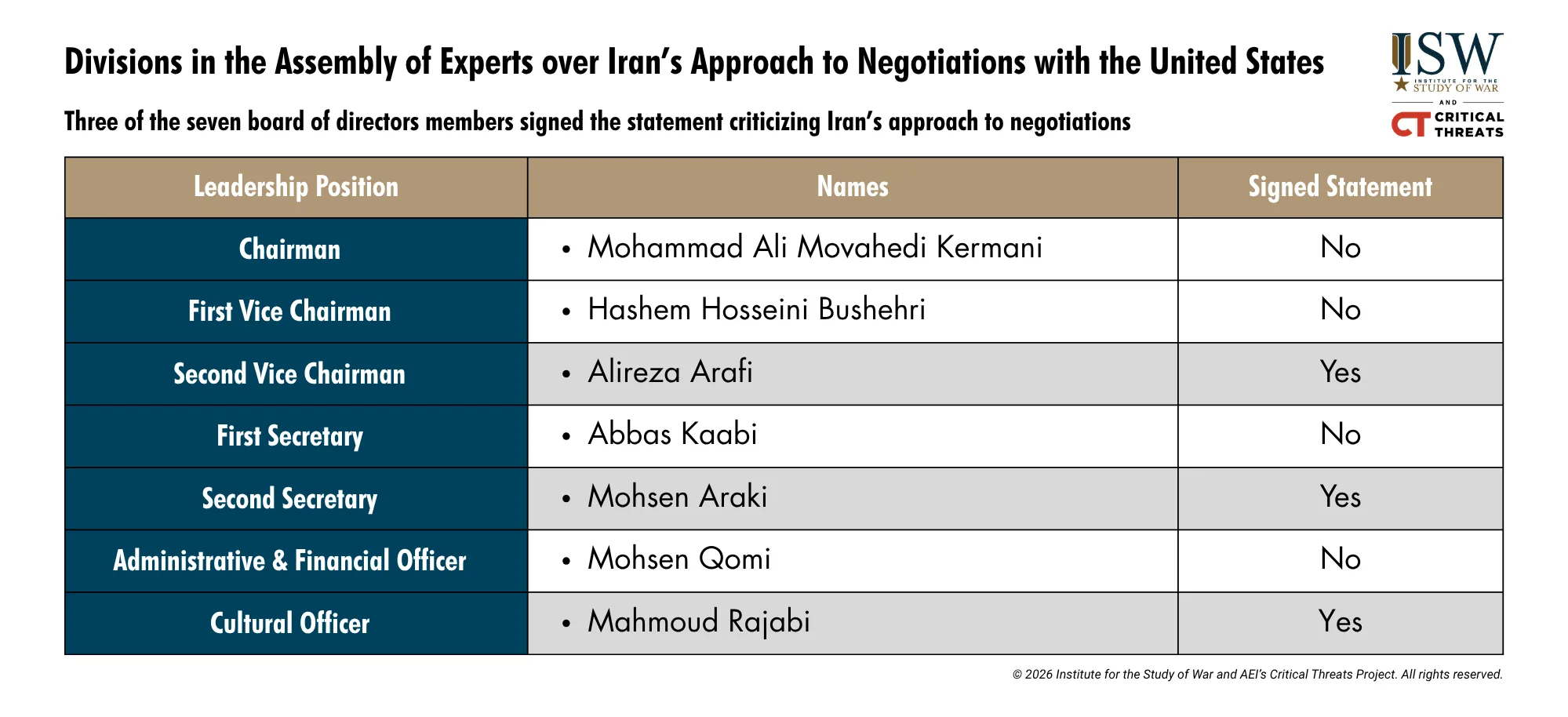
Clerics within Iran’s Assembly of Experts, including within the body’s leadership, appear divided over how the regime should implement the US-Iran MoU and how much latitude Iranian negotiators should have in talks with the United States. The Assembly of Experts is an 88-member clerical body that is responsible for appointing and supervising the Supreme Leader, according to the Iranian constitution.[7] Sixty Assembly members issued a 10-point statement on June 28 in which they warned negotiators not to violate Supreme Leader Mojtaba Khamenei’s red lines.[8] These red lines include solidifying Iranian control over the Strait of Hormuz, securing compensation and the release of Iranian frozen assets, securing sanctions relief, and forcing US troops to withdraw from the region.[9] Mojtaba outlined these Iranian objectives in a statement on June 18.[10] The Assembly of Experts statement also reiterated that Mojtaba barred negotiators from discussing Iran’s nuclear program with the United States.[11] The statement notably did not receive unanimous support within the Assembly, even among its Board of Directors, which is highly unusual given the body’s seniority and its tendency to present a unified public posture on issues. The Assembly of Experts Secretariat later issued a statement on June 28 clarifying that the statement did not represent the Assembly’s official position and that official Assembly statements are only released by the Secretariat, the chairman, or the presidium.[12] The Secretariat added that the Assembly of Experts members who did not sign the statement either opposed the statement or were not informed about it. The chart below displays which Assembly of Experts leaders signed the original statement and which ones did not.
It remains unclear who pushed the group of Assembly members to issue the statement outside the Assembly’s normal process. This incident is at least the second incident in recent months that has publicly revealed divisions within the Assembly of Experts. Mojtaba’s selection as Supreme Leader previously divided the Assembly’s members, according to anti-regime and Western media. Anti-regime media reported in March that Islamic Revolutionary Guards Corps (IRGC) commanders heavily pressured Assembly of Experts members to appoint Mojtaba as Supreme Leader, but that some Assembly members refused to attend the vote in protest.[13] The New York Times similarly reported in March that IRGC Commander Major General Ahmad Vahidi and former IRGC Commander Major General Mohammad Ali Jafari pushed the Assembly of Experts to select Mojtaba as Supreme Leader after Ali Khamenei’s death.[14]
Iranian President Masoud Pezeshkian separately appears to be trying to build support for the MoU among senior clerics and defend the Iranian negotiating team. Pezeshkian met with several senior Shia clerics in Qom Province on June 28, likely to rally clerical support for the agreement, present the MoU as a source of economic relief, and insulate negotiators from criticism by hardline clerics.[15] Pezeshkian emphasized that the government expects the MoU to create economic openings, including via sanctions relief and the release of Iranian frozen assets.[16] Pezeshkian told Ayatollah Mousa Shobairy Zanjani that the agreement is a major victory, the United States has lifted oil and petrochemical sanctions, and Qatar will soon release $6 billion USD of Iran’s $12 billion USD worth of assets currently frozen in Qatar.[17] Pezeshkian’s emphasis on economic relief suggests that he is trying to sell the MoU domestically as a tangible victory to ease public pressure and protect Iranian negotiating members from hardline criticisms, such as from members of the Assembly of Experts (see above).
Iranian officials and media are signaling that Iran will not allow Oman to constrain Iran’s effort to establish control over the Strait of Hormuz. IRGC-affiliated Tasnim News Agency argued in an op-ed on June 29 that tying the future management of the strait to Omani consent would harm Iranian interests.[18] Tasnim argued that Oman can participate in and benefit from Iran’s control over the strait but cannot determine whether Iran manages the waterway.[19] Tasnim added that the strait is an “existential” issue for Iran but only an “economic” issue for Oman and argued that Iran should not let the United Nations Convention on the Law of the Sea (UNCLOS) or Omani opposition return the strait back to its pre-war status.[20] UNCLOS does not permit states bordering international waterways to restrict transit passage or impose charges for transit.[21] Supreme Leader Adviser Ali Akbar Velayati similarly stated on June 29 that Iran has adopted a “new and decisive approach” to organizing traffic, managing traffic costs, and maintaining the strait, and called this issue strategic and non-negotiable.[22] Velayati also warned Oman against letting external pressure, including from the Gulf countries, damage its relationship with Iran.[23] These comments come as the Omani government has signaled its opposition to Iranian control of the strait, including via a joint Gulf Cooperation Council-US statement on June 25 that explicitly rejected any Iranian attempts to exert control over the strait.[24] The International Maritime Organization (IMO) and Oman also announced a joint effort on June 23 to move hundreds of stranded vessels through the strait through a designated safe route along the Omani coast but later paused this effort on June 26 after Iran attacked a Singapore-flagged cargo ship on June 25.[25] The IMO-Omani route undermines Iranian efforts to control the strait by offering an alternative route to Iran’s illegitimate traffic separation scheme, which forces vessels into Iranian territorial waters. Omani Foreign Minister Badr al Busaidi additionally stated that Oman does not support transit fees for passage through the strait during an interview with French media on June 29.[26] Omani officials similarly told CNN on June 27 that Oman opposes “mandatory fees or tolls” in the strait.[27] Busaidi did not rule out “mechanisms related to maritime services,” such as “enhancing navigation safety,” and “combating pollution,” however.[28] Iranian media argued that Busaidi’s comment suggested that Oman would be open to charging fees for maritime services.[29] Iran has consistently sought to impose fees on vessels transiting through the strait as part of its effort to solidify control over the waterway.
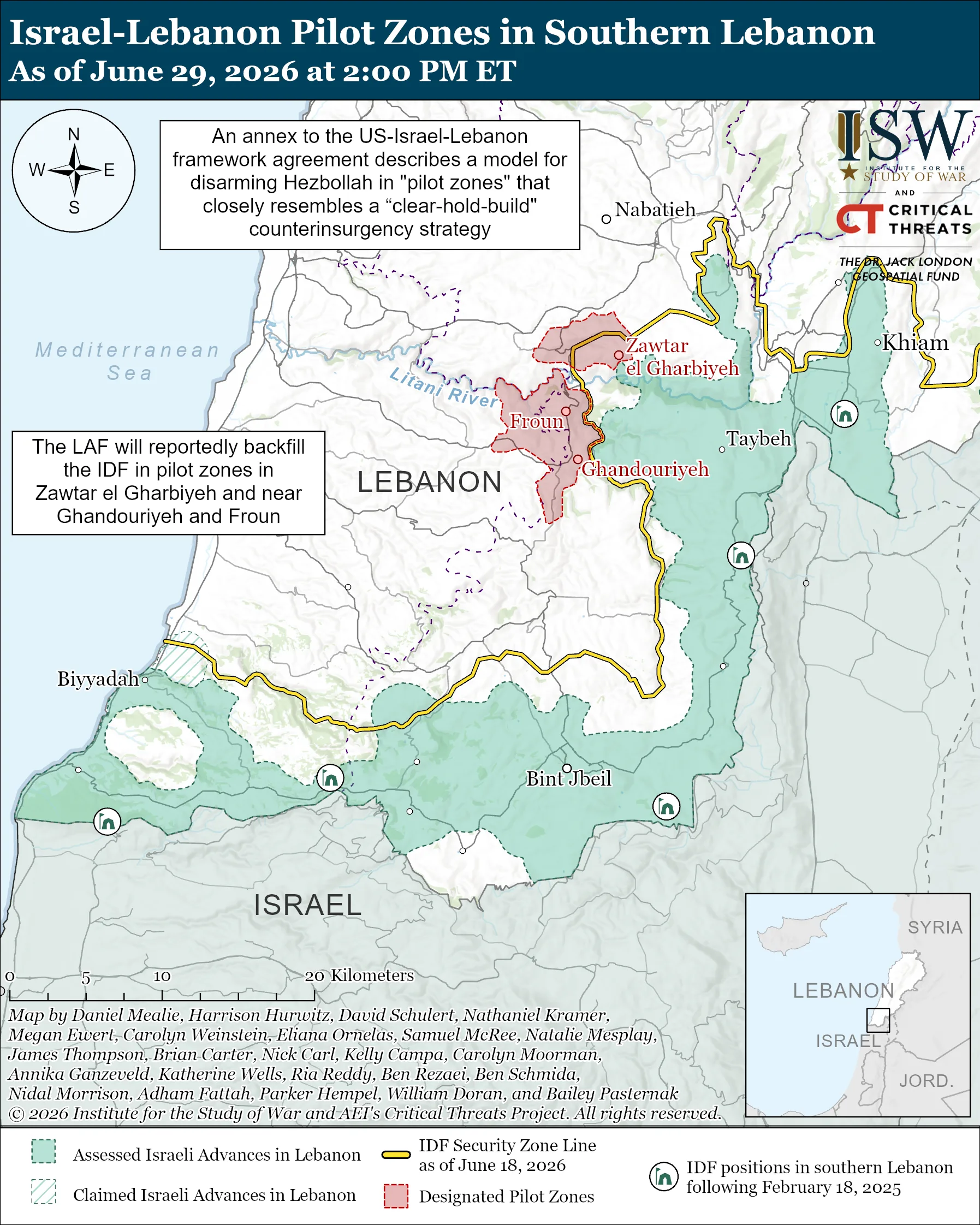
An international media correspondent released on June 29 the reported text of the June 26 Israel-Lebanon-United States trilateral framework agreement’s security annex, which stipulates the process by which the Lebanese Armed Forces (LAF) will backfill the Israel Defense Forces (IDF) in southern Lebanon.[30] The annex includes a four-stage mechanism for the LAF and IDF to dismantle non-state armed groups in designated “pilot zones” in southern Lebanon.[31] The annex’s model for disarming non-state groups in pilot zones closely resembles a “clear-hold-build” counterinsurgency strategy. The agreement’s security annex stipulates that security forces will take “legal measures” against armed non-state fighters and destroy all non-state groups’ infrastructure and weapons, which an unspecified third party will verify.[32] LAF units will then hold and establish control over the pilot zones, coinciding with IDF units’ phased withdrawal from the zones, to prevent non-state armed groups from reconstituting in those areas.[33] The Lebanese government will finally begin reconstruction efforts in these areas with international assistance and political oversight.[34] The annex also stipulates that Israel and Lebanon will establish a military deconfliction body to verify disarmament progress in southern Lebanon and operate as an indirect backchannel between the IDF and LAF.[35] It is unclear whether the IDF and LAF will share responsibility for initial clearing operations in the pilot zones.[36] The security annex also does not clarify whether Israel and Lebanon will establish additional pilot zones in the future. Israeli Defense Minister Israel Katz told Israeli journalists on June 29 that the IDF will not “retreat a single millimeter” further from Israeli-held territory in southern Lebanon, except for the two current pilot zones, until Hezbollah is disarmed.[37] An unspecified official separately told Israeli media on June 28 that the annex will enable the IDF to retain its “freedom of action” in Lebanon, although the reported text does not clarify whether the IDF may continue to target Hezbollah in areas where the LAF is operating.[38]
Hezbollah officials and media are attempting to delegitimize the trilateral framework agreement by accusing the Lebanese government of violating Lebanese law and public interests. Hezbollah-affiliated media argued on June 29 that the agreement is invalid because it allegedly violates Lebanese sovereignty, popular consent, and the Lebanese constitution due to the agreement being signed under Israeli military “duress.”[39] Hezbollah officials, including Secretary General Naim Qassem, have made similar statements in recent days, claiming that the agreement and ongoing Lebanese negotiations with Israel constitute acts of “high treason” and violate the constitution, the sensitive sectarian National Pact, and Lebanon’s territorial integrity.[40]
Hezbollah is also likely attempting to mobilize non-Shia elements of the Lebanese public to oppose the framework agreement. Hezbollah-affiliated media published statements from Lebanese Sunni religious leaders that denounced the agreement and expressed support for Hezbollah on June 29.[41] Hezbollah may assess that platforming non-Shia opposition to the framework agreement strengthens the group’s narrative that the Lebanese government is violating the interests of all Lebanese civilians, rather than exclusively Hezbollah’s predominantly Shia support base.[42]
Hezbollah is pursuing multiple lines of effort to oppose the framework agreement and deter the Lebanese government from disarming Hezbollah. Senior Hezbollah officials are conducting an information operation to deter the Lebanese government from disarming Hezbollah by threatening renewed civil war in Lebanon.[43] Hezbollah Parliamentarian Hassan Fadlallah has repeatedly warned that Hezbollah will mobilize mass protests to stop the government from implementing the agreement, for example.[44] Other Hezbollah officials and allies, including Hezbollah Deputy Political Council leader Mahmoud Qamati and Lebanese Parliament Speaker Nabih Berri, have discouraged Hezbollah and Amal Movement supporters from organizing public demonstrations, however.[45] Hezbollah parliamentary bloc leader Mohammad Raad has also attempted to spread disinformation about the agreement’s provisions and alleged on June 27 that the agreement is a “cover up” for a permanent Israeli military presence in Lebanon.[46]
US-Iran Negotiations
See topline section.
Maritime Activity in the Strait of Hormuz and Persian Gulf
See topline section.
US and Israeli Air Campaign
Nothing significant to report.
Iranian Domestic Affairs
See topline section.
Iran’s Axis of Resistance
Lebanese Hezbollah and the Israeli Campaign in Lebanon
The IDF and Hezbollah continued to engage each other on June 28 and 29 in southern Lebanon. The IDF reported that it destroyed a Hezbollah underground tunnel complex under Majdal Zoun, southern Lebanon, on June 28.[47] The IDF reported that the 200-meter-long and 25-meter-deep complex hosted four underground drone launchers and “hundreds” of Hezbollah weapons, including Iranian-produced drones and drone components.[48] Hezbollah fighters previously defended Majdal Zoun against advancing Israeli forces in early June using a variety of weapons, including anti-tank guided missiles (ATGM), improvised explosive devices (IED), mortars, rockets, and rocket-propelled grenades (RPG).[49]
The IDF also reported that it struck three Hezbollah headquarters on June 28 near Maifadoun and Nabatieh in southern Lebanon.[50] The IDF reported on June 29 that an explosion “seriously injured” an Israeli reserve soldier near Arnoun in Nabatieh Governorate, southern Lebanon.[51] The IDF stated that it is investigating the cause of the incident.[52]
US CENTCOM Commander Admiral Brad Cooper met with Lebanese President Joseph Aoun and Lebanese Armed Forces (LAF) Commander General Rodolphe Haykal in Beirut on June 29 to discuss preparations to implement the June 26 trilateral framework agreement.[53] Lebanese media reported that Cooper visited Lebanon to oversee the initial stages of the LAF’s deployment to the two “pilot zones” that Israel and Lebanon agreed on in the framework agreement.[54]
Other Axis of Resistance Activity
Iraqi authorities arrested around 50 people on June 28 as part of an Iraqi federal government anti-corruption campaign that is expected to last at least six months.[55] Iraqi Prime Minister Ali al Zaydi said during a cabinet meeting on June 28 that the arrests were the “first phase” of the Iraqi government’s efforts to recover public funds.[56] An informed source told Iraqi media on June 28 that the current phase of the anti-corruption campaign is expected to last 72 hours.[57] Iraqi authorities, including the Counter Terrorism Service, arrested individuals in multiple areas of Baghdad as well as in Maysan, Babil, Diyala, and Salah al Din provinces and Iraqi Kurdistan.[58] Iraqi authorities closed the Green Zone, which houses the Iraqi parliament, the US Embassy, and several other government buildings, on June 28 to conduct arrests but reopened it on June 29.[59] Iraqi media reported that the arrested individuals include senior officials, political leaders, former and current government agents, company owners who launder funds to political leaders, brokers, and intermediaries.[60] The highest-profile arrested figure was Sunni Azm Alliance head Muthanna al Samarrai.[61] Central Anti-Corruption Criminal Court Judge Diaa Jaafar told Iraqi media that the Iraqi government’s investigation of former Ministry of Oil Undersecretary for Refining Affairs Adnan al Jumaili implicated many parliamentarians whom Iraqi authorities arrested on June 28.[62] Iraqi authorities arrested Jumaili in May 2026 and have seized more than $74 million USD since his arrest, according to Iraq’s Supreme Judicial Council.[63]
These arrests follow US pressure on the Iraqi federal government to dismantle Iranian-backed Iraqi militia-linked financial networks and combat corruption. The US Government has reportedly conditioned US financial support to Zaydi’s government on Zaydi’s progress in meeting these US demands.[64] The Iraqi federal government has taken initial steps to strengthen its anti-money laundering and counter-terrorist financing measures in recent weeks, including by replacing the Central Bank of Iraq governor with the head of the bank’s anti-money laundering and counter-terrorist financing reform office and establishing a government oversight body.[65] Zaydi may have also facilitated these arrests to demonstrate his political prowess, given his lack of previous government experience before assuming the premiership, or to undermine his political opponents. A Shia parliamentarian and an Iraq analyst noted on June 28 and 29 that most of the individuals who were arrested are either Sunni or members of former Prime Minister Mohammad Shia al Sudani’s coalition.[66]
Iraqi Federal Government Spokesperson Haider al Aboudi announced on June 29 that Zaydi has set September 30 as the final deadline for Iraqi citizens and armed groups to surrender their weapons to Iraqi authorities.[67] Aboudi stated that any weapons not handed over to the state by this deadline will be considered “irregular weapons.”[68] Iranian-backed Iraqi militias, such as Harakat Hezbollah al Nujaba, have continuously asserted that the government’s efforts to restrict arms to the state do not apply to the militias.[69] Zaydi said on June 24 that “resistance groups,” which refers to Iranian-backed Iraqi militias, will not need to remain armed after US-led international coalition forces leave Iraq at the end of September, however.[70] US-led international coalition forces left federal Iraq in January 2026 and are currently based in Iraqi Kurdistan.[71] Zaydi also said in an interview with regional media on June 29 that the Iraqi federal government will announce a “National Sovereignty Conference” by the end of the year to solidify the Iraqi state’s exclusive right to use force.[72]
The Iraqi federal government’s lack of accurate information on the number and types of weaponry in Iraq will make it difficult to determine the progress of the government’s efforts to restrict arms to the state. The Interior Ministry (MoI) announced on April 20 that it had established 864 weapon registration offices across Iraq, and that more than 310,000 firearm registration applications have been submitted.[73] The MoI also announced that the National Arms Bank, which the Iraqi federal government reportedly created to track all government-owned weapons in December 2025, has received over 5.8 million firearms.[74] An unidentified senior Iraqi military official told al Araby al Jadeed on June 29 that the Iraqi federal government has not yet received any “advanced” weaponry, such as drones or long-range missiles, despite a government program to buy medium and heavy weapons from Iraqi citizens and armed groups.[75] Iran has provided its partners in Iraq with drones and missiles for years, which militias used to strike US and foreign targets in Iraq and the region during the recent war.[76] Iraqi media noted that the federal government lacks accurate information on the number, and likely the types, of weapons in the country. It is therefore difficult to determine what proportion of the total number of weapons in Iraq the MoI’s numbers represent.[77] The Iranian-backed Popular Mobilization Forces, which includes many Iranian-backed Iraqi militias, operate with limited government oversight, for example.[78] Many Iraqi militias, including Harakat Hezbollah al Nujaba, Kataib Sayyid al Shuhada, and Kataib Hezbollah, have also continuously refused to disarm.[79]

[1] https://truthsocial.com/@realDonaldTrump/116833168246538290
[2] https://t.me/farsna/445443
[3] https://t.me/iribnews/347909
[4] https://t.me/iribnews/347909
[5] https://t.me/iribnews/347909
[6] https://www.criticalthreats.org/analysis/iran-update-evening-special-report-june-13-2026
[7] https://www.brookings.edu/articles/everything-you-need-to-know-about-irans-assembly-of-experts-election/
[8] https://www.irna dot ir/news/86194414
[9] https://t.me/rahbar_enghelab_ir/686
[10] https://www.irna dot ir/news/86194414 ;
https://t.me/rahbar_enghelab_ir/686
[11] https://www.irna dot ir/news/86194414
[12] https://www.tabnak dot ir/fa/news/1381981
[13] https://www.iranintl.com/en/202603052337
[14] https://www.nytimes.com/2026/03/16/world/middleeast/iran-mojtaba-khamenei-election-supreme-leader.html?smid=nytcore-ios-share
[15] https://t.me/mehrnews/390976 ;
https://t.me/farsna/445430 ;
https://inn dot ir/news/article/157534
[16] https://t.me/mehrnews/390976 ;
https://t.me/farsna/445430 ;
https://inn dot ir/news/article/157534
[17] https://t.me/farsna/445430
[18] https://t.me/Tasnimnews/426494
[19] https://t.me/Tasnimnews/426494
[20] https://t.me/Tasnimnews/426494
[21] https://www.un.org/depts/los/convention_agreements/texts/unclos/unclos_e.pdf
[22] https://t.me/Tasnimnews/426354
[23] https://t.me/Tasnimnews/426354
[24] https://www.mc-doualiya dot com/الشرق-الأوسط/20260628-وزير-الخارجية-العماني-لمونت-كارلو-الدولية-ملتزمون-بعدم-فرض-رسوم-للعبور-في-مضيق-هرمز ;
https://www.ynetnews dot com/article/byz9v11l7fx#google_vignette
[25] https://www.imo.org/en/mediacentre/pressbriefings/pages/imo-accounces-evacuation-plan-in-strait-of-hormuz.aspx ;
https://www.npr.org/2026/06/26/nx-s1-5871963/un-agency-pauses-evacuation-of-ships-through-strait-of-hormuz-after-attack-vessel ; https://twitter.com/UK_MTO/status/2070160682264269241
[26] https://www.mc-doualiya dot com/الشرق-الأوسط/20260628-وزير-الخارجية-العماني-لمونت-كارلو-الدولية-ملتزمون-بعدم-فرض-رسوم-للعبور-في-مضيق-هرمز
[27] https://x.com/alexplitsas/status/2070976910822142012?s=20
[28] https://www.mc-doualiya dot com/الشرق-الأوسط/20260628-وزير-الخارجية-العماني-لمونت-كارلو-الدولية-ملتزمون-بعدم-فرض-رسوم-للعبور-في-مضيق-هرمز
[29] https://t.me/farsna/445470
[30] https://x.com/HibaNasr/status/2071617895331746115
[31] https://x.com/HibaNasr/status/2071617895331746115 ; https://www.state.gov/releases/office-of-the-spokesperson/2026/06/trilateral-framework-between-the-united-states-of-america-the-state-of-israel-and-the-republic-of-lebanon/
[32] https://x.com/HibaNasr/status/2071617895331746115
[33] https://x.com/HibaNasr/status/2071617895331746115
[34] https://x.com/HibaNasr/status/2071617895331746115
[35] https://x.com/HibaNasr/status/2071617895331746115
[36] https://x.com/HibaNasr/status/2071617895331746115
[37] https://t.me/moriahdoron/32085
[38] https://www.timesofisrael dot com/liveblog_entry/source-israel-lebanon-security-annex-preserves-full-idf-freedom-of-action-jerusalem-remains-wary-of-iran-interference/
[39] https://www.al-akhbar dot com/NewspaperArticles/lebanon/897379/إطار-واشنطن–صك-إذعان-بحبر-سيادي
[40] https://t.me/sameralhajali/8194 ; https://t.me/mmirleb/17618 ; https://understandingwar.org/research/middle-east/iran-update-special-report-june-27-2026/
[41] https://www.almanar dot com.lb/article/986932/ ; https://www.almanar dot com.lb/article/987017/
[42] https://t.me/mmirleb/17618 ; https://t.me/mmirleb/17619
[43] https://understandingwar.org/research/middle-east/iran-update-special-report-june-27-2026/ ; https://t.me/sameralhajali/8183
[44] https://t.me/sameralhajali/8215 ; https://t.me/almanarnews/256194
[45] https://t.me/alakhbar_news/90047 ; https://www.naharnet dot com/stories/en/320988-qmati-says-hezbollah-won-t-quit-govt-or-resort-to-street-action
[46] https://t.me/sameralhajali/8199
[47] https://x.com/idfonline/status/2071335515987509275
[48] https://x.com/idfonline/status/2071335515987509275 ; https://www.timesofisrael dot com/idf-captures-hezbollah-drone-factory-and-launch-site-hidden-inside-south-lebanon-mountain/ ; https://www.ynetnews dot com/article/r12mnqgqgl#autoplay
[49] https://understandingwar.org/research/middle-east/iran-update-special-report-june-12-2026/ ; https://understandingwar.org/research/middle-east/iran-update-special-report-june-13-2026/ ; https://t.me/mmirleb/17349 ; https://t.me/mmirleb/17325 ; https://t.me/mmirleb/17376 ; https://t.me/mmirleb/17377
[50]https://x.com/idfonline/status/2071488012073025680 ; https://x.com/geo_lego/status/2071534265985020163?s=20
[51] https://t.me/moriahdoron/32089 ; https://x.com/idfonline/status/2071644373943550405?s=20
[52] https://t.me/moriahdoron/32089 ; https://x.com/idfonline/status/2071644373943550405?s=20
[53] https://x.com/CENTCOM/status/2071615234159116667?s=20
[54] https://x.com/ALJADEEDNEWS/status/2071643326311215378
[55] https://shafaq dot com/ar/سیاسة/حصري-حملة-مكافحة-الفساد-تستهدف-كثر-من-200-شخصية-خلال-72-ساعة-وتستمر-ستة-شهر ; https://almadapaper dot net/441193/ ; https://ina dot iq/ar/political/266920-47.html
[56] https://shafaq dot com/ar/سیاسة/الزيدي-يستعين-بـ-حراس-قويا-لمكافحة-الفساد-لن-نتهاون-بعد-اليوم
[57] https://shafaq dot com/ar/سیاسة/الزيدي-يستعين-بـ-حراس-قويا-لمكافحة-الفساد-لن-نتهاون-بعد-اليوم ; https://shafaq dot com/ar/سیاسة/حصري-حملة-مكافحة-الفساد-تستهدف-كثر-من-200-شخصية-خلال-72-ساعة-وتستمر-ستة-شهر
[58] https://almadapaper dot net/441193/ ; https://shafaq dot com/ar/%D8%A3%D9%85%D9%80%D9%86/%D8%AA%D9%81%D8%A7%D8%B5%D9%8A%D9%84-%D8%AC%D8%AF%D9%8A%D8%AF%D8%A9-%D8%B9%D9%86-%D8%A7%D9%84%D9%85%D8%B9%D8%AA%D9%82%D9%84%D9%8A%D9%86-%D9%81%D9%8A-%D8%B1%D8%A8%D9%8A%D9%84-%D8%A8%D8%AA%D9%87%D9%85-%D8%A7%D9%84%D9%81%D8%B3%D8%A7%D8%AF ; https://x.com/Tammuz_Intel/status/2071025246983836022 ; https://x.com/Tammuz_Intel/status/2071042453335945695
[59] https://www.shafaq dot com/ar/سیاسة/خاص-استمرار-غلاق-المنطقة-الخضرا-وصدور-منع-سفر-بحق-بعض-مطلوبين ; https://www.shafaq dot com/ar/أمـن/بعد-حملة-اعتقالات-القوات-الامنية-تعيد-افتتاح-الخضرا-في-بغداد
[60] https://shafaq dot com/ar/سیاسة/حصري-حملة-مكافحة-الفساد-تستهدف-كثر-من-200-شخصية-خلال-72-ساعة-وتستمر-ستة-شهر
[61] https://shafaq dot com/ar/سیاسة/ول-تعليق-من-تحالف-العزم-بعد-اعتقال-السامرا-ي-نثق-بالقضا-ونرفض-التسييس
[62] https://shafaq dot com/ar/سیاسة/القضا-العراقي-التحقيق-مع-الجميلي-كشف-تورط-نواب-وقاد-لى-اعتقالهم
[63] https://www.arabnews dot com/node/2648301/middle-east
[64] https://almadapaper dot net/441014/ ; https://www.alaraby.co dot uk/economy/خاص-وصول-دفعتين-من-الدولار-نقداً-إلى-بغداد-تزامنا-مع-زيارة-توم-براك
[65] https://shafaq dot com/en/Iraq/Iraqi-PM-appoints-new-central-bank-governor-investment-chief ; https://www.iraqinews dot com/iraq/iraq-establishes-supreme-sovereign-council-integrity-asset-recovery-2026/
[66] https://www.kurdistan24 dot net/ckb/story/922625/%DA%86%D9%88%D8%A7%D8%B1%DA%86%DB%8E%D9%88%DB%95%DB%8C-%D9%87%DB%95%D9%85%D8%A7%D9%87%DB%95%D9%86%DA%AF%DB%8C-%D8%A8%DB%86-%D8%A8%DB%95%D8%B1%DB%95%D9%86%DA%AF%D8%A7%D8%B1%D8%A8%D9%88%D9%88%D9%86%DB%95%D9%88%DB%95%DB%8C-%DA%AF%DB%95%D9%86%D8%AF%DB%95%DA%B5%DB%8C-%DA%AF%D9%84%DB%86%D9%BE%DB%8C-%D8%B3%DB%95%D9%88%D8%B2%DB%8C-%D8%A8%DB%86-%D8%B9%DB%95%D9%84%DB%8C-%D8%B2%DB%95%DB%8C%D8%AF%DB%8C-%D9%87%DB%95%DA%B5%DA%A9%D8%B1%D8%AF%D9%88%D9%88%DB%95 ; https://x.com/LizHurra/status/2071281219405336922
[67] https://almadapaper dot net/441232/
[68] https://almadapaper dot net/441232/
[69] https://shafaq dot com/ar/سیاسة/30-يلول-الحكومة-العراقية-تحدد-خر-موعد-لتسليم-السلاح-غير-المرخص
[70] https://english dot aawsat.com/arab-world/5288763-al-zaidi-no-justification-presence-%E2%80%98resistance%E2%80%99-iraq-after-september
[71] https://www.cnn.com/2026/01/18/middleeast/iraq-announces-full-withdrawal-of-us-forces-from-its-federal-territory
[72] https://english.aawsat dot com/interviews/5289965-ali-al-zaidi-asharq-al-awsat-no-protection-corrupt-restricting-arms-state-will
[73] https://www.pukmedia dot com/EN/Details/81189 ; https://almadapaper dot net/441232/
[74] https://english.news dot cn/20251206/84fc96ed61304678b54d096e501296bb/c.html ; https://www.pukmedia dot com/EN/Details/81189
[75] https://www.alaraby dot co.uk/politics/العراق-حكومة-الزيدي-تحدد-موعداً-نهائياً-أمام-الفصائل-لتسليم-سلاحها
[76] https://www.longwarjournal.org/archives/2026/04/irans-war-against-regional-states-uae-bore-the-brunt-iraqi-kurdistan-still-under-fire.php ; https://www.al-monitor.com/originals/2026/05/majority-attacks-saudi-arabia-carried-out-pro-iran-militias-iraq
[77] https://almadapaper dot net/441232/
[78] https://www.washingtoninstitute.org/sites/default/files/pdf/PolicyFocus163-KnightsMalikTamimi-v3%281%29.pdf#pdfjs.action=download , pg 58-59
[79] https://rudaw dot net/english/categories/iraq/958915