
Toplines
Taiwan is demonstrating tactical lessons learned from the war in Ukraine in its military exercises. Integrating unmanned systems with traditional platforms will be critical for Taiwan’s future defense capabilities. Taiwan’s Third, Fourth, and Fifth Operational Zones conducted live-fire artillery drills on August 27.[1] The drills focused on precision strikes and rapid maneuvering of artillery systems, dispersed firing, and target acquisition.[2] Taiwan’s Fourth and Fifth Operational Zones, covering south and central Taiwan respectively, incorporated unmanned systems into their target acquisition and firing procedures.[3] Taiwan’s Ministry of National Defense (MND) stated on August 27 that drones were used to detect targets and transmit intelligence to artillery units, enabling a faster precision kill chain.[4]
The war in Ukraine has demonstrated the effectiveness of drone-enabled precision artillery in preventing large force concentrations and mechanized maneuver. Pervasive unmanned reconnaissance alongside precision fires has allowed both Russia and Ukraine to strike high-value targets near the frontline.[5] Drone-corrected artillery fire, alongside drone-launched munitions and suicide drones, has prevented both Russia and Ukraine from conducting large-scale mechanized offensives.[6] The integration of emerging platforms, principally unmanned systems, with traditional systems is critical to creating similar operational and tactical effects during a Taiwan invasion scenario.
Drone-corrected artillery fire will likely be insufficient to prevent the People’s Liberation Army (PLA) mechanized maneuver. Unmanned systems are responsible for an increasing proportion of frontline casualties in Ukraine.[7] Taiwan’s high-end artillery systems may also be vulnerable to PLA precision strikes during a conflict. Taiwan would likely benefit from combining its traditional artillery with significant numbers of cheap strike drones to ensure its emerging precision fires complex is not easily degraded during an invasion and can effectively prevent the PLA from building up the forces necessary to establish lodgments in Taiwan and conduct subsequent breakout operations.
Bloomberg reported that the United States is investigating Singapore-based firm Apex Logistics for its role in facilitating illegal semiconductor trade to the People’s Republic of China (PRC)’s in violation of US export controls, which may potentially result in the first legal action being taken against a transportation company for chip smuggling.[8] Bloomberg reported that the US Department of Commerce’s Bureau of Industry and Security (BIS) is investigating 47 Apex shipments, of which two Apex employees incorrectly labeled as hardware not subject to US export controls in the shipping code. Apex is cooperating with US authorities in the investigation, and the probe is focused on investigating transshipments from the United States to Southeast Asia.
Falsification of shipping records and transshipments through Southeast Asia are common elements of PRC semiconductor smuggling cases. One recent example is a US Department of Justice case from March involving three Super Micro employees, which featured transshipments through Southeast Asia with falsified records to hide that the end user was based in the PRC.[9] The White House’s Office of Trade and Manufacturing Policy published a report on August 13 on illicit PRC transshipment strategies to evade US tariffs, highlighting the complex regulatory challenges of enforcing bilateral trade policies amid global shipping networks.[10]
The United States can pursue a variety of civil and criminal penalties for export control violations.[11] The maximum administrative penalty is currently $374,474 per violation or twice the value of the transaction, whichever is greater. The United States could also potentially issue a Temporary Denial Order (TDO), which would deny Apex the rights to export any US-origin goods for up to 180 days and is generally renewable for an additional 180-day period.
Key Takeaways
- Taiwanese Military Modernization: Taiwan conducted live fire artillery drills integrating unmanned systems with traditional platforms on August 27. Taiwan is demonstrating tactical lessons learned from the war in Ukraine, which could have applications to a potential Taiwan invasion scenario.
- PRC Illicit Semiconductor Trade: Bloomberg reported that the United States is investigating a Singapore-based firm for its role in facilitating the illegal semiconductor trade to the People’s Republic of China (PRC) in violation of US export controls, which could result in the first legal action being taken against a company for this behavior. The United States maintains export controls intended to limit PRC access to advanced semiconductors due in part to concerns over the PRC’s ability to use these semiconductors for high-tech military equipment.
Cross-Strait Relations
Taiwan
Taiwan’s Central Election Commission (CEC) approved on August 28 that it would hold a referendum on repealing Taiwan’s “nuclear-free homeland” policy. Introducing nuclear power to Taiwan’s electrical grid may help reduce Taiwan’s vulnerability to PRC coercion targeting Taiwan’s energy supply. Taiwan’s opposition Kuomintang (KMT) proposed the referendum in July with support from the opposition Taiwan People’s Party (TPP).[12] The referendum will ask voters if they support reintroducing nuclear power to Taiwan’s energy grid alongside Taiwan’s nationwide local elections in November.[13]
Developing Taiwan’s domestic nuclear power capacity may allow Taiwan to reduce its reliance on imported liquefied natural gas (LNG) for electricity generation and reduce its vulnerability to the PRC’s energy-related coercion. Taiwan relies on imported LNG to generate around half of its total electricity supply, but its current LNG reserves only store enough for around 12 days of usage.[14] The PRC exploits Taiwan’s vulnerability to LNG supply shocks by threatening Taiwan’s populace with the prospect of widespread electricity shortages, undermining Taiwanese faith in the Taiwanese government’s ability to provide basic necessities.[15]
PRC state media published images and reports in 2025 showing missile strikes on sites resembling mock Taiwanese LNG storage facilities and claiming that the PLA rehearsed cutting off Taiwan’s power supply by blockading Taiwanese ports in December 2025.[16] The PRC launched an online social media disinformation campaign in March that claimed Taiwan would soon face LNG shortages and electricity blackouts due to Iran’s closure of the Strait of Hormuz and advocated for “peaceful unification” with the PRC to secure Taiwan’s energy supply.[17] Suspected PRC hackers also targeted at least seven Taiwanese energy companies in a cyberattack in early July.[18]
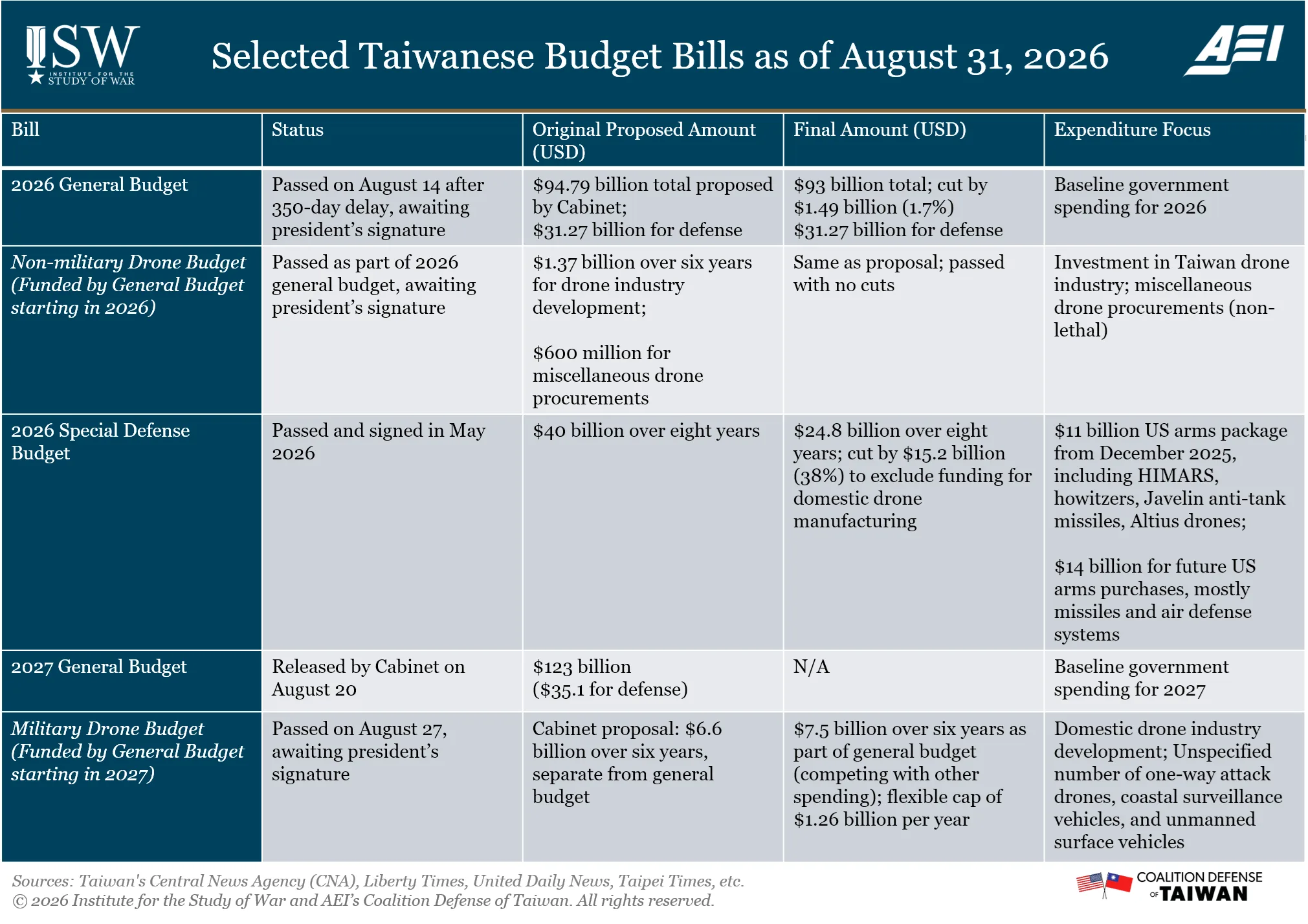
Taiwan’s Executive Yuan will reportedly support the recently passed NT$ 240 billion supplemental budget for drone procurement, which will significantly increase the funding for development and procurement of unmanned systems. Taiwanese media outlet Taipei Times reported on August 30 that the Taiwanese Executive Yuan would refrain from criticizing the opposition KMT’s version of the special budget for unmanned systems and support the measure.[19] Taiwan’s Legislative Yuan (LY) passed an NT$ 240 billion (approximately $7.5 billion) special budget on August 27 to fund the procurement of unmanned systems and the development of Taiwan’s domestic drone industry.[20] The LY passed a version of the bill that differed significantly from President William Lai Ching-te’s administration’s version. Taiwan will fund the bill as a component of Taiwan’s annual budget rather than through supplementary funding.[21] Taipei Times cited on August 30 an unnamed source within Taiwan’s cabinet who stated that Taiwanese Premier Cho Jung-tai would countersign the bill, and that the cabinet was preparing to add funding to the 2027 general budget in accordance with the opposition’s bill.[22]
The cabinet’s decision to support the bill will allow Taiwan to begin the process of bolstering its unmanned systems inventory uninhibited by political infighting. The pace of innovation of modern unmanned systems, as demonstrated in Ukraine, makes any delay in unmanned systems procurement particularly costly, as even minor delays could cause Taiwan to acquire obsolete technology.[23] The inclusion of significant unmanned systems funding in Taiwan’s annual budget will increase the necessity of timely passage of those budgets as well. The opposition’s version of the bill caps annual drone spending and forces yearly reviews rather than multi-year funding, which could lead to partisan gridlock preventing timely drone procurements. Taiwan’s LY passed its 2026 general budget on August 14 after a nearly year-long delay.[24] Similar delays would decrease the efficacy of the opposition’s NT$240 billion allocation and have deleterious effects on Taiwan’s military modernization.
Taiwan is improving the ability of its legacy submarines to conduct anti-surface warfare (ASuW) missions. Taiwan could use this capability to degrade a PLA invasion force as it approaches Taiwan’s coast. Taiwanese media reported on August 29 that Taiwan’s navy was finalizing upgrades to its two Hai Lung-class diesel-electric submarines.[25] The upgrades will focus on the vessels’ combat systems, situational awareness, and weapons launching systems; extending the service life and enhancing the combat capabilities of the vessels. The upgrades will allow the vessels to operate the US-made Mk-48 Mod 6AT heavyweight torpedo and a submarine-launched variant of the Harpoon anti-ship missile.[26] These upgrades will improve the Hai Lung-class’ ability to target enemy surface vessels as they approach Taiwan’s coast.
Upgrades to Taiwan’s Hai Lung-class submarines are important for Taiwan’s undersea warfare capabilities as its indigenous submarine program continues to face delays. Taiwan’s Navy was supposed to receive the first of eight Hai Kun-class vessels in November 2025 but is still yet to do so at the time of writing.[27] Improving Taiwan’s Hai Lung-class vessels could ensure it retains a robust undersea warfare capability while its indigenous submarine program matures.
Diesel-electric submarines like the Hai Lung-class support Taiwan’s recent emphasis on littoral defense. Taiwan created a Littoral Combat Command (LCC) in July to centralize coastal defense assets under a single command. Diesel-electric submarines possess significant advantages in littoral combat due to their small size, maneuverability, and ability to lie virtually undetectable beneath the surface for several days at a time.[28] These qualities make diesel-electric submarines less vulnerable to anti-submarine warfare when operating in shallow waters, particularly those within their own territory. Taiwan could use its diesel-electric submarine fleet to target PLA amphibious assault vessels as they approach Taiwan’s coast in tandem with the LCC’s coastal defense assets to devastate a PLA landing before it reaches Taiwan.
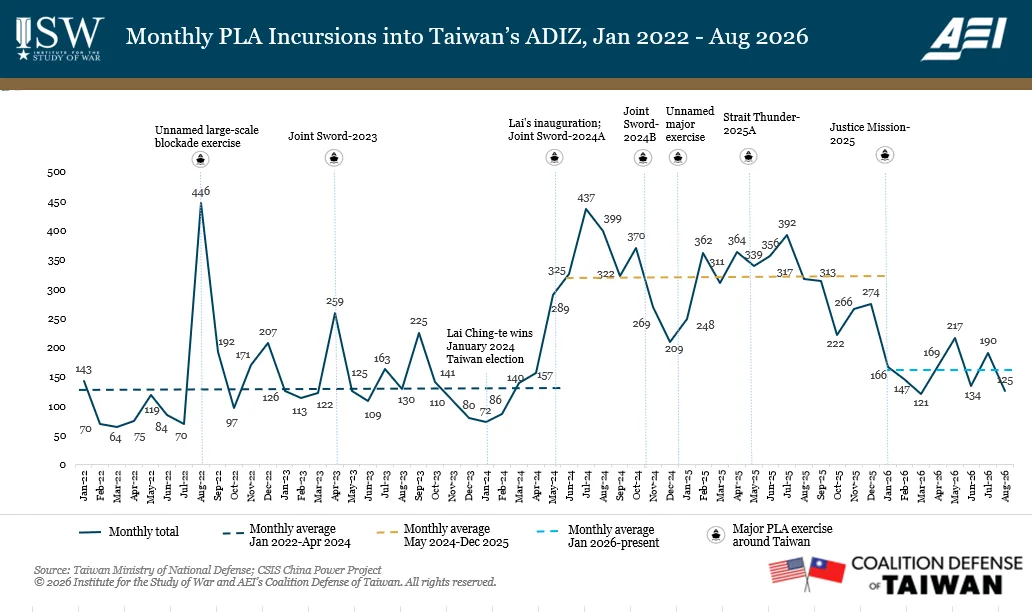
The PLA carried out 125 aerial incursions into Taiwan’s Air Defense Identification Zone (ADIZ) in August, continuing the trend of reduced incursions compared to 2024 and 2025. The monthly incursion total is less than half the total number of incursions observed in August 2024 and August 2025.[29] Taiwan’s MND reported eight days in July without any ADIZ incursions across the median line of the Taiwan Strait.[30] The PLA doubled its monthly volume of incursions to over 300 per month after President William Lai Ching-te’s inauguration in May 2024 but appears to have reverted to numbers similar to the pre-Lai baseline since the start of 2026. The decline in monthly PLA sorties around Taiwan since the start of 2026 likely reflects an adjustment in the PRC’s coercion strategy targeting Taiwan, rather than seasonal fluctuations or other short-term factors. ISW-CDOT has previously assessed that the reduction in ADIZ incursions may free up PLA sorties and resources to focus on other military priorities and reestablish the utility of ADIZ incursions as a means of short-term political signaling.[31] A consistently high volume of ADIZ incursions also allows the PRC to degrade Taiwan’s threat awareness by desensitizing it to repeated aerial intrusions.
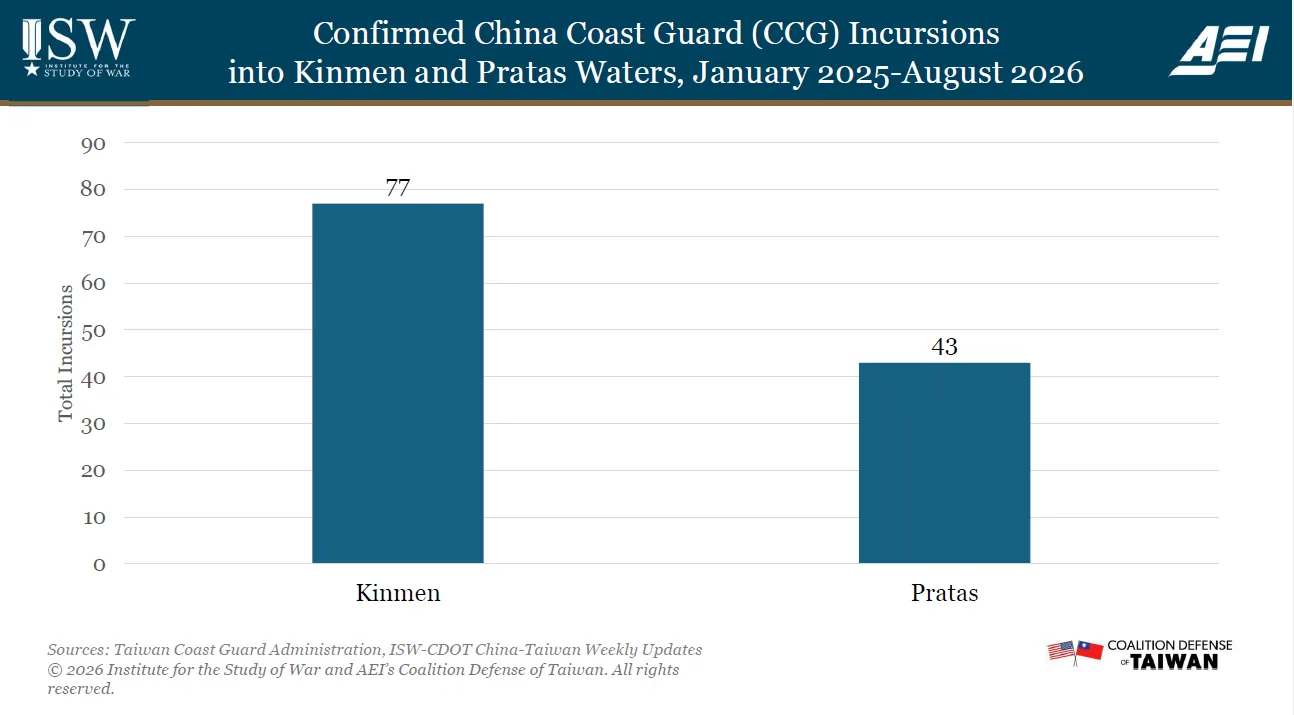
The China Coast Guard (CCG) made four incursions into Taiwan-administered waters near Taiwan’s Kinmen islands and one incursion near Pratas Island in August. Taiwan’s Coast Guard Authority (CGA) reported that four CCG ships intruded into the restricted waters near Kinmen on August 5, 13, and 19.[32] The four CCG ships also intruded into the prohibited waters around Kinmen during the August 13 incursion.[33] Two CCG ships entered the restricted waters around Kinmen on August 29.[34] The CCG ships remained in the restricted waters for around two hours during each incursion.[35]
Kinmen is a Taiwanese county comprised of several islands approximately two miles from the PRC, with Taiwan maintaining “restricted” and “prohibited” waters around the islands.[36] These waters function similarly to a contiguous zone or territorial waters; however, Taiwan does not claim them as such due to Kinmen’s proximity to the PRC. The PRC has normalized a pattern of four CCG incursions into the waters around Kinmen per month since February 2024.[37]
The CGA also reported that two CCG ships intruded into the restricted waters around Pratas Island on August 18.[38] Ship-tracking data from Starboard Maritime Intelligence shows one of the ships leaving the restricted waters around Pratas after around nine and a half hours. The other CCG vessel did not appear in the tracking data and was likely travelling with its Automatic Identification System (AIS) turned off. The CGA did not report when the two ships left the restricted waters.
Pratas is a Taiwanese atoll north of the South China Sea with no permanent population, which serves as a Taiwanese marine garrison.[39] The CCG frequently intrudes into Taiwan’s restricted waters around these islands to boost PRC jurisdictional claims and erode Taiwan’s territorial sovereignty.[40] The PRC also likely conducts these incursions to test the CGA’s monitoring and response capabilities while eroding Taiwan’s threat awareness by desensitizing it to repeated intrusions.[41]
Taiwan’s CGA reported that the number of PRC ships around Taiwan has significantly increased since the PRC began permanent patrols East of Taiwan in May. Persistent PRC presence in Taiwanese waters furthers PRC coercion by harassing Taiwan and eroding Taiwanese territorial sovereignty. Taiwan reported 152 non-warship PRC vessels in the first 21 days of August, approximately 60 percent of which were coast guard vessels.[42] The CGA reported 244 PRC vessels in Taiwan’s waters in July — a record high — compared to 58 PRC vessels observed in Taiwanese waters in July of 2025.[43] The CGA observed a total of 1247 PRC vessels in the waters near Taiwan and its outlying islands since May 2026.[44]
The PRC uses law enforcement and civilian vessels to conduct its short-of-war activities near Taiwan to support PRC statements that these activities are not military exercises. PRC activity near Taiwan includes “scientific research” carried out by civilian vessels, which could include PRC seafloor mapping activity and serves a dual military and scientific research purpose. The CGA reported it drove away a PRC research vessel, Xiangyanghong 3, on August 27.[45]
China
The PRC officially purged former PLA generals Zhang Youxia and Liu Zhenli on August 28 from the Central Military Commission. These purges support CCP General Secretary Xi Jinping’s efforts to crack down on corruption and prioritize loyalty over combat experience. Zhang formerly served as Vice Chair of the Central Military Commission (CMC) and Liu formerly served as Chief of Staff of the CMC’s Joint Staff Department.[46] This decision was made regarding the PRC State CMC. The two generals maintain their positions in the CCP CMC body at the time of writing, however.[47]
The CMC’s announcement of Zhang and Liu’s purging is likely intended to send a message to current PLA leadership. Zhang, in particular, was previously considered a close ally of Xi’s with significant patronage ties. The CMC likely intends to send a message to the PLA that corruption and ideological disagreements will not be tolerated at any level within the PLA, regardless of personal political influence or military experience. The CMC has faced significant purges, currently retaining only two out of seven members, including Xi himself.[48] ISW-CDOT previously assessed that remaining CMC member Zhang Shengmin is likely one of the only top PLA generals to maintain Xi’s trust throughout the purges, leaving Xi increasingly isolated.[49] Recent promotions within the PLA have elevated individuals lacking ties to purged officials.[50]

[1] https://www.cna.com dot tw/news/aipl/202608280149.aspx
[2] https://mna.mnd.gov dot tw/news/detail/?UserKey=37d11763-dde3-4ae8-88e9-3a9e99a61047; https://mna.mnd.gov dot tw/news/detail/?UserKey=d6a5bd94-8a84-4e75-aa6a-264b56136741; https://mna.mnd.gov dot tw/news/detail/?UserKey=ac34b1ae-11bd-4523-8018-1d32c7ccc940
[3] https://mna.mnd.gov dot tw/news/detail/?UserKey=37d11763-dde3-4ae8-88e9-3a9e99a61047; https://mna.mnd.gov dot tw/news/detail/?UserKey=174520fe-1bd4-412a-ad47-8ce42c7890f0
[4] https://mna.mnd.gov dot tw/news/detail/?UserKey=37d11763-dde3-4ae8-88e9-3a9e99a61047
[5] https://understandingwar.org/research/future-of-war/ukraine-and-the-problem-of-restoring-maneuver-in-contemporary-war/
[6] https://understandingwar.org/research/future-of-war/ukraine-and-the-problem-of-restoring-maneuver-in-contemporary-war/
[7] https://www.csis.org/analysis/russian-blood-and-treasure-ballooning-costs-putins-war
[8] https://www.bloomberg.com/news/articles/2026-08-27/us-probes-apex-logistics-over-alleged-nvidia-ai-chip-smuggling
[9] https://understandingwar.org/research/china-taiwan/china-taiwan-update-march-27-2026/
[10] https://www.whitehouse.gov/releases/2026/08/th
[11] https://media.bis.gov/enforcement/penalties
[12] https://udn dot com/news/story/6656/9626629; https://www.cna.com dot tw/news/aipl/202607140116.aspx
[13] https://www.taipeitimes dot com/News/front/archives/2026/08/29/2003863317; https://www.taipeitimes dot com/News/taiwan/archives/2026/08/31/2003863423
[14] https://www.aei.org/commentary/china-taiwan-update-june-5-2026/; https://understandingwar.org/research/china-taiwan/china-taiwan-update-june-5-2026/; https://www.aei.org/articles/china-taiwan-update-april-3-2026/; https://understandingwar.org/research/china-taiwan/china-taiwan-update-april-3-2026/; https://www.csis.org/analysis/iran-conflict-illuminates-taiwans-unique-energy-security-challenge; https://www.esist.org dot tw/
[15] https://www.aei.org/commentary/china-taiwan-update-june-5-2026/; https://understandingwar.org/research/china-taiwan/china-taiwan-update-june-5-2026/
[16] https://www.aei.org/commentary/china-taiwan-update-june-5-2026/; https://understandingwar.org/research/china-taiwan/china-taiwan-update-june-5-2026/; https://www.taipeitimes dot com/News/taiwan/archives/2025/04/06/2003834705?utm; https://www.aei.org/articles/china-taiwan-update-special-edition-december-31-2025/; https://understandingwar.org/research/china-taiwan/china-taiwan-special-report-december-31-2025/
[17] https://www.aei.org/commentary/china-taiwan-update-june-5-2026/; https://understandingwar.org/research/china-taiwan/china-taiwan-update-june-5-2026/; https://www.aei.org/articles/china-taiwan-update-april-3-2026/; https://understandingwar.org/research/china-taiwan/china-taiwan-update-april-3-2026/; https://factcheck.afp dot com/doc.afp.com.A4QY4CQ
[18] https://www.aei.org/commentary/china-taiwan-update-august-18-2026/; https://understandingwar.org/research/china-taiwan/china-taiwan-update-august-18-2026/
[19] https://www.taipeitimes dot com/News/front/archives/2026/08/30/2003863358
[20] https://understandingwar.org/research/china-taiwan/china-taiwan-update-august-28-2026/
[21] https://understandingwar.org/research/china-taiwan/china-taiwan-update-august-28-2026/
[22] https://www.taipeitimes dot com/News/front/archives/2026/08/30/2003863358
[23] https://understandingwar.org/research/russia-ukraine/a-defense-of-taiwan-with-ukrainian-characteristics-lessons-from-the-war-in-ukraine-for-the-western-pacific/
[24] https://focustaiwan dot tw/politics/202608140026
[25] https://www.taiwannews.com dot tw/news/6430357; https://def.ltn.com dot tw/article/breakingnews/5556513
[26] https://def.ltn.com dot tw/article/breakingnews/5556513
[27] https://www.taipeitimes dot com/News/front/archives/2026/06/02/2003858380
[28] https://www.usni.org/magazines/proceedings/1993/july/submarines-littorals; https://archive.navalsubleague.org/1999/shifting-from-blue-to-brown-lt-vlattas; https://www.usni.org/magazines/proceedings/1993/july/submarines-littorals; https://archive.navalsubleague.org/1999/shifting-from-blue-to-brown-lt-vlattas; https://defencyclopedia.com/2014/04/27/anti-submarine-warfare-part-2-diesel-electric-submarines/
[29] https://x.com/MoNDefense?lang=en ; https://docs.google.com/spreadsheets/d/1qbfYF0VgDBJoFZN5elpZwNTiKZ4nvCUcs5a7oYwm52g/edit?gid=1177684118#gid=1177684118
[30] https://x.com/MoNDefense?lang=en ; https://docs.google.com/spreadsheets/d/1qbfYF0VgDBJoFZN5elpZwNTiKZ4nvCUcs5a7oYwm52g/edit?gid=1177684118#gid=1177684118
[31] https://understandingwar.org/research/china-taiwan/china-taiwan-update-march-20-2026/
[32] https://www.cga.gov dot tw/GipOpen/wSite/ct?xItem=168665&ctNode=650&mp=999; https://www.cga.gov dot tw/GipOpen/wSite/ct?xItem=168744&ctNode=650&mp=999; https://www.cga.gov dot tw/GipOpen/wSite/ct?xItem=168778&ctNode=650&mp=999
[33] https://www.cga.gov dot tw/GipOpen/wSite/ct?xItem=168744&ctNode=650&mp=999
[34] https://www.cga.gov dot tw/GipOpen/wSite/ct?xItem=168847&ctNode=650&mp=999
[35] https://www.cga.gov dot tw/GipOpen/wSite/ct?xItem=168665&ctNode=650&mp=999; https://www.cga.gov dot tw/GipOpen/wSite/ct?xItem=168744&ctNode=650&mp=999; https://www.cga.gov dot tw/GipOpen/wSite/ct?xItem=168778&ctNode=650&mp=999; https://www.cga.gov dot tw/GipOpen/wSite/ct?xItem=168847&ctNode=650&mp=999
[36] https://www.aei.org/commentary/china-taiwan-update-june-5-2026/; https://understandingwar.org/research/china-taiwan/china-taiwan-update-june-5-2026/
[37] https://www.aei.org/commentary/china-taiwan-update-august-7-2026/; https://www.aei.org/commentary/china-taiwan-update-august-7-2026/; https://understandingwar.org/research/china-taiwan/china-taiwan-update-august-7-2026/
[38] https://www.cga.gov dot tw/GipOpen/wSite/ct?xItem=168776&ctNode=650&mp=999
[39] https://www.aei.org/commentary/china-taiwan-update-june-5-2026/; https://understandingwar.org/research/china-taiwan/china-taiwan-update-june-5-2026/
[40] https://www.aei.org/commentary/china-taiwan-update-june-5-2026/; https://understandingwar.org/research/china-taiwan/china-taiwan-update-june-5-2026/
[41] https://www.aei.org/commentary/china-taiwan-update-june-5-2026/; https://understandingwar.org/research/china-taiwan/china-taiwan-update-june-5-2026/
[42] https://www.taipeitimes dot com/News/front/archives/2026/08/28/2003863266
[43] https://www.taipeitimes dot com/News/front/archives/2026/08/28/2003863266; https://www.cnn.com/2026/08/28/asia/taiwan-china-ships-record-intl-hnk
[44] https://www.taipeitimes dot com/News/front/archives/2026/08/28/2003863266
[45] https://www.cga.gov dot tw/GipOpen/wSite/ct?xItem=168846&ctNode=650&mp=999
[46] https://understandingwar.org/research/china-taiwan/xi-jinpings-military-purges-leave-him-increasingly-powerful-but-isolated/
[47] https://www.reuters.com/world/asia-pacific/china-removes-top-generals-state-central-military-commission-2026-08-28/; https://asia.nikkei.com/politics/china-removes-top-generals-from-state-central-military-commission
[48] https://www.reuters.com/world/asia-pacific/china-removes-top-generals-state-central-military-commission-2026-08-28/; https://understandingwar.org/research/china-taiwan/xi-jinpings-military-purges-leave-him-increasingly-powerful-but-isolated/
[49] https://understandingwar.org/research/china-taiwan/xi-jinpings-military-purges-leave-him-increasingly-powerful-but-isolated/
[50] https://asia.nikkei.com/opinion/xi-purged-his-generals.-now-he-needs-new-ones; https://understandingwar.org/research/china-taiwan/china-taiwan-update-august-14-2026/
[51] https://www.globaltimes dot cn/page/202608/1369196.shtml; https://apnews.com/article/japan-china-takaichi-taiwan-f8d51071001799e9499f47f4b6f48e92
[52] https://www.globaltimes dot cn/page/202608/1369196.shtml; https://apnews.com/article/japan-china-takaichi-taiwan-f8d51071001799e9499f47f4b6f48e92
[53] https://asia.nikkei.com/politics/international-relations/japan-china-tensions/china-s-policy-toward-japan-remains-unchanged-ccp-official-says
[54] https://asia.nikkei.com/politics/international-relations/japan-china-tensions/china-s-policy-toward-japan-remains-unchanged-ccp-official-says
[55] https://asia.nikkei.com/politics/international-relations/japan-china-tensions/china-s-policy-toward-japan-remains-unchanged-ccp-official-says
[56] https://www.globaltimes dot cn/page/202608/1369196.shtml