
Toplines
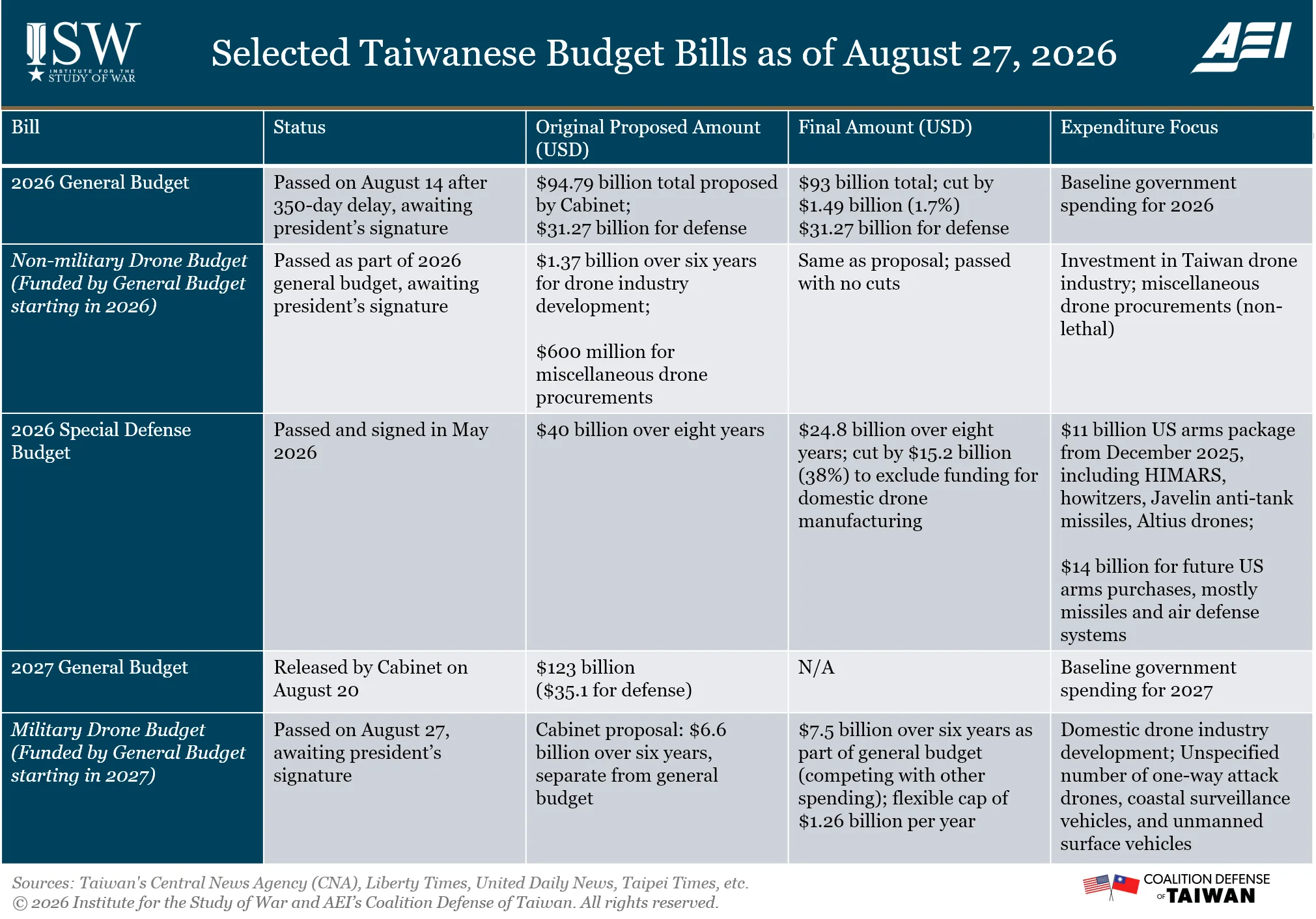
Taiwan’s Legislative Yuan (LY) passed a NT$240 billion (US$7.3 billion) six-year budget for the procurement and development of unmanned systems. Taiwan’s legislature passed the opposition Kuomintang’s (KMT) version of the drone procurement bill on August 27, including funding for coastal attack drones, coastal reconnaissance drones, unmanned surface vehicles (USVs), and domestic drone industry development.[1] The original Cabinet bill requested funding for 208,200 one-way attack drones, 1,446 coastal reconnaissance drones, and 1,320 USVs. The KMT bill does not include procurement numbers, however, and instead focuses on developing Taiwan’s domestic drone industry.[2] The bill includes a NT$40 billion (US$1.26 billion) annual spending cap that may be increased with LY approval.[3] The bill also requires the Cabinet to establish a National Unmanned Vehicle Industry Development Strategy Special Committee to coordinate the national drone policy, whose members will be nominated by the LY.[4]
The bill designates Taiwan’s Ministry of Economic Affairs (MOEA) with overseeing the overall budget, while making Taiwan’s Ministry of National Defense (MND) responsible for military procurement. The MOEA will be responsible for setting standards for Taiwanese indigenous systems and supply chains, establishing test sites for manufacturers to evaluate drone performance, and accrediting local manufacturers who have reached the required domestic production levels.[5] The bill will take effect in 2027, six months after it is signed.[6]
The new drone budget will be funded as part of Taiwan’s annually approved general government budget, which will likely make the funding less stable than that of the Cabinet’s original special budget proposal.[7] Taiwanese Defense Minister Wellington Koo criticized the budget’s annual spending cap, saying it could delay and obstruct the military’s planned procurements. The MND has already announced plans to spend NT$42.1 billion (US$1.33 billion) on drones in 2027.[8] Taiwan has suffered partisan gridlock in the LY since 2024, which has complicated Taiwanese efforts to pass its annual budget and other legislation. Taiwan’s 2026 annual budget passed on August 14 after being delayed for nearly a year.[9] The LY’s nomination of oversight committee members may also be a source of friction.
The passage of this drone bill will nonetheless provide substantial funding for the asymmetric systems required for Taiwan’s self-defense. This bill will also provide funding for the development of Taiwan’s defense industry. Taiwan’s 2026 annual budget allocated $2 billion of funding for largely non-military drones and industry development.[10] A Taiwanese domestic drone industry would allow Taiwan to continue to manufacture drones during war or blockade and reduce its dependence on arms imports from the United States, which are often delayed.
The MND separately announced a NT$26.9 billion (US$847 million) contract on August 27 for 1,554 Altius-700M loitering munitions and 478 Altius-600ISR reconnaissance drones from the US defense firm Anduril.[11] The contract is part of a December 2025 US arms package and will be funded through the special defense budget passed in May.[12] The Altius-700M is a high-precision heavy strike drone meant for destroying fortified targets at ranges of up to 160 km. The Altius-700M can strike ships in the middle of the Taiwan Strait or just off the coast of the People’s Republic of China (PRC), significantly further than the range of Taiwan’s planned domestically developed one-way attack drones, which the bill describes as being for coastal defense.[13] The Altius-600ISR is a long-range, long-endurance surveillance and reconnaissance drone with a range of around 400 km, a much longer range than Taiwan’s planned indigenous reconnaissance drones.[14] Taiwan’s drone budgets could significantly improve its defense self-sufficiency but will not eliminate the importance of acquiring higher-end US systems.
The PRC is soliciting reports of corruption related to procurements for the PLA Rocket Force (PLARF), indicating that Beijing is dissatisfied with the progress of its anti-corruption campaign within the PLARF. The CCP likely fears that corruption may compromise the People’s Liberation Army (PLA) readiness for key wartime missions. The PLA’s procurement website issued a notice on August 24 that called for military suppliers, bidding agencies, evaluation experts, and military personnel to submit reports about suspected corruption in procurement for the PLARF by November 30.[15] The notice did not specify a requirement for when the reported corruption must have occurred. The website previously made a similar request for reports for the PLA Air Force (PLAAF) in December 2025 and the PLA Cyberspace Force in August 2024 — just four months after the PLA Cyberspace Force was created.[16]
Corruption within the PLARF was a likely impetus for a wave of high-level military purges and corruption investigations beginning in 2023 that have impacted a vast majority of the PLA’s top leadership. The CCP’s disciplinary body opened investigations in 2023 into former PLARF Commanders Li Yuchao, Zhou Yaning, and Wei Fenghe and expelled Li and Wei from the CCP in 2024.[17] The PLARF Commander who replaced Li Yuchao in 2023, Wang Houbin, was removed from his post and expelled from the CCP in 2025.[18] Western media and intelligence reports shed light on deep corruption in the PLARF, including unverified allegations that graft had led to non-functional missile silo doors and missiles being filled with water instead of fuel.[19] PLA purges have impacted all branches, services, and theater commands of the PLA as well as the Central Military Commission (CMC).[20] The PLA purges have expanded their scope beyond conventional corruption and likely led to purges based on perceived factionalism and ideological disagreements, as seen during the investigation into former CMC Senior Vice Chairman Zhang Youxia in January 2026. The CMC’s only remaining member besides CCP General Secretary Xi Jinping is the CMC’s former discipline inspection chief Zhang Shengmin. Zhang was promoted to vice chairman in October 2025.[21]
Xi is likely concerned that corruption regarding military procurement will harm the effectiveness of the PLARFs’ equipment. The procurement website notice and the purge of Wang Houbin — whom Xi himself promoted to lead the PLARF after removing his predecessors — indicate that the CCP believes that corruption remains within the PLARF. Faulty PLARF equipment could compromise PLA missions in an attack on Taiwan, including joint firepower strikes on key Taiwanese and partnered military infrastructure and anti-access/area denial preventing US forces from sending reinforcements to Taiwan. Xi may hope to root out corruption and ensure PLA loyalty ahead of the PLA’s 100th anniversary in August 2027. The CCP’s 21st National Party Congress will also happen in late 2027 and very likely feature a major leadership reshuffle of the aging senior leadership of the party.[22]
Key Takeaways
- Taiwanese Unmanned Systems Budget: Taiwan’s Legislature passed a NT$240 billion six-year budget for the procurement of unmanned systems and development of Taiwan’s drone industry. This budget will be funded by Taiwan’s annual general government budget, which could present difficulties given Taiwanese legislative gridlock.
- People’s Liberation Army (PLA) Purges: The People’s Republic of China (PRC) issued a notice on August 24 calling for reports of procurement-related corruption for the PLA Rocket Force, indicating that the PRC views the years of high-level purges within the service as insufficient. The PRC likely fears that corruption could impact PLA readiness in a future conflict.
Cross-Strait Relations
Taiwan
KMT Vice Chairman Chang Jung-kung attended a cross-Strait youth exchange organized by the PRC Taiwan Affairs Office (TAO). The PRC uses cross-Strait exchanges to undermine Taiwanese sovereignty and present the KMT as the only acceptable Taiwanese interlocutors. TAO Director Song Tao presented the event, which reportedly had approximately 1000 attendees, as an opportunity to advance PRC “national rejuvenation” and open avenues of communication between CCP and KMT youth.[23]
KMT Vice Chairman Chang reiterated common KMT talking points during the event, including referencing the “1992 consensus,” an alleged verbal agreement between the KMT and CCP that both sides of the Taiwan Strait constitute “one China,” though disagreeing on who controls that “China.”[24] KMT officials often participate in cross-Strait exchange events. Chang recently attended the Straits Forum, a cross-Strait event held in the PRC in June and drew criticism from Taiwan’s Mainland Affairs Council (MAC) for echoing PRC talking points.[25]
The PRC regularly uses cross-Strait exchanges to advance its vision of cross-Strait “integration.” The PRC has shown increasing willingness to cooperate with the KMT, hosting KMT Chair Cheng Li-wun for a visit with PRC CCP General Secretary Xi Jinping in April 2026. The PRC could use its cooperation with the KMT as a vector for political influence in Taiwan. The PRC also commonly uses cross-Strait exchanges to denigrate Taiwan’s ruling Democratic Progressive Party (DPP) as unreasonable and provocative “separatists.” TAO spokesperson Zhang Han gave several press statements on August 26 that blamed the DPP for impeding cross-Strait exchanges.[26] The PRC’s exchanges with the KMT solidify the PRC’s insistence that the 1992 Consensus must be the basis for cross-Strait political exchanges — the PRC cut off most official exchanges with Taiwan after former Taiwanese President Tsai Ing-wen was elected in 2016. The CCP likely aims to present the KMT as a more effective and legitimate spokesperson for Taiwan than the DPP; a narrative that the CCP likely hopes will convince Taiwanese voters to elect KMT politicians to ensure cross-Strait stability.
China
The PLA tested PLAAF Shenyang J-16 fighter jets against Western-designed combat aircraft in the “Eagles of Civilization 2026” combined military exercise in Egypt running from August 22 to early September. The PRC is using the exercise to practice long-distance power projection and demonstrate its strong diplomatic relationships in the Middle East. The PLAAF’s J-16s participated alongside Egypt’s French-made Dassault Rafale fighter jets, giving the PLAAF the chance to test J-16s against a Western-designed combat aircraft.[27] The exercise appears to be the first instance of J-16 twin-engine multirole fighters being tested against Western-designed combat aircraft, though the PLA deployed J-10C single-engine multirole fighter jets in the 2025 exercise iteration.[28] The PRC-made J-10C fighters operated by Pakistan faced off against Indian-owned Rafales in a May 2025 conflict between India and Pakistan, though India and Pakistan made conflicting claims about how their aircraft performed and how many of the other side’s aircraft they downed in the conflict.[29] The PRC-Egypt military exercises will give the PLA an opportunity to gather more accurate and comprehensive data on the J-16’s capabilities against one type of Western combat aircraft.[30]
PRC commentary on the exercises and the use of J-16s noted that the J-16s crossed over 3,700 miles and four countries in a nearly nine-hour trans-continental journey with a YY-20A tanker refueling two J-16s simultaneously mid-flight.[31] A statement from the PRC Ministry of National Defense (MoD) described these exercises as a display of diplomatic and military cooperation between the PRC and Egypt with an eye to “regional peace and stability.”[32] The exercises preceded CCP General Secretary Xi Jinping’s upcoming state visit to Egypt. Xi’s visit to Egypt is part of a multi-state international trip lasting from August 30 to September 3.[33]
The US Department of Justice (DOJ) seized domains connected to PRC-sponsored cyberattacks against US critical infrastructure on August 26. PRC cyberattacks pose an ongoing risk to the security of the United States. DOJ stated that a hacking group known as QTFY targeted numerous US government agencies, including the National Aeronautics and Space Administration (NASA), the National Institutes of Health (NIH), the Senate, and the Federal Reserve.[34] QTFY is a PRC state-sponsored entity whose clients include the PRC Ministry of State Security (MSS) and the PLA. The two platforms involved in the attack, QScan and QTRouter, attacked “internet of things” devices and obscured the origins of the attack.[35] The DOJ stated on August 26 that the United States seized the domains of these actors and rendered them inoperable.[36] The PRC Ministry of Foreign Affairs (MFA) denied the United States’ accusations in an August 27 press conference.[37]
The seizure of QTFY’s domains is part of a larger US crackdown against the PRC’s malicious cyber activity in recent years.[38] PRC advanced persistent threat (APT) cyber actors carry out attacks around the world, and the PRC regularly uses cyberattacks to steal data and degrade US infrastructure. The United States has tracked QTFY’s activity since at least 2018.[39]
Iran
The PRC threatened unspecified countermeasures against new US secondary sanctions against Iran’s trade partners, which include several PRC and Hong Kong entities. The US government has expanded sanctions determinations, which could impact additional PRC entities, but the sanctions are unlikely to impact PRC financial institutions or cause major economic damage to the PRC. US Treasury Secretary Scott Bessent announced on August 24 that the United States has enacted sanctions against 60 entities in several countries, including several entities in the PRC and Hong Kong, and demanded “immediate action” from nations maintaining economic and commercial ties with Iran.[40] The United States is implementing these sanctions to deepen Iran’s economic isolation and strengthen international sanctions enforcement.[41] The sanctions are aimed at severing the economic and commercial ties that help Iran sustain its economy and combat operations amid the war with the United States. The United States implemented the sanctions against the 60 specified entities on August 24 and stated that it would give “defined timeline[s]” to enact further sanctions if other countries do not comply with the United States’ order to curtail all commercial and financial ties with Iran’s digital assets, technology, gold, aviation, and shipping sectors.[42] PRC Foreign Ministry spokesperson Lin Jian responded to Bessent’s announcement on August 24 and said that US secondary sanctions will not help resolve the war and will only exacerbate tensions and escalate the situation.[43] Lin later stated on August 25 that the PRC will take “all necessary measures to resolutely safeguard its own legitimate rights and interests.”[44]
The United States has thus far declined to sanction any PRC financial institutions suspected of facilitating Iran’s oil trade, making it unlikely that the new sanctions will have a major impact on the PRC economy.[45] US sanctions on PRC entities thus far have not deterred the PRC from maintaining its current level of economic and commercial ties with Iran.[46] The PRC Ministry of Commerce implemented an anti-sanctions law on May 2, directing PRC companies to ban compliance with US sanctions against five US-designated PRC independent oil refineries, which were sanctioned for importing sanctioned Iranian crude oil.[47] The PRC is by far Iran’s largest trading partner and consumer of Iranian oil, importing around 90 percent of Iran’s oil exports in recent years.[48]
India
PRC Foreign Minister Wang Yi and Indian Special Representative and National Security Advisor Ajit Doval met in Beijing on August 25 to discuss border disputes and deescalate tensions as part of a broader mutual effort to deepen bilateral relations. The PRC and India announced an eight-point consensus to “seek a fair, reasonable, and mutually acceptable solution” to the border disputes and to strengthen exchanges and improve cooperation.[49] The PRC readout stated that the eight points include enhancing communications through existing channels, adding two meeting points for commander-level talks, creating new military hotlines, and tasking the Expert Group on Boundary Delimitation and Working Group on Border Management with advancing discussions on border issues. India and the PRC will hold a follow-up meeting in September 2026 to discuss water management of trans-border rivers and a future round of boundary talks to be held in India in 2027.
Reuters reported that CCP General Secretary Xi Jinping is expected to visit New Delhi for the BRICS summit from September 12 to 13, which would be his first visit to India in seven years.[50] Indian Prime Minister Narendra Modi visited Tianjin, PRC in August 2025 for the Shanghai Cooperation Organization Summit, his first visit to the PRC in seven years. Xi stated during that meeting that his previous meeting with Modi at the 2024 BRICS summit “marked the restart of China-India relations” and emphasized the importance of the two countries working together following a period of border tensions.[51] The PRC readout for that meeting stated that “the boundary question should not define the overall relationship.”[52] The agreement to hold the next round of border talks in India in 2027 indicates mutual efforts to work past the historically contentious issue during this thawing of bilateral relations.
The PRC and India share a largely undemarcated border along the Himalayas called the Line of Actual Control (LAC), which stretches approximately 2100 miles.[53] The PRC and India have long disputed these boundaries, and recent clashes between soldiers have resulted in casualties on both sides.[54] The PRC and India signed a disengagement agreement in October 2024 to end a four-year military standoff following deadly clashes in 2020.[55]

[1] https://focustaiwan dot tw/politics/202608270021
[2] https://focustaiwan dot tw/politics/202608270021; https://understandingwar.org/research/china-taiwan/china-taiwan-update-july-24-2026/ ; https://understandingwar.org/research/china-taiwan/china-taiwan-update-august-18-2026/
[3] https://focustaiwan dot tw/politics/202608270021
[4] https://www.taiwannews.com dot tw/news/6429036; https://focustaiwan dot tw/politics/202608270021
[5] https://www.taipeitimes dot com/News/taiwan/archives/2026/08/27/2003863212
[6] https://www.taiwannews.com dot tw/news/6429036
[7] https://focustaiwan dot tw/politics/202608270021
[8] https://www.reuters.com/world/china/taiwan-parliament-approves-military-drone-spending-rejects-special-budget-2026-08-27/
[9] https://understandingwar.org/research/china-taiwan/china-taiwan-update-august-18-2026/
[10] https://understandingwar.org/research/china-taiwan/china-taiwan-update-august-18-2026/
[11] https://def.ltn.com dot tw/article/breakingnews/5553730
[12] https://tsm.schar.gmu.edu/weekly-arms-update-3-18-26/
[13] https://www.anduril.com/altius ; https://www.taiwannews.com dot tw/news/6428878 ; https://www.chinatimes dot com/realtimenews/20260827001804-260417?chdtv
[14] https://www.anduril.com/altius ; https://www.taiwannews.com dot tw/news/6428878
[15] https://www.plap.mil dot cn/freecms/site/juncai/hydt/info/2026/2739189.html ; https://www.scmp dot com/news/china/military/article/3365247/china-seeks-public-tips-procurement-violations-pla-rocket-force-probe-continues?module=top_story&pgtype=subsection
[16] https://www.scmp dot com/news/china/military/article/3365247/china-seeks-public-tips-procurement-violations-pla-rocket-force-probe-continues?module=top_story&pgtype=subsection
[17] https://thediplomat.com/2024/01/the-shakeup-in-chinas-rocket-force-continues/ ; https://www.reuters.com/world/china/chinas-communist-party-expels-two-former-defence-ministers-corruption-2024-06-27/ ; https://www.reuters.com/world/china/chinas-communist-party-removes-ex-foreign-defence-ministers-top-body-2024-07-18/
[18] https://understandingwar.org/research/china-taiwan/china-taiwan-weekly-update-october-24-2025/
[19] https://www.bloomberg.com/news/articles/2024-01-06/us-intelligence-shows-flawed-china-missiles-led-xi-jinping-to-purge-military
[20] https://chinapower.csis.org/china-pla-military-purges/
[21] https://understandingwar.org/research/china-taiwan/xi-jinpings-military-purges-leave-him-increasingly-powerful-but-isolated/
[22] https://jamestown.org/purges-aging-set-stage-for-21st-party-congress-turnover/
[23] https://www.news dot cn/tw/20260825/79dd069dc2ed417f83a7552bb07ad244/c.html; https://www.gwytb.gov dot cn/xwdt/zwyw/202608/t20260825_12784322.htm
[24] https://www.gwytb dot gov.cn/xwdt/zwyw/202608/t20260825_12784322.htm
[25] https://focustaiwan dot tw/politics/202606130016
[26] https://www.gwytb.gov dot cn/xwdt/xwfb/wyly/202608/t20260826_12784582.htm
[27] https://www.news dot cn/world/20260824/5a48240edbc34f0696a6afe5eb90328e/c.html; http://www.mod dot gov.cn/gfbw/qwfb/16479343.html; https://www.mod dot gov.eg/modwebsite/NewsDetailsAr.aspx?id=45900 ; https://www.bloomberg.com/news/articles/2026-08-24/china-s-fighter-jet-gets-rare-chance-to-face-rafales-in-exercise
[28] https://nationalinterest.org/blog/buzz/chinas-fighter-jets-flying-over-egypt-sa-082626
[29] https://www.bloomberg.com/news/articles/2025-10-06/chinese-arms-did-exceptionally-against-india-pakistan-says; https://www.bloomberg.com/news/articles/2026-08-24/china-s-fighter-jet-gets-rare-chance-to-face-rafales-in-exercise
[30] https://nationalinterest.org/blog/buzz/chinas-fighter-jets-flying-over-egypt-sa-082626
[31] https://weibo dot com/1989660417/Rf4J54t0e; https://tv.cctv dot cn/2026/08/24/VIDEqr4stiESmK9xzJThCck9260824.shtml; https://baijiahao.baidu dot com/s?id=1874397745688573178&wfr=spider&for=pc; https://decode39.com/16298/chinas-j-16-deployment-to-egypt-is-about-more-than-six-fighter-jets/
[32] http://www.mod dot gov.cn/gfbw/xwfyr/jt/16479387.html
[33] https://www.mfa dot gov.cn/web/fyrbt_673021/202608/t20260826_12010898.shtml
[34] https://www.justice.gov/opa/pr/justice-department-and-fbi-seize-platforms-operated-and-used-china-state-sponsored-hackers; https://www.wsj.com/tech/cybersecurity/fbi-shuts-down-sprawling-china-linked-hacking-network-61eade59?mod=Searchresults&pos=1&page=1
[35] https://www.justice.gov/opa/pr/justice-department-and-fbi-seize-platforms-operated-and-used-china-state-sponsored-hackers
[36] https://www.justice.gov/opa/pr/justice-department-and-fbi-seize-platforms-operated-and-used-china-state-sponsored-hackers
[37] https://www.fmprc.gov dot cn/fyrbt_673021/202608/t20260827_12011623.shtml
[38] https://www.justice.gov/opa/pr/justice-department-and-fbi-seize-platforms-operated-and-used-china-state-sponsored-hackers
[39] https://www.justice.gov/opa/pr/justice-department-and-fbi-seize-platforms-operated-and-used-china-state-sponsored-hackers
[40] https://www.reuters.com/world/middle-east/us-treasury-broaden-scope-secondary-sanctions-iran-source-says-2026-08-24/ ; https://www.scmp dot com/news/us/diplomacy/article/3365111/us-sanctions-chinese-entities-issues-global-warning-economic-d-day-against-iran?module=top_story&pgtype=homepage
[41] https://understandingwar.org/research/middle-east/iran-update-august-24-2026/
[42] https://home.treasury.gov/news/press-releases/sb0613
[43] https://www.mfa.gov dot cn/fyrbt_673021/202608/t20260824_12009243.shtml
[44] https://www.globaltimes dot cn/page/202608/1368965.shtml; https://www.fmprc dot gov.cn/fyrbt_673021/202608/t20260825_12010101.shtml
[45] https://www.reuters.com/world/china/iran-vows-retaliate-after-us-widens-sanctions-2026-08-25/
[46] https://www.fmprc dot gov.cn/fyrbt_673021/202608/t20260825_12010101.shtml
[47] https://understandingwar.org/research/china-taiwan/china-taiwan-update-may-8-2026/
[48] https://understandingwar.org/research/middle-east/iran-update-august-24-2026/
[49] https://english.news dot cn/20260826/e93395ccb079415f90737d5af8c333b9/c.html
[50] https://www.reuters.com/world/china/chinas-xi-likely-visit-india-with-big-delegation-first-time-seven-years-2026-08-24/
[51] https://www.mfa.gov dot cn/zyxw/202508/t20250831_11699054.shtml
[52] https://thediplomat.com/2025/09/how-does-beijing-view-modis-visit-to-china/; https://www.mfa.gov dot cn/zyxw/202508/t20250831_11699054.shtml
[53] https://www.bbc.com/news/world-asia-53062484
[54] https://www.bbc.com/news/world-asia-53062484
[55] https://www.indiandefensenews dot in/2024/11/octobers-patrolling-pact-with-china.html; https://economictimes.indiatimes dot com/news/defence/october-2024-agreement-been-implemented-as-per-modalities-timelines-agreed-govt-on-lac-issue/articleshow/123190550.cms