
Toplines
North Korea is unlikely to agree to negotiations with the United States based on a nuclear freeze and arms control. US President Donald Trump described his relationship with Workers’ Party of Korea (WPK) General Secretary Kim Jong Un positively when asked by reporters on August 20. Trump stated during this engagement that his positive relationship with Kim was “a good thing” given that North Korea possessed 57 nuclear warheads.[1] Trump did not comment on the US’ North Korean denuclearization goal when asked by a reporter.[2] Trump added that the United States cannot allow Iran to have a nuclear weapon but stated “[Kim] will be fine as long as we have a smart president.”[3] Trump stated that he expects to meet with Kim in 2026, without specifying when or how. The Wall Street Journal (WSJ) reported on August 18 that Trump is pushing to arrange a meeting with Kim at the upcoming Asia-Pacific Economic Cooperation (APEC) in Shenzhen, People’s Republic of China (PRC), in November.[4] North Korea dismissed Trump’s calls for engagement and decision to reduce US combined exercises with South Korea as “meaningless” on August 18.[5] The South Korean Ministry of Foreign Affairs (MOFA) stated on August 25 that Washington and Seoul remain aligned on the objective of denuclearization of the Korean Peninsula.[6]
A US policy change on denuclearization could present opportunities for engagement with North Korea. North Korea most likely will not discuss arms control and reduction, however. WPK General Secretary Kim Jong Un said in February that Pyongyang can maintain good relations with Washington if the United States respects North Korea’s “constitutional status” and abandons its hostile policy.[7] North Korea’s constitution describes North Korea as a “nuclear-armed state” and states that the regime would continuously “develop nuclear weapons” to guarantee its right to survival.[8] Negotiations on pausing nuclear weapon development would contradict North Korea’s constitutional provisions mandating continual development of its nuclear forces.
ISW-CDOT previously assessed that North Korea is adopting a more delegative nuclear command and control (NC2) structure and dispersing its nuclear forces to maintain military readiness.[9] These posture changes indicate that North Korea is very unlikely to accept any arms control agreements, given that standard International Atomic Energy Agency (IAEA) inspections on facilities would reveal the locations of North Korea’s key nuclear sites.[10]
ISW-CDOT has assessed that North Korea is unlikely to negotiate with the United States without a change in US policy, as North Korea has little to gain from engagement with the United States at present. The United States has not announced an official change in its denuclearization policy at the time of writing. Kim could demand that the United States omit reference to denuclearization during a future summit, viewing a summit with Trump as an opportunity to display North Korea’s international standing and the US’ tacit acceptance of the regime’s nuclear status.
South Korea’s opposition conservative bloc is discussing the development of an independent South Korean nuclear armament amid concerns that the United States will accept North Korea as a nuclear-armed state. South Korean opposition People Power Party (PPP) lawmakers Na Kyung-won, Yoon Sang-hyun, and Ahn Cheol-soo advocated for South Korea to acquire some form of nuclear capability on August 20 after the annual US-South Korea combined Ulchi Freedom Shield (UFS) exercise ended early following US President Donald Trump’s order.[11] Na and Ahn explicitly called for South Korea’s independent nuclear armament, while Yoon proposed a redeployment of US tactical nuclear weapons. Former Reform Party leader Lee Jun-seok and former PPP lawmaker Yoo Seung-min also raised concerns over potential South Korean vulnerabilities, with Yoo explicitly stating the need to persuade Washington to allow Seoul’s nuclear armament.[12] South Korean President Lee Jae Myung previously opposed calls for South Korean nuclear armament and described the idea as “unrealistic and irresponsible” and as something that could “harm the national interest.”[13] Lee argued that pursuing nuclear weapons would withdraw South Korea from the Nuclear Non-Proliferation Treaty, triggering international economic sanctions. The South Korean Ministry of National Defense (MND) is introducing a bill that would codify South Korea’s commitment to not seek nuclear weapons amid its development of a nuclear-powered attack submarine.[14] A potential US policy change could galvanize a shift in South Korea’s public sentiment, however, due to a fear of abandonment by the United States. South Korean public support for an independent nuclear capability has generally stood at around 60-70 percent of the surveyed population, with roughly 40 percent viewing acquiring nuclear capabilities as a rational decision despite potential negative consequences.[15]
Pyongyang will most likely exclude Seoul from any future North Korean dialogues with Washington based on North Korea’s designation of South Korea as a separate, hostile enemy state. WPK General Affairs Department Director, and sister of Kim Jong Un, Kim Yo Jong released a statement on August 20 mocking South Korea as a “puppet state” of the United States.[16] Trump directed a substantial reduction in the US-South Korea UFS combined military exercises on August 16, reportedly to reduce hostile signaling toward Pyongyang.[17] Kim Yo Jong highlighted the “contradictions” inherent within the Lee administration’s defense policy, citing Seoul’s support of the exercise reduction while concurrently pursuing force build-up.[18] Kim Yo Jong reiterated that North Korea’s nuclear buildup is intended to protect North Korea from foreign aggression, referring to South Korean military activity.[19] Kim Yo Jong did not directly criticize Washington or Trump, however. These comments followed Kim Yo Jong’s August 19 statements on Trump’s decision to reduce the UFS exercise, in which Kim Yo Jong noted that changes in the UFS do not reverse Pyongyang’s fundamental hostility toward Washington and Seoul, while confirming that Trump and Kim Jong Un maintain a good relationship.[20]
Pyongyang is reinforcing its “talking with Washington, isolating Seoul [통미봉남]” strategy, also referred to as its “Korea passing” doctrine, by signaling its absolute disinterest in engaging with Seoul while preserving diplomatic flexibility for direct bilateral engagement with Washington.[21] Former South Korean President Kim Yong-sam raised concerns about this “Korea passing” doctrine during the 1993 North Korea Nuclear Non-Proliferation Treaty (NPT) withdrawal crisis, when Pyongyang and Washington prioritized direct dialogue while sidelining the inter-Korean channel.[22] Pyongyang appears to have concluded that inter-Korean relations yield very limited value following the collapse of the two 2019 US-North Korea summits.[23] Kim Jong Un later introduced this strategic shift in 2023 through the “hostile two-state framework,” an official categorization of Seoul as a hostile foreign enemy.[24] Kim Yo Jong’s denunciation of South Korea as a US “puppet state” highlights Pyongyang’s complete dismissal of the prospect for dialogue with Seoul. Pyongyang will most likely reject Seoul’s participation in any future US-North Korea dialogues and will likely boycott future negotiations if Washington attempts to integrate Seoul into the process. Pyongyang’s approach likely seeks to render the South Korean Ministry of Unification’s (MOU) conciliatory policies irrelevant while driving a wedge into US-South Korean security cooperation. Pyongyang has consistently leveraged missile launches and aggressive rhetoric to protest US-South Korea security cooperation, to degrade US-South Korea coordination.
Key Takeaways
- US-North Korea Relations: US President Donald Trump is continuing to push for dialogue with Workers’ Party of Korea General Secretary Kim Jong Un, though North Korea is unlikely to agree to dialogue with the United States without a change in US policy towards denuclearization. North Korea appears to be altering its nuclear command and control structure and dispersing its nuclear forces to enhance its military readiness, which would make North Korea reticent to accept any arms control agreements.
- South Korean Nuclear Weapons Development: South Korean opposition politicians are discussing the possibility of South Korea developing its own independent nuclear armament amid concerns over US acceptance of North Korean nuclear weapons and concerns about the US alliance. The South Korean Ministry of National Defense is proposing legislation that would codify South Korea’s commitment to non-proliferation in line with the stated policy of the Lee Jae Myung administration.
- Inter-Korean Relations: North Korea will likely exclude South Korea from any future dialogue between the United States and North Korea. North Korea has regarded South Korea as a hostile foreign enemy since its 2023 policy change, despite attempts by Lee Jae Myung and the South Korean Ministry of Unification to unilaterally reduce tensions with Pyongyang.
North Korean Domestic Politics
Nothing significant to report.
North Korean Military Developments
Ukrainian Intelligence reported that North Korea deployed a 400-person drone unit among its deployment of 8,500 new troops sent mostly to Russia’s Kursk Oblast, along with potential additional KN-23 and KN-24 ballistic missile shipments. North Korean military personnel will likely continue to build on practical experience gained in the war in Ukraine, including in emerging technologies and contemporary drone warfare. Ukrainian Main Military Intelligence Director (GUR) Deputy Head Major General Vadym Skibitskyi reported on August 21 that the 400-person drone unit operators could survey and strike targets in Ukraine, and that the broader 8,500 troops deployed will likely not fight within Ukraine but rather reinforce Russia’s rear areas and free up Russian troops.[25] Skibitskyi stated that North Korea has thus far deployed or rotated about 25,000 troops alongside the Russian military, and that Russian President Vladimir Putin may ask WPK General Secretary Kim Jong Un for as many as 50,000 additional North Korean troops when they meet in September 2026. [26] Ukrainian President Volodymyr Zelensky stated on August 8 that North Korea was preparing to deploy between 30,000 and 50,000 personnel to Russia at an unspecified time. South Korean intelligence responded to these reports that it has found no signs of imminent North Korean troop deployment.[27] ISW has previously reported evidence of North Korean forces operating first-person view (FPV) and reconnaissance drones alongside Russian troops in Kursk Oblast during their first Russian deployment in August and October 2025.[28] Skibitskyi further stated that North Korea sent at least 150 KN-23 or KN-24 ballistic missiles to Russia before August 2025 and pledged to send 120 more at an undisclosed date.[29]
This deployment confirmed previous ISW-CDOT reporting that North Korean troops are likely gaining significant practical experience fighting in Ukraine, including with emerging technologies and contemporary drone warfare, which is already being implemented on the battlefield and could be used in the event of conflict on the Korean Peninsula.[30] North Korea may further be able to benefit from Russian technological advancements, which have significantly improved the accuracy of North Korea’s KN-23 and KN-24 ballistic missiles, with the potential to significantly enhance the threat the KN-23 and KN-24 ballistic missiles pose to South Korea and US forces in the region.[31]
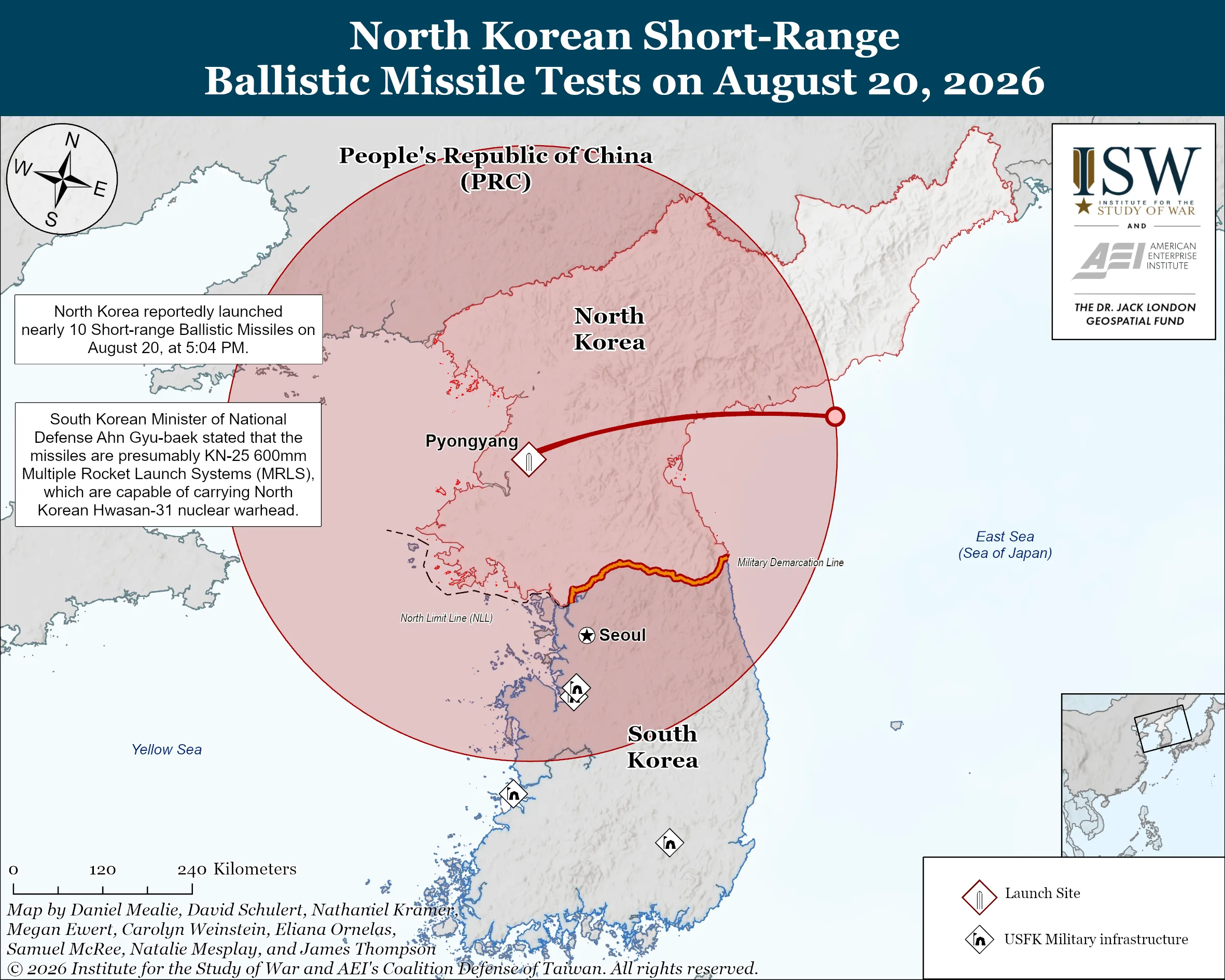
North Korea launched approximately 10 short-range ballistic missiles (SRBMs) towards the East Sea/Sea of Japan on August 20. The South Korean Joint Chiefs of Staff and the Japanese Ministry of Defense reported that North Korea launched multiple missiles eastward from the Pyongyang area, which flew 300-320 km (186-199 miles) with an apogee of 90 km (56 miles).[32] South Korea Defense Minister Ahn Gyu-baek assessed that the missiles were likely KN-25 600 mm multiple launch rocket systems (MLRS), which are also capable of carrying North Korean nuclear warheads.[33] The August 20 launch marks North Korea’s third consecutive missile test in August, following launches on August 6 and August 12.[34] North Korean state media has not reported on any of the August missile launches.[35] ISW-CDOT previously assessed that North Korea’s lack of coverage suggests the ongoing development of new missile systems.[36] The August 20 launch marks the first time North Korea fired nearly ten missiles in a single day since 12 launches conducted on March 14.[37] The South Korean Defense Intelligence Agency (DIA) assessed on August 23 that North Korea has largely completed the development of its Hwasong-11 series SRBMs and new MLRS platforms.[38] The South Korean DIA noted that North Korea likely enhanced the operational performance of these systems using combat data gleaned from the Russia-Ukraine war and possible Russian technical support.[39] The South Korean DIA projected that North Korea would deploy the new systems along the Military Demarcation Line (MDL).[40] North Korea will likely use these ongoing missile tests to support the operational development of new strike systems while reinforcing its “fortification” of its southern border, the MDL. WPK General Secretary Kim Jong Un emphasized the reinforcement of artillery assets near the MDL, where North Korea is continuing to deploy troops to conduct land-clearing operations, lay minefields, and construct fences.[41] North Korea can strike any targets within South Korea if the systems are forward deployed.
North Korean Foreign Relations
North Korea likely seeks to generate foreign currency through tourism and demonstrate the expansion of its anti-Western partnerships by developing greater ties with Belarus. Belarusian Foreign Minister Maxim Ryzhenkov told Belarusian state media Belteleradio on August 24 that Belarus and North Korea will sign a mutual visa exemption agreement in the “near term.”[42] Ryzhenkov said he met with North Korean Foreign Minister Choe Son Hui to discuss the agreement.[43] Seoul-based media outlet NK News reported that Ryzhenkov likely visited Pyongyang from August 6 to 20, with a Telegram post linked to the Belarusian Foreign Ministry explicitly stating that Ryzhenkov took his family on vacation to North Korea.[44] NK News added that Ryzhenkov praised North Korea’s Wonsan Kalma Resort during an interview with Belteleradio.[45]
The visa agreement follows a summit between Belarusian President Alexander Lukashenko and WPK General Secretary Kim Jong Un in Pyongyang in March 2026.[46] The two leaders signed an agreement that expanded bilateral cooperation in education, culture, healthcare, agriculture, information and press, physical education and sports, and between the two states’ commerce and foreign ministries.[47] Ryzhenkov said Lukashenko directed his officials to pursue a deal that would waive visa requirements for North Korean residents entering Belarus following the summit.[48]
North Korea-Belarus relations have improved significantly in recent years, likely driven by the two states’ mutual support for Russia.[49] Kim and Lukashenko first met in Beijing on September 3, 2025, on the sidelines of the PRC’s Victory over Japan Day parade.[50] Belarus then invited North Korean Foreign Minister Choe Son Hui to attend the Minsk International Conference on Eurasia Security for the first time in October 2025.[51] North Korea may be seeking to attract Belarusian tourists through the new visa agreement. North Korea may also seek to portray expanding relations with Belarus, a Russian proxy state, as part of its development of a coalition against the West.[52]
North Korean Cognitive Warfare
Nothing significant to report.
Inter-Korean Relations
North Korea is strengthening its fortifications on the border with South Korea, likely to communicate North Korea’s opposition to unification and engagement with South Korea. South Korea’s MND reported that North Korea will likely complete its fortification efforts along the MDL by 2028.[53] South Korea’s MND claimed that North Korea had completed 90 percent of its land clearance efforts and 30 to 60 percent of its fencing and minelaying efforts along the MDL.[54] The MND further stated that North Korea may be deploying new long-range strike capabilities to its frontline units, including 240 mm and 600 mm multiple launch rocket systems MLRS and tactical ballistic missiles.[55] ISW-CDOT previously assessed that North Korea may be augmenting its frontline artillery forces to conduct operational- and strategic-level strikes, as unmanned systems increasingly provide tactical fire support on the modern battlefield.[56]
North Korea’s enhanced border posture likely serves to signal externally that North Korea remains committed to its hostile two-state policy and will not acquiesce to any step toward unification. WPK General Secretary Kim Jong Un first promulgated the “hostile two-state framework” in 2023, transitioning away from North Korea’s previous goal of unification.[57] North Korea formally codified the principle into law in May 2026.[58] North Korea destroyed road and rail connections between the North and South in 2024 to solidify its hostility towards South Korea and opposition to unification.[59] North Korea’s fortification efforts likely serve a similar purpose, creating an environment on the ground between North and South Korea that makes increased inter-Korean cooperation unfeasible.
The South Korean MOU is expanding multilateral inter-Korean civilian engagement proposals aimed at inducing Pyongyang’s participation. The MOU appears emboldened to expand its outreach by US President Donald Trump’s pro-engagement stance towards Pyongyang. The MOU announced “four major peaceful exchange projects” on August 19 to prepare for potential inter-Korean dialogue.[60] The MOU stated that these initiatives are steps to implement President Lee Jae Myung’s August 15 Liberation Day speech on “peaceful coexistence,” during which Lee proposed multilateral engagement and discussion to end the Korean War for the first time.[61] The MOU’s proposed initiatives seek to induce North Korean engagement through multilateral economic cooperation involving neighboring states.[62] The initiatives include connecting cross-border rail connections through the PRC and Mongolia, developing Wonsan-Kalma tourism packages for overseas Koreans, revitalizing the Greater Tumen Initiative (GTI) regional development framework, and modernizing local North Korean hospitals.[63]
The MOU’s new initiatives appear to mark a transition from 2025’s focus on bilateral conciliatory initiatives to multilateral economic and infrastructural projects to encourage Pyongyang’s engagement. The Lee administration has implemented proactive de-escalation measures targeting issues sensitive to Pyongyang since Lee took office, including suspending Demilitarized Zone (DMZ) broadcasts and propaganda leaflet launches, reducing US-South Korea combined military exercises, and easing restrictions on inter-Korean trade.[64] Pyongyang has rebuffed bilateral engagement with Seoul, however. The MOU likely aims to create diplomatic openings through multilateral cooperation in areas of significant necessity for Pyongyang, such as in medical infrastructure and tourism development. The MOU also supports policies that align with Trump’s engagement efforts with Pyongyang to solidify Seoul’s role as a “pacemaker” aiding US-North Korea dialogue. South Korean Minister of Unification Chung Dong-young welcomed Trump’s directive to reduce the UFS combined military exercise and reaffirmed his commitment to support Washington and ultimately revive inter-Korean relations.[65] The MOU will likely accelerate its conciliatory policies and expand multilateral engagement initiatives if Washington’s engagement efforts continue.
South Korean Domestic Politics
Nothing significant to report.
Counter-North Korean Coalition Building Efforts
The United States and South Korea completed the reduced UFS combined military exercises, and the US canceled the large-scale, combined amphibious Twin Dragon exercises on August 21. This reduction and cancellation could hinder operational control (OPCON) transfer despite optimistic statements from South Korean Minister of National Defense Ahn Gyu-baek and South Korean President Lee Jae Myung. Ahn stated that the US Force Korea (USFK) and South Korean forces conducted two drills to verify Full Operational Capabilities (FOC) as part of preparations for the OPCON transfer during the first phase of the UFS combined military exercise.[66] Ahn added that the participating forces completed two major drills, including counterfire operations.[67] Ahn clarified that the downscaling of UFS did not impede the OPCON assessment, as the combined forces had already completed the planned assessment in the first phase of UFS. [68] Ahn also stated that participating forces remain on track to execute 159 Field Training Exercises (FTXs) this year. [69] The Wall Street Journal reported that the United States notified South Korea of its withdrawal from this year’s Twin Dragon exercises in June.[70] South Korea-based Chosun Ilbo reported that the South Korean military would now conduct an independent exercise in late September.[71]
The reduction of live outdoor drills, simulated command exercises, and combined field maneuver training as part of the UFS, alongside fewer joint field training exercises and the US withdrawal from amphibious assault and landing simulations, could affect US-South Korean coordination and military readiness. Joint and multinational military exercises are critical for refining doctrinal interoperability, improving combat readiness, and testing new technologies.[72] Any reduction in US-South Korean military coordination and readiness could further hinder South Korea’s capacity to assume wartime OPCON.[73] Planned assessments related to OPCON transfer were fortunately not impacted by the UFS reduction but could be affected during future UFS exercises if reductions continue.[74] Lee still intends to complete the OPCON transfer without interruption. However, the transfer has been unsuccessful in previous liberal administrations, and the prospects for OPCON transfer completion by Lee’s announced deadline could now be later considering the UFS reduction.[75]

[1] https://www.foxnews.com/politics/trump-reveals-exact-number-north-koreas-nuclear-weapons
[2] https://www.chosun dot com/international/us/2026/08/21/B3FS2KC3KVAUJCMGHRCCH4N2FY/
[3] https://www.chosun dot com/international/us/2026/08/21/B3FS2KC3KVAUJCMGHRCCH4N2FY/
[4] https://www.wsj.com/world/asia/trump-pushes-for-kim-jong-un-meeting-this-year-2a9f9ae0?eafs_enabled=false
[5] https://www.scmp dot com/week-asia/politics/article/3364725/why-north-korea-keeping-door-open-dialogue-trump
[6] https://www.yna.co.kr/view/AKR20260825139951504?section=nk/news/all
[7] https://www.yna.co.kr/view/AKR20260226061200504
[8] https://www.donga dot com/news/Politics/article/all/20260507/133874331/2
[9] https://www.aei.org/commentary/special-report-north-koreas-constitutional-amendments-cement-the-regimes-strategic-posture/
[10] https://www.nknews.org/pro/why-guidance-systems-are-the-achilles-heel-of-north-koreas-missile-arsenal/
[11] https://www.yna.co.kr/view/AKR20260821143051001?section=nk/news/all
[12] https://www.yna.co.kr/view/AKR20260821143051001?section=nk/news/all
[13] https://www.yna.co.kr/view/AKR20251202084700001
[14] https://imnews.imbc dot com/news/2026/politics/article/6840555_36911.html
[15] https://www.rfa.org/korean/in-focus/2025/03/20/opinion-poll-nuclear-armament-exaggerated/; https://opendata.mofa.go dot kr/mofapub/resource/Publication/14265.page
[16] https://kcnawatch.org/newstream/1787227411-859347022/%ea%b9%80%ec%97%ac%ec%a0%95-%ec%a4%91%ec%95%99%ec%9c%84%ec%9b%90%ed%9a%8c-%eb%b6%80%ec%9e%a5-%eb%8b%b4%ed%99%94-%eb%b0%9c%ed%91%9c/; https://kcnawatch.org/newstream/1787227415-320259129/press-statement-of-kim-yo-jong-department-director-of-c-c-wpk/
[17] https://www.yna.co.kr/view/AKR20260817008851071
[18] https://kcnawatch.org/newstream/1787227411-859347022/%ea%b9%80%ec%97%ac%ec%a0%95-%ec%a4%91%ec%95%99%ec%9c%84%ec%9b%90%ed%9a%8c-%eb%b6%80%ec%9e%a5-%eb%8b%b4%ed%99%94-%eb%b0%9c%ed%91%9c/; https://kcnawatch.org/newstream/1787227415-320259129/press-statement-of-kim-yo-jong-department-director-of-c-c-wpk/
[19] https://kcnawatch.org/newstream/1787227411-859347022/%ea%b9%80%ec%97%ac%ec%a0%95-%ec%a4%91%ec%95%99%ec%9c%84%ec%9b%90%ed%9a%8c-%eb%b6%80%ec%9e%a5-%eb%8b%b4%ed%99%94-%eb%b0%9c%ed%91%9c/; https://kcnawatch.org/newstream/1787227415-320259129/press-statement-of-kim-yo-jong-department-director-of-c-c-wpk/
[20] https://kcnawatch.org/newstream/1787146411-363936873/%ea%b9%80%ec%97%ac%ec%a0%95-%ec%a4%91%ec%95%99%ec%9c%84%ec%9b%90%ed%9a%8c-%eb%b6%80%ec%9e%a5-%ec%a3%bc%ec%9a%94%ea%b5%ad%ec%a0%9c%eb%ac%b8%ec%a0%9c%eb%93%a4%ec%97%90-%eb%8c%80%ed%95%9c-%eb%a6%bd/
[21] https://www.voakorea.com/a/5045490.html; https://www.yna.co.kr/view/MYH20200113020300038
[22] https://www.hankookilbo dot com/news/article/A2025032814300000996
[23] https://www.voakorea.com/a/korea_korea-politics_us-korea-summit-1/6058741.html
[24] https://www.joongang.co.kr/article/25426277
[25] https://www.cnn.com/2026/08/21/europe/russia-north-korea-ukraine-drones-intl; https://understandingwar.org/research/russia-ukraine/russian-offensive-campaign-assessment-august-21-2026/
[26] https://www.cnn.com/2026/08/21/europe/russia-north-korea-ukraine-drones-intl; https://understandingwar.org/research/russia-ukraine/russian-offensive-campaign-assessment-august-21-2026/
[27] https://x.com/ZelenskyyUa/status/2086145876662083676; https://understandingwar.org/research/china-taiwan/korean-peninsula-update-august-11-2026/; https://nk.news1.kr/news/articles/6266553
[28] https://understandingwar.org/research/adversary-entente/adversary-entente-task-force-update-august-27-2025/; https://understandingwar.org/research/russia-ukraine/russian-offensive-campaign-assessment-october-16-2025/; https://understandingwar.org/research/russia-ukraine/russian-offensive-campaign-assessment-october-10-2025/
[29] https://world.kbs.co dot kr/service/news_view.htm?lang=e&id=In&Seq_Code=203744
[30] https://understandingwar.org/research/china-taiwan/korean-peninsula-update-august-11-2026/
[31] https://understandingwar.org/research/china-taiwan/korean-peninsula-update-june-30-2026/
[32] https://www.mod.go.jp/j/press/news/2026/08/20d.html; https://www.joongang.co.kr/article/25454857
[33] https://www.rfa.org/korean/in-focus/2026/08/21/ballistic-missile-silent-nuclear-600mm/; https://www.chosun.com/politics/north_korea/2026/08/20/QNVX466WCZA6PNSJZ3VA2UMFNY/
[34] https://www.chosun.com/politics/north_korea/2026/08/20/QNVX466WCZA6PNSJZ3VA2UMFNY/; https://understandingwar.org/research/china-taiwan/korean-peninsula-update-august-19-2026/
[35] https://news.kbs.co.kr/news/pc/view/view.do?ncd=8643291
[36] https://understandingwar.org/research/china-taiwan/korean-peninsula-update-august-19-2026/
[37] https://www.yna.co.kr/view/AKR20260820158752504
[38] https://www.yna.co.kr/view/AKR20260821148100504
[39] https://www.yna.co.kr/view/AKR20260821148100504
[40] https://www.yna.co.kr/view/AKR20260821148100504
[41] https://www.joongang.co.kr/article/25454886; https://www.news1.kr/nk/politics-diplomacy/6160155
[42] https://belta dot by/politics/view/belarus-i-kndr-gotovjatsja-k-vzaimnoj-otmene-viz-797432-2026/; https://zviazda dot by/ru/news/belarus-i-kndr-gotovyatsya-k-vzaimnoy-otmene-viz/; https://news dot by/news/prezident/vremya-pervogo-minsk-neypido-oruzheyniy-suverenitet-bezviz-uborochnaya-i-kurs-rublya; https://www.yna.co.kr/view/AKR20260824002451108?section=nk/news/all
[43] https://belta dot by/politics/view/belarus-i-kndr-gotovjatsja-k-vzaimnoj-otmene-viz-797432-2026/; https://news dot by/news/prezident/vremya-pervogo-minsk-neypido-oruzheyniy-suverenitet-bezviz-uborochnaya-i-kurs-rublya; https://www.yna.co.kr/view/AKR20260824002451108?section=nk/news/all
[44] https://www.nknews.org/2026/08/belarusian-foreign-chief-vacations-in-north-korea-works-out-visa-free-deal/; https://t dot me/belarusdiplomacy/603
[45] https://www.nknews.org/2026/08/belarusian-foreign-chief-vacations-in-north-korea-works-out-visa-free-deal/
[46] https://president dot gov.by/ru/events/peregovory-s-predsedatelem-gosudarstvennyh-del-korejskoj-narodno-demokraticeskoj-respubliki-kim-cen-ynom; https://www.interfax dot ru/world/1080140; https://www.nknews.org/2026/03/belarusian-leader-lukashenko-kicks-off-talks-with-kim-jong-un-in-pyongyang/
[47] https://belta dot by/president/view/lukashenko-i-kim-chen-yn-podpisali-dogovor-o-druzhbe-i-sotrudnichestve-mezhdu-belarusjju-i-kndr-771859-2026/; https://www.interfax dot ru/world/1080143
[48] https://belta dot by/politics/view/lukashenko-postavil-zadachi-otkryt-v-kndr-posolstvo-belarusi-i-uskorit-rabotu-nad-bezvizom-772178-2026/; https://www.nknews.org/2026/03/lukashenko-orders-opening-of-belarusian-embassy-in-north-korea/
[49] https://www.csis.org/analysis/north-koreas-ties-belarus-limited-not-insignificant
[50] https://life dot ru/p/1785899; https://www.nknews.org/2025/09/kim-jong-un-meets-belarusian-leader-in-beijing-invites-him-to-north-korea/
[51] https://www.sb dot by/articles/ministr-inostrannykh-del-kndr-nakhoditsya-v-belarusi-s-ofitsialnym-vizitom.html ; https://mfa.gov dot by/en/press/news_mfa/b4b388a405eec036.html
[52] https://understandingwar.org/research/china-taiwan/korean-peninsula-update-july-21-2026/
[53] https://www.yna.co.kr/view/AKR20260820079300504?input=1195m
[54] https://www.yna.co.kr/view/AKR20260820079300504?input=1195m
[55] https://www.yna.co.kr/view/AKR20260820079300504?input=1195m
[56] https://understandingwar.org/research/china-taiwan/korean-peninsula-update-august-19-2026/
[57] https://understandingwar.org/research/china-taiwan/north-koreas-constitutional-amendments-cement-the-regimes-strategic-posture/
[58] https://understandingwar.org/research/china-taiwan/north-koreas-constitutional-amendments-cement-the-regimes-strategic-posture/
[59] https://www.reuters.com/world/asia-pacific/north-korea-blows-up-parts-inter-korean-roads-its-side-s-korean-military-says-2024-10-15/
[60] https://www.news1.kr/diplomacy/unikorea/6262699
[61] https://www.news1.kr/diplomacy/unikorea/6262699; https://unikorea.go.kr/web/unikorea/bbs/bbs_0000000000000004/59760; https://understandingwar.org/research/china-taiwan/korean-peninsula-update-august-19-2026/
[62] https://www.news1.kr/diplomacy/unikorea/6262699
[63] https://www.news1.kr/diplomacy/unikorea/6262699; https://unikorea.go.kr/web/unikorea/bbs/bbs_0000000000000004/59760
[64] https://www.president.go.kr/speeches/D98WJ2gY?sSearchTxt=%EA%B4%91%EB%B3%B5%EC%A0%88; https://unikorea.go.kr/web/unikorea/bbs/bbs_0000000000000004/58782
[65] https://www.yonhapnewstv.co.kr/news/AKR20260819143642D6u
[66] https://www.yna.co.kr/view/AKR20260820099800504?input=1195m
[67] https://www.yna.co.kr/view/AKR20260820099800504?input=1195m
[68] https://www.yna.co.kr/view/AKR20260820099800504?input=1195m; https://www.asiae.co.kr/en/article/2026082014264482482
[69] https://www.yna.co.kr/view/AKR20260820099800504?input=1195m
[70] https://www.wsj.com/world/asia/u-s-cancels-marines-drills-with-south-korea-b592bbb7;
[71] https://www.chosun.com/politics/diplomacy-defense/2026/08/22/2327SR3DAZCL5AW7WCKTQLMPZY/
[72] https://centralfloridatechgrove.org/military-training-technology-and-operational-readiness/?hsLang=en
[73] https://www.theguardian.com/world/2026/aug/19/us-south-korea-army-drills-cut-trump-push-kim-jong-un-talks; https://www.aljazeera.com/news/2026/8/19/south-korea-us-scale-back-annual-military-drills-after-trumps-order; https://www.bbc.com/news/articles/cx2lll7zvn0o
[74] https://www.asiae.co.kr/en/article/2026082014264482482
[75] https://www.koreatimes dot co.kr/southkorea/defense/20260818/why-lee-is-pushing-to-regain-wartime-opcon-within-his-term; https://www.theguardian.com/world/2026/aug/18/south-korea-president-trump-military-drills-control-opcon-kim-jong-un