
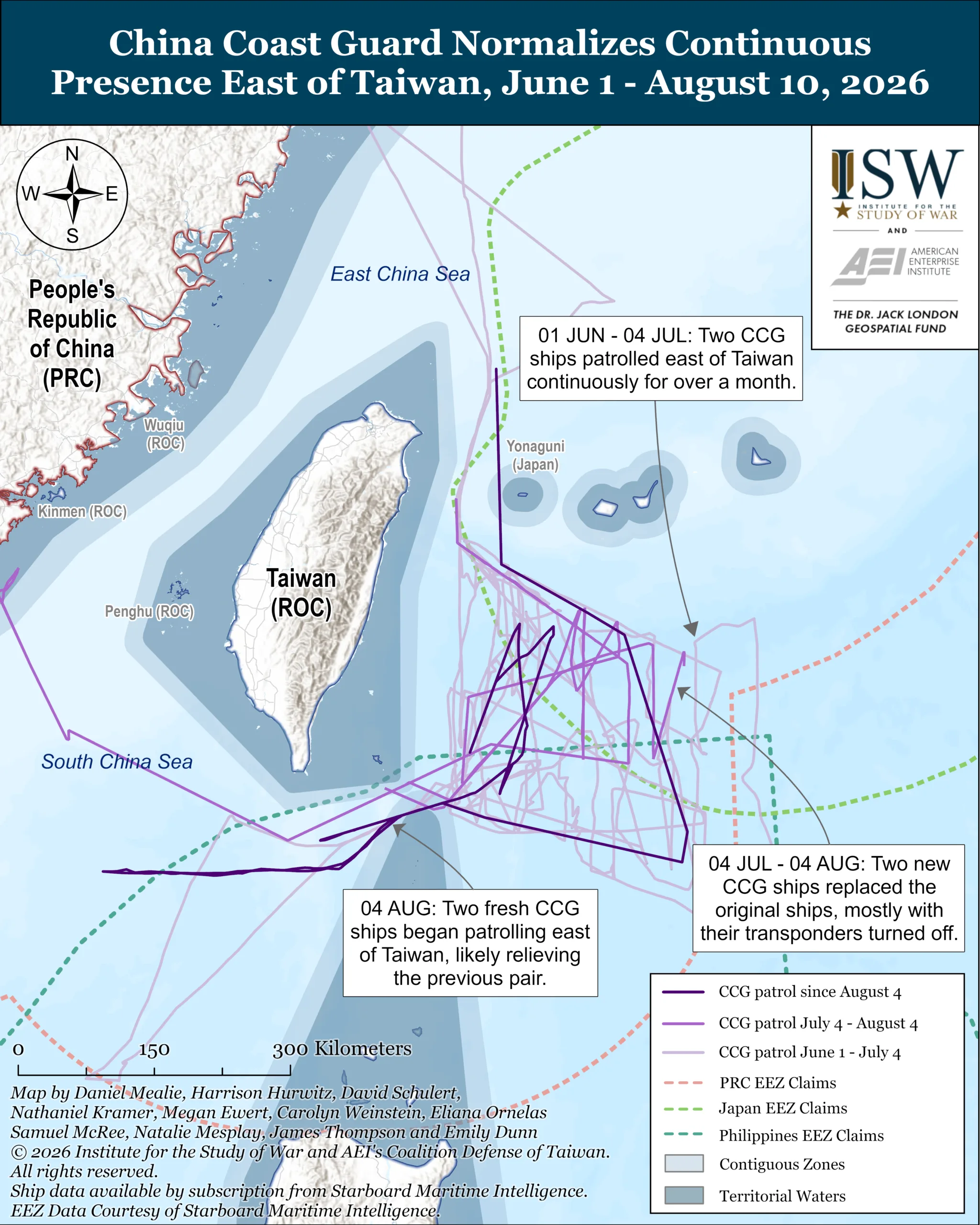
The People’s Republic of China (PRC) has very likely established a permanent “law enforcement” presence and regularized scientific surveys in the waters east of Taiwan. The PRC deployed two China Coast Guard (CCG) ships to patrol the PRC’s claimed Exclusive Economic Zone (EEZ) east of Taiwan on June 1.[1] The ships patrolled for over a month in a wide area extending approximately 200 nautical miles east of Taiwanese territory before being relieved by a new pair of CCG ships on July 4.[2] This marked the first time the PRC maintained continuous CCG patrols east of Taiwan, as opposed to infrequent short-duration operations. Ship-tracking data from Starboard Maritime Intelligence shows that the original CCG ships kept their Automatic Identification Systems (AIS) on throughout the entire patrol, making their paths easily trackable. The replacement CCG ships have mostly kept their AIS off since July 5, however, except for a brief period on July 12 and 13. ISW-CDOT therefore cannot prove that the ships remained east of Taiwan since arriving on July 4, but assesses that they likely continued the patrol in that area. Starboard data shows that a fresh pair of CCG ships appears to have arrived and begun patrolling on August 4, exactly one month after the first rotation.
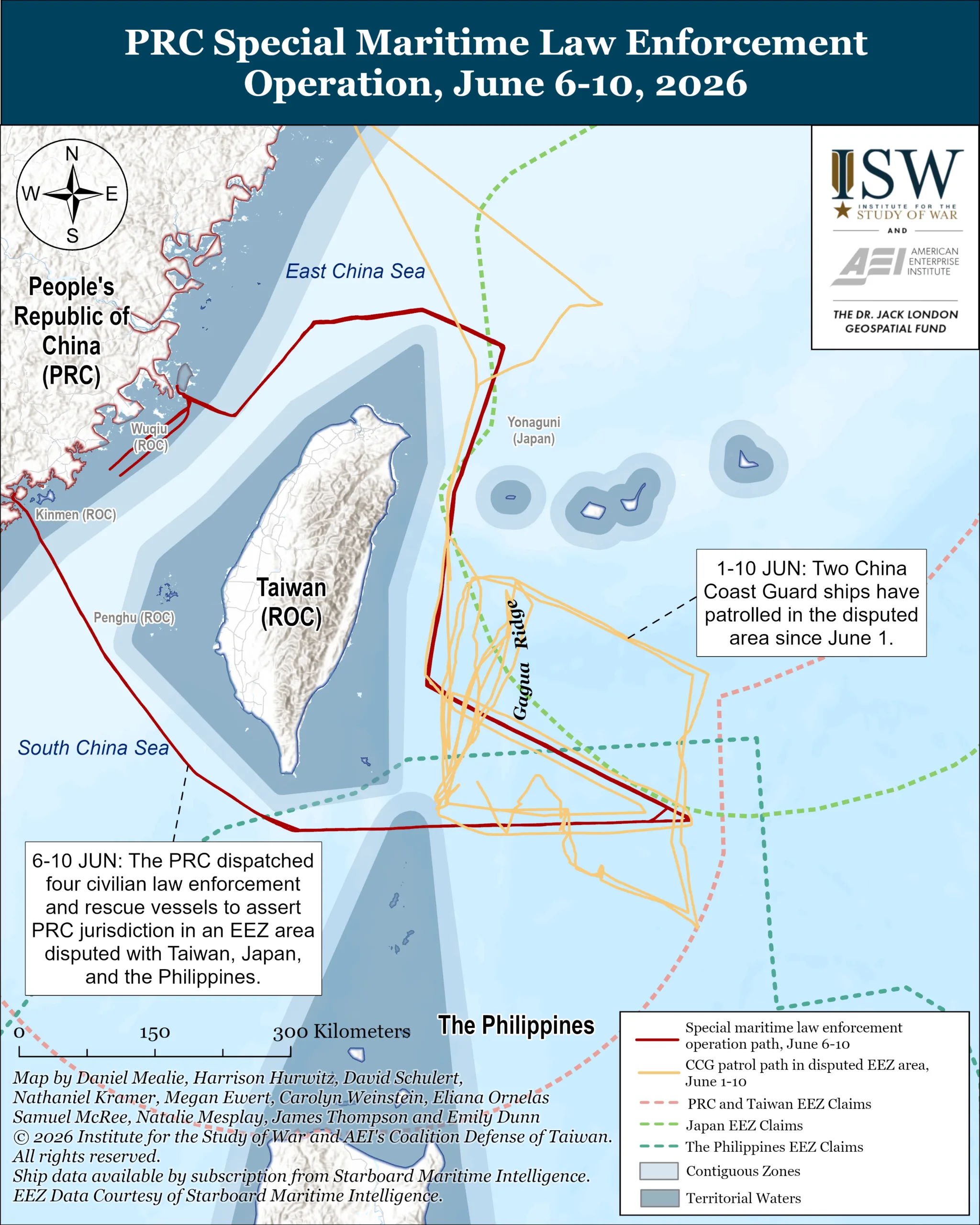
The PRC Ministry of Transportation deployed four civilian law enforcement ships on a special “law enforcement” operation to the waters east of Taiwan from June 6 to 10, under escort by the CCG ships.[3] The law enforcement ships hailed passing foreign cargo vessels and requested identity, origin, and destination information from at least three of them as a form of “traffic control,” according to both Taiwanese and PRC government sources.[4] PRC state media claimed the ships carried out 198 checks on passing vessels and “corrected violations” by three vessels — likely referring to the same three vessels that the ships contacted by radio.[5]
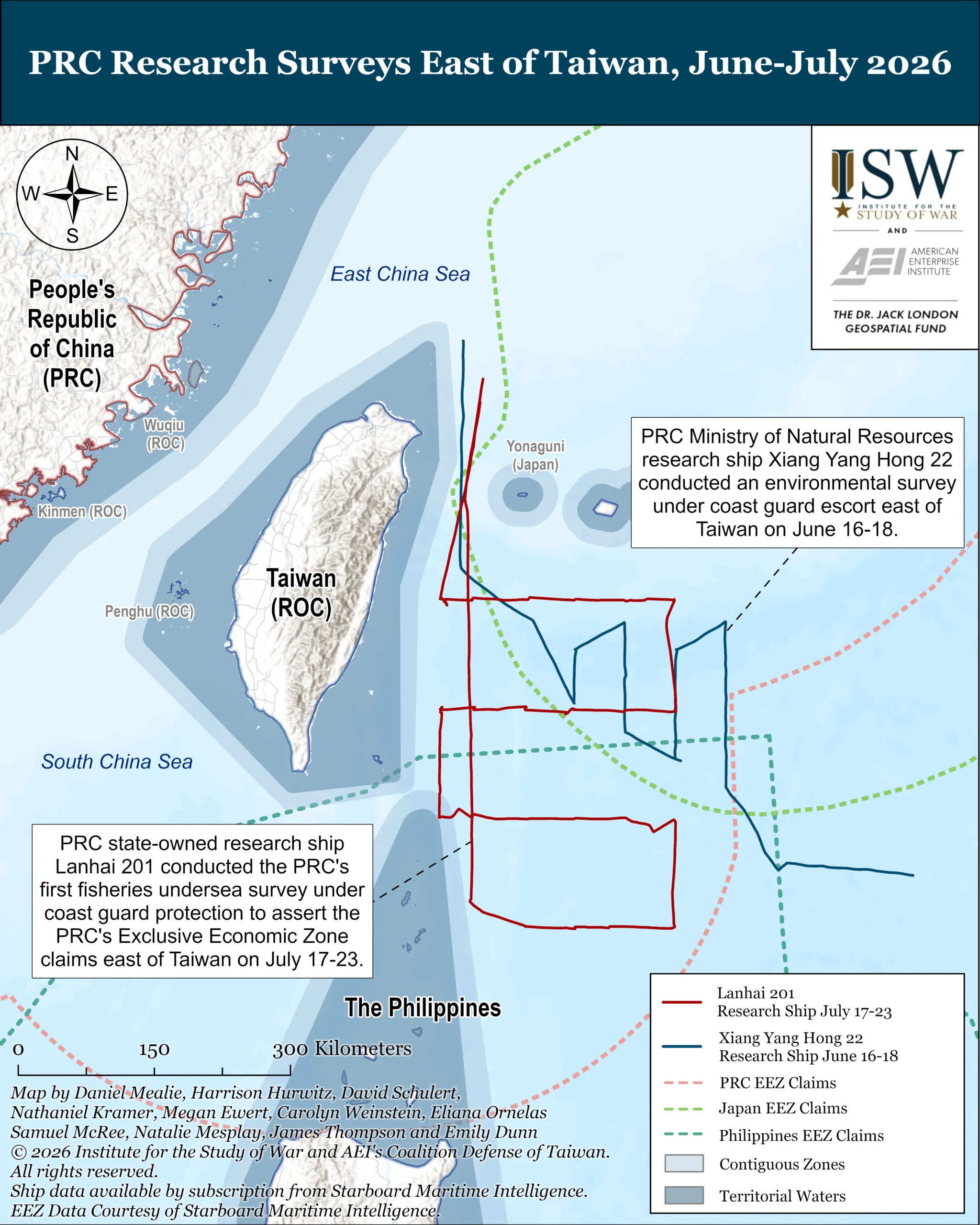
The PRC Ministry of Natural Resources (MNR) deployed the state-owned research ship Xiang Yang Hong 22 for a “marine survey” in the waters east of Taiwan under CCG escort from June 16-18.[6] The MNR implied in a statement that it would authorize more such surveys in the future.[7] PRC state social media account Yuyuan Tantian cited unnamed “experts” on June 20 who said that the PRC may begin to do regular undersea resource surveys and eventually extract resources and even build infrastructure east of Taiwan.[8] The PRC Ministry of Agriculture and Rural Affairs’ East China Sea Fisheries Research Institute (ECSFRI) deployed another research ship, Lanhai 201, to conduct a weeklong “fisheries” survey in the EEZ east of Taiwan from July 17 to July 23, also under CCG protection.[9] ECSFRI Deputy Director Zheng Hanfeng said that the institute will lead “regular, long-term monitoring and surveys in the years ahead.”[10]
The People’s Liberation Army Navy (PLAN) and state media further bolstered the PRC’s maritime expansionist campaign by publicizing a combined “naval navigation exercise” with an Indonesian navy ship east of Taiwan on August 12.[11] PLAN guided-missile frigate Honghe and Indonesian Navy frigate KRI I Gusti Ngurah Rai practiced maritime communication and replenishment at sea but did not drill any combat capabilities.[12] An Indonesian navy spokesperson downplayed the exercise by stating that the Indonesian ship was conducting several such “routine” passing exercises with the PRC, Japan, and the United States as it sailed back from exercises with Russia.[13] PRC state-owned tabloid Global Times highlighted the exercise’s significance, however, reporting that it was the first time the PLAN and a foreign navy had conducted combined exercises in the EEZ extending east of Taiwan, demonstrating the PRC’s “sovereign rights and jurisdiction” over the EEZ.[14] Taiwan’s Mainland Affairs Council (MAC) called the exercise a “military provocation,” while an unnamed Taiwanese senior security official said that the PRC was deliberately exaggerating the significance of a normal passing exercise.[15]
The PRC will likely continue coast guard patrols, law enforcement missions, military drills, and scientific surveys in the area to assert its jurisdiction, prevent rival states from making use of those waters, and pre-position assets for future military operations.
The PRC claims that its patrol activities east of Taiwan are a response to transgressions by Japan and the Philippines, which agreed to talks to delimit their EEZ boundaries without consulting the PRC. Beijing’s reaction is likely because its exclusion from the delimitation talks could imply that Japan and the Philippines do not recognize the PRC’s claim to Taiwan. Japanese Prime Minister Takaichi Sanae and Philippine President Ferdinand Marcos, Jr., agreed on May 28 to begin talks to delimit the boundary between their claimed EEZs, which currently overlap in the area east of Taiwan where the PRC is patrolling.[16] PRC officials condemned Japan and the Philippines for “unilaterally” initiating the delimitation talks and “seriously infringing upon China’s maritime rights,” as Beijing asserts an EEZ in the same area based on its claim to Taiwan.[17] Japan and the Philippines’ One China Policies (like the US One China Policy) are deliberately ambiguous about whether they consider Taiwan to be part of the PRC. Both policies state that the government “fully understands and respects” the PRC’s position that Taiwan is part of PRC territory.[18] Japan and the Philippines lack formal diplomatic relations with Taiwan and did not directly consult with Taiwan prior to agreeing to delimitation talks. Japanese Chief Cabinet Secretary Kihara Minoru insisted that Japan-Philippines bilateral delimitation talks would not be legally binding on any third parties, and Taiwanese President William Lai Ching-te made the same point to dismiss concerns that Japan and the Philippines were encroaching on Taiwan’s rights.[19]
The CCG’s continuous patrols east of Taiwan resemble the CCG’s prior behavior during territorial disputes with countries other than Taiwan, rather than typical CCG coercion against Taiwan. The PRC may attempt to restrict other countries’ economic, scientific, and military activities east of Taiwan. The CCG has escalated coercion around Taiwan in recent years, including conducting periodic incursions into Taiwan-administered waters around Taiwan’s outlying Kinmen and Pratas islands.[20] The PRC has not previously maintained round-the-clock patrols around Taiwan or Taiwanese territories, however. The PRC has conducted continuous coast guard patrols since 2012 around the Japan-administered and PRC-claimed Senkaku Islands, by contrast, including patrols within the 24-nautical mile contiguous zone around the islands nearly every day of 2025.[21] The PRC also used CCG ships to seize control of the disputed Scarborough Shoal from the Philippines in 2012 and now maintains a permanent CCG, PLAN, and maritime militia presence around the shoal to block access to Philippine vessels.[22]
The PRC conducts continuous patrols around the uninhabited Senkaku Islands and Scarborough Shoal to prevent rival claimants from making use of the islands. The CCG is likely seeking to accomplish the same goal in the waters east of Taiwan. The CCG’s patrols have successfully prevented military use of the Senkaku Islands and Scarborough Shoal, such as by placing radar or missile systems there, and have also blocked most non-fishing economic activity around those features. Taiwan’s outlying islands are already fully controlled and occupied by the Taiwanese military, by contrast, and some have substantial civilian populations. The CCG has not attempted to stop Taiwan from conducting military or economic activities on and around those islands. The PRC very likely would be unable to seize those islands from Taiwan using only nonviolent patrols unless it implements a quarantine or blockade at risk of violent escalation. The PRC instead has carried out periodic incursions around the islands to challenge Taiwan’s control of the surrounding waters, test Taiwan’s response, and practice maneuvers for a future blockade or quarantine at a time when it feels prepared to take on the risk of war.
PRC propaganda about its activities east of Taiwan has focused on portraying Beijing as the only government willing and able to defend Taiwan’s rights against foreign challengers, such as Japan and the Philippines. A Taiwan Affairs Office (TAO) spokesperson accused Taiwan’s ruling Democratic Progressive Party (DPP) on June 17 of “groveling and betrayal of national interests in the face of serious infringements by Japan and the Philippines,” while defending the PRC’s actions as necessary in response to the alleged “serious infringements.”[23] PRC state media portrayed both the PRC’s “traffic control” and survey activities as an exercise of the PRC’s claimed exclusive rights in the Taiwanese EEZ.[24] Yuyuan Tantian wrote that the special “law enforcement” operations and the environmental surveys show that the PRC is applying a “nearshore governance model” to the waters east of Taiwan, functionally treating those waters — rather than the Taiwan Strait — as the new eastern boundary of PRC “domestic” administration.[25] PRC state-owned tabloid Global Times cited a Shanghai Ocean University professor who said that the PRC’s scientific surveys counter Japanese and Philippine territorial claims because international law requires countries to provide advance notice and secure approval before conducting resource surveys in another country’s EEZ.[26] Global Times also reported that two CCG vessels “protected” the Lanhai 201 fisheries survey ship from an approaching Japanese coast guard ship, while also noting that military aircraft from a “certain country” — likely the United States — circled overhead.[27]
The PRC’s maritime expansionism east of Taiwan is very likely part of a multi-year campaign to erode Taiwan’s customary maritime rights, rather than an unplanned reaction to Japanese and Philippine delimitation talks. Ships from most countries have de facto respected Taiwan’s administrative rights in Taiwan’s claimed territorial waters, contiguous zone, and EEZ even if those countries do not have diplomatic relations with Taiwan. Areas where Taiwan’s EEZ claim overlaps with the EEZ claims of other countries, such as Japan and the Philippines, are the main exception to this trend. The PRC likewise has respected most of Taiwan’s maritime boundaries despite claiming Taiwan as a province of the PRC. PRC naval, coast guard, law enforcement, and survey vessels almost always avoid crossing into Taiwan’s contiguous zone or territorial waters when sailing around Taiwan, even though PRC officials routinely deny that Taiwan has any maritime boundaries separate from the PRC.
The new CCG presence and other PRC activity east of Taiwan are the latest stage of the PRC’s campaign to erode Taiwan’s customary jurisdiction in Taiwanese waters, however. The CCG’s periodic patrols into the contiguous waters of Taiwan’s Kinmen and Pratas Islands since 2024 broke the precedent of Beijing tacitly respecting Taiwan’s law enforcement jurisdiction in those waters. The Guangdong Maritime Safety Administration (MSA) declared temporary traffic controls between August 6 and 9, 2026, in a part of the Taiwan Strait that includes Taiwanese and international waters.[28] The PRC state-owned China National Offshore Oil Corporation (CNOOC) has operated 12 oil rigs in Taiwan’s EEZ near Pratas Island since at least May 2020, and in 2026 installed a floating wind turbine near the same area.[29] The PRC has also carried out extensive marine surveys within Taiwan’s de facto EEZ south and west of Taiwan since at least 2020, according to ship tracking data from Starboard. PRC fishing and commercial activities in general have regularly operated in Taiwan’s de facto EEZ without Taiwan’s authorization, though Taiwan still expels PRC fishing boats from its territorial and contiguous waters. The PRC coast guard, law enforcement, and survey operations east of Taiwan are the latest in multiple PRC lines of effort to squeeze Taiwan from all sides. The United Nations Convention on the Law of the Sea (UNCLOS) grants countries the exclusive right to manage, survey, and exploit undersea resources in their EEZ, but Taiwan has very limited recourse to advocate for its rights on the international stage.[30] Taiwan is not a member of the United Nations (UN), most countries and international organizations do not formally recognize Taiwan as a sovereign nation, and Taiwan’s maritime boundaries are not enshrined in international treaties or international legal judgments. The extent to which the PRC succeeds in restricting Taiwan’s maritime rights depends on the willingness of the PRC to forcibly restrict Taiwanese and other countries’ activities in these waters, therefore, and the willingness of other countries to comply with the PRC’s expanded jurisdictional claims around Taiwan.
The PRC may be testing the willingness of foreign commercial vessels to accept its supposed jurisdiction east of Taiwan as it calibrates its plans for a future quarantine or blockade. The PRC’s “law enforcement” activities east of Taiwan may test how passing foreign commercial ships respond to Beijing’s assertion of authority and various “law enforcement” tactics. Commercial vessels that respond to PRC law enforcement communications in disputed waters, answer questions, or even comply with PRC boarding and inspection under minimal pressure during peacetime could also comply with a PRC-imposed blockade or quarantine of Taiwan, under threat of force. Shipping companies are likely to be very risk-averse and to comply with whatever authorities they perceive as having de facto control of the waters they are transiting, or else avoid the area altogether.
The PRC can likely deter a lot of commercial traffic around Taiwan simply by declaring no-sailing zones in relevant areas, as it has done during recent blockade exercises.[31] Cargo ships would likely stay away to avoid being attacked or detained, especially if the United States and other military powers are unwilling to provide protective escorts. Any risk of conflict in the region would also inflate shipping insurance rates, which would amplify commercial incentives to avoid the area.
A permanent PRC law enforcement presence east of Taiwan can make future PRC blockade or quarantine around Taiwan more abrupt and effective. The expanded CCG presence east of Taiwan is the latest development in a trend of increased CCG activity on all sides of Taiwan, including patrols around the Kinmen and Pratas Islands, the Senkaku Islands, and the South China Sea. CCG ships also took part in the People’s Liberation Army (PLA) encirclement exercises around Taiwan in 2024 and 2025, coordinating with the PLAN.[32] Beijing has also increased the PLAN’s permanent presence around Taiwan in recent years. The Wall Street Journal reported on June 19 that the number of PLAN ships regularly stationed around Taiwan rose from one in 2020 to five or six in 2026.[33]
Pre-positioning CCG, PLAN, and other government ships on all sides of Taiwan can constantly make it easier for the PRC to launch a blockade or quarantine on short notice. The ships continuously patrolling around Taiwan can strengthen the capabilities they will need to execute a blockade or quarantine, including traffic-control operations, long-term deployment, and at-sea refueling. The PRC would very likely have to form a tighter perimeter around Taiwan in a real blockade or quarantine than its ships are currently doing, however. PRC ships that intend to interdict seaborne traffic to and from Taiwanese ports will very likely have to station themselves within Taiwan’s 24-nautical mile contiguous zone or even closer, rather than far out in the EEZ. A tighter encirclement would allow the PRC to more effectively block sailing paths to and from Taiwanese ports, while also allowing Beijing to portray its operations as legal under international law. International maritime law does not permit countries to block transit or enforce customs laws in their EEZ but does permit such operations in the relevant country’s contiguous zone or territorial waters.[34] The PRC already argues that it has sole legitimate authority over Taiwan and Taiwan’s adjacent waters, a position that many countries and international organizations accept.
The PRC aims to control waters and chokepoints east of Taiwan as well as disrupt coordination and coalition-building between Japan and the Philippines, which are US treaty allies that together control most of the territory of the first island chain. The EEZs of Japan, the Philippines, and Taiwan overlap in an area that is partially bounded by the Batanes Islands, the Ryukyu Islands, and Taiwan itself, making it an exit point of many important waterways through the first island chain including the Luzon Strait and the Miyako Strait. The PRC must secure its own ability to transit these sea lanes while blocking Taiwan’s partners from using them to aid or defend Taiwan. Controlling the sea east of Taiwan would also allow the PRC to prevent US and allied forces from reinforcing Taiwan and block possible escape routes by Taiwanese leaders through eastern ports such as Hualien.[35]
PRC research ships have intensified undersea research east of Taiwan in recent years to support submarine navigation and detection.[36] These activities have included the aforementioned Xiang Yang Hong 22 and Lanhai 201 survey operations, periodic surveys on both sides of the Luzon Strait, and continuous recent operations over Gagua Ridge, an undersea mountain range in the sea east of Taiwan and the Philippines.[37] The PRC can use research ships to enhance its undersea warfare capabilities and domain awareness through activities such as seabed mapping, ecological surveys, hydrographic surveys, placement of undersea sensors and navigation beacons, launching of unmanned underwater vehicles (UUVs), and installation of undersea weapons.[38]
The CCG’s patrols east of Taiwan are the first instance of the PRC permanently extending its territorial enforcement beyond the first island chain. The PRC may be laying the informational groundwork to widen this “breach” of the first island chain to include the Philippines’ Batanes Islands and Japan’s Ryukyu Islands, which would theoretically grant Beijing control of all major waterways between itself and the Pacific Ocean. The Batanes and Ryukyu Islands are the territories from which the Philippines and Japan derive their EEZ claims east of Taiwan. PRC universities and state media have promoted historical narratives about the past independence of the Ryukyu Islands during periods of diplomatic tension with Japan.[39] The PRC has amplified the grievances of Ryukyu natives against the Japanese government and US military presence on their islands while implying that Japan’s sovereignty over the island chain may be illegitimate.[40] The PRC resumed this informational campaign most recently following Japanese Prime Minister Takaichi’s comments in November 2025 that Japan may militarily intervene in a PRC invasion of Taiwan.[41] PRC authoritative and semi-authoritative sources typically do not explicitly claim the Ryukyus as PRC territory, but still note that the independent Ryukyu Kingdom was a Chinese tributary state under the Ming and Qing Dynasties before it was annexed by Japan.[42]
The PRC may be experimenting with a similar narrative to undermine Philippine sovereignty over the Batanes Islands, the archipelago that spans the Luzon Strait. PRC state media amplified a symposium at Jinan University in June 2026 which concluded that the Philippines’ Batanes Islands are historically associated with Taiwan and thus rightly belong to the PRC.[43] The scholars argued that the Philippine borders as delineated by the US-Spain Treaty of Paris in 1898 did not include the northern Batanes. This PRC narrative selectively ignores the 1900 Treaty of Washington, however, which the United States and Spain signed to correct errors in the 1898 treaty’s defined boundaries and clarified that Philippine territory includes anything that Spain controlled within the archipelago, including the Batanes.[44] PRC officials declined to comment on the scholars’ conclusions, likely indicating that Beijing is not prepared to officially dispute Philippine sovereignty over the Batanes but simultaneously does not wish to dispel the false narrative about PRC sovereignty over the islands.[45]
The PRC is unlikely to attempt to seize the Ryukyus or Batanes directly in the near term because any attack on Japanese or Philippine territory could trigger war with the United States. The PRC may be setting informational conditions to justify expanded maritime activity in Japanese or Philippine waters around the archipelagos, however. The PRC already disputes the EEZs that the Ryukyus and Batanes generate for their respective countries east of Taiwan. Any efforts to further contest the archipelagos could strengthen the PRC’s anti-access/area-denial capabilities in the region and its ability to freely sail past the first island chain. The PRC may strike these islands during a war over Taiwan to prevent the United States and its allies from using them for military operations and may use pre-established information campaigns to justify its actions. Philippine Defense Secretary Gilberto Teodoro said on July 25 that any PRC action against Taiwan “will involve the northern Philippines to challenge our hold over the Bashi Channel,” referring to the portion of the Luzon Strait between the Batanes and Taiwan.[46]
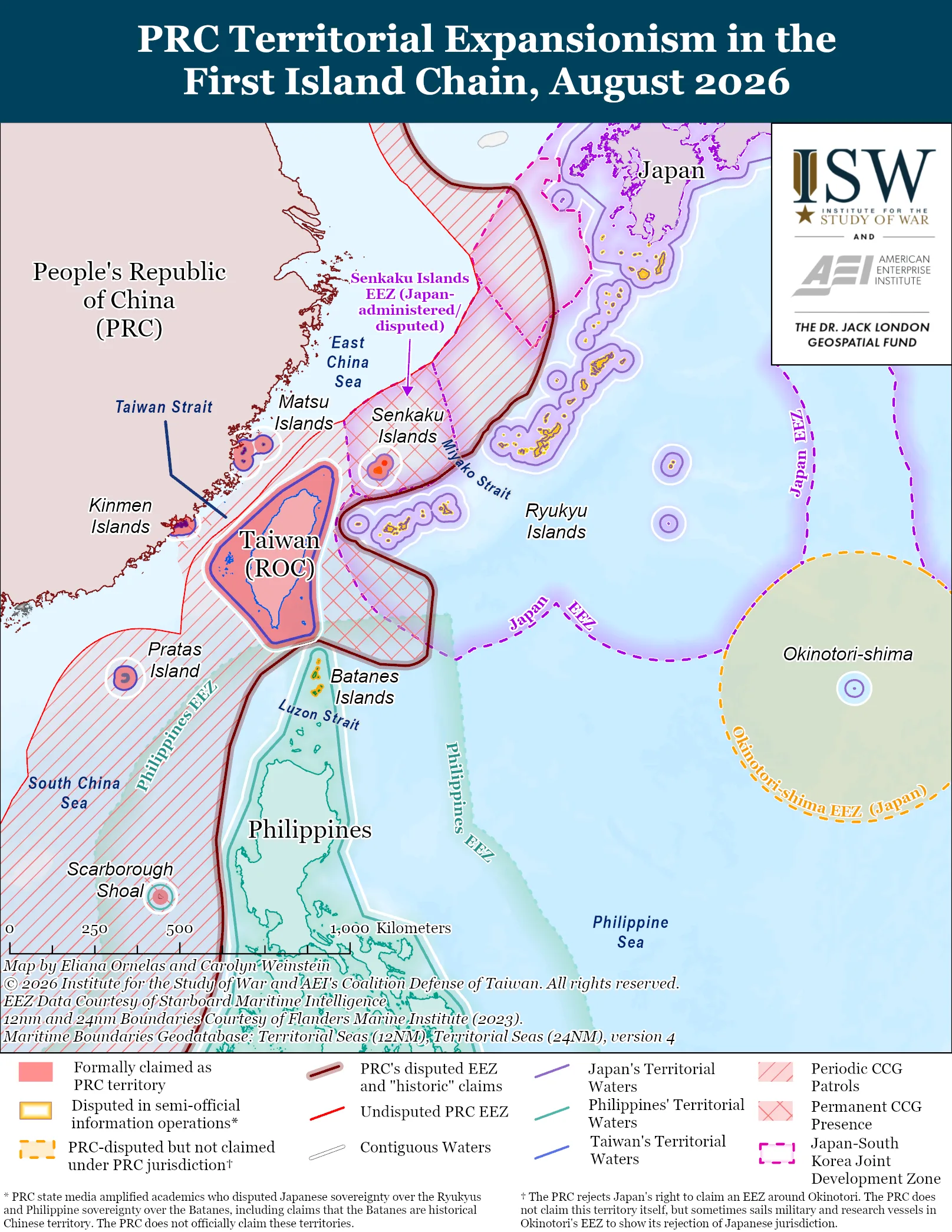
The CCG’s normalized permanent patrols east of Taiwan are part of a long-term PRC strategy to encircle Taiwan and break through the first island chain. The PRC is challenging territorial jurisdiction around Taiwan and neighboring island states, through means short of war, to set favorable conditions for military action. Maximally asserting PRC jurisdiction, challenging neighboring states’ jurisdiction, and expanding PRC sea and air presence around Taiwan will enhance the PRC’s ability to position military assets around Taiwan that it can use to attack or blockade Taiwan and to detect and block foreign intervention. Taiwan can work with its partners to stop the PRC campaign from securing long-term military and legal advantages for Beijing using some of the following means:
- Advise Taiwanese and foreign vessels not to comply with PRC “law enforcement” in the disputed waters. Pass legislation and regulations to forbid vessels from complying with expansionist PRC “law enforcement,” when possible.
- Unofficially establish a working arrangement between Taiwan, Japan, and the Philippines to prevent conflict among themselves and jointly counter PRC expansionism.
- Collaborate on coast guard and other law enforcement patrols with the United States and other nations within the PRC’s claimed EEZ to directly challenge the PRC’s claims.
- Use various sea, undersea, ground, air, and space-based reconnaissance tools to track PRC operations east of Taiwan. Detection methods can include submarines and unmanned underwater vehicles (UUVs), ship-based radar and sonar, buoys equipped with sensors, satellite imagery, AIS tracking, reconnaissance flights by manned and unmanned aircraft, and human surveillance on boats. Human surveillance can include not only official law enforcement personnel, but also civilians on commercial and fishing boats who can be deputized to conduct surveillance or simply compensated for any reports they voluntarily submit about PRC activities near their location.
- Find and covertly remove or sabotage sensors, submarine navigation beacons, and other devices that the PRC places underwater east of Taiwan.
- Reinforce undersea communications cables that the PRC may try to sabotage.
- File arbitration petitions and lawsuits with international bodies, such as the UN, to challenge PRC actions. These filings must be done by nations other than Taiwan, because Taiwan lacks representation in the UN and most other international organizations.
- Publicize PRC gray zone activities east of Taiwan, including confrontations with non-PRC ships in the region. Propagate the (accurate) narrative that these activities represent PRC expansionism into foreign waters.
- Publicize the above efforts to the Taiwanese public to counter the PRC-backed narrative that Taiwan is unwilling to defend its waters.

[1] http://www.mod.gov dot cn/gfbw/qwfb/yw_214049/16464756.html ; https://understandingwar.org/research/china-taiwan/china-taiwan-update-june-5-2026/
[2] https://understandingwar.org/research/china-taiwan/china-taiwan-update-july-10-2026/
[3] https://understandingwar.org/research/china-taiwan/china-taiwan-update-june-12-2026/
[4] https://www.cga.gov dot tw/GipOpen/wSite/ct?xItem=168164&ctNode=650&mp=999 ; https://www.news dot cn/tw/20260610/1e17a67b473c45da969affe36a260c53/c.html ; https://www.globaltimes dot cn/page/202606/1363243.shtml
[5] https://www.globaltimes dot cn/page/202606/1363243.shtml
[6] https://understandingwar.org/research/china-taiwan/china-taiwan-update-june-18-2026/ ; https://www.news dot cn/tw/20260618/49703711800e407c8b1f6ffe4837b8f2/c.html
[7] https://understandingwar.org/research/china-taiwan/china-taiwan-update-june-18-2026/ ; https://www.news dot cn/tw/20260618/49703711800e407c8b1f6ffe4837b8f2/c.html
[8] https://www.thepaper dot cn/newsDetail_forward_33420119
[9] https://www.globaltimes dot cn/page/202607/1366630.shtml ; https://focustaiwan dot tw/politics/202607230023 ; https://www.globaltimes dot cn/page/202607/1366777.shtml
[10] https://www.globaltimes dot cn/page/202607/1366854.shtml
[11] http://eng.mod.gov dot cn/2025xb/N/T/16479065.html ; http://www.mod.gov dot cn/gfbw/qwfb/16479045.html
[12] https://www.reuters.com/world/china/taiwan-condemns-dangerous-planned-chinese-navy-drill-with-indonesia-its-east-2026-08-12 ; https://english.news dot cn/20260812/023dc236538f4487bbc6578c85cf684a/c.html ; http://www.81 dot cn/yw_208727/16479246.html
[13] https://www.reuters.com/world/china/taiwan-condemns-dangerous-planned-chinese-navy-drill-with-indonesia-its-east-2026-08-12/
[14] https://www.globaltimes dot cn/page/202608/1368067.shtml
[15] https://www.reuters.com/world/china/taiwan-condemns-dangerous-planned-chinese-navy-drill-with-indonesia-its-east-2026-08-12/
[16] https://www.mofa.go.jp/files/101035755.pdf ; https://understandingwar.org/research/china-taiwan/china-taiwan-update-june-5-2026/
[17] https://www.fmprc.gov dot cn/fyrbt_673021/202605/t20260529_11921244.shtml
[18] https://www.mofa.go.jp/region/asia-paci/china/joint72.html ; https://www.csis.org/programs/international-security-program/isp-archives/asia-division/policy-and-perspectives ; https://ph.china-embassy.gov dot cn/eng/zfgx/zzgx/200011/t20001115_1336097.htm ; https://www.pna.gov dot ph/articles/1257594
[19] https://www.reuters.com/world/china/taiwan-says-japan-philippines-must-respect-its-rights-maritime-border-talks-2026-06-03/ ; https://focustaiwan dot tw/politics/202606180022
[20] https://understandingwar.org/research/china-taiwan/china-taiwan-weekly-update-july-21-2025/
[21] https://thediplomat.com/2026/01/china-coast-guard-presence-near-senkaku-diaoyu-islands-reaches-record-high-in-2025/ ; https://www.mofa.go.jp/region/page23e_000021.html
[22] https://amti.csis.org/counter-co-scarborough-standoff/ ; https://amti.csis.org/occupational-risk-chinese-presence-surges-at-scarborough-shoal/
[23] https://www.gwytb.gov dot cn/xwdt/xwfb/xwfbh/202606/t20260617_12771495.htm
[24] https://www.globaltimes dot cn/page/202607/1366630.shtml
[25] https://news.cctv dot com/2026/06/15/ARTITmYEwWndFmR2cFe0m6tQ260615.shtml ; https://news.cctv dot com/2026/06/19/ARTI7YTqyqZOfzQSfVZNdSiD260619.shtml ; https://understandingwar.org/research/china-taiwan/china-taiwan-update-june-26-2026/
[26] https://www.un.org/depts/los/convention_agreements/texts/unclos/part13.htm ; http://globaltimes dot cn/page/202607/1366630.shtml
[27] https://www.globaltimes dot cn/page/202607/1366749.shtml
[28] https://understandingwar.org/research/china-taiwan/china-taiwan-update-august-14-2026/
[29] https://jamestown.org/rigging-the-game-prc-oil-structures-encroach-on-taiwans-pratas-island/ ; https://jamestown.org/wind-turbine-among-new-structures-in-taiwans-eez/
[30] https://www.un.org/depts/los/convention_agreements/texts/unclos/part5.htm
[31] https://understandingwar.org/research/china-taiwan/china-taiwan-special-report-december-31-2025/
[32] https://understandingwar.org/research/china-taiwan/china-taiwan-weekly-update-may-24-2024/ ; https://understandingwar.org/research/china-taiwan/china-taiwan-weekly-update-october-18/ ; https://understandingwar.org/research/china-taiwan/china-taiwan-weekly-update-april-4-2025/ ; https://understandingwar.org/research/china-taiwan/china-taiwan-special-report-december-31-2025/
[33] https://www.wsj.com/world/china/how-chinas-navy-is-tightening-the-noose-on-taiwan-7c8ab9bd
[34] https://www.un.org/depts/los/convention_agreements/texts/unclos/part5.htm ; https://www.un.org/depts/los/convention_agreements/texts/unclos/unclos_e.pdf
[35] https://understandingwar.org/research/china-taiwan/china-taiwan-special-report-december-31-2025/ ; https://understandingwar.org/research/china-taiwan/china-taiwan-weekly-update-may-24-2024/
[36] https://understandingwar.org/research/china-taiwan/china-taiwan-update-june-12-2026/ ; https://understandingwar.org/research/china-taiwan/china-taiwan-weekly-update-august-29-2025/ ; https://understandingwar.org/research/china-taiwan/china-taiwan-weekly-update-july-21-2025/ ; https://understandingwar.org/research/china-taiwan/china-taiwan-weekly-update-may-9-2025/
[37] https://understandingwar.org/research/china-taiwan/china-taiwan-update-june-12-2026/
[38] https://www.reuters.com/investigations/china-is-mapping-ocean-floor-it-prepares-submarine-warfare-with-us-2026-03-24/
[39] https://understandingwar.org/research/china-taiwan/china-taiwan-update-november-25-2025/
[40] https://www.aspistrategist.org.au/when-china-japan-disputes-arise-beijing-plays-the-ryukyus-card/
[41] https://understandingwar.org/research/china-taiwan/china-taiwan-update-november-25-2025/
[42] https://www.chinadaily.com dot cn/a/202512/02/WS692e1edca310d6866eb2c592.html ; https://visitokinawajapan.com/discover/overview-okinawa-history/
[43] https://www.globaltimes dot cn/page/202607/1365585.shtml
[44] https://x.com/jaytaryela/status/1891604043879088271
[45] https://www.japantimes.co.jp/news/2026/07/11/asia-pacific/philippines-china-sovereignty-claims-batanes/
[46] https://www.taiwannews.com dot tw/news/6408688


