
Toplines
Taiwan’s National Chung-Shan Institute of Science and Technology (NCSIST) revealed details of a hypersonic missile interceptor that could be central to the proposed T-Dome air defense concept. Taiwan’s legislative gridlock has delayed and obstructed Taiwan’s development of advanced air defenses. NCSIST, a state-owned corporation that serves as Taiwan’s primary military research and development hub, disclosed the specifications of the Chiang Kung (Strong Bow) interceptor on August 22.[1] NCSIST said the Chiang Kung, also known as the Tien Kung IV (Sky Bow IV), would use a land-based mobile vertical launch system to fire interceptor missiles at up to hypersonic speeds to intercept ballistic missiles at “mid-level” altitudes — up to 70 km, according to an unnamed defense official, which is a major improvement on the Tien Kung III missile’s maximum altitude of 45 km.[2] Each launcher can hold four missiles at a time. The missile will use a two-stage solid-fuel rocket to propel the warhead and thrust-vector control to maneuver it at high altitudes.[3] The Chiang Kung system includes a mobile active electronically scanned array radar vehicle co-developed by Taiwan and the United States, which can classify, track, and engage multiple tactical ballistic missiles while being resistant to electronic jamming.[4]
The Chiang Kung will form the outermost layer of the multilayered T-Dome integrated air and missile defense (IAMD) concept, which Taiwanese President William Lai Ching-te proposed in October 2025.[5] Taiwan’s Ministry of National Defense (MND) plans to build two Chiang Kung systems with at least 128 missiles on a proposed budget of $1.13 billion.[6] The T-Dome will also include Tien Kung III and Patriot Advanced Capability-3 (PAC-3) missiles.[7] The Chiang Kung could improve Taiwan’s interception capacity and speed and reduce Taiwan’s vulnerability to the People’s Liberation Army (PLA) missile strikes. Indigenous production of the Chiang Kung system will reduce Taiwan’s dependence on procurements and technical assistance from the United States.
Taiwan’s legislative gridlock remains a major obstacle to Taiwan actualizing the T-Dome concept. Taiwan’s Cabinet initially proposed funding for Chiang Kung missile production as part of its 2026 special defense budget, but the final budget bill that passed in May excluded funding for the missile and other domestically produced systems.[8]
Taiwan’s Keelung District Prosecutors Office announced indictments for nine individuals, which included one Nvidia employee and two Super Micro employees, for smuggling Super Micro advanced artificial intelligence (AI) servers containing high-end Nvidia chips to the People’s Republic of China (PRC) in violation of US export control regulations.[9] Prosecutors alleged that the defendants attempted to claim that the 130 B300 Super Micro servers were for a rented server facility in Taiwan, even though the proposed facility lacked sufficient rack space, power, and bandwidth to use the servers.[10] Taiwanese prosecutors accused a senior Nvidia manager, surnamed Chang, of being the “core figure” responsible for the smuggling.[11] Prosecutors alleged that Chang assured managers that on-site inspections had cleared to facilitate approval for the server sale.[12] Prosecutors alleged that the defendants falsified information about the servers’ end users, other uses, and other information to resell them to PRC buyers, sometimes using triangulation shipment methods through Indonesia, Japan, and Hong Kong.[13] Taiwanese customs managed to intercept 56 of the servers, while the other 74 successfully reached PRC customers.[14] The statutory maximum for server-export offenses under Taiwanese law is five years, and prosecutors requested this sentence for four individuals, including senior Nvidia manager Chang.[15]
The indictment follows multiple rounds of investigation. The US Department of Justice unsealed an indictment on March 19 that charged three Super Micro employees for diverting advanced servers to the PRC, including a co-founder and a Taiwan office manager.[16] Taiwanese authorities searched the Taiwanese offices of US firm Super Micro, Super Micro’s Taiwanese distributor Albatron, and data center operator Chief Telecom on June 29 and were investigating six individuals at that time.[17]
US export controls aim to cut off PRC access to advanced chips due to national security concerns. The Nvidia B300 is Nvidia’s most powerful and advanced graphics processing unit (GPU) designed for AI training and inference and is significantly more powerful than the H200 chip that the US has allowed PRC firms to purchase.[18] These export controls have constrained PRC AI development. PLA official newspaper PLA Daily frequently argues that AI is an essential technology for future warfare, with applications ranging from drone swarm capabilities to precision long-range strikes.[19]
Recent PLA discussions of contemporary and future warfare illustrate select lessons learned from the war in Ukraine, including the rapid innovation cycle and importance of legacy systems in modern conflict. The PLA likely continues to view the war in Ukraine as a transitory phase of modern warfare, however, which will give way to “intelligentized” warfare dominated by AI and drone swarm technology. PLA official newspaper PLA Daily published a series of commentaries that demonstrated how select lessons learned from the war in Ukraine are being discussed within the PLA, with a particular emphasis placed on the speed of the innovation cycle in modern combat that will force the PLA to alter its procurement structure to react faster to battlefield changes.[20] A PLA Daily article from August 19 argued that the war in Ukraine demonstrates how battlefield tactics are driving technological development in a new era of warfare.[21] The article focused on how battlefield data rapidly informed the iteration of unmanned systems technology as tactical dynamics changed rapidly on the frontline.[22] An August 16 PLA Daily article similarly discussed the importance of the widespread use of low-cost unmanned systems on the Ukrainian battlefield, describing such systems as the “spear” of modern conflict.[23] Another PLA Daily commentary urged commanders to learn how to integrate legacy platforms into new methods of war, stating that the war in Ukraine has shown that decades-old systems can still be effective on modern battlefields.[24]
Other recent PLA Daily commentaries reflected the PLA’s belief that modern conflict will gradually shift toward a new kind of warfare that centers information technology over physical equipment. An August 19 PLA Daily article argued, for instance, that future AI-enabled drone swarms will revolutionize traditional firepower strike complexes, allowing for total battlefield transparency and extremely rapid precision kill chains.[25] An August 12 PLA Daily article similarly argued that AI will revolutionize long-range reconnaissance, long-range strike, and drone swarm capabilities, reshaping basic battlefield dynamics as they currently exist.[26] An August 13 PLA Daily article clarified these changes, claiming that the modern “war of attrition” would eventually give way to “dissipative warfare.”[27] In dissipative warfare, the center of gravity is an enemy’s operational system rather than their physical equipment and warfighting formations.[28] Dissipative warfare aims to use information superiority, which AI superiority helps create, to prevent an enemy from fighting as a coherent whole.[29]
The PLA’s discussion of the war in Ukraine and the future of warfare suggests that it is preparing for a conflict of a significantly different character while extracting certain tactical lessons from the war in Ukraine. The PLA likely does not view the Ukraine War as an instantiation of dissipative war, as neither Russia nor Ukraine has demonstrated significant AI-enabled swarming technology and algorithm-centric battlefield dynamics, although the role of AI in the war is expanding significantly.[30] This is consistent with ISW-CDOT’s assessment that the PLA likely views the war in Ukraine as a temporary, imperfect phase of future war — or dissipative war — that will only yield certain useful lessons for the war the PLA intends to fight.[31] The lessons that the PLA does extract from contemporary wars, such as the pace of innovation displayed in Ukraine, will likely be shaped by the PLA’s overarching conclusions on the direction of future warfare and the role of emerging technologies. These discussions could suggest that elements of the PLA believe its long-standing conclusions on the informatization and intelligentization of war have largely been confirmed, which could in turn limit the amount of structural and doctrinal change that PLA observations from Ukraine yield.
Key Takeaways
- Taiwanese Military Development: Taiwan’s National Chung-Shan Institute of Science and Technology (NCSIST) disclosed details of the Chiang Kung hypersonic missile interceptor on August 22. The Chiang Kung would form the outermost layer of Taiwan’s proposed T-Dome integrated air and missile defense (IAMD) concept and reduce Taiwan’s vulnerability to the People’s Liberation Army (PLA) missile strikes.
- AI Chip Smuggling: Taiwanese prosecutors announced they were charging nine individuals, including one Nvidia employee and two Super Micro Employees, for smuggling advanced AI servers containing high-end chips to the People’s Republic of China (PRC) in violation of US export controls. US export controls aim to cut off PRC access to advanced chips due to national security concerns presented by PRC integration of AI into its military systems.
- PLA Discussions of the Ukraine War: PLA Daily published a series of commentaries discussing how lessons from the war in Ukraine will drive technological development in a new era of warfare. The commentaries indicate that a portion of PRC military analysts likely view the war in Ukraine as a transitory period of modern warfare that will give way to “intelligentized” warfare.
Cross-Strait Relations
Taiwan
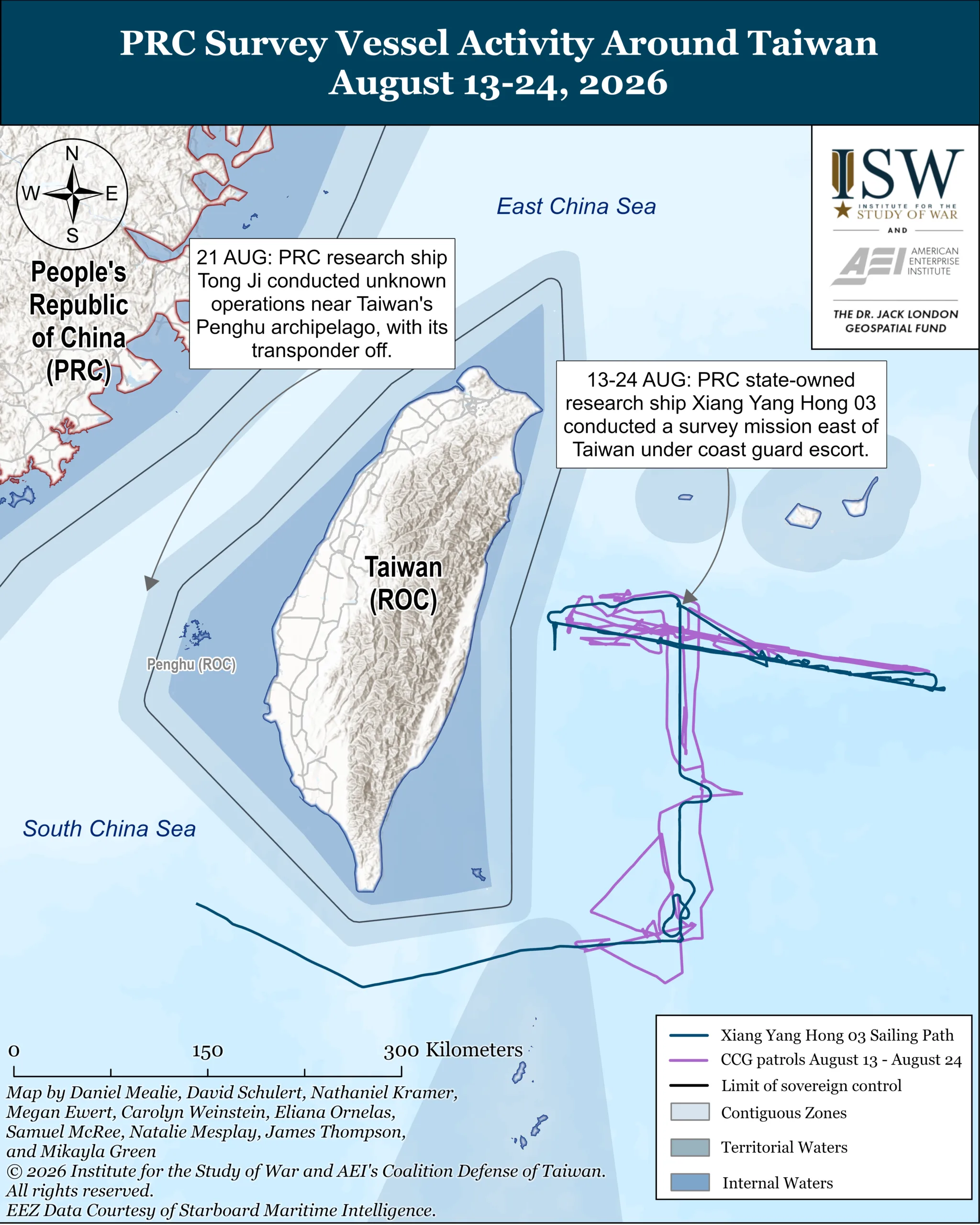
The PRC is continuing to conduct research vessel operations around Taiwan, likely to erode Taiwan’s sovereignty and enhance PRC undersea warfare. Taiwan’s Coast Guard Administration (CGA) encountered PRC research ship Tong Ji 0.3 nautical miles outside of Taiwan’s contiguous zone northwest of Penghu on August 20 and southwest of Taiwan on August 21, sailing southeast.[32] Penghu is a Taiwanese offshore island group and the site of a major Taiwanese naval base. Ship-tracking data from Starboard Maritime Intelligence shows Tong Ji was in port in Xiamen, PRC on August 18 but turned off its Automatic Identification System (AIS) around the time of its encounter with the CGA, indicating that Tong Ji was attempting to conduct its operations covertly. The CGA did not see Tong Ji drop any equipment into the waters around Penghu. Tong Ji circumnavigated Taiwan and dropped equipment in waters southeast of Taiwan in May, however.[33] Tong Ji, commissioned in 2025, has a variety of sensors and acoustic equipment and can deploy unmanned underwater vehicles (UUVs) and unmanned surface vehicles (USVs).[34]
Starboard data also showed that PRC Ministry of Natural Resources research ship Xiang Yang Hong 03 surveyed waters east of Taiwan while under China Coast Guard (CCG) escort since August 13. Xiang Yang Hong 03 repeatedly sailed east to west from the edge of Taiwan’s contiguous zone near Hualien County to around 155 nautical miles east of Taiwan. The CCG has maintained permanent patrols in Taiwan’s Exclusive Economic Zone (EEZ) up to 200 nautical miles east of Taiwan since June. The CCG’s activity may be in response to Japan and the Philippines agreeing to delimit their overlapping EEZs without consulting Beijing. Japanese, Philippine, PRC, and Taiwanese EEZ claims overlap in that maritime region, with the PRC drawing its claims based on its claim to Taiwanese territory. The PRC also conducted two other CCG-escorted state-sponsored research missions in the waters east of Taiwan since June.[35] PRC government agencies and state media announced the earlier two surveys but did not announce the Xiang Yang Hong 03‘s mission, possibly because the PRC intends to normalize such activities without broadcasting them.
The PRC is expanding and normalizing survey, law enforcement, coast guard, and military operations around Taiwan to assert its claimed jurisdiction, erode Taiwan’s resources and threat awareness, collect data to support submarine navigation and detection, and possibly pre-position equipment underwater that can aid in future PRC military operations against Taiwan.
The PRC is limiting or delaying shipments to Taiwan of germanium- and quartz-based materials used in optical, semiconductor, and aerospace applications. Nikkei Asia quoted an industry executive and other anonymous sources on August 20 who stated that materials including the two critical minerals were having trouble passing through PRC customs, and that PRC authorities had questioned PRC suppliers of the materials on their customers and shipments.[36] Nikkei Asia further reported that permanent magnets, including neodymium permanent magnets used in aerospace industries and advanced robotics, are facing similar challenges without cost-effective alternatives. [37] Nikkei Asia quoted a Taiwanese chip equipment executive who stated that the strict quality and precision standards for quartz in the chip industry mean that Taiwan does not have an alternative source for the mineral outside the PRC. Delayed PRC shipments of these critical minerals are causing months-long delays and revenue loss for chip equipment makers.[38] The largest known high-purity quartz deposits are in the United States. Recently discovered quartz deposits in the PRC are mainly used by PRC chipmakers.[39] Taiwan received only 0.14 percent of US quartz exports in 2024, valued at $113,000, leaving room for US quartz exports to Taiwan to increase if PRC export controls continue to strain Taiwanese quartz supplies.[40] Quartz is a critical material for a number of high-tech supply chains, including the production of optical components and semiconductor manufacturing.[41]
PRC limits or delays of germanium-based material exports will likely impact Taiwanese critical and emerging technology production even more than limits on quartz-based materials exports. The PRC is currently the largest global supplier of germanium. The PRC controlled an estimated 60 percent of global germanium supply and processing from 2024 to 2025.[42] Germanium is a key material used in a variety of defense and industrial applications, including producing thermal images, fiber optics production, and photonics.[43] The PRC enacted export controls on US purchases of germanium in July 2023, significantly reducing US germanium imports.[44]
A U.S. Navy P-8A Poseidon anti-submarine patrol aircraft transited the Taiwan Strait in international airspace on August 21. The US 7th Fleet stated that the transit demonstrated the United States’ commitment to a free and open Indo-Pacific.[45] The PRC-based tabloid Global Times reported on August 21 that a PLA source stated that the PLA had been tracking and monitoring the US aircraft throughout the transit.[46] Taiwan News reported that the aircraft took off from Okinawa, Japan, and flew at 6,400 meters.[47] The US Navy P-8A Poseidon anti-submarine patrol aircraft last transited the Taiwan Strait on March 11, making this the second US aerial transit of 2026. This transit follows the January 16 to 17 naval transits through the Taiwan Strait by the US guided missile destroyer USS John Finn and survey ship USNS Mary Sears.[48] The US conducts freedom of navigation exercises in the Taiwan Strait to counter PRC claims to Taiwanese waters and support international legal principles which allow states to sail through international waters without interference.[49]
China
See toplines.
Northeast Asia
South Korea
The PRC allegedly pressured South Korea to exclude two South Korean lawmakers who visited Taiwan earlier in 2026 from a planned delegation to Beijing. South Korea announced on August 20 that a delegation of 15 South Korean lawmakers was to travel to Beijing for four days to attend a robotics conference and meet with senior PRC officials. South Korea ultimately canceled the trip, citing a variety of issues including flight scheduling problems.[50] An unnamed South Korean National Assembly official revealed on August 20 that the PRC Embassy requested the exclusion of ruling Democratic Party lawmaker Kwak Sang-eon and opposition People Power Party lawmaker Kim Gi-hyeon, who had met with Taiwanese Deputy Foreign Minister Wu Chih-chung and Taiwanese Foreign Minister Lin Chia-lung, respectively, earlier in 2026.[51] Kwak accused Beijing of interfering in the official legislative duties of South Korean lawmakers.[52] Kim denounced the PRC Embassy’s demands on August 21 as “an act of disrespect toward South Korea and its National Assembly.”[53] The PRC Embassy in Seoul declined to comment on the matter.[54] South Korean media outlet Chosun Ilbo reported that in 2004 Beijing similarly denied visas to South Korean lawmakers attending the inauguration of former Taiwanese President Chen Shui-bian, before reversing the decision after facing formal protests from Seoul.[55]
The PRC’s demand to exclude the two lawmakers revealed its intent to ensure that states comply with the “One China” principle and to indirectly signal PRC dissatisfaction with Seoul’s informal ties with Taipei. Beijing has consistently placed economic, political, or military pressure on states that send delegations to Taiwan, likely because such delegations indirectly acknowledge Taiwanese sovereignty.[56] The PRC Embassy in Seoul’s recent intervention aligned with the PRC’s broader strategy to diplomatically isolate Taiwan.
Southeast Asia
Philippines
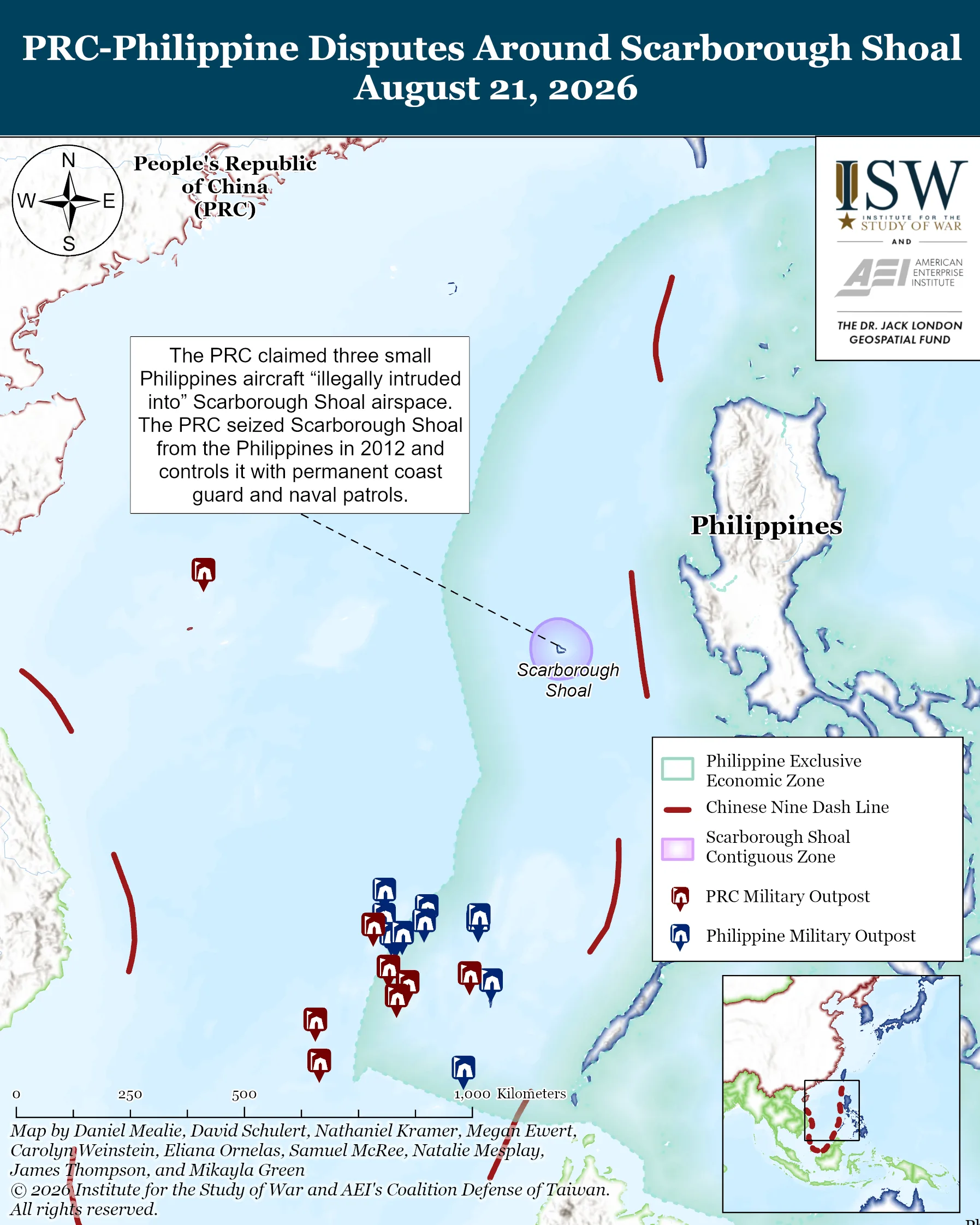
The PRC continues to assert sovereignty over the Scarborough Shoal, announcing on August 21 that three small Philippine aircraft “illegally intruded” into airspace over the shoal without PRC government permission. PLA Southern Theater Command (STC) Spokesperson Air Force Senior Colonel Li Jianjian stated that the STC organized naval and air forces to track, monitor, and issue warnings in response, and called the Philippines’ acts “provocative.”[57] The PRC claims the Scarborough Shoal as its territory despite the shoal’s location within the Philippine EEZ. The PRC seized the Scarborough Shoal from the Philippines in 2012 and gradually expanded patrols and legal measures to establish jurisdiction of the shoal. The PRC established a nature reserve on part of the Scarborough Shoal in September 2025 and used the reserve as a justification for expanding measures prohibiting unauthorized foreign activity around the Scarborough Shoal earlier in August 2026.[58] PRC state-owned tabloid Global Times published an article on August 22 claiming that the Philippines organized “so-called ‘joint patrols’” with other countries, and that the PLA tracked and surveilled the activities.[59] The Philippines has not commented on these alleged patrols at time of writing and ISW-CDOT is unable to verify whether the patrols occurred.

[1] https://www.ncsist.org dot tw/csistdup/products/product.aspx?product_Id=601&catalog=28 ; https://www.taipeitimes dot com/News/taiwan/archives/2026/08/23/2003862977
[2] https://www.taipeitimes dot com/News/taiwan/archives/2026/08/23/2003862977 ; https://www.janes.com/defence-intelligence-insights/defence-news/defence/tadte-2023-ncsist-develops-enhanced-variants-of-sky-bow-iii-sam-system
[3] https://www.ncsist.org dot tw/csistdup/products/product.aspx?product_Id=601&catalog=28
[4] https://www.ncsist.org dot tw/csistdup/products/product.aspx?product_Id=601&catalog=28
[5] https://www.scmp dot com/news/china/military/article/3365082/taiwan-unveils-strong-bow-anti-ballistic-missile-specs-push-us113-billion-funding ; https://understandingwar.org/research/china-taiwan/china-taiwan-weekly-update-october-20-2025/ ; https://www.taipeitimes dot com/News/taiwan/archives/2026/08/23/2003862977
[6] https://www.taiwannews.com dot tw/news/6338219
[7] https://www.scmp dot com/news/china/military/article/3365082/taiwan-unveils-strong-bow-anti-ballistic-missile-specs-push-us113-billion-funding
[8] https://www.chinatimes dot com/realtimenews/20260824001409-260417?chdtv ; https://understandingwar.org/research/china-taiwan/china-taiwan-update-may-8-2026/
[9] https://www.reuters.com/world/asia-pacific/taiwan-indicts-9-over-alleged-illegal-export-ai-servers-china-2026-08-24/
[10] https://www.reuters.com/world/asia-pacific/taiwan-indicts-9-over-alleged-illegal-export-ai-servers-china-2026-08-24/; https://www.wsj.com/tech/taiwan-charges-nine-in-connection-with-smuggling-of-ai-servers-to-china-d1f72f47?msockid=1e7993fab93767f3158c86ebb8786616
[11] https://www.bloomberg.com/news/articles/2026-08-24/taiwan-indicts-nvidia-manager-following-chip-smuggling-probe
[12] https://www.wsj.com/tech/taiwan-charges-nine-in-connection-with-smuggling-of-ai-servers-to-china-d1f72f47?msockid=1e7993fab93767f3158c86ebb8786616
[13] https://www.taiwannews dot com.tw/news/6426981
[14] https://www.reuters.com/world/asia-pacific/taiwan-indicts-9-over-alleged-illegal-export-ai-servers-china-2026-08-24/
[15] https://www.taiwannews dot com.tw/news/6426981
[16] https://www.aei.org/commentary/china-taiwan-update-march-27-2026/
[17] https://understandingwar.org/research/china-taiwan/china-taiwan-update-july-10-2026/
[18] https://www.runpod.io/articles/guides/nvidia-b300; https://dev.to/digitalocean/nvidia-b300-blackwell-ultra-a-technical-deep-dive-5c6i
[19] http://www.81 dot cn/yw_208727/16480085.html;http://www.81 dot cn/yw_208727/16478926.html
[20] https://www.tandfonline.com/doi/abs/10.1080/01402390.2012.730484
[21] http://www.81 dot cn/yw_208727/16480086.html
[22] http://www.81 dot cn/yw_208727/16480086.html
[23] http://www.81 dot cn/yw_208727/16479628.html
[24] http://www.81 dot cn/yw_208727/16479121.html
[25] http://www.81 dot cn/yw_208727/16480085.html
[26] http://www.81 dot cn/yw_208727/16478926.html
[27] http://www.81 dot cn/yw_208727/16479121.html
[28] http://www.81 dot cn/yw_208727/16479121.html; https://cdotimes.com/2025/09/19/dissipative-warfare-the-plas-potential-new-strategy-in-the-ai-era-the-jamestown-foundation/
[29] http://www.81 dot cn/yw_208727/16479121.html; https://cdotimes.com/2025/09/19/dissipative-warfare-the-plas-potential-new-strategy-in-the-ai-era-the-jamestown-foundation/
[30] https://www.cnas.org/publications/commentary/roles-and-implications-of-ai-in-the-russian-ukrainian-conflict
[31] https://understandingwar.org/research/china-taiwan/lessons-learned-with-chinese-characteristics-understanding-the-limits-of-pla-efforts-to-adapt-to-contemporary-warfare/
[32] https://www.cga.gov dot tw/GipOpen/wSite/ct?xItem=168799&ctNode=650&mp=999
[33] https://www.cga.gov dot tw/GipOpen/wSite/ct?xItem=168799&ctNode=650&mp=999 ; https://understandingwar.org/research/china-taiwan/china-taiwan-update-may-15-2026/
[34] https://www.scmp dot com/news/china/diplomacy/article/3364922/mainland-chinese-research-ship-spotted-near-taiwans-largest-naval-base
[35] https://understandingwar.org/research/china-taiwan/china-taiwan-update-july-31-2026/ ; https://understandingwar.org/research/china-taiwan/china-taiwan-update-june-26-2026/
[36] https://asia.nikkei.com/spotlight/supply-chain/exclusive-china-slows-exports-of-key-optical-aerospace-metals-to-taiwan
[37] https://asia.nikkei.com/spotlight/supply-chain/exclusive-china-slows-exports-of-key-optical-aerospace-metals-to-taiwan
[38] https://asia.nikkei.com/spotlight/supply-chain/exclusive-china-slows-exports-of-key-optical-aerospace-metals-to-taiwan
[39] https://www.thinkbrg.com/insights/publications/when-the-chips-are-down-high-purity-quartz-and-the-hidden-geography-of-semiconductor-leverage/; https://interestingengineering.com/energy/china-identifies-high-purity-quartz-source
[40] https://oec.world/en/profile/bilateral-product/quartz/reporter/usa
[41] https://asia.nikkei.com/spotlight/supply-chain/exclusive-china-slows-exports-of-key-optical-aerospace-metals-to-taiwan
[42] https://theasiagroup.com/wp-content/uploads/2026/06/TAG-Spotlight-Industry-Risks-and-Responses-to-Chinas-Export-Controls-on-Critical-Minerals-and-Rare-Earths.pdf
[43] https://asia.nikkei.com/spotlight/supply-chain/exclusive-china-slows-exports-of-key-optical-aerospace-metals-to-taiwan; https://www.taiwannews.com dot tw/news/6425607
[44] https://www.stimson.org/2025/chinas-germanium-and-gallium-export-restrictions-consequences-for-the-united-states/
[45] https://www.reuters.com/world/china/us-navy-aircraft-transited-taiwan-strait-it-says-2026-08-22/
[46] https://www.globaltimes dot cn/page/202608/1368726.shtml
[47] https://www.taiwannews dot com.tw/news/6426158
[48] https://understandingwar.org/research/china-taiwan/china-taiwan-update-march-20-2026/; https://understandingwar.org/research/china-taiwan/china-taiwan-update-january-23-2026/
[49] https://2021-2025.state.gov/freedom-of-navigation-report-annual-release/; https://policy.defense.gov/Portals/11/Documents/FON/DoD%20FON%20Report%20for%20FY23.pdf?ver=Qri5K_yYFNOa0m5BluOvsQ%3d%3d
[50] https://www.chosun.com/politics/politics_general/2026/08/20/NL73WR7ITNF3FBQZHNXLZ7CCYE/
[51] https://www.chosun.com/politics/politics_general/2026/08/20/NL73WR7ITNF3FBQZHNXLZ7CCYE/
[52] https://www.chosun.com/politics/politics_general/2026/08/20/NL73WR7ITNF3FBQZHNXLZ7CCYE/
[53] https://www.news1.kr/diplomacy/defense-diplomacy/6265905; https://www.chosun.com/politics/politics_general/2026/08/20/NL73WR7ITNF3FBQZHNXLZ7CCYE/
[54] https://www.chosun.com/politics/politics_general/2026/08/20/NL73WR7ITNF3FBQZHNXLZ7CCYE/
[55] https://www.chosun.com/politics/politics_general/2026/08/20/NL73WR7ITNF3FBQZHNXLZ7CCYE/
[56] https://understandingwar.org/research/china-taiwan/china-taiwan-update-april-24-2026/; https://understandingwar.org/research/china-taiwan/china-taiwan-update-may-8-2026/
[57] https://www.peopleapp dot com/column/30052980649-500007661729; http://www.81 dot cn/fyr/16480591.html; https://www.reuters.com/world/china/china-says-it-drove-away-philippine-vessels-fresh-south-china-sea-incident-2026-07-23/
[58] https://understandingwar.org/research/china-taiwan/china-taiwan-update-august-7-2026/ ; https://understandingwar.org/research/china-taiwan/china-taiwan-weekly-update-september-15-2025/
[59] https://www.globaltimes dot cn/page/202608/1368751.shtml