
The Institute for the Study of War (ISW) and The Critical Threats Project (CTP) at the American Enterprise Institute are publishing updates Monday through Friday to provide analysis on the war with Iran. Most updates cover events from the past 24-hour period, whereas Monday updates also include events from the preceding weekend, collected after ISW-CTP’s 2:00 PM ET Friday data cutoff. ISW-CTP may publish special updates on Saturdays and Sundays if events warrant, however.
Key Takeaways
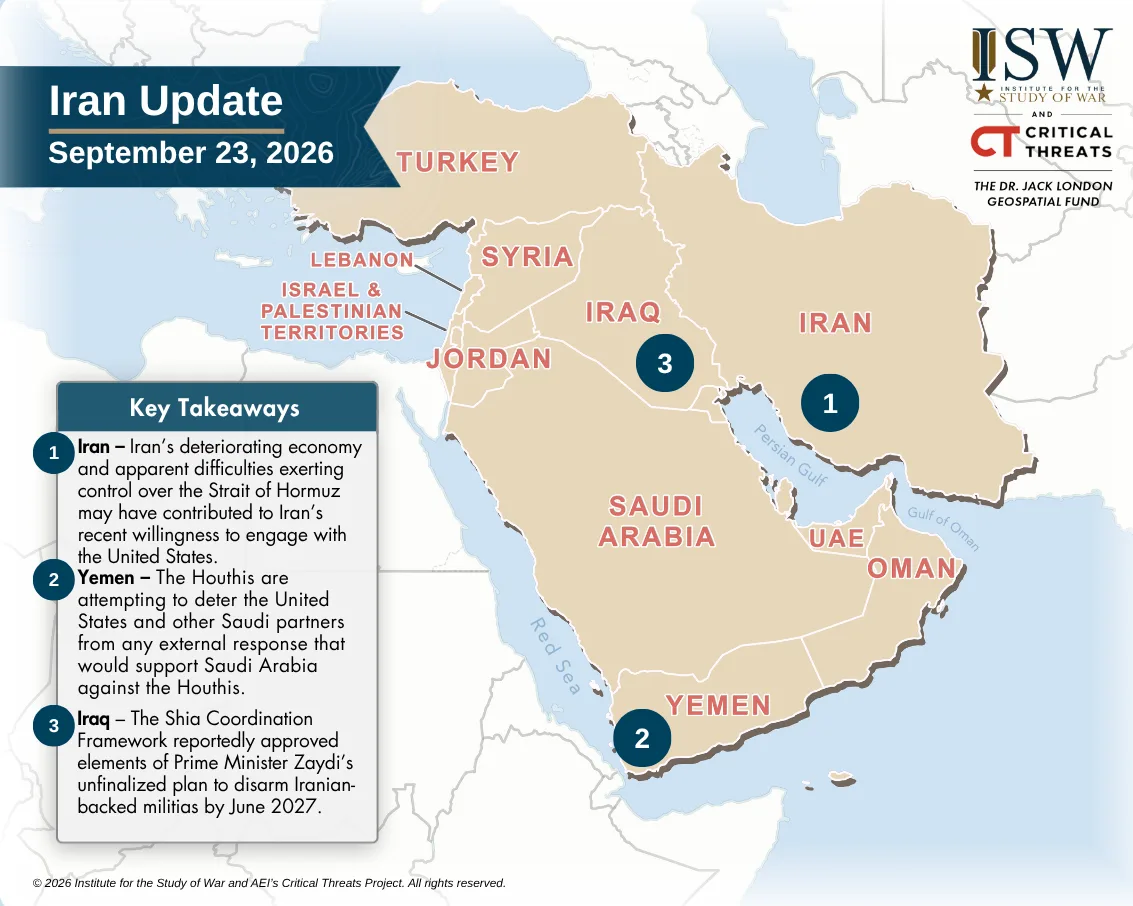
- Iran’s deteriorating economy and apparent difficulties exerting control over the Strait of Hormuz may have contributed to Iran’s recent willingness to engage with the United States. Iran’s renewed engagement with the United States does not indicate that the regime has softened its negotiating position or is willing to make meaningful concessions on core demands.
- The Houthis are attempting to deter the United States and other Saudi partners from any external response that would support Saudi Arabia against the Houthis.
- ISW-CTP is considering five possible Houthi military courses of action (COAs) that the group could take against the United States or other Saudi partners if these parties increase their military support for Saudi Arabia against the Houthis, including by providing defensive air support or conducting airstrikes on Houthi targets in Yemen. In a most likely COA (MLCOA), the Houthis expand their naval blockade against Saudi vessels to include vessels affiliated with the United States or other Saudi partners.
- The Shia Coordination Framework, which includes multiple Iranian-backed Iraqi actors, has reportedly approved some details of an unfinalized Iraqi government plan to disarm Iranian-backed Iraqi militias by June 2027. The Iraqi militias will almost certainly exploit certain provisions of Iraqi Prime Minister Ali al Zaydi’s plan to retain their arms.
- Iraq’s most prominent militias continue to condition disarmament on demands that the federal government is highly unlikely to meet, which indicates that they have no intention to disarm.
Toplines
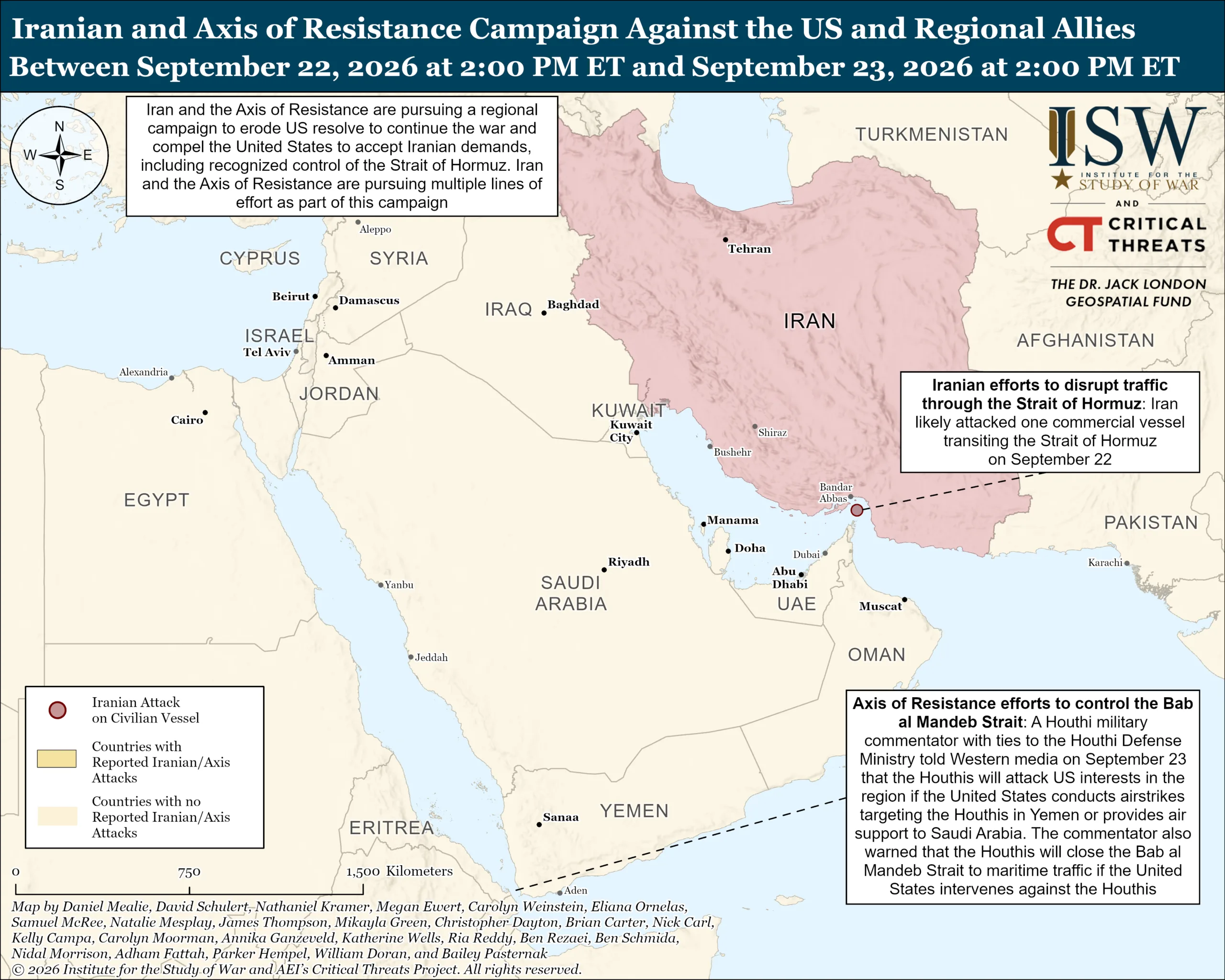
Iran’s deteriorating economy and apparent difficulties exerting control over the Strait of Hormuz may have contributed to Iran’s recent willingness to engage with the United States. US Special Envoy to the Middle East Steve Witkoff and Jared Kushner communicated indirectly with Iranian Foreign Affairs Minister Abbas Araghchi through Qatari mediators on the sidelines of the UN General Assembly (UNGA) in New York on September 22.[1] This indirect meeting is the first diplomatic engagement between US and Iranian officials since high-level talks in Burgenstock, Switzerland, on June 21, four days after both parties signed a memorandum of understanding (MoU) that ultimately collapsed a few weeks later.[2] The US-Iran indirect meeting took place several days after Iranian Supreme National Security Council (SNSC) Secretary Major General Mohsen Rezaei announced on September 19 that Iran had communicated seven conditions for beginning negotiations to the United States.[3] The regime’s state broadcasting network, Islamic Republic of Iran Broadcasting (IRIB), reported on September 22 that Iran accepted Witkoff’s request for the meeting in order to communicate Iran’s conditions for “reopening” the strait, which include lifting of the US naval blockade, the release of all frozen Iranian assets, and an end to the war across all fronts.[4] Iran has held these core demands since Spring 2026. The sequence of events suggests that Iran signaled its openness to engagement with the United States ahead of UNGA, but Iran’s willingness to engage the United States does not indicate that it is willing to make any meaningful concessions. The timing of this engagement is nevertheless notable given the mounting economic pressure on Iran.[5]
Iran’s worsening economic conditions are likely in part driving its renewed engagement with the United States. The US blockade on Iranian ports is preventing Iran from generating revenue from its illicit international oil trade.[6] Iran is facing a shortage of foreign currency reserves and access to US dollars, which is exacerbated by intensifying US economic pressure.[7] US sanctions have also targeted the Iranian regime’s other illicit channels and ability to move cash around.[8] US Treasury Secretary Scott Bessent warned on September 21, for example, that foreign companies providing fuel or other services to Iranian airlines would risk facing secondary sanctions.[9] Iraq subsequently suspended Iranian flights to Baghdad.[10] The United Arab Emirates (UAE), which has traditionally served as a hub for Iranian trade and illicit financing, has also started reducing economic ties with Iran as part of the United States and its allies’ economic pressure campaign. The UAE Central Bank barred Iranian Bank Melli branches from conducting transactions in the UAE on September 23, further restricting Iran’s access to regional financial networks.[11] Iranian officials who previously supported the MoU to obtain economic relief may view renewed diplomatic engagement with the United States as a means of securing further relief and preventing an economic collapse. Iranian officials, including President Masoud Pezeshkian, reportedly pressed Supreme Leader Mojtaba Khamenei to accept the previous US-Iran MoU in June because of the significant pressure that the US naval blockade was placing on the Iranian economy.[12] Pezeshkian and other “pro-concessions” figures, including Parliament Speaker Mohammad Bagher Ghalibaf, have warned in recent weeks that Iran‘s current deteriorating economic conditions are unsustainable.[13]
Iran’s diminishing ability to exert control over the Strait of Hormuz may also have motivated Iran’s willingness to engage with the United States.[14] Iran continues to pose a serious threat to commercial shipping, but the regime has appeared to be either unwilling or unable to enforce its control over the strait in recent weeks.[15] Increased commercial vessel transit levels indicate that Iran is having difficulty in preventing some commercial vessels from using the southern route, for example. Maritime data tracking firm Tanker Trackers reported on September 23 that approximately 13 million barrels of non-Iranian oil per day continued to pass through the strait despite the conflict and Iranian restrictions.[16] ISW-CTP has observed several indicators that suggest that Iranian forces are facing operational restraints that are limiting Iran’s ability to attack vessels and force them into Iranian routes.[17] The regime has also struggled to secure buy-in from the other Persian Gulf littoral states for Iranian diplomatic efforts to solidify Iranian management over the strait, as required under the MoU.[18] Iranian officials may view renewed negotiations as another opportunity to secure some formalization of its authority over the waterway. The June 2026 MoU’s language required Iran to reach an agreement with the Gulf states that Iran attempted to use to codify its own management over shipping lanes in the strait, for example.
Iran’s renewed engagement with the United States does not indicate that the regime has softened its negotiating position or is willing to make meaningful concessions. Rezaei stated on September 23 that Iran will neither formally negotiate nor “reopen” the strait until the United States first meets Iran’s conditions.[19] Iran’s claim that it would “reopen” the strait under a deal may refer to permitting greater commercial traffic under an Iranian-managed system rather than Iran’s relinquishing of its claimed authority over shipping. Iran’s indirect meeting with the United States also does not necessarily indicate that regime officials have overcome internal disagreements about how Iran should engage with the United States. These disagreements significantly complicated US efforts to negotiate with Iran in previous months. Iranian hardline actors have criticized Araghchi for participating in the UNGA meeting.[20] Islamic Revolutionary Guard Corps-affiliated (IRGC) Tasnim News Agency argued that intermediaries had already communicated Iran’s conditions, claimed that Iranian policy-making bodies opposed the contact, and demanded that Araghchi explain who authorized the meeting.[21] The backlash from hardliners is likely in part targeting a domestic Iranian audience.[22] Rezaei separately stated that he, Pezeshkian, and Araghchi jointly decided to communicate Iran’s conditions, which suggests that senior officials authorized the contact in some form.[23]
The Houthis are attempting to deter the United States and other Saudi partners from any external response that would support Saudi Arabia against the Houthis. A Houthi military commentator with ties to the Houthi Defense Ministry, Brigadier General Abed Mohammed al Thawr, told Agence France-Presse (AFP) on September 23 that the Houthis will attack US interests within Houthi projectile range if the United States conducts airstrikes targeting the Houthis in Yemen or provides air support to Saudi Arabia.[24] Houthi drones can range up to nearly 2,000 kilometers, as demonstrated in a July 2024 Houthi drone attack on Tel Aviv.[25] The commentator warned that the Houthis view their control of the Bab al Mandeb as a “red line” and that the group will fight to retain it, including by “completely” halting shipping if deemed necessary.[26] Thawr was a Houthi Brigadier General and member of the Houthi Defense Ministry as recently as August 2025 and has previously spoken to regional media on behalf of the Houthis.[27] Thawr now primarily acts as a military advisor and military commentator for Houthi media.[28] The Houthi warning to the United States is likely in response to recent Western reporting that the US President Donald Trump considered launching US airstrikes against Houthi targets in Yemen but decided to refrain “for the time being.”[29]
The Houthis have threatened Saudi Arabia’s international partners to isolate Saudi Arabia and prevent Saudi partners from forming a coalition against Houthi efforts in the Red Sea. The Houthis likely calculate that limiting international involvement improves conditions for the Houthis to secure their objectives, which include acquiring key economic concessions from Saudi Arabia and asserting Houthi authority over the Bab al Mandeb.[30] Houthi officials, including Houthi Supreme Leader Abdulmalik al Houthi, have warned Turkey and Pakistan against supporting Saudi Arabia, for example.[31] Pakistan and Turkey are parties to a mutual defense pact with Saudi Arabia.[32]
The Houthis have simultaneously pursued diplomatic efforts with the United States that are likely intended to prevent the United States or its partners from supporting or joining the Saudi offensive campaign against the Houthis. Houthi officials reportedly told US officials in Muscat on September 16 that the Houthis do not intend to target US vessels and remain committed to the May 2025 ceasefire.[33] Trump has also repeatedly stated that the United States is in contact with the Houthis and that the group continues to insist that they do not seek conflict with the United States.[34]
ISW-CTP is considering five possible Houthi military courses of action (COAs) that the group could take against the United States or other Saudi partners if these parties increase military support for Saudi Arabia. The Houthis have explicitly warned Saudi partners, including the United States, against intervening militarily against the Houthis, which could include striking Houthi targets in Yemen, increasing defensive air support for Saudi Arabia, or forming a coalition against Houthis efforts in the Red Sea. These COAs are not mutually exclusive, and the Houthis could pursue a combination of these COAs. The Houthis could also decide to progress through several of the below COAs to gradually increase pressure on the United States and other parties to compel these countries to end military support for Saudi Arabia against the Houthis.
- In a most likely course of action (MLCOA), the Houthis expand their naval blockade against Saudi vessels to include vessels affiliated with the United States or other Saudi partners. The Houthis previously expanded a limited campaign to disrupt Israeli shipping in the Red Sea in 2023-2025 by imposing wider parameters for vessels that “violated” the Houthi blockade.[35] The Houthis responded to US and UK airstrikes in Yemen in January 2024 by targeting US and UK-linked vessels as part of their campaign against international shipping.[36] The Houthis have enforced a blockade on Saudi vessel traffic through the Bab al Mandeb Strait since July 22 by attacking multiple Saudi and Saudi-affiliated vessels in the Red Sea and Bab al Mandeb.[37] The Houthis could expand this Saudi blockade to include vessels affiliated with the United States and other Saudi partners. The Houthis may further view direct US support for Saudi Arabia, such as strikes on Houthi targets in Yemen, as a violation of the May 2025 US-Houthi ceasefire and decide to renege upon the group’s previous pledge to refrain from targeting US vessels.[38]
- The Houthis’ new positions along the Red Sea coast — particularly on islands in and near the Bab al Mandeb — can facilitate Houthi attacks on Saudi partner-affiliated vessels, given that these positions enabled the Houthis to use a broader range of weapons systems to target shipping lanes.[39] The Houthis have historically employed a range of capabilities to threaten maritime traffic and disrupt shipping, including anti-ship ballistic missiles, unmanned surface vessels (USVs), and even hijacking commercial vessels.[40] The Houthis conducted these attacks while based in the Houthi-controlled Hudaydah Port, which is located nearly 250 kilometers north of the Bab al Mandeb Strait. The Houthis’ new positions enable them to deploy tactical drones, including short-range drones or hexacopter drones to attack and harass shipping from these new positions closer to the Bab al Mandeb Strait.[41] The Houthis’ new positions near the Bab al Mandeb, such as al Aradi, Lahij Governorate, also put them within artillery range of the shipping lanes in the Bab al Mandeb.[42]
- The Houthis attempt to halt international shipping through the Bab al Mandeb and “close” the strait to drive concessions from the United States and Saudi partners. Thawr warned that the Houthis could “completely” halt shipping if the group deems it necessary.[43] The Houthis continue to claim that the group only intends to target Saudi-linked vessels, but Houthi officials and Houthi-aligned individuals have increasingly asserted the Houthis’ authority over the strait in recent days.[44] The Houthis also appear to be attempting to set conditions to establish themselves as the legitimate authority and guarantor of passage through the Bab al Mandeb, including by preparing to deploy a Houthi “coast guard” to surveil the strait and by investigating the installation of maritime sensing capabilities in newly seized Houthi territory with support from the IRGC.[45] The Houthis have previously referenced the Iranian precedent for assuming control over international chokepoints as a means through which to drive concessions from an adversary or adversaries.[46]
- The Houthis launch attacks against US and Saudi partner naval vessels operating in the Red Sea. The Houthis repeatedly launched drones and missile attacks targeting US Navy vessels in the Red Sea in 2024.[47] The Houthis also deployed USVs against US Naval and commercial vessels in 2024.[48] The Houthis may expand attacks to US and Saudi partner naval vessels to deter greater military support for Saudi Arabia and assert control over the Bab al Mandeb, especially if the Houthis also attempt to halt commercial shipping through the strait.
- The Houthis conduct attacks targeting US and Saudi partner forces operating from Saudi territory. US servicemembers are currently stationed in Saudi Arabia to provide intelligence, targeting, and air defense support to Saudi Arabia.[49] The Houthis could increasingly and deliberately target Saudi bases where US and Saudi partner military forces are located and operating from, particularly in a scenario in which the United States stations and launches airstrikes against the Houthis from Saudi territory. Houthi military spokesperson Yahya Sarea regularly claims that the Houthis are able to track and locate Saudi military bases from which Saudi aircraft conduct airstrikes on Houthi targets in Yemen.[50] Other Saudi partners, such as the United Kingdom, provide defensive military support to Saudi Arabia in the wake of Iranian and Houthi attacks.[51] A Houthi projectile damaged an Italian Eurofighter Typhoon fighter jet during an attack targeting King Fahd Air Base in Taif, Saudi Arabia, on September 17.[52] It is unclear whether the Houthis intentionally targeted the aircraft. Houthi-affiliated media recently claimed on September 19 that the Houthis possess an extensive target bank of Saudi military sites.[53]
- The Houthis or other Axis of Resistance groups launch attacks on US military bases in Gulf states from positions in Iraq. Houthi forces in Iraq have increasingly coordinated with Iranian-backed Iraqi militias to launch coordinated attacks targeting Saudi Arabia in recent months.[54] The Houthis have also directly launched attacks from Iraq targeting Saudi oil infrastructure.[55] The Houthis could attack US military bases in neighboring countries surrounding Iraq, including other Gulf states, to increase the human and political costs for the United States and deter continued military support to the Saudi campaign against the Houthis in Yemen. Iranian-backed Iraqi militias have repeatedly attacked US military bases in Iraq and neighboring countries since the start of the US-Iran War in February 2026.[56]
The Shia Coordination Framework, which includes multiple Iranian-backed Iraqi actors, has reportedly approved some details of an unfinalized Iraqi government plan to disarm Iranian-backed Iraqi militias by June 2027. The Iraqi militias will almost certainly exploit certain provisions of Iraqi Prime Minister Ali al Zaydi’s plan to retain their arms. Zaydi recently outlined a two-phased plan to disarm the militias. Under the first phase, the Iraqi militias would agree to refrain from conducting attacks for 90 days and the United States would abstain from attacking the militias during this period.[57] The militias would then begin to hand over their weapons to the government under the second phase in a process that would end in June 2027.[58] It is unclear how the federal government would enforce any aspect of this plan, including preventing the militias from conducting attacks. Baghdad-based Iraqi sources revealed to Qatari-owned, UK-based media on September 22 that unspecified framework members and senior Iraqi Shia officials have approved previously unreported, additional details of Zaydi’s plan.[59] Zaydi and other framework members have said that the plan’s full details will be released on September 30, which is the date of the withdrawal of US-led coalition forces from Iraq and Zaydi’s previous deadline for militia disarmament.[60] The framework agreed to create a new directorate in the Popular Mobilization Forces’ (PMF) administrative body, the Popular Mobilization Commission, to receive militia weapons and determine storage and usage protocols for them under Iraqi federal government supervision.[61] Iranian-backed Iraqi militias and actors have already successfully infiltrated the PMF, which heightens the risk that the Iraqi militias will maintain access to their arms under the plan.[62] The Iraqi sources revealed to Qatari-owned, UK-based media that the plan provides immunity and the right to participate and run in Iraqi elections if militia members abstain from participating in attacks or forming new militias.[63] The Iraqi federal government is likely unable to enforce this stipulation given the covert nature of the militias. The Iraqi militias have also used facade groups to obfuscate their kinetic activity for decades.[64]
Iraq’s most prominent militias continue to condition disarmament on demands that the federal government is highly unlikely to meet, which indicates that they have no intention to disarm. The Iraqi sources speaking to Qatari-owned, UK-based media said that four unspecified Iraqi militias that have consistently refused to disarm agreed to the plan’s June 2027 deadline for disarmament, provided that the federal government met several demands.[65] The four militias’ demands included the complete withdrawal of US and Turkish forces from Iraq, Iraq’s acquisition of advanced air defense systems, and removal of Iranian anti-regime groups from Iraqi Kurdistan.[66] The Islamic Resistance of Iraq, which is an Iraqi militia coalition that includes Kataib Hezbollah, Harakat Hezbollah al Nujaba, and Kataib Sayyid al Shuhada, has previously listed many of these preconditions for disarmament, which suggests that the “four unspecified Iraqi militias” may include groups within the Islamic Resistance of Iraq.[67] The militias are likely including conditions that the federal government will struggle to implement in order to maintain a plausible basis on which to remain armed. Zaydi mentioned in a September 21 New York Times (NYT) interview that he “aim[s]” to integrate the four Iraqi militias who refuse to disarm as individuals within the PMF, likely referring to at least Kataib Hezbollah, Kataib Sayyid al Shuhada, and Harakat Hezbollah al Nujaba.[68] The premise of integrating these militias into the PMF as “individuals” suggests that Zaydi is concerned that the militias could attempt to exploit integration into the PMF, including through the process of reflagging former militias as new PMF units. Zaydi’s ability to integrate militias into the PMF as individuals, along with other options that Zaydi has considered to professionalize the PMF, depends upon militia willingness to comply with his plans in the absence of proper enforcement mechanisms from the Iraqi federal government.
Zaydi’s attempt to obtain US support for this plan is consistent with his continued efforts to balance between the United States and Iranian-backed Iraqi actors. The United States has applied intense economic pressure on the Iraqi federal government in recent months to disarm the militias, including by temporarily cutting off Iraq’s access to its oil revenue held in the New York Federal Reserve.[69] The Iraqi sources said that Zaydi told the framework that the United States wants “measurable, practical steps” to disarm the militias.[70] Zaydi also emphasized to the framework the importance of further consultations with the United States before the plan is finalized.[71] Zaydi almost certainly discussed this plan with Trump during their September 23 meeting in New York during UNGA.[72] Zaydi has taken limited steps in recent months to crack down on the militias but has also proven himself to be somewhat responsive to Iranian-backed Iraqi actors’ pressure on him.[73] Zaydi appeared to have backed down from a plan to forcibly take back a Kataib Hezbollah stronghold to which the group had blocked federal government access for over a decade, following severe pushback by Iran and Iranian-backed Iraqi actors, for example.[74]
US and Partner Military Operations
Nothing significant to report.
Iranian Strike Campaign
Assessed Iranian War Aims:
- Secure international recognition of Iranian control over the Strait of Hormuz
- Degrade the US ability and willingness to continue the war
- Restore deterrence vis-à -vis the United States and its regional partners
- Divide the United States and Israel from the Arab states
Nothing significant to report.
US-Iran Negotiations
See topline section.
Iranian Domestic Affairs
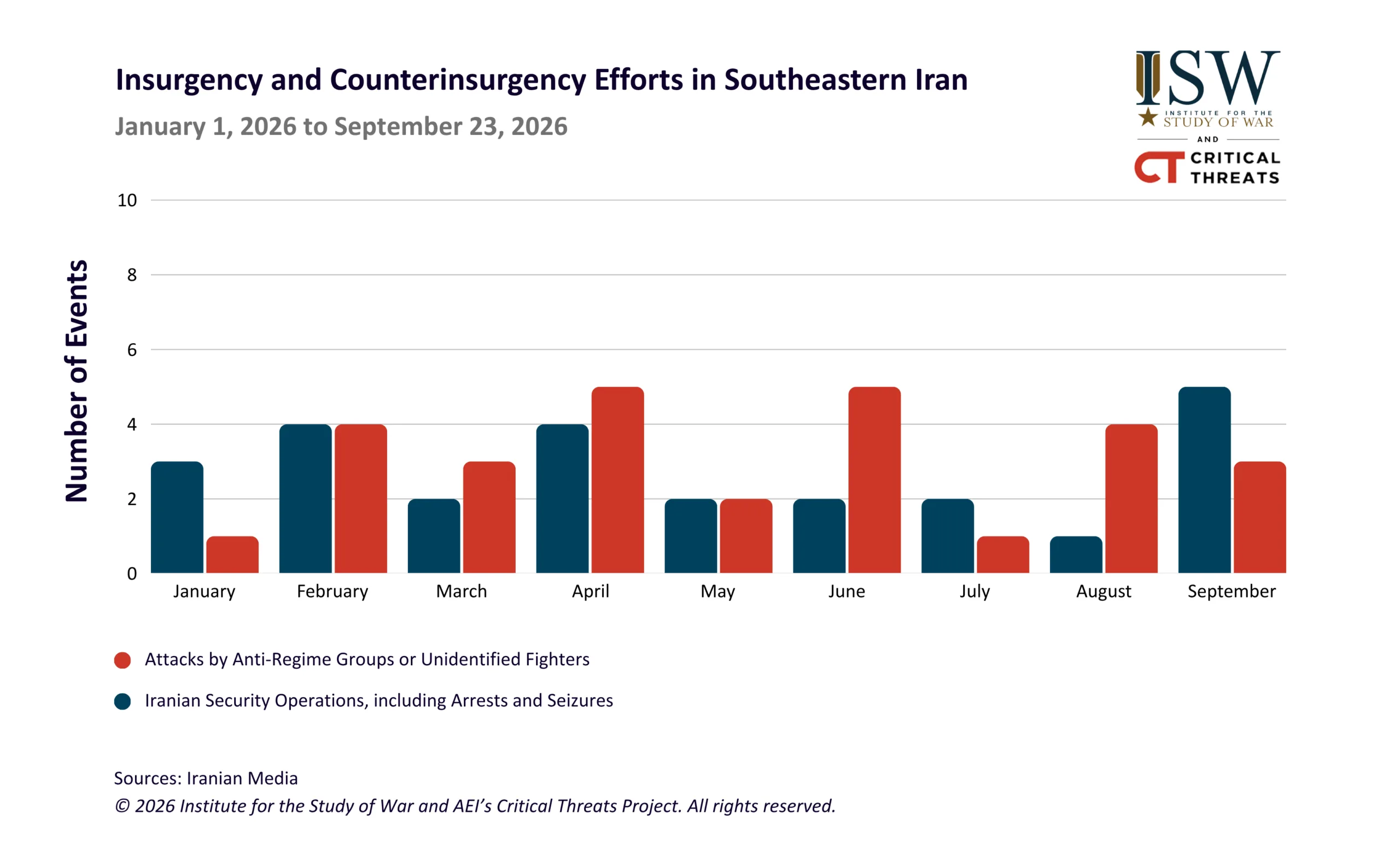
Likely Mobarizoun Popular Front (MPF) fighters killed two high-ranking IRGC Ground Forces commanders in southeastern Iran on September 23. IRGC-affiliated media reported on September 23 that Iranian security forces killed five insurgents and seized their weapons during a counterinsurgency operation in Saravan, Sistan and Baluchistan.[75] A separate regime media outlet later reported that the insurgents killed IRGC Ground Forces Shahid Sajjad Operational Headquarters Commander Brigadier General Hossein Zarifi and Intelligence Commander Major General Ahmad Zeraati during the operation.[76] It is unclear which incident occurred first, however. Regime media is almost certainly referring to the MPF, which is a Baloch anti-regime militant coalition with a history of attacking regime security forces and pro-regime clerics in Sistan and Baluchistan Province.[77]
The regime may increase security measures and counterinsurgency operations in the southeast in response to the killing of these two high-ranking commanders. ISW-CTP has observed a recent uptick in Iranian security operations in southeastern Iran over the past month, which will likely continue due to Zarifi and Zeraati’s killing.[78] Sistan and Baluchistan Province is a hotspot for anti-regime activity, including both armed and non-armed movements. Zahedan, Sistan and Baluchistan Province, experienced significant protest activity long after the end of the Mahsa Amini protests in the rest of Iran, even after the violent regime crackdown in the province, for example.[79] The regime may calculate that it needs to increase its security efforts in Sistan and Baluchistan to discourage all kinds of anti-regime activity. It is unclear at this time how effectively the regime can suppress such activity, however, due to its ongoing internal security struggles in the northwest and the broader degradation of the regime’s security forces by the United States and Israel during the war.[80]
Anti-regime media reported on September 23 that small-scale economic protests took place in northwestern Iran.[81] Anti-regime media posted footage of a group of nurses and staff from Kermanshah University of Medical Sciences protesting working conditions in front of the university building on September 22.[82] Student protests at universities are notable, given the regime’s historical concern about anti-regime unrest among young people. Student protesters spearheaded the Mahsa Amini movement in 2022, for example.[83] Anti-regime media separately posted footage of protests by employees of an Iranian oil company in Ahvaz, Khuzestan Province, on September 23.[84] The workers demanded settlement of overdue financial claims, comprehensive reforms to wage and benefit structures, and improvements to workplace safety standards.[85] The economic roots of the protests are notable because the Winter 2026 protests — Iran’s largest in modern history — emerged due to economic grievances but rapidly evolved into widespread anti-regime protests.[86]
Lebanon
Nothing significant to report.
Iraq
See topline section.
Arabian Peninsula
See topline section.

[1] https://x.com/BarakRavid/status/2102479164590686662 ; https://twitter.com/SEPeaceMissions/status/2102541416832336240
[2] https://www.eda.admin dot ch/en/memorandum-of-understanding-between-the-usa-and-iran ;
https://edition.cnn.com/2026/06/17/middleeast/us-iran-war-mou-text-intl
[3] https://x.com/ir_rezaee/status/2101389332900663793
[4] https://t.me/iribnews/362741
[5] https://t.me/iribnews/362741
[6] https://apnews.com/article/iran-us-hormuz-strait-war-july-14-2026-abd060c55feea216625689e57d8f76be ;
https://home.treasury.gov/news/press-releases/sb0623 ;
https://www.wsj.com/world/middle-east/squeezed-at-sea-iran-faces-new-restrictions-on-its-flights-1e1af416 ;
https://home.treasury.gov/news/press-releases/sb0613
[7] https://understandingwar.org/research/middle-east/iran-update-august-24-2026; https://understandingwar.org/research/middle-east/iran-update-september-4-2026/
[8] https://understandingwar.org/research/middle-east/iran-update-august-24-2026; https://understandingwar.org/research/middle-east/iran-update-september-4-2026/
[9] https://x.com/CNBC/status/2102246534121168975
[10] https://www.reuters.com/world/middle-east/iraq-suspends-iranian-flights-baghdad-after-us-sanctions-threat-sources-say-2026-09-22/
[11] https://www.thenationalnews dot com/business/2026/09/23/uae-central-bank-bars-bank-melli-iran-from-conducting-transactions/
[12] https://www.nytimes.com/2026/07/04/world/middleeast/iran-supreme-leader-funeral-divisions.html
[13] https://www.mehrnews dot com/news/6922951; https://www.mehrnews dot com/news/6922785; https://president dot ir/fa/165495
[14] https://understandingwar.org/research/middle-east/iran-update-september-2-2026/ ; https://understandingwar.org/research/middle-east/iran-update-september-4-2026/
[15] https://understandingwar.org/research/middle-east/iran-update-september-21-2026/
[16] https://x.com/TankerTrackers/status/2102728349932019787
[17] https://understandingwar.org/research/middle-east/iran-update-september-2-2026/ ; https://understandingwar.org/research/middle-east/iran-update-september-4-2026/
[18] https://www.criticalthreats.org/analysis/iran-update-evening-special-report-july-8-2026 ;
https://www.reuters.com/world/middle-east/oman-presented-regional-mechanism-hormuz-iran-source-says-2026-07-28
[19] https://www.tasnimnews dot ir/fa/news/1405/07/01/3704600
[20] https://www.tasnimnews dot ir/fa/news/1405/07/01/3704331 ; https://twitter.com/EbrahimRezaei14/status/2102691330749067343
[21] https://www.tasnimnews dot ir/fa/news/1405/07/01/3704331
[22] https://www.tasnimnews dot ir/fa/news/1405/07/01/3704331 ; https://twitter.com/EbrahimRezaei14/status/2102691330749067343
[23] https://www.tasnimnews dot ir/fa/news/1405/07/01/3704600
[24] https://www.skynewsarabia dot com/middle-east/1893946-الحوثيون-يهددون-أميركا-باب-المندب-جسد-واحد-إيران ; https://www.alaraby dot co.uk/politics/الحوثيون-يهددون-واشنطن-سنستهدف-مصالحكم-إذا-ساندتم-السعودية
[25] https://www.theguardian.com/world/article/2024/jul/19/yemen-houthis-claim-deadly-drone-attack-on-tel-aviv-israel
[26] https://www.skynewsarabia dot com/middle-east/1893946-الحوثيون-يهددون-أميركا-باب-المندب-جسد-واحد-إيران ; https://www.alaraby dot co.uk/politics/الحوثيون-يهددون-واشنطن-سنستهدف-مصالحكم-إذا-ساندتم-السعودية
[27] https://shafaq dot com/en/Middle-East/Houthis-reject-Trump-s-claims-of-surrender ; https://farsnews dot ir/Qaysar/1756100691758159285/At-Least-Six-Killed-Dozens-Injured-in-Yemens-Sanaa-in-Israeli-Heavy-Bombardment?lang=en; https://shafaq dot com/en/Middle-East/Houthis-unveil-new-plan-to-confront-Israel; https://www.alaraby dot co.uk/politics/الحوثيون-يهددون-واشنطن-سنستهدف-مصالحكم-إذا-ساندتم-السعودية
[28] https://x.com/BashaReport/status/2032933553298608225 ; https://www.skynewsarabia dot com/middle-east/1893946-الحوثيون-يهددون-أميركا-باب-المندب-جسد-واحد-إيران ; https://www.alaraby dot co.uk/politics/الحوثيون-يهددون-واشنطن-سنستهدف-مصالحكم-إذا-ساندتم-السعودية
[29] https://www.nytimes.com/2026/09/20/us/politics/trump-yemen-houthis-red-sea-iran.html
[30] https://understandingwar.org/research/middle-east/iran-update-september-22-2026/
[31] https://x.com/TvAlmasirah/status/2102133125551706502 ; https://www.reuters.com/world/asia-pacific/saudi-arabia-turkey-pakistan-sign-joint-defence-deal-amid-regional-turmoil-2026-08-07/
[32] https://www.reuters.com/world/asia-pacific/saudi-arabia-turkey-pakistan-sign-joint-defence-deal-amid-regional-turmoil-2026-08-07/
[33] https://www.reuters.com/world/middle-east/us-officials-met-iran-backed-houthis-oman-over-weekend-sources-say-2026-09-16/ ; https://www.axios.com/2026/09/16/us-houthi-oman-to-discuss-red-sea-crisis
[34] https://www.reuters.com/world/middle-east/trump-call-with-yemen-president-did-not-pledge-military-support-against-houthis-2026-09-21/ ; https://www.nytimes.com/2026/09/20/us/politics/trump-yemen-houthis-red-sea-iran.html ; https://www.axios.com/2026/09/16/us-houthi-oman-to-discuss-red-sea-crisis
[35] https://www.washingtoninstitute.org/policy-analysis/houthi-shipping-attacks-patterns-and-expectations-2025
[36] https://www.criticalthreats.org/analysis/iran-update-january-12-2024; https://understandingwar.org/research/middle-east/iran-update-november-19-2023/ ; https://understandingwar.org/research/middle-east/iran-update-march-17-2025/ ; https://understandingwar.org/research/middle-east/iran-update-july-9-2025/ ; https://www.washingtoninstitute.org/policy-analysis/houthi-shipping-attacks-patterns-and-expectations-2025
[37] https://understandingwar.org/research/middle-east/iran-update-special-report-july-21-2026/ ; https://t.me/army21ye/3656 ; https://understandingwar.org/research/middle-east/iran-update-special-report-july-23-2026/
[38] https://t.me/army21ye/3656 ; https://t.me/army21ye/3588 ; https://t.me/army21ye/3644
[39] https://understandingwar.org/research/middle-east/iran-update-september-10-2026/
[40] https://www.criticalthreats.org/analysis/iran-update-january-4-2024 ; https://www.maritime.dot.gov/msci/2026-006-red-sea-bab-el-mandeb-strait-gulf-aden-arabian-sea-and-somali-basin-houthi-attacks ; https://www.lloydslist.com/hot-topics/red-sea-risk/map-and-list-of-attacks ; https://understandingwar.org/research/middle-east/iran-update-november-19-2023/
[41] https://understandingwar.org/research/middle-east/iran-update-september-11-2026/
[42] https://understandingwar.org/research/middle-east/iran-update-september-11-2026/ ; https://www.globalmilitary.net/vehicles/d-20/ ; https://www.oryxspioenkop.com/2015/09/pre-war-yemeni-fighting-vehicles_20.html ; https://www.facebook.com/watch/?v=943450894895511 ; https://x.com/BashaReport/status/2098385535521767522
[43] https://www.skynewsarabia dot com/middle-east/1893946-الحوثيون-يهددون-أميركا-باب-المندب-جسد-واحد-إيران ; https://www.alaraby dot co.uk/politics/الحوثيون-يهددون-واشنطن-سنستهدف-مصالحكم-إذا-ساندتم-السعودية
[44] https://x.com/TvAlmasirah/status/2102506638683042194?s=20 ; https://www.alaraby dot co.uk/politics/الحوثيون-يهددون-واشنطن-سنستهدف-مصالحكم-إذا-ساندتم-السعودية ; https://www.axios.com/2026/09/16/us-houthi-oman-to-discuss-red-sea-crisis ; https://x.com/TvAlmasirah/status/2098074305796128789
[45] https://www.skynewsarabia dot com/middle-east/1893153-اليمن-خبراء-إيرانيون-ورادارات-حوثية-قرب-باب-المندب ; https://t.me/alakhbar_news/95705
[46] https://www.saba dot ye/en/news3754303.htm
[47] https://abcnews.com/International/us-navy-shoots-houthi-missiles-targeting-us-flagged/story?id=116363642 ; https://www.npr.org/2024/01/10/1223906769/yemens-houthis-red-sea-attack-missiles-drones-us-navy-un-resolution ; https://www.voanews.com/a/us-destroyer-shoots-down-missile-drones-launched-by-houthis/7515647.html
[48] https://apnews.com/article/houthis-drone-ships-navy-missile-79aca676da82a61ce4a8151951727973
[49] https://edition.cnn.com/2026/09/10/politics/us-military-support-saudi-arabia-houthi-iran-yemen ; https://www.state.gov/u-s-security-cooperation-with-saudi-arabia
[50] https://t.me/army21ye/3759 ; https://t.me/army21ye/3757 ; https://t.me/army21ye/3754
[51] https://www.bbc.com/news/articles/cqlykpe4dk0yo ; https://theaviationist dot com/2026/07/31/task-force-air-arabia/
[52] https://t.me/BenTzionM/8374 ; https://theaviationist dot com/2026/09/18/italian-eurofighter-hit-saudi-arabia/
[53] https://x.com/shmsanarmy/status/2101406684963119362 ; https://x.com/shmsanarmy/status/2101406760598704468 ; https://x.com/shmsanarmy/status/2099533638756864276
[54] https://english.aawsat dot com/arab-world/5301398-houthi-ties-iraqi-factions-deepen-operational-alliance ; https://www.al-akhbar dot com/NewspaperArticles/arab/900355
[55] https://www.reuters.com/world/middle-east/yemens-houthis-are-attacking-saudi-arabia-iraq-sources-say-2026-07-30/ ; https://understandingwar.org/research/middle-east/iran-update-special-report-july-29-2026/ ; https://understandingwar.org/research/middle-east/iran-update-special-report-july-30-2026/
[56] https://x.com/SecWar/status/2077182768602132823 ; https://www.state.gov/releases/office-of-the-spokesperson/2026/04/deputy-secretary-landaus-meeting-with-iraqi-ambassador-khirullah/ ; https://ctc.westpoint.edu/standing-with-iran-the-integrated-combat-performance-of-iraqi-militias-during-operation-epic-fury/
[57] https://www.nytimes.com/2026/09/21/world/middleeast/iraq-prime-minister-interview-disarm-militias.html
[58] https://www.nytimes.com/2026/09/21/world/middleeast/iraq-prime-minister-interview-disarm-militias.html
[59] https://www.alaraby dot co.uk/politics/خاص-تفاصيل-مهلة-30-يونيو-لحصر-سلاح-الفصائل-العراقية
[60] https://www.aljazeera dot com/news/2026/8/12/iraq-says-sept-30-deadline-to-end-us-led-military-coalition-final ; https://www.nytimes.com/2026/09/21/world/middleeast/iraq-prime-minister-interview-disarm-militias.html ; http://shafaq dot com/ar/%D8%B3%DB%8C%D8%A7%D8%B3%D8%A9/%D8%A7%D9%84%D9%85%D8%A7%D9%84%D9%83%D9%8A-%D9%8A%D9%83%D8%B4%D9%81-%D9%84%D9%84%D9%82%D8%A7-%D9%85-%D8%A8%D8%A7%D9%84-%D8%B9%D9%85%D8%A7%D9%84-%D8%A7%D9%84-%D9%85%D9%8A%D8%B1%D9%83%D9%8A-%D8%B9%D9%86-%D8%B3%D9%82%D9%81-%D8%B2%D9%85%D9%86%D9%8A-%D9%88%D8%A8%D8%B1%D9%86%D8%A7%D9%85%D8%AC-%D9%84%D8%AD%D8%B5%D8%B1-%D8%A7%D9%84%D8%B3%D9%84%D8%A7%D8%AD-%D8%A8%D8%B9%D8%AF-30-%D9%8A%D9%84%D9%88%D9%84
[61] https://www.alaraby dot co.uk/politics/%D8%AE%D8%A7%D8%B5-%D8%AA%D9%81%D8%A7%D8%B5%D9%8A%D9%84-%D9%85%D9%87%D9%84%D8%A9-30-%D9%8A%D9%88%D9%86%D9%8A%D9%88-%D9%84%D8%AD%D8%B5%D8%B1-%D8%B3%D9%84%D8%A7%D8%AD-%D8%A7%D9%84%D9%81%D8%B5%D8%A7%D8%A6%D9%84-%D8%A7%D9%84%D8%B9%D8%B1%D8%A7%D9%82%D9%8A%D8%A9
[62] https://understandingwar.org/research/middle-east/the-leadership-and-purpose-of-iraqs-popular-mobilization-forces/
[63] https://www.alaraby dot co.uk/politics/%D8%AE%D8%A7%D8%B5-%D8%AA%D9%81%D8%A7%D8%B5%D9%8A%D9%84-%D9%85%D9%87%D9%84%D8%A9-30-%D9%8A%D9%88%D9%86%D9%8A%D9%88-%D9%84%D8%AD%D8%B5%D8%B1-%D8%B3%D9%84%D8%A7%D8%AD-%D8%A7%D9%84%D9%81%D8%B5%D8%A7%D8%A6%D9%84-%D8%A7%D9%84%D8%B9%D8%B1%D8%A7%D9%82%D9%8A%D8%A9
[64] https://www.washingtoninstitute.org/policy-analysis/how-use-militia-spotlight-profiles
[65] https://www.alaraby dot co.uk/politics/خاص-تفاصيل-مهلة-30-يونيو-لحصر-سلاح-الفصائل-العراقية
[66] https://www.alaraby dot co.uk/politics/خاص-تفاصيل-مهلة-30-يونيو-لحصر-سلاح-الفصائل-العراقية
[67] https://t.me/AbumujahidAlasaf/15 ; https://www.washingtoninstitute.org/policy-analysis/profile-islamic-resistance-iraq
[68] https://www.nytimes.com/2026/09/21/world/middleeast/iraq-prime-minister-interview-disarm-militias.html
[69] https://www.alsumaria dot tv/news/security/576227/الكشف-عن-وصول-رسائل-أمريكية-إلى-العراق-بشأن-حصر-السلاح ; https://www.wsj.com/world/middle-east/u-s-blocks-iraqs-dollar-shipments-to-squeeze-its-iran-backed-militias-3270d5af ; https://www.newarab dot com/news/us-sends-dollar-shipment-iraq-threatens-sanctions; https://shafaq dot com/ar/سیاسة/حصري-اميركا-تشترط-تفكيك-الفصا-ل-مقابل-تحرير-30-مليار-دولار-من-موال-صدام
[70] https://www.alaraby dot co.uk/politics/خاص-تفاصيل-مهلة-30-يونيو-لحصر-سلاح-الفصائل-العراقية
[71] https://www.alaraby dot co.uk/politics/خاص-تفاصيل-مهلة-30-يونيو-لحصر-سلاح-الفصائل-العراقية
[72] https://ina.iq/ar/political/274331-.html
[73] https://shafaq dot com/ar/أمـن/الداخلية-العراقية-تعلن-غلاق-71-مقرا-وهميا-للحشد-الشعبي ; https://shafaq dot com/ar/ أمـن/محاصرة-مقر-فصيل-شيعي-مسلح-في-طراف-بغداد ; https://x.com/Tammuz_Intel/status/2080784147853750721 ; https://www.alaraby dot co.uk/politics/العراق-لماذا-تتم-عملية-حصر-سلاح-الفصائل-سراً ; https://almadapaper dot net/442723/
[74] https://www.alaraby dot co.uk/politics/جرف-الصخر-اختبار-أوّل-صعب-لخطة-حصر-السلاح-في-العراق ; https://ctc.westpoint.edu/standing-with-iran-the-integrated-combat-performance-of-iraqi-militias-during-operation-epic-fury/ ; https://understandingwar.org/research/middle-east/iran-update-august-19-2026/
[75] https://t.me/farsna/463917
[76] https://fararu dot com/fa/news/1004541/
[77] https://www.irna dot ir/news/86265341/ ; https://understandingwar.org/research/middle-east/iran-update-february-17-2026/ ; https://understandingwar.org/research/middle-east/iran-update-special-report-april-29-2026/
[78] https://www.criticalthreats.org/analysis/iran-update-september-21-2026
[79] https://www.hrw.org/news/2022/12/22/iran-bloody-friday-crackdown-years-deadliest
[80] https://understandingwar.org/research/middle-east/iran-update-morning-special-report-march-5-2026/ ; https://understandingwar.org/research/middle-east/iran-update-special-report-march-27-2026/
[81] https://x.com/IranIntl/status/2102790101235560531
[82] https://x.com/IranIntl/status/2102790101235560531
[83] https://www.criticalthreats.org/analysis/iran-update-may-23-2023
[84] https://x.com/IranIntl/status/2102729699172454653
[85] https://x.com/IranIntl/status/2102729699172454653
[86] https://www.criticalthreats.org/analysis/iran-update-january-15-2026