
The Institute for the Study of War (ISW) and The Critical Threats Project (CTP) at the American Enterprise Institute are publishing updates Monday through Friday to provide analysis on the war with Iran. Most updates cover events from the past 24-hour period, whereas Monday updates also include events from the preceding weekend, collected after ISW-CTP’s 2:00 PM ET Friday data cutoff. ISW-CTP may publish special updates on Saturdays and Sundays if events warrant, however.
Key Takeaways
- Recent Iranian attacks on US regional assets indicate that Iranian decision-makers — particularly the hardline Islamic Revolutionary Guards Corps (IRGC) faction that appears to be controlling decision-making — are dissatisfied with the current status of the war because Iran has not yet achieved its key objectives in the conflict, namely securing recognized control over the Strait of Hormuz. These decision-makers appear intent on trying to change the trajectory of the conflict through the use of military force.
- Iran is facing several constraints that are limiting its ability to achieve its political objectives in the war. The operational constraints imposed by US strikes are temporary, and Iran will likely try to reconstitute its degraded capabilities and develop new capabilities to adapt to the constraints on its military campaign.
- Iran’s ongoing cash flow crisis will likely limit Iran’s ability to overcome these constraints in the near term. Iran is facing a shortage of foreign currency reserves and access to US dollars, which has been exacerbated by intensifying US economic pressure.
- Iran is constrained by its relationships with the Gulf states because it seeks to increase political and economic costs on the United States while, at least at this time, avoiding actions that could push the Gulf states to support a resumption of large-scale US operations against Iran. Iran has also faced consistent opposition from the Gulf states toward its efforts to control shipping in the strait.
Toplines
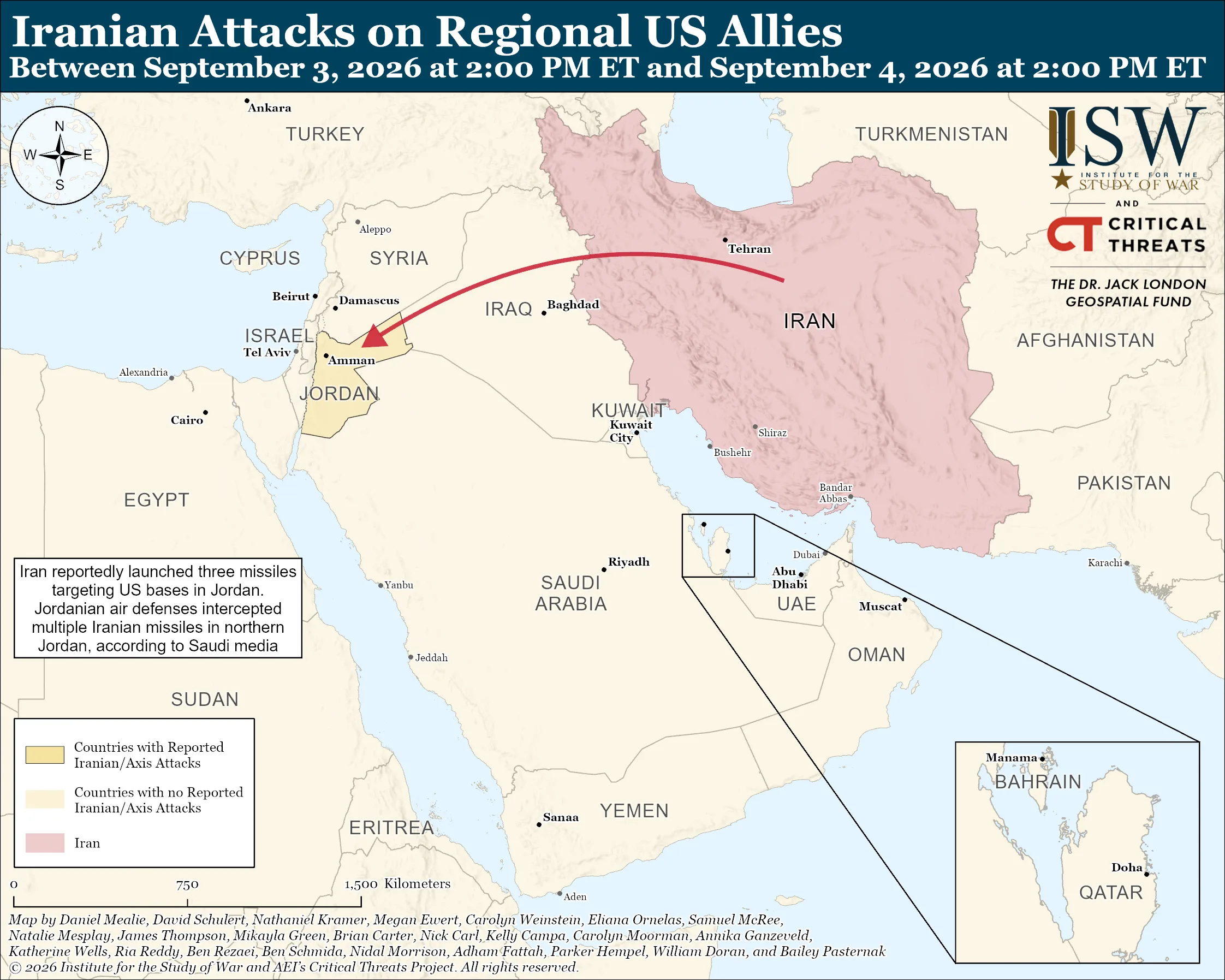
Recent Iranian attacks on US regional assets indicate that Iranian decision-makers — particularly the hardline Islamic Revolutionary Guards Corps (IRGC) faction that appears to be controlling decision-making — are dissatisfied with the current status of the war because Iran has not yet achieved its key objectives in the conflict, namely securing recognized control over the Strait of Hormuz. These decision-makers appear intent on trying to change the trajectory of the conflict through the use of military force. Iran launched drone and missile attacks at US bases in the United Arab Emirates (UAE), Kuwait, and Jordan on September 3 and 4.[1] These attacks are part of Iran’s months-long military campaign to erode US resolve to continue the war and coerce the United States to surrender to Iranian demands. Iranian decision-makers believe that Iran can outlast the United States’ will to continue the war and have calculated throughout the war that they can increase US domestic pressure on US President Donald Trump’s administration to stop the war by increasing international oil prices.[2] The Iranian regime indicated at the start of its campaign to disrupt shipping in the Strait of Hormuz in March that its goal was to increase oil prices to $200 USD per barrel.[3] Oil prices did initially spike at the start of Iran’s campaign, but oil prices have remained below $100 USD per barrel since May.[4] The United States also appears to be having some success in facilitating the flow of oil out of the strait. US Energy Secretary Chris Wright recently noted that 17 million barrels of oil — close to pre-war levels of around 20 million barrels per day — exited the strait on August 31, for example.[5]
Iran may be waiting for a more advantageous moment to drive up oil prices and increase pressure on the United States, potentially timing such actions around the period leading up to the US midterm elections. Such a decision would be intended to raise economic and political costs for the Trump administration to pressure it to end the conflict and acquiesce to Iranian demands.
Iran is facing several constraints that are limiting its ability to achieve its political objectives in the war. Iran is facing structural limitations that are, by Iran’s own standards, hindering the success of Iran’s military campaign. Iran has structured its armed forces and invested in capabilities that are meant to affect Iranian adversaries’ resolve, but these tools are currently not bearing success for Iran. The IRGC Navy, for example, has heavily relied on asymmetric capabilities, such as laying mines in the strait and launching missiles at commercial vessels, to disrupt shipping in the strait during the war.[6] The United States has cleared the strait of mines and degraded Iran’s ability to mine the strait, rendering this Iranian tactic currently ineffective.[7]
ISW-CTP has not observed an increase in Iranian drone and missile attacks on commercial vessels in the Strait of Hormuz despite the reported increase in vessel traffic through the waterway, which suggests that Iran is struggling to fix commercial vessel targets.[8] Iran would presumably increase attacks on commercial vessels in response to increased traffic through the strait if it had the ability to do so, given that Iran is dissatisfied with the current state of the war. “Fixing” a target is part of the “find, fix, finish” targeting cycle, which involves forces detecting and identifying a specific threat (find), tracking and pinpointing its exact location in time and space to prevent escape (fix), and deploying military options to capture, neutralize, or destroy the target (finish).[9] Most Iranian systems are GPS-guided, which means that Iran must be able to track the speed and heading of a commercial vessel in order to determine the coordinates to strike the vessel at a certain time.[10] Without being able to fix a commercial vessel target and track it over time, Iran is unable to determine the coordinates to attack the vessel. Recent US strikes have targeted Iranian coastal radars, which could, at least partially, explain Iran’s difficulty in fixing targets.[11] Other actions, such as electronic warfare, could also disrupt Iran’s ability to fix targets.[12]
The operational constraints imposed by US strikes are temporary, and Iran will likely try to reconstitute its degraded capabilities and develop new capabilities to adapt to the constraints on its military campaign. Iran has recently adopted suboptimal methods, such as attempting to use rockets to launch naval mines and using fast attack craft (FAC) to identify commercial vessels, in response to US strikes on Iranian military capabilities.[13] Iran has sought to rebuild these capabilities, including radars. US President Donald Trump noted on September 1 that US forces had struck radars that Iran had “almost” rebuilt, for example.[14] Iran will also likely try to develop new technologies and capabilities to avoid facing the same constraints in the future.
Iran’s ongoing cash flow crisis will likely limit Iran’s ability to overcome the challenges outlined above in the near term. Iran is facing a shortage of foreign currency reserves and access to US dollars, which has been exacerbated by intensifying US economic pressure.[15] The US blockade on Iranian ports is preventing Iran from generating revenue from its illicit international oil trade.[16] US sanctions have also targeted the Iranian regime’s other illicit channels and its ability to move cash around.[17] Even the UAE — a traditional hub for Iranian trade and illicit financing — has started reducing economic ties with Iran as part of the United States and its allies’ economic pressure campaign against Iran.[18]
US sanctions also make it difficult for Iran to send funds to its proxies and partners.[19] Recent regional reporting indicates that Iran is struggling to transfer funds to Hezbollah.[20] The lack of funding for these groups will restrain one of Iran’s main mechanisms for projecting power beyond its borders and pressuring the United States and its regional allies.[21]
Iran is constrained by its relationships with the Gulf states because it seeks to increase political and economic costs on the United States while, at least at this time, avoiding actions that could push the Gulf states to support a resumption of large-scale US operations against Iran. Gulf states such as Saudi Arabia, Qatar, and the UAE persuaded the United States in early August not to resume the war with Iran.[22] Iran currently appears reluctant to drive these states to change their opposition to large-scale fighting, which constrains the actions Iran can take to impose pressure on the United States. Large-scale Iranian attacks on regional energy infrastructure would likely drive up global oil prices, but such attacks would also increase the risk of changing the Gulf states’ aversion to resuming the war, for example.
Iran has also faced consistent opposition from the Gulf states toward its efforts to control shipping in the strait. Iran’s most amiable regional partner, Oman, reportedly rejected a bilateral agreement with Iran over managing the strait because of Iran’s insistence on enforcing service “fees.”[23] Iran was required, under the memorandum of understanding (MoU), to negotiate an arrangement for the Strait of Hormuz with Oman. Oman and the rest of the Gulf states’ opposition to Iranian control of the strait constrains Iranian efforts to secure formal recognition of the waterway.
Current indicators suggest that Iran and Hezbollah are unlikely to respond to the Israel Defense Forces’ (IDF) announcement that it cleared a major underground Hezbollah facility beneath the Ali al Taher Ridge in Lebanon on September 3 by attacking Israel in the near term.[24] Iranian media and Hezbollah officials are instead attempting to understate Ali al Taher’s military significance, likely in an effort to mitigate Hezbollah’s loss without escalating with the IDF. ISW-CTP outlined three possible courses of action that Iran could take in response to the IDF’s clearing of Ali al Taher on September 3, including a large-scale missile and drone attack targeting Israel, a limited “symbolic” attack on Israeli military targets to demonstrate solidarity with Hezbollah without risking a massive US-Israeli response, and the possibility that Iran would refrain from attacking Israel in order to avoid a kinetic response.[25] Ali al Taher occupies advantageous terrain overlooking the Litani River and the neighboring Houla Valley that enabled Hezbollah to target Israeli forces in southern Lebanon and civilian settlements in northern Israel.[26] Iranian regime media outlets argued on September 4 that the IDF exaggerated the physical size and military significance of Ali al Taher in order to bolster Israeli Prime Minister Benjamin Netanyahu’s reelection campaign ahead of Israeli elections in October.[27] Iranian media efforts to downplay the significance of Ali al Taher suggest that Iran is not likely to attack Israel in response in the near term, despite recent reports that unspecified Iranian officials threatened Israel that it would do so if Israel began an offensive to seize the area.[28] Iran previously launched missiles at Israel in June following Israeli strikes on a Hezbollah first-person view (FPV) drone headquarters in Beirut’s southern suburbs.[29] Iranian military and security officials publicly threatened to strike Israel in response to the IDF strikes on Beirut but did not make the same public threats before or after the IDF cleared Ali al Taher.[30] Iran’s reported missile strikes targeting US bases in Jordan on September 4 could be in response to the IDF clearing Ali al Taher, but Iran has previously confined its response attacks following Israeli kinetic activity against Hezbollah in southern Lebanon to striking Israel rather than other regional targets.[31]
Hezbollah is similarly attempting to downplay the significance of Ali al Taher, which indicates that Hezbollah is also unlikely to attack Israel in the near term. Hezbollah Political Council Deputy Chairman Mahmoud Qamati, the most senior Hezbollah official to comment on Ali al Taher at the time of this writing, stated on September 4 that the Israeli government is overemphasizing the military importance of Ali al Taher and is using the site to help Netanyahu’s political campaign.[32] Current Hezbollah messaging around Ali al Taher echoes similar statements that Hezbollah officials made after the IDF announced that it surrounded Ali al Taher in late June 2026.[33] Ali al Taher was a significant military asset for Hezbollah, however. Hezbollah reportedly spent 20 years constructing the tunnels beneath Ali al Taher that previously contained the headquarters of Hezbollah’s Badr Unit, which is one of the main Hezbollah units that has engaged the IDF in southern Lebanon.[34]
US and Partner Military Operations
Nothing significant to report.
Iranian Strike Campaign
Assessed Iranian War Aims:
- Secure international recognition of Iranian control over the Strait of Hormuz
- Degrade the US ability and willingness to continue the war
- Restore deterrence vis-à -vis the United States and its regional partners
- Divide the United States and Israel from the Arab states
See topline section.
US-Iran Negotiations
Nothing significant to report.
Iranian Domestic Affairs
Recent leadership changes within Iran’s security apparatus and calls for deeper judicial and technological cooperation with the People’s Republic of China (PRC) may reflect Iranian regime efforts to prepare for renewed domestic unrest. Iranian Law Enforcement Command (LEC) Commander Brigadier General Ahmad Reza Radan appointed nine senior officials on September 4.[35] Radan appointed a new Prevention Police chief, human resources deputy, command oversight official, and head of his Special Office, among others.[36] Radan appointed former Tehran Municipality Basij head Hadi Sahami to head his Special Office.[37] Tehran Province IRGC Mohammad Rasoul Ollah Unit Commander Brigadier General Hassan Hassanzadeh appointed Sahami to his previous position in 2022 and tasked him with serving as a “link” between the Basij and Tehran municipal institutions.[38] Sahami’s appointment could therefore be meant to facilitate greater coordination between the LEC and the Basij. Judiciary Chief Gholam Hossein Mohseni Ejei separately called for deeper judicial and technological cooperation with the PRC, including the use of artificial intelligence in judicial affairs, during a September 3 meeting with Chinese Supreme Court Chief Justice Zhang Jun in India.[39] These discussions are notable given that Iran has previously sought the PRC’s support to expand its domestic surveillance capabilities, including through Chinese-made facial-recognition technology and law enforcement cooperation.[40] Radan previously expanded LEC cooperation with the PRC, including through a 2024 law enforcement MoU and an agreement in January 2026 that covered public and political security.[41] Radan’s appointments and Ejei’s meeting with a Chinese judicial official come amid Iranian officials’ heightened concern that worsening economic conditions could trigger renewed anti-regime protests, such as those that occurred in Winter 2025-2026.[42]
Lebanon
The IDF returned four additional Lebanese detainees to Lebanese authorities on September 4 to advance the implementation of the June 26 Israel-Lebanon Trilateral Framework Agreement.[43] The International Committee of the Red Cross announced that it successfully facilitated the return of five Israeli-held Lebanese detainees to Lebanon on September 3 and 4.[44] Israeli Prime Minister Benjamin Netanyahu announced on September 3 that Israel agreed to release the five Lebanese individuals to advance ongoing Israel-Lebanon negotiations after Lebanon helped Israel search for the remains of Lebanese Jewish leaders killed during the Lebanese Civil War.[45] Lebanese President Joseph Aoun thanked the United States for securing the release of the five Lebanese citizens during a meeting with US Ambassador to Lebanon Michel Issa and a US Congressional delegation on September 4.[46] Aoun stated that the United States and Lebanon must secure the release of the remaining Israeli-held Lebanese detainees, in accordance with the Trilateral Framework Agreement.[47] Two Lebanese sources told Reuters that 35 Lebanese citizens remain in Israeli custody.[48] Aoun and the US delegation also discussed ongoing preparations for the next round of US-mediated Israel-Lebanon negotiations.[49] Saudi media reported on September 3 that US, Israeli, and Lebanese delegations are expected to hold political talks in Rome in mid-September and separate military talks at the US Central Command headquarters in Tampa, Florida, on an unspecified date.[50]
Iraq
Iraq, the Kurdistan Regional Government (KRG), and Turkey have reportedly begun to implement a mechanism to disarm the Kurdistan Workers’ Party (PKK) in Iraq, according to Turkish and Kurdish media on September 4.[51] The PKK, which Turkey and the United States have designated as a terrorist organization, announced its intention to dissolve and disarm in May 2025.[52] Turkish media reported on August 31 that Iraq, the KRG, and Turkey agreed on a framework to disarm the PKK.[53] The framework reportedly stipulates that Turkish intelligence will monitor PKK camps in northern Iraq to verify the group’s disarmament while Iraqi border security and Iraqi Kurdish Peshmerga forces receive weapons from PKK fighters and backfill PKK positions in areas they withdraw from, according to Turkish media.[54] Kurdish and Turkish media reported that Turkey and Iraq seek to disarm and evacuate PKK members from 18 PKK camps and 72 near-border positions by October 1.[55] It is unclear whether Turkish forces will withdraw from northern Iraq once Turkey verifies the PKK’s complete disarmament in Iraq. Turkey has long used the PKK’s continued activity in the area to justify Turkey’s bases in northern Iraq, which Iranian-backed militias oppose.[56] Some Iranian-backed Iraqi militias have conditioned their disarmament on Turkey’s withdrawal from northern Iraq, among other demands, in response to Iraqi Prime Minister Ali al Zaydi’s efforts to restrict weapons to the state.[57] The militias’ use of this precondition, among other demands, indicates that the militias do not intend to disarm.[58]
Arabian Peninsula
Nothing significant to report.

[1] https://t.me/iribnews/359507;
https://t.me/iribnews/359507;
https://x.com/KuwaitArmyGHQ/status/2095324773253341615;
https://x.com/no_itsmyturn/status/2095916718111519080; https://x.com/AlArabiya_Brk/status/2095914604593344748
[2] https://understandingwar.org/research/middle-east/iran-update-special-report-april-18-2026/ ; https://www.al-monitor dot com/originals/2026/08/oil-prices-fall-after-iran-steps-truce-efforts-us-says-hormuz-mines-cleared
[3] https://www.reuters.com/world/middle-east/combatants-mideast-war-trade-more-air-strikes-iran-clamps-down-dissent-2026-03-11/
[4] https://www.macrotrends.net/2516/wti-crude-oil-prices-10-year-daily-chart See one year graph
[5] https://www.cnbc.com/2026/09/02/energy-secretary-chris-wright-tells-cnbc-that-more-than-17-million-barrels-of-oil-transited-hormuz-on-monday.html
[6] https://www.wsj.com/world/europe/mine-warfare-with-iran-hampers-u-s-efforts-to-win-control-of-hormuz-45abc6b0 ; https://understandingwar.org/research/middle-east/iran-update-august-31-2026/
[7] https://www.axios.com/2026/08/19/hormuz-iran-oil-gulf-trump; https://x.com/CENTCOM/status/2093131928023023729?s=20 ;
https://www.nytimes.com/2026/08/31/us/politics/us-strikes-iran-new-naval-mine.html
[8] Data upon request
[9] https://understandingwar.org/research/middle-east/iran-update-august-31-2026/;
https://www.swcs.mil/Special-Warfare-Journal/Article/4565489/has-f3ead-outlived-its-usefulness/
[10] https://www.cnn.com/2026/03/06/science/gps-jamming-ships-planes-iran-war
[11] https://x.com/CENTCOM/status/2094826294466810366?s=20;
https://x.com/TreyYingst/status/2094854875154731098?s=20; https://www.axios.com/2026/07/29/us-airstrikes-iran-trump-resume
[12] https://www.bbc.com/news/articles/c3ewwlx9e1xo
[13] https://understandingwar.org/research/middle-east/iran-update-august-31-2026/;
https://x.com/MartinKelly/status/2094129711483891783?s=20; https://www.nytimes.com/2026/08/31/us/politics/us-strikes-iran-new-naval-mine.html
[14] https://x.com/TreyYingst/status/2094854875154731098?s=20
[15] https://understandingwar.org/research/middle-east/iran-update-august-24-2026/
[16] https://understandingwar.org/research/middle-east/iran-update-august-24-2026/; https://www.reuters.com/world/middle-east/trump-says-us-will-control-strait-hormuz-get-paid-it-2026-07-13/; https://understandingwar.org/research/middle-east/iran-update-august-20-2026/; https://www.irna dot ir/news/86240378/
[17] https://understandingwar.org/research/middle-east/iran-update-august-28-2026/; https://home.treasury.gov/news/press-releases/sb0614; https://home.treasury.gov/news/press-releases/treasury-severs-iranian-regime-s-financial-lifelines-turkiye/; https://www.wsj.com/world/middle-east/trumps-plan-to-squeeze-irans-economy-will-live-or-die-in-dubai-8f9f561e
[18] https://www.wsj.com/world/middle-east/trumps-plan-to-squeeze-irans-economy-will-live-or-die-in-dubai-8f9f561e
[19] https://home.treasury.gov/news/press-releases/treasury-severs-iranian-regime-s-financial-lifelines-turkiye/
[20] https://x.com/HibaNasr/status/2095547161576440134?s=20
[21] https://x.com/CENTCOM/status/2082260118930956482?s=20; https://x.com/HibaNasr/status/2095547161576440134?s=20
[22] https://www.reuters.com/business/media-telecom/four-arab-states-urged-against-us-iran-escalation-official-says-2026-01-15/
[23] https://nypost.com/2026/09/03/world-news/oman-quietly-rejects-irans-pitch-for-strait-of-hormuz-fees-despite-irgc-claim-of-deal/; https://www.reuters.com/world/middle-east/drone-hits-fuel-tank-omans-duqm-port-2026-03-03/
[24] https://x.com/IDF/status/2095569785522360508?s=20 ; https://x.com/CaptainElla1/status/2095566303587369429?s=20
[25] https://understandingwar.org/research/middle-east/iran-update-september-3-2026/
[26] https://understandingwar.org/research/middle-east/iran-update-september-3-2026/ ; https://www.reuters.com/world/middle-east/ali-al-taher-ridge-emerges-flashpoint-israel-hezbollah-war-2026-09-03/
[27] https://www.mehrnews dot com/news/6937158 ; https://t.me/mehrnews/410248
[28] https://www.reuters.com/world/middle-east/iran-warns-us-against-israeli-attack-south-lebanon-ridge-held-by-hezbollah-2026-09-03/
[29] https://x.com/manniefabian/status/2063908738772152639?s=20 ; https://x.com/IsraeliPM_heb/status/2063595227927941407?s=20 ; https://x.com/idfonline/status/2063500781085401359?s=20 ; https://t.me/mmirleb/17225
[30] https://x.com/shoaam_ir/status/2066209121817231389; https://t.me/Tasnimnews/422640; https://x.com/Ebrahimazizi33/status/2066192525203812838?s=20; https://t.me/defapress_ir/60978 ; https://x.com/mb_ghalibaf/status/2066136825408753984
[31] https://understandingwar.org/research/middle-east/iran-update-special-report-june-8-2026/
[32] https://x.com/ALJADEEDNEWS/status/2095833410740572592 https://www.mtv dot com.lb/News/محليات/1733632/نائب–الحزب—سيطرة-الإسرائيلي-على-تل-ة-علي-الطاهر-ليست-بكارثة ; https://x.com/murat_toni/status/2095826853575397812
[33] https://t.me/mmirleb/17617 ; https://t.me/sameralhajali/11130
[34] https://hezbollah.org/organizational-chart ; https://israel-alma dot org/sectors-of-hezbollahs-geographical-units-in-southern-lebanon/ ; https://israel-alma dot org/hezbollahs-land-of-tunnels-a-strike-on-one-of-its-strategic-assets-in-southern-lebanon/ ; https://www.timesofisrael dot com/liveblog_entry/idf-says-it-has-finished-clearing-out-hezbollahs-ali-taher-ridge-facility-ahead-of-demolition/
[35] https://t.me/defapress_ir/66808
[36] https://t.me/defapress_ir/66808
[37] https://t.me/defapress_ir/66808
[38] https://www.ghadirinews dot ir/news/paper/page/?id=1401145567 ;
https://farsnews dot ir/Provinces/1649266889000752302
[39] https://www.irib-news dot ir/fa/news/5901805
[40] https://www.criticalthreats.org/analysis/iran-update-february-14-2025 ;
https://www.criticalthreats.org/analysis/iran-update-january-29-2026 ;
https://www.criticalthreats.org/analysis/iranian-national-police-force-adopts-new-measures-to-confront-anticipated-unrest
[41] https://www.criticalthreats.org/analysis/iran-update-january-29-2026
[42] https://understandingwar.org/research/middle-east/iran-update-september-3-2026/ ;
https://understandingwar.org/research/middle-east/iran-update-august-31-2026/
[43] https://x.com/ICRC/status/2095791441154912663 ; https://www.state.gov/releases/office-of-the-spokesperson/2026/06/trilateral-framework-between-the-united-states-of-america-the-state-of-israel-and-the-republic-of-lebanon/
[44] https://x.com/ICRC/status/2095791441154912663
[45] https://www.gov dot il/en/pages/spoke-lebanon030926
[46] https://x.com/LBpresidency/status/2095885949787877457
[47] https://x.com/LBpresidency/status/2095885949787877457
[48] https://www.reuters.com/world/middle-east/israel-release-five-lebanese-detainees-amid-talks-with-lebanon-2026-09-03/
[49] https://x.com/LBpresidency/status/2095885949787877457
[50] https://www.alhadath dot net/2026/09/03/مصادر-للعربية-لا-انسحابات-اسرائيلية-اضافية-في-جنوب-لبنان-ولا-اتفاق-على-المراقبين
[51] https://www.nefes dot com.tr/mitten-surece-siki-denetim-72-kamp-ve-magara-yerinde-kontrol-edilecek-149064 ; https://www.kurdistan24 dot net/en/story/937157/turkey-to-monitor-72-pkk-camps-as-disarmament-process-enters-implementation-phase
[52] https://www.reuters.com/world/middle-east/kurdish-pkk-dissolves-after-decades-struggle-with-turkey-news-agency-close-2025-05-12
[53] https://www.hurriyet dot com.tr/yazarlar/nedim-sener/silahlarin-tesliminde-ankara-bagdat-erbil-suleymaniye-mekanizmasi-43290592
[54] https://www.nefes dot com.tr/mitten-surece-siki-denetim-72-kamp-ve-magara-yerinde-kontrol-edilecek-149064
[55] https://www.nefes dot com.tr/mitten-surece-siki-denetim-72-kamp-ve-magara-yerinde-kontrol-edilecek-149064 ; https://www.kurdistan24 dot net/en/story/937157/turkey-to-monitor-72-pkk-camps-as-disarmament-process-enters-implementation-phase
[56] https://www.bbc.com/news/articles/c985lw7lywlo ; https://www.reuters.com/article/world/timeline-turkeys-military-operations-in-iraq-and-syria-idUSKBN1WQ274/ ; https://t.me/AbumujahidAlasaf/15
[57] https://understandingwar.org/research/middle-east/iran-update-special-report-august-18-2026/ ; https://t.me/AbumujahidAlasaf/15
[58] https://understandingwar.org/research/middle-east/iran-update-special-report-august-18-2026/