
Toplines
The People’s Republic of China (PRC) is likely enhancing its ability to mobilize civilian resources for military purposes during a conflict or short-of-war engagement. The PRC could use this capability to improve its military transport and sealift capacity during an invasion of Taiwan and mobilize its civilian artificial intelligence (AI) and drone sectors. The PRC’s National People’s Congress passed a revised version of the National Defense Mobilization Law on August 28, which will go into effect on October 1.[1] The original law enabled the PRC to requisition civilian assets for military purposes during national security crises.[2] The revisions outline when the PRC may invoke the law, such as when the PRC’s national sovereignty, unity, territorial integrity, security, and development interests are under “direct threat.”[3] This language likely broadens the cases to which the law applies, potentially allowing the PRC to invoke it below the threshold of war.[4] The revised law now allows the government to “expropriate” private property instead of “requisitioning” it, implying a more expansive and permanent control over civilian assets seized for People’s Liberation Army (PLA) use.[5]
The expanded mobilization law could benefit the PLA significantly, particularly in transport capacity and drone production. A major limiting factor for PLA amphibious landings is its relatively small military sealift capacity. This constrains the amount of equipment and personnel the PLA can deploy to a beachhead.[6] The PLA has practiced using various civilian watercraft to increase its sealift capacity, and a more forceful national mobilization law could further enhance this ability.
The PRC also possesses the world’s largest civilian drone industry — around 70 percent of global production volume by some estimates.[7] The revisions to the mobilization law emphasized expanding control over emerging technologies, such as unmanned systems.[8] The PRC could use these new regulations to leverage the PRC’s massive civilian drone sector for military use, potentially allowing the PRC to meet the likely high wartime demand.
The PRC likely views its ability to use civilian resources in a whole-of-society mobilization as a critical advantage during a future conflict. PLA sources still discuss the concept of “People’s War,” a theory of guerrilla warfare developed in the 1930s by Mao Zedong, and how to adapt it to modern conditions.[9] Some PLA sources suggest that “People’s War” remains a critical advantage for the PLA, as it describes the mobilization of the civilian economy — particularly emerging technologies like AI, quantum computing, and unmanned systems — for military use.[10] Other PLA sources suggest using civilian assets, like armed cargo vessels or research vessels, for military reconnaissance and strike missions.[11] The PRC’s expanded national mobilization law signals that the PLA will likely rely significantly on civilian assets and technologies during a future conflict, particularly in areas where it sees significant shortcomings in conventional military capabilities.
Unnamed US officials told Reuters that the PRC is using China Ocean Shipping Company (COSCO) vessels to collect data with potential military relevance. COSCO’s global presence could support the PRC’s established pattern of nontraditional intelligence-gathering methods. The anonymous officials claimed the PRC gathers information on vessels and aircraft using hidden signals intelligence equipment on ships belonging to COSCO, a PRC state-owned conglomerate that maintains a fleet of vessels and ports globally.[12] One of the officials stated that this equipment provides information on “military communications technologies and encryption.”[13] Reuters reported that the intelligence partnership between the PRC and COSCO has existed for decades.[14] The PRC Embassy in the United States denied these allegations on September 2.[15] Reuters reported on September 4 that COSCO also denied the allegations.[16]
COSCO’s global network of ships, ports, and shipping lanes could give the PRC extensive access to sensitive information. COSCO owns 464 container vessels, operates 271 international shipping routes, and has called at 668 ports globally as of July 2026, per its website.[17] COSCO also maintains shipping terminals or holds stakes in ports globally, including within the United States and throughout the Americas.[18] COSCO and its subsidiaries hold stakes in multiple US ports in California and Seattle.[19] COSCO Shipping also owns a 60 percent stake and directs activities at Peru’s new Chancay megaport.[20] COSCO formerly operated at the Panama Canal’s Balboa Port, previously managed by a subsidiary of Hong Kong-based firm CK Hutchison, but suspended operations there in March.[21]
COSCO has long operated in support of PRC civil-military fusion.[22] The PRC, as part of civil-military fusion, can conscript COSCO in support of military efforts, including signals intelligence collection. The PRC has shown that it can equip civilian vessels with drone launching systems, prompting concerns that the PRC could do the same with COSCO’s ships.[23] The PRC’s revisions to its defense mobilization law reflect its ongoing commitment to civil-military fusion, which could allow the PRC to seize civilian assets for wartime purposes.
Reuters’ findings align with established patterns of PRC behavior. The PRC frequently uses civilian vessels in short-of-war functions — including intelligence collection — particularly in regions the PRC deems strategically critical. The PRC regularly deploys ostensibly “research” vessels, which likely collect bathymetric data relevant to anti-submarine warfare, near Taiwan and throughout the Pacific.[24] The PRC may also be preparing to equip civilian vessels with naval weaponry, as illustrated by the growth of its civilian roll-on-roll-off (RORO) fleet that could support an amphibious invasion.[25]
Key Takeaways
- PRC Defense Mobilization: The People’s Republic of China (PRC) National People’s Congress passed a revision to the National Defense Mobilization Law on August 28 that would likely broaden the PRC’s ability to requisition civilian assets for military purposes to include short-of-war engagements. The PRC could use this capability to significantly increase its military transport and sealift capacity during a Taiwan invasion scenario by using civilian vessels to carry out these operations.
- PRC Intelligence Gathering: Unnamed US officials reported that the PRC is using state-owned conglomerate China Ocean Shipping Company (COSCO) vessels to collect maritime data with potential military relevance. COSCO maintains a global network of ships, ports, and shipping lanes, which could give the PRC extensive access to information relevant to future military operations.
Cross-Strait Relations
Taiwan
Taiwanese prosecutors indicted a researcher working at Taiwan’s Ministry of Health and Welfare on August 31 for spying for the PRC. PRC espionage supports the PRC’s cognitive warfare efforts to reduce Taiwanese people’s confidence in Taiwan’s government and military in addition to gathering sensitive information for the PRC. Taiwanese prosecutors stated that a PRC agent recruited the researcher, a woman surnamed Lin, in May 2025.[26] Lin allegedly agreed to gather scandalous or unfavorable information about Taiwan’s government for the PRC agent in exchange for payment.[27]
Taiwanese prosecutors also accused Lin of leaking confidential government documents to the PRC agent and laundering PRC bribes to Taiwanese military personnel involved in former CTi TV anchor Lin Chen-you’s spy ring.[28] Lin Chen-you recruited Taiwanese soldiers to commit espionage for the PRC and film ‘surrender videos’ pledging not to resist the PLA during an invasion of Taiwan.[29]
The PRC may attempt to publicize unfavorable information about Taiwan’s government and “surrender videos” of Taiwanese soldiers, acquired through PRC espionage operations, to discredit Taiwan’s government and reduce the Taiwanese people’s confidence in its military. The PRC likely seeks to erode Taiwan’s will to resist PRC annexation efforts and reduce the appeal of Taiwan’s existing democratic system of government.
China
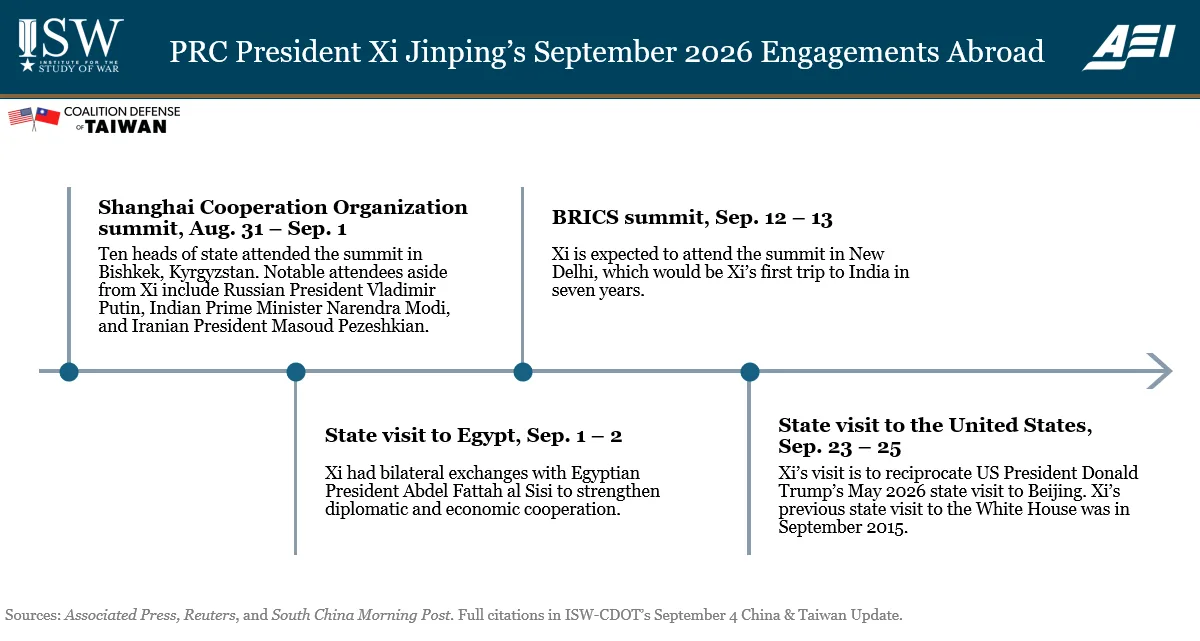
CCP General Secretary Xi Jinping’s September 2026 itinerary is his busiest series of diplomatic engagements abroad in over seven years, reflecting PRC efforts to assert itself as a global leader.[30] Xi attended the Shanghai Cooperation Organization (SCO) summit in Bishkek, Kyrgyzstan, from August 31 to September 1.[31] The PRC and Russia helped found the SCO as an alternative to Western-led multilateral institutions. Other notable individuals in attendance included Russian President Vladimir Putin, Indian Prime Minister Narendra Modi, and Iranian President Masoud Pezeshkian.[32] Xi delivered two speeches, which promoted the SCO’s importance for multilateral cooperation and development and emphasized the importance of dialogue for fair governance.[33] Xi’s bilateral meetings with Putin and Pezeshkian on the sidelines further illustrate PRC engagement with countries adversarial to the West.[34] The SCO notably unanimously condemned US strikes on Iran.[35]
Xi also made official state visits to Kyrgyzstan, the SCO host country, from August 30 to September 1 and Egypt from September 1 to 2.[36] Xi met with Kyrgyzstan President Sadyr Japarov and signed over 30 cooperative agreements.[37] PRC state media outlet Xinhua noted that this is the first time Japarov has invited a foreign head of state to his residence.[38] Xi then traveled to Cairo, the first visit by a PRC head of state to Egypt in 10 years, which Xinhua framed as “a significant diplomatic move” toward the Middle East.[39] Xi stated that Cairo and Beijing should jointly oppose “unilateralism and acts of bullying,” repeating standard PRC rhetoric that implicitly criticizes US policy under the current administration.[40]
The PRC has consistently framed itself as a supporter of multilateralism in implicit contrast to the United States, capitalizing on global discontent with new US tariffs and the US’s war with Iran. Xi’s series of diplomatic engagements leading up to his meeting with US President Donald Trump in late September likely seeks to demonstrate the PRC’s geopolitical importance and attempt to improve Xi’s position ahead of the talks. Xi will likely attend the BRICS summit in New Delhi from September 12 to 13, which would be his first visit to India in seven years.[41] Xi is also scheduled to have a state visit to the United States from September 23 to 25 for the first time in 11 years.[42]
[43]
The PLA continues to demonstrate efforts to learn select tactical lessons from the battlefield in Ukraine, with an emphasis on efforts to restore maneuver to the modern battlefield. The PLA also likely envisions future warfare displaying certain characteristics distinct from the war in Ukraine, particularly in the complexity and survivability of unmanned systems and the role of AI. Official PLA newspaper PLA Daily published an article on September 2 focused on Russian efforts to decrease the vulnerability of armored vehicles to unmanned systems, highlighting innovations like placing large wire cages around vehicles, mounting electromagnetic countermeasures on tanks, and equipping tanks with active protection systems (APS).[44] The article stated that more advanced protection measures like APS would become increasingly important for future armored operations.[45] ISW reported that Russia experimented with using APS to restore maneuver to the battlefield by increasing armored survivability.[46] APS does not neutralize the threat that drones pose to armored vehicles, however.[47] ISW-CDOT also reported that the PLA was equipping its older ZTZ-96 main battle tanks with APS in April.[48] Another September 2 PLA Daily article focused on the development of interceptor drones in Russia and Ukraine and noted that the widespread development of interceptor drones would become inevitable on the modern battlefield due to the need to counter the threat drones pose to personnel and equipment.[49] These reflections suggest that elements of the PLA are examining tactical dynamics in Ukraine to think through how maneuver will be restored to the modern battlefield.
Other PLA reflections on future warfare suggest that advancements in unmanned technology and AI will transform the problem of maneuver as it has manifested in Ukraine. A September 2 PLA Daily article discussed the development of unmanned amphibious vehicles and their utility in future amphibious warfare.[50] The article suggested that complex unmanned amphibious vehicles could form the vanguard of a future amphibious landing, traversing the “kill zone” between amphibious assault ships and the beach before preparing the beachhead for follow-on forces and manned platforms.[51] A September 1 PLA Daily article expanded on the future of manned-unmanned warfare, describing a situation in which AI takes over data processing, operational planning, and target identification, allowing human commanders to focus on critical decision-making and the overall operational picture.[52] These discussions indicate that elements of the PLA view future unmanned systems as survivable and capable of taking over complex tactical tasks from manned systems, while AI will increasingly define battlefield information and awareness.
These observations, taken together, may indicate that the PLA believes restoring maneuver to the future battlefield will require some technical improvements to existing equipment and forces but will ultimately depend on AI-enabled informational and unmanned superiority. ISW-CDOT has assessed that the PLA is discussing a new domain of strategy and a new way of war in which a military’s center of gravity lies in the discernment of its AI algorithms and ability to deceive an adversary’s algorithms.[53] The PLA likely believes that while traditional maneuver forces relied on material superiority and concentration of force, future maneuver elements would depend upon information superiority created, in part, through effective use of AI to successfully maneuver on the battlefield. Critical failure in the information domain, according to this view of future warfare, would create cascading failures, rendering any material disparity between opposing forces largely irrelevant.[54] The PLA’s efforts to restore maneuver to the modern battlefield may center primarily on information technology and AI-enabled unmanned systems warfare, as a result.
Northeast Asia
Japan
The PRC may be setting information conditions for future military action against Japan. The PRC likely seeks to portray its aggressive activity against Japan as actions against Japanese “militarism.” A PRC Ministry of Foreign Affairs (MFA) spokesperson stated on September 2 that the United Nations (UN) Charter’s “enemy state” clause remains in effect against former Axis powers, including Japan.[55] The “enemy state” clause refers to several measures in the UN Charter that allow signatories to take military action, without needing UN Security Council approval, against former Axis states to prevent a “renewal of aggressive policy.”[56] The PRC previously supported removing the clause from the UN Charter. The PRC’s invocation of this clause against Japan reflects a reversal in policy, likely caused by worsening PRC-Japan relations.[57] The PRC MFA spokesperson further stated that the clause holds “particular significance” considering Japan’s efforts to “remilitarize.”[58] The PRC Embassy in Japan cited the clause in November 2025 in response to Japanese Prime Minister Takaichi Sanae’s suggestion that Japan would be involved in a Taiwan contingency.[59]
The PRC could use the enemy state clause to frame future aggression against Japan as being within the bounds of international law. The PRC has undertaken a massive diplomatic, economic, and military effort to dissuade Japan from modernizing its military, including conducting aircraft carrier deployments near Japan in December 2025 and May 2026.[60] The PRC’s efforts have, so far, not succeeded in dissuading Japan from increasing its military spending and discussing revisions to its pacifist constitution.[61] The PRC likely views a modernized Japanese military as a significant threat to its regional ambitions and may be developing options for short-of-war or outright military action against Japan. A PRC attack on Japan remains highly unlikely, however. The PRC’s discussion of the enemy state clause may be an effort to prepare informational conditions should the PRC deem some form of military action against Japan necessary.
Oceania
PRC influence over Pacific island states may have disrupted attempts at the Pacific Islands Forum (PIF) to issue a joint criticism of a PRC missile test. The PIF is an annual gathering of Pacific Islands leaders that focuses on issues of common economic and political concern. Four national leaders — from Kiribati, New Caledonia, the Solomon Islands, and Vanuatu — were absent from this year’s PIF, however.[62] Solomon Islands Prime Minister Matthew Wale left Palau shortly after arriving to address a vote of no confidence pitched in the Solomon Islands parliament.[63] New Zealand Foreign Minister Winston Peters implied that foreign interference might have caused the absences but did not directly name any countries responsible for the interference.[64] The PRC MFA denied the indirect accusation, however.[65]
Palau led efforts — backed by Australia — to rally Pacific island nations to produce a joint statement criticizing the PRC’s July missile test in the Pacific.[66] The July test involved a submarine-launched intercontinental ballistic missile (ICBM), which ultimately landed in the South Pacific Nuclear-Free Zone.[67] Australian Prime Minister Anthony Albanese criticized the test, which he said took place with “very little warning.”[68] The PRC MFA objected to these efforts, calling Palau’s intentions “malicious” in a press conference on September 3.[69] The Pacific nations ultimately failed to produce a unanimous and strongly worded statement on the missile test, however. Some participating states made a statement expressing “concern” over the test but not strongly condemning it.[70] Naoero (formerly known as Nauru) dissented from the statement, and Kiribati did not participate.[71] Kiribati and Naoero both recognize the PRC over Taiwan, unlike Palau.[72] Palauan President Surangel Whipps Jr. has accused the PRC of targeting Palau with economic and short-of-war coercion, possibly due to its recognition of Taiwan.[73]
The PRC likely views the PIF as an instrument to pursue its regional policy goals, including its goals toward Taiwan. The PRC consistently attempts to exert influence over the PIF to delegitimize and isolate Taiwan. The PRC objected to Taiwan’s 2026 participation in the PIF and threatened “consequences,” consistent with its past stance aimed at excluding Taiwan from participating.[74] The PRC is considered a “dialogue partner” of the PIF, along with the United States, Japan, India, Canada, Britain, and the European Union.[75] Taiwan is not a member of the PIF but has since 1993 been considered a “development partner,” which typically holds events on the sidelines of the event.[76]
Russia
PRC MFA spokesman Guo Jiakun declined to confirm whether CCP General Secretary Xi Jinping and Russian President Vladimir Putin discussed the “Power of Siberia 2” pipeline at the SCO summit. The PRC is likely using its strong influence over SCO states and strategic partnership with Russia to advance PRC rhetoric and norms, while sidelining Russia’s interests. Xi and Putin met on the sidelines of the SCO summit in Bishkek, Kyrgyzstan, on August 31.[77] Putin reportedly stated that Russia was ready to strengthen bilateral energy cooperation with the PRC, in addition to other areas of cooperation.[78] Xi’s comments at the meeting largely emphasized PRC cooperation with SCO countries to promote “global governance reform,” regional stability, and multipolarity.[79]
Russian Energy Minister Sergei Tsivilev stated on September 2 that Russia is in the “final stages of moving to the construction” of the pipeline and that Putin had renamed the project “Power of Baikal.”[80] Guo did not confirm to reporters during a September 1 press conference whether Xi and Putin discussed the proposed “Power of Baikal” liquefied natural gas (LNG) pipeline.[81]
The “Power of Baikal” pipeline would reportedly more than double the volume of annual Russian LNG exports to the PRC once completed.[82] The PRC only generates about 4 percent of its electricity from natural gas and maintains a significant LNG stockpile and domestic production capacity.[83] Russian LNG only comprised around 12.5 percent of the PRC’s LNG imports from January to July.[84] Most of the growth in Russian LNG exports to the PRC in 2026 came from increased seaborne exports from Russia’s Arctic LNG 2 Project, not from LNG exported through Russia-PRC pipelines.[85] The PRC is thus highly resilient against LNG supply shocks and likely does not urgently need the increased LNG imports that “Power of Baikal” could provide. Increased Russian LNG exports to the PRC could also crowd out domestic PRC producers, eroding PRC energy autonomy and resilience.[86]
The PRC likely aims to continue publicly promoting PRC-Russian alignment on political objectives, such as promoting multipolarity and the “community of common destiny,” and opposing US and Western sanctions while avoiding becoming overly reliant on Russia or committing to support Russian economic interests. The PRC invested significantly in Russia’s Yamal LNG project in 2014 to save it from collapse after Western sanctions impacted the project.[87] The PRC is likely refusing to commit to supporting the “Power of Baikal” to avoid becoming embroiled in a similar funding crisis for a project the PRC likely views as nonessential for its energy security.

[1] http://www.npc.gov dot cn/npc/c2/c30834/202608/t20260828_457247.html
[2] https://www.scmp dot com/news/china/military/article/3365993/china-highlights-advanced-wartime-tech-defence-mobilisation-law-update?module=top_story&pgtype=section
[3] http://www.npc.gov dot cn/npc/c2/c30834/202608/t20260828_457247.html ; https://www.scmp dot com/news/china/military/article/3365993/china-highlights-advanced-wartime-tech-defence-mobilisation-law-update?module=top_story&pgtype=section
[4] https://www.taiwannews.com dot tw/news/6431616;
[5] http://www.npc.gov dot cn/npc/c2/c30834/202608/t20260828_457247.html ; https://www.scmp dot com/news/china/military/article/3365993/china-highlights-advanced-wartime-tech-defence-mobilisation-law-update?module=top_story&pgtype=section
[6] https://understandingwar.org/research/china-taiwan/china-taiwan-update-november-25-2025/
[7] https://quasa.io/media/top-10-drone-manufacturing-countries-in-2025-global-leaders-trends-and-analysis; https://www.dronebrands.org/who-is-the-largest-drone-exporter-in-the-world/
[8] http://www.npc.gov dot cn/npc/c2/c30834/202608/t20260828_457247.html; https://www.scmp dot com/news/china/military/article/3365993/china-highlights-advanced-wartime-tech-defence-mobilisation-law-update?module=top_story&pgtype=section; https://www.taiwannews.com dot tw/news/6431616
[9] https://www.airuniversity.af.edu/Portals/10/CASI/documents/Translations/2022-01-26%202020%20Science%20of%20Military%20Strategy.pdf; http://eng.chinamil.com dot cn/OPINIONS_209196/Opinions_209197/16400232.html
[10] http://eng.chinamil.com dot cn/OPINIONS_209196/Opinions_209197/16400232.html; https://www.airuniversity.af.edu/Portals/10/CASI/documents/Translations/2022-01-26%202020%20Science%20of%20Military%20Strategy.pdf
[11] https://digital-commons.usnwc.edu/cgi/viewcontent.cgi?article=1075&context=cmsi-translations; https://www.scmp dot com/news/china/military/article/3351887/why-beijings-weaponised-cargo-ship-could-be-crucial-player-taiwan-strait?module=top_story&pgtype=subsection
[12] https://www.reuters.com/world/china/chinese-shipper-cosco-collects-intel-beijing-with-concealed-equipment-us-2026-09-01/
[13] https://www.reuters.com/world/china/chinese-shipper-cosco-collects-intel-beijing-with-concealed-equipment-us-2026-09-01/
[14] https://www.reuters.com/world/china/chinese-shipper-cosco-collects-intel-beijing-with-concealed-equipment-us-2026-09-01/
[15] https://www.globaltimes dot cn/page/202609/1369626.shtml
[16] https://www.reuters.com/world/china/chinese-shipper-cosco-denies-its-vessels-spied-beijing-2026-09-04/
[17] https://lines.coscoshipping dot com/home/about/about/profile
[18] https://na.coscoshipping dot com/col27430/art/2023/art_27430_331754.html; https://carnegieendowment.org/posts/2025/02/examining-the-prcs-strategic-port-investments-in-the-western-hemisphere-and-the-implications-for-homeland-security
[19] https://carnegieendowment.org/posts/2025/02/examining-the-prcs-strategic-port-investments-in-the-western-hemisphere-and-the-implications-for-homeland-security
[20] https://www.csis.org/analysis/examining-prcs-strategic-port-investments-western-hemisphere-and-implications-homeland
[21] https://www.reuters.com/world/asia-pacific/chinas-cosco-shipping-suspends-operations-panamas-balboa-port-la-prensa-media-2026-03-10/
[22] https://www.csis.org/analysis/examining-prcs-strategic-port-investments-western-hemisphere-and-implications-homeland; https://homeland.house.gov/2025/01/22/chairmen-green-gimenez-moolenaar-press-the-coast-guard-on-screening-vetting-of-ccp-backed-shipping-corporations-operations-at-us-ports/; https://www.congress.gov/119/meeting/house/119432/witnesses/HHRG-119-FA05-Wstate-SadlerB-20260722.pdf
[23] https://news.usni.org/2026/01/07/chinese-merchant-ship-sports-electromagnetic-drone-launcher-vertical-launching-systems; https://www.newsweek.com/russias-pearl-harbor-fuels-fears-over-chinese-cargo-ships-us-ports-2080051
[24] https://www.reuters.com/investigations/china-is-mapping-ocean-floor-it-prepares-submarine-warfare-with-us-2026-03-24/; https://understandingwar.org/research/china-taiwan/china-taiwan-update-june-12-2026/
[25] https://understandingwar.org/research/china-taiwan/china-taiwan-update-january-2-2026/; https://chinapower.csis.org/analysis/china-construct-ro-ro-vessels-military-implications/
[26] https://www.qtc.moj.gov dot tw/10181/10255/10257/1434366/post; https://www.taipeitimes dot com/News/taiwan/archives/2026/09/01/2003863484
[27] https://www.qtc.moj.gov dot tw/10181/10255/10257/1434366/post; https://www.taipeitimes dot com/News/taiwan/archives/2026/09/01/2003863484; https://focustaiwan dot tw/society/202608310014; https://www.rti.org dot tw/news?uid=3&pid=229226
[28] https://www.qtc.moj.gov dot tw/10181/10255/10257/1434366/post; https://www.taipeitimes dot com/News/taiwan/archives/2026/09/01/2003863484; https://focustaiwan dot tw/society/202608310014; https://www.rti.org dot tw/news?uid=3&pid=229226
[29] https://www.taipeitimes dot com/News/front/archives/2026/05/07/2003856894
[30] https://www.bloomberg.com/news/articles/2026-09-01/xi-s-busiest-travel-itinerary-in-seven-years-is-all-about-trump
[31] https://apnews.com/article/shanghai-cooperation-organization-russia-china-india-cf543dfad0a20097ed4c2b415a26e8b4
[32] https://thediplomat.com/2026/08/after-25-years-the-shanghai-cooperation-organization-faces-an-uncertain-future/; https://apnews.com/article/shanghai-cooperation-organization-russia-china-india-cf543dfad0a20097ed4c2b415a26e8b4
[33] https://www.fmprc.gov dot cn/zyxw/202609/t20260901_12013951.shtml; https://www.fmprc.gov dot cn/zyxw/202609/t20260901_12013896.shtml; https://www.fmprc dot gov.cn/zyxw/202609/t20260901_12014047.shtml
[34] https://www.reuters.com/world/china/chinas-xi-tells-putin-that-foundations-ties-will-be-stronger-2026-08-31/; https://www.fmprc.gov dot cn/zyxw/202608/t20260831_12013401.shtml; https://www.scmp dot com/news/china/diplomacy/article/3365890/xi-putin-vow-deepen-strategic-ties-after-meeting-sco-summit?module=top_story&pgtype=section; https://en.irna dot ir/news/86252077/Pezeshkian-Xi-hold-brief-talks-on-sidelines-of-SCO-summit; https://www.cnbc.com/2026/09/02/china-trump-iran-summit-nuclear-trade-tariffs-sanctions-.html
[35] https://www.scmp dot com/news/china/diplomacy/article/3366129/iran-wins-sco-backing-against-us-strikes-will-it-be-enough?module=top_story&pgtype=section
[36] https://www.news dot cn/world/20260903/d182f885d24543588da3cd205527666c/c.html
[37] https://www.news dot cn/world/20260903/d182f885d24543588da3cd205527666c/c.html
[38] https://www.news dot cn/world/20260903/d182f885d24543588da3cd205527666c/c.html
[39] https://www.news dot cn/world/20260903/d182f885d24543588da3cd205527666c/c.html
[40] https://apnews.com/article/egypt-china-middle-east-iran-war-us-946c3b90b6251c08fdcb219e24a088a2
[41] https://www.reuters.com/world/china/chinas-xi-likely-visit-india-with-big-delegation-first-time-seven-years-2026-08-24/; https://www.indiatoday dot in/world/story/xi-jinping-india-visit-brics-summit-delhi-400-member-delegation-china-7-years-2979416-2026-08-25
[42] https://www.scmp dot com/news/china/diplomacy/article/3353761/xi-jinping-pay-first-state-visit-us-more-decade-trump-says
[43] https://apnews.com/article/shanghai-cooperation-organization-russia-china-india-cf543dfad0a20097ed4c2b415a26e8b4; https://apnews.com/article/egypt-china-middle-east-iran-war-us-946c3b90b6251c08fdcb219e24a088a2 ; https://www.reuters.com/world/china/chinas-xi-likely-visit-india-with-big-delegation-first-time-seven-years-2026-08-24/; https://www.scmp dot com/news/china/diplomacy/article/3353761/xi-jinping-pay-first-state-visit-us-more-decade-trump-says
[44] http://www.81 dot cn/yw_208727/16482938.html
[45] http://www.81 dot cn/yw_208727/16482938.html
[46] https://understandingwar.org/research/russia-ukraine/russian-offensive-campaign-assessment-august-9-2026/
[47] https://understandingwar.org/research/russia-ukraine/russian-offensive-campaign-assessment-august-9-2026/
[48] https://understandingwar.org/research/china-taiwan/china-taiwan-update-april-10-2026/
[49] http://www.81 dot cn/yw_208727/16482939.html
[50] http://www.81 dot cn/yw_208727/16482936.html
[51] http://www.81 dot cn/yw_208727/16482936.html
[52] http://www.81 dot cn/yw_208727/16482644.html
[53] https://understandingwar.org/research/china-taiwan/china-taiwan-update-august-25-2026/
[54] https://understandingwar.org/research/china-taiwan/china-taiwan-update-august-25-2026/; https://understandingwar.org/research/china-taiwan/china-taiwan-update-july-10-2026/; https://digital-commons.usnwc.edu/cmsi-translations/90/
[55] https://www.mfa.gov dot cn/web/wjdt_674879/fyrbt_674889/202609/t20260902_12015002.shtml
[56] https://legal.un.org/repertory/art53.shtml
[57] https://docs.un.org/en/A/RES/50/52; https://x.com/MofaJapan_en/status/1992511156913901804?s=20
[58] https://www.fmprc.gov dot cn/fyrbt_673021/202609/t20260902_12015002.shtml
[59] https://www.globaltimes dot cn/page/202511/1348768.shtml
[60] https://militarywatchmagazine.com/article/china-liaoning-carrier-japan-fleet; https://defencesecurityasia.com/en/china-liaoning-carrier-strike-group-live-fire-western-pacific-indo-pacific-taiwan/
[61] https://news.usni.org/2025/12/03/japan-poised-to-increase-defense-spending-to-70-billion-2-of-its-gdp; https://www.nbcnews.com/world/asia/japan-approves-scrapping-ban-lethal-weapons-exports-rcna341143; https://www.bloomberg.com/news/features/2026-03-13/japan-s-sanae-takaichi-pushes-to-revise-pacifist-constitution
[62] https://asia.nikkei.com/politics/international-relations/china-leader-absences-hang-over-key-pacific-islands-forum-meeting-in-palau
[63] https://apnews.com/article/pacific-islands-forum-palau-china-taiwan-5b5811d8a4f7bb18761b84255661f8db; https://asia.nikkei.com/politics/international-relations/china-leader-absences-hang-over-key-pacific-islands-forum-meeting-in-palau
[64] https://www.abc.net.au/news/2026-08-30/solomon-islands-prime-minister-no-confidence-motion/107094924
[65] https://www.fmprc.gov dot cn/fyrbt_673021/202609/t20260901_12014070.shtml
[66] https://www.abc.net.au/news/2026-08-31/pacific-islands-forum-leaders-meeting-politically-charged/107095316; https://asia.nikkei.com/politics/international-relations/china-leader-absences-hang-over-key-pacific-islands-forum-meeting-in-palau; https://www.abc.net.au/news/2026-09-03/australia-palau-push-to-condemn-china-over-missile-test/107110624
[67] https://www.csis.org/analysis/chinas-slbm-test-underscores-importance-ballistic-missile-launch-notification-agreement
[68] https://www.abc.net.au/news/2026-09-03/australia-palau-push-to-condemn-china-over-missile-test/107110624
[69] https://www.fmprc.gov dot cn/fyrbt_673021/202609/t20260903_12015775.shtml
[70] https://apnews.com/article/pacific-islands-forum-china-missile-launch-palau-cc1d1750ef59bfe8e44a6770b1b7d3fb
[71] https://apnews.com/article/pacific-islands-forum-china-missile-launch-palau-cc1d1750ef59bfe8e44a6770b1b7d3fb; https://www.reuters.com/world/china/pacific-summit-backs-concerns-over-china-missile-test-despite-nauru-dissent-2026-09-04/
[72] https://asia.nikkei.com/politics/international-relations/taiwan-foreign-minister-decries-chinese-bullying-at-pacific-forum
[73] https://apnews.com/article/palau-china-surangel-whipps-beijing-pacific-influence-045ec0a4f8e67e48d2a4adf0cbd13918; https://www.scmp dot com/news/asia/australasia/article/3286354/palau-accuses-china-uninvited-maritime-intrusions
[74] https://www.abc.net.au/news/2026-09-01/china-warns-of-consequences-over-taiwan-attendance/107100296; https://apnews.com/article/pacific-islands-forum-palau-china-taiwan-5b5811d8a4f7bb18761b84255661f8db; https://asia.nikkei.com/politics/international-relations/taiwan-foreign-minister-decries-chinese-bullying-at-pacific-forum; https://apnews.com/article/china-taiwan-pacific-islands-forum-beijing-taipei-98d61be45393e17135c4f88f7bd5e4ee
[75] https://www.theguardian.com/world/2026/sep/01/china-warns-of-consequences-taiwan-pacific-islands-forum-palau
[76] https://focustaiwan dot tw/politics/202608260012
[77] https://www.fmprc.gov dot cn/zyxw/202608/t20260831_12013401.shtml
[78] https://www.fmprc.gov dot cn/zyxw/202608/t20260831_12013401.shtml; https://understandingwar.org/research/russia-ukraine/russian-offensive-campaign-assessment-september-1-2026/
[79] https://www.fmprc.gov dot cn/zyxw/202608/t20260831_12013401.shtml
[80] https://www.reuters.com/business/energy/russias-putin-renames-planned-power-siberia-2-pipeline-power-baikal-pipeline-2026-09-02/; https://tass dot ru/ekonomika/28068871
[81] https://www.fmprc.gov dot cn/fyrbt_673021/202609/t20260901_12014070.shtml
[82] https://www.reuters.com/business/energy/russias-putin-renames-planned-power-siberia-2-pipeline-power-baikal-pipeline-2026-09-02/
[83] https://www.nytimes.com/2026/04/08/business/china-natural-gas-reserves-iran-war.html
[84] https://www.spglobal.com/energy/en/news-research/latest-news/lng/082826-russian-lng-gains-traction-in-china-as-arctic-lng-2-deliveries-increase
[85] https://www.spglobal.com/energy/en/news-research/latest-news/lng/082826-russian-lng-gains-traction-in-china-as-arctic-lng-2-deliveries-increase
[86] https://www.spglobal.com/energy/en/news-research/latest-news/lng/082826-russian-lng-gains-traction-in-china-as-arctic-lng-2-deliveries-increase
[87] https://www.csis.org/analysis/how-power-siberia-2-deal-could-reshape-global-energy