The Institute for the Study of War (ISW) and The Critical Threats Project (CTP) at the American Enterprise Institute are publishing daily updates to provide analysis on the war with Iran. The updates cover events from the past 24-hour period.
Note: ISW-CTP has revised its update structure due to the resumption of war between the United States and Iran. Iran is currently engaged in an information effort to frame its attacks on US bases and regional states as retaliatory and defensive. Iran is not merely responding to US strikes on Iran, however, but is engaged in proactive military operations to achieve discrete objectives. The revised update structure reflects some of these key objectives.
Key Takeaways
- Iranian Supreme Leader Mojtaba Khamenei may be trying to reduce President Masoud Pezeshkian and other “pragmatist” officials’ ability to influence the regime’s approach toward the United States in the current conflict. Senior cleric Mohammad Bagher Kharrazi, who has familial ties to Mojtaba, claimed on August 3 that Mojtaba formally warned Pezeshkian that he would accept Pezeshkian’s resignation if Pezeshkian tried to resign again. Mojtaba may have made this warning to prevent Pezeshkian from using the threat of his resignation to influence regime policies.
- Kharrazi’s comments come as a contingent of “pragmatist” regime officials has directly and indirectly questioned how much effort the regime should exert to control the Strait of Hormuz. Former Iranian Foreign Affairs Minister Mohammad Javad Zarif, who played a central role in the 2015 Joint Comprehensive Plan of Action (JCPOA) negotiations, warned on August 3 that a prolonged closure or “short-term exploitation” of the Strait of Hormuz could generate an international consensus against Iran, including from the People’s Republic of China (PRC).
- The Islamic Revolutionary Guard Corps (IRGC) faction that currently appears to be dominating regime decision-making has likely not diverged from its maximalist positions and will likely maintain these positions in reported upcoming talks with the United States, however. Supreme Leader Military Adviser Major General Mohsen Rezaei, whom ISW-CTP assesses is part of the IRGC faction controlling regime decision-making, stated on August 3 that Iran will not allow the use of a second corridor in the strait “under any circumstances.”
- The IRGC continued to use force to assert Iranian control over the Strait of Hormuz on August 2, which reflects the IRGC’s unwillingness to compromise on its control over the waterway. United Kingdom Maritime Trade Operations (UKMTO) reported on August 2 that an explosion occurred near a civilian vessel off the coast of Oman.
- Mojtaba may be trying to increase his influence over key regime institutions, including the Supreme National Security Council (SNSC). Kharrazi claimed that Mojtaba wants to replace Vahidi-appointed SNSC Secretary Mohammad Bagher Zolghadr with one of his military advisers, former IRGC Commander Major General Mohsen Rezaei. Iranian outlet Tabnak, which is affiliated with Rezaei, notably circulated Kharrazi’s claim.
Toplines
Iranian Supreme Leader Mojtaba Khamenei may be trying to reduce President Masoud Pezeshkian and other “pragmatist” officials’ ability to influence the regime’s approach toward the United States in the current conflict. Senior cleric Mohammad Bagher Kharrazi, who has familial ties to Mojtaba, claimed on August 3 that Mojtaba formally warned Pezeshkian in a written statement that he would accept Pezeshkian’s resignation if Pezeshkian tried to resign again.[1] Kharrazi claimed that the warning caused Pezeshkian to “back down.”[2] Mojtaba may have made this warning to prevent Pezeshkian from using the threat of his resignation to influence regime policies. Four senior Iranian officials told the New York Times on July 4 that Pezeshkian previously threatened to resign if Mojtaba rejected the US-Iran memorandum of understanding (MoU), which increased pressure on Mojtaba to approve the deal.[3] Mojtaba stated on June 18 that he had authorized the MoU despite holding “a different opinion in principle” and emphasized that Pezeshkian and the Supreme National Security Council (SNSC) are responsible for protecting Iranian and Axis of Resistance interests.[4] ISW-CTP assessed on June 18 that Mojtaba likely placed responsibility for the agreement on Pezeshkian and the SNSC to distance himself from any failure resulting from the MoU or negotiations.[5] Kharrazi does not appear to hold significant influence over current regime decision-making, and he provided no evidence to substantiate his claims. His remarks are nevertheless noteworthy given his familial ties to Mojtaba Khamenei and Kamal Kharrazi, who previously served as a senior adviser to the Supreme Leader.[6]
Kharrazi’s comments come as a contingent of “pragmatist” regime officials has directly and indirectly questioned how much effort the regime should exert to control the Strait of Hormuz. Former Iranian Foreign Affairs Minister Mohammad Javad Zarif, who played a central role in the 2015 Joint Comprehensive Plan of Action (JCPOA) negotiations, warned on August 3 that a prolonged closure or “short-term exploitation” of the Strait of Hormuz could generate an international consensus against Iran, including from the People’s Republic of China (PRC).[7] Zarif added that Iran has a time-sensitive window of opportunity to capitalize on its control of the strait and argued that Iran should use the strait as leverage in negotiations to recover economically and avoid further US military action.[8] Zarif previously served as the vice president for strategic affairs under President Masoud Pezeshkian, who has similarly advocated for a diplomatic settlement to end the war.[9] Pezeshkian stated on August 2 that all SNSC members supported the MoU and that Iran must strive to compel the United States to uphold it, suggesting that Pezeshkian supports a return to the MoU and may, therefore, not support continued fighting over the Strait of Hormuz.[10] An Iranian media outlet that was previously associated with Iran’s chief negotiator and Parliament Speaker Mohammad Bagher Ghalibaf also argued in July that Iran does not have to allocate excessive resources to controlling the strait, particularly if doing so requires Iran to sacrifice other objectives, such as preserving its nuclear program or ensuring regime stability.[11] Araghchi, who is also part of Iran’s negotiating delegation, also reportedly expressed support for a recent US- and Qatari-formulated proposal in which inbound traffic in the Strait of Hormuz would go through Iranian waters while outbound traffic would pass through Omani waters.[12]
The Islamic Revolutionary Guard Corps (IRGC) faction that currently appears to be dominating regime decision-making has likely not diverged from its maximalist positions and will likely maintain these positions in reported upcoming talks with the United States. US President Donald Trump announced on August 2 that US and Iranian officials would soon meet to discuss reopening the Strait of Hormuz and nuclear issues.[13] Supreme Leader Military Adviser Major General Mohsen Rezaei, whom ISW-CTP assesses is part of the IRGC faction controlling regime decision-making, stated on August 3 that Iran will not allow the use of a second corridor in the strait “under any circumstances.”[14] It is unclear whether Rezaei was referring to the recent proposal about inbound and outbound traffic or the current southern route along the Omani coast, but Rezaei’s statement nevertheless highlights his view that traffic through the Strait of Hormuz must only pass through Iran’s traffic separation scheme. The Wall Street Journal separately reported on August 3 that Iranian negotiators supported the proposal on inbound and outbound traffic but that they are awaiting approval from the IRGC.[15] This report highlights how the IRGC continues to wield outsized authority in the regime. On August 2, IRGC-affiliated media denied that Iran had agreed to reopen the strait. The Assembly of Experts, which is an 88-member clerical body that is responsible for appointing and supervising the Supreme Leader, separately described on August 3 “calls for surrender” in negotiations with the United States as an “unforgivable betrayal” and grounds for legal action.[16]
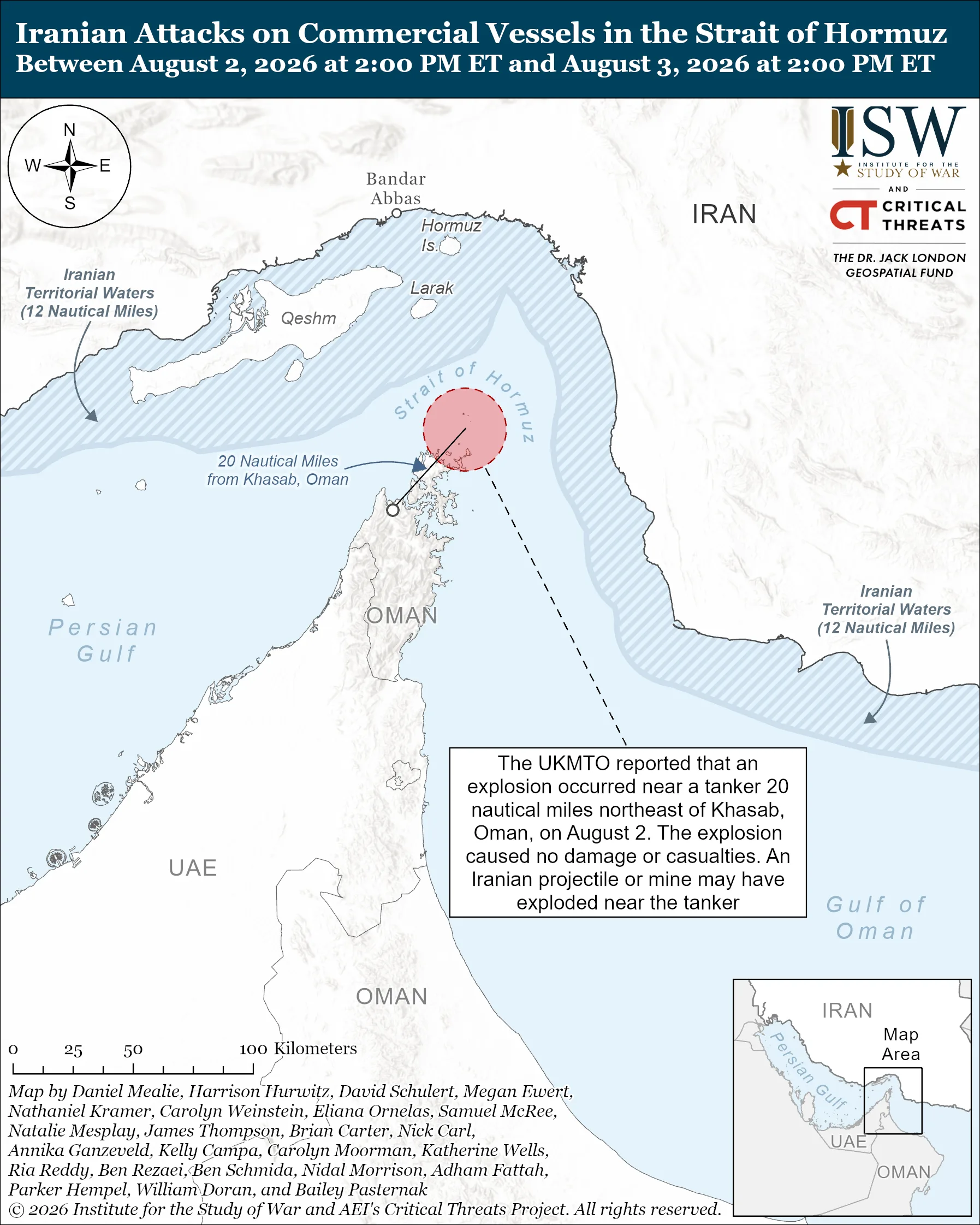
The IRGC continued to use force to assert Iranian control over the Strait of Hormuz on August 2, which reflects the IRGC’s unwillingness to compromise on its control over the waterway. United Kingdom Maritime Trade Operations (UKMTO) reported on August 2 that an explosion occurred near a civilian vessel off the coast of Oman.[17] An Iranian projectile or mine may have exploded near the tanker. The IRGC Navy has repeatedly attacked vessels attempting to transit through the strait using the southern route along Oman’s coast because traffic on this route undermines Iranian efforts to assert full control over the strait.
Mojtaba may be trying to increase his control over key regime institutions. Kharrazi claimed that Mojtaba wants to replace SNSC Secretary Mohammad Bagher Zolghadr with Major General Mohsen Rezaei.[18] The SNSC is the regime’s highest national security and foreign policy decision-making body.[19] IRGC Commander Major General Ahmad Vahidi previously pressured Pezeshkian to appoint Zolghadr as the SNSC secretary.[20] Mojtaba appointed Rezaei as one of his military advisers in March.[21] Rezaei’s appointment as a military adviser was one of only three political appointments that Mojtaba has made since becoming Supreme Leader in March.[22] Mojtaba’s reported desire to replace Zolghadr with Rezaei may reflect an effort by Mojtaba to assert more direct control over the SNSC by removing Vahidi’s appointee and replacing him with Rezaei, who is part of his inner circle. Iranian outlet Tabnak, which is affiliated with Rezaei, notably circulated Kharrazi’s claim.[23]
US and Partner Military Operations
Nothing significant to report.
Iranian Strike Campaign
Assessed Iranian War Aims:
- Secure international recognition of Iranian control over the Strait of Hormuz
- Degrade the US ability and willingness to continue the war
- Restore deterrence vis-à -vis the United States and its regional partners
- Divide the United States and Israel from the Arab states
Nothing significant to report.
US-Iran Negotiations
See topline section.
Iranian Domestic Affairs
An Artesh Ground Forces special forces brigade reportedly conducted multiple ground raids against Kurdish opposition groups in Iraqi Kurdistan, which would be consistent with the Iranian regime’s heightened concern about the threat that these groups pose to Iranian security.[24] An adviser to the Artesh commander, Brigadier General Mojtaba Jafari, claimed on August 3 that the Artesh’s “23rd Nohed Brigade” conducted at least 14 raids against anti–regime Kurdish fighters in Erbil and Sulaymaniyah provinces, killing and capturing several Kurdish fighters.[25] No Iraqi or Kurdish sources have confirmed Jafari’s claim at the time of this writing, and it remains unclear when the Iranian special forces raids took place. Jafari made the claim during a press conference discussing Iranian armed forces achievements during the 12-Day War and the current US-Iran War, suggesting that the Artesh conducted these raids in one or both of these conflicts.[26] The “23rd Nohed Brigade” is likely the Artesh Ground Forces 65th Airborne Special Forces Brigade, also referred to as NOHED, which separated from the Artesh Ground Forces 23rd Division in the early 1990s.[27] The 65th Brigade is an elite Artesh special forces unit that specializes in irregular warfare and previously deployed to Syria during the civil war in 2016.[28]
Jafari’s claim comes amid heightened regime concern about the threat of Kurdish opposition groups. IRGC Ground Forces Commander Brigadier General Mohammad Karami threatened to turn northwestern Iran into a “graveyard” if anti-regime groups attacked Iranian forces during a field tour of the IRGC Ground Forces Hamzeh Seyyed ol Shohada Operational Base in northwestern Iran on August 3.[29] Karami’s statement follows an increase in Kurdish anti-regime activity along Iran’s northwestern border, including a likely Kurdistan Free Life Party (PJAK) engagement with IRGC forces from the IRGC Ground Forces Hamzeh Seyyed ol Shohada Operational Base in Mahabad and Piranshahr cities in West Azerbaijan Province.[30] Armed Forces General Staff-run Defa Press previously reported in June that Iran had replaced “purely defensive reactions” with an “active deterrence” doctrine against Kurdish fighters while closely monitoring Kurdish-populated provinces.[31] Iran may have also deployed reinforcements to the Iran-Iraq border in July over concerns that Kurdish opposition groups would exploit heightened US-Iran tensions, according to Iraqi media.[32] Iran and Iranian-backed Iraqi militias have consistently conducted drone attacks on anti-regime Kurdish fighters since the US-Iran War began on February 28.[33] Jafari’s statement is the first claim that ISW-CTP has observed that Iran has conducted ground operations against these groups in the conflict, however.
Lebanon
Lebanese President Joseph Aoun met with the Beirut Rafic Hariri International Airport Security Chief, Lebanese Armed Forces (LAF) Brigadier General Fadi Kfoury, on August 3 to discuss efforts to strengthen airport security.[34] The Lebanese government did not publish details of what measures Aoun and Kfoury discussed. Aoun and Kfoury’s meeting comes amid recent tensions between the Lebanese government and Hezbollah over Hariri International Airport. Hezbollah Political Council Deputy Chairman Mahmoud Qamati threatened on July 21 that Hezbollah may shut down the airport in response to Lebanese government restrictions on Iranian influence in Lebanon.[35] Hezbollah officials and supporters have long accused Kfoury of serving US interests against Hezbollah and enforcing discriminatory sectarian practices against Shia employees at Hariri International Airport as part of Hezbollah’s broader effort to delegitimize the Lebanese government.[36]
Iraq
Nothing significant to report.
Arabian Peninsula
Yemeni military sources told Saudi media on August 3 that the Houthis have reinforced drone and missile launch sites on the Red Sea coast with IRGC assistance, which suggests more extensive Houthi coordination with the IRGC in recent weeks.[37] The sources claimed that the IRGC helped the Houthis reinforce launch sites on high ground overlooking the Bab al Mandeb Strait and the Houthis’ main port at Hudaydah.[38] The sources added that the Houthis have also developed a base for conducting attacks using explosive fast attack craft, drones, and missiles on Kamaran Island in the Red Sea, although the sources did not specify whether IRGC operatives assisted the Houthis on Kamaran Island as well.[39] The Houthis have reportedly coordinated directly with the IRGC and other Axis of Resistance members in recent weeks to advance shared interests. These interests include weakening Saudi Arabia’s willingness to continue its blockade against the Houthis and resisting Iranian control of the Strait of Hormuz.[40] Iranian sources told Reuters on July 23 that the IRGC dispatched senior commanders and advisers with weapons components and gold to Houthi-controlled territory on July 13, shortly before the Houthis imposed a blockade on Saudi Arabia in the Red Sea on July 20.[41] A Yemeni journalist also reported that US-Saudi airstrikes in Iraq killed a senior Houthi member on July 29.[42] Regional sources separately told Reuters on July 30 that Saudi Arabia has assessed that the Houthis conducted attacks on Saudi Arabia from Iraqi territory in coordination with the IRGC and Iraqi militias.[43]

[1] https://www.tabnak dot ir/fa/news/1388044 ;
https://www.radiofarda.com/a/iran-khamenei-family-oligarchy-media/30244850.html
[2] https://x.com/IranIntl/status/2084332418140414114?s=20
[3] https://www.nytimes.com/2026/07/04/world/middleeast/iran-supreme-leader-funeral-divisions.html
[4] https://x.com/MKhamenei_ir/status/2067671868954268060?s=20
[5] https://understandingwar.org/research/middle-east/iran-update-special-report-june-18-2026/
[6] https://www.radiofarda.com/a/iran-khamenei-family-oligarchy-media/30244850.html
[7] https://www.entekhab dot ir/fa/amp/news/933438
[8] https://www.entekhab dot ir/fa/amp/news/933438
[9] https://www.nytimes.com/2026/07/04/world/middleeast/iran-supreme-leader-funeral-divisions.html ; https://iranwire.com/en/news/150515-exclusive-irgc-has-no-post-war-plan-pezeshkian-warns/
[10] https://x.com/drpezeshkian/status/2083981813697933429
[11] https://www.asriran dot com/fa/news/1177470/
[12] https://www.mako dot co.il/news-world/2026_q3/Article-cf1b00b3d11cf91027.htm
[13] https://www.foxnews.com/live-news/trump-iran-war-israel-hormuz-august-2#post-138c707
[14] https://t.me/farsna/454282
[15] https://www.wsj.com/world/middle-east/iran-says-no-talks-with-the-u-s-on-hormuz-strait-9863c9f0?mod=middle-east_news_article_pos1
[16] https://www.etemadonline dot com/بخش-سیاسی-9/785202-خبرگان-رهبری-توافق
[17] https://x.com/UK_MTO/status/2084043922519572654?s=20
[18] https://www.tabnak dot ir/fa/news/1388044 ;
https://www.iranintl.com/202608036820
[19] https://www.unitedagainstnucleariran.com/government-institution/supreme-national-security-council-snsc
[20] https://www.iranintl.com/en/202603250024
[21] https://www.iranintl.com/202603162557
[22] https://www.tasnimnews dot ir/en/news/2026/07/05/3640515/ ;
https://eghtesadjournal dot com/political-cultural-social/316575/
[23] https://www.tabnak dot ir/fa/news/1388044
[24] https://t.me/sepah_pasdaran/207961
[25] https://t.me/sepah_pasdaran/207961 ; https://www.qudsonline dot ir/news/1159683/فیلم-برای-اولین-بار-اعلام-شد-انجام-عملیات-زمینی-ارتش-در-کردستان
[26] https://t.me/sepah_pasdaran/207961 ; https://www.qudsonline dot ir/news/1159683/فیلم-برای-اولین-بار-اعلام-شد-انجام-عملیات-زمینی-ارتش-در-کردستان
[27] https://www.criticalthreats.org/analysis/translation-the-deployment-of-artesh-special-forces-to-syria
[28] https://www.criticalthreats.org/analysis/translation-the-deployment-of-artesh-special-forces-to-syria ; https://greydynamics.com/nohed-irans-special-forces/
[29] https://t.me/farsna/454230
[30] https://understandingwar.org/research/middle-east/iran-update-special-report-june-30-2026/ ; https://t.me/Nournews_ir/368591 ; https://www.iranintl.com/en/202606307939 ;
[31] https://t.me/defapress_ir/61408 ; https://understandingwar.org/research/middle-east/iran-update-special-report-july-14-2026/
[32] https://understandingwar.org/research/middle-east/iran-update-special-report-july-14-2026/ ; https://www.alsumaria dot tv/news/localnews/570104/نقل-جنود-واسلحة-ثقيلة-وتحركات-مريبة-ماذا-يحدث-على-الحدود-العراقية-الاي
[33] https://www.middleeasteye.net/news/why-iran-attacking-kurdish-groups-northern-iraq ; https://www.rudaw dot net/english/categories/kurdistan/953555 ; https://www.fdd.org/analysis/2026/07/21/iran-renews-attacks-on-kurdish-iranian-opposition-groups-in-iraq/
[34] https://x.com/LBpresidency/status/2084178410163564828?s=20
[35] https://today.lorientlejour dot com/article/1541978/no-more-planes-will-land-in-beirut-qomati-criticized-after-new-threats-against-the-state.html ; https://aawsat dot com/العالم-العربي/المشرق-العربي/5298558-حزب-الله-يلوّح-بشلّ-مطار-بيروت-دفاعاً-عن-الطيران-الإيراني ; https://understandingwar.org/research/middle-east/iran-update-special-report-july-22-2026/
[36] https://today.lorientlejour dot com/article/1541980/campaign-against-shiites-rhia-security-measures-expose-lebanons-deepening-polarization.html ; https://www.al-akhbar dot com/NewspaperArticles/lebanon/886224 ; https://www.al-akhbar dot com/Politics/351749/قائد-أمني-للمطار-بمواصفات-أميركي ; https://www.kataeb dot org/articles/من-وراء-الحملة-المنظمة-على-العميد-الركن-فادي-كفوري
[37] https://aawsat dot com/العالم-العربي/الخليج/5302758-استنفار-حوثي-خشية-هجوم-حكومي
[38] https://aawsat dot com/العالم-العربي/الخليج/5302758-استنفار-حوثي-خشية-هجوم-حكومي
[39] https://aawsat dot com/العالم-العربي/الخليج/5302758-استنفار-حوثي-خشية-هجوم-حكومي
[40] https://understandingwar.org/research/middle-east/iran-update-special-report-july-29-2026/ ; https://understandingwar.org/research/middle-east/iran-update-special-report-august-1-2026/ ; https://www.reuters.com/world/middle-east/iran-flew-irgc-commanders-missile-gear-yemens-houthis-sources-say-2026-07-23/
[41] https://www.reuters.com/world/middle-east/iran-flew-irgc-commanders-missile-gear-yemens-houthis-sources-say-2026-07-23/ ; https://saba dot ye/ar/news3746630.htm
[42] https://x.com/Alsakaniali/status/2082579742901837847
[43] https://www.reuters.com/world/middle-east/yemens-houthis-are-attacking-saudi-arabia-iraq-sources-say-2026-07-30/