
Key Takeaways
- Russia continues to pursue a policy of deporting Ukrainian prisoners, including female political detainees, to penal colonies in Russia.
- The Russian government continues to fund University Shifts — a federal initiative that temporarily transfers Ukrainian teenagers to Russia to attend university classes with the goal of exposing youth to Russian values and forging long-term ties with the Russian state.
- Russian social and ethnic affairs policy in occupied Ukraine continues to be solely premised on Russification and the eradication of any distinct Ukrainian identities.
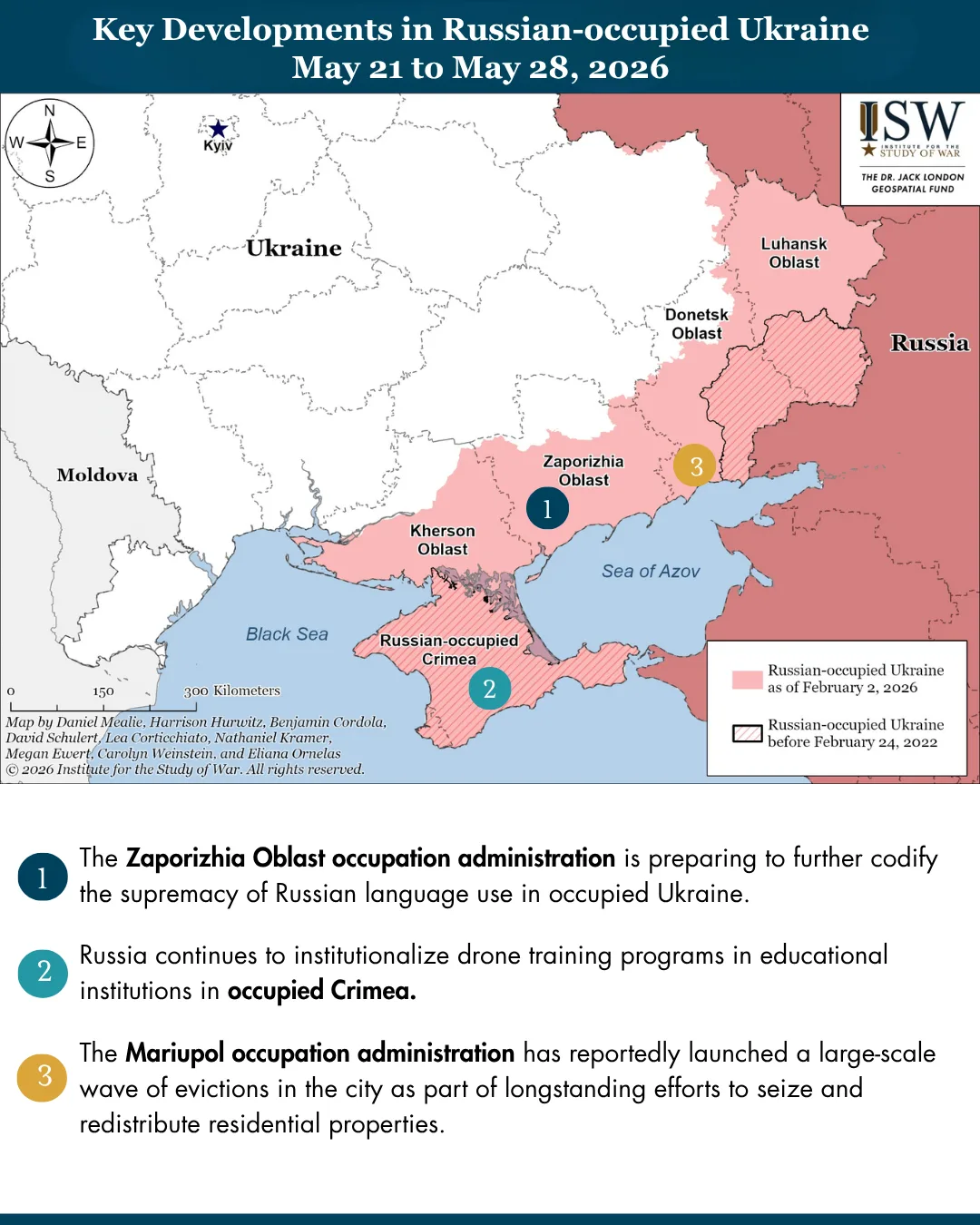
- The Zaporizhia Oblast occupation administration is preparing to further codify the supremacy of Russian language use in occupied Ukraine.
- Russia is institutionalizing drone training programs in educational institutions in occupied Crimea.
- The Mariupol occupation administration has reportedly launched a large-scale wave of evictions.
- The Russian Ministry of Internal Affairs (MVD) has proposed measures to simplify the renunciation of Ukrainian citizenship in occupied areas.
- The Crimea occupation administration is attempting to obscure its inability to address fuel shortages that are resulting from ongoing Ukrainian strikes against Russia’s fuel capacity.
- The Russian government continues efforts to incentivize investment in occupied Ukraine.
- Russia continues efforts to build up occupied Ukraine as an attractive tourist destination.
Deportation and Forcible Transfer of Ukrainian Citizens, Including Children
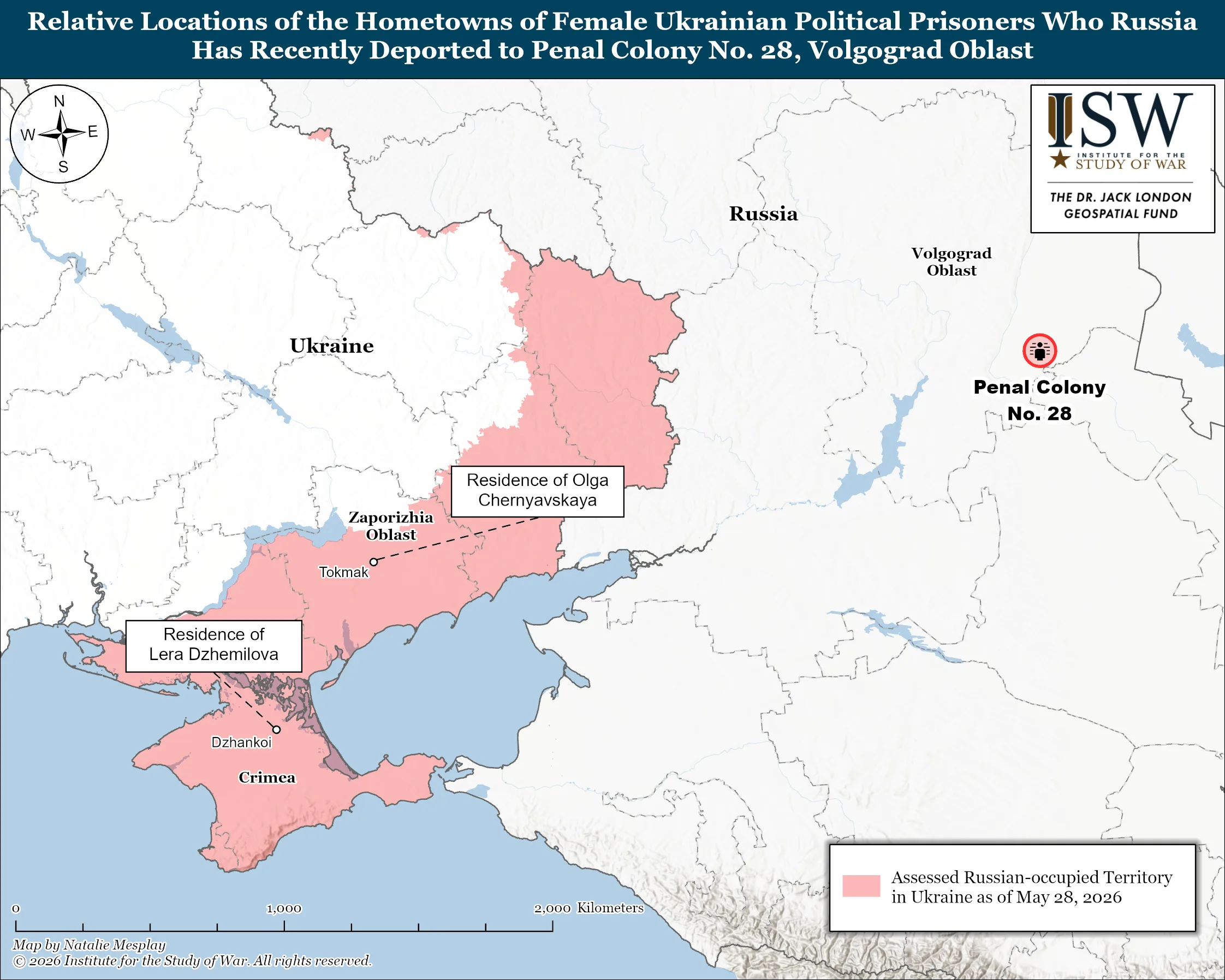
Russia continues to pursue a policy of deporting Ukrainian prisoners, including female political detainees, to penal colonies in Russia. Occupied Crimea-based human rights monitoring group Crimean Tribunal reported on May 18, citing a source within the Russian Federal Penitentiary Service (FSIN), that Russia is transferring Crimean Tatar political prisoner Lera Dzhemilova to Penal Colony No. 28 in Volgograd Oblast.[1] Crimean Tribunal noted that Olga Chernyavskaya, a political prisoner from occupied Zaporizhia Oblast, is currently serving her sentence at Colony No. 28. The Crimea occupation Supreme Court sentenced Dzhemilova to 15 years in prison on treason charges in August 2025 on the allegation that she transferred information to Ukrainian intelligence.[2] Russia first began the practice of deporting political prisoners, often Crimean Tatars, from occupied Crimea to prisons deep within Russia following the annexation of Crimea in 2014, and has scaled up the practice since 2022.[3] The charges that Russia uses to justify the detention and deportation of political prisoners, especially Crimean Tatars, are fabricated or overblown treason, terrorism, or espionage charges. This policy likely violates human rights and humanitarian law, including the Fourth Geneva Convention’s prohibitions on the transfer of civilians from occupied territory.[4] Ukrainian General Prosecutor Ruslan Kravchenko announced on May 21 that he submitted evidence to the International Criminal Court detailing Russia’s additional deportation of over 1,800 Ukrainian prisoners from occupied Kherson and Mykolaiv oblasts in November 2022 — emphasizing that the illegal deportation of prisoners is occurring beyond the context of Crimean political detainees.[5]
The Russian government continues to fund University Shifts — a federal initiative that temporarily transfers Ukrainian teenagers to Russia to attend university classes with the goal of exposing youth to Russian values and forging long-term ties with the Russian state. Russian Prime Minister Mikhail Mishustin signed an order on May 19 allocating over 155 million rubles ($2 million) to University Shifts for 2026.[6] The order states that the funding will provide for at least 2,300 schoolchildren from occupied Donetsk, Luhansk, Kherson, and Zaporizhia oblasts to attend Russia’s “leading pedagogical universities” across Russia, including in Samara, Tula, Volgograd, and Perm. Mishustin emphasized that University Shifts pays special attention to exposing teenagers to Russian “educational and cultural events.” Russian President Vladimir Putin ordered the creation of University Shifts in Summer 2022, and it has since facilitated the transfer of tens of thousands of Ukrainian teenagers to Russian universities for career guidance and cultural integration opportunities.[7] University Shifts also represents a Russian government-directed effort at long-term Russification, as it exposes Ukrainian youth to the Russian educational system and encourages them to forge long-term ties with Russia at the expense of their Ukrainian identities.
Sociocultural Control
Russian social and ethnic affairs policy in occupied Ukraine continues to be solely premised on Russification and the eradication of any distinct Ukrainian identities. A conference on “the implementation of state national policy” took place in occupied Donetsk City on May 23 in accordance with the official designation of 2026 as “the Year of the Unity of the Peoples of Russia.”[8] Donetsk People’s Republic (DNR) Head Denis Pushilin addressed the conference at a plenary session framed around the claim that occupied Donbas is the “stronghold of [Russian] civic unity.” Several Russian milbloggers, including the prominent Rybar Kremlin-aligned media project, praised the conference and Pushilin’s speech, claiming that they emphasize the development of “Russian statehood” and Russian national identity in occupied Donetsk Oblast.[9] The conference comes six months after Russian President Vladimir Putin signed a decree in November 2025 officially approving Russia’s “State National Policy” strategy, which is aimed at “strengthening the unity of the multinational people of the Russian Federation, all Russian civic identity, civil unity and patriotism, [and] interethnic and religious harmony” in order to ensure Russia’s national interests and safeguard Russia’s national security.[10] The 2026 State National Policy, which will remain in force until 2036, codifies the Russification of occupied areas as a matter of Russian state policy.[11] The reflection of prominent milbloggers on the successful formation of “Russian national identity” in occupied Donetsk Oblast suggests that Russification measures are having tangible effects on identity formation and presentation in occupied areas.
The Zaporizhia Oblast occupation administration is preparing to further codify the supremacy of Russian language use in occupied Ukraine, likely at the expense of continued access to Ukrainian language sources. Head of the ruling United Russia party’s occupied Zaporizhia Oblast Committee on Culture, Sports, Tourism, Ecology, and Youth Affairs Stepan Kuvachev announced on May 25 that the Zaporizhia Oblast occupation legislative assembly is drafting a law on the “protection of the Russian language.”[12] Kuvachev claimed that some businesses in occupied Zaporizhia Oblast are already replacing signs with Latin characters to Cyrillic characters, even before the law is passed. Russian occupation authorities and Russian federal law is already harshly restricting Ukrainian language use in occupied areas, particularly in schools, and the proposed draft law will likely contribute to even more intense efforts to privilege the Russian language in public spaces.[13]
Militarization of Occupied Areas
Russia is institutionalizing drone training programs in educational institutions in occupied Crimea. Director of the occupied Simferopol-based Romanov Hospitality College Marina Palchuk announced on May 26 that the Romanov College and the Simferopol College of Radio Electronics received licenses to start “unmanned aerial vehicle operation” courses for the 2026/2027 school year.[14] Students of the Simferopol College of Radio Electronics previously received drone operation training from a Rosgvardia unit as part of the widescale “Drone Operator Cadre of Crimea” strategic project — an initiative of Crimea occupation head Sergei Aksyonov.[15] Chief Technical Training Specialist at the Crimean Research Institute of Unmanned Technologies Alexander Gritsenko additionally told Russian state news outlet Ria Novosti Krym on May 26 that over 2,000 students of technical and vocational colleges in occupied Crimea have taken part in the drone operator strategic project since February 2026.[16] The initiative selected 200 secondary-school students for further training, after which graduates can serve in the Russian military or various security agencies as certified drone operators. Aksyonov has previously claimed that “Crimea is the only region in [Russia] where a complete, end-to-end cycle” of drone operators has been established, starting with schoolchildren, refined in college and university students, and finalized in the “strategic talent pool.”[17] Drone training courses are now available for young children through the Artek International Children’s Center and primary school courses via the Fundamentals of Security and Protection of the Motherland curriculum, and the institutionalization of drone operation certificates at secondary education institutions further solidifies and streamlines the cycle of militarization.[18] The focus on drone training is especially salient as the Russian military grapples with recruitment challenges, including for its drone forces.[19]
Administrative and Bureaucratic Control
The Mariupol occupation administration has reportedly launched a large-scale wave of evictions in the city as part of longstanding efforts to seize and redistribute residential properties. The Ukrainian Resistance Center reported on May 21 that the Mariupol occupation administration has started a widespread eviction campaign and that official eviction notices have begun appearing on the entrances of apartment buildings demanding that people leave their homes and surrender their keys to occupation authorities.[20] The Ukrainian Resistance Center posted pictures of some of the eviction notices and reported that authorities are also evicting residents who have gone through the “proper” steps of re-registering their properties under Russian law.[21] Mariupol occupation head Anton Koltsov notably announced on May 27 that his administration has begun a “mass” redistribution of previously abandoned housing from the municipal housing stock — the stock of housing transferred to the occupation administration via court order after being deemed “ownerless.”[22] While ISW has not observed evidence to independently corroborate Ukrainian reporting on the newest wave of evictions, ISW has previously reported on open-source evidence detailing similar patterns of evictions and property redistribution in occupied Mariupol and elsewhere in occupied Ukraine.[23] An ostensibly pro-Russian user of the VKontakte social media platform, for example, posted in August 2025 about evictions in occupied Mariupol and called the situation “dire.”[24] The Mariupol occupation administration is very likely using these forced evictions to transfer more housing to the municipal housing stock, after which it can be transferred to Russian immigrants in support of Russia’s broader campaign to repopulate occupied Ukraine.[25]
The Russian Ministry of Internal Affairs (MVD) has proposed measures to simplify the renunciation of Ukrainian citizenship in occupied areas, suggesting that Russian forced passportization measures in occupied areas may be encountering resistance.[26] The MVD published a draft project in the Russian Federal Portal of Draft Regulatory Legal Acts on May 26 that proposes amendments to a 2023 MVD order on applying for “non-compliance with Ukrainian citizenship” by eliminating the requirement for an official Russian translation of documents. The amendment, if passed, would essentially remove the requirement to have Russian-language documents prepared for the formal process of renouncing one’s Ukrainian citizenship to obtain a Russian passport.[27] The removal of a bureaucratic barrier to entry for Russian citizenship suggests that Russian passportization efforts in occupied Ukraine may not be proceeding according to plan. Ukrainians living in occupied areas currently face a complicated bureaucratic process to obtain Russian passports, which are effectively required for anyone in occupied areas to maintain access to medical care and basic services.[28] Significant portions of the population in occupied areas may be resisting going through that bureaucratic process, however, and the Kremlin has recently issued simplified requirements likely in order to streamline coerced passportization processes.[29]
Occupation Administration Mismanagement and Internal Dynamics
The Crimea occupation administration is attempting to obscure its inability to address fuel shortages that are resulting from ongoing Ukrainian strikes against Russia’s fuel capacity in order to maintain the guise of effective governance. Several Ukrainian and Russian opposition sources have recently reported that occupied Crimea has been facing intensified gasoline and diesel deficits in the last few weeks, and that the Sevastopol occupation administration has imposed a limit of 20 liters of fuel per vehicle in response to the shortages.[30] The fuel shortages are likely a direct result of recent Ukrainian mid and long-range strikes on Russian energy assets and fuel transportation logistics, but Russian occupation officials appear unable to adequately respond to the shortages.[31] Crimea occupation Minister of Fuel and Energy Vladimir Voronkin claimed on May 28 that the fuel shortages are a result of “technical issues” but that Crimea “generally has sufficient fuel reserves, so people should not panic.”[32] Voronkin’s dismissal of fuel shortages as a “technical issue” highlights the delicate balancing act that occupation administrations are engaged in. On one hand, the Crimea occupation administration is trying to posture itself as a legitimate and capable governing body, while also facing the mounting consequences of Russia’s illegal war on Ukraine. Official responses to fuel and water shortages in occupied areas have historically illuminated this governance dynamic.
Physical and Legal Repressions
Nothing significant to report.
Economic and Financial Control
The Russian government continues efforts to incentivize investment in occupied Ukraine. The Russian State Duma passed a bill in its second and third readings on May 26 aimed at improving and streamlining the regulatory framework of the free economic zone (FEZ) that covers occupied Donetsk, Luhansk, Kherson, and Zaporizhia oblasts.[33] The draft law includes provisions that would reduce the minimum required capital investment from 30 percent to 10 percent, and authorizes the lease of land plots in occupied areas to participants of the FEZ without legal tender. The Kremlin established the FEZ in occupied Ukraine in 2023 and has offered participants reduced taxes and insurance rates for investing and operating in occupied areas, but the initial incentives were likely insufficient for the Kremlin’s intended vision for the FEZ given the Russian government’s subsequent efforts aimed at lowering barriers to entry even further.[34] The FEZ is more broadly intended to facilitate the economic integration of occupied Ukraine into Russia while providing Russia with a tangible way to profit off of its illegal occupation of Ukrainian territory. The FEZ also supports Russian efforts to attract Russian resettlement in occupied areas.[35]
Information Space Control
Nothing significant to report.
Infrastructure and Development Projects
Russia continues efforts to build up occupied Ukraine as an attractive tourist destination. Russian Federation Council Senator from occupied Donetsk Oblast Alexander Voloshin told Kremlin newswire TASS on May 21 that Russia is developing occupied Mariupol to become one of the largest tourist centers on the Azov Sea coast “for decades to come.”[36] Voloshin claimed that in order to stimulate tourism in occupied Mariupol, Russia is investing heavily in the restoration of residential, transportation, and public infrastructure. The Russian Federal Unified Institute of Spatial Planning (EIPP) additionally told TASS on May 25 that it is forecasting that tourist flows to occupied Berdyansk, Zaporizhia Oblast, will increase to 1.5 million by 2044 due to the construction of new hotels and a yacht marina.[37] The development of tourist infrastructure in occupied Ukraine, particularly in areas along the Azov and Black Sea coasts, is a critical component of Russia’s campaign to forcibly integrate occupied areas into the Russian sphere of influence. Tourist flows to occupied areas normalize the occupation to both Russian and international audiences. These efforts ignore and obfuscate the fact that occupied Ukraine remains an active warzone, however, and that Ukrainian mid-range strikes are able to reach these occupied areas, which is likely to disincentivize active tourism as long as the war continues.

[1] https://t.me/tribunal_crimean/360
[2] https://memopzk dot org/figurant/dzhemilova-lera-dilyaver-kyzy/; https://enbv dot org/person/lera-dzhemilova/
[3] https://thinktank.4freerussia.org/politics/exile-by-design/; https://reports dot ovd.info/en/krym_medicine; https://www.pravda.com dot ua/eng/news/2024/01/19/7438102/
[4] https://ihl-databases.icrc.org/en/ihl-treaties/gciv-1949
[5] https://t.me/ruslan_kravchenko_ua/955
[6] http://static.government dot ru/media/files/D4HiS9WpzUlYs1qZISjdH0a5cVJYbdUu.pdf; http://government dot ru/docs/58767/; https://dan-news dot ru/obschestvo/bolee-23-tys-shkolnikov-donbassa-i-novorossii-posetjat-universitetskie-smeny/
[7] https://almenda.org/en/programa-universitetski-zmini-yak-instrument-shho-prodovzhuye-znishhuvati-ukrainsku-identichnist-ditej-z-okupovanix-teritorij/; https://understandingwar.org/research/russia-ukraine/russian-occupation-update-november-26-2025/; https://understandingwar.org/research/russia-ukraine/russian-occupation-update-march-5-2026/; https://understandingwar.org/research/russia-ukraine/russian-occupation-update-july-24-2025/; https://understandingwar.org/research/russia-ukraine/russian-occupation-update-november-20-2025/; https://understandingwar.org/research/russia-ukraine/russian-occupation-update-june-3-2025/
[8] https://dan-news dot ru/politics/v-donecke-proshla-vserossijskaja-strategicheskaja-sessija-po-nacpolitike/
[9] https://t.me/rybar/80574; https://t.me/rusmonstr/93137
[10] https://www.garant dot ru/products/ipo/prime/doc/413034563/; publication.pravo dot gov.ru/document/0001202511250024
[11] https://understandingwar.org/research/russia-ukraine/russian-occupation-update-december-4-2025/
[12] https://tass dot ru/obschestvo/27523933
[13] https://understandingwar.org/research/russia-ukraine/russian-occupation-update-june-26-2025/; https://www.radiosvoboda.org/a/novyny-pryazovya-posylennya-rusyfikatsiyi-v-okupatsiyi/32977221.html; https://mova-ombudsman.gov dot ua/oglyad-ukrayinskoyi-movi-na-timchasovo-okupovanih-teritoriyah-ukrayini
[14] https://t.me/rian_crimea/94171; https://t.me/radiocrimea/33300
[15] https://simf-scr dot ru/news/7bb77865-c602-46cb-81b4-bd2e5bcc3c33
[16] https://crimea dot ria.ru/20260526/kto-sostavlyaet-kadrovyy-rezerv-operatorov-bpla-v-krymu–1156347521.html
[17] https://t.me/Aksenov82/9070
[18] https://understandingwar.org/research/russia-ukraine/russian-occupation-update-april-23-2026/
[19] https://understandingwar.org/research/russia-ukraine/russian-offensive-campaign-assessment-may-27-2026/
[20] https://sprotyv.org dot ua/masove-vyselennia-v-mariupoli-okupanty-vymahaiut-kliuchi-vid-kvartyr/; https://t.me/sprotyv_official/8571
[21] https://t.me/sprotyv_official/8571
[22] https://t.me/KoltsovAnton/3512; https://understandingwar.org/research/russia-ukraine/russias-resettlement-strategy-in-occupied-ukraine/
[23] https://www.nytimes.com/2026/04/22/world/europe/russia-occupied-territories-mariupol.html
[24] https://vk dot com/wall-66823924_280173
[25] https://understandingwar.org/research/russia-ukraine/russias-resettlement-strategy-in-occupied-ukraine/
[26] https://regulation.gov dot ru/projects/168161/
[27] https://t.me/sotaproject/113582
[28] https://medicine.yale.edu/news-article/forced-passportization-in-russia-occupied-areas-of-ukraine/
[29] https://understandingwar.org/research/russia-ukraine/russian-occupation-update-march-12-2026/
[30] https://injir dot org/na-krimskomu-pivostrovi-znovu-zagostryuyetsya-palivna-kriza-u-sevastopoli-vveli-obmejennya-na-prodaj-benzinu-22-05-2026/; https://t.me/yellowribbon_ua/13544; https://t.me/Crimeanwind/98722
[31] https://understandingwar.org/research/russia-ukraine/russian-occupation-update-october-23-2025/; https://understandingwar.org/research/russia-ukraine/russian-occupation-update-september-8-2025/
[32] https://crimea.ria dot ru/20260528/chto-proiskhodit-s-benzinom-v-krymu—otvet-mintopenergo-1156402477.html
[33] https://tass dot ru/ekonomika/27535597
[34] https://sozd dot duma.gov.ru/bill/1142342-8; https://understandingwar.org/research/russia-ukraine/russian-occupation-update-april-2-2026/; https://understandingwar.org/research/russia-ukraine/russias-resettlement-strategy-in-occupied-ukraine/
[35] https://understandingwar.org/research/russia-ukraine/russias-resettlement-strategy-in-occupied-ukraine/
[36] https://tass dot ru/obschestvo/27478667
[37] https://tass dot ru/obschestvo/27524049