
Key Takeaways
- Russia continues the deportation of Ukrainian political prisoners in apparent violation of international law.
- Russian occupation officials used the beginning of the 2026-2027 schoolyear to showcase enrollment figures while continuing efforts to institutionalize pro-Russian curricula, military-patriotic education, and behavioral monitoring mechanisms throughout occupied Ukraine.
- Early voting for the Russian State Duma elections has begun in occupied Ukraine as Russian occupation officials continue to set conditions to control electoral outcomes.
- Russian and occupation courts continue to issue over decades-long sentences to residents of occupied areas accused of pro-Ukrainian activities.
- The Donetsk Oblast occupation administration is trying to present occupied Donetsk Oblast as an attractive investment destination for Russians and foreigners.
- Russian elites are using their ties to development projects in occupied Ukraine for self-enrichment.
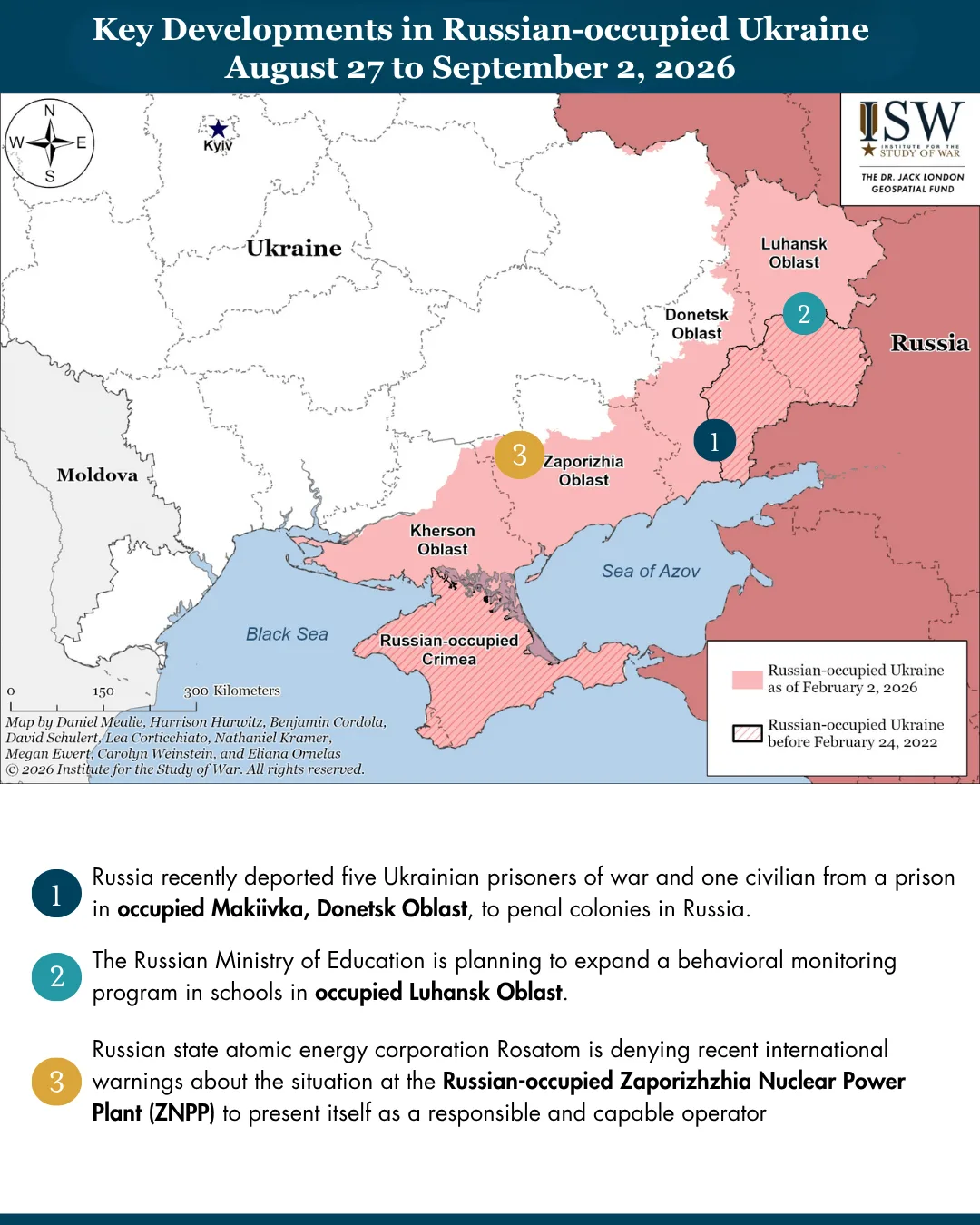
- Russian state atomic energy corporation Rosatom is denying recent international warnings about the situation at the Russian-occupied Zaporizhzhia Nuclear Power Plant (ZNPP) to present itself as a responsible and capable operator.
- Russian occupation administrations continue to rely on Russian patron regions for construction and development projects in occupied areas.
Deportation and Forcible Transfer of Ukrainian Citizens, Including Children
Russia continues the deportation of Ukrainian political prisoners in apparent violation of international law. Occupied Crimea-based human rights monitoring group Crimean Tribunal reported on August 31 that Russian authorities deported pro-Ukrainian partisan activist Ksenia Svetlishina from occupied Crimea to a women’s prison in Russia’s Vologda Oblast.[1] The Sevastopol City occupation court sentenced Svetlishina to 13 years in prison in 2024 on the allegation that she shared information on Russian military movements with Ukrainian intelligence and that she vandalized public property with pro-Ukrainian graffiti.[2] Ukrainian outlet Donbas News additionally reported on August 26 that Russia has deported five Ukrainian prisoners of war (POWs) and one civilian from Colony No. 2 in occupied Makiivka, Donetsk Oblast, to penal colonies in Russia over the past two weeks.[3] Donbas News noted that all the Ukrainian prisoners, including POWs, had been issued extensive sentences under Russian criminal law and that all of the prisoners have experienced deteriorating health during their detention in Makiivka. Russia’s continued deportation of Ukrainian political prisoners is likely a violation of the Fourth Geneva Convention Relative to the Protection of Civilian Persons in Time of War, which prohibits the deportation of civilian detainees to serve their sentences on the territory of the occupying state.[4]
Sociocultural Control
Russian occupation officials used the beginning of the 2026-2027 schoolyear to showcase enrollment figures while continuing efforts to institutionalize pro-Russian curricula, military-patriotic education, and behavioral monitoring mechanisms throughout occupied Ukraine. Occupation heads from Donetsk, Luhansk, Kherson, and Zaporizhia oblasts and Crimea claimed that hundreds of thousands of children began school on September 1, including tens of thousands of first graders entering the school system for the first time.[5] Many occupation officials emphasized that most schools will be operating in-person despite the threat of drone strikes and frequent water and electricity outages.[6] The Russian Ministry of Education published recommendations in advance of the first day of school on August 28 suggesting that schools throughout Russia and occupied Ukraine feature servicemembers and veterans of the war in Ukraine in first day of school ceremonies.[7] Zaporizhia Oblast occupation head Yevgeny Balitsky posted images on September 1 of small children dressed in cadet-style uniforms interacting with uniformed Russian personnel on the occasion of the first day of school.[8]
Russian Ministry of Education officials also emphasized Russian efforts to propagate state-approved history textbooks and pro-Russian curricula in occupied areas.[9] An occupied Luhansk Oblast education official notably stated on August 27 that the Russian pilot program for behavioral assessments will expand beyond the five schools in which it was being tested in occupied Luhansk Oblast.[10] The behavioral testing program is a Russian Ministry of Education initiative that seeks to grade children based on their perceived classroom behavior.[11] Ukrainian officials and human rights advocates have warned that the testing program is likely to endanger children who engage in perceived anti-Russian or pro-Ukrainian activities, therefore acting as a coercive occupation tool that extends Russian state oversight into the school system.[12]
Militarization of Occupied Areas
Nothing significant to report.
Administrative and Bureaucratic Control
Early voting for the Russian State Duma elections has begun in occupied Ukraine as Russian occupation officials continue to set conditions to control electoral outcomes. The Luhansk People’s Republic (LNR) Electoral Commission announced on August 29 that early voting has begun in occupied Luhansk Oblast and will continue until September 15.[13] Early voting is also underway for Russian military personnel in occupied Donetsk Oblast from August 30 to September 17, and for civilians starting on September 8.[14] The LNR Electoral Commission claimed that volunteers informed over 100,000 people in occupied Luhansk Oblast about the upcoming elections and helped them prepare to vote.[15] Ukraine’s Foreign Intelligence Service (SZRU) warned on August 31 that Russia is preparing to stage elections in occupied Ukraine in order to increase social control, justify funding reappropriations, and give the occupation a sense of grassroots legitimacy — echoing ISW’s assessment.[16]
Occupation Administration Mismanagement and Internal Dynamics
Nothing significant to report.
Physical and Legal Repressions
Russian and occupation courts continue to issue over decades-long sentences to residents of occupied areas accused of pro-Ukrainian activities. ISW collected information about seven court decisions issued by the Russian Southern District Military Court and courts in occupied Luhansk, Zaporizhia, and Donetsk oblasts and occupied Crimea between August 25 and September 1.[17] The accused in three of the seven cases were women.[18] Courts accused the defendants in all seven cases of treason or espionage on the allegation that they either shared intelligence on Russian military movements and positions with Ukraine or that they sent funds to the Ukrainian military. The courts issued corresponding sentences ranging from 13 to 23 years across the seven cases. These seven cases are consistent with a broader trend of Russian and occupation courts issuing politically motivated and inordinately intense sentences against residents of occupied Ukraine to punish them for any activity deemed to be pro-Ukrainian or anti-Russian.[19] A King’s College London study recently found that in occupied Zaporizhia Oblast, for example, the act of sending money to Ukraine is punished more harshly than murder.[20]
Economic and Financial Control
The Donetsk Oblast occupation administration is trying to present occupied Donetsk Oblast as an attractive investment destination for Russians and foreigners. Donetsk People’s Republic (DNR) Deputy Prime Minister Kirill Makarov represented occupied Donetsk Oblast at the Eastern Economic Forum in Vladivostok, Russia, on September 1.[21] Russia has historically used the Eastern Economic Forum as a platform to showcase its economic development and build relationships with Asian partners, particularly the People’s Republic of China (PRC). This is the first year that the DNR government has presented at the Forum, which Makarov framed as an opportunity to advertise the region’s vast economic potential.[22] Makarov claimed that there are 16 million square meters of “ready-made investment” sites in occupied Donetsk Oblast and advertised the potential for manufacturing, logistics, tourism, and construction development. The Russian government has gone to great lengths to present occupied Ukraine as an attractive investment opportunity both to Russians and to foreign entities in order to increase the profitability of its occupation.[23]
Russian elites are using their ties to development projects in occupied Ukraine for self-enrichment. Independent Belarusian outlet Vot Tak published an investigation on August 31 detailing how Russian oligarchs and politicians are profiting off the development of occupied Mariupol.[24] Vot Tak found that Russian elites, including a relative of a Russian Presidential Administration employee, United Russia politician Sergey Kolunov, and sanctioned Russian oligarch Vladimir Yevtushenkov, have made hundreds of millions of dollars from a massive mortgage-backed construction program in occupied Ukraine. Vot Tak revealed that the Republican Construction Company (RSK) is one of the major Russian federal developers in occupied Ukraine and that Yevtushenkov has personally made millions of dollars off RSK construction in occupied areas. The investigation highlighted the fact that Russian construction projects, particularly in major occupied cities such as Mariupol, are happening at the expense of locals, many of whom are forced out of their homes to accommodate Russian-backed construction efforts. Vot Tak’s reporting is consistent with a broader trend of Russian elites, occupation regime loyalists, and Kremlin-affiliated officials using their proximity to or direct involvement in the occupation of Ukraine for personal self-aggrandizement.[25]
Information Space Control
Nothing significant to report.
Infrastructure and Development Projects
Russian state atomic energy corporation Rosatom is denying recent international warnings about the situation at the Russian-occupied Zaporizhzhia Nuclear Power Plant (ZNPP) to present itself as a responsible and capable operator. The International Atomic Energy Agency (IAEA) reported on August 29 that the ZNPP had been without external power supply for 10 days and only has enough fuel for diesel generators to last another 10 days.[26] Rosatom Director General Alexey Likhachev responded to the IAEA statement on August 31, noting that Rosatom welcomes the IAEA’s recognition of “the complex situation” at the ZNPP but emphasizing that Rosatom has “full control” over the situation at the plant and has very different estimates for how long the plant can autonomously operate without external power supply.[27] The ZNPP’s occupation leadership has not addressed the IAEA report as of September 2.[28] The divergence between Likhachev’s and the IAEA’s statements is likely purposeful. Rosatom and the ZNPP’s occupation leadership has engaged in a concerted effort to present themselves as capable and responsible stewards of the plant, furthering the narrative that the ZNPP is a Russian nuclear asset available for Russian use and exploitation despite widespread evidence of Russian militarization and operational malpractice at the plant.[29]
Russian occupation administrations continue to rely on Russian patron regions for construction and development projects in occupied areas. Moscow Mayor Sergei Sobyanin told Russian President Vladimir Putin on August 29 that Moscow has sponsored the reconstruction of 30 educational institutions in occupied Donetsk and Luhansk cities.[30] Sobyanin also claimed that Moscow’s city service workers have helped renovate public spaces and other buildings and structures in occupied Donetsk and Luhansk cities, including 1,900 structures in Donetsk City alone.[31] A doctor working at the Republican Vascular Center in occupied Donetsk City told Kremlin newswire TASS on August 30 that specialists from Moszhilniproekt — the Moscow Research and Design Institute of Housing — renovated the Vascular Center.[32] Moscow City is an official sponsor city of occupied Donetsk and Luhansk cities, meaning that the Moscow government channels some of the city’s funds into maintaining the occupation via construction and cultural projects.[33] The patronage system allows the Russian federal government to offset some of the costs of the occupation onto Russian federal subject budgets, while also ensuring that Russia cultivates profitable assets in occupied territories.

[1] https://t.me/tribunal_crimean/400
[2] https://ovd dot info/en/persons/ksenia-svetlishina; https://crimean-process dot org/sud-dobavil-ksenii-svetlishinoj-vosem-let-k-vynesennomu-ranee-prigovoru/
[3] https://novosti.dn dot ua/news/71334-shestero-vyazniv-makiyivskoyi-koloniyi-etapovani-do-rf/
[4] https://ihl-databases.icrc.org/en/ihl-treaties/gciv-1949/article-76?activeTab=
[5] https://crimea.ria dot ru/20260901/za-party-shkol-kryma-seli-bolee-223-tysyach-uchenikov-1158986769.html; https://lug-info dot ru/news/pochti-sto-tys.-detej-pojdut-v-shkoly-lnr-v-etom-godu/; https://t.me/glava_lnr_info/5453; https://t.me/vrogov/25843; https://t.me/PushilinDenis/10236 ; https://t.me/KoltsovAnton/4144
[6] https://dan-news dot ru/exclusive/v-dnr-nazvali-procent-shkol-kotorye-1-sentjabrja-zarabotajut-ochno/
[7] https://zonews dot ru/news/minprosveschenija-posovetovalo-priglashat-na-shkolnye-linejki-uchastnikov-svo/
[8] https://t.me/BalitskyEV/8942
[9] https://dan-news dot ru/exclusive/uchebniki-po-istorii-donbassa-i-novorossii-napravleny-vo-vse-shkoly-dnr/; https://t.me/svobodnieslova/9518
[10] https://lug-info dot ru/news/pilotnyj-proekt-po-ocenivaniju-povedenija-budet-rasshiren-v-shkolah-luganska/
[11] https://understandingwar.org/research/russia-ukraine/russian-occupation-update-august-28-2025/
[12] https://t.me/luhanskaVTSA/37575; https://zmina dot info/news/v-okupovanomu-melitopoli-planuyut-povernuty-oczinky-za-povedinku/
[13] https://tass dot ru/vnutrennyaya-politika/28056521
[14] https://mrpl dot news/news/v-dnr-startovalo-dosrochnoe-golosovanie-na-vyborah-deputatov-gosdumy-rf/
[15] https://lug-info dot ru/news/uchastniki-proekta-informuik-proinformirovali-o-predstojaschih-vyborah-166-tys./
[16] https://szru dot gov.ua/news-media/news/kreml-hotuie-novu-vyborchu-vystavu-na-tymchasovo-okupovanykh-terytoriyakh ; https://understandingwar.org/research/russia-ukraine/russian-occupation-update-august-27-2026/; https://understandingwar.org/research/russia-ukraine/russian-occupation-update-august-14-2026/
[17] https://tass dot ru/proisshestviya/28049231; https://tass dot ru/proisshestviya/28044945; https://www.vesti dot ru/ns/zhitelnicu-donecka-osudili-na-13-let-za-shpionazh-i-prizyvy-k-terrorizmu; https://tass dot ru/proisshestviya/28042393; https://lug-info dot ru/news/sud-prigovoril-k-18-godam-kolonii-shpiona-ukrainskih-specsluzhb-v-lnr/; https://tass dot ru/proisshestviya/28048817; https://tass dot ru/proisshestviya/28045239; https://crimea.ria dot ru/20260901/krymchanin-osuzhden-na-18-let-za-gosizmenu-1158991672.html; https://dan-news dot ru/emergencies/medrabotnik-iz-donecka-poluchil-14-let-za-peredachu-dannyh-ukrainskoj-razvedke/
[18] https://tass dot ru/proisshestviya/28044945; https://www.vesti dot ru/ns/zhitelnicu-donecka-osudili-na-13-let-za-shpionazh-i-prizyvy-k-terrorizmu; https://tass dot ru/proisshestviya/28048817; https://tass dot ru/proisshestviya/28045239
[19] https://realgazeta.com dot ua/zaliakuvannia-nieloialnikh-iak-rosiia-buduie-informatsiinu-mashinu-tieroru-na-okupovanikh-tieritoriiakh-ukrayini/; https://mipl.org dot ua/rosiya-za-misyacz-zasudyla-26-czyvilnyh-ukrayincziv-sered-yakyh-nepovnolitnij/; https://understandingwar.org/research/russia-ukraine/russian-occupation-update-july-30-2026/; https://understandingwar.org/research/russia-ukraine/russian-occupation-update-april-17-2025/; https://understandingwar.org/research/russia-ukraine/russian-occupation-update-november-13-2025/; https://understandingwar.org/research/russia-ukraine/russian-occupation-update-template-january-30-2026/; https://understandingwar.org/research/russia-ukraine/russian-occupation-update-august-6-2026/
[20] https://totinsights.org/dashboards/zaporizhzhia_court_sentencing.html
[21] https://t.me/makarov_kb/5061
[22] https://t.me/makarov_kb/5061; https://t.me/PushilinDenis/10250
[23] https://understandingwar.org/research/russia-ukraine/russian-occupation-update-june-19-2025/; https://understandingwar.org/research/russia-ukraine/russian-occupation-update-july-3-2025/; https://understandingwar.org/research/russia-ukraine/russian-occupation-update-july-29-2025/
[24] https://vot-tak dot tv/95060714/kto-zarabatyvajet-na-mariupolcah; https://t.me/vottaktv/80792
[25] https://understandingwar.org/research/russia-ukraine/russian-occupation-update-july-3-2025/; https://understandingwar.org/research/russia-ukraine/russian-occupation-update-april-30-2026/; https://understandingwar.org/research/russia-ukraine/russian-offensive-campaign-assessment_22-17/; https://understandingwar.org/research/russia-ukraine/russian-occupation-update-october-30-2025/; https://t.me/mozhemobyasnit/15562; https://poligon dot media/lyudi-gibli-za-metall/
[26] https://www.iaea.org/newscenter/pressreleases/update-364-iaea-director-general-statement-on-situation-in-ukraine; https://understandingwar.org/research/russia-ukraine/russian-offensive-campaign-assessment-august-29-2026/
[27] https://tass dot ru/ekonomika/28060109
[28] https://t.me/s/znppofficial
[29] https://t.me/DIUkraine/8884; https://understandingwar.org/research/russia-ukraine/russian-occupation-update-january-8-2026/; https://understandingwar.org/research/russia-ukraine/russian-offensive-campaign-assessment-october-5/
[30] https://tass dot ru/obschestvo/28056639
[31] https://tass dot ru/obschestvo/28058391; https://tass dot ru/obschestvo/28045289
[32] https://tass dot ru/obschestvo/28058375
[33] https://understandingwar.org/research/russia-ukraine/fact-sheet-the-kremlins-occupation-playbook-coerced-russification-and-ethnic-cleansing-in-occupied-ukraine/; https://jamestown.org/kremlin-builds-patronage-economy-in-ukraines-occupied-territories/; https://meduza dot io/feature/2022/07/08/putin-i-kirienko-zastavili-rossiyskie-regiony-vzyat-shefstvo-nad-gorodami-i-rayonami-donbassa-meduza-vyyasnila-kak-ustroena-eta-sistema-na-kotoruyu-iz-byudzheta-potratyat-milliardy-rubley


