
Key Takeaways
- The Russian Ministry of Education is institutionalizing classes teaching Russian “traditional values” to preschool and kindergarten-aged children, including in occupied Ukraine.
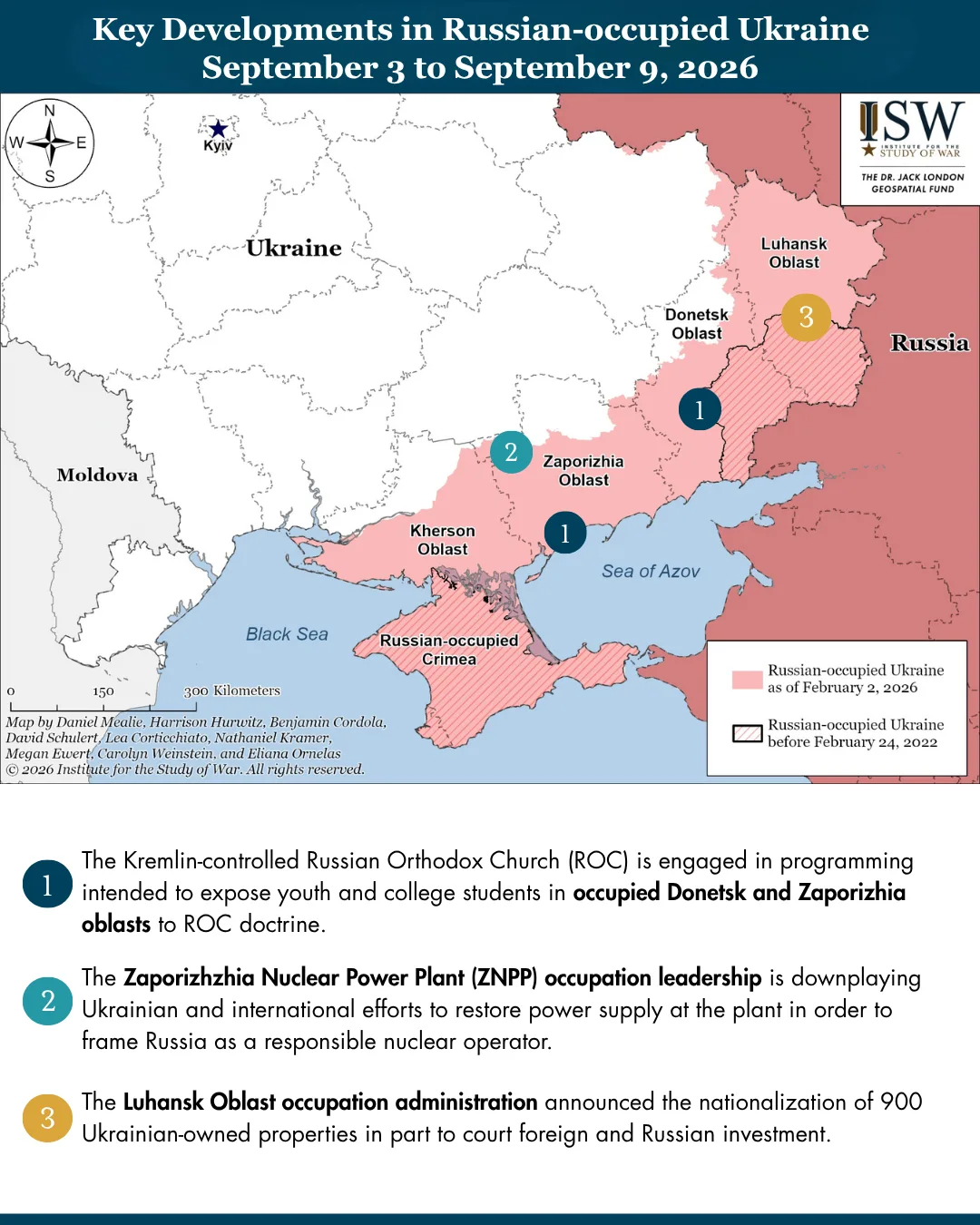
- The Kremlin-controlled Russian Orthodox Church (ROC) continues efforts to integrate itself with the youth space in occupied Ukraine.
- The Zaporizhzhia Nuclear Power Plant (ZNPP) occupation leadership continues efforts to frame itself as a responsible steward of the ZNPP, even though it is reliant on Ukrainian and international intervention to maintain the plant’s basic functions.
- Courts throughout occupied Ukraine and Russia continue to issue lengthy sentences against residents of occupied areas to discourage dissent against the occupation.
- Russian occupation administrations continue to pursue punitive property nationalization, in part to generate investment revenue for administration budgets.
Deportation and Forcible Transfer of Ukrainian Citizens, Including Children
Nothing significant to report.
Sociocultural Control
The Russian Ministry of Education is institutionalizing classes teaching Russian “traditional values” to preschool and kindergarten-aged children, including in occupied Ukraine. Russian Minister of Education Sergei Kravtsov announced on September 7 that the Ministry of Education is launching two educational programs for preschool-aged children (typically children under the age of seven) — “Orlyata-preschoolers” (Orlyata-doshkolyata, translated as Eaglet Preschoolers) and “Kind Games.”[1] The two programs are intended to “introduce preschoolers to traditional Russian spiritual and moral values.” Kremlin officials frequently invoke the concept of “traditional values” as a means of justifying the war in Ukraine and legitimizing domestic control mechanisms.[2] The Orlyata program in particular is connected to the “Orlyata Rossii” (Eaglets of Russia) military-patriot program, which aims to instill Russian civic and patriotic values in young primary school-aged students (typically between six- to ten-year-olds).[3] Occupied Ukraine-based media outlets advertised Kravtsov’s announcement, suggesting that these programs will also come into force in preschools in occupied areas.[4] The new Ministry of Education programs for preschoolers represent the increased institutionalization of Russification efforts for even the youngest children in occupied Ukraine. Russia has effectively formed an indoctrination pipeline starting in preschools that disseminates pro-Russian values to children and youth across all educational levels in occupied territories.
The Kremlin-controlled Russian Orthodox Church (ROC) continues efforts to integrate itself with the youth space in occupied Ukraine. Donetsk People’s Republic (DNR) occupation head Denis Pushilin reported on September 7 that he attended the first-ever “Orthodox Donbas” youth forum, which brought together youth, students, occupation officials, and ROC clergy.[5] Russian President Vladimir Putin’s “Youth and Children” national project sponsored and implemented the Orthodox Donbas forum. Pushilin stressed the role of the ROC in supporting the Russian military and invoked historical narratives about the ties between the ROC and Russian identity. The Azov State Pedagogical University — a Russian-established and controlled institution in occupied Berdyansk, Zaporizhia Oblast — similarly announced on September 7 that it will begin courses and discussions on ROC spiritual culture in cooperation with the ROC diocese in occupied Berdyansk.[6] The ROC serves as a direct extension of the Kremlin’s governance policy in occupied Ukraine, and has increasingly embedded itself in schools, youth programs, and militarization efforts since 2022.[7]
Militarization of Occupied Areas
Nothing significant to report.
Administrative and Bureaucratic Control
Nothing significant to report.
Occupation Administration Mismanagement and Internal Dynamics
The Zaporizhzhia Nuclear Power Plant (ZNPP) occupation leadership continues efforts to frame itself as a responsible steward of the ZNPP, even though it is reliant on Ukrainian and international intervention to maintain the plant’s basic functions. The International Atomic Energy Agency (IAEA) announced on September 7 that it conducted repairs to successfully reconnect the ZNPP to its external power line, restarting power supply to the plant after an over two-week-long blackout.[8] The IAEA noted that it negotiated a localized ceasefire in order to conduct the repairs. Ukrainian nuclear energy operator Energoatom noted that Ukrainian nuclear specialists conducted repairs on the plant despite the risks of Russian attacks and the challenging frontline situation.[9] The ZNPP’s occupation leadership thanked the IAEA and Russian officials, including the Russian Ministry of Foreign Affairs and the Russian Ministry of Defense, for facilitating repairs on the plant.[10] ZNPP occupation director Yuriy Chernichuk responded to the reconnection of the plant by emphasizing Russian efforts to issue operating licenses to several of the ZNPP’s power units — indicating that the occupation leadership’s priority continues to be the integration of the ZNPP into Russia’s domestic power grid, regardless of the risks that process might pose to nuclear security.[11] Chernichuk’s statement fits a broader pattern of the ZNPP’s occupation leadership attempting to downplay the IAEA’s and Ukraine’s involvement in repairs critical to the plant’s operation in order to further the claim that Russia is a responsible and capable nuclear operator.[12]
Physical and Legal Repressions
Courts throughout occupied Ukraine and Russia continue to issue lengthy sentences against residents of occupied areas to discourage dissent against the occupation. ISW collected information about five court cases in occupied Donetsk, Luhansk, and Kherson oblasts between September 2 and 9. Three of the cases involved treason or espionage charges on the allegation that the defendants shared intelligence with Ukraine.[13] One case involved alleged affiliation with a terrorist organization (an unspecified Ukrainian armed group), and one involved the dissemination of “false information” about the Russian armed forces.[14] Defendants in the five cases received between five and 16 years in prison. ISW has written at length about similar Russian efforts to use court cases and extensive prison sentences as a form of lawfare intended to coerce cooperation with the occupation.[15]
Economic and Financial Control
Russian occupation administrations continue to pursue punitive property nationalization, in part to generate investment revenue for administration budgets. Luhansk People’s Republic (LNR) occupation Deputy Prime Minister Svetlana Podlipaeva told Kremlin newswire TASS on September 5 that Luhansk Oblast occupation authorities have nationalized 900 properties that were previously Ukrainian-owned, 500 of which have been transferred to oblast-level ownership and 200 of which have been transferred to municipal-level occupation administrations.[16] Podlipaeva noted that the list of nationalized properties includes industrial assets, which the occupation administration intends to transfer to investors. Russian occupation administrations throughout occupied Ukraine, particularly in occupied Crimea, have frequently used nationalization as a way to punish both Ukrainians who have left occupied territories and those who still support Ukraine.[17] Occupation authorities stand to make potentially billions of rubles from nationalization processes, and are thus incentivized to pursue punitive nationalization policies for budgetary reasons.[18] Nationalization of assets, particularly industrial assets, also supports the Kremlin’s broader efforts to attract Russian and foreign investment into occupied Ukraine.[19]
Information Space Control
Nothing significant to report.
Infrastructure and Development Projects
Nothing significant to report.

[1] https://www.rbc dot ru/rbcfreenews/6a9f599eba27253978834573?utm_referrer=https%3A%2F%2Fwww.google.com%2F
[2] https://understandingwar.org/research/russia-ukraine/russian-offensive-campaign-assessment_19-3/; https://understandingwar.org/research/russia-ukraine/russian-offensive-campaign-assessment_6-3/
[3] https://understandingwar.org/research/russia-ukraine/russian-occupation-update-october-9-2025/
[4] https://zonews dot ru/news/v-detsadah-budut-priobschat-rebjat-k-tradicionnym-cennostjam/; https://xonews dot ru/news/v-detsadah-budut-priobschat-rebjat-k-tradicionnym-cennostjam/
[5] https://t.me/PushilinDenis/10267
[6] https://zonews dot ru/news/v-pedagogicheskom-vuze-zaporozhskoj-oblasti-zapustjat-duhovno-prosvetitelskie/
[7] https://understandingwar.org/research/russia-ukraine/russian-occupation-update-june-25-2026/; https://understandingwar.org/research/russia-ukraine/russian-occupation-update-july-30-2026/; https://understandingwar.org/research/russia-ukraine/russian-occupation-update-august-21-2025/; https://understandingwar.org/research/russia-ukraine/russian-occupation-update-november-20-2025/
[8] https://x.com/iaeaorg/status/2097019815835652235?s=46&t=pqCxPqQh0zP3yv5i4U3U0g
[9] https://t.me/energoatom_ua/28124
[10] https://t.me/znppofficial/1847
[11] https://zonews dot ru/news/chernichuk-zaes-rabotaet-ne-v-absoljutnoj-blokade-no-logistika-krajne-zatrudnena/; https://understandingwar.org/research/russia-ukraine/russian-offensive-campaign-assessment-may-27-2025/; https://understandingwar.org/research/russia-ukraine/russian-occupation-update-february-5-2026/
[12] https://understandingwar.org/research/russia-ukraine/russian-occupation-update-september-3-2026/
[13] https://tass dot ru/proisshestviya/28082099; https://tass dot ru/proisshestviya/28086705
[14] https://tass dot ru/proisshestviya/28069603; https://tass dot ru/proisshestviya/28071551
[15] https://understandingwar.org/research/russia-ukraine/russian-occupation-update-august-6-2026/; https://understandingwar.org/research/russia-ukraine/russian-occupation-update-july-30-2026/; https://understandingwar.org/research/russia-ukraine/russian-occupation-update-june-25-2026/; https://understandingwar.org/research/russia-ukraine/russian-occupation-update-july-2-2026/
[16] https://tass dot ru/ekonomika/28082265
[17] https://understandingwar.org/research/russia-ukraine/russian-occupation-update-november-20-2025/; https://understandingwar.org/research/russia-ukraine/russian-occupation-update-july-17-2025/
[18] https://understandingwar.org/research/russia-ukraine/russian-occupation-update-july-17-2025/
[19] https://understandingwar.org/research/russia-ukraine/russian-occupation-update-september-3-2026/; https://understandingwar.org/research/russia-ukraine/russian-occupation-update-august-6-2026/; https://understandingwar.org/research/russia-ukraine/russian-occupation-update-june-18-2026/